
Mui Ne and Phan Thiet Travel Guide: Two Sand Dunes, Prices, Getting There, Where to Stay
Mui Ne has two sand dunes and they are not in the same place: the red one is 2.4km from the hotel strip, the white one 26.4km. This guide covers what each costs, what you ride there, the heritage sites in Phan Thiet town 24km away, how to arrive from Ho Chi Minh City, which nights the train runs, and how many days the whole thing needs.
| Two dunes | The red dune is 2.4km from Mui Ne, the white dune at Bau Trang is 26.4km. |
|---|---|
| Prices | The red dune is free to walk into. Bau Trang charges 10,000 VND per person. |
| Distance to town | Phan Thiet town centre is 24km from the Mui Ne strip, about 24 minutes by car. |
| From Ho Chi Minh City | 197km from Tan Son Nhat airport, around 2 hours 30 minutes on the expressway. |
| Train | One return service a day, and from 11 September to 30 December only on Fri, Sat and Sun. |
| Wind | Strong from November to April, then the sea flattens out from May onwards. |
1. There are two dunes, and that decides your days
2. Mui Ne and Phan Thiet are two different places
3. The Red Sand Dunes: free, and best before sunrise
4. Bau Trang, the White Sand Dunes: 29 minutes out, and newly regulated
5. Fairy Stream: shoes off, ankle-deep, half an hour up
6. The fishing village and Hon Rom
7. Wind: November to April, and everything else
8. Phan Thiet town in half a day
9. Po Sah Inu and Lau Ong Hoang
10. Duc Thanh school and the water tower
11. Van Thuy Tu and the market
12. What to eat in Phan Thiet
13. South of town: Ta Cu cable car and a 49m Buddha
14. Ke Ga lighthouse, reached by boat
15. NovaWorld and Sea Links: the resort complexes
16. Phu Quy island: two hours by boat
17. Getting there from Ho Chi Minh City
18. Onward to Da Lat and Nha Trang
19. Getting around Mui Ne itself
20. Where to stay
21. How many days, and in what order
22. What it costs per day
23. When to go
24. Things worth knowing before you go
25. How the area is changing
26. 🌊 More Vietnam guides
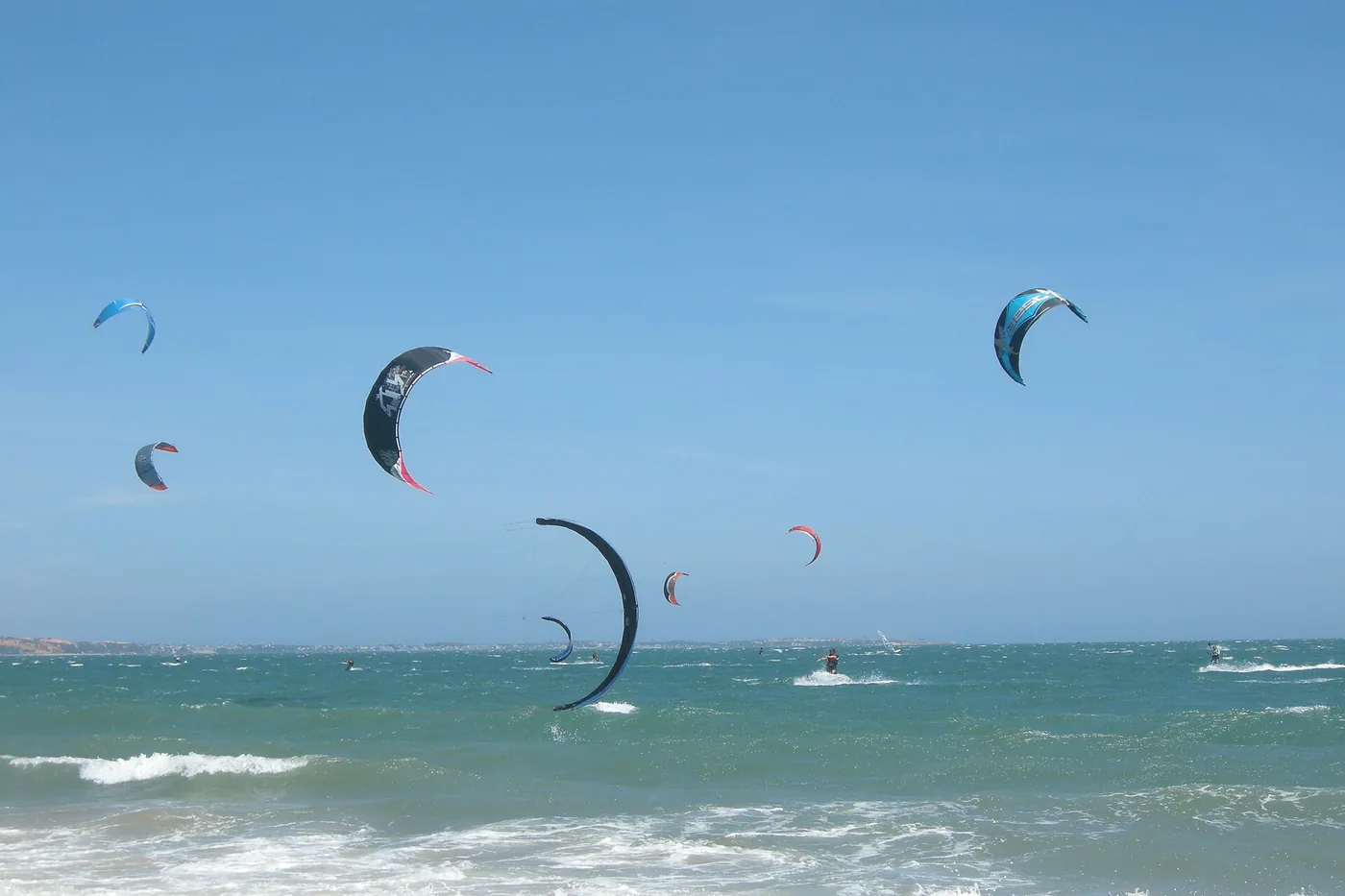
1. There are two dunes, and that decides your days
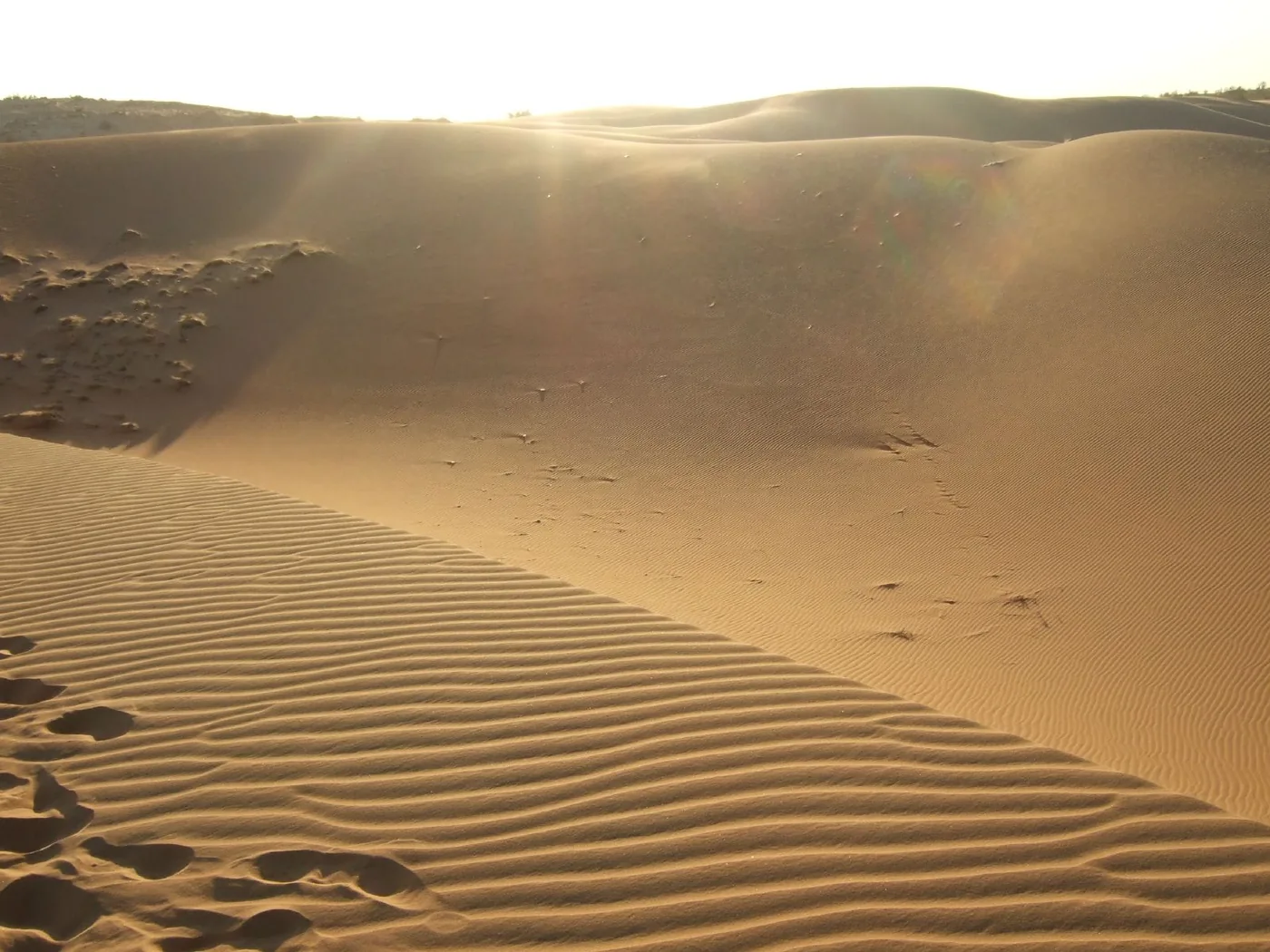
When someone in Mui Ne says they are going to the sand dunes, they mean one of two places. The Red Sand Dunes sit 2.4km from the hotel strip, two minutes in a car. The White Sand Dunes at Bau Trang are 26.4km away, twenty-nine minutes. The names get used interchangeably in tour listings, and that is where itineraries fall apart: one is a quick trip before breakfast, the other eats half a day.
The two dunes side by side
| Item | Red dune (Doi Cat Bay) | White dune (Bau Trang) |
|---|---|---|
| Distance from Mui Ne | 2.4km | 26.4km |
| Drive time | 2 minutes | 29 minutes |
| Entry | Free | 10,000 VND per person |
| What you do there | Slide down on a plastic sheet | Quads, jeeps, kayaks on the lake |
| Time needed | Under an hour | Three hours to half a day with travel |
| Busiest | Sunrise and sunset | Mornings |
Measure the drive times from the strip and the shape of the place becomes obvious. Almost everything worth seeing is strung along one coastal road, and only four things sit off it: Bau Trang to the north, Phan Thiet town to the south-west, and Ta Cu mountain and Ke Ga lighthouse further down the coast.
Drive times out of Mui Ne
| Destination | Distance | By car |
|---|---|---|
| Red Sand DunesMap | 2.4km | 2 min |
| Fairy StreamMap | 3.9km | 4 min |
| Hon RomMap | 7.1km | 7 min |
| Sea Links golf courseMap | 14.6km | 15 min |
| Po Sah Inu towersMap | 18.2km | 19 min |
| Phan Thiet town centre | 24.0km | 24 min |
| White Sand Dunes, Bau TrangMap | 26.4km | 29 min |
| NovaWorldMap | 40.5km | 41 min |
| Ta Cu mountainMap | 54.8km | 47 min |
| Ke Ga lighthouseMap | 59.1km | 58 min |
Those figures come from road data rather than from a taxi meter, so they do not include high-season traffic on the strip. For planning the order of a day they hold up: the red dune, Fairy Stream and the fishing village fit in one half-day because all three are inside seven minutes of each other.
The local names overlap too. The red one is Doi Cat Bay or Doi Hong depending on who is speaking, and the white one answers to both Bau Trang and Doi Cat Trang. If you book from a product title alone you can pay for a tour without knowing which dune it goes to.
Jeep tours are priced by where they go rather than by the hour, so the red-dune loop and the Bau Trang run are different products at different prices.
2. Mui Ne and Phan Thiet are two different places
The two names travel together in brochures, but 24km of road sits between them. Mui Ne has the beach, the dunes and the kite schools; Phan Thiet town has the Cham towers, the museums, the market and the fish sauce. Most visitors sleep in Mui Ne and give the town a half-day.
What is on each side
| Mui Ne side | Phan Thiet town | |
|---|---|---|
| Sights | Red dune, Fairy Stream, fishing village, Hon Rom | Po Sah Inu, Duc Thanh school, water tower, Van Thuy Tu, market |
| Where you sleep | Resorts and guesthouses along the beach road | City hotels, most of them away from the sand |
| What you eat | Seafood and tourist-facing restaurants | Fish-cake noodle soup, raw fish salads, local breakfasts |
| Getting around | One coastal road, end to end | A grid either side of the river |
An administrative change in July 2025 dissolved Phan Thiet city as a unit and split the area into seven commune-level units answering directly to Lam Dong province. Ham Tien and Thien Nghiep were folded into a single Mui Ne ward. For a visitor the only practical effect is how addresses are written.
That new Mui Ne ward covers 118.59 square kilometres and has just over fifty thousand residents, which is worth knowing if you pictured a single beach village. The strip alone runs for kilometres, and walking from one end to the other is not a short walk.
The same reform put Mui Ne and Da Lat in one province. Pairing the coast with the highlands has become the standard route, and the Da Lat travel guide covers the other half of it.
3. The Red Sand Dunes: free, and best before sunrise
There is no entrance fee at the Red Sand Dunes, and no opening or closing time either, which is why people walk up in the dark for sunrise. A 15,000 VND ticket was announced back in 2019, ran into local opposition and was never enforced; walking in is still free.
What costs money is riding. A plastic sliding sheet is 10,000 to 40,000 VND, and a jeep or quad across the sand runs 400,000 to 800,000 VND. Those vehicle prices are per vehicle rather than per person, so a group of four pays the same as a couple.
What you actually pay
| Activity | Price | Notes |
|---|---|---|
| Walking up | Free | Bring shoes; midday sand is hot enough to hurt |
| Sand sled | 10,000~40,000 VND | Children stay busy with this for an hour |
| Jeep or quad | 400,000~800,000 VND per vehicle | Negotiable. Agree the route before you get in |
There is no shade anywhere on the dune, so the middle of the day is unpleasant rather than dangerous. Most people go around six in the morning or late in the afternoon, and that is when the jeep drivers gather outside the hotels.
The Vietnamese name means the dune that flies, which is a description rather than a flourish: the wind moves the sand and the ridgelines shift. Trying to find the exact crest you saw in a photograph is a waste of an hour.
Jeeps hired at the hotel and jeeps hired at the dune entrance are priced differently. The entrance is cheaper to start from, but before sunrise there are few vehicles waiting, so if you want the early light it is worth fixing a time the evening before.
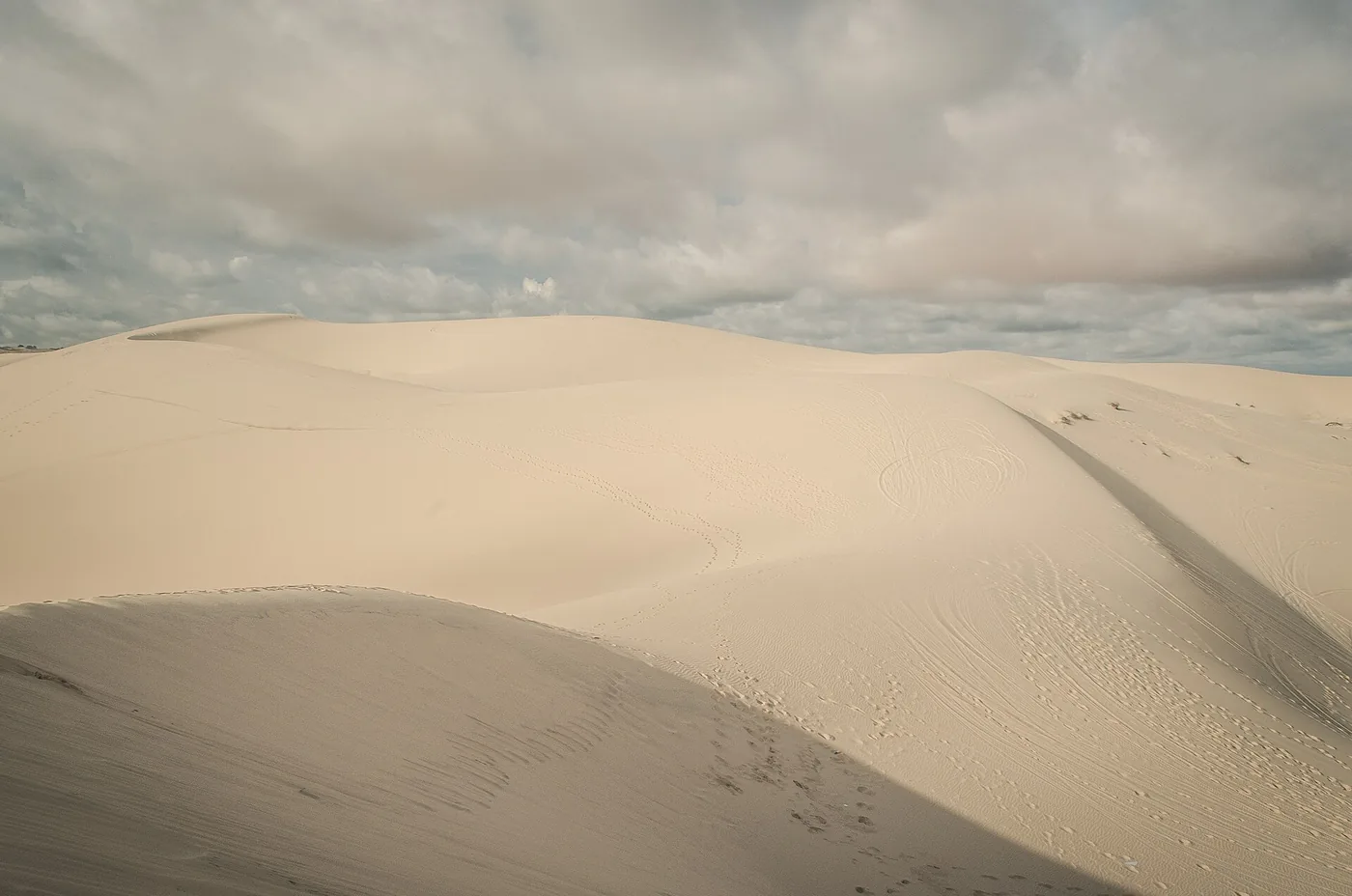
4. Bau Trang, the White Sand Dunes: 29 minutes out, and newly regulated
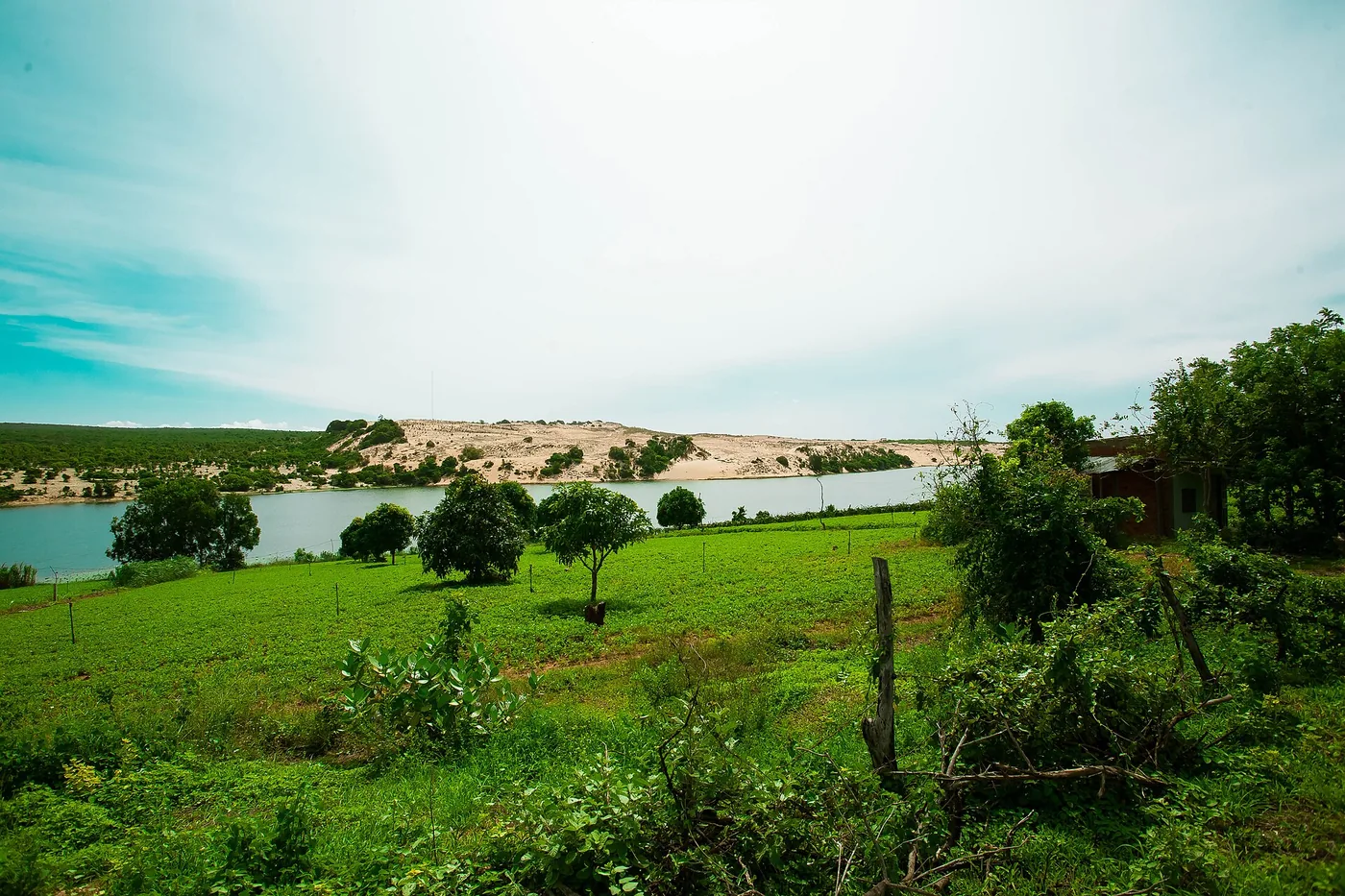
Bau Trang, the White Sand Dunes, is a nationally listed scenic site and entry is 10,000 VND a head. It is 26.4km from Mui Ne, twenty-nine minutes by road. A lake sits right against the sand, so you walk up the dune from the water’s edge.
There is more to ride here than at the red dune, and it costs more. A quad is 600,000 to 800,000 VND for twenty minutes, a jeep is 800,000 VND for a run up the dune and back with up to eight people, and a kayak on the lake is 300,000 VND for three people for twenty to thirty minutes.
Prices at Bau Trang
| Item | Price | Duration |
|---|---|---|
| Entry | 10,000 VND per person | – |
| Quad bike | 600,000~800,000 VND | 20 minutes |
| Jeep | 800,000 VND per vehicle | One run up and back, up to 8 people |
| Kayak | 300,000 VND | 20~30 minutes, up to 3 people |
The quad bikes have a safety record worth reading
On 25 May 2025 a quad went into the lake and a tourist drowned. Within a week the district asked for the service to be suspended while the paperwork was sorted out, and helmets became mandatory for passengers. The site management reinforced the barriers along the water, added warning signs and put more staff on patrol.
The problems predate that accident. A joint inspection in October 2024 counted 188 off-road vehicles working the dune, 94 cars and 94 quads, and found that all four operating companies lacked business licences and technical and environmental certificates. Many vehicles had no plates, expired inspections or had passed their service life. In May 2023 part of the Trinh Nu dune collapsed, and off-road traffic was named as one of the causes.
None of that is an argument for skipping the ride. It is an argument for looking at the vehicle and the helmet before you hand over money, and for telling a driver to slow down near the water. With children in the vehicle that goes double.
Tickets and vehicles are sold in different places. You pay at the gate, then walk a short way along the lake to where the quads and jeeps are parked, and the price you agreed at the gate is not always the price quoted at the sand.
5. Fairy Stream: shoes off, ankle-deep, half an hour up
Fairy Stream is 15,000 VND for adults and 6,000 VND for children, open from 06:30 to 17:30. The entrance is on Huynh Thuc Khang in Ham Tien, 3.9km from the middle of the strip, close enough that some people walk.
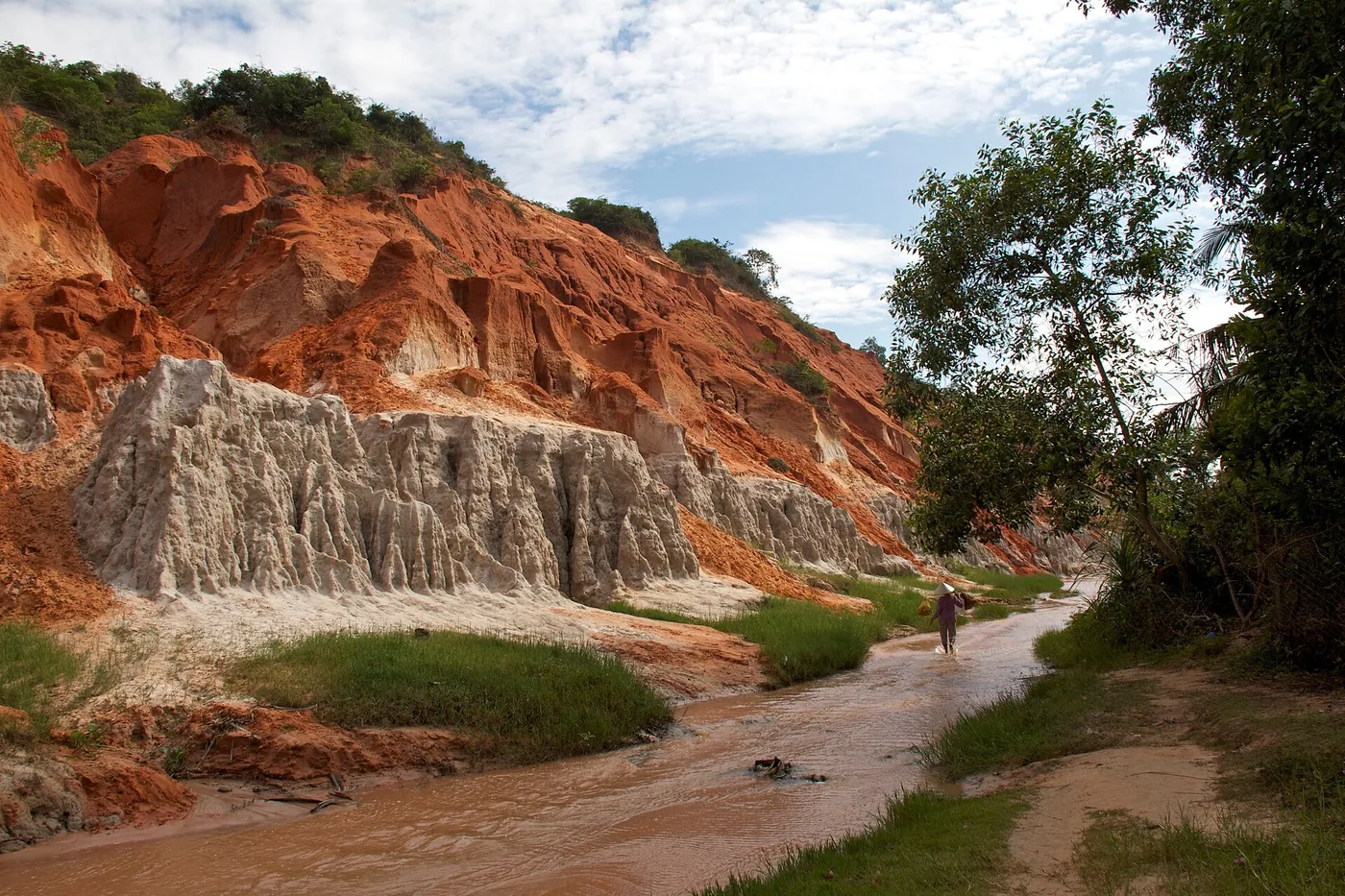
Despite the name it is a shallow watercourse rather than a spring. You wade up it between clay walls for thirty minutes to an hour, in water that runs from ankle to knee deep. Shoes stay at the entrance and the bed is sand, so bare feet are fine for most of it.
Before you go
| Item | Detail |
|---|---|
| Entry | 15,000 VND adult / 6,000 VND child |
| Hours | 06:30~17:30 |
| Time needed | 30 minutes to an hour, there and back |
| Bring | Clothes that can get wet, a towel, drinking water |
| Watch for | Unofficial guides attaching themselves at the entrance. Decline at the start, not halfway up |
Water depth changes with the season. Between May and October it can be above the ankle for long stretches; in the dry months it is shallower. A few sections have gravel mixed into the sand, so if bare feet bother you, sandals that can get wet are the answer.
Put this in the same half-day as the red dune and the harbour. All three are within seven minutes of each other and the whole loop is comfortable before the heat arrives.
6. The fishing village and Hon Rom
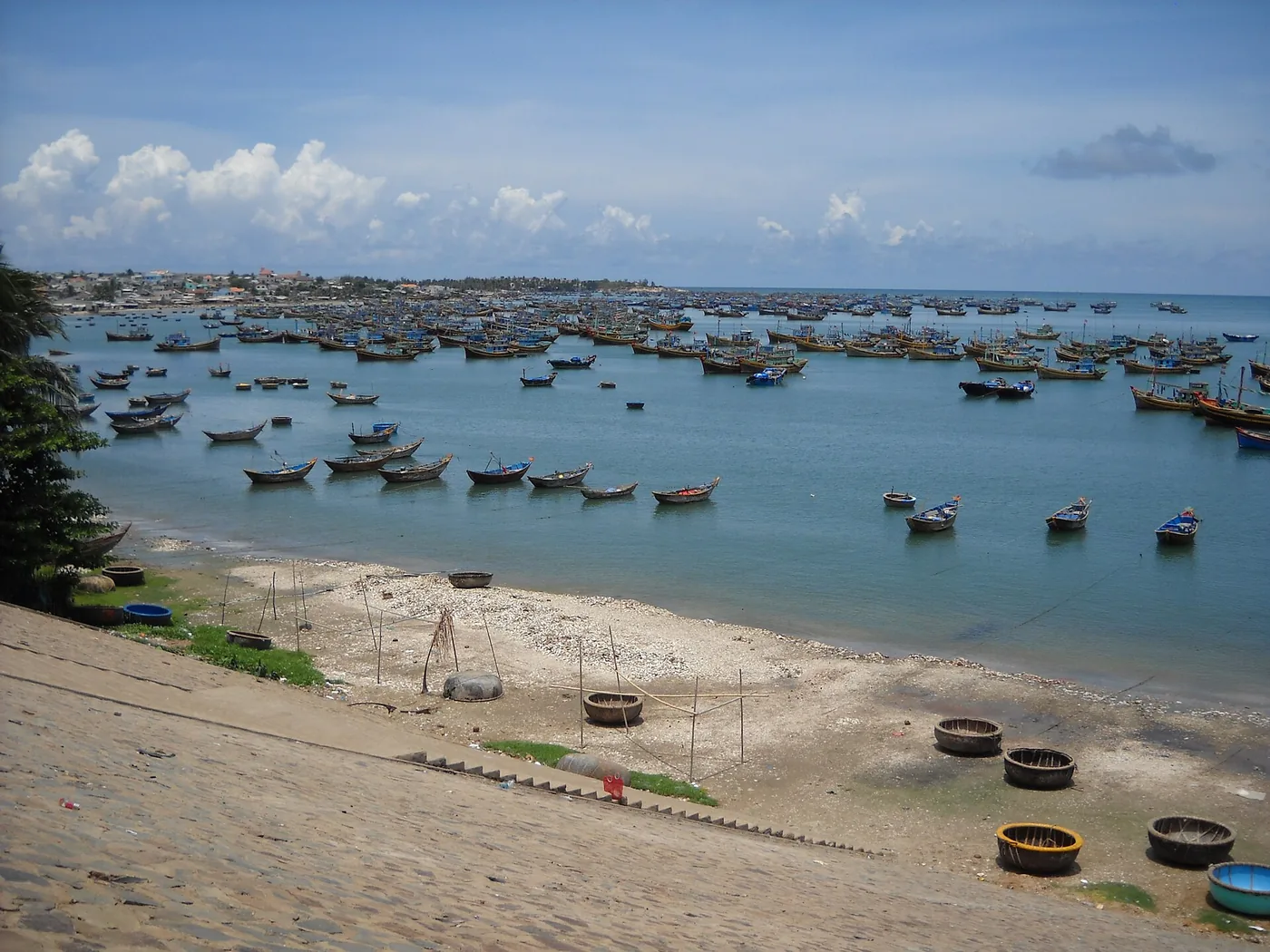
Mui Ne fishing village is busiest when the night boats come back, roughly between five and seven in the morning. The bay fills with moored boats, and round basket boats woven from bamboo sit on the sand where the boats unload.
What is on sale is whatever came in that morning: fish, prawns, squid. It is weighed in front of you, and restaurants along the road will cook what you carry in. Ask the price per kilo and the cooking charge separately before anything goes on a scale, because they are two different bills.
Seven minutes north of the harbour is Hon Rom, where the beach is wider and emptier. Some people stay out there deliberately. In exchange, shops and restaurants thin out badly once you leave Ham Tien.
You can also go out in a basket boat. A fisherman paddles you around the inside of the bay, it does not take long, and there is no fixed price list, so settle the number before you step in.
Distances around the harbour
| Leg | By car |
|---|---|
| Mui Ne strip to the harbour | Under 2 minutes |
| Harbour to Hon Rom | 7 minutes |
| Harbour to the red dune | 4 minutes |
7. Wind: November to April, and everything else
The kite season runs from November to April. The north-east monsoon holds 15 to 30 knots through it, and from December to March there are days above 40. From May the wind drops and the sea flattens, which turns the same beach into a swimming and boat destination.
Mui Ne records around 227 days a year with wind over 12 knots. That consistency is why the schools clustered here rather than anywhere else on this coast: C2Sky, Jibes Beach Club, Vietnam Kiteboarding School, K1, Mui Ne Kitesurf School and Surfpoint all operate along Ham Tien beach.
What each part of the year is good for
| Period | Wind | Best for |
|---|---|---|
| November, March–April | Strong but steady | Learning, first lessons |
| December–February | Strongest, with gusts | Experienced riders, photography |
| May–August | Light | Swimming, boats, islands |
| September–October | Rain increases | Lower prices |
Schools advertise lessons at around 40 US dollars an hour, and a certified beginner course of five days and ten hours at 450 to 600 dollars. In high season the instructors book out before the rooms do, so turning up and asking around usually means taking whatever slot is left.
Gear rents from the schools. Bringing your own is possible but check airline baggage rules and excess charges first, because a board bag on a Vietnamese domestic leg is not always cheap.
When the wind is up the sea is rough as well as fast. Some stretches of beach have no flags and no supervision, so with children the resort pool is the safer choice on the windiest days.
The same wind that makes the sport also makes the beach hard to sit on: umbrellas do not stay up and sand hits at face height. If lying on the sand is the point of the trip, come after May; if flying a kite is the point, come after November.
8. Phan Thiet town in half a day
The sights in town sit within about two kilometres of the river, so once you have made the 24-minute drive you can do the rest on foot. Only Po Sah Inu is out of that circle, on a hill on the way in, which makes it the natural first or last stop.
A walking order
The Ca Ty river runs through the middle of town, bridges tie the two banks together, and the market and the government offices sit on opposite sides of it. The water tower is on the left bank as you look downstream.
All five stops take two to three hours at a normal pace. Driving in for the morning, eating in town and heading back to the beach for the afternoon is the version that does not feel rushed.
9. Po Sah Inu and Lau Ong Hoang
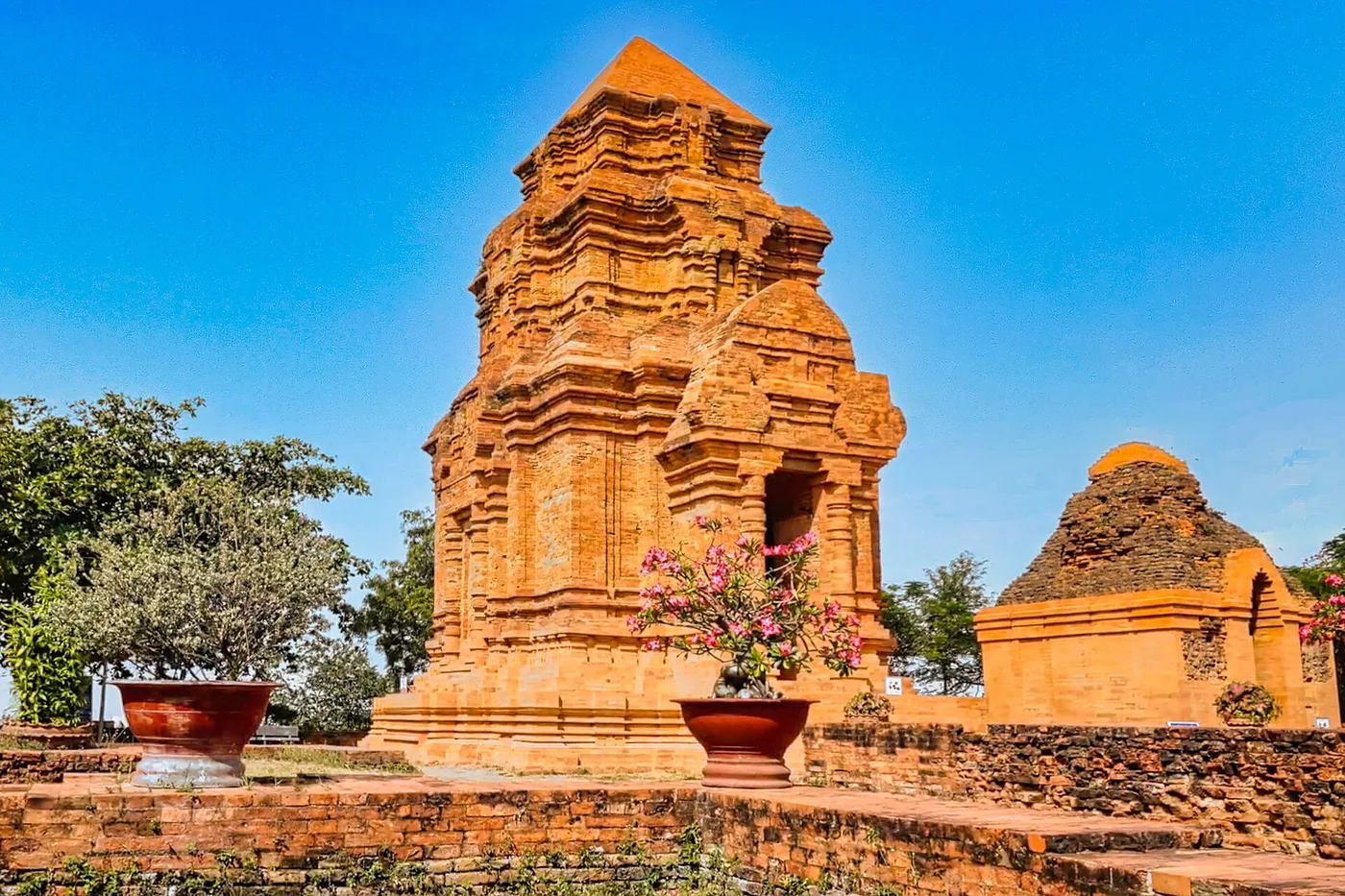
Po Sah Inu is 15,000 VND for adults and 7,000 VND for children, open 07:30 to 17:30. It stands on a hill on the road between Mui Ne and Phan Thiet, which is why it works as a bookend to a town day.
Three brick towers survive from the Cham period. The complex is far smaller than My Son near Hoi An, and twenty to thirty minutes covers it, but the hill gives you the bay, which the photographs of the towers alone never show.
Below the same hill are the walls of Lau Ong Hoang, a French-era villa that is now a ruin. There is no ticket, and late afternoon opens the view towards the water.
On Cham festival days there are ceremonies in front of the towers. Those days are busy and parking is difficult, so if you want the site quiet, avoid them.
Pairing the two
| Item | Po Sah Inu | Lau Ong Hoang |
|---|---|---|
| Entry | 15,000 VND adult | None |
| Time needed | 20~30 minutes | 15 minutes |
| From Mui Ne | 18.2km, 19 minutes | Same hill |
10. Duc Thanh school and the water tower
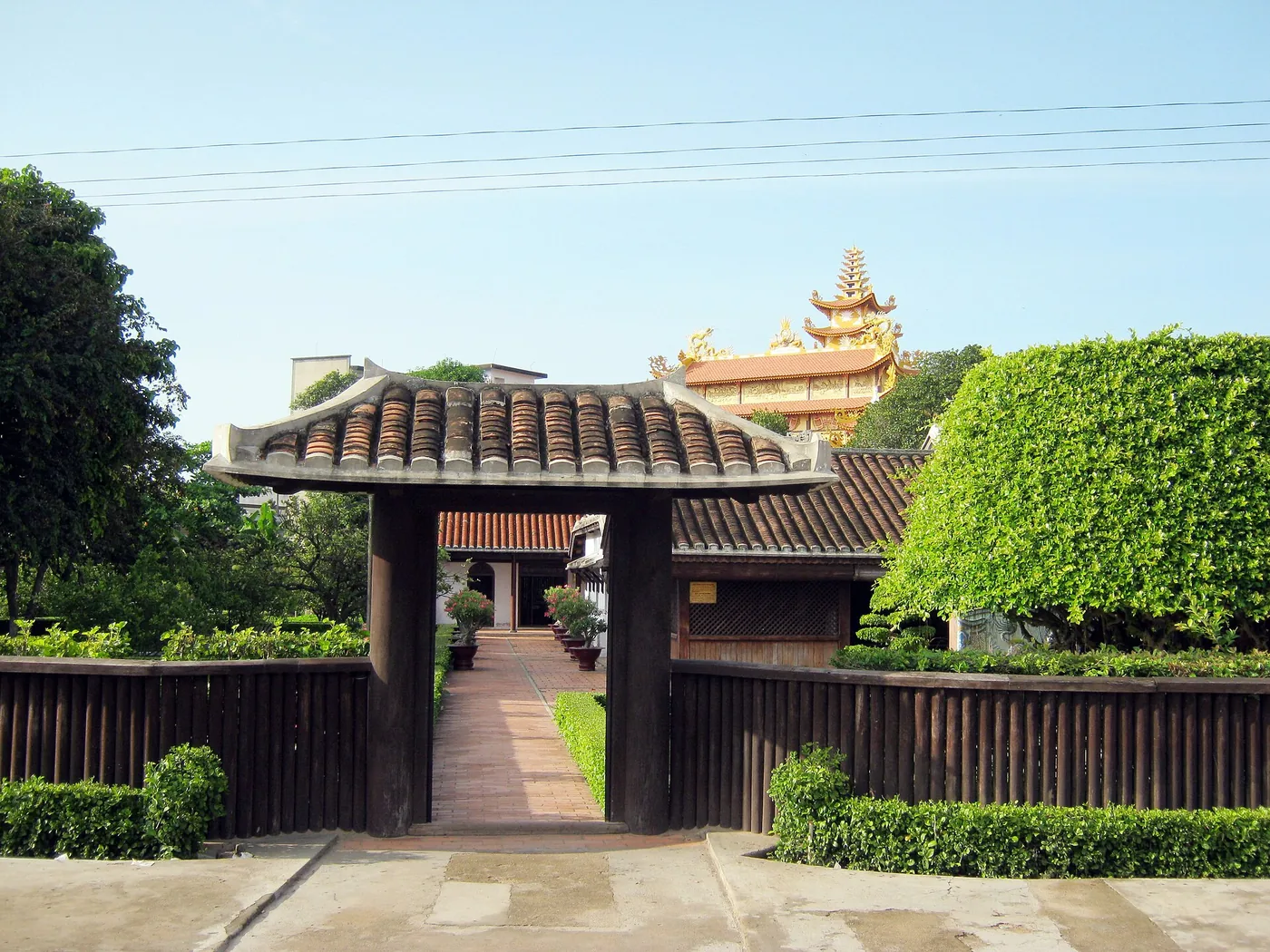
Duc Thanh school is free to enter. Ho Chi Minh taught here briefly in 1910, so the wooden classrooms and the well behind them are preserved as a heritage site, with a branch of the Ho Chi Minh museum next door. The two are visited together.
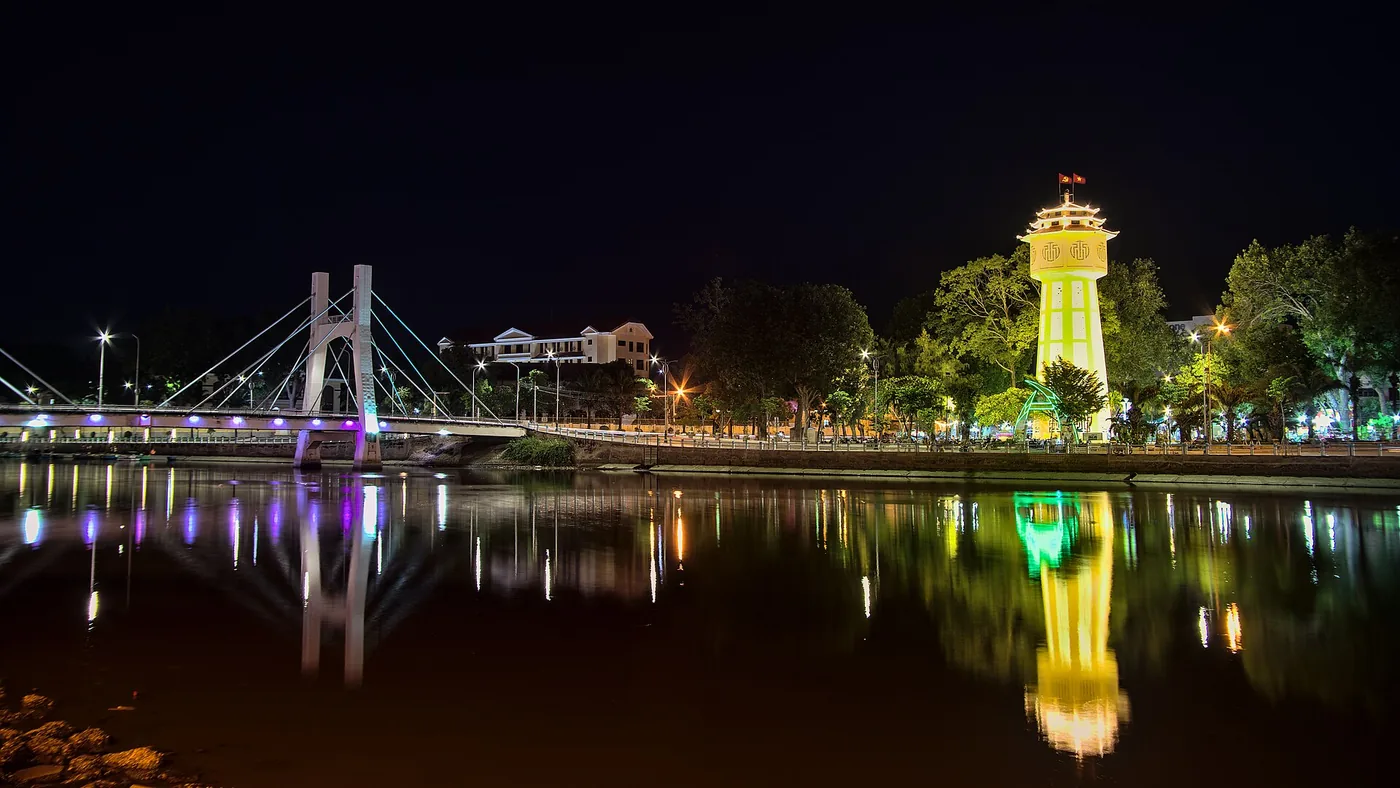
Across the river is the water tower. Construction began at the end of 1928 and finished in early 1934, and it was designed by Souphanouvong, then a Lao prince studying at a lycee in Hanoi. It was built to supply the French administration with water and is now the shorthand image of the city.
The tower by the numbers
| Item | Figure |
|---|---|
| Total height | 32m |
| Octagonal base | 22m tall, 10m across |
| Tank section | 5m tall, 9m across |
| Completed | 1934 |
The two sites are under ten minutes apart on foot. Seeing the school and the museum first and crossing the river to the tower afterwards keeps the walk in one direction.
You cannot go inside the tower. It is lit at night, so the honest advice is to see it on an evening walk along the river rather than at midday. The construction history is set out in the Vietnamese-language entry for the Phan Thiet water tower.
11. Van Thuy Tu and the market
Van Thuy Tu is a whale temple, and the skeleton of a large whale is assembled inside it. It is on Ngu Ong street, walkable from Duc Thanh school, and takes a donation rather than an admission fee.
The temple is among the older buildings in the fishing quarter and comes out of a local belief that treats whales as protectors at sea. It is dark inside, so daytime is better if you want to see the skeleton properly.
Phan Thiet market is a morning market. Fish, dried seafood and fish sauce take up most of it and there is little aimed at visitors. Fish sauce is the local product, and plenty of people buy a bottle, but glass has to go in checked baggage if you want it to arrive intact.
What people actually buy
| Item | Notes |
|---|---|
| Fish sauce | Higher nitrogen grades cost more. Check the seal before you pack it |
| Dried fish and shrimp | Ask for vacuum packing and the smell stays in the bag |
| Dried fruit | Dragon fruit is the crop of this province |
12. What to eat in Phan Thiet
The dish this town is known for is banh canh cha ca, a thick tapioca noodle soup with fish cake, and it is cheap. The broth is made from fish rather than pork bones, and the cakes are pounded and fried on site.
The shops are scattered through town. Ba Ly on Tran Hung Dao has been at it for over twenty years, and Banh Canh Xiu, Co Be, Quan Gai and Banh Canh Phuong are the other names locals give you. Several open early and close when the pot is empty, so late arrivals get turned away.
Local dishes worth ordering
| Dish | What it is | Price band |
|---|---|---|
| Banh canh cha ca | Thick noodles in fish broth with fish cake | Low |
| Lau tha | Raw fish, noodles and herbs served as a spread you assemble yourself | Mid |
| Goi ca mai | Small silver fish cured in lime and tossed with herbs | Mid |
| Banh hoi long heo | Sheets of fine rice noodle with pork and offal, eaten at breakfast | Low |
| Seafood | Bought at the harbour or market and cooked at a restaurant | Mid to high |
Many of these are breakfast foods. Banh canh and banh hoi are safest between six and ten in the morning; by early afternoon a good number of shops have shut for the day.
Lau tha is a shared spread and awkward to order alone. On your own, the noodle soups are the better call.
Vegetarians do better on the Mui Ne strip than in town. Restaurants used to foreign guests keep a separate menu, whereas the town breakfast places are built around fish and pork.
Restaurants on the beach road charge tourist prices for a fairly uniform menu. If you want the local food properly, the drive into town is the price of admission.
13. South of town: Ta Cu cable car and a 49m Buddha
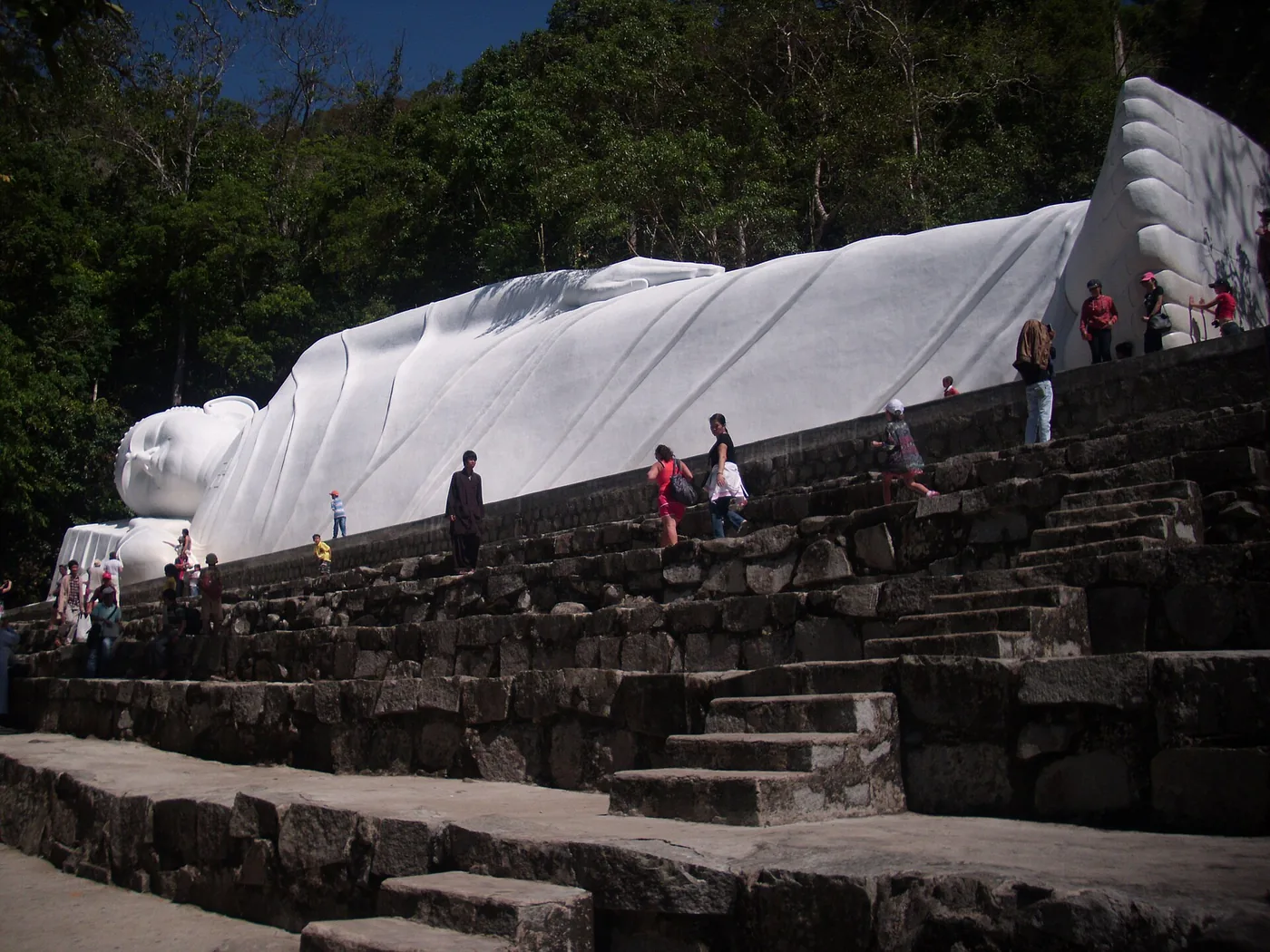
The Ta Cu cable car costs 45,000 VND for adults and 25,000 VND for children, runs from 08:00 to 17:00, and stops selling tickets at 16:00. It is 30.6km from Phan Thiet, twenty-five minutes, or forty-seven minutes if you set off from Mui Ne.
At the top is a reclining Buddha 49m long. The cable car takes fifteen minutes each way; walking is 7.3km there and back and takes two to three hours. The final flight of steps from the pagodas up to the statue is steep but short, about ten minutes.
Two ways up
| Method | Time | Cost |
|---|---|---|
| Cable car | 15 minutes each way | 45,000 VND adult / 25,000 VND child |
| On foot | 2~3 hours return | Free |
There are two pagodas on the mountain with steps between them, and macaques that approach people. Carrying food in your hand is how you end up in a tug of war with one.
Because the ticket office closes an hour before the last ride, afternoon plans need arithmetic. Leaving Mui Ne at three in the afternoon means arriving at ten to four for a window that shuts at four. Current prices and hours are published by the operator, TTC Hospitality.
14. Ke Ga lighthouse, reached by boat
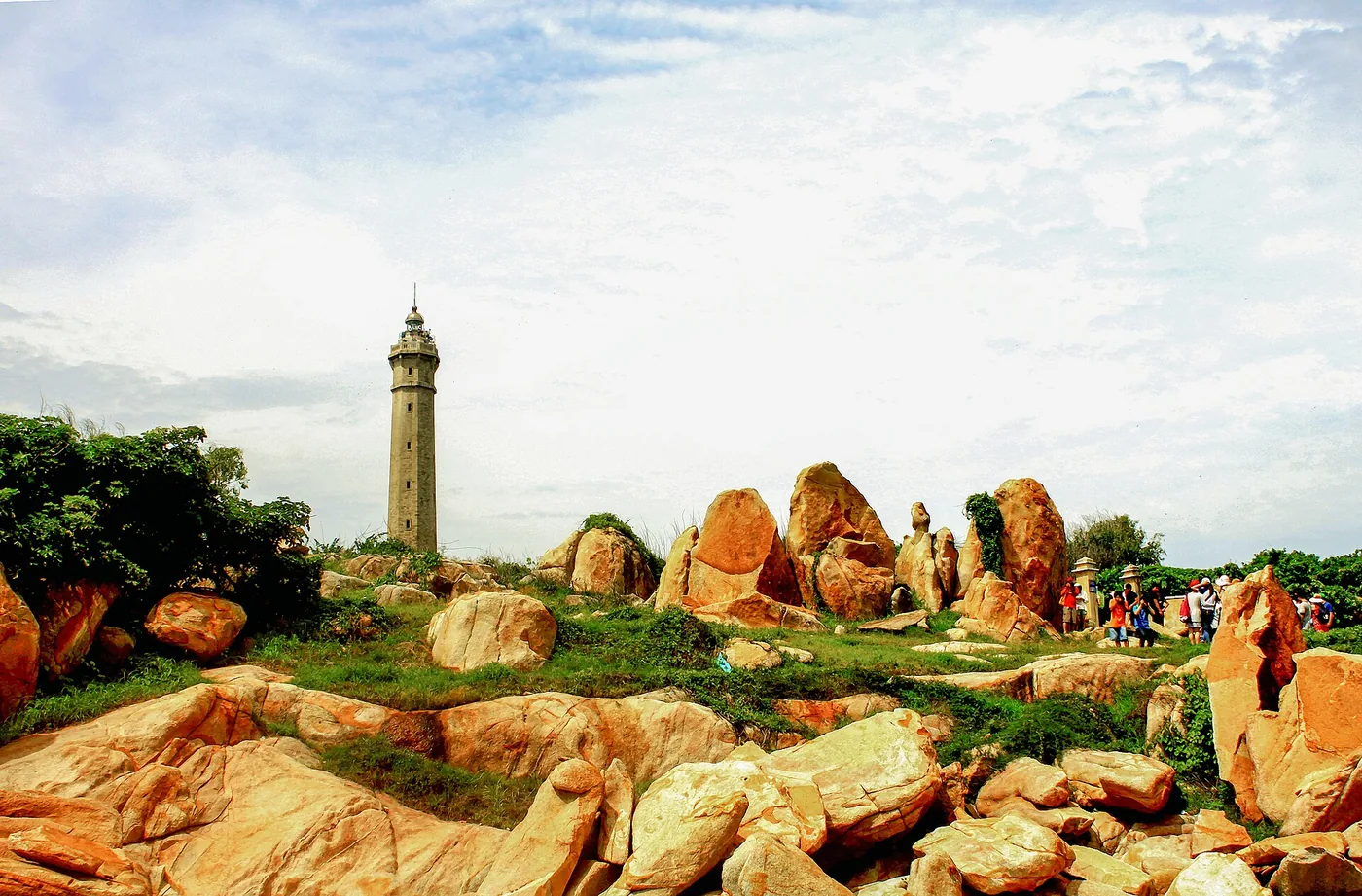
Ke Ga lighthouse is free to visit and open from 07:30 to 17:30, but it stands on an island, so you have to get on a boat. A fisherman’s boat is 30,000 to 50,000 VND a head and a motorboat 50,000 to 100,000, depending on numbers and time of day.
The tower is 35m tall and 65m from the light down to sea level. Inside, 183 spiral steps take you to the top and the whole cape opens up. Construction started in February 1897, finished at the end of 1898, and the light was first lit in 1900. Vietnam’s records centre lists it as both the tallest and the oldest lighthouse in the country.
Getting there and what it costs
| Item | Detail |
|---|---|
| Entry | Free |
| Hours | 07:30~17:30 |
| Fisherman’s boat | 30,000~50,000 VND per person |
| Motorboat | 50,000~100,000 VND per person |
| From Mui Ne | 59.1km, 58 minutes |
| From Phan Thiet | 34.9km, 36 minutes |
Late afternoon is the better time for photographs. The lighthouse faces west, and as the sun drops the boulders and the tower throw long shadows across the cape.
On windy days the boats do not run at all, and between December and March that is common on this stretch. The yellow boulders along the cape are worth the drive even when the crossing is off.
15. NovaWorld and Sea Links: the resort complexes
South-west of Phan Thiet, golf courses, hotels and water parks are grouped into single developments. NovaWorld Phan Thiet is 16.5km from town, eighteen minutes. From Mui Ne it is forty-one minutes, which makes it a place to stay rather than a place to visit for the day.
Between Mui Ne and Phan Thiet there is also Sea Links Golf Club, 14.6km and fifteen minutes from the hotel strip. If golf is the reason for the trip, staying in that stretch keeps the daily driving short.
The complexes are large enough that you move around them in electric buggies. Which zone your room sits in changes how long every trip takes, so it is worth checking on the map rather than the brochure.
If you stay out there
| Item | Detail |
|---|---|
| NovaWorld Phan Thiet | 18 minutes from town, 41 from Mui Ne |
| Sea Links | 15 minutes from Mui Ne |
| Suits | Golf, families, days spent inside the resort |
| Does not suit | Daily trips to the dunes and the harbour |
16. Phu Quy island: two hours by boat
Boats from Phan Thiet port reach Phu Quy island in two hours, and tickets run from 250,000 to 700,000 VND depending on the class of seat. There is a sailing most days, but the departure time is not fixed: it is set against the tide and the weather, so you confirm it a few days out.
The 2025 reform made Phu Quy a special zone. It has volcanic terrain and beaches with very few visitors, which is the opposite of Mui Ne in almost every respect. With four hours of sailing each way and the chance of cancellation, it is not a day trip. One night is the minimum and two is more comfortable.
On the island itself you rent a motorbike. There are almost no taxis, the road system is simple, and a day is enough to go around the whole thing.
Going out to Phu QuyMap
| Item | Detail |
|---|---|
| Crossing | 2 hours, about 15 minutes longer in poor weather |
| Fare | 250,000~700,000 VND |
| Departs | Phan Thiet port; times move with tide and weather |
| Nights needed | At least one |
| Warning | Sailings get cancelled. Do not book it against a flight home the next day |
On any boat here, wear the life jacket for the whole crossing and refuse an overloaded vessel. Southern Vietnam has had fatal incidents involving overloading and bad weather in recent years, and the rule is the same on a tourist boat as on a ferry.
17. Getting there from Ho Chi Minh City
The fastest way in is by road. Tan Son Nhat airport to Mui Ne is 197km, about two and a half hours on the expressway. The Dau Giay to Phan Thiet expressway opened on 29 April 2023 and cut a five-hour drive to well under three.
Comparing the options
| Mode | Time | Price | Notes |
|---|---|---|---|
| Private car or limousine van | 2h30~3h | 170,000~500,000 VND | Hotel door to hotel door |
| Bus | 3~4h | 170,000~500,000 VND | Frequent departures |
| Train | 3h48 | 185,000~253,000 VND | Plus 26 minutes from Phan Thiet station |
| Flight | None | – | Phan Thiet airport has no passenger service yet |
Buses are run by large operators such as Phuong Trang with several departures a day. Seats come as sleepers or uprights, and some services drop at hotels along the Mui Ne strip while others stop at the Phan Thiet terminal. Check which one you are buying, because the difference is a 24km taxi ride.
The train runs on specific days
There is one return service a day between Saigon and Phan Thiet. It leaves Saigon in the morning, arrives late morning, and starts back in the early afternoon. From 11 September to 30 December 2026, however, tickets are only sold for Friday, Saturday and Sunday. If your plan depends on a weekday train in that window, it needs another mode.
| Service | Departs | Arrives |
|---|---|---|
| Saigon to Phan Thiet | 06:45 | 10:42 |
| Phan Thiet to Saigon | 13:30 | 17:46 |
Stops are Saigon, Di An, Bien Hoa, Binh Thuan and Phan Thiet. The operating days and fares are set out in the railway operator’s notice, and seats are sold through Vietnam Railways. From Phan Thiet stationMap there are still 26.8km to the beach, about 26 minutes.
The airport is still a building site
Phan Thiet has an airport site and a runway plan, but no passenger flights. The civil terminal broke ground on 27 April 2026 with a two-year build. Until it opens, road is the only way in, whichever guide you read.
18. Onward to Da Lat and Nha Trang
Da Lat is 147km from Mui Ne and Nha Trang 220km. On road data that is 2 hours 14 and 3 hours 18. The Da Lat number comes with a condition: highway 28B, the road up to the plateau, is still being rebuilt. The vehicles, fares and departure times for that drive are in how to get from Nha Trang to Da Lat.
The 147km in the table assumes 28B is finished. The route drivers actually take today, through Phan Thiet, measures 190km, which is the figure our other guides use.
That project was aiming at April 2026, slipped after landslides and difficult geology, and is now targeting September. There was a stretch on the Dai Ninh pass where a bridge had not been connected, and traffic moved badly through it. Check the current state before you commit to an afternoon departure.
Next stops
| Destination | Distance | Road data | What to actually allow |
|---|---|---|---|
| Da Lat | 147km | 2h14 | 4~5h while 28B is under work |
| Nha Trang | 220km | 3h18 | 4~6h |
| Ho Chi Minh City | 197km | 2h28 | About 3h |
| Lien Khuong airport (Da Lat) | 126km | 2h07 | Includes the roadworks |
| Cam Ranh airport (Nha Trang) | 182km | 2h27 | About 3h |
Night buses exist and put you in Da Lat at breakfast. Plenty of travellers avoid them on the 28B section specifically, because it is mountain road and the works are unlit.
Most itineraries enter through Ho Chi Minh City, take Mui Ne, then climb to Da Lat, or come south from Nha Trang. The city guides are here: Da Lat, Nha Trang and Ho Chi Minh City, and the mode-by-mode breakdown is in getting around Vietnam. Progress on 28B is reported by the provincial paper Bao Lam Dong.
19. Getting around Mui Ne itself
Everything in Mui Ne is on one road. Nguyen Dinh Chieu through Ham Tien runs for about eight kilometres, and the hotels, restaurants and kite schools are lined up along it. You cannot get lost, but the pavement gives out in places, which matters after dark.
By mode
| Mode | Notes |
|---|---|
| Walking | Fine for a kilometre or two around your hotel. Some stretches are unlit |
| Taxi and ride-hailing | Fewer cars than a city, so waits are longer. Book the dune trip as a return |
| Motorbike rental | Rented by the day. Helmets are compulsory; check the licence rules |
| Jeep | Dune vehicle only. Priced per vehicle, agree the route first |
Ride-hailing apps do not fill up here the way they do in the cities. Which app works where is covered in the ride-hailing guide. Motorbikes bog down in the soft sand at the dune approaches, so for the dunes themselves a car or jeep is the safer choice.
The beach road is patchily lit at night. If you plan to walk to dinner, take a light and stay on the inside of the road rather than the sand shoulder.
20. Where to stay
The accommodation is strung along the same coastal road, and which stretch you pick changes the trip. There are 53 resorts on the eight kilometres of Nguyen Dinh Chieu alone. Across the wider tourism area there are more than 600 properties and about 18,000 rooms.
Plot them by coordinate and the distribution is lopsided. Ham Tien holds the bulk of the hotels and resorts; the fishing village and Hon Rom have far fewer; and the town hotels are away from the sand altogether.
What each stretch is like
| Stretch | What it is | Suits |
|---|---|---|
| Ham Tien (Nguyen Dinh Chieu) | Most of the resorts, restaurants and kite schools | First visit, kitesurfing |
| Phu Hai and Sea Links | Larger resorts and the golf course, quieter | Resort stays, golf |
| Mui Ne fishing village | Market and harbour close by, few rooms | Seeing the working town |
| North of Hon Rom | Wide, empty beach. Shops are far | Trips with a car |
| Phan Thiet town | City hotels, a drive from the beach | One-night stops, town food |
Occupancy in season averages 80 to 85 percent, and 85 to 95 percent in three- to five-star properties. Between December and March, weekend rooms in the stretch you want are gone if you leave it late.
Construction is under way in several zones, so check where a room actually sits on the map. Within one resort, road-facing and sea-facing rooms are different propositions for noise.
The room and property counts are published by Lam Dong province’s investment, trade and tourism promotion centre.
For the accommodation on its own, where to stay in Mui Ne goes through the 35 sea-side properties, the 141 across the road and what the sea walls changed.
21. How many days, and in what order
Two nights covers both dunes and the town. One night realistically gets you the red dune, Fairy Stream and the harbour. Bau Trang is the constraint: it needs its own half-day.
One night
| When | Plan |
|---|---|
| Day 1 afternoon | Arrive from Ho Chi Minh City, beach |
| Day 2 early | Sunrise at the red dune, then the harbour |
| Day 2 morning | Fairy Stream, lunch, drive back |
Two nights
| When | Plan |
|---|---|
| Day 1 | Arrive, beach, evening on the strip |
| Day 2 morning | Bau Trang half-day, afternoon off |
| Day 3 early | Red dune, harbour, Fairy Stream |
| Day 3 afternoon | Phan Thiet town on the way out |
Three nights
| When | Plan |
|---|---|
| Day 1 | Arrive, beach |
| Day 2 | Red dune, Fairy Stream, harbour |
| Day 3 | Bau Trang, kite lesson in the afternoon |
| Day 4 | Phan Thiet town and Po Sah Inu, or Ta Cu if you go south |
Early starts need a car booked the night before. To be on the sand for first light you are leaving the hotel before five, and that is not a time you can flag something down.
In the wet months put the dunes in the morning. Between May and October the rain tends to arrive in the afternoon, so keeping indoor plans for later in the day protects the schedule.
Adding Ta Cu and Ke Ga means another day. They are 47 and 58 minutes south, and pairing either with a dune morning produces a day that is mostly driving.
22. What it costs per day
Admission prices here are small. All the entry tickets together come to under 40,000 VND a person. The cost sits in the vehicles and the transfers, and jeeps and quads are priced per vehicle, so group size changes the total more than anything else.
Two people, two nights
| Item | For two | Notes |
|---|---|---|
| All admissions | About 80,000 VND | Bau Trang, Fairy Stream, Po Sah Inu |
| One jeep run | 400,000~800,000 VND | Per vehicle |
| Quad, 20 minutes | 600,000~800,000 VND | Optional |
| Food | 300,000~700,000 VND a day | Higher with seafood |
| Room | 600,000~3,000,000 VND a night | By stretch and season |
| Return transport from Ho Chi Minh City | 680,000~2,000,000 VND | Bus, van or train |
Because jeeps go by the vehicle, two people pay double what four do. Hotel desks will often put guests from the same time slot into one vehicle if you ask, and that halves the line item.
A kite course changes the shape of the budget entirely. At 40 dollars an hour, or 450 upwards for certification, it costs more than everything else on the list combined. Payment and cash mix are covered in the money guide for Vietnam.
23. When to go
Come between November and April for wind, and between May and August for a calm sea. This part of the coast is one of the drier corners of Vietnam, so in the dry season a dune plan rarely collapses because of weather.
What changes through the year
| Period | Weather | The dunes | Crowds |
|---|---|---|---|
| November–February | Dry, strong wind | Blowing sand. Protect your eyes | High season |
| March–April | End of the dry season, hotter | Sand is hot by mid-morning | Busy |
| May–August | Start of the wet season, showers | Go in the morning | Thinner |
| September–October | Wettest | Plans slip | Cheapest |
An umbrella is close to useless when the wind is up, because the rain comes in sideways. A light rain jacket earns its space in the bag.
Public holidays are their own calculation. Tet and the 30 April to 1 May break fill the beach hotels with domestic travellers and push prices up. If you cannot avoid those dates, book the room first and build the itinerary around it.
24. Things worth knowing before you go
On the sand
Midday sand is hot enough to burn. Closed shoes beat flip-flops, and on a windy day sunglasses are the difference between looking around and squinting. If you ride a quad, take the helmet and put it on, and say something if the driver speeds up near the water.
Agreeing prices
Jeeps, quads and boats are all negotiated before you get in, and the number you need is not just the price but the route. Confirm whether it is per vehicle or per person. At the harbour, ask for the price per kilo and the cooking charge separately.
Cash
Dune entry, boats and the market run on cash. Resorts and larger restaurants take cards, small shops still do not. Small notes save you an argument over change.
Timing
Some ticket offices shut well before the attraction does. The Ta Cu cable car runs to five but sells until four. Ke Ga boats simply do not sail when the wind is wrong.
What to bring
| Item | Why |
|---|---|
| Closed shoes | Hot sand and blowing grit |
| Sunglasses and a hat | There is no shade on either dune |
| Clothes that can get wet | Fairy Stream is a wade, not a walk |
| Small notes | Entry fees, boats, market |
| A dry bag or plastic sleeve | Sand and water both get into cameras |
Entry requirements and visa conditions are in the Vietnam entry guide, and connectivity in the eSIM and SIM guide.
25. How the area is changing
Mui Ne was designated a national tourism area in 2018, and in November 2025 a master plan out to 2040 was approved. It covers 14,760 hectares. The structure is a single coastal corridor with three centres along it.
The three planning zones
| Zone | Area | Role in the plan |
|---|---|---|
| Phu Thuy and Mui Ne | About 6,625 ha | Resorts and wellness. Fairy Stream and the dunes sit here |
| Hoa Thang | About 7,165 ha | A new tourism town along provincial road 716 |
| Phan Ri Cua | About 970 ha | Coastal resorts |
The targets are 14 million visitors by 2030 and 25 million by 2040, with room stock rising to 41,000 and then 71,500. For scale, Mui Ne received just over 1.14 million visitors in the first half of 2026.
What that means for a trip this year is construction. Road and resort works are running in several places, parts of the beach road are torn up, and some hotels have a building site next door. Recent reviews are more useful than photographs here.
The road tells you where the plan is actually moving. The largest zone is the new town along road 716, and driving that stretch you pass a steady line of works traffic.
26. 🌊 More Vietnam guides
Southern Vietnam guide · Vietnam travel guide · Da Lat travel guide · Where to stay in Da Lat · Datanla Falls and the alpine coaster · Nha Trang travel guide · Things to do in Nha Trang · Ho Chi Minh City guide · Where to stay in Ho Chi Minh City · Getting around Vietnam · Long Thanh airport explained · Vietnam entry requirements · Vietnam eSIM guide · Money in Vietnam · Tourist scams · Ride-hailing apps
🎡Things to Do23
🍜Food3
🏨Where to Stay9
🚇Getting Around4
🧭Travel Tips11
🧭Vietnam-wide essentials116
Mui Ne and Phan Thiet: frequently asked questions
With one day, the red dune. It is 2.4km from the hotel strip and two minutes by car, so you can be back for breakfast. Bau Trang is 26.4km and twenty-nine minutes, which means a half-day, but it has the white sand, the lake, and more to ride: quads, jeeps and kayaks. With two nights or more, do both.
The red dune is free. Bau Trang is 10,000 VND per person. Riding is separate at both: jeeps are 400,000 to 800,000 VND per vehicle, and quads at Bau Trang are 600,000 to 800,000 VND for twenty minutes.
197km from Tan Son Nhat airport, about two and a half hours on the expressway that opened in April 2023. Buses take three to four hours, and the train is 3 hours 48 minutes to Phan Thiet plus 26 minutes on to the beach.
Check the day first. There is one return service between Saigon and Phan Thiet, and from 11 September to 30 December 2026 tickets are only sold for Friday, Saturday and Sunday. It leaves Saigon at 06:45 and arrives 10:42; the return runs at 13:30. From Phan Thiet station it is another 26.8km to Mui Ne.
Not for passengers yet. The site and runway plan exist and the civil terminal broke ground on 27 April 2026 with a two-year schedule. For now you fly into Ho Chi Minh City, Nha Trang or Da Lat and drive.
Two nights covers both dunes and Phan Thiet town. One night gets the red dune, Fairy Stream and the harbour. Add a night if you want Ta Cu mountain or Ke Ga lighthouse, which are 47 and 58 minutes south of the strip.
November to April, when the north-east monsoon holds 15 to 30 knots. December to March is the strongest and suits experienced riders; November, March and April are easier for learning. From May the wind drops and the beach turns into a swimming destination.
Yes. Da Lat is 147km and Nha Trang 220km. Highway 28B up to Da Lat is still being rebuilt, so allow four to five hours rather than the two the map suggests. Since the 2025 reform, Mui Ne and Da Lat are in the same province.
There has been a fatality. In May 2025 a quad went into the lake and a tourist drowned, and helmets became compulsory afterwards. An inspection in October 2024 found that all four operators there were working without business licences. If you ride, look at the vehicle and the helmet, and tell the driver to keep away from the water.
Banh canh cha ca, a thick noodle soup with fish cake, is the local dish. Ba Ly on Tran Hung Dao is the long-standing name, and Banh Canh Xiu, Co Be and Quan Gai are the others locals mention. Lau tha, a raw-fish spread, needs two or more people. Town food beats the beach road for anything local.
Not really. The crossing is two hours each way from Phan Thiet port, departure times move with the tide and weather, and sailings get cancelled. Plan at least one night, and do not schedule it immediately before a flight home.
For a first visit, Ham Tien: the eight kilometres of Nguyen Dinh Chieu hold 53 resorts plus the restaurants and kite schools. For quiet, Phu Hai and Sea Links. For an empty beach, north of Hon Rom, with the caveat that shops are far. Town hotels make sense only for a one-night stop.