
Nha Trang in the Rainy Season (Sep-Nov): Is It Still Worth It? An Honest Guide
Early September is the window worth booking; October and November only work if you can move plans around the weather.
| Best window | Early September (mildest, calmest sea, boats usually run) |
|---|---|
| Wettest / roughest | October and November (together roughly half the year’s rain) |
| Typhoon window | Sep-Nov, rare direct hits (Typhoon Damrey, Nov 2017) |
| Rain pattern | Short heavy afternoon bursts, mornings usually usable |
| Sea temperature | Warm all season, about 26-29 C |
| Best rainy-day picks | Mud baths, Institute of Oceanography, VinWonders |
| November alternative | Phu Quoc, near-dry while Nha Trang peaks |
| Money angle | Low season begins, softer rates and thinner crowds |
1. Can you still visit Nha Trang from September to November?
2. Why is Nha Trang’s rainy season so late compared with the rest of the south?
3. What is September like in Nha Trang?
4. What is October like in Nha Trang?
5. What is November like in Nha Trang?
6. How often does Nha Trang get typhoons?
7. When it floods, what actually gets disrupted?
8. How do you read the forecast and the beach flags here?
9. What is the daily rain rhythm, and how safe is the sea?
10. What still works? Activities in the rainy season, ranked
11. A flexible four-day rainy-season itinerary
12. The best indoor and rainy-day options
13. Nha Trang vs Da Nang vs Phu Quoc from September to November
14. Where should you stay for a rainy trip?
15. Booking, refunds, and how cheap it really gets
16. Getting there, getting around, and what to pack
17. The verdict: should you go?
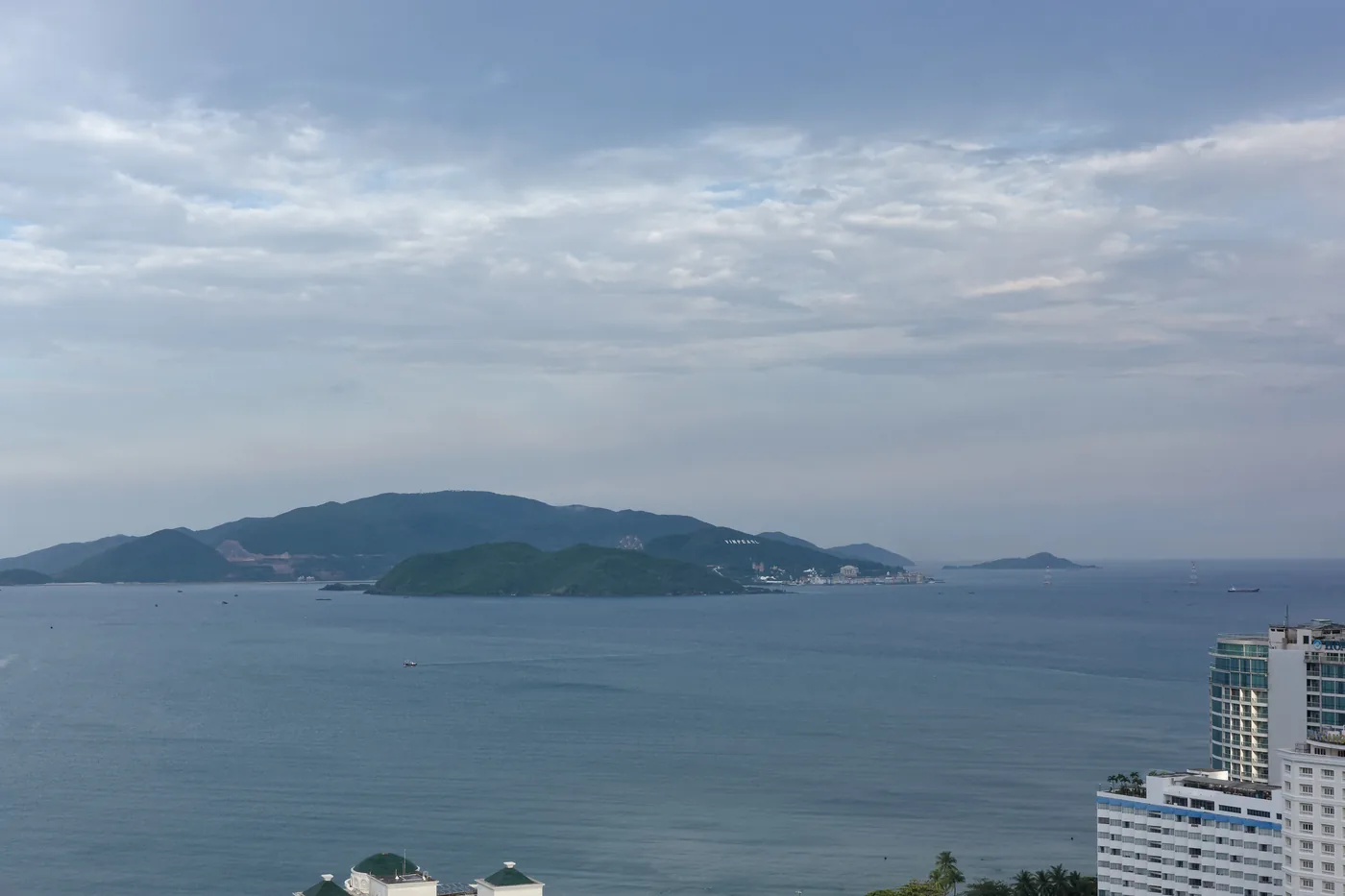
1. Can you still visit Nha Trang from September to November?
🏖️ Things to do in Nha Trang: how a day divides, with fares and travel times →
Yes, and early September is the best of the three months, but October and November only pay off if you keep your plans flexible.
Most seasonal advice stops at “avoid October and November,” which helps nobody who already has those dates booked. It also misjudges the risk. The disruption that actually costs travellers days here is rarely a typhoon; it is ordinary heavy rain closing the port, slowing the airport road, or shutting a waterfall trail. Those are knowable and plannable, which is what the rest of this guide is for.
For wider context, see the main Nha Trang guide, the southern Vietnam overview and the Vietnam travel guide.
2. Why is Nha Trang’s rainy season so late compared with the rest of the south?
Nha Trang follows a different seasonal cycle: it stays dry all summer and takes almost all its rain in autumn and early winter, driven by the northeast monsoon rather than the summer southwest one.
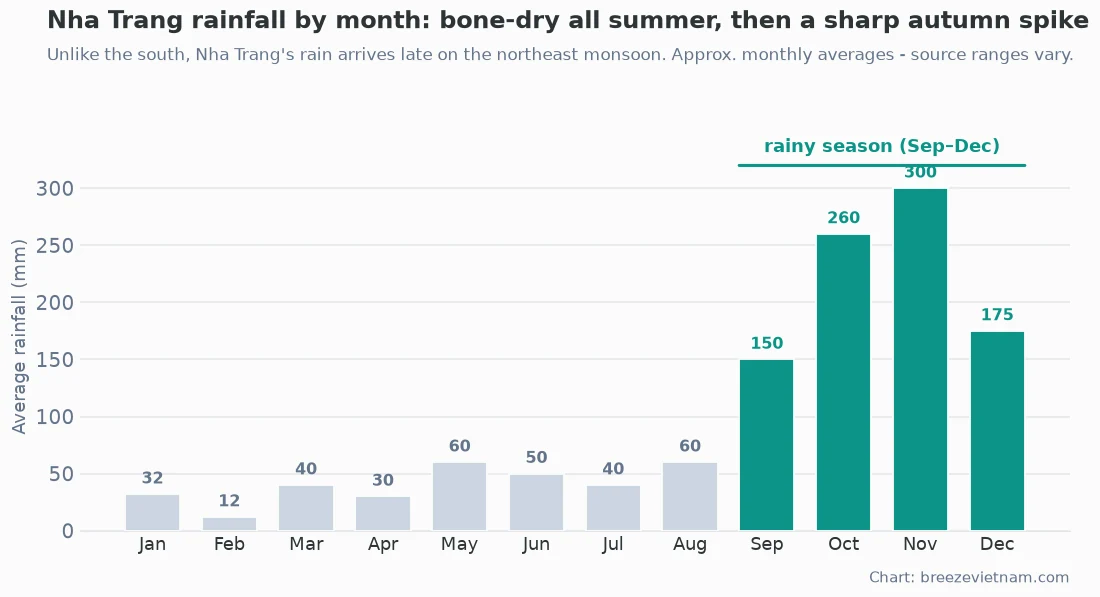
Most of southern Vietnam, including Ho Chi Minh City, the Mekong and Phu Quoc, is wet from about May to October under the southwest monsoon, then dries out by November. Nha Trang does the opposite. It stays clear through the hot season and the rain arrives late, roughly September to December, peaking in October and November. Those two months alone bring close to half the year’s total.
This puts Nha Trang on the same seasonal regime as Da Nang and the central coast, but with less total rain and a gentler peak. The reason matters: it is not that mountains or islands shelter the bay. It is lower rainfall on the same monsoon pattern, plus a position well south of the worst typhoon belt. That lowers the odds without removing them.
How the wet season lines up across Vietnam:
| Region | Wet season | Driver |
|---|---|---|
| North (Hanoi, Sapa) | May-Sep | Summer monsoon |
| South (HCMC, Mekong, Phu Quoc) | May-Oct | Southwest monsoon |
| Central coast (Da Nang, Hue) | Sep-Dec | Northeast monsoon |
| Nha Trang / Khanh Hoa | Sep-Dec (lighter) | Northeast monsoon |
Nha Trang’s own year, month by month, shows a dry first half and a sharp autumn rise:
| Month | Rain (mm, approx) | Feel |
|---|---|---|
| January | ~25-40 | Dry, breezy |
| February | ~5-20 | Driest month |
| March | ~30-50 | Dry, warming |
| April | ~20-40 | Hot, dry |
| May | ~50-70 | Hot, first stray showers |
| June | ~40-60 | Hot, mostly dry |
| July | ~30-50 | Hot, dry |
| August | ~50-70 | Hot, occasional shower |
| September | ~137-165 | Rain begins, still good |
| October | ~213-312 | Wet, sea roughens |
| November | ~198-382 | Wettest, flood risk |
| December | ~155-191 | Easing, still damp |
If picking dates is your whole question, the best-time-to-visit breakdown compares all four seasons side by side. In short: Nha Trang is dry when the rest of the south is wet, and wet when the south dries out.
[climate12]
3. What is September like in Nha Trang?
September is the mildest of the three months, with the calmest sea, boats usually running, and low-season prices starting to appear.
September brings roughly 137-165 mm of rain over about 14-15 rainy days, though “rainy day” overstates it. Most September days open bright and warm, then bring a short heavy burst in the afternoon or evening that clears within about half an hour. Daytime highs sit around 31-32 C, nights around 25 C, and the sea is 29 C. Humidity is high, near 80 percent, so it feels sticky between showers.
The main advantage is that the sea is usually still calm enough for island trips. The port rarely closes this early, snorkelling visibility is only starting to drop, and the Hon Mun Map reef boats run most days. Tran Phu Beach Map is quiet on a September morning, and the usual pattern is a clear start, a shower in the mid-afternoon, and sun again within an hour.
The first half of September is the safest window, before the rain ramps up. The main thing to watch is crowds rather than weather: National Day falls on Wednesday 2 September 2026, a public holiday when domestic tourists fill beach cities and prices rise for a few days. The week after gives the same mild weather without the surge.
If you can only travel in one autumn month, choose September. It is the closest the rainy season comes to dry-season conditions.
[ponagar]

4. What is October like in Nha Trang?
🧖 Nha Trang mud baths compared — five venues, what the price really covers →
October is the turning point: rainy days climb, the sea roughens, tours start cancelling at short notice, but mornings are often still clear and prices fall further.
October rain rises to roughly 213-312 mm across about 16-18 rainy days. Highs ease to around 30 C, the sea cools slightly to about 28 C, and cloud cover thickens, so morning sun is less reliable. Clear windows still come, just fewer of them, and full grey days become more likely.
The bigger change is at sea. October is when rough spells begin closing the port and cancelling boat departures at a few hours’ notice. Operators respond to conditions, not schedules, so an island day booked for Tuesday can be called off on Monday night. On breezy but runnable days, the better operators swap the exposed outer islands for sheltered near-shore stops. Snorkelling clarity also drops, often below 10 metres.
None of this rules out October. The approach shifts to morning-first with an indoor backup. Do beach and boat activities early, keep afternoons free for Thap Ba Hot Spring Map, the aquarium or a mall, and do not commit to a boat more than a day or two ahead.
The compensation is cost. October is deep low season: hotels are quiet, rates are soft, and a beachfront room can cost what a mid-range place charges in July. For travellers content to wait out an afternoon downpour in a cafe, October offers Nha Trang at a discount.
5. What is November like in Nha Trang?
🎟️ VinWonders tickets explained — full-day vs after-4pm, and what the cable car includes →
November is the wettest, greyest and highest-flood-risk month, disruptive at its worst, workable if you plan around indoor days, and the month when pure-beach travellers should choose Phu Quoc instead.
November is peak wet. Rainfall is often cited as the highest of the year, in a wide 198-382 mm band, and this is the month of multi-day rain rather than short afternoon bursts. Highs slip to about 28-29 C, the sea cools to 26-27 C, sunshine drops to around four and a half hours a day, and the sky can stay overcast for long stretches. It stays warm, but grey and wet.
Flood and landslide risk also peaks. The northeast monsoon can deliver very large totals in a short time, rivers rise, low-lying wards flood, and mountain roads and waterfall areas become dangerous. This is not hypothetical: November 2025 brought historic floods to Khanh Hoa. November therefore requires a buffer in the schedule and a willingness to change plans.
The month still works if the trip is built around indoor options. Nha Trang has plenty: mud baths, the Institute of Oceanography, the large indoor share of VinWonders, malls, cafes, spas and shows. Book centrally so you can walk between them without finding a taxi in the rain, and use any clear morning immediately.
For flat sea and reliable sun, though, November is the wrong month here. Phu Quoc is drying into its dry season while Nha Trang peaks, so the island is the better choice for a pure beach holiday. The full comparison is further down.
6. How often does Nha Trang get typhoons?
Direct typhoon hits are rare here, roughly a once-in-two-decades event for the province and clearly rarer than Da Nang or Hue, but the season for them is exactly September to November, and rain-driven flooding is the far more common disruptor.
The reason for fewer hits is geography rather than local shelter. Nha Trang sits at about 12.25 degrees north, south of the main strike belt that runs roughly 14-17 degrees north (Quang Tri down to Quang Ngai). Landfall frequency drops as you go south: the north coast takes around 2 to 2.5 cyclones a year and the bulk of the strong ones, while the south takes only about a quarter of that load. Early-season storms curve into the north and centre; the strike zone only slides this far south late in the year, in October and November, which is exactly when Khanh Hoa’s rare hits cluster.
The common claim that mountains and islands protect the bay is a myth, and a risky one to plan around. The real factors are latitude and storm climatology, and they lower the odds rather than remove them. The record:
| Storm / event | When | Where it hit | What happened |
|---|---|---|---|
| Typhoon Damrey | 4 Nov 2017 | Landfall at Van Ninh, Khanh Hoa | Cat 2, 130-165 km/h; about 107 deaths nationwide; roughly 14.7 trillion dong (~US$647M) damage in-province; ~30,000 evacuated. The strongest to hit Khanh Hoa in about 20 years. |
| Storm / depression Toraji | 18-19 Nov 2018 | Weakened to a depression, flooded Nha Trang | City outskirts over a metre deep; a landslide killed 13 in Vinh Truong. Proof a weak system still kills through flooding. |
| Typhoon Molave | late Oct 2020 | Quang Ngai / Quang Nam (~15 N, central, not Khanh Hoa) | Only fringe flooding reached Nha Trang, showing most “south-central” storms actually strike north of it. |
| Historic floods | 16-20 Nov 2025 | Khanh Hoa (northeast-monsoon deluge) | Rivers past records; mountain gauges 400-994 mm; ~9,000 homes flooded to 1.5 m; the Phu Kieng bridge washed away; about 22 dead. |
A full Damrey-scale typhoon is rare. But Toraji and 2025 show the more likely threat is a slow, rain-heavy system, or no named storm at all, delivering enough water to flood roads, cut power and cause deaths. The practical response is not to focus on typhoons alone: watch the forecast, keep plans flexible, and carry cover for a trip you may have to change.
Named storms usually give two to four days’ warning, so check a 3-5 day forecast before you commit boat days, and build in a buffer so a bad spell costs you one activity rather than the trip. If Da Nang typhoon exposure is part of your comparison, the central-coast storm guide goes deeper on that stretch of coast.
7. When it floods, what actually gets disrupted?
Floods hit low-lying city fringes and riverside wards first, and heavy multi-day rain can cut roads, delay flights, close the airport road and turn waterfall and mountain zones deadly.
Knowing what fails first makes it easier to plan around. In rough order:
- Low-lying and riverside wards. The flat fringes of the city and areas near the Cai River flood earliest. Central beachfront blocks along Tran Phu are generally higher and safer, which is one more reason to stay central and, ideally, above the ground floor.
- The Cam Ranh airport road. The airport sits 30-35 km south, a 45-60 minute drive. In heavy rain that road slows badly and, in the worst events, sections flood. That threatens transfers and, combined with storms, flight delays and cancellations.
- Rail and intercity roads. Prolonged deluges can cut the north-south rail line and highways, stranding onward travel for a day or more.
- Waterfalls and mountains. The highest-risk category. Ba Ho and similar spots flash-flood with little warning and the rocks become dangerously slippery. In November 2025 a stream bridge at Ba Ho was washed out and the park was cut to sightseeing only. Skip these entirely in wet spells.
If a serious event does hit, the rules are simple. Stay on high ground. Keep well away from rivers, waterfalls and mountain roads. Never drive or wade through flooded roads, since depth and current are impossible to judge. Follow local authority notices, which are issued. And keep the itinerary flexible enough that staying put for a day costs you little.
8. How do you read the forecast and the beach flags here?
Use NCHMF for official warnings, Windy for rain and wind timing, and JTWC or JMA for storm tracks, then obey the beach’s green-yellow-red flag system and its four-language no-swim signs on the day.
Reading conditions correctly is most of the skill of a rainy-season trip. The sources worth using, and what each is for:
- NCHMF (nchmf.gov.vn), Vietnam’s national hydro-meteorological centre, for official storm and flood warnings. This is the authority; check it first.
- Windy.com for the hour-by-hour picture: when rain and wind arrive and how strong. Useful for choosing which morning to book a boat.
- JTWC and JMA for tropical storm tracks and forecast cones, so you can see a system forming days out.
On the sand, the beach runs a flag system: green for fine, yellow for caution, red for no swimming. When the sea turns rough, the Bay Management Board posts no-swim signs in four languages, Vietnamese, English, Russian and Korean, and its patrol enforces them. Note that there are no fixed lifeguard towers and no marked swim zones on the main beach. The flags and the patrol are the safety system, so treat a red flag as absolute.
The decision rules are straightforward. Check the 3-5 day forecast before committing to any boat day, since storms usually signal two to four days ahead. A red flag means no swimming. A port closure means no boats leave, so have an indoor plan ready. Multi-day heavy rain means flood and landslide risk, so stay out of the mountains. And a tropical depression, short of a full storm, can still flood a city and cause deaths, so do not dismiss a weak system. A data eSIM for checking forecasts anywhere is part of the safety kit here.
9. What is the daily rain rhythm, and how safe is the sea?
Most Sep-Nov days give you clearer mornings and short heavy afternoon bursts, so mornings are your working window, but the sea can turn genuinely dangerous, and rip currents here are sometimes fatal.
The typical day, especially in September and October, is a clear morning followed by a heavy shower of 20-40 minutes in the afternoon or evening, then clearing. The rain is warm and passes quickly. That is why every plan in this guide is morning-first: do the beach, the boat or the temples early and keep afternoons flexible. November is the exception, when a whole day can stay grey and wet. The three months compare as follows:
| Month | Rainy days | Day high | Sea temp | Sun / day |
|---|---|---|---|---|
| September | ~14-15 | ~31-32 C | ~29 C | ~6.5 h |
| October | ~16-18 | ~30 C | ~28 C | ~6 h |
| November | ~12-18 | ~28-29 C | ~26-27 C | ~4.5 h |
Sea safety deserves attention. In October and November rough spells bring a 1-2 metre shore-break and strong rip currents. There were rescues in October 2025, and a Russian visitor drowned on 22 October 2025. The main beach has no fixed lifeguards, so responsibility rests with you and the flags.
Learn the rip-current escape before entering the water, since panic is the main danger. If you are pulled out, do not fight the current or try to swim straight back to shore against it. Stay calm, keep floating, and swim parallel to the beach until you are clear of the pull, then angle back in. Obey the flags and the patrol, and when in doubt, do not swim.
Three smaller notes. Water clarity drops below 10 metres in October and November, so snorkelling is less rewarding. Box and fire jellyfish peak roughly April to October, so September catches the tail of that season before it eases as the water cools. And the sea stays at 26-29 C throughout, so temperature is never the limiting factor. Rain and sea state are.
[beach]
10. What still works? Activities in the rainy season, ranked
Most of the city still works: mud baths and the aquarium are rain-proof, VinWonders is a strong full-day fallback, island boats run on calm mornings but cancel when rough, and diving and waterfalls are the ones to drop.
The viability table, then the detail on each:
| Activity | Sep-Nov viability | Note |
|---|---|---|
| Mud baths / hot springs | Excellent | Best on a grey, cool day |
| Institute of Oceanography | Excellent | Indoor, no boat needed |
| VinWonders | Very good | Big indoor share; water rides pause in lightning |
| Island / snorkel boats | Fair, weather-dependent | Great early Sept, frequent Oct-Nov cancellations |
| Cham towers / pagodas | Fair | Open-air, light rain only, slippery steps |
| Diving | Poor | Clarity collapses Oct-Nov |
| Ba Ho Waterfalls | Avoid | Flash-flood and landslide risk |
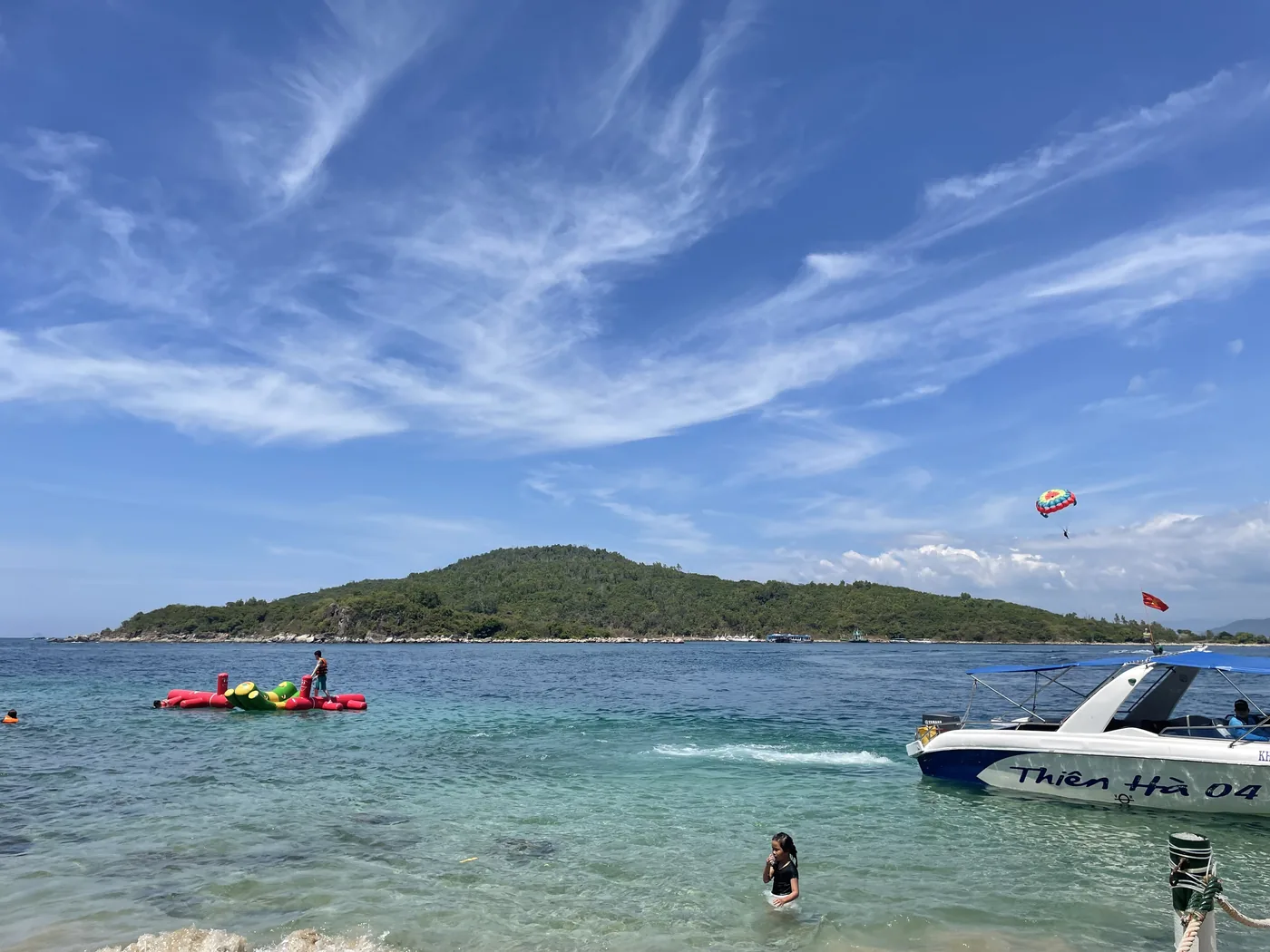
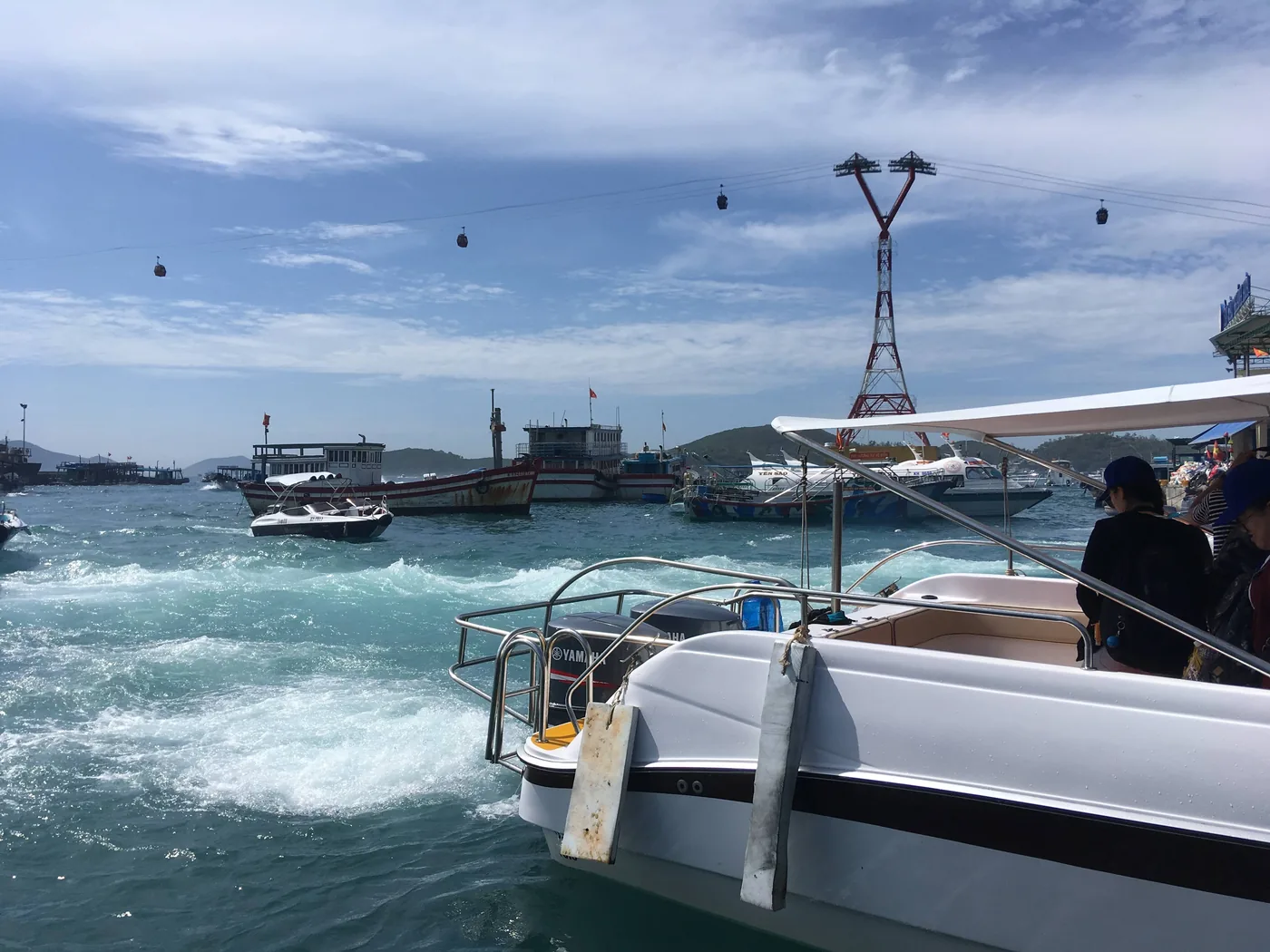
Island-hopping and snorkel boats. These are sea-dependent. The port bans departures when it is rough, so short-notice October and November cancellations are common, while early September is usually reliable. On windy but runnable days, operators swap the exposed outer islands like Hon Mun and Hon Mot for sheltered near-shore stops such as Hon Tam, and morning departures are always the safest bet. Hon Mun is Vietnam’s first Marine Protected Area, with a small reserve fee around 22,000 dong. A party boat with music and a floating bar runs about US$10-20; a premium speedboat, calmer with more water time, runs about US$40-50.
Diving. Best March to October, peaking April to August, with 15-30 m visibility. September to November is poor and October to November is the worst, often sub-10 m. Some operators pause over winter; Whale Island runs roughly 15 January to 15 October. The water stays warm enough for a 3 mm suit into October. Note also the mid-2022 Hon Mun coral-recovery restrictions, so confirm locally what is open and treat any promise of unrestricted diving with caution.
VinWonders on Hon Tre. The best full-day rain fallback. A large share of it is indoor, including the Neptune Palace aquarium that reopened on 6 February 2026, about 4,000 square metres with a roughly 100 m 360-degree tunnel, plus a dome show. The outdoor water park and rides pause in thunderstorms and lightning. Adult tickets run about 950,000-1,050,000 dong (~US$40), cheaper after around 16:00. You reach it by the Vinpearl cable car, an over-sea run of about 2,643 m and 8-10 minutes and one of the world’s longest, which shuts in strong wind around Beaufort 7; a speedboat backup means island access is never lost. A documented maintenance shutdown ran 15 October to 15 November in 2024, overlapping the peak, so verify the current year’s dates.
Tap Ba hot spring and mud baths. The most rain-proof option. Warm mineral mud and roughly 40 C pools suit a grey, cool day, and there are indoor and covered areas, though open-air soak pools may close in a storm. Thap Ba Hot Spring starts around 120,000 dong for a communal soak or about 500,000 dong for a private tub for two; I-Resort starts around 170,000 dong.
Institute of Oceanography. The best land-based, no-boat marine stop for a wet day, at 01 Cau Da, about 40,000 dong, open roughly 06:00-18:00, and worth 1.5-2 hours.
Temples and the rest. Po Nagar Cham Towers Map (about 08:00-18:00, 30,000 dong) and the Long Son Pagoda with its White Buddha (193 exposed, slippery steps, free, about 07:00-17:00) are fine in light passing rain but poor in a downpour. Ba Ho Waterfalls are the highest-risk option in the wet and should be skipped, and the small Tri Nguyen aquarium on Hon Mieu requires an 8-10 minute boat crossing, which makes it unreliable in rough seas.
[island]
11. A flexible four-day rainy-season itinerary
Build the trip morning-first with buffers baked in: fix the rain-proof things, keep one beach or boat day un-committed, and hold one whole day loose to catch whatever weather you missed.
This plan is designed to survive bad weather. Two rules underpin it: never commit to the boat early, and always keep a spare day.
- Day 1, arrival and settle. A late-morning walk along Tran Phu Beach if it is dry, then the Po Nagar Cham Towers and Long Son Pagoda, which are fine in light rain. In the afternoon, a Tap Ba mud bath, which works well if the day turns wet, then a seafood dinner. If it rains: go straight to the mud bath and move the beach walk to a clear morning.
- Day 2, the flex day, watch the forecast. If the sea is calm and the sky is clear, take the early island and snorkel boat to Hon Mun. Do not book this more than a day or two ahead. If it rains or the port closes: switch to a full day at VinWonders, which is indoor-heavy and works well in the wet.
- Day 3, culture and indoors. Morning at the Institute of Oceanography, then the cathedral and the market. If it rains: an afternoon of cafes, a mall and a spa, then sunset from the Tran Phu bridge if the sky clears.
- Day 4, buffer and depart. Keep this free for whatever you missed, a beach morning or the boat if Day 2 rained out. Allow extra time on the 45-60 minute Cam Ranh road, which is slower in the wet.
The flex day plus buffer is what makes the plan work. Fix the indoor and light-rain activities, let the sea-dependent ones move to the best window, and Nha Trang’s autumn becomes manageable rather than a gamble.
12. The best indoor and rainy-day options
Nha Trang has a wide range of wet-weather options: the VinWonders indoor zones, the Institute of Oceanography, mud baths, beachfront malls, a strong cafe scene, a puppet show and cooking classes.
When rain settles in for the afternoon, or a November day stays grey, there is plenty left. The practical details:
- VinWonders indoor zones. The VinWonders Map complex on Hon Tre has a large covered share, including the Neptune Palace aquarium and the dome show, which makes it the anchor of any wet day. Adult tickets around 950,000-1,050,000 dong, cheaper after 16:00, open 09:00-20:00.
- Institute of Oceanography. Tanks, specimens and marine history at 01 Cau Da, about 40,000 dong, 06:00-18:00, and completely rain-proof.
- Mud baths and hot springs. Thap Ba Hot Spring and I-Resort work as well in the rain as out of it. From about 120,000 dong communal.
- Beachfront malls. Nha Trang Center and Vincom Plaza Tran Phu, the latter with a Lotte cinema and bowling, plus Lotte Mart. An easy few hours out of the wet.
- The cafe scene. Nha Trang’s cafe culture is strong, from the Rainforest Cafe to An Cafe and several book cafes, all suited to waiting out a shower.
- Shows and classes. An indoor puppet show at the Do Theater, the “Life Puppetry” production at Vega City, spa and massage, or a cooking class.
The practical approach is to group two or three of these within walking distance of your hotel, so a sudden downpour changes the order rather than the plan. A morning mud soak, lunch in a book cafe and an afternoon at the aquarium makes a full day regardless of the weather.
[cablecar]
13. Nha Trang vs Da Nang vs Phu Quoc from September to November
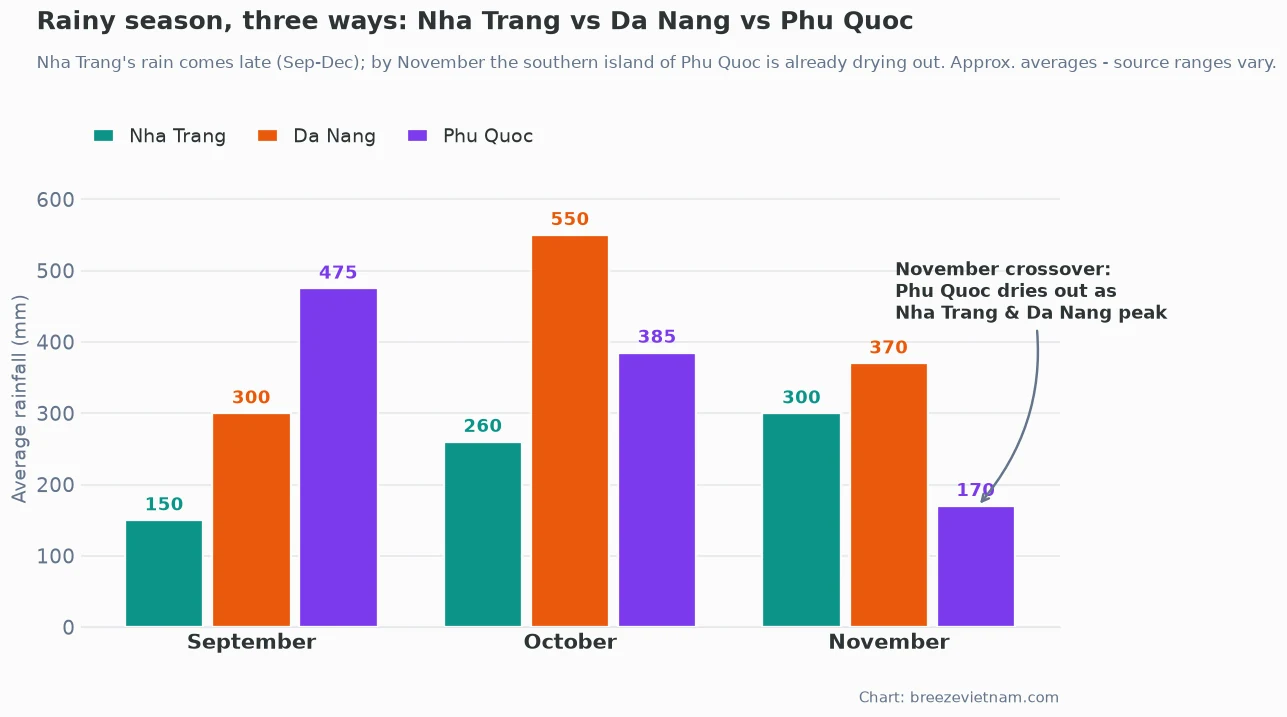
Nha Trang is the mildest central-coast option in early September, Da Nang is wetter and more storm-exposed every month, and in November the position reverses: Phu Quoc turns near-dry while Nha Trang and Da Nang peak.
This is the choice most autumn travellers are making, so here are the numbers side by side:
| Month | Nha Trang | Da Nang | Phu Quoc |
|---|---|---|---|
| September | ~137-160 mm | ~292-310 mm | ~475 mm |
| October | ~213-300 mm | ~455-650 mm (peak) | ~385 mm |
| November | ~198-330 mm | ~305-430 mm | ~170 mm (drying out) |
Month by month: in early September, Nha Trang is the mildest of the three, drier than Da Nang and much drier than a still-monsoonal Phu Quoc. Through October, Da Nang is at its wettest and its highest storm exposure, so on the Da Nang and Nha Trang choice, Nha Trang is the better October option for anyone focused on the sea.
November reverses the picture. Phu Quoc, on the opposite southwest-monsoon cycle, is drying into its dry season while Nha Trang and Da Nang reach their wettest. So for a pure beach holiday in November, choose Phu Quoc over the central coast. For the mildest central option, choose Nha Trang and travel in September. And if Da Nang is on your list, weigh its heavier rain and higher typhoon odds.
[climate]
14. Where should you stay for a rainy trip?
Stay central on Tran Phu so you can walk between things while dodging showers, favour higher floors, and avoid low-lying riverside fringes in the peak flood weeks.
In the dry season, location is mostly about the view. In the rainy season it is about walking distance. The three zones compare as follows:
- Central Tran Phu beachfront. The best rainy-season base. The beach, malls, cafes and restaurants are all walkable, which matters when showers are frequent and taxis are hard to find in the rain. It also sits on higher ground than the fringes.
- Cam Ranh and Bai Dai resorts. Well appointed, but 45-60 minutes from town on a road that deteriorates in heavy rain. A good choice if you plan to stay at the resort throughout, less so if you want to visit town, since every trip becomes a long, rain-slowed drive.
- Downtown Biet Thu and Hung Vuong. The cheapest option, a few blocks off the sand, with plenty of cafes and eateries for wet afternoons. A strong budget choice if you do not need a sea view.
Two flood precautions regardless of zone: choose a higher floor, and avoid the low-lying wards near the Cai River during peak flood weeks. Neither costs anything and both matter in November.
15. Booking, refunds, and how cheap it really gets
The rainy season is the cheapest time to visit, September is often the lowest month of all, and the key habit is booking boats on free-24-hour-cancellation listings so weather cannot cost you money.
September opens the low season: thinner crowds, softer room rates and discounted luxury, all directional rather than fixed percentages. A realistic off-peak budget:
| Item | Off-peak price |
|---|---|
| Hostel / 2-star room | from ~US$7-10 / night |
| Solid 3-star | ~US$9-15 / night |
| 4-5 star | from ~US$13+ (much more for beachfront / Cam Ranh) |
| Island boat | US$10-50 by tier |
| VinWonders (adult) | ~US$40 |
| Mud bath | 120,000-500,000 dong |
| Institute of Oceanography | ~40,000 dong |
| Po Nagar towers | ~30,000 dong |
On booking, the priority is protection against weather cancellations. Book boats and tours on listings with free 24-hour cancellation, leave the boat day open until a day or two ahead, and take morning slots. Refund norms favour you here: if the operator cancels for weather, you get a full refund or a free reschedule, since platforms such as Klook and GetYourGuide treat weather as force majeure. If you cancel, you are refunded only outside the cutoff, commonly 24 hours, which is the reason not to book the boat early.
For a fuller breakdown of Vietnam trip costs, see the budget and money guide. In short: autumn is when Nha Trang is cheapest, and some booking discipline lets you take advantage without risking a deposit.
16. Getting there, getting around, and what to pack
Fly into Cam Ranh and pre-book a private transfer for the 45-60 minute drive, use Grab or Xanh SM in town, carry a data eSIM for the forecast, and pack for rain, sun and sea all at once.
Cam Ranh (CXR) is 30-35 km south of the city, a 45-60 minute drive (about 12 km if you are staying at Bai Dai). There is no city airport. In heavy rain the road slows, so a pre-booked private car is better than negotiating a taxi on arrival.
Around town, Grab and Xanh SM, the electric-car service, are the easiest way to move in the rain: cheap and widely available. Avoid scooters in heavy rain or floodwater, and note that US, UK, Canadian and Australian international permits are not valid for riding here in any case, so check the visa rules and entry requirements before planning to drive yourself. A data connection is part of the safety kit for forecasts and maps, so arrange a travel eSIM before you land.
What to pack for this window:
| Category | Bring |
|---|---|
| Rain | Light jacket or poncho, dry-bag, quick-dry clothes, a light long-sleeve, grippy or waterproof shoes |
| Sun | Sunscreen, hat, sunglasses (the sun still breaks through) |
| Sea | Swimwear, reef-safe sunscreen |
| Health | Insect repellent, any personal meds, a reusable bottle |
| Documents | Travel insurance details, passport, e-visa printout |
Two events sit in this window. National Day falls on Wednesday 2 September 2026, a public holiday with fireworks and music, when beach cities fill up and prices climb. The Mid-Autumn Lantern Festival (Tet Trung Thu) is on Friday 25 September 2026, not a public holiday but a good evening, with lanterns along the Cai River Map, lion dances and mooncakes. October and November have no major festival, which is part of why they are so firmly off-peak. Note also that the Sea Festival is a summer event around mid-July, not in this window.
[nightview]
17. The verdict: should you go?
Go, but pick your month and stay flexible: early September is a genuine yes, October rewards the easygoing, November is for indoor-happy travellers, and pure-beach seekers should shift to Phu Quoc.
Nha Trang in the rainy season is not a postcard trip. Planned well, it is a warm, cheap, uncrowded holiday with plenty to do in bad weather, on a coast that takes its rain later and lighter than its central-coast neighbours.
Match the month to the traveller. Early September suits almost anyone: calm sea, boats running, mild weather and thinner crowds. October suits flexible travellers happy to work morning-first and wait out an afternoon downpour in a cafe. November suits those who enjoy aquariums, mud baths and evening entertainment, and treat a clear morning as a bonus. If what you want is four days of flat sea and sun, go to Phu Quoc in November instead, during its dry season.
Whatever month you choose, the method is the same: keep one beach or boat day uncommitted, hold one buffer day, watch the forecast and the flags, and never treat a weak system as harmless. On that basis, Nha Trang’s autumn is a sound, low-cost trip rather than a gamble.
🏖️ The Nha Trang Guide Library
🗓️ Going in February? This guide covers September to November. February sits furthest from that, and it is set out in Nha Trang in February.
🗓️ Going in March? This guide covers September to November. March comes after that window has closed, and it is set out in Nha Trang in March.