
Central Vietnam Travel Guide: Da Nang, Hoi An, Hue, My Son
The middle of Vietnam holds three UNESCO sites within two hours of one airport, and a wet season that runs opposite to the rest of the country.
| What it is | The Đà Nẵng–Hội An–Huế triangle, plus Phong Nha, Quy Nhơn and Mang Đen |
|---|---|
| Best base | Đà Nẵng for logistics, Hội An for atmosphere, Huế as a two-night leg |
| How many nights | 5 for the triangle; 7–10 to do Huế properly or add Phong Nha |
| Best months | February to April — March is the driest month and among the cheapest |
| Avoid | October and November: 650 mm and 430 mm in Đà Nẵng, plus flood and typhoon risk |
| Don’t miss | The Đà Nẵng–Huế train, Mỹ Sơn after the Cham Museum, one lantern night |
| Getting in | Đà Nẵng (DAD). Huế’s Phú Bài is HUI and domestic in practice |
| Headline prices | Bà Nà Hills 1,000,000₫ · Hội An ticket 120,000₫ · Huế Citadel 200,000₫ |
1. What Central Vietnam is, and whether it is your Vietnam
2. How the region fits together
3. What changed in 2025, and why your guidebook now disagrees with your booking
4. When to go: the month-by-month reality
5. The flood question, answered honestly
6. How many nights, and routes that actually work
7. Đà Nẵng: what the city is actually for
8. Hội An: the prettiest town in Vietnam, and the caveats
9. Huế: the city people skip, and why that is usually a mistake
10. Beyond the triangle: passes, ruins, caves and the quiet coast
11. Getting in, and getting around
12. Where to base yourself: the decision table
13. The food of the centre, and what is actually regional
14. What Central Vietnam costs
15. What older guides still get wrong
16. Where to go next
1. What Central Vietnam is, and whether it is your Vietnam
Central Vietnam is the narrow coastal belt where the country keeps three of its UNESCO sites within about two hours of one another, and it is the right part of Vietnam for anyone who wants culture and a beach in the same week rather than one or the other. The working core is a triangle of three places: Đà Nẵng, Hội An and Huế. Everything else hangs off it. Come for the density. Do not come expecting wilderness, and do not come in October without a plan.
The density argument, which is the only one that matters
Vietnam is 1,650 kilometres long and most itineraries lose whole days to that fact. The centre is the one stretch where the good things are close enough together that you do not spend the trip in transit. A former imperial capital, a preserved 15th-to-19th-century trading port and a Cham temple valley sit inside a radius that a car covers in an afternoon, with an international airport in the middle of it and a swimmable beach on the same road.
Put concretely: the Museum of Cham Sculpture in Đà Nẵng, the Mỹ Sơn towers whose statuary fills that museum, and Hội An’s assembly halls are three stops in one long day. Huế’s Imperial City is 103 kilometres up the coast, and the train that gets you there is one of the better rail journeys in Southeast Asia. Nowhere else in the country stacks that much in that little space.
Who the centre suits, and who should go elsewhere
This is a hub, so it will route you generously — but only after telling you honestly whether the region is a fit at all. The answer depends less on budget than on what you actually want from a week.
| You want | Verdict | Why |
|---|---|---|
| Heritage plus a beach in one trip | Yes, emphatically | Nowhere else in Vietnam does both within 30 km |
| A first trip to Vietnam, 7–10 nights | Yes, as one leg of two or three | Pairs naturally with Hanoi and the north, or with Saigon and the Mekong |
| Food that is genuinely different from what you get at home | Yes | Central cuisine is its own thing, not a mild version of Hanoi’s |
| Mountains, ethnic-minority villages, trekking | No, go north | Sa Pa and Hà Giang are a different country in every sense that matters here |
| Nothing but a beach and a resort for a week | Probably not | Phú Quốc’s dry season is longer and its resort inventory is deeper |
| Big-city energy, nightlife, rooftop bars until 3am | No, go south | Đà Nẵng closes early by Saigon standards and is not pretending otherwise |
| A guaranteed dry fortnight in November | No | November is 430 mm across 20 days in Đà Nẵng and 620 mm in Huế |
| Caves, on a serious scale | Yes, but as a separate trip | Phong Nha needs its own two to four nights and its own season |
The comparison most Anglophone readers are actually running is against the two beach destinations they have already heard of. If that is the decision, the two head-to-heads are written out in full: the centre against Nha Trang and Đà Nẵng against Phú Quốc.
What the centre is not
Three corrections worth making before you book, because each of them causes a specific kind of disappointment.
- Mỹ Sơn is not Angkor. It is a small group of brick towers in a valley, heavily damaged by bombing in 1969, and it takes about two hours. It is worth those two hours. It is not worth a day of anticipation built on photographs of Cambodia.
- Đà Nẵng is not an old city. Almost nothing pre-1975 survives in the centre, and the beachfront is a wall of towers. Its value is as infrastructure with a very good beach attached — which is a real value, just not the one the word “city break” implies.
- Hội An is not undiscovered. It is the most visited small town in Vietnam and the retail has organised itself around that. It is still the prettiest place in the country at eight in the evening. Both statements are true and any guide that gives you only one of them is selling something.
The three-UNESCO point, stated carefully
The Complex of Huế Monuments, the Hội An Ancient Town and the Mỹ Sơn Sanctuary are all inscribed, and they are the reason this region outranks any other single slice of Vietnam for cultural density. Phong Nha–Kẻ Bàng, the karst national park north of Huế, is a fourth — but it is a genuine extension rather than a day out, and it is dealt with separately below because pretending otherwise is how people lose two days.
What this means in practice is that a five-night trip based in one place can take in an imperial citadel, a merchant town, a Cham temple valley and a swim, without a single internal flight. That is unusual, and it is the single best reason to give the centre a week rather than the three nights most itineraries allocate.
The paperwork, for readers reading this in English
Vietnam’s 45-day visa exemption covers the United Kingdom, Germany, France, Italy, Spain, the Nordic countries, Japan, South Korea, Russia and Belarus. It does not cover the United States, Canada or Australia — those passports need an e-visa, applied for online in advance, and it is a straightforward process rather than a consular ordeal. That single distinction catches out a lot of readers who assume the whole Anglosphere is treated alike.
Two other pieces of admin repay attention before you fly: entry rules and their small print, in the current entry requirements, and a data plan, because Grab, maps and river-gauge bulletins are all useless without one. The eSIM options are compared separately.
This page sits under the Vietnam country guide, between the north and the south. If you are still deciding which third of the country to give your fortnight to, start there and come back.
2. How the region fits together
Think of Central Vietnam as a triangle with a long tail: Đà Nẵng and Hội An 30 kilometres apart, Huế 103 kilometres north over a mountain pass, and everything else radiating outwards from those three points. The triangle is what a five-night trip covers. The tail — Phong Nha, Quy Nhơn, Mang Đen — is where a second week goes. Getting the geography right first is what stops you booking a day trip that is really a travel day.
The distances, from Đà Nẵng
Đà Nẵng is the natural reference point because its airport is 3 kilometres from the city centre and almost every international arrival lands there. Times below are typical door-to-door by car outside rush hour; add a third in summer traffic on the coast road.
| From Đà Nẵng to | Distance | Typical time | What that makes it |
|---|---|---|---|
| Marble Mountains (Ngũ Hành Sơn) | ~10 km | 20 min | A half-day, or a stop en route to Hội An |
| Hội An | ~30 km | 40–55 min | Either city works as a base for the other |
| Bà Nà Hills | 25–35 km | 45–60 min | A full day, whatever the tour desk says |
| Mỹ Sơn | ~60 km | 1h15–1h30 | A half-day from Đà Nẵng, an hour from Hội An |
| Hải Vân Gate (road summit) | ~25 km | 45 min | A morning, or the first stop on the Huế road |
| Lăng Cô and Lập An lagoon | ~40 km | 1h–1h15 over the pass | The natural lunch stop between the two cities |
| Huế | 103 km by rail, ~100 km by road | 2h–2h30 by road; 2h30–3h15 by train | A long day trip, or better, two nights |
| Cù Lao Chàm | ~30 km to Cửa Đại port, then 15–30 min by sea | Half a day minimum | Weather-dependent in every month |
| Quy Nhơn | 281–345 km | 5h10–6h by train to Diêu Trì; 6–7.5h by coach | An overnight destination, never a day trip |
| Phong Nha | — | 6–7h by road; 4–5h by train to Đồng Hới plus 40 km | Two nights minimum, and a separate season |
| Mang Đen | — | A full travel day, usually via Pleiku or Quy Nhơn | A trip of its own, not an add-on |
What is an hour apart and what is a day apart
The single most useful mental model for this region is that it has four rings, and the mistake almost everyone makes is treating ring three as if it were ring two.
| Ring | What is in it | What it costs you |
|---|---|---|
| 1. The base | Đà Nẵng city and beach, or Hội An Old Town and An Bàng | Nothing — you walk or cycle |
| 2. Half-day radius | Marble Mountains, Sơn Trà, Mỹ Sơn, Cửa Đại, the beach road | A morning or an afternoon, back for dinner |
| 3. Full-day radius | Bà Nà Hills, Cù Lao Chàm, Huế and the tombs, the Hải Vân by car | A whole day, and you will be tired |
| 4. Overnight only | Phong Nha, Quy Nhơn, Mang Đen | Two nights minimum, usually more |
Huế is the borderline case and the one worth arguing about. It is doable in a day from Đà Nẵng — people do it constantly, and the day-trip options from Đà Nẵng cover the mechanics. But you will see the Imperial City and one tomb, in a rush, having spent four to five hours in transit, and you will conclude Huế is overrated. Two nights turns the same city into the best cultural leg in Vietnam.
Why the geography behaves like this
The Trường Sơn range runs north-west to south-east down the whole length of the country’s midriff and pushes hard against the sea. What is left is a coastal plain rarely more than 30 or 40 kilometres wide, with rivers running short and steep out of the mountains into flat estuaries. Every town in this region sits on that strip, which is why the distances are small and why the flooding is fast.
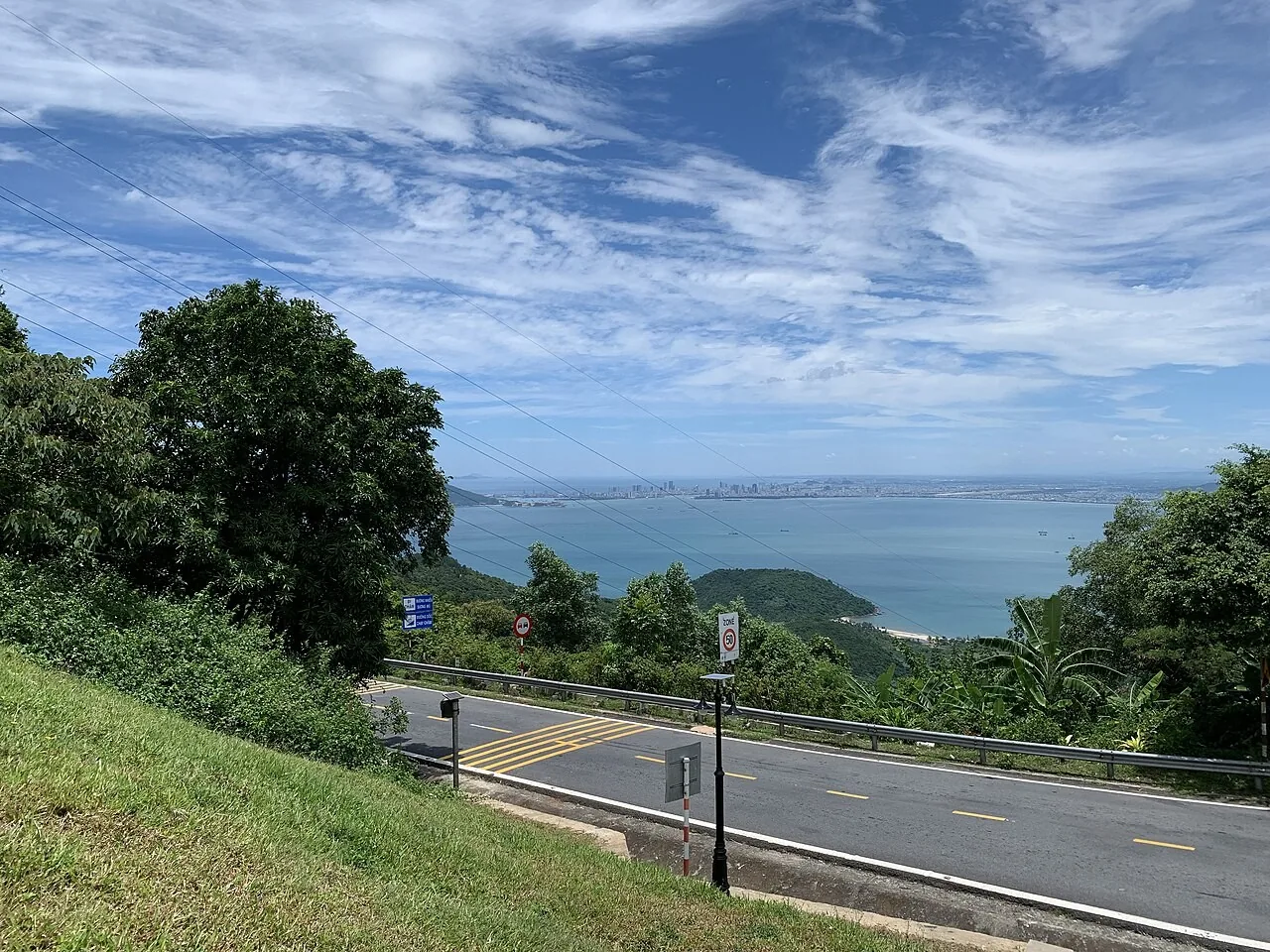
The Hải Vân — the “ocean cloud” pass — is where that range actually reaches the water, and it does two things at once. It is the scenic set piece of the region, and it is a genuine climatic wall: Huế sits under drizzle while Đà Nẵng, 25 kilometres south over the ridge, is in sun. Over a full year that ridge is worth about 645 mm of rain: Huế collects roughly 2,800 mm against Đà Nẵng’s 2,155 mm, at essentially the same latitude and altitude. Riders cross out of rain into sunshine inside twenty minutes. Hải Vân Pass
The full treatment of the pass, including the thing most guides get wrong about the railway, is in the Hải Vân crossing compared mode by mode.
The 2025 wrinkle you will notice on maps
Hội An, Mỹ Sơn and Cù Lao Chàm are all administratively part of Đà Nẵng city now, which sounds like trivia until your hotel confirmation and your guidebook disagree about which province you are in. That reform gets its own section below, because it changes what you should type into a search box.
What this means for how you plan
- One base covers more than you think. From either Đà Nẵng or Hội An, everything in rings one to three is reachable and you never repack. Đà Nẵng and Hội An both work; the choice is temperamental, not logistical.
- Two bases is the better five-night shape. Three nights in the triangle plus two in Huế gives the region its full range without a single wasted morning.
- Every hotel move costs half a day. Checkout, transfer, check-in, reorientation. Three bases in five nights is a logistics exercise, not a holiday.
- The extensions are trips, not excursions. Phong Nha and Mang Đen both reward the effort and both punish anyone who tries to squeeze them into a week that already has Huế in it.
3. What changed in 2025, and why your guidebook now disagrees with your booking
On 1 July 2025 Vietnam cut its 63 provinces down to 34, and the reform landed directly on this region: Quảng Nam was absorbed into Đà Nẵng city, so Hội An, Mỹ Sơn and Cù Lao Chàm are now administratively Đà Nẵng. Huế became a centrally governed city in its own right. Phong Nha moved into Quảng Trị, Quy Nhơn into Gia Lai, Mang Đen into Quảng Ngãi. Nothing moved on the ground. Everything moved on paper, and most published guidance has not caught up.
The changes that affect this region
| What you will read in older sources | What it is now | Where this bites |
|---|---|---|
| Hội An, Quảng Nam province | Hội An, Đà Nẵng city | Hotel confirmations, insurance address fields, some booking-site filters |
| Mỹ Sơn, Quảng Nam | Mỹ Sơn, Đà Nẵng city | Tour listings that still sell it as a “Quảng Nam excursion” |
| Cù Lao Chàm, Quảng Nam | Tân Hiệp island commune, Đà Nẵng city | The suspending authority is now the Đà Nẵng Maritime Port Authority |
| Thừa Thiên Huế province | Huế, a centrally governed city | Provincial dropdowns on forms; older festival and monument pages |
| Phong Nha, Quảng Bình province | Phong Nha, Quảng Trị province | Almost every English cave guide in circulation |
| Quy Nhơn, Bình Định province | Quy Nhơn, Gia Lai province — and its administrative centre | Rail and coach listings; regional statistics |
| Mang Đen, Kon Tum province | Mang Đen, Quảng Ngãi province | Highland transport information, which was thin already |
What actually changes for a traveller: almost nothing, and one thing that matters
No road moved. No ticket office relocated. The Imperial City is where it was and the Thu Bồn still runs past Bạch Đằng street. What changed is the metadata: the province printed on your booking, the option list in an insurance form, the phrasing of a tour listing, and the confidence with which a search engine matches an old page to your query.
The practical instruction is simple. Navigate by city and street, not by province. “Hội An” as a search term still works perfectly; “Quảng Nam” increasingly returns a mix of live and dead information. If a booking form insists on a province that no longer exists, pick the nearest match and move on — nobody at the front desk will care.
The knock-on nobody has written up
Here is a consequence of the merger that no English page seems to have connected: because Hội An is now part of Đà Nẵng city, Hội An residents qualify for Bà Nà Hills’ Đà Nẵng-resident rate, which runs roughly 35% below the standard fare — 650,000₫ against 1,000,000₫ for an adult, on production of ID. That is no use to a visitor directly. It is very much of use if you are travelling with Vietnamese friends or family who live in Hội An, and it is a good illustration of how far the administrative change reaches into everyday pricing. The full ticket structure is in the Bà Nà Hills breakdown.
Why your sources will contradict each other for another year or two
Guidebooks are printed on multi-year cycles. Blogs are updated when someone gets round to it. Booking platforms carry legacy region fields that are expensive to migrate. Government tourism pages moved fastest, foreign-language travel content slowest. The result is a two-year window — we are in the middle of it — where a reader comparing three sources will see three different provinces attached to the same town and reasonably conclude that one of them is wrong.
None of them is wrong, exactly. They are dated. The tell is the date stamp on the page, and the second tell is Phong Nha: any 2026-dated article that still puts it in Quảng Bình was not actually revised in 2026. That is a useful filter to apply to everything else on the same page, including its prices. Phong Nha’s own guide uses the current provincial name.
What did not change, and is worth saying out loud
- UNESCO inscriptions are unaffected. Huế, Hội An and Mỹ Sơn are listed as they were.
- Ticket prices and opening hours are set by site authorities, not provinces, so the reform did not move them. What moved them was 2026 pricing, covered separately.
- Visa and entry rules are national and untouched by the merger. See the entry requirements.
- Ward and commune names changed in a lot of places too, which matters mainly if you are typing an address into a delivery app rather than a map.
One last practical note. If you are booking a boat to Cù Lao Chàm, the suspension notices you want to read now come from the Đà Nẵng Maritime Port Authority rather than a Quảng Nam body. The decision is still made on the wind and wave forecast, and it is still made at short notice.
4. When to go: the month-by-month reality
February and March are the best weeks of the Central Vietnamese year, and they are also among the cheapest. March delivers about 20 mm of rain over four days in Đà Nẵng and Hội An, at low-season room rates. The region’s wet season runs September to December, the inverse of southern Vietnam’s. That single fact is why the familiar advice to visit the country between November and April misfires here.
Start with the window most guides skip
March is the driest month of the year on this coast: about 20 mm of rain across four days, six hours of sun a day, a mean daily maximum of 28.5°C. February is barely wetter at 25 mm over six days, and cooler. Both sit in the lowest band of hotel rates. Most English-language sources reach for November instead, and November brings 430 mm over twenty days in Đà Nẵng and 620 mm in Huế. That is not a shoulder season, it is the back end of the wet one.
The honest cost is the water. February’s sea sits at 23.5°C, the coldest of the year, because sea temperature lags the air by about a month, and it is April before swimming is properly pleasant at 26°C. February and March are for walking, riding and ruins, and a trip built around swimming runs on the Đà Nẵng beach calendar instead.
The inversion, proved with December and July
The claim that matters to a Vietnam-wide reader is that the centre is wet when the south is dry. October is the month people reach for to prove it, and October is the wrong month. Use December and July.
| Month | Đà Nẵng / Hội An | Huế | Phú Quốc | Hà Nội |
|---|---|---|---|---|
| December | 215 mm / 18 days | 310 mm / 20 days | 60 mm / 6 days | 20 mm / 5 days |
| July | 85 mm / 9 days | 90 mm / 8 days | 420 mm / 22 days | 255 mm / 16 days |
| October | 650 mm / 20 days | 755 mm / 21 days | 385 mm / 22 days | 155 mm / 11 days |
December is the clean demonstration: same country, same week, ten times the rain between Phú Quốc and Huế. July runs the other way, the centre at its brightest while the Gulf of Thailand drowns. Anyone flying Đà Nẵng to Phú Quốc in either month is changing season, not latitude.
October is the month both coasts are wet. Phú Quốc takes 385 mm over 22 rainy days and is not sunny. What separates the centre in October is volume, roughly twice as much water, with river flooding and cyclone landfall on top. “Sunny in the south, flooded in Hội An” is the October error this page exists to correct; the honest version is that it is wet everywhere and catastrophically wet here. The cyclone season on this coast is worth reading before anyone books an autumn trip.
Where these numbers come from, and what they are not
Every figure here is from climatestotravel.com, which states a 1991–2020 period of record for Đà Nẵng, Huế, Hà Nội and Nha Trang, and 2000–2020 for Phú Quốc. Values are rounded to 5 mm and whole days, which is why the twelve months sum to 2,145 mm against a stated Đà Nẵng annual total of 2,155 mm. That gap is rounding, not error.
These are not official WMO normals. Vietnam’s National Centre for Hydro-Meteorological Forecasting does not publish its long-term station normals in an openly readable table. The trap is Wikipedia: its Đà Nẵng and Huế climate boxes run on a 1961–1990 baseline, thirty-five years older, and the Huế page states no period of record at all. Mix the two and you get differences that look like signal and are only bookkeeping.
Hội An has no separate long-record normal in accessible sources. It sits 30 km down the same coastal plain, so the Đà Nẵng table is the right proxy and this page says so rather than pretending otherwise. Hội An’s real difference is hydrological, not meteorological: the same rain, a far worse river.
Đà Nẵng and Hội An, month by month
| Month | Rain | Sun (h/day) | Max °C | Sea °C |
|---|---|---|---|---|
| January | 85 mm / 12 days | 4.5 | 25.2 | 24.0 |
| February | 25 mm / 6 days | 5.0 | 26.4 | 23.5 |
| March | 20 mm / 4 days | 6.0 | 28.5 | 24.5 |
| April | 35 mm / 5 days | 7.0 | 31.1 | 26.0 |
| May | 85 mm / 10 days | 8.0 | 33.6 | 28.5 |
| June | 90 mm / 9 days | 8.0 | 35.0 | 29.5 |
| July | 85 mm / 9 days | 8.0 | 34.5 | 29.5 |
| August | 115 mm / 11 days | 7.0 | 34.1 | 29.5 |
| September | 310 mm / 14 days | 6.0 | 32.1 | 29.5 |
| October | 650 mm / 20 days | 4.5 | 29.6 | 28.0 |
| November | 430 mm / 20 days | 4.0 | 27.7 | 26.5 |
| December | 215 mm / 18 days | 3.5 | 25.3 | 25.0 |
Read September against August: rainfall multiplies by 2.7 in four weeks. That is the switch flipping, and September is the most misjudged month here, capable of a cheap, near-empty, beautiful trip or a typhoon, with no way to know which until about 72 hours out. Then read May against October. Both look wet by rain-day count, ten days against twenty, but May carries 85 mm on eight hours of sun a day, meaning showers you plan around, while October carries 650 mm on four and a half. September to December brings 74.5% of Đà Nẵng’s annual rain; October and November alone are 50.1%, and Đà Nẵng’s October exceeds Hà Nội’s entire June and July combined.
Huế, 100 km north and a different climate
| Month | Rain | Sun (h/day) | Max °C | Sea °C |
|---|---|---|---|---|
| January | 125 mm / 14 days | 3.5 | 23.8 | 23.5 |
| February | 65 mm / 12 days | 4.0 | 25.4 | 23.0 |
| March | 45 mm / 10 days | 4.5 | 28.0 | 24.0 |
| April | 60 mm / 11 days | 6.0 | 31.4 | 25.5 |
| May | 100 mm / 13 days | 7.5 | 34.1 | 28.0 |
| June | 115 mm / 10 days | 7.5 | 35.5 | 29.5 |
| July | 90 mm / 8 days | 8.0 | 35.1 | 29.5 |
| August | 115 mm / 11 days | 7.0 | 34.8 | 30.0 |
| September | 395 mm / 17 days | 6.0 | 32.2 | 29.5 |
| October | 755 mm / 21 days | 4.5 | 29.5 | 28.0 |
| November | 620 mm / 22 days | 3.5 | 27.0 | 27.0 |
| December | 310 mm / 20 days | 2.5 | 23.8 | 25.0 |
Huế is wetter than Đà Nẵng in every month of the year: about 2,800 mm against 2,155 mm, 168 rainy days against 139. December averages two and a half hours of sun a day, and twenty rainy days on that much light is a grim week to discover on arrival. The compensation is that Huế in mist, mausoleums half-dissolved in cloud, is the version of the city its own painters preferred. What Huế asks of your time matters more than in the other two cities, because a rained-out Huế day has fewer indoor substitutes.
Rain days are not rain
A claim that circulates widely is that February and March have more rainy days than July. It is true in Huế and false in Đà Nẵng, and the cities are 100 km apart. Huế sits further into the winter drizzle belt, the mưa phùn, and picks up grey days that Đà Nẵng does not.
| City | February | March | July |
|---|---|---|---|
| Huế | 65 mm / 12 days | 45 mm / 10 days | 90 mm / 8 days |
| Đà Nẵng / Hội An | 25 mm / 6 days | 20 mm / 4 days | 85 mm / 9 days |
Note what the two measures do. Huế’s February has four more rainy days than July but 25 mm less water, because February rain is all-day drizzle and July rain arrives in half an hour and leaves. Rain days tell you how often you get wet; millimetres tell you how hard. Any sentence about this must name the city and say which measure it means.
Why the centre runs backwards
The Trường Sơn range runs northwest to southeast the whole length of central Vietnam, between Laos and the coast. In summer the southwest monsoon drops its water on the Lao side, and the air descends the eastern slope warming and drying as it falls. That is the foehn effect, known locally as the gió Lào, the Lao wind: it reaches the coast quoted at 40–44°C with humidity down to 30–35%, hardest in June and July. So the central coast is the dry side of Vietnam in high summer while the Mekong Delta is under water.
From roughly September the wind reverses. The northeast monsoon comes off a sea still at 28–29°C, hits the same range from the seaward side and is forced up, wringing out onto the narrow strip where Huế, Đà Nẵng and Hội An sit. Stack the peak cyclone window on those weeks and the annual rainfall budget arrives in days. Hải Vân is where the mechanism is visible: Huế’s January mean daily maximum is 23.8°C against Đà Nẵng’s 25.2°C, and 125 mm against 85 mm, at essentially the same latitude. Riders cross in winter and come out of drizzle into sunshine inside twenty minutes, so never take a Đà Nẵng forecast as a Huế one. What to do with a wet day here is worth answering before you need it.
Best month for what you actually came to do
| What you want | Best | Workable | Avoid |
|---|---|---|---|
| Swimming and islands | June–July | May, August, April | October–February |
| Old Town walking | March | February, April | June–July heat, October–December rain |
| Riding the Hải Vân | March–April | February, May | September–December fog |
| Caves at Phong Nha | April–August | January–March | October–December |
| Fewest crowds | September, late January | October–November, with the trade stated | Tết, 30 April, June–July |
| Cheapest rooms | February–March | November, October | Tết, 30 April, DIFF nights |
Three rows need their reasoning attached. The Hải Vân has its own weather: from September fog forms fast at the summit and visibility can collapse in minutes while Đà Nẵng below is clear, so ride mornings. The caves are more specific than any blanket month range: Sơn Đoòng runs January to August and not at all from September to the end of December, Hang Én December to mid-September, and permits are limited and booked far ahead. And fewest crowds is a trade, not a free win, because October and November are empty on account of the weather. September before the switch flips, or late January outside the Tết week, buys most of the quiet without the flooding. A fuller month-by-month reading of the seasons goes deeper than a routing page can.
The price calendar, which has nothing to do with rain
Weather is half the calendar. The other half is Vietnamese holidays and one fireworks competition, and they move rates harder than rain does.
| When | What it is | Effect |
|---|---|---|
| Tết 2027: Sat 6 February, core days to Mon 8 February | Lunar new year; practical national break roughly 5–13 February | Flights, trains and homestays up 50–200%; shops, banks and family restaurants shut for days; hotels and major sites open |
| March, 17th–19th day of the second lunar month | Quán Thế Âm festival at the Marble Mountains | Three days of heavy domestic crowds at a small, steep site, inside the year’s best weather |
| 30 April – 1 May | Reunification and Labour Day; four-day block in 2026 | Biggest domestic surge after Tết; rates up 50–200% |
| Late May to early or mid July | DIFF fireworks festival, Đà Nẵng | Hàn River rates roughly double against the same room in May; leftovers 30–50% above normal at 2–4 weeks out |
| June–July | Vietnamese school holidays | Đà Nẵng beach strip at its fullest and dearest; Hội An less affected |
| 2 September | National Day, two paid days off | Full domestic crowds meeting the first serious rain |
DIFF deserves care because its dates move. The 2026 edition ran 30 May to 11 July on the theme “United Horizons”: ten teams from nine countries, six competition nights, two teams a night, roughly 20–22 minutes each from 20:00 on the Hàn River grandstand. The 2027 dates were unannounced as of July 2026, so distrust any page printing them. The pattern is stable: a multi-week format from late May or early June, weekly Saturday competition nights, a gap, then a final in early to mid July. Riverside rooms with a Dragon Bridge view go two to three months ahead. If fireworks are not your reason for coming, stay on the beach side or in Hội An and the premium disappears. The fireworks festival in detail covers viewing spots and booking lead times.
Hội An’s lantern night is the 14th day of each lunar month, so it falls twelve or thirteen times a Gregorian year and drifts about eleven days earlier annually. The core closes to motorbikes from around 17:30 and the town’s electric street lighting is switched off for the evening; what the night actually consists of is set out in the Hội An section below. Verified 2026 dates:
- 2 January, 1 February, 2 March, 1 April, 30 April
- 30 May, 28 June, 27 July, 26 August, 24 September
- 23 October, 22 November, 22 December
Two caveats. The October and November nights fall inside flood season and are cancelled or curtailed on high water, so building a trip around one of those dates carries real risk. And dates shift by a day between sources depending on whether they count the 14th lunar day or the full moon itself, so confirm with your hotel in the week of arrival. The lantern night, and what it is actually like is worth reading if you plan dates around it.
One correction almost every English page still gets wrong: the Huế Festival is no longer biennial. It ran in even years from 2000 to 2020, and since 2022 the city has run a year-round Four Seasons Festival model, roughly eighty events across the calendar, with an International Arts Festival Week inside it, 13–18 June in 2026. Do not time a trip for a fixed festival week. Assume something is on and check the programme.
Where the regime ends
This autumn-peak pattern runs south as far as Nha Trang, which takes 300 mm in October and 330 mm in November despite being marketed as a southern beach town, and whose driest months are February and March at 15 mm and 30 mm. Anyone routing Hội An to Nha Trang in November is escaping the river, not the weather.
It does not reach Phú Quốc or the Mekong Delta. The rough northern boundary is the Hải Vân, where the Trường Sơn meets the sea; the southern one sits below Nha Trang, around Phan Thiết. A genuine dry-season beach in December means going that far, because the beaches on this coast are a summer proposition. An Bàng, Cửa Đại and the Hội An beach question sets out what is swimmable when.
5. The flood question, answered honestly
Hội An’s Old Town floods three or four times in an average year. That figure comes from residents quoted in Vietnamese local press rather than from a hydrological dataset, and it should be read with that caveat attached. The overwhelming majority of those events are shallow, confined to the riverside streets and finished within a day. Fewer than one year in five produces the kind of flood that reaches international news.
Both popular positions are wrong. “Hội An floods every year” is technically true and practically useless, because most of those floods are one wet street. “Hội An hardly ever floods” is what people say after a dry October.
The water does not come from the sky over Hội An
This is the mechanism nobody explains and it changes how you read a forecast. Hội An’s floods arrive down the Thu Bồn and Vu Gia, which drain steep mountain catchments in the Trường Sơn into a flat estuary a few kilometres from the sea. Three things compound: prolonged or heavy upstream rain, regulated discharge from upstream hydropower reservoirs releasing flood water, and tidal backwater at the river mouth that stops the whole thing draining.
The consequence is that the town can flood on a day that is dry in Hội An. Rain that falls in the mountains reaches the streets within hours, and the flood peak follows the rain by roughly 12 to 36 hours. That lag is not a technicality. It is the warning window, and it is long enough to change hotels or move a booked day.
The order in which streets go under is consistent. Bạch Đằng riverfront first, together with Công Nữ Ngọc Hoa and An Hội island across the bridge, then Nguyễn Thái Học, Nguyễn Thị Minh Khai, Phan Bội Châu and Phan Châu Trinh. An ordinary event puts 0.3–1.0 m into the riverside streets. A significant one puts 1.0–1.5 m through the core and requires boats. Above that you are in 1964 and 2025 territory.
The gauge myth
In late October 2025 a line went round the world’s press: the Thu Bồn at Hội An had hit 5.62 m and beaten the 1964 record. It is a station mix-up, worth unpicking because the same error will recur next time.
| Station | Alarm level 3 | 1964 peak | Oct 2025 peak | Why it matters |
|---|---|---|---|---|
| Thu Bồn at Hội An | 2.00 m | 3.40 m | 3.39 m (30 Oct) | The gauge that describes the Old Town. Matched 1964 to within a centimetre without beating it |
| Thu Bồn at Cầu Lâu, Duy Xuyên (upstream) | 4.00 m | 5.48 m | 5.62 m (30 Oct) | The number in the headlines, because it is the bigger one. Not Hội An |
| Vu Gia at Ái Nghĩa | not stated here | not stated here | 10.60 m (29 Oct) | The Đà Nẵng-side catchment |
| Hương at Kim Long, Huế | not stated here | not stated here | 5.05 m (27 Oct) | Still 0.77 m above alarm 3 on 3 November |
| Bồ at Phú Ốc, Huế | not stated here | not stated here | 5.25 m (27 Oct) | Above the 2020 record |
The second error compounds the first. The widely quoted “3.5 m, ten centimetres above the record” was a forecast issued on the evening of 29 October 2025, published by Vietnamese outlets as a warning of what the night might bring. The observed peak was 3.39 m. A forecast that did not verify is not a record, and several English pages still carry it as one.
Third, understand what a gauge reading is. It is a river stage measured against a datum, not the depth of water on Trần Phú street. Street depths in the worst phase of October 2025 were reported at 1.2–1.5 m on the riverside streets and around 1.0 m in the inner ones. Bad, and not the same number.
What a reading means on the ground
| Hội An gauge | What is under water | What still works |
|---|---|---|
| Below 2.00 m | Riverside streets only, often just Bạch Đằng | Most of the Old Town on foot; a 4 December 2025 event was logged locally as one street affected |
| 2.00–2.50 m | Riverside plus the first inland streets; ground floors taking water | Upper-floor cafés, the higher blocks, everything in Đà Nẵng and at the beach |
| 2.50–3.00 m | Most of the Old Town core; boats required | Nothing ticketed inside the core; the town moves by boat |
| Above 3.00 m | The 1964 and 2025 scenario; evacuation territory | Leave the riverside; this is not a photo opportunity |
Watch that gauge, not the headline number, which is usually Cầu Lâu because Cầu Lâu is bigger.
Thirty-six hours: what a direct hit actually costs
Typhoon Trami made landfall on Huế and Đà Nẵng on 27 October 2024 with maximum sustained winds around 88 km/h. Over 600 mm fell on Hội An in 72 hours, the Old Town streets went waist-deep, thousands of travellers were stranded. Airports closed for hours rather than days: Đà Nẵng from 06:00 on the 27th to 04:00 on the 28th, Phú Bài 06:00 to 22:00 on the 27th, Đồng Hới 06:00 to 19:00.
By the 28th, the day after landfall, sunny dry conditions had returned across Huế, Đà Nẵng and Hội An and commerce was normal. A direct typhoon hit cost roughly 36 hours. That is the most useful calibration on this page, and the reason the right response to flood season is to book differently rather than stay away.
2025, which was not a normal year
The 2025 central Vietnam floods ran 16 October to 6 December, were described as the worst central flooding in around fifty years, submerged over 272,000 houses region-wide and caused an estimated US$1.61 billion in damage. The death toll ran into the hundreds. It is the reference disaster, which is why the recovery timeline is worth printing.
| Date (2025) | What happened | Access |
|---|---|---|
| 26–27 October | Bạch Mã records 1,739.6 mm in 24 hours; Huế river gauges peak on the 27th | Huế monuments close |
| 29–30 October | Vu Gia at Ái Nghĩa peaks, then the Thu Bồn | Hội An Old Town closed 28–31 October |
| 31 October | Roughly 70% of the Old Town drained | Huế reopens its Citadel and royal tombs, ahead of Hội An |
| 1–2 November | Hội An largely reopens | Mud clearance under way; ground floors still closed |
| 3 November | A second rainfall pulse re-closes the Old Town | Second closure, shorter |
| 7 November | All major attractions across Huế and Hội An open again | Rail still cancelled; road and air running |
Rail was the fragile link throughout. The SE7/SE8 and SE21/SE22 services were cancelled from 30 October to 9 November while National Highway 1A between Huế and Đà Nẵng stayed open and both airports kept operating. If a leg of your trip has to hold to a date, fly or drive it. Do not put it on the train.
The 1.7 metres that did not fall on Huế
Bạch Mã station recorded 1,739.6 mm in the 24 hours from 19:00 on 26 October to 19:00 on 27 October 2025, a Vietnamese national record beating the 990 mm set at Huế in 1999. Bạch Mã is a mountain station at roughly 1,450 m inside Huế’s administrative area, and its five-day total reached 4,161 mm.
“Huế got 1.7 metres of rain” is therefore a misreading of a real record. Lowland totals across Huế were 450–900 mm and 300–600 mm around Đà Nẵng. Still enormous numbers, and not the mountain number.
Huế floods in a different shape
Huế is wetter than Hội An in absolute terms, 755 mm in October and 620 mm in November against 650 mm and 430 mm, with more rainy days and less sun in every wet-season month. But its Old Quarter and the Citadel sit higher relative to the river than Hội An’s Old Town does. What Huế floods is its suburbs, its riverbanks and its outlying tombs. In 2025 the Imperial City and the Minh Mạng, Gia Long, Tự Đức and Đồng Khánh mausoleums were all inundated at various points, with Lương Đình pavilion inside the Citadel taking half a metre. A roughly 15 m section of the Citadel’s outer wall collapsed after sustained rain, which is the clearest illustration available that this is a heritage-preservation problem and not only a tourism inconvenience.
The distinguishing feature of a bad Huế season is repetition rather than a single peak. In 2025 the city had three record-setting floods in just over a week, and three severe floods within ten days in early November, to the point where Vietnamese experts were publicly asked to explain the recurrence. Plan for a second hit after the first clears. Note also the quieter risk: because Huế has more rain and fewer sun hours than Đà Nẵng every month from September to December, the Huế leg is the one most likely to be rained out in a year with no flood at all.
What closes and what stays open
| Thing | In a significant Hội An flood | Note |
|---|---|---|
| Đà Nẵng city and beach strip | Open | Operated normally through the whole 2025 sequence; its own low-lying districts flood only in extremes |
| Đà Nẵng and Phú Bài airports | Open | Closed for hours, not days, even in a direct landfall |
| Highway 1A and the Hải Vân tunnel | Open | Stayed open in 2025 |
| Reunification Line trains | Cancelled | The first thing to go and the last to come back |
| Ticketed Old Town houses, halls and museums | Closed | The Japanese Covered Bridge area sits high enough to stay reachable in most events |
| Cẩm Thanh basket boats, Mỹ Sơn day trips, market cooking classes | Cancelled first | Lantern-boat releases and the monthly lantern night go with them |
| Upper-floor riverside cafés | Open | Brisk trade; the view is the product |
| Bà Nà Hills, Marble Mountains, Đà Nẵng museums | Generally open once wind eases | The cable car suspends for wind and the summit is usually in cloud |
How to book around it
None of this is a reason to cancel. It is a reason to book differently, and the differences are cheap.
- Take refundable rates for any September to December stay. The option usually costs little and the flood decision is made 48 to 72 hours out, not months ahead.
- Choose by elevation, not charm. Riverside Old Town homestays on Bạch Đằng and An Hội are the ones that evacuate guests by boat; the higher Hội An neighbourhoods, the An Bàng and Cửa Đại strip and the Đà Nẵng beachfront all operated normally throughout 2025.
- Build a buffer day before any fixed commitment: an onward international flight, a cave permit, a booked boat.
- Do not let a wet-season itinerary depend on one day in one place. Two nights in Hội An in October is a coin flip. Four nights is near-certain to contain usable weather.
- Buy insurance at the time of booking. Once a storm is officially named, insurers treat it as a known event and exclude claims arising from it. Check for trip cancellation and interruption cover for weather, and whether the policy needs an evacuation order or a carrier cancellation to trigger. “The hotel was knee-deep and I did not want to go” is generally not covered.
Cancellation is warranted for a named typhoon with a forecast direct landfall, and that is a 48 to 72 hour decision, not one to make in March about a trip in October. How the storm season behaves here is the detail behind that judgement, and the seasonal picture across the year the wider frame.
Reading the forecast yourself
The National Centre for Hydro-Meteorological Forecasting publishes river-stage bulletins and cyclone tracks at nchmf.gov.vn/kttv, bilingual and free, and it is where the alarm levels come from. Flash-flood and landslide risk mapping sits at luquetsatlo.nchmf.gov.vn. The US Embassy in Vietnam issued dated weather alerts throughout the 2025 events and is a readable English-language warning channel whatever your nationality.
What to watch, in order: the Thu Bồn stage at the Hội An station against its 2.00 m alarm level 3; upstream rainfall in the Trường Sơn; and the 12 to 36 hour lag between them. That lag is the whole game, long enough to move hotels, swap a Mỹ Sơn day for a Đà Nẵng one, or bring an onward journey forward. Indoor options for a written-off day belong on a list before you need them.
The register this subject deserves
Two things are true at once. The 2025 season killed hundreds of people across central Vietnam, and it is not a novelty attraction. At the same time, Hội An’s own economy runs boats through the flooded streets to move goods and carry passengers, Vietnamese press describes operators launching flood-season boat tours, and upper-floor riverside cafés stay open and trade on the view. Booking an upper-floor riverside room and treating the boats as the day is legitimate, and locals support it, because it is income in a hard week.
The architecture makes the point better than any statistic. A 300-year-old house in the Old Town carries carved flood marks for 1964, 1999, 2007 and 2009, and many merchant houses have interior hatches and ladders to the mezzanine built for exactly this. Flooding is not an anomaly in Hội An’s history; the buildings are a response to it. The genuine long-term worry, raised by Vietnamese heritage bodies rather than tour operators, is that increasingly frequent inundation is degrading the timber.
On climate, this page does not assert a warming-driven trend in Hội An flooding, and readers should be wary of pages that do without evidence. World Weather Attribution’s analysis of the October 2020 Vietnam flooding, the best-studied recent event in this region, found a limited role for climate change in that specific flood. What is not in doubt is the practical picture: a recurring, forecastable, mostly short disruption that a prepared traveller absorbs and an unprepared one loses a week to.
6. How many nights, and routes that actually work
Five nights is the honest minimum for the Đà Nẵng, Hội An and Huế triangle; seven is where it stops feeling like a schedule. Three nights buys one base and two good days. Ten reaches Phong Nha or Quy Nhơn without a forced march. Two errors recur in almost every itinerary written for this region: one night in Huế, which cannot hold a walled city and four royal tombs, and a full day at Bà Nà Hills, which is a theme park attached to a viewpoint.
What each night count actually buys
| Nights | Bases | What fits | What gets cut |
|---|---|---|---|
| 3 | Hội An only | Old Town, one beach afternoon, one of Mỹ Sơn or the Marble Mountains | Huế; the Hải Vân; Cù Lao Chàm |
| 5 | Hội An 3 + Huế 2 | The triangle at a workable pace, the pass by car, Citadel and two tombs | Bà Nà; Cù Lao Chàm; any slack |
| 7 | Hội An 3 + Huế 2 + Đà Nẵng 2, or triangle plus Phong Nha | The above plus a real buffer day and either caves or islands | Still a choice between Phong Nha and the island |
| 10 | Triangle + Phong Nha 2, or triangle + Quy Nhơn 3 | The region rather than the highlight reel; one extension done properly | Mang Đen; a second extension |
| 14 | Triangle + two extensions, or the triangle very slowly | Phong Nha and Quy Nhơn, or Mang Đen with its transport slack built in | Nothing, on sensible routing |
The under-booking of Huế is systematic. The Citadel needs two and a half to three hours minimum and has very little shade; the four headline tombs are 7–16 km out of the city in three different directions, so each costs a car journey as well as a ticket. One night gives an arrival evening and a half day. What Huế is and what it demands is the argument for two.
The over-booking of Bà Nà is the mirror image. The adult ticket is 1,000,000₫ from 1 January 2026, about US$38.50 at 26,000₫ to the dollar, and since that date it is valid 72 hours across three consecutive days with unlimited cable-car rides. Base-station queues run one to two hours at weekends and on public holidays, and the summit is frequently in cloud. A legitimate half-day on an early start and a clear forecast. The full Bà Nà arithmetic is worth checking before it eats a whole one.
Three nights: one base, no transfers
| Day | Base | The day |
|---|---|---|
| 1 | Hội An | Land at DAD, transfer 30 km, Old Town in the evening. Nothing else |
| 2 | Hội An | Old Town ticket in the morning, bicycle to Cẩm Thanh or An Bàng in the afternoon, riverfront at dusk |
| 3 | Hội An | Mỹ Sơn early, back by early afternoon; tailor fitting or beach; second Old Town evening |
| 4 | Departure | Marble Mountains on the way to the airport if the flight is after 14:00 |
Two arrival-day realities decide whether day one works. Much of the Korean and Japanese inbound lands at Đà Nẵng after 22:00 and Grab supply at DAD after midnight is thin, so a pre-booked private transfer at 390,000–650,000₫, against 250,000–350,000₫ for a Grab or Green SM car, means you avoid a 01:00 queue negotiation with luggage. That negotiation is the most common bad first impression of Vietnam.
The second is the Old Town vehicle ban. Cars are permanently excluded from the core, and during pedestrian hours it is walking, bicycles and cyclos only. Sources conflict on the hours, one set giving 09:00–21:30 in summer and 09:00–21:00 in winter, another roughly 15:00–21:30; both agree the evening block is absolute. Your car stops at the edge and you walk in with your bags.
Mỹ Sơn on day three works because it is about an hour away and opens at 05:00. The valley traps heat and the ruins are exposed; by 10:00 in summer it is unpleasant. Entry is 150,000₫ for foreign visitors and usually not in the shuttle price, quoted around 495,000₫ per person shared. The Chăm towers and how to time them and a fuller Hội An day plan go deeper than a routing table can.
Five nights: the triangle done properly
| Day | Base | The day |
|---|---|---|
| 1 | Hội An | Arrive DAD, transfer, Old Town evening |
| 2 | Hội An | Old Town ticket, merchant houses and assembly halls; beach or Cẩm Thanh afternoon |
| 3 | Hội An | Mỹ Sơn at opening; afternoon free, or Cù Lao Chàm if the sea forecast is calm |
| 4 | Huế | Private car over the Hải Vân, 4–5 hours with stops; arrive Huế late afternoon |
| 5 | Huế | Đại Nội from opening, Khải Định and one more tomb in the afternoon |
| 6 | Departure | Train Huế to Đà Nẵng, 2h30–3h15, then DAD. Only if the flight is late afternoon or later |
Day four justifies the whole shape. A private car over the pass costs 1,300,000–1,900,000₫ from Hội An or 1,000,000–1,500,000₫ from Đà Nẵng, four to five hours with stops against two and a half non-stop: Hải Vân Gate, the Lăng Cô viewpoint, Lập An lagoon. Say “đèo Hải Vân, không đi hầm” when you book, because some drivers default to the 6.28 km tunnel, which is faster, pays the same and shows you nothing. The three ways over the Hải Vân explains why road and railway are not the same journey.
Day six is the honest weak point. A train arriving mid-afternoon leaves no margin for a flight before roughly 18:00, and rail is the first thing cancelled in flood season. For a morning departure, add a Đà Nẵng night; the airport is 3 km from the centre.
On the Huế day, Đại Nội is 200,000₫ for adults, charged identically to foreigners and Vietnamese, with opening hours reported inconsistently, so arrive by 16:30. The four headline tombs are 150,000₫ each. The arithmetic worth knowing: Citadel plus Khải Định alone is 350,000₫ and no combo beats it, which makes it the honest minimum for a one-day visitor. Khải Định’s mosaic interior is the one nobody regrets.
Seven nights: add the caves, or slow the triangle down
| Day | Base | The day |
|---|---|---|
| 1–3 | Hội An | As the five-night route: Old Town, beach, Mỹ Sơn |
| 4 | Huế | Over the Hải Vân by car with stops; Perfume River in the evening |
| 5 | Huế | Đại Nội, then two tombs; buffer day if weather has cost you one earlier |
| 6 | Phong Nha | Train to Đồng Hới 2h30–3h30, then 40 km by road; or tourist bus about 5 hours |
| 7 | Phong Nha | Phong Nha Cave by dragon boat plus Paradise Cave, or a single guided cave day |
| 8 | Departure | Fly VDH to Hanoi or HCMC, or road back to Huế for a DAD connection |
Phong Nha is an extension, not a day trip, and two nights is the floor. The caving season runs roughly March to August; October to December brings flooding that closes cave systems and sometimes roads. Prices belong in ranges: Phong Nha Cave entry is 150,000₫ plus a dragon boat charged per boat at 750,000₫ for up to about twelve people, so a couple pays for the whole boat unless they share at the wharf. The Phong Nha cave system, priced and seasoned sets out which cave is worth which day.
The alternative seven-night shape adds slack rather than distance: Hội An three, Đà Nẵng two, Huế two, with Cù Lao Chàm, the Marble Mountains, the Cham Museum and an early Bà Nà morning filling the extra days. Better for a first wet-season trip, because every added day is one the weather can take. Two days in Đà Nẵng covers the city end, and the day trips actually worth the drive sorts the rest.
Ten nights: Quy Nhơn or Mang Đen
| Day | Base | The day |
|---|---|---|
| 1–3 | Hội An | Old Town, beach, Mỹ Sơn, Cù Lao Chàm if the sea allows |
| 4–5 | Huế | Over the pass; Đại Nội, tombs, Perfume River, garden houses |
| 6 | Đà Nẵng | Train south, left-hand side; Cham Museum, Sơn Trà, beach evening |
| 7 | Quy Nhơn | Train Đà Nẵng to Diêu Trì, 5h10–6h, then 12–15 km by road into the city |
| 8–9 | Quy Nhơn | Beaches, Chăm towers, Kỳ Co and Eo Gió; the quiet version of this coast |
| 10 | Đà Nẵng | Back north by train or coach; buffer night before flying |
| 11 | Departure | DAD |
Be clear about the cost. Quy Nhơn is 281–345 km from Đà Nẵng: five hours ten to six hours by train at 238,000₫ for a seat up to about 640,000₫ for a berth, or six to seven and a half hours by Futa coach at 210,000–320,000₫. Trains stop at Diêu Trì, not in Quy Nhơn, and booking a ticket “to Quy Nhơn” without knowing that is a standard arrival shock. Anyone selling a Đà Nẵng to Quy Nhơn day trip is selling twelve hours in a vehicle.
Mang Đen is harder and the information thinner. There is no good direct link from Đà Nẵng, so the realistic chain is Đà Nẵng to Quy Nhơn then a coach at 150,000₫ for a 29-seater or 180,000₫ for a 16-seater, or in via Pleiku with a shared shuttle at about 200,000₫. Kon Tum to Mang Đen is about 50 km, taxis 500,000–700,000₫. Budget a full day, expect to arrange the last leg locally, and ignore aggregator routings here.
One base or two
Đà Nẵng and Hội An are 30 km apart and either works as a single base for both. A Grab or Green SM car runs 250,000–400,000₫ over 40–55 minutes door to door; public bus route 1 costs 20,000–35,000₫ over 60–80 minutes, roughly 05:30 to 18:00, terminal to terminal. The choice is not logistical. It is what you want your evenings to be: lanterns and a pedestrianised riverfront, or a beach strip and a city that stays open late.
Huế at 103 km is a different question. A day trip is possible, with limousine minivans at 140,000–250,000₫ per person taking two to two and a half hours each way through the tunnel. But the Citadel plus the tombs in one June day, at a mean daily maximum of 35.5°C under a gió Lào wind, with little shade inside Đại Nội and the tombs scattered 7–16 km apart, is a bad idea rather than a tight one. Two nights, or accept the Citadel and nothing else.
Where the slack goes
Slack is not spare time. It sits immediately before whatever cannot be moved.
- Before an international flight and before a Phong Nha cave day. Permits and long-haul departures are the two commitments that cost real money to miss, and cave permits are limited, booked far ahead and non-transferable.
- Never on the day before you fly: Cù Lao Chàm. Crossings are suspended by the maritime authority on wind and wave forecasts, not by the calendar. On 16 July 2026, peak dry season, services stopped on a forecast of force 4–5 gusting force 6 and nearly 300 mostly foreign tourists were stranded until 19 July. The Cù Lao Chàm crossing, honestly assessed covers the boats from Cửa Đại port.
- In flood season, on any leg that has to hold to a date. Rail goes first: SE7/SE8 and SE21/SE22 were cancelled 30 October to 9 November 2025 while Highway 1A and both airports stayed open.
What to cut when the weather takes a day
| Trip length | Cut this | Protect this |
|---|---|---|
| 3 nights | Mỹ Sơn | One full Old Town day and evening |
| 5 nights | The Hải Vân by car; take the tunnel or the train instead | Two nights in Huế and the Citadel morning |
| 7 nights | Cù Lao Chàm, or Bà Nà | Phong Nha if permits are booked; the buffer day exists for this |
| 10 nights | The second extension, not the first | The travel days themselves; do not compress a six-hour rail leg |
The rule holds across all four rows: cut what is outdoors, ticketed and weather-dependent, keep what is indoors, flexible or already paid for. Museums, cooking classes, the Marble Mountains caves and a tailor fitting survive rain. Basket boats and island crossings do not.
Which direction, and which side of the train
Most international arrivals land at Đà Nẵng, which has no direct service from Europe, North America or Australia and is reached by connecting through a Southeast or Northeast Asian hub, or through Hanoi or Ho Chi Minh City. That makes the northbound shape, Hội An first and Huế last, the default, and it puts the awkward leg on the last day. The southbound argument is that finishing in Đà Nẵng or Hội An turns the departure morning into a 3 km hop rather than a 103 km run against a check-in deadline. The cost is spending arrival day travelling straight through to Huế: a fair trade after a short hop from within Asia, a poor one after eighteen hours in the air.
What does not decide the direction is the view. The sea lies east of the railway, so the sides are a mirror pair: Đà Nẵng to Huế is the right-hand side, Huế to Đà Nẵng the left. Any source giving the same side for both is refuting itself, and several large travel blogs do. Book the seat deliberately, because the other side faces a rock wall for much of the scenic stretch. Windows are fixed and often scratched or tinted, which is why photographers end up in the vestibule.
From Đà Nẵng railway station the leg is 103 km and takes two and a half to three and a quarter hours, slow for the distance because the line contours the seaward flank of the massif on tight curves through six tunnels. The scenic section is roughly 45 to 60 minutes of it, ending in the descent to Lăng Cô. Fares run about 95,000₫ hard seat and 106,000–150,000₫ soft seat depending on service and source; a sleeper berth is pointless on a three-hour daylight run.
The heritage service HD1 to HD4 is the alternative on the same track: HD1 Huế 07:45 to Đà Nẵng 10:35 and HD3 14:25 to 17:40 southbound, HD2 Đà Nẵng 07:50 to Huế 11:05 and HD4 15:00 to 17:45 northbound, timetables shifting seasonally. Five air-conditioned soft-seat cars plus a community carriage with live Huế court music, handicraft demonstrations and central Vietnamese food, and a ten-minute sightseeing stop at Lăng Cô the SE trains do not make. Headline fare 150,000₫ single, though one source instead describes about 220,000₫ return and the two do not reconcile. It is no faster and the scenery is identical; it buys atmosphere and the stop. The rail journey in full compares it against the SE services.
7. Đà Nẵng: what the city is actually for
Đà Nẵng is infrastructure with a very good beach attached. The region’s only real international airport sits about 3 km from the centre and 30 km from Hội An, the hotel spread is the widest in Vietnam, and almost everything worth seeing in the centre is inside an hour’s drive. It rewards a traveller who wants a base. It disappoints one who arrives expecting an old city, because there is no old city here to find.
What Đà Nẵng is not
There is almost no pre-1975 fabric. Tourane, as the French called it, was fought over and bombed, and most of what stands today went up after 1997, when Đà Nẵng was separated from Quảng Nam province and spent two decades widening roads and throwing bridges across the Hàn.
The survivors are countable: the 1915 museum building on 2 Tháng 9, the 1923 cathedral with the rooster on its spire, the French administrative block at 42 Bạch Đằng, a few shophouse rows behind Chợ Hàn. That is close to the lot.
The irony of the 1 July 2025 reform is that Quảng Nam is now inside Đà Nẵng again. Hội An, Mỹ Sơn and Cù Lao Chàm are administratively part of this city. The old town Đà Nẵng lacks is, on paper, 30 km down its own coast. Our fuller city write-up carries the detail this section skips.
Mỹ Khê and the beach strip
The beach is the reason to sleep here rather than commute. Roughly thirty kilometres of open, east-facing sand run from the foot of Sơn Trà south to the Marble Mountains: wide, gently shelving, swept daily, with lifeguard towers and a flag system on the central sections. Mỹ Khê beach
Mỹ Khê is the stretch everyone means. It has been trading on a Forbes listing since 2005 and the city has never stopped quoting it. The sand genuinely is good; what stands behind it has changed.
| Window | Sea temp | Swimming | Crowd |
|---|---|---|---|
| Feb–Mar | 23.5–24.5°C | Cool and flat. Northern Europeans swim; nobody else does | Low |
| April | 26.0°C | The first genuinely pleasant month | Low to moderate |
| May–Aug | 28.5–29.5°C | The window. Seven to eight hours of sun a day | Heavy domestic June to mid-August |
| September | 29.5°C | Still warm, surf building, rain days jump to 14 | Falls away fast |
| Oct–Nov | 26.5–28.0°C | Frequently flagged off for rip currents. Red means out of the water | Lowest of the year |
| Dec–Jan | 24.0–25.0°C | Grey and cool, 3.5–4.5 sun hours a day | Low |
That October and November line is not a formality. Swimming at Mỹ Khê is restricted often enough in those two months that a beach-first trip planned for them is a bad trip, and the flags are enforced rather than suggested. Climate figures are climatestotravel.com on a 1991–2020 record, usable for comparison but not official normals.
The honest con is architectural. Võ Nguyên Giáp, the beach road, is now a near-continuous wall of towers, and the low-rise expatriate pocket at An Thượng behind it has been thoroughly commercialised. There is a full rundown of the city’s beaches and a separate look at the resort strip south of the centre if you want to choose by frontage.
The river, the bridges and the Dragon
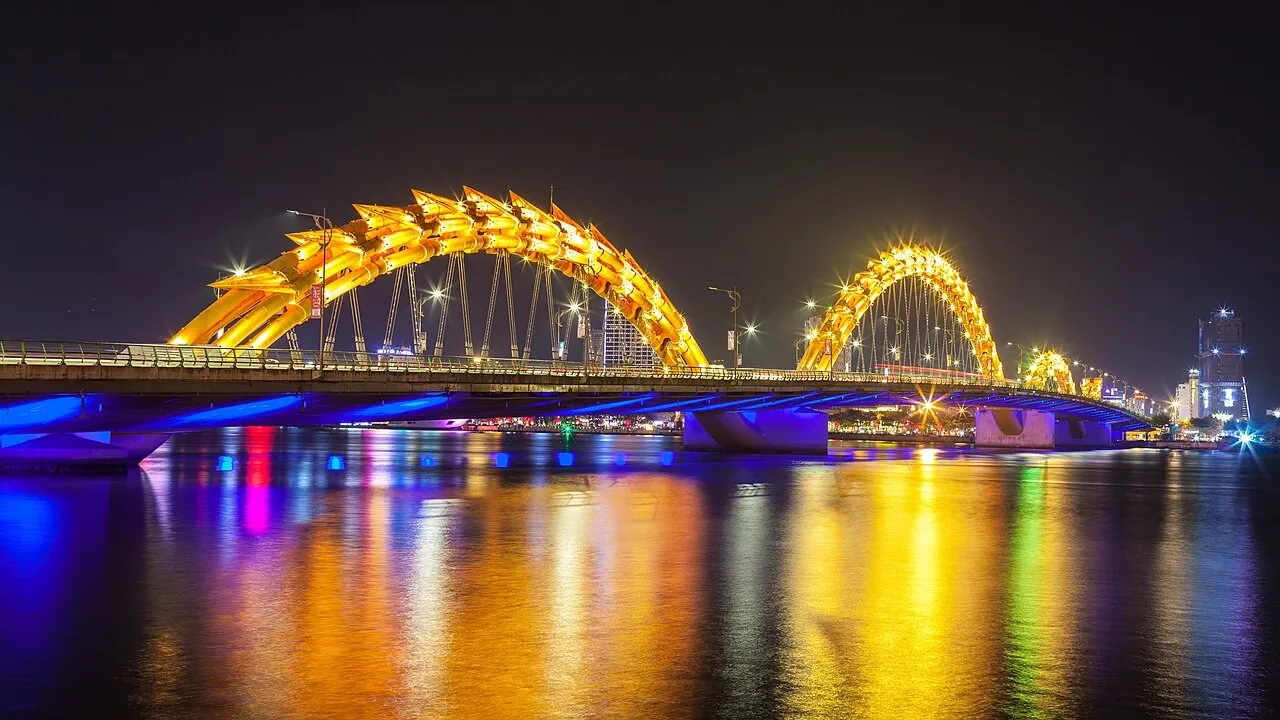
Đà Nẵng’s civic showpiece is the Hàn River and the bridges over it. Cầu Rồng, the Dragon Bridge, is 666 m of steel dragon that breathes fire and then sprays water at 21:00 on Fridays, Saturdays and Sundays with extra nights added in high season. Confirm the night with your hotel; the schedule moves.
It is twenty minutes and it is free. Stand on the eastern bank near the dragon’s head, and accept that the water phase soaks the front rows, deliberately. Cầu Rồng, the Dragon Bridge
The Bạch Đằng riverside promenade on the west bank is the pleasant end of the city after dark, and the Sông Hàn swing bridge downstream still rotates in the small hours to let boats through. Our piece on the bridge and the show covers timings and where to stand.
Sơn Trà and the Lady Buddha
Sơn Trà is the forested peninsula on the city’s northeast shoulder, and it is the best half-day Đà Nẵng owns outright. The road climbs through canopy that still holds red-shanked douc langurs, a genuinely endangered primate you have a real chance of seeing in the early morning.
Linh Ứng pagoda on its western slope holds the 67 m standing Quan Âm, the tallest such figure in Vietnam, on a lotus base facing the sea. Entry is free. It is also the single most coach-visited spot in the city, so go before 08:00 or after 16:00. Linh Ứng pagoda
Two warnings. The upper roads are steep, narrow and periodically restricted to certain vehicles, so check before hiring anything. And riding without a licence Vietnam recognises voids your travel insurance. Details in the peninsula write-up and in the pagoda piece.
The Cham Museum, and why to see it before Mỹ Sơn
The Museum of Cham Sculpture is the one unarguable sight in Đà Nẵng and most itineraries skip it. Entry is 60,000₫ adult, 10,000₫ children and students, audio guide about 20,000₫ extra, open daily roughly 07:00–17:30. Tickets are sold at the gate booth only, cash or a domestic-bank QR, so bring notes.
Sixty to ninety minutes covers it: the largest collection of Champa sculpture anywhere, in a 1915 French pavilion built for it. Museum of Cham Sculpture
Here is the argument that matters. A great deal of what is in these rooms was physically removed from Mỹ Sơn. Go to the temples first and you walk past empty brick chambers and bare plinths without understanding what is missing. Go to the museum first and the plinths become legible: you have already seen the Trà Kiệu altar, the dancing apsaras, the Shiva heads that used to sit in them.
It also fixes the chronology. Champa was a Hindu and later partly Islamic polity that held this coast for over a thousand years before the Vietnamese pushed south, and nothing at Mỹ Sơn explains that on site. Our museum walkthrough suggests an order for the galleries; the sanctuary itself is covered in the day-trip section further down.
What is actually worth your time
| Sight | Cost (checked July 2026) | Time | Verdict |
|---|---|---|---|
| Museum of Cham Sculpture | 60,000₫ adult / 10,000₫ student, cash or domestic QR | 60–90 min | The one thing that is genuinely unmissable. Do it before Mỹ Sơn |
| Mỹ Khê and the beach road | Free; sunbed hire extra | Half a day | The reason to stay in this city rather than day-trip it |
| Sơn Trà and Linh Ứng | Free; transport 200,000–400,000₫ return | Half a day | Strong, if you go early. Dreadful at 11:00 with the coaches |
| Dragon Bridge fire and water | Free | 20 min | Worth planning a weekend evening around, not a whole trip |
| Ngũ Hành Sơn, the Marble Mountains | 40,000₫ entry, lift 15,000₫ one way / 30,000₫ return, Âm Phủ cave 20,000₫ at a separate entrance. Cash ₫ only, realistically 75,000–90,000₫ all in | 2–3 hours | Good caves, pushy marble showrooms at the base selling largely imported stone |
| Chợ Hàn market | Free to enter | 45 min | Fine for an hour |
| Bà Nà Hills and the Golden Bridge | 1,000,000₫ adult from 1 January 2026 | Full day | A day trip, not a city sight. Handled separately below |
That is a shorter list than the city’s marketing suggests, and the shortness is the point. Our list of things to do in the city goes wider, and there is a ready-made two- and three-day plan if you want the sequencing done for you.
Rain, and the theme-park layer
From September to December you will lose days. The undercover options that hold up are the Cham Museum, the Marble Mountain caves, Chợ Hàn, a cooking class and a long massage. Our wet-weather options go further.
Then there is the family layer, described here without the enthusiasm it has not earned. Mikazuki, on the northern beach road, is a Japanese-run resort with an indoor and outdoor water park and hot baths, and the indoor half is the genuine wet-day answer if you are travelling with children.
Núi Thần Tài is a hot-springs and water park roughly 30 km west, on the road out towards Bà Nà, usually sold as a full day with transport included. Both change their pricing frequently, so buy from the operator’s own site rather than a Facebook page and check the current rate on the day. See the Mikazuki water park and the Núi Thần Tài springs for what each actually contains.
DIFF, and what it does to room rates
The Đà Nẵng International Fireworks Festival is a multi-week competition on the Hàn River, and it is the one calendar event that should change how you book. The 2026 edition ran 30 May to 11 July, ten teams from nine countries, six competition nights, two teams a night from 20:00. The 2027 dates were unannounced at the time of writing.
The pattern is stable even when the dates are not: a run from late May or early June to early or mid-July, roughly weekly Saturday competition nights, and a gap before the final. The price effect is sharp and narrow.
| What you book | Effect during DIFF | Lead time |
|---|---|---|
| Riverside room, Hàn River | Roughly double the same room’s May rate | 4–6 weeks minimum |
| Riverside room with a Dragon Bridge view | Sells out entirely on peak nights | 2–3 months |
| Anything left citywide at 2–4 weeks out | 30–50% above normal | Book earlier or move |
| Beach side or Hội An | Largely unaffected. The premium is concentrated on the river | Normal |
If fireworks are not the point of your trip, stay on the beach and let the river charge whatever it likes. If they are, the festival write-up has the grandstand and free-viewing detail.
Where to sleep, and the one lever that matters
Đà Nẵng has the widest accommodation spread of any Vietnamese city. That is a real advantage, and it makes booking-aggregator averages close to meaningless: they blend beachfront five-stars with a large low-star inventory well back from the water.
| Band | Per room per night | What you get |
|---|---|---|
| Hostel dorm | US$8–14 | Mostly in An Thượng and near the beach road. Fine standard, noisy |
| Budget guesthouse | US$18–30 | Inland streets, a 10-minute walk from sand |
| 3-star | US$35–65 | Pool on the roof, breakfast, no view worth the name |
| 4-star or boutique | US$65–120 | The value sweet spot, and where the inland lever bites hardest |
| 5-star beachfront | US$140–280 | Direct sand access, which is what the money buys |
| Ultra-luxury | US$280–500+ | The resort strip south towards Ngũ Hành Sơn |
The single biggest lever any reader has in this city: a four-star two blocks inland can be half the price of the identical standard on the Mỹ Khê beachfront. You give up the balcony view and a three-minute walk. Nothing else changes, including the pool.
Our neighbourhood-by-neighbourhood accommodation breakdown sets out which streets are worth the premium.
The honest case against Đà Nẵng
- No historic core. If your image of Vietnam is tiled shophouses and lanterns, this city will read as any prosperous mid-sized Asian seafront. That image is available 30 km away.
- The beachfront is a wall. Continuous high-rise along Võ Nguyên Giáp, and it has been built to the sand rather than set back from it.
- The domestic summer crowd is real. June to mid-August the beaches fill with Vietnamese families, prices firm up and the restaurants queue.
- Two-price economics. Mì Quảng is 35,000–50,000₫ in a local shop and 80,000–120,000₫ in a tourist-facing one on the same street.
- October and November swimming is unreliable. Frequently flagged off at Mỹ Khê for rip currents, which removes the city’s main asset for two months.
None of that stops Đà Nẵng being the correct base for most first trips to the centre. It is the only city here with an international airport, the widest range of beds, and a road network that puts Hội An, the Marble Mountains, Bà Nà and the Hải Vân within an hour or so. Our regional transport notes cover the mechanics.
8. Hội An: the prettiest town in Vietnam, and the caveats
Hội An deserves its reputation and is also the most crowded, most commercialised and most misreported place in central Vietnam. A few hundred metres of intact merchant town, silk lanterns over the Thu Bồn, and a tailoring trade that can genuinely produce a suit worth owning. It is also the dearest of the three cities at midrange level and the one where you are most likely to be sold something invented in the last twenty years as tradition.
The Old Town ticket, correctly
This is the single most misreported item in central Vietnam, so it is worth being exact. The Hội An Ancient Town ticket is 120,000₫ for an adult and 50,000₫ for a child between 1.0 and 1.4 m tall, free below 1.0 m. The electric buggy is a separate 10,000₫ per ride.
What you buy is not an entry fee. It is a strip of five tear-off coupons, nominally valid 24 hours, redeemable at a roster of about 22 eligible heritage sites. Coupons are torn at the door of each building by staff, one per site, and when the five are gone they are gone.
It is not a turnstile fee to walk into the Old Town. In April 2023 the town announced that every visitor would have to buy one at the gates; the backlash was immediate and the mandate was scrapped. The standing policy since is that organised tour groups must hold tickets while individuals and families are encouraged but not compelled.
There are around eleven yellow booths at the walking-street entrances and the sellers there will ask. You may say no. Street-level enforcement skews to weekday mornings, when the coaches arrive; evenings and weekends are barely checked at all.
| Your visit | Buy a ticket? | Why |
|---|---|---|
| Two or more heritage houses or assembly halls | Yes, clearly | Five coupons for 120,000₫ works out at 24,000₫ a site. Nothing else in Vietnam is priced like that |
| Lanterns, the river, food and shopping only | You can honestly skip it | None of that is ticketed, and nobody will stop you walking the streets |
| Arriving on an organised group tour | Yes, and usually already included | Groups are required to hold tickets. Check whether your operator has bought them |
| Staying several nights and coming and going | Buy on the day you do the houses | The 24-hour validity is nominal and loosely applied, but do not plan around stretching it |
One point in the ticket’s favour before you decide to dodge it: the money funds conservation of 1,360 listed relics in a town that floods several times a year. A hundred and twenty thousand đồng is under US$5 at 26,000₫ to the dollar.
What the five coupons are actually best spent on
| Category | Examples | Time | Worth a coupon? |
|---|---|---|---|
| Merchant houses | The old family homes on Nguyễn Thái Học and Trần Phú, several still lived in by descendants | 15–20 min each | Yes. One or two, not four. They repeat |
| Chinese assembly halls | The Fujian hall is the grandest; Cantonese, Chaozhou and Hainan halls nearby | 15–25 min | Yes, one. The Fujian hall if you only do one |
| Japanese Covered Bridge | The town’s emblem, restored and reopened after a major 2022–2024 intervention | 10 min | Yes, on principle. It is small and it is busy |
| Small museums | Trade ceramics, folk culture, Sa Huỳnh culture | 20–30 min | Only the ceramics one, and only if the trading history interests you |
| Handicraft workshop and bài chòi | Scheduled performance and craft demonstrations | 30–40 min | Yes if the timing suits. Bài chòi is UNESCO-listed and genuinely local |
A sensible five: one merchant house, the Fujian assembly hall, the bridge, the ceramics museum and the bài chòi performance. That is a solid three hours and covers the categories rather than repeating one. Our town coverage and the one- and two-day plans sequence it against the light.
The vehicle ban, and what it does to your arrival
Cars are permanently banned from the Old Town core. During pedestrian hours it is walking, bicycles and cyclos only, and the evening block is absolute.
The hours themselves are reported inconsistently. One set of sources gives 09:00–21:30 in summer and 09:00–21:00 in winter, with Phan Châu Trinh restricted 17:30–21:30; another describes roughly 15:00–21:30. The sources conflict, and this page is not going to pretend otherwise. What they agree on is the evening.
The practical consequence catches people out constantly. Your Grab, taxi or pre-booked transfer cannot deliver you to a hotel inside the core during those hours. You are dropped at the edge of the pedestrian zone and you walk in with your luggage over uneven paving.
Book with that in mind. Either choose a hotel outside the core, or time your arrival outside the blocked hours, or accept the walk and pack accordingly. The Đà Nẵng to Hội An transfer options are worth reading before you book a late flight, since a Grab car from the airport runs 250,000–350,000₫ over 30–45 minutes and drops you at the same barrier as everyone else. Hội An Old Town
The lantern night
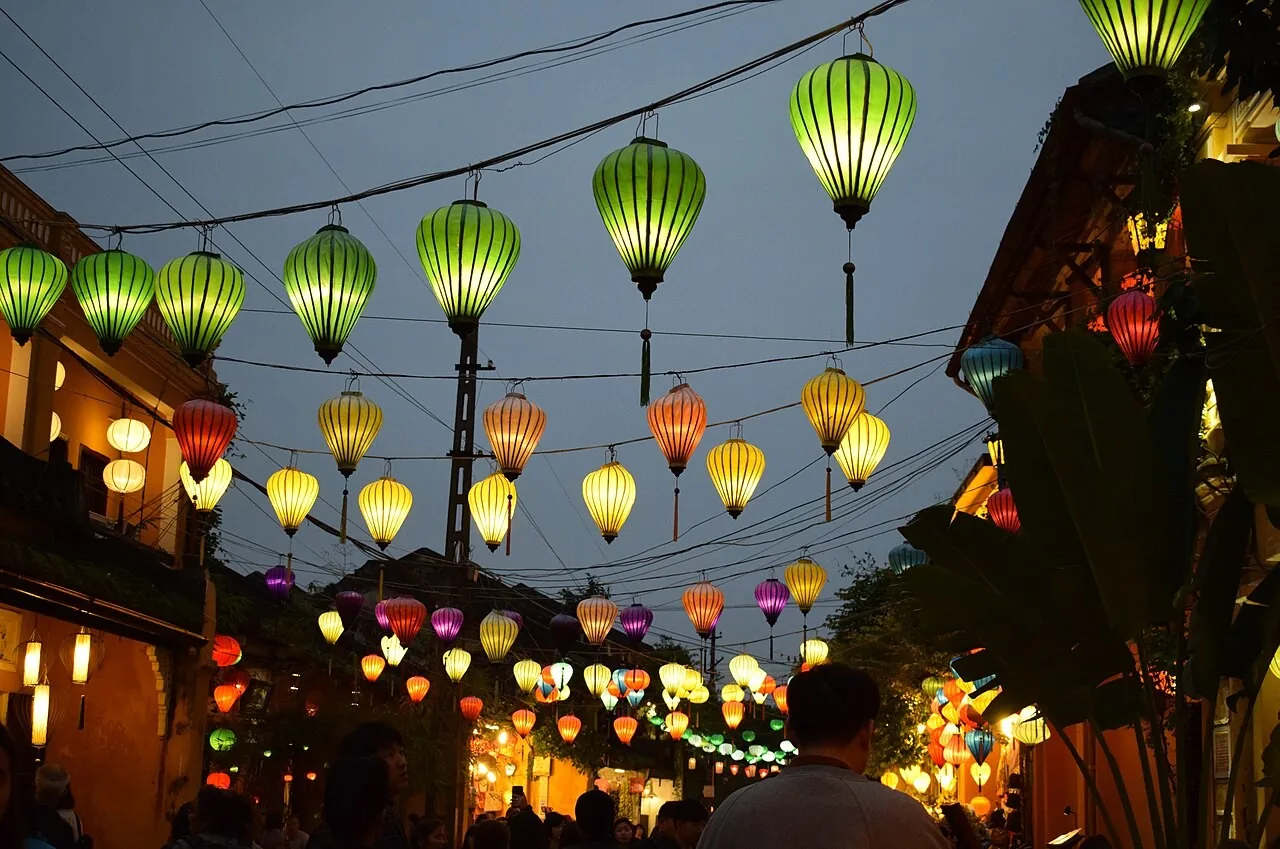
The full-moon lantern night falls on the 14th day of each lunar month, which gives 12 or 13 nights a Gregorian year. From about 17:30 motorbikes are pushed out of the core. From about 18:00 to 22:00 the electric street lighting is deliberately switched off and the streets run on silk lanterns alone.
Peak is 19:00 to 21:30, with hoa đăng candle floats going onto the Thu Bồn, bài chòi being sung and street chess played on the riverbank. It is the best the town looks and it is also the most crowded it gets.
| Remaining 2026 dates | Falls on | Note |
|---|---|---|
| 27 July 2026 | Monday | Peak dry season, hot, reliable |
| 26 August 2026 | Wednesday | Last of the confident-weather nights |
| 24 September 2026 | Thursday | Mid-Autumn. The biggest domestic turnout of the second half of the year, and September rain has already started |
| 23 October 2026 | Friday | Inside flood season. Cancelled or curtailed on high water |
| 22 November 2026 | Sunday | Inside flood season. Same caveat |
| 22 December 2026 | Tuesday | Wet and cool, but the flood peak has usually passed |
Earlier 2026 nights ran 2 January, 1 February, 2 March, 1 April, 30 April, 30 May and 28 June, with 2 March the largest as the first full moon of the lunar year. Dates occasionally shift by a day, so confirm with your hotel in the week you arrive rather than booking flights around a table on the internet, including this one. There is more in the lantern festival write-up.
The lantern boat, and the two frictions
The posted rate is 170,000₫ per boat for one to three people and 220,000₫ for four to five. Per boat, not per person. That is the number touts blur, and the difference on a family of four is not trivial. Paper floats are 5,000–10,000₫ each and the ride is about 20 minutes, boarding near the An Hội bridge.
Two frictions are reported often enough to warrant a warning. The first is a spurious “ticket” of around 30,000₫ sold at the counter that gets you nothing. The second is hard tip pressure at the end of the ride, sometimes with the boat held at the steps. From 2026 a 100,000₫ per-guest surcharge also applies on designated holiday dates, which is legitimate.
Agree the price before you step in, in đồng, and repeat the number. That single habit removes most of the friction in this town.
Tailoring, honestly costed
Hội An’s tailoring is real, and it is also the most oversold thing in Vietnam. There are hundreds of shops and a very wide quality range hiding behind identical window displays.
| Spend | What it buys | Turnaround |
|---|---|---|
| From ~US$149 | Entry-level advertised price. Expect basic cloth and a garment that photographs better than it wears | Often 24 hours, which is the problem |
| US$150–400 | A genuine custom two-piece from a competent shop | 2–3 days, two fittings |
| US$350–600 | Something that stands comparison with Western bespoke | 2–3 days minimum, sometimes more |
| Three-piece | More, for the extra cloth and work rather than any change in skill | As above |
Fabric is the dominant variable, not labour. That is the fact that explains the whole price ladder, and it is why a “100% cashmere” claim at the bottom of the range deserves scepticism you would apply anywhere else.
Twenty-four-hour turnarounds exist and they are how most disappointing suits get made. Two to three days with two fittings is what produces a garment you will actually wear at home. Build that into your nights here rather than treating it as an errand on the last afternoon. Our tailoring notes cover how to judge a shop and what to bring.
Beaches, bicycles and sleeping outside the core
Hội An has two beaches and a bicycle culture, and both are underused by visitors who never leave the lantern streets. An Bàng is the livelier one, with beach bars and a scruffy charm; Cửa Đại has suffered serious erosion and is now heavily engineered, with sections behind sandbag revetments.
The bicycle is the correct vehicle here. The town is flat, compact and closed to cars, the ride out to An Bàng is about four kilometres of rice field and lane, and most hotels lend bikes free. An Bàng beach
That geography creates the money decision. Sleeping in the rice fields or at the beach rather than inside the Ancient Town saves 20–30% on the same standard of room, and gives you quiet, a pool with space around it and a ten-minute cycle in. What you lose is the ability to walk home at midnight. See the beach comparison and what there is to do beyond the Old Town.
What a bed costs
| Band | Per room per night | Note |
|---|---|---|
| Hostels | From ~US$7 | Concentrated north and west of the core |
| Midrange average | ~US$25, high season ~US$47 | The high-season figure is the one to plan on for Feb–Apr and Jun–Aug |
| 3-star | ~US$32 | Usually a pool, usually a free bicycle |
| 4-star | ~US$54 | Dearer than the Đà Nẵng equivalent inland |
| Five-star beach resorts | ~US$370 average | The Cửa Đại and An Bàng strip. Honeymoon pricing |
Hội An is the most expensive of the three cities at midrange level, and the reason is structural rather than greedy. Supply is squeezed against a small protected town and a short beach strip, the town is a multi-night rather than a one-night stop, and it carries heavy honeymoon demand. Add 15–30% for Tết, the 30 April week and Christmas.
Book refundable rates for anything between September and December, and choose by elevation rather than by charm. The riverside streets are the ones that go under. Where to stay in Hội An breaks the town into zones.
The honest case against Hội An
- The crowds. Between about 16:00 and 21:00 the core is shoulder to shoulder in high season, and the coach groups own the mornings. The town is genuinely lovely at 06:30 and at 22:30, and difficult in between.
- Retail sameness. Tailors, lantern shops, leather, the same six souvenir lines repeated down every street. After two days the shopfronts blur.
- Invented tradition. A good deal of what is sold as ancient here is a commercial layer laid down since the UNESCO listing in 1999. The buildings are old. The lantern-and-tailor economy around them is not.
- Flooding. Bạch Đằng, the riverfront, goes under first, then Nguyễn Thái Học and Phan Bội Châu. Residents put it at three or four times a year, which is a figure from local press rather than a hydrological dataset.
- Price. You pay Hội An rates for a bed and tourist-strip rates for food unless you deliberately walk away from the river.
Take all of it and the town still earns its reputation. Nowhere else in Vietnam has this much intact eighteenth and nineteenth-century trading architecture in one walkable piece. Pair it with the Cham sanctuary inland and the islands offshore, eat well using the local dish list, and consider a cooking class as the wet-day fallback, since those are the first things cancelled when the river rises.
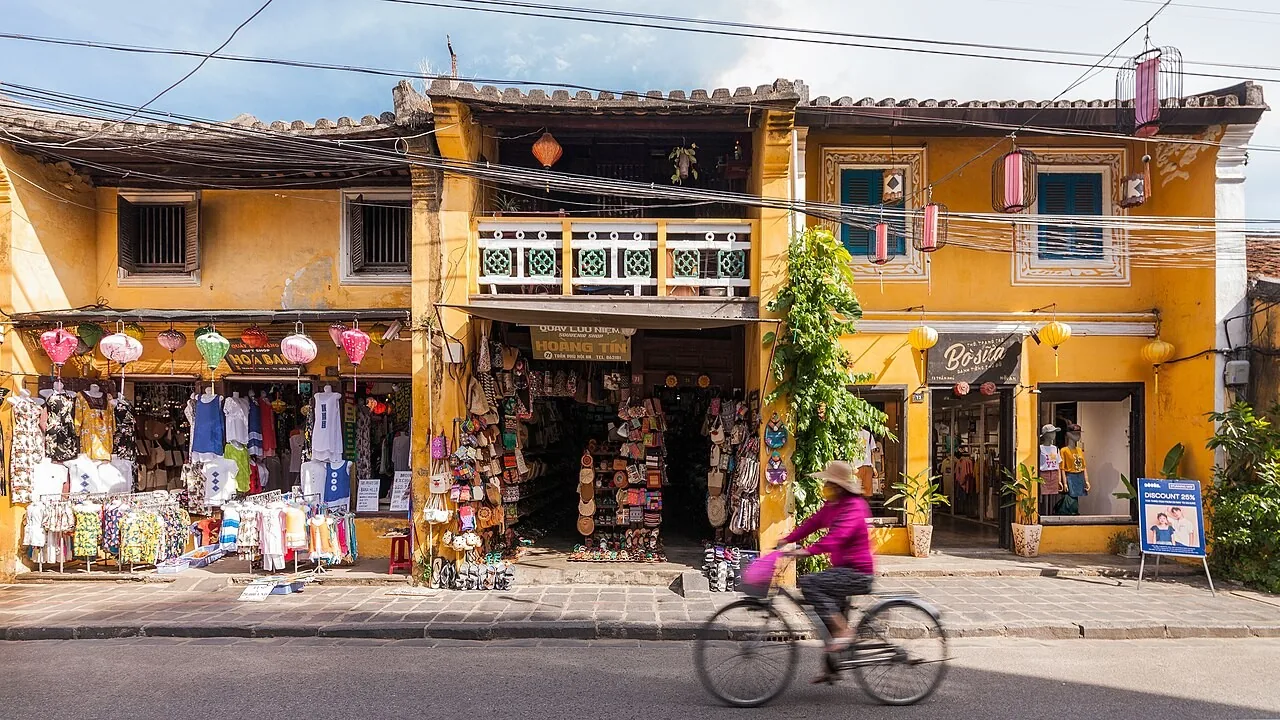
9. Huế: the city people skip, and why that is usually a mistake
Huế is the only place in Vietnam where you can see what the country’s own imperial court looked like. It is also the cheapest major UNESCO city in Vietnam and the one Anglophone visitors most often have never heard of. The catch is meteorological rather than cultural: Huế is wetter and greyer than Đà Nẵng in every month of the wet season, which is the honest reason a two-night leg here sometimes disappoints.
The Imperial Citadel
Đại Nội, the walled palace complex on the north bank of the Perfume River, costs 200,000₫ for an adult and 40,000₫ for a child aged 7 to 12, free under 7. The price is identical for foreigners and Vietnamese nationals. Any blog quoting a separate foreigner rate is out of date, and several still do.
Opening hours are reported inconsistently, at 06:30–17:30 in some places and 07:00–18:00 with the ticket window shutting at 17:30 in others. The safe instruction is to arrive by 16:30. Budget two and a half to three hours as a minimum and understand that there is very little shade inside those walls.
| Inside the walls | What it is | Why it matters |
|---|---|---|
| Ngọ Môn | The south gate and its pavilion | The ceremonial front door of the Nguyễn dynasty, and where the last emperor abdicated in 1945 |
| Thái Hoà palace | The throne hall | Recently reopened after major restoration. Lacquer, red columns, the throne itself |
| The Royal Theatre | Duyệt Thị Đường | Short performances of nhã nhạc court music, which is UNESCO-listed in its own right |
| Tô Miếu complex | The dynastic temple enclosure | Holds the Nine Dynastic Urns, cast in the 1830s. The single most impressive object group on the site |
| Kiến Trung palace | Restored and reopened | The strange French-Vietnamese hybrid the late dynasty built for itself |
Much of the enclosure is still ruin and open ground, because the Citadel was fought through in 1968 and the reconstruction is a decades-long project. That is worth knowing before you go, because a visitor expecting Beijing’s Forbidden City will find something more fragmentary and more moving. Đại Nội, the Imperial Citadel
The tombs, with the arithmetic printed
The Nguyễn emperors built themselves elaborate tomb-parks outside the city, and they are the other half of what Huế is for. They sit 7 to 16 km out in three different directions, so transport is a genuine additional cost on top of the tickets, whether that is a Grab car, a driver for the day or a boat.
| Site | Adult | Child 7–12 | Roughly |
|---|---|---|---|
| Khải Định | 150,000₫ | 30,000₫ | 10 km south. Concrete outside, extraordinary mosaic inside |
| Tự Đức | 150,000₫ | 30,000₫ | 7 km. The largest and greenest complex, pine and lake |
| Minh Mạng | 150,000₫ | 30,000₫ | 12 km. The most formally classical layout |
| Gia Long | 150,000₫ | Free | 16 km and remote. Half-empty even in season |
| Đồng Khánh | 100,000₫ | — | Small, close to Tự Đức |
| Minor monuments | 50,000₫ | — | Thiệu Trị, Hòn Chén, An Định palace, Nam Giao, Hổ Quyền, the Royal Antiquities Museum |
Combination tickets exist and are valid two days. Any two sites cost 200,000–240,000₫, any three cost 420,000₫, and the four-site route of Citadel plus Minh Mạng plus Tự Đức plus Khải Định costs 530,000₫ adult and 100,000₫ child. The child rate on the three-site combo is reported at both 80,000₫ and 30,000₫; sources disagree, so ask at the window rather than budgeting for the lower one.
| What you want to see | Bought singly | Best combo | Verdict |
|---|---|---|---|
| Citadel + Khải Định | 350,000₫ | None applies | Buy the two singles. No combo beats this, and it is the honest minimum for a one-day visit |
| Citadel + two tombs | 500,000₫ | 420,000₫ | Saves 80,000₫. Worth it if you were going anyway |
| Citadel + three tombs | 650,000₫ | 530,000₫ | Saves 120,000₫, about US$4.60. The best headline discount and the hardest day |
The verdict most visitors need: Citadel plus Khải Định, 350,000₫, and no combination ticket improves on it. Khải Định is the tomb nobody regrets, because its interior is a wall-to-wall ceramic and glass mosaic unlike anything else in the country, and it is compact enough to see properly in an hour. the tomb of Khải Định
Three tombs in one day, in Huế’s heat, spread across three directions, is more than most people actually want. The combo saves money you will pay back in exhaustion. Our Huế coverage sets out a sensible route for one full day.
The Perfume River
Dragon boats leave from the Toà Khâm wharf at 49 Lê Lợi. The Thiên Mụ run is 250,000₫ for a single boat and 400,000₫ for a double; a fishing-village circuit is 200,000₫ and 300,000₫; Hòn Chén plus Thiên Mụ is 350,000₫ and 750,000₫. A ca Huế folk performance on the water starts at about 150,000₫ a head.
The touting problem here is documented and specific. Arrivals at the wharf are steered towards sellers quoting as much as 800,000₫ for what the official counter sells at around 250,000₫. Buy at the counter at 49 Lê Lợi and walk past anyone who approaches you on the approach road. Toà Khâm wharf, 49 Lê Lợi
Cyclos, and the thing almost no English source mentions
A cyclo in Huế is sightseeing, not transport. The posted rates are reasonable and the overcharging pattern is consistent: no price agreed at the start, then a higher number at the end. Agree the fare, write the number down, and hand it over in đồng.
| Duration | Posted rate | Street haggling |
|---|---|---|
| 30 minutes | 80,000₫ | 100,000–300,000₫ depending entirely on how the conversation starts |
| 45 minutes | 120,000₫ | |
| 1 hour | 150,000₫ | |
| 90 minutes | 180,000₫ | |
| 2 hours | 200,000₫ |
The genuinely new development: Grab Cyclo, Grab Xích Lô, launched in Huế on 20 August 2025, the first service of its kind in Vietnam, under a three-year agreement with the city. It started with four pick-up points near the Citadel and the Toà Khâm wharf, takes one passenger, and covers rides of up to 60 minutes.
The point is not novelty. It is that the fare is set in the app before you get in, which removes the exact friction that has made Huế cyclos a complaint magnet for twenty years. Almost no English-language source has caught up with it.
What Huế eats, briefly
Huế has the strongest regional cuisine in the country and it gets its own section further down, so two lines here. Bún bò Huế is the export, and it is spicier and beefier at home than anywhere it has travelled. The royal small-plate tradition, dozens of tiny dishes descended from court service, is the thing you cannot easily eat elsewhere, and the chè stalls on the south bank are worth a stop after dark.
Huế Festival, corrected
Almost every English guide still describes Huế Festival as biennial, held in even years. That was true from 2000 to 2020 and it has not been true since 2022.
Since then Huế has run a year-round Four Seasons Festival model, roughly eighty events spread across the calendar, with a concentrated International Arts Festival Week inside it. In 2026 that week fell 13–18 June. The practical advice is the opposite of the usual: do not time your trip around the festival, because something is usually on. Check the current programme when you book.
Why Huế is cheap
| Band | Per room per night | In đồng |
|---|---|---|
| Budget | ~US$12 | roughly 200,000–500,000₫ |
| Midrange | ~US$22, high season ~US$41 | roughly 600,000–1,200,000₫ |
| “Luxury” | Averaging only ~US$40 | The quotation marks are doing work |
The reason is structural. Huế is largely a one-night stop between Đà Nẵng and the north, so hotels compete on price for a transient market that will not stay a second night regardless of what they do. There is no beach resort inventory to lift the top end, which is why the “luxury” average sits where a midrange room sits in Hội An.
A whole midrange day here runs US$55–100 against US$85–150 in Hội An and US$95–165 in Đà Nẵng. That gap is the single strongest practical argument for giving Huế two nights rather than a rushed day trip: the extra night costs less than the day trip’s private car.
The weather truth
Here is the honest reason a Huế leg sometimes goes wrong, and no amount of enthusiasm about the Citadel gets around it. Huế takes 2,800 mm of rain a year against Đà Nẵng’s 2,155 mm, over 168 rain days against 139, at essentially the same latitude a hundred kilometres away.
| Month | Huế: mm / rain days / sun h | Đà Nẵng: mm / rain days / sun h |
|---|---|---|
| September | 395 / 17 / 6.0 | 310 / 14 / 6.0 |
| October | 755 / 21 / 4.5 | 650 / 20 / 4.5 |
| November | 620 / 22 / 3.5 | 430 / 20 / 4.0 |
| December | 310 / 20 / 2.5 | 215 / 18 / 3.5 |
| Year | 2,800 / 168 / 5.4 | 2,155 / 139 / 6.0 |
More water and more rain days in every month of the wet season, level on sunshine in September and October and behind it in November and December. December is the number that should stop you: 310 mm falling across 20 days on two and a half hours of sun a day. That is not a shower between sights. That is the whole day.
The flip side is worth stating, because it corrects a claim that circulates in the other direction. February and March in Huế carry 12 and 10 rain days respectively, more than July’s 8. But July carries more water, 90 mm against February’s 65 mm, because winter rain here is all-day drizzle and July rain is short and heavy. Name the city and separate rain days from rain volume, or the comparison is meaningless: in Đà Nẵng, February and March have 6 and 4 rain days against July’s 9, so the same claim is simply false.
The mechanism is the Trường Sơn range, which is also why the Hải Vân works as a visible weather wall: the same ridge routinely separates a grey Huế from a sunny Đà Nẵng on the same afternoon. Build an indoor fallback into any Huế day between September and January. Our seasonal breakdown covers the whole year.
One correction to the flood picture, since Huế is usually lumped in with Hội An. Huế’s tourist core sits higher relative to its river than Hội An’s does; it floods its suburbs, riverbanks and outlying tomb complexes hard, but the Citadel is less often under water. In the severe 2025 season Huế reopened its Citadel and tombs on 31 October, before Hội An’s Old Town reopened.
Getting there, briefly
The train is the point. It is 103 km and takes 2h30 to 3h15, slow for the distance because the line contours the seaward flank of the Hải Vân massif on tight curves through six tunnels rather than taking the tunnelled road. Sit on the right side going north from Đà Nẵng and the left side coming south; the sea is east of the line, and any source giving the same side for both directions is refuting itself.
Phú Bài, the city’s airport, carries the code HUI and is international in name only, with scheduled service essentially domestic. The road runs through the 6.28 km tunnel, which means buses and limousine minivans see nothing of the pass at all; if you want the pass you have to hire a car and insist on it, usually with a stop at the Lập An lagoon under the northern descent. All of that is set out properly in the Đà Nẵng to Huế rail notes and the pass write-up.
Huế is also the sensible launch point northwards. Phong Nha and its cave systems are about five hours by tourist bus or a train to Đồng Hới plus 40 km of road, and that extension needs at least two nights of its own.
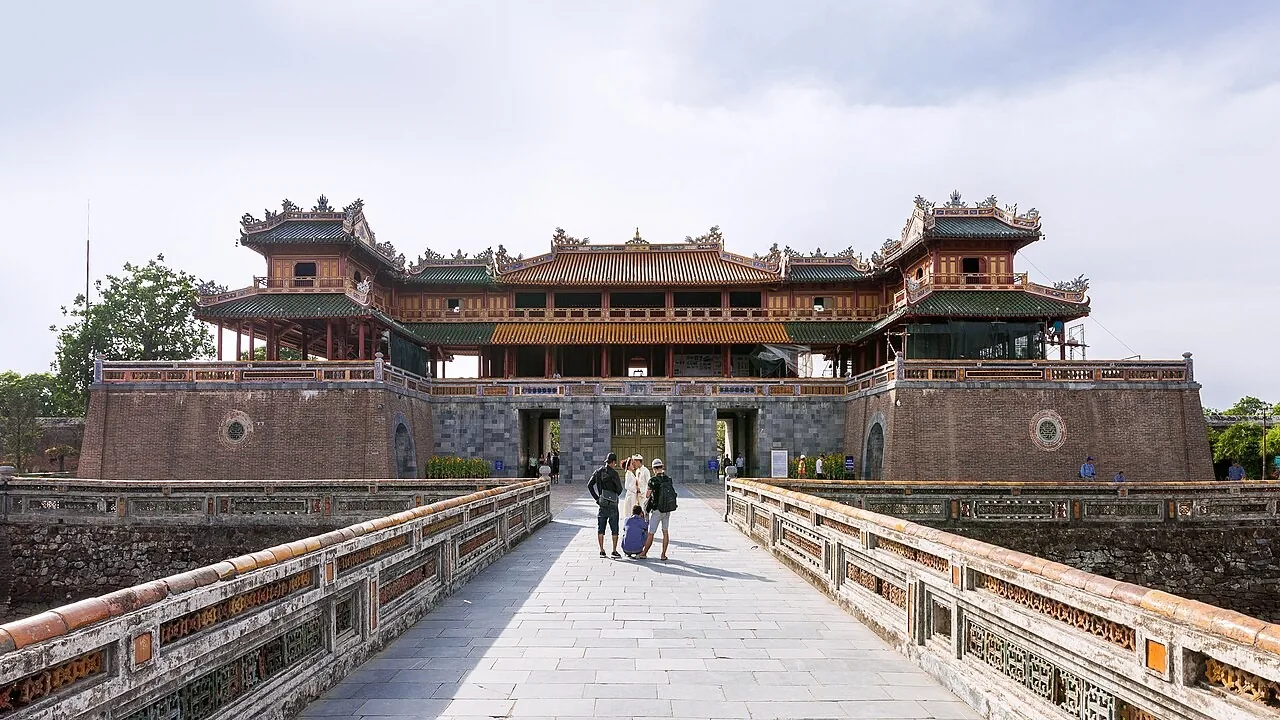
10. Beyond the triangle: passes, ruins, caves and the quiet coast
Four of these places are worth rearranging a trip for, and the rest are worth a day at most. The Hải Vân is a transfer you happen to enjoy. Mỹ Sơn is an hour from Hội An and needs three. Bà Nà costs a million đồng and a full day. Cù Lao Chàm can be cancelled the morning you go. Phong Nha, Quy Nhơn and Mang Đen are not day trips at all, and pretending otherwise is how central Vietnam itineraries fall apart.
The Hải Vân: three crossings, and most advice confuses them
The mountain is crossed three separate ways, and mixing up their numbers is the root of most bad Hải Vân advice.
| Crossing | What it is | What you see |
|---|---|---|
| Road pass (old Highway 1) | About 20–21 km of switchbacks, summit around 496–500 m, the Hải Vân Gate fort at the top | The summit panorama, Đà Nẵng Bay behind and Lăng Cô ahead. You can stop, which is the point |
| Road tunnel | 6.28 km, opened 5 June 2005. Almost all through traffic uses it, coaches and limousine vans included | Tunnel lighting for eight minutes |
| Railway | A separate alignment contouring the seaward flank well below the road summit, through six tunnels (Nos. 9–14, 2,337 m total, longest about 600 m), calling at Kim Liên, Hải Vân Nam, Hải Vân, Hải Vân Bắc and Lăng Cô | Roughly 45–60 minutes of clifftop coast the road cannot reach, ending in the descent to Lăng Cô |
The train does not cross the pass: it never reaches the road summit and never passes the gate. Sources saying the railway “climbs to 496 m” are quoting the road figure. The railway’s own summit elevation is not reliably published anywhere, so this page prints no number for it and you should distrust any page that does. The road buys the summit, the rail buys the coast.
| Way over | Cost | Time | Verdict |
|---|---|---|---|
| Train, SE or heritage service | 95,000–280,000₫ by class; heritage HD service 150,000₫ single (checked July 2026) | 2h30–3h15; scenic stretch 45–60 min | Cheapest and safest, luggage no problem. You cannot stop and never see the summit |
| Private car over the pass | 1,000,000–1,500,000₫ from Đà Nẵng, 1,300,000–1,900,000₫ from Hội An, for the vehicle | 4–5 hours with stops | The only option combining summit, stops and no personal risk. Split four ways it undercuts an easy rider |
| Easy rider, riding pillion | 1,170,000–1,700,000₫ each, usually with driver, fuel, helmet, rain gear, hotel pickup and luggage moved separately | A full day | The motorbike day without the motorbike risk. Book on recent reviews and confirm the luggage arrangement |
| Self-ride | Scooter 110,000–320,000₫ a day; one-way to Huế from about 750,000₫ with baggage transfer; 150cc manual or 300–500cc 780,000–1,560,000₫ | 4–6 hours with stops | Right if you already ride, and the worst decision on this page if you do not. Licensing is dealt with under transport |
A car day is an itinerary rather than a transfer. The standard stops are the Hải Vân Gate, the Lăng Cô viewpoint, the Lập An lagoon at the northern foot of the pass, and often Elephant Springs and the Marble Mountains. Four stops is realistic in five hours; six is a slideshow.
Lập An is a mirror in late afternoon and mud and oyster racks at low tide, which the photographs never show. The seafood shacks on its western shore are the reason to stop, and Lăng Cô’s railway halt is where the heritage train pauses.
Say “đèo Hải Vân, không đi hầm” when you book, and again to the driver on the morning. Some default to the tunnel because it is faster and they are paid the same. Our breakdown of the pass goes stop by stop; the rail alternative is covered under transport.
Do not ride it between September and December. Fog forms fast at the summit, the surface goes slick, and visibility collapses in minutes while Đà Nẵng sits in sunshine below. February to May is the reliable window. A clear Đà Nẵng forecast is not a forecast for the top.
Mỹ Sơn
A valley of Cham brick towers built between roughly the fourth and thirteenth centuries. It is small, heavily bomb-damaged and nothing like Angkor: arrive expecting scale and you leave disappointed, arrive expecting a compact and un-Vietnamese piece of Hindu architecture and you do not.
| Item | Figure (2026) | Note |
|---|---|---|
| Entry, foreign visitor | 150,000₫ (~US$5.75 at 26,000₫ = US$1) | Genuine dual pricing, unlike Huế, which charges everyone the same |
| Entry, Vietnamese national | 100,000₫ | |
| Entry, child 5–15 | 30,000₫; under 5 free | |
| Included | Buggy from the gate, the Cham exhibition, the scheduled apsara dance | Without the buggy the walk in is about 2 km |
| Hours | 05:00–17:00 | The early opening is not a gimmick |
From Hội An it is about 40 km and an hour, from Đà Nẵng about 60 km and 1h15–1h30. A shared shuttle from Đà Nẵng and back is around 350,000₫, or 450,000₫ via Hội An; a private half-day car from Hội An 700,000–1,200,000₫. Read the small print: many day tours quote a headline price excluding the 150,000₫, collected at the gate.
The sunrise slot exists to beat the heat and the coaches, and here that is fact rather than sales copy: the valley traps heat, there is no shade, and by 10:00 in summer it is genuinely unpleasant. The trade is that a 05:30 arrival misses the dance.
The strongest sequencing tip on this page is not about timing: see the Cham sculpture collection in Đà Nẵng first, 60,000₫ for an hour. It holds the statuary removed from these temples, and it turns the empty plinths at the sanctuary from blanks into absences. Skip Mỹ Sơn if your trip is three days and beach-shaped, or if you have one spare day in the wet season: these tours are among the first cancelled when the rivers rise.
Bà Nà Hills and the Golden Bridge
A French hill station rebuilt as a mountaintop theme park, reached by cable car, with a 150-metre walkway held up by two enormous stone hands. It is the most photographed thing in central Vietnam, and worth naming plainly: a theme park attached to a viewpoint, not a nature excursion.
| Tier | Price from 1 January 2026 | Applies to |
|---|---|---|
| Adult standard | 1,000,000₫ (~US$38.50) | All international visitors. Anyone over 1.40 m pays this regardless of age |
| Child 1.00–1.39 m | 800,000₫ | Under 1.00 m free |
| Senior 70+ | 800,000₫ | |
| Đà Nẵng resident with ID | 650,000₫ adult / 550,000₫ child and senior | Roughly 35% off, and since the 2025 merger this now includes Hội An residents |
The change nothing older mentions: since 1 January 2026 the ticket is valid 72 hours across three consecutive days, with unlimited cable-car rides. That turns a one-shot million-đồng day into a pass worth spreading over two visits if you are based nearby, which is also the only sane answer to a summit frequently in cloud. Go up, get fogged out, come back next morning free. The 900,000₫ figure still printed on pages date-stamped 2026 is the stale pre-2026 fare.
Bundled: the round-trip cable car, the bridge, the French Village, Fantasy Park, the funicular, Moon Castle, the Sun God waterfall, the gardens, and a voucher for a beer or a fast-food item. Not bundled: meals, the wax museum, the wine cellar, several coin-op attractions. Base-station queues run one to two hours at weekends and on Vietnamese public holidays, which is why a promotion exists for riders going up before 08:00. Take it.
It is 25–35 km west of Đà Nẵng, 45–60 minutes from the centre and 75–90 from Hội An; shuttles run from central pick-up points for ticket holders, and a car or Grab is 400,000–700,000₫ each way. If the summit has vanished at breakfast, the substitute half-day is the hot-spring park in the same hills. Skip Bà Nà if crowds ruin your day: that ticket is a whole midrange day’s budget. See the resort write-up and the bridge itself.
The Marble Mountains (Ngũ Hành Sơn)
Five outcrops rising out of the coastal plain between the two cities, with pagodas, caves and viewpoints inside the largest. Two to three hours, and best built into a transfer.
| Ticket | Price | What it buys |
|---|---|---|
| Thuỷ Sơn entry | 40,000₫ (students 10,000₫) | The summit complex: pagodas, the Huyền Không and Tàng Chơn caves, the viewpoints |
| Lift | 15,000₫ one way / 30,000₫ return | Replaces the first climb only; stairs and uneven cave floors continue above it |
| Âm Phủ cave | 20,000₫ (students 7,000₫) | A separate gate down the road. Your Thuỷ Sơn ticket buys nothing here |
| Realistic all-in | 75,000–90,000₫ per adult | Cash ₫ only at every booth |
The common error is quoting the 40,000₫ as “the price of the Marble Mountains”, which leaves readers at a second booth with the wrong money. The free eastern staircase of 150-plus steps is a genuine option; plenty ride up and walk down. The showrooms at the base are pushy and their stone is largely imported. More in the piece on the caves.
Cù Lao Chàm
Eight islands about 15 km off Cửa Đại port, a marine protected area, and the standard beach day out of Hội An. Decent snorkelling rather than world class, and small enough for one day.
| Item | Figure | Note |
|---|---|---|
| Speedboat, same-day return | 500,000₫ per adult | Quoted as already including the 70,000₫ island entrance and 30,000₫ ecological fee |
| Speedboat, open return | 550,000₫ | Other operators quote the boat alone at 500,000–600,000₫ |
| Conservation charge | 70,000₫ + 30,000₫, or a single 100,000₫ marine conservation fee | The same money described two ways. Do not add the descriptions together |
| Crossing | 15–30 min by speedboat; 60–90 min on the cheaper wooden ferry | Departures typically 08:00, 09:00, 10:00, 13:30, 14:00 |
Bring your passport, because identity details are taken for the manifest, and leave plastic bags behind: the island’s ban is enforced.
Now the correction that matters more than any price. Suspensions are forecast-triggered, not calendrical: the port authority stops crossings whenever the wind and wave forecast crosses a safety threshold, and that happens in high summer too. On 16 July 2026, in peak dry season, services were suspended on a forecast of force 4–5 winds gusting force 6, and nearly 300 tourists, mostly foreign, were stranded until the morning of 19 July.
So the line is not “avoid October to February”, but that those months are when suspensions are most frequent and longest and that cancellation is possible in any month. Two rules follow: never put the island the day before an international flight, and treat an overnight as the risky version, because if the boats stop you are the one stuck. The island page covers the rest.
Phong Nha
Phong Nha–Kẻ Bàng is now in Quảng Trị province, not Quảng Bình, which was abolished on 1 July 2025 and which every older guide still names. It holds the largest cave passage on earth, and it is an extension rather than a day trip: two nights minimum, more for the serious expeditions.
| Route in | Cost | Time |
|---|---|---|
| Huế, tourist bus | 180,000–450,000₫ per person | About 5 hours. The standard budget answer |
| Huế, train to Đồng Hới then road | Fare plus taxi 300,000–400,000₫ or shared minibus 50,000–100,000₫ | 2h30–3h30 by rail, then 40 km |
| Huế, private car | 1,200,000–1,800,000₫ for a four-seat car | 3–4 hours |
| Đà Nẵng, road or rail | Private car 1,500,000–2,200,000₫, or the train plus the same transfer | 4–5 hours by car, 6–7 by bus, 4–5 by rail plus 40 km |
Huế is the natural staging point. There is no Đà Nẵng–Đồng Hới flight worth using: Đồng Hới airport serves Hanoi and Ho Chi Minh City, with Nha Trang added from 16 August 2026. Cave prices need ranges rather than point values, because 2026-dated sources disagree and the spread tracks which bundle and which season each page describes.
| Cave | Reported price | The catch |
|---|---|---|
| Phong Nha Cave | 150,000₫ entry, plus a dragon boat charged per boat at 750,000₫ for up to about 12 people | About 62,500₫ each in a full boat and the whole 750,000₫ alone. Ask at the wharf to join another party |
| Paradise Cave | 250,000₫ or 270,000₫, sources disagree; children 1.1–1.3 m 135,000₫; buggy 15,000₫ one way / 25,000₫ return, possibly now bundled | Covers a boardwalk through the first kilometre of a 31 km system; the deep trek is a separate tour |
| Dark Cave | Quoted at 350,000₫, or as 450,000₫ mud-bath-and-zipline / 220,000₫ lesser / 80,000₫ entry only | An activity rather than a sightseeing cave, so the number tracks the bundle |
| Tiên Sơn | 80,000₫ | Shares the same 750,000₫ boat |
| Nước Moọc, Botanic Garden | Nước Moọc 100,000₫ against a seasonal 180,000₫ Oct–Mar / 220,000₫ Apr–Sep; garden 20,000₫ against 40,000₫ | Contested. Carry more cash than the lowest figure suggests |
Above that sits Hang Én, 500,000₫ on paper but realistically only reached on a guided package of 4,000,000–6,000,000₫ over one or two days. Then Sơn Đoòng, reported at roughly 79,500,000₫ per person (about US$3,000) for four days and three nights including VAT, park entry and conservation fees. Treat that as second-hand: the operator’s own page could not be read. Oxalis is the sole licensee, permits are capped at roughly 1,000 a year, and 2026 and 2027 are sold out with 2028 open.
Season by cave, not by blanket month range. Sơn Đoòng runs January to August and not at all from September to the end of December; Hang Én runs December to mid-September; October to December brings flooding that closes systems and sometimes roads. Permits cannot absorb a weather delay, so build the buffer day here. See the Phong Nha guide.
Quy Nhơn
Quy Nhơn is now in Gia Lai province and is its administrative centre, another line older guides get wrong. A working coastal city with a long beach, Cham towers above it and a fraction of Đà Nẵng’s tourism, 281–345 km away. The distance is the part people underestimate.
| From Đà Nẵng | Cost | Time | Note |
|---|---|---|---|
| Train to Diêu Trì | From about 238,000₫ seat to about 640,000₫ sleeper | 5h10–6h, roughly five expresses a day | Trains stop at Diêu Trì, 12–15 km inland, not in the city. A common arrival shock |
| Futa coach | 210,000–320,000₫, up to 500,000₫ on premium coaches | 6–7.5 hours, about five departures | The cheap version of the same day |
| Fly | Not usable | — | Phù Cát (UIH) is 30 km north but connects only to Hanoi and Ho Chi Minh City |
Anyone selling a Đà Nẵng–Quy Nhơn day trip is selling twelve hours in a vehicle. Give it three nights or leave it out.
Mang Đen
Mang Đen sits in the Kon Plông highlands and is now in Quảng Ngãi province, Kon Tum having been abolished in the same reform. Pine forest, waterfalls, cool nights, and a domestic boom that has outrun its English-language coverage. The usual gateway is Pleiku: shared shuttle about 200,000₫, private car 1,300,000–1,700,000₫, roughly three hours. From Quy Nhơn, coaches are 150,000₫ on a 29-seater and 180,000₫ on a 16-seater; Kon Tum to Mang Đen is 50 km and 500,000–700,000₫ by taxi. From Đà Nẵng there is no good direct link.
Expect to arrange the last leg locally, in Vietnamese. Journey planners are unreliable here to the point of comedy, one proposing Quy Nhơn to Kon Tum via Đà Lạt. Our highland notes set out what is there.
Which extension is worth the days it costs
| Extension | Days | Worth it for | Skip if |
|---|---|---|---|
| Hải Vân by car or train | None; it replaces a transfer | Everybody | You are riding it yourself September to December |
| Mỹ Sơn | Half a day | Anyone curious about what was here before Vietnam was | You want ruins at Angkor scale |
| Marble Mountains | 2–3 hours in a transfer | Almost everyone; the best value per đồng in the region | Stairs are a problem |
| Bà Nà Hills | A day and 1,000,000₫ | Families and first-timers | Crowds ruin your day |
| Cù Lao Chàm | A day, plus one in reserve | Snorkellers with a flexible week | You fly home the next day |
| Phong Nha | Three days minimum | Anyone who would rearrange a trip for a cave | You have under ten days, or travel October to December |
| Quy Nhơn | Three nights, two of them travel | Second-timers who found Đà Nẵng too developed | The triangle is still unseen |
| Mang Đen | Three to four days | Independent travellers | You need everything booked in English in advance |
If there is room for one, take Phong Nha; if none, take the pass slowly and put the saved day into Huế. The day-trip roundup compares the shorter options.
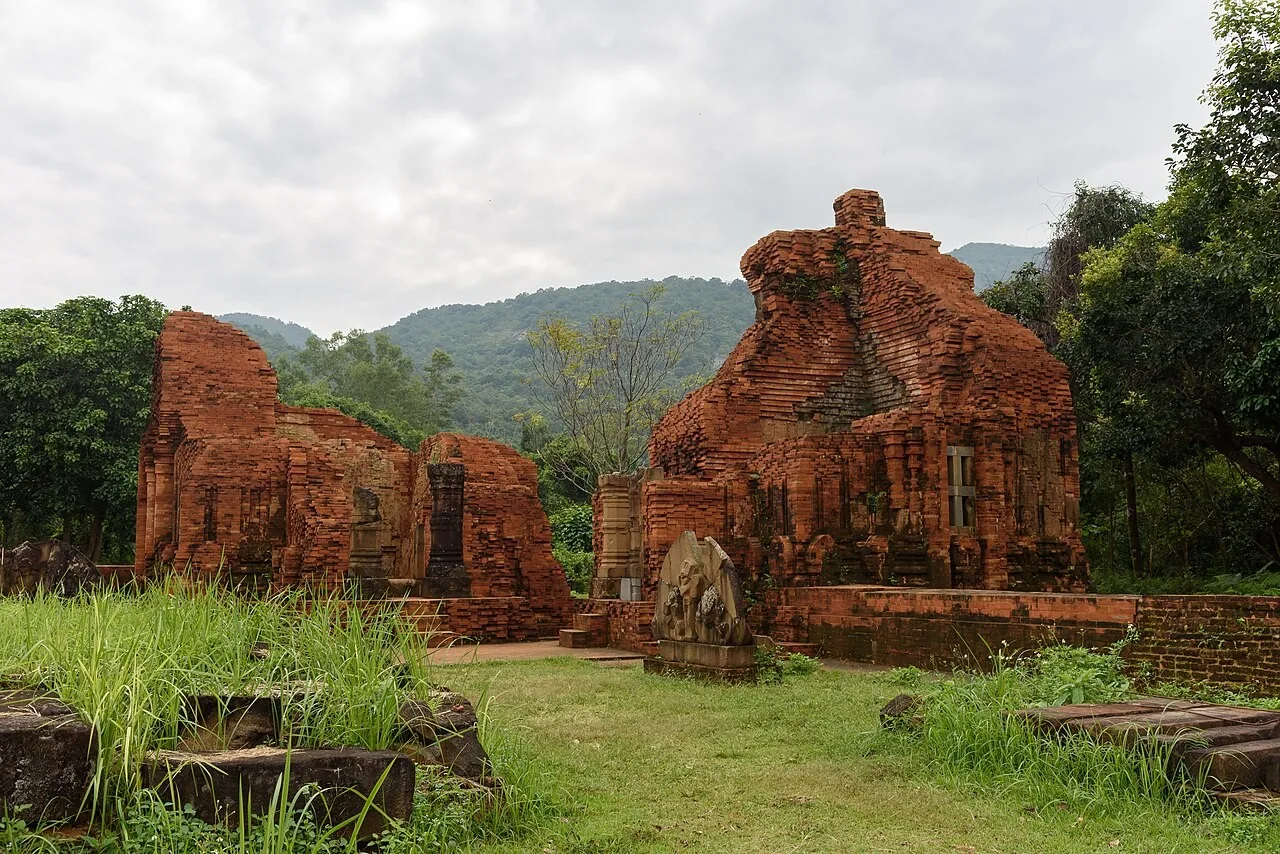
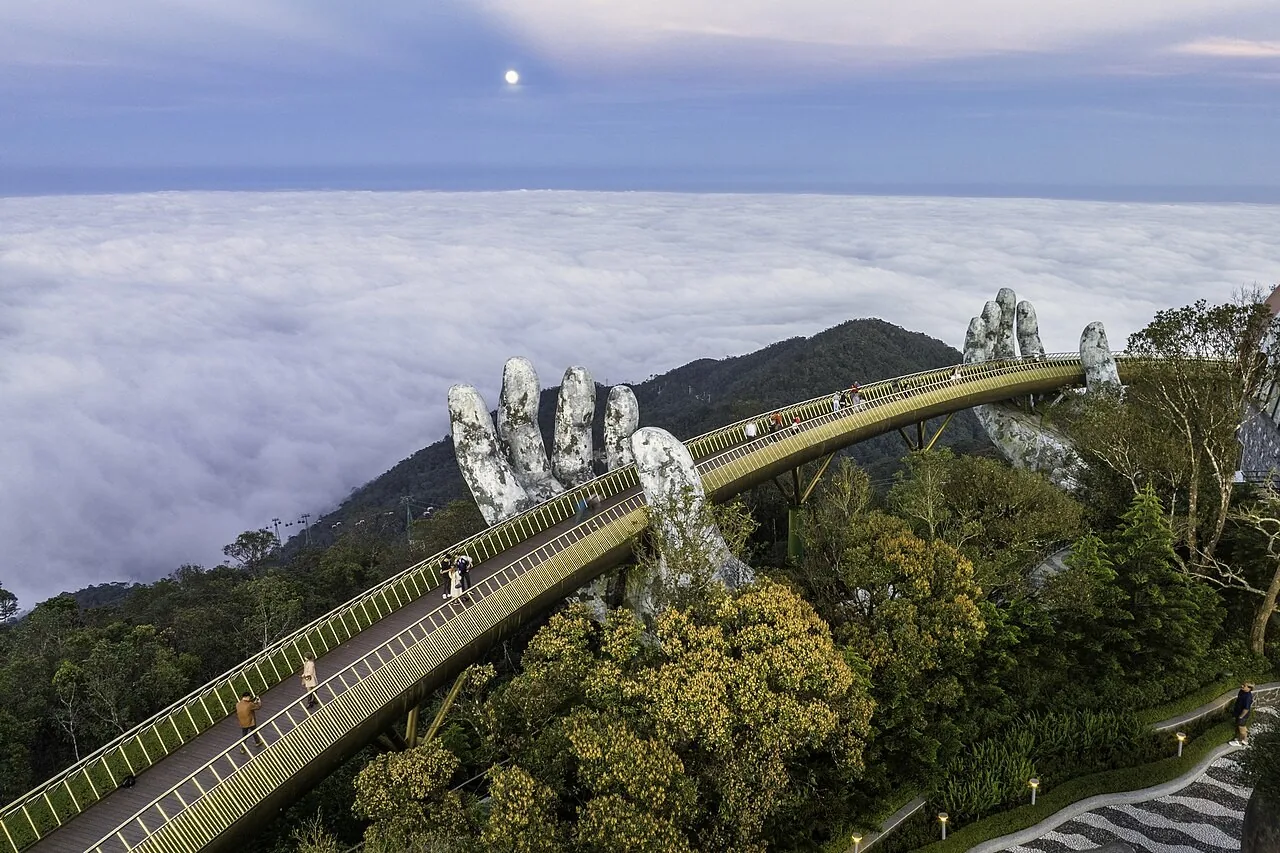
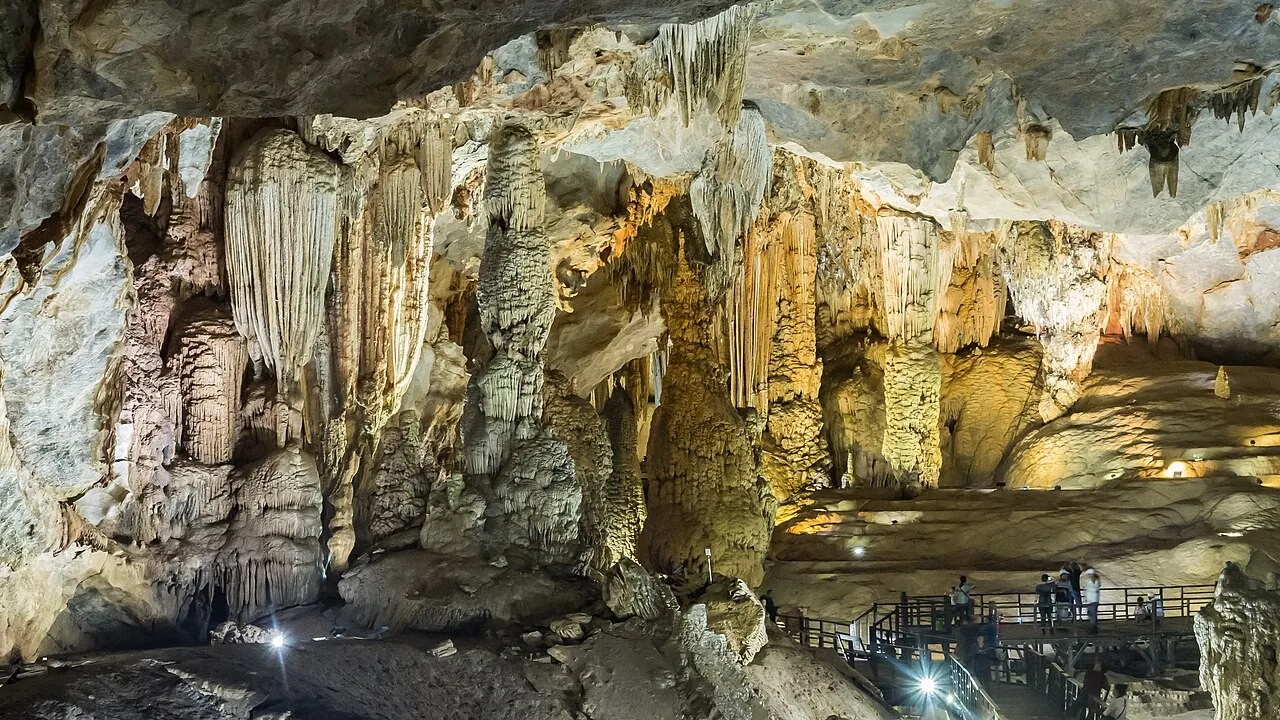
11. Getting in, and getting around
Fly into Đà Nẵng, then use the train, a car or a scooter, and largely forget the other airports. DAD is the region’s only meaningful international gateway, sits 3 km from the city centre and handles roughly 40 airlines. There is no direct service from Europe, North America or Australia, so those readers connect. Inside the region the road and the railway do everything, and the only genuinely difficult decision is whether to ride a motorbike yourself.
Đà Nẵng International Airport (DAD)
Đà Nẵng airport is about 3 km from the centre, effectively an in-city airport, and about 30 km from Hội An. As of July 2026 roughly 40 airlines serve about 30 destinations, with 18 regular international routes. T1 is domestic, T2 international, and T2 holds a Skytrax 5-star rating.
Works are the thing to plan around. A T2 expansion of roughly 1,500 billion₫ broke ground on 19 May 2026, taking check-in desks to 85, jet bridges to 7 and capacity to six million a year, on a roughly twelve-month build. Expect hoardings and temporary layouts into 2027.
The network is almost entirely Northeast and Southeast Asian: Incheon, Busan, Daegu and Cheongju, Korea being much the biggest inbound market; Tokyo Narita and Osaka Kansai; Taipei and Kaohsiung; Hong Kong and Macau; Bangkok, Singapore, Kuala Lumpur, Manila, Siem Reap and Yangon; plus Ahmedabad and Dubai. Nothing from Europe, the Americas or Australia, so British readers connect through a Gulf or Asian hub, or on a domestic leg from Hanoi or Saigon.
The other three airports, and their correct codes
| Airport | Code | Reality in 2026 |
|---|---|---|
| Phú Bài, Huế | HUI, not “HUE” (ICAO VVPB) | About 15 km southeast of the city. International in name only: scheduled service is domestic, to Hanoi and Saigon with thinner links to Đà Lạt and Côn Đảo. All scheduled flights moved to the new T2 on 28 April 2023 |
| Đồng Hới | VDH, not “DIH” (ICAO VVDH) | The gateway for Phong Nha, 40 km away. Domestic only; Vietnam Airlines and VietJet to Hanoi and Saigon, SGN–VDH about 1h40. Sun PhuQuoc Airways adds Hanoi daily and Nha Trang three times weekly from 16 August 2026. Thins outside the caving season |
| Phù Cát, for Quy Nhơn | UIH | About 30 km north of Quy Nhơn. Domestic in practice: Hanoi and Saigon, around 541 arriving flights a month as of June 2026. Aggregators listing Tokyo or Brisbane “routes” here are showing connections, not direct flights |
Indicative domestic fares, as ranges rather than quotes: Hanoi or Saigon to Đà Nẵng runs 700,000–1,800,000₫ one way on VietJet or Bamboo booked ahead, and 1,500,000–2,800,000₫ on Vietnam Airlines or at short notice. Either city to Huế is roughly 800,000–2,000,000₫, with thinner sale inventory.
Anyone heading for Huế should still fly into DAD and come overland; the train or a car over the pass beats a domestic connection. Paperwork is in the entry requirements piece: British readers have the 45-day exemption, while American, Canadian and Australian readers need the e-visa.
The railway
The Reunification Line runs Hanoi to Saigon, 1,726 km, single-track metre gauge, and it is the region’s spine. Central stations north to south: Đồng Hới for Phong Nha, Đông Hà for the DMZ, Huế, the Lăng Cô halt, Đà Nẵng, Tam Kỳ, Quảng Ngãi and Diêu Trì. There is no station at Hội An, which is reached from Đà Nẵng by road, and trains for Quy Nhơn stop at Diêu Trì, 12–15 km outside the city.
Then the seat-side question, which a surprising number of large blogs get backwards. The sea is east of the line. Northbound, Đà Nẵng to Huế, it is on your right. Southbound, Huế to Đà Nẵng, on your left. The two directions must be mirror images, so any source giving the same side for both refutes itself. The other side faces a rock wall for much of the scenic stretch.
| Class | Đà Nẵng–Huế fare | Comment |
|---|---|---|
| Hard seat | About 95,000₫ | Cheapest, on some services only |
| Soft seat, air-conditioned | 106,000–150,000₫ (two source sets differ; take the range) | The normal choice. A berth is pointless on a three-hour daylight run |
| Hard sleeper, lower berth, 6-berth | 215,000–219,000₫ | Lower berths cost more and are easier |
| Soft sleeper, lower berth, 4-berth | 265,000–280,000₫ | The comfortable overnight option on longer legs |
The leg is 103 km and takes 2h30 to 3h15, slow because the line contours the Hải Vân on tight curves instead of diving under it. Everywhere else on this railway slowness is a cost; here it is the product. Five or six usable daylight departures run each way. Elsewhere: about 20 hours Hanoi–Huế, 2h30–3h30 Huế–Đồng Hới, 5h10–6h Đà Nẵng–Diêu Trì, 9–10 hours Đà Nẵng–Nha Trang, 16–18 hours Đà Nẵng–Saigon.
Booking: dsvn.vn is Vietnam Railways’ own site and the cheapest, but takes foreign cards inconsistently; the station window is equally cheap and the only reliable way to pick a seat; Baolau, 12Go and Vexere are easier in English at a markup that barely matters on a fare this small. Book ahead in summer, at Tết and around 30 April.
One warning nobody else prints: the windows are fixed and often scratched or tinted, so photographs come out worse than the view. Photographers end up at the vestibule doors, which is where everyone with a camera congregates on the Hải Vân stretch. More in the Đà Nẵng to Huế rail piece and, for the road, the pass.
The heritage train, HD1 to HD4
Almost no English guide mentions this service, launched on 26 March 2024 and relaunched with new livery on 26 March 2026: “Hành trình kết nối di sản miền Trung”, five air-conditioned soft-seat cars plus a community carriage with live Huế court music, handicrafts and central Vietnamese food.
| Service | Departs | Arrives |
|---|---|---|
| HD1, southbound | Huế 07:45 | Đà Nẵng 10:35 |
| HD3, southbound | Huế 14:25 | Đà Nẵng 17:40 |
| HD2, northbound | Đà Nẵng 07:50 | Huế 11:05 |
| HD4, northbound | Đà Nẵng 15:00 | Huế 17:45 |
Timetables shift seasonally, so check dsvn.vn rather than trusting these to the minute. The differentiator is a scheduled ten-minute sightseeing stop at Lăng Cô, which the ordinary SE services do not make.
The headline fare is 150,000₫ single, checked July 2026. One source instead describes “about 220,000₫ round trip”, and the two do not reconcile, so take 150,000₫ as the working figure. Honest verdict: it is no faster than an SE service and sees no different scenery, because it is the same track. It buys atmosphere and the Lăng Cô stop.
Đà Nẵng to Hội An
| Mode | Price | Time | Honest note |
|---|---|---|---|
| Grab or Green SM car | 250,000–400,000₫; 250,000–350,000₫ typical | 40–55 min | The default answer. Fixed price before you book, no meter argument |
| Metered taxi | 300,000–450,000₫ | 40–55 min | Dearer than the app, and the reason is the meter, not a scam. Stick to Mai Linh or Vinasun off the street |
| Private car with driver | 300,000–600,000₫ one way for the vehicle | 30–60 min direct | Book it as a half-day with the Marble Mountains built in and it stops looking expensive |
| Shared shuttle | 115,000–250,000₫ per person | 60–90 min with stops | Only worth it solo; two people do better in a Grab for a similar total |
| Public bus route 1 | 20,000–35,000₫; the posted fare is the fare whatever you are quoted | 60–80 min | Roughly 05:30–18:00 every 15–30 min. Cheap and usable, but it ends where you do not want to be and stops early |
| Rented scooter | 110,000–180,000₫ a day plus fuel | 45–60 min | Flat, wide, busy. This is the leg on which most visitors ride illegally without realising it |
Where the buses actually stop is in the Đà Nẵng to Hội An comparison.
Đà Nẵng to Huế
| Mode | Price | Time | Honest note |
|---|---|---|---|
| Train | 95,000–280,000₫ by class; heritage service 150,000₫ | 2h30–3h15 | Centre to centre, no traffic, and the only way to see the seaward face of the Hải Vân |
| Limousine minivan, 9–10 seats | 140,000–250,000₫ per person; some operators price front seats lower | 2–2.5 hours, roughly hourly | Hotel to hotel and the practical choice if the view is irrelevant. Goes through the tunnel, so you see nothing of the pass |
| Public bus | 35,000–80,000₫ | 2–3 hours | Cheap, slow, terminal to terminal, no luggage help |
| Private car over the pass | 1,000,000–1,500,000₫ from Đà Nẵng, 1,300,000–1,900,000₫ from Hội An | 2.5–3 hours through the tunnel; 4–5 over the pass with stops | The version where the pass is the point. Specify the pass or you will be routed under it |
| Intercity Grab | No reliable 2026 figure; expect roughly 900,000–1,400,000₫ if it works | 2–2.5 hours | Availability for a 100 km run is inconsistent, and a driver who accepts may resent the empty return |
| Flight | Not applicable | Not applicable | There is no useful Đà Nẵng–Huế flight. Anyone recommending one is padding a list |
Airport transfers
| Leg | Options | Time |
|---|---|---|
| DAD to Đà Nẵng city, ~3 km | Grab or Green SM 60,000–120,000₫; metered taxi 80,000–150,000₫; GrabBike 30,000–60,000₫ with a daypack | 10–15 min |
| DAD to Hội An, ~30 km | Grab or Green SM 250,000–350,000₫; metered taxi 300,000–450,000₫; pre-booked private transfer 390,000–650,000₫ with meet-and-greet; shared shuttle 115,000–250,000₫ per person | 30–45 min |
| HUI Phú Bài to Huế, ~15 km | Taxi 250,000–300,000₫; Vietnam Airlines shuttle 50,000₫, though some sources quote 5,000–25,000₫ for a local service; pre-booked car 300,000–500,000₫ | 20–30 min |
A hotel offering a “special airport transfer rate” for the 3 km hop into Đà Nẵng is selling you nothing. Ride-hailing pickup at DAD is from a designated bay, not the kerb, so follow the pin in the app and walk past the men calling out destinations.
The late-arrival argument matters, because much of the Korean and Japanese inbound lands after 22:00. Grab supply at DAD after midnight is thin, drivers know it, and negotiating in a taxi queue at 01:00 with luggage is the most common bad first impression of Vietnam. A fixed-price pre-book costs perhaps 100,000₫ more. Pay it.
Phú Bài has its own quirk: ride-hailing pickup at arrivals is reported to be restricted, though the rule is unconfirmed. Treat the app as a fallback and take the Vietnam Airlines shuttle, timed to flights, or a pre-booked car. Pickup points are in the airport transfer notes.
Ride-hailing
| App | Where it works | Why you would use it |
|---|---|---|
| Grab | Reliable across Đà Nẵng, Hội An and Huế, car and bike. Unreliable on the outskirts | The widest coverage. Foreign cards work and cash is accepted |
| Green SM | Strong in Đà Nẵng, present in Huế and Hội An, thinner outside the urban cores | VinFast electric fleet, distinctively cyan, cars newer and cleaner than the Grab average, fares moving less in surge |
| Be | Nationwide Vietnamese platform | A third option, less useful to foreign visitors |
Install both and compare before every ride: on the Đà Nẵng–Hội An run the gap can be 100,000₫. Short city hops are 25,000–55,000₫ by bike and 45,000–90,000₫ by car. Uber does not operate in Vietnam. Both apps need data, which is the case for an eSIM before landing; account setup is in the ride-hailing walkthrough.
Scooters, and the licence reality
This matters to British readers specifically, because the usual internet advice gets the UK wrong. Vietnam is a party to the 1968 Vienna Convention and recognises International Driving Permits issued under that convention only, carried with your home licence and bearing the category A motorcycle endorsement.
| Licence origin | Position | Confidence |
|---|---|---|
| United Kingdom | Recognised. The UK is a 1968 party and issues 1968-format IDPs. Several 2026 rental blogs wrongly lump it in with the non-recognised countries | High |
| Most of Europe | Recognised, as 1968 parties | High |
| USA, Canada, Ireland | Not parties. Their 1949 Geneva IDPs are not recognised and no 1968-format permit is available to them | High |
| Australia | Consistently placed outside the 1968 Convention by secondary sources, but not confirmed against the UNECE depositary list, so treat it as probable rather than settled | Hedged, deliberately |
There is an engine-size trap on top. Since 1 January 2025, A1 covers motorcycles up to 125cc and full category A anything above, so the 150cc bike commonly rented for the Hải Vân needs category A. Shops do not check, which is why people meet the distinction at a checkpoint. Decree 168/2024 raised penalties from the same date: riding without a recognised licence is reported at roughly 2,000,000–4,000,000₫ under 125cc and 6,000,000–8,000,000₫ above. Checkpoints on the Hải Vân approaches and the Đà Nẵng–Hội An road are routine.
The fine is not the consequence that matters. Travel and medical policies almost universally exclude injury sustained operating a vehicle you were not licensed to operate. Ride without a licence Vietnam recognises, come off, and you pay your own hospital bill and your own repatriation, which from Vietnam to Europe or North America is a five-figure US-dollar bill. Third-party liability is uninsured too. That is the trade: it is common, easy and normalised here, and it is the one decision on this trip whose downside is unlimited.
Rental practice: automatics run 110,000–180,000₫ a day and manuals 160,000–320,000₫, and most shops deliver. They will ask for security, so give them a passport photocopy and never the passport itself. Deposits and damage disputes are in the scooter hire guide.
Long-distance coaches
Sleeper coaches are how most Vietnamese travel the north-south corridor: cheap, frequent and, on the major operators, fine. Futa, also called Phương Trang, is the largest and runs to its own terminals, calmer but further from your hotel. The Sinh Tourist runs the open-ticket backpacker corridor, and counterfeit shopfronts using that name exist. Hạnh Café is strong on Nha Trang–Đà Nẵng–Huế, and local nine-seat vans do Đà Nẵng–Huế hotel to hotel.
| Route | Fare | Time |
|---|---|---|
| Hanoi–Huế sleeper | 400,000–550,000₫ | Overnight |
| Huế–Hội An | 150,000–200,000₫ | About 4 hours |
| Đà Nẵng–Huế limousine van | 140,000–250,000₫ | 2–2.5 hours |
| Đà Nẵng–Quy Nhơn, Futa | 210,000–320,000₫ | 6–7.5 hours, about five departures a day |
The details that matter are physical. Berths fit travellers to roughly 180 cm; above about 188 cm the footwell genuinely does not work. Shoes come off at the door, which is why the floors are clean. Pods recline to about 160 degrees, not flat.
On-board toilets exist and are routinely locked, so the plan is rest stops every three or four hours. Front-row pods get the most motion, so book mid-coach if you are prone to travel sickness, and the realistic threat is not a crash but petty theft from the overhead racks while people sleep.
Getting around locally
Hội An’s Old Town core is permanently closed to cars, and during pedestrian hours it is walking, bicycles and cyclos only. The hours are genuinely contested: one set of sources gives 09:00–21:30 in summer and 09:00–21:00 in winter, another roughly 15:00–21:30. Both agree the evening block is absolute, so assume the restriction applies.
The luggage consequence catches people out: your Grab or pre-booked transfer cannot deliver you to a hotel inside the Old Town during those hours, so it drops you at the edge and you walk in with your bags.
Otherwise Hội An is flat and compact and the bicycle is the correct vehicle; most hotels lend them free. Huế is flat but spread out, so a bicycle works for the Citadel and the south bank and not for the tombs, 7–16 km out in three directions.
Huế cyclos have posted rates: 80,000₫ for 30 minutes, 120,000₫ for 45, 150,000₫ for an hour, 200,000₫ for two, against street haggling at 100,000–300,000₫. Grab launched a Grab Cyclo pilot here on 20 August 2025, the first in Vietnam, under a three-year city agreement, initially four pick-up points near the Citadel and Toà Khâm wharf, one passenger, rides to 60 minutes. It puts a fixed price on what was pure negotiation. A cyclo is sightseeing rather than transport, lovely along the river early or late and miserable at midday in June.
Đà Nẵng is too big and too fast for casual cycling except on the beach road. The getting-around overview pulls the local options together, and excursions are in the day-trip roundup.
12. Where to base yourself: the decision table
For a first trip the choice is Đà Nẵng or Hội An, and it turns on one question: do you want a city that happens to have a beach, or a small town that shuts its centre to cars every evening? Huế is a two-night leg rather than a base for most people. Phong Nha is a separate trip with its own airport and its own weather. Everything after that is detail, and most of the detail is money.
The blunt answer first
Đà Nẵng and Hội An are about 30 km apart, which is 40 to 55 minutes in a Grab car at 250,000–400,000₫ (checked July 2026). That distance is the single most important fact in this section. It means either city works as a single base for the whole triangle except Huế, and it means the choice between them is about what you want to walk out of your hotel into at eight in the evening, not about access.
Walk out in Đà Nẵng and you get a wide beach road, a working Vietnamese city behind it, and traffic. Walk out in Hội An and you get a lantern-lit lane with no cars in it, and about four thousand other people who have read the same thing you have. Both are true statements about the same 30 km of coast. See the Đà Nẵng section above and what Hội An is actually like for the character; this section only decides where the suitcase goes.
| Who you are | Base | Why |
|---|---|---|
| First-timer, 5 nights | Hội An 3 nights, then Đà Nẵng 2 | Front-load the town while you are fresh, end near the airport. One move, half a day lost, worth it. |
| Couple, no children | Hội An | Everything is within walking distance of everything, including dinner and the walk home from it. |
| Family with young children | Đà Nẵng beach strip | Wide shallow sand, hotel pools, the region’s best-equipped private hospitals, and a 10-minute airport run at either end. |
| Honeymoon | An Bàng or Cửa Đại resort strip, Hội An | Beach resort quiet, Old Town dinner 10 minutes away by taxi, and you never have to be in a city. |
| Digital nomad | Đà Nẵng, inland of An Thượng | The only real long-stay market of the three: monthly rates, coworking, fibre, and food not priced for tourists. |
| Budget backpacker | Huế, or Đà Nẵng well back from the beach | Huế is the cheapest major heritage city in Vietnam. The Đà Nẵng beachfront is where budgets go to die. |
| Mainly wants the beach | Đà Nẵng, Mỹ Khê | Longer, wider and more consistently swimmable sand than Hội An’s, with a whole city of restaurants behind it. |
| Mainly wants heritage | Huế, 2 nights minimum | The Citadel alone is 2.5–3 hours and the tombs are 7–16 km out in three directions. A day trip from Đà Nẵng wastes five hours in a vehicle. |
| Travelling September–December | Đà Nẵng beach strip, or An Bàng | Elevation. Riverside Old Town properties are the ones that evacuate guests by boat; beach-strip hotels ran normally through the whole October–November 2025 sequence. |
| 3 nights and a late flight out | Đà Nẵng | DAD is about 3 km from the city centre. From Hội An it is 30 km and a 45-minute run you will be doing at midnight. |
What each base costs, and why the city matters more than your travel style
This is the least intuitive number in the whole article. At the same comfort level, the three cities vary against each other by roughly 1.5 to 2.5 times. That is a wider swing than moving yourself a whole tier up or down, which means a midrange traveller in Huế is spending less than a careful backpacker on the Đà Nẵng beachfront. Choose the city and you have already made most of the budget decision.
| Base | Accommodation, per room per night | Midrange, per person per day | The honest read |
|---|---|---|---|
| Đà Nẵng | Dorm US$8–14 · guesthouse US$18–30 · 3-star US$35–65 · 4-star US$65–120 · 5-star beachfront US$140–280 · above that US$280–500+ | US$95–165 | The widest spread of any Vietnamese city. The beach is the price line, and it is a hard one. |
| Hội An | Hostels from ~US$7 · midrange averaging ~US$25, high season ~US$47 · 3-star ~US$32 · 4-star ~US$54 · An Bàng and Cửa Đại five-stars averaging ~US$370 | US$85–150 | Dearest of the three at midrange level. Small protected centre, short beach strip, and a lot of honeymoons. |
| Huế | Budget ~US$12 · midrange ~US$22, high season ~US$41 · the local top end averaging only ~US$40 | US$55–100 | The cheapest major UNESCO city in Vietnam, and structurally so: it is largely a one-night stop, so hotels compete for transient trade. |
| Phong Nha | From ~US$10–13, almost entirely homestays and farmstays in Sơn Trạch village | Bed cost is trivial; a cave day with boats is 400,000–900,000₫ | A different product: the money goes into the ground, not the bed. No upper tier exists. |
Figures are aggregator averages and trade sources cross-checked in July 2026, directional rather than quotable. They move 15–30% at Tết, across the 30 April week and at Christmas. Our breakdown of what a week actually costs works the arithmetic through properly.
The two levers you actually control
Almost every other cost in this region is fixed by the calendar or the ticket office. These two are not, and both are worth more than any amount of comparison-shopping between booking sites.
- In Đà Nẵng, walk two blocks inland. A 4-star two streets back from Mỹ Khê can be half the price of the identical standard on the beachfront, for a 400-metre walk to the same sand. This is the single biggest lever available anywhere in central Vietnam. The full picture is in our Đà Nẵng neighbourhood-by-neighbourhood breakdown.
- In Hội An, sleep outside the Ancient Town and cycle in. Saves 20–30% and most hotels lend bicycles free. The town is flat, compact and closed to cars in the evening anyway, so you were going to be walking or pedalling regardless. See where to sleep in and around Hội An.
Neighbourhood orientation
| Area | What it is | Good for | The catch |
|---|---|---|---|
| Đà Nẵng, Mỹ Khê beachfront | Mid- and high-rise resorts facing the sea | Families, swimmers, early risers | The dearest square metre in the region, and the food in front of it is priced to match |
| Đà Nẵng, An Thượng | A dense grid of small hotels, bars and cafés a block behind the beach | Solo travellers, long-stayers, anyone who wants company | Prices run 1.5–2x local rates and it reads as a resort suburb |
| Đà Nẵng, riverside | City-side hotels facing the Dragon Bridge | Night views, city food, business trips | No beach, and rates roughly double during the fireworks season |
| Đà Nẵng, inland | Ordinary residential blocks 1–3 km back | Value, long stays, eating where locals eat | Committed to a scooter or to Grab for everything |
| Hội An, Old Town and its edges | Restored merchant houses and small hotels in or beside the protected core | Atmosphere, walking, evenings | Dearest, noisiest, lowest-lying, and cars cannot reach the door during pedestrian hours |
| Hội An, An Bàng and Cửa Đại | The beach strip 4–5 km out, surf shacks to five-star resorts | Beach days, honeymoons, wet-season safety | Taxiing or cycling into town every evening |
| Hội An, the rice fields | Homestays and small pool villas in the paddy belt | Quiet, value, the best cycling in the region | Nothing walkable after dark |
| Huế, south bank | The modern side of the Hương river, where the hotels and restaurants are | Everyone. This is where you stay in Huế | The Citadel is across the river, a ride rather than a walk in the heat |
Two pins worth having on the phone before you book: the An Thượng grid and An Bàng beach. Everything else in the table is easy to place once those two are fixed. For which stretch of sand suits which kind of swimmer, see our survey of the central coast beaches and the more specific comparison of Hội An’s own beaches.
One base or two
Moving hotels costs roughly half a day once you count packing, checkout, the transfer and check-in at the other end. On a five-night trip that is 10% of your time. The case for doing it anyway is that Hội An in the evening and Đà Nẵng in the morning are genuinely different experiences, and a day trip only ever gives you one of them.
| Nights | Recommended split | Alternative |
|---|---|---|
| 3 | One base only. Hội An for the town, Đà Nẵng if the flight is late or early | Do not split. A third of the trip would go on transit and lobbies |
| 5 | Hội An 3 + Đà Nẵng 2 | Đà Nẵng 5 with one long Hội An evening, if the trip is about the beach |
| 7 | Hội An 3 + Đà Nẵng 2 + Huế 2 | Hội An 4 + Đà Nẵng 3, taking Bà Nà and Mỹ Sơn instead of Huế |
| 10 | Hội An 3 + Đà Nẵng 3 + Huế 2 + Phong Nha 2 | Drop Phong Nha for beach days if anyone dislikes caves or long drives |
| 14 | The above plus 3 nights south to Quy Nhơn, or 3 more in Huế and the DMZ | Stay put. Two weeks in one good hotel with a scooter is a cheaper holiday and a legitimate one |
Huế is the exception to the single-base rule. It is 2 to 3 hours away over the Hải Vân, and a day trip means leaving at seven and getting back at eight for about four usable hours at a site that needs two days. If Huế matters to you, sleep there. Our Huế section above explains what those two days buy.
The wet-season override
From September to December, ignore everything above and choose by elevation. Through the entire October–November 2025 flood sequence, the worst central flooding in about 50 years, Đà Nẵng’s beach strip and Hội An’s An Bàng and Cửa Đại hotels operated normally. Riverside Old Town homestays on Bạch Đằng and An Hội evacuated guests by boat.
This is not an argument for avoiding the region in the wet season. It is an argument for booking a room whose floor is above the water and holding a refundable rate, which buys the decision at 48 to 72 hours out rather than months ahead. The beach resort inventory is the safest ground in the region for a September to December stay.
How the centre compares with Vietnam’s other beach regions
If you are choosing between coasts rather than between cities, the honest summary is that the centre is not the country’s best beach destination and does not need to be. Nowhere else in Vietnam puts a good beach half an hour from a UNESCO town, an hour from a Cham sanctuary and two hours from an imperial capital.
| Region | Driest window | What it is for | Where it disappoints |
|---|---|---|---|
| Central coast | February–August, with March the driest month in Đà Nẵng and Hội An at about 20 mm over 4 days | Culture and coast in the same trip, on the same day if you want | October and November: 650 mm and 430 mm respectively in Đà Nẵng, plus river flooding |
| Nha Trang | January–August | Diving, islands, a denser beach-resort city than anything in the centre | Thin on heritage, and its own wet season runs October to December |
| Phú Quốc | November–April | The best dry-season beaches in the country between December and March | Almost no cultural draw, and 3,030 mm a year concentrated May to October |
Climate figures are climatestotravel.com on a 1991–2020 record, rounded, usable for comparing cities but not official WMO normals. The practical implication: December sends you to Phú Quốc, July sends you to the centre, and October is the one month when both coasts are wet. We work through the trade-offs properly in the centre against Nha Trang and the centre against Phú Quốc.
13. The food of the centre, and what is actually regional
Central Vietnamese food is a distinct cuisine, not a milder rehearsal for Hanoi or a blander cousin of Saigon. It is saltier, chilli-forward, built on shrimp paste and turmeric, and served in small portions with a lot of herbs. Ordering phở in Đà Nẵng is not a mistake exactly, but it is a wasted meal in the one part of Vietnam where the local bowl is genuinely different.
What is actually from here, and what is not
Menus in tourist-facing restaurants blur this deliberately. One laminated page offering cao lầu, phở, bún bò Huế, pad thai and a burger tells you the kitchen specialises in none of them.
| Dish | Where it is from | What it actually is | Honest note |
|---|---|---|---|
| mì Quảng | Quảng Nam, so Hội An and Đà Nẵng both claim it fairly | Wide turmeric-yellow rice noodles in a broth that barely covers them, with pork and prawn, chicken or frog, peanuts, and a sesame cracker snapped over the top | Not a soup. If it arrives swimming, the kitchen is cooking it for foreigners. Eaten with a plate of herbs you tear in yourself |
| cao lầu | Hội An only, genuinely | Thick chewy noodles, char siu-style pork, greens, croutons cut from the same dough, almost no liquid | The well-worn story is that the noodles need Bá Lễ well water and lye from ash burned on Chàm island. That is the traditional account every shop repeats; treat it as an origin story rather than a verified 2026 supply chain |
| bún bò Huế | Huế | Round noodles in a lemongrass and shrimp-paste broth with beef shank, pork knuckle and, traditionally, cubed congealed blood | A different animal from phở: different noodle, different aromatics, far more assertive. Ask for it without the blood if you would rather not |
| bánh xèo and nem lụi | Central, and usually eaten together | Small crisp turmeric pancakes and lemongrass-skewered pork, rolled at the table in rice paper with green banana, starfruit and herbs, dipped in a thick peanut sauce | Not the giant folded Saigon pancake. The central version is palm-sized and you eat several. The sauce is what people go back for |
| bánh mì | National | A thin-crusted roll with pâté, cold cuts, pickled vegetables, coriander and chilli | Hội An’s famous shops are a specific heavy-pâté, house-sauce style rather than the national standard. A roadside cart at 25,000₫ is often the better sandwich |
| bún chả cá | Đà Nẵng, with rival versions down the coast | A clear, faintly sweet fish broth with fried and steamed fish cake, pumpkin and bamboo shoots | The city’s real breakfast, and the dish tourists most often miss |
| cơm gà | Hội An, though Tam Kỳ down the road disputes it | Shredded poached chicken over rice cooked in the stock and turmeric, with herbs, pickled onion and a bowl of broth | Deceptively plain and easy to do badly. Judge it on the rice, not the chicken |
| bánh bèo, bánh nậm, bánh bột lọc | Huế | The small-plate family: steamed rice discs with dried shrimp, flat parcels steamed in banana leaf, and translucent tapioca dumplings | Ordered as a set and grazed. The clearest surviving trace of court cooking, which built prestige out of many tiny dishes |
| cơm hến | Huế | Room-temperature rice with tiny river clams, crackling, peanuts, herbs and a small bowl of clam broth | The most divisive dish in the region, and worth trying precisely because it is nobody’s idea of tourist food |
| hoành thánh and white rose | Hội An | Fried and soup wontons, and bánh vạc: small shrimp dumplings pinched into a flower shape | One family workshop is widely said to supply most of the town’s white rose. We cannot verify that today, but the dumplings do taste identical everywhere |
| chè | National, but Huế has the deepest repertoire | Sweet soups and puddings of beans, jellies, fruit and coconut milk, hot or over ice | Dozens of Huế varieties, including one built around a lotus seed wrapped in longan. Cheap, and the right answer to three in the afternoon |
Phở, bún chả and bánh cuốn are northern; cơm tấm and hủ tiếu are southern. All available here, all fine, just not what the region does. Our Đà Nẵng eating rundown and the Hội An equivalent name the shops, and mì Quảng and how to order it covers the bowl that best explains the region.
The two-price city
Central Vietnam runs two parallel economies for the same food, and the gap is wider than in Hanoi or Saigon because tourist concentration is higher relative to the size of the towns. A bowl of mì Quảng is 35,000–50,000₫ in a local shop and 80,000–120,000₫ in a tourist-facing restaurant three streets away (checked July 2026). Same dish, frequently a worse version of it.
You do not need Vietnamese to tell the two apart. You need about fifteen seconds of looking.
| Signal | Local shop | Tourist-facing room |
|---|---|---|
| The sign | One dish name, in Vietnamese, in large letters | Four cuisines, photographs, and the words “traditional” or “authentic” |
| The menu | A price list on the wall, or no menu at all | A laminated book in four languages with photographs of everything |
| The furniture | Plastic stools, steel tables, a fan | Wooden chairs, air conditioning, a host at the door |
| The hours | Opens at 06:00, sells out by 10:00, closes | Open 08:00 to 22:00, seven days |
| The customers | Vietnamese, eating fast, mostly alone or in twos | Foreigners, eating slowly, mostly in fours |
| The bill | 35,000–60,000₫ a head | 150,000–350,000₫ a head |
None of this makes the second column dishonest. Air conditioning, English menus and a lavatory cost money, and after a morning at Mỹ Sơn in June you may want all three. It becomes a problem only when someone assumes the 120,000₫ bowl is the real one because it cost more.
What things cost
| Item | Local price (Đà Nẵng / Hội An, 2026) | US$ at 26,000₫ = US$1 | Tourist strip |
|---|---|---|---|
| bánh mì | 25,000–40,000₫ | US$0.95–1.55 | Named Hội An shops charge at the top of that band and above |
| mì Quảng | 35,000–50,000₫ | US$1.35–1.90 | 80,000–120,000₫ |
| bún chả cá | 50,000–80,000₫ | US$1.90–3.10 | Roughly double on the beachfront |
| Bottled local beer | 15,000–30,000₫ at a local eatery, from ~12,000₫ in a shop | US$0.60–1.15 | ~25,000₫+ in a café |
| Rooftop cocktail | 120,000–200,000₫ | US$4.60–7.70 | A six- to tenfold jump on the beer, and the fastest way a cheap day stops being cheap |
| cà phê sữa đá | 25,000–45,000₫ | US$0.95–1.75 | Third-wave cafés in An Thượng and Hội An charge well above |
These are 2026 street-level figures. An Thượng, the Hội An Ancient Town core and the Mỹ Khê beachfront run 1.5 to 2 times them, consistently and unapologetically. Two streets is usually the whole difference.
Coffee, taken seriously
Vietnam grows robusta, not arabica, and central coffee culture is built on it: dark, bitter, high in caffeine, drunk with condensed milk over a full glass of ice. Cà phê sữa đá at 25,000–45,000₫ is the default, brewed in a small metal phin filter that drips at its own pace.
| Drink | What arrives | Who it is for |
|---|---|---|
| cà phê sữa đá | Robusta dripped over condensed milk, poured onto ice | Everyone, all day, and the reference price for everything else |
| cà phê đen đá | The same without milk, sugar on request | Anyone who finds the sweet version cloying |
| Egg coffee | Whipped yolk and condensed milk over strong coffee, warm | Visitors, mostly. Hanoi’s invention, now on every central menu because people ask |
| Coconut coffee | Coffee over blended frozen coconut milk | A dessert that is honest about it, and good in the heat |
| Third-wave filter or espresso | Single-origin Vietnamese arabica, at Western prices | A small but serious scene in An Thượng and around Hội An |
The third-wave cafés are the region’s most reliable air-conditioned refuge in a downpour, at three to four times the price of the plastic-stool version. A fair trade for a table, a socket and Wi-Fi. More on the roasters and the phin method in our guide to Vietnamese coffee.
Seafood without being overcharged
The mechanism that catches people is not a fake bill. It is pointing at a tank without ever establishing what the thing weighs or costs per kilogram. Prices are legitimately by weight and legitimately variable, which is what makes the gap exploitable.
- Agree the price per kilogram and the approximate weight before anything is netted. Have them show you the scale.
- Ask the cooking method when you order. Steamed with lemongrass and grilled with cheese and butter are different bills.
- Beach-strip restaurants charge a view premium. The seafood streets behind the strip, and the cooked stalls at the markets, do not.
- Lobster, crab and abalone are where the arithmetic goes wrong fastest. Clams, prawns, squid and whatever came in that morning rarely do.
- If nobody will quote a per-kilo figure, that is your answer. Walk.
Hàn Market is the easiest place to see the wholesale end before you eat at the retail end. Our seafood rundown covers species, seasons and where the local crowd goes.
Vegetarian, vegan and halal
Central Vietnam is far easier for vegetarians than most travellers expect, because of Buddhist chay cooking rather than any concession to visitors. Dedicated chay restaurants exist in every town of any size, usually cheap and signed with the word “chay”. Around the first and fifteenth of each lunar month their number multiplies and ordinary shops put on chay versions of their dishes.
The caveats are real. Fish sauce and shrimp paste are in almost everything by default, so “no meat” is not the same request as “chay”, and broths are usually pork-based. Saying you eat chay is understood immediately where a long explanation is not. Halal options exist in Đà Nẵng, concentrated around the hotels serving Malaysian and Indonesian tour groups; Hội An and Huế have far fewer and certification varies, so check rather than assume.
A cooking class is the best wet-day fallback
If a day is written off by rain, a cooking class is the most useful three hours in the region. Most run a market visit, sometimes a basket-boat trip through the water coconut palms, then four or five dishes you eat. It teaches you how the food works rather than just feeding you.
The caveat is that classes with a market visit are among the first things cancelled when the water comes up, with basket-boat trips, Mỹ Sơn tours and the lantern boats. One that cooks indoors will usually still run. See which cooking classes are worth the money.
When and where to eat
| Time | What is happening | What to do |
|---|---|---|
| 06:00–09:00 | The serious meal. Bún chả cá, mì Quảng, bún bò Huế and cơm gà are breakfast dishes here | Get up. The best shops sell one dish, sell out and shut. A 07:30 queue is the strongest quality signal in the region |
| 11:00–13:30 | Lunch, and the heat | Small plates, chè, an air-conditioned café. Huế’s bánh bèo and its relatives suit this hour exactly |
| 17:00–19:00 | Street kitchens set up; bánh xèo and nem lụi grills start | The best hour for rolled-at-the-table food; the streets behind the beach strip fill with Vietnamese families |
| 19:00–22:00 | The Hội An Ancient Town core at maximum density | Where you pay the most for the least. Eat before or after, outside the core or across the bridge |
The geography of value is simple. Hàn Market and the residential streets behind Đà Nẵng’s beach strip are where the arithmetic changes; Hội An rewards walking ten minutes out of the core in any direction; Huế’s food clusters on the south bank and around Đông Ba market, and is the cheapest of the three by a clear margin. See our Huế section and the Hội An section.
Water, ice and not being ill
Tap water is not for drinking anywhere in the region. Bottled water costs 5,000–10,000₫ and most hotels refill free. Ice in commercial establishments is factory-made from treated water, comes in uniform cylinders with a hole through the middle, and is generally fine. The blanket advice to refuse all ice in Vietnam is a decade out of date.
Beyond that, the heuristic is turnover. The busiest stall at 07:30, cooking one dish in front of you with a fast-emptying pot, is safer than a quiet restaurant holding food in a warmer all afternoon. Worry about a lukewarm buffet rather than raw herbs. Our bánh mì piece makes the same point about carts: join the one with a queue.
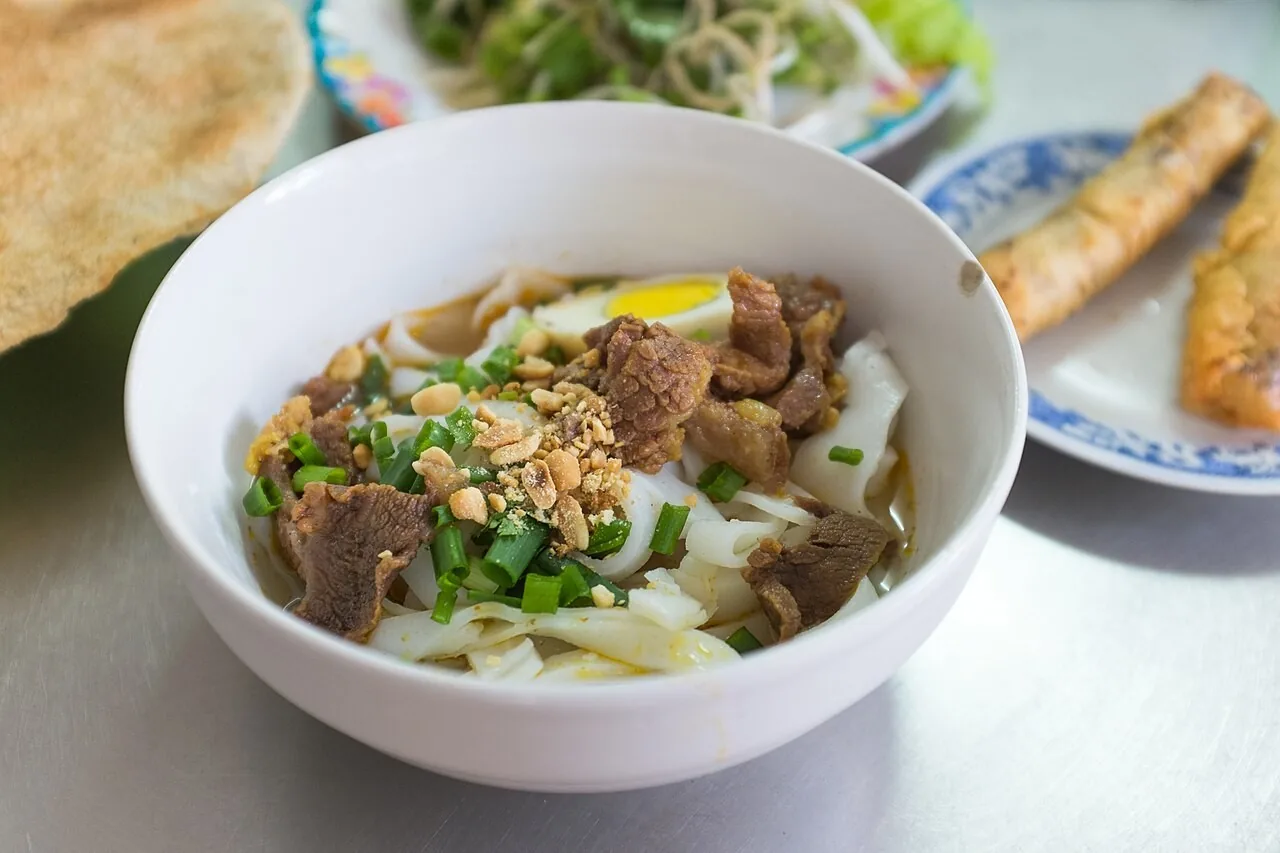
14. What Central Vietnam costs
At 26,000₫ to the US dollar, the rate used for every conversion in this article, a midrange traveller spends US$80–150 a day in central Vietnam. That is the headline, and it is less useful than the qualifier: the number moves more with which city you sleep in than with how you travel. Huế at US$55–100 and the Đà Nẵng beachfront at US$95–165 are the same trip at different prices.
The 2026 ticket table
Central Vietnam is unusual in that a handful of sights cost real money. Everything below was checked in July 2026 against 2026-dated sources, with contested items flagged rather than resolved.
| Sight | 2026 price | Note and as-of |
|---|---|---|
| Hội An Ancient Town | 120,000₫ adult; 50,000₫ child 1.0–1.4 m | Five coupons for ~22 heritage buildings, not a fee to walk the streets. Page updated 2 Jan 2026 |
| Mỹ Sơn | 150,000₫ foreign; 100,000₫ Vietnamese; 30,000₫ children 5–15 | Genuine dual pricing, rare here. Many Hội An tours quote a headline excluding it |
| Bà Nà Hills cable car | 1,000,000₫ adult; 800,000₫ child 1.00–1.39 m and seniors 70+ | From 1 Jan 2026, valid 72 hours over 3 days, unlimited rides. Over 1.40 m pays adult whatever the age. 900,000₫ is stale |
| Marble Mountains | 40,000₫ + 15,000₫ lift one way or 30,000₫ return + 20,000₫ Âm Phủ | Three separate tickets, cash ₫ only, all-in 75,000–90,000₫ |
| Huế Imperial Citadel | 200,000₫ adult; 40,000₫ children 7–12 | Same price for all nationalities. Hours given as 06:30–17:30 or 07:00–18:00, sales to 17:30, so arrive by 16:30 |
| Huế royal tombs | 150,000₫ each at Minh Mạng, Tự Đức, Khải Định and Gia Long; 100,000₫ Đồng Khánh; 50,000₫ minor sites | Combos valid 2 days: 2 sites 200,000–240,000₫, 3 sites 420,000₫, 4-site route 530,000₫. The 3-site child rate is given as both 80,000₫ and 30,000₫ |
| Museum of Cham Sculpture | 60,000₫ adult; 10,000₫ children and students | Gate booth only, cash or a domestic QR |
| Cù Lao Chàm | 500,000–600,000₫ round-trip speedboat; 550,000₫ open return | Quoted as including the 70,000₫ island entry and 30,000₫ eco fee, called one 100,000₫ fee elsewhere. Do not double-count |
| Hội An lantern boat | 170,000₫ per boat for 1–3; 220,000₫ for 4–5 | Per boat, the figure touts blur. From 2026 a 100,000₫ per-guest surcharge on designated dates |
| Phong Nha Cave | 150,000₫ entry plus 750,000₫ per boat for up to ~12 | The boat is the bigger half. A solo traveller pays all of it unless they share |
| Other Phong Nha caves | Paradise 250,000 or 270,000₫; Dark Cave 80,000₫ entry to a 450,000₫ package; Nước Moọc 100,000₫ or seasonal 180,000/220,000₫ | All contested between 2026-dated lists, probably package tiers rather than error. Use ranges |
| Sơn Đoòng | ~79,500,000₫ per person (~US$3,000), 4 days and 3 nights. Hang Én, the achievable version, is 4,000,000–6,000,000₫ | Second-hand figure: the operator’s page could not be read. 2026 and 2027 sold out, 2028 open |
Do the Huế arithmetic first. The Citadel plus the three headline tombs singly is 650,000₫ against 530,000₫ for the four-site combo. But the Citadel plus Khải Định alone is 350,000₫ and no combo beats it, which is the honest minimum for a one-day visit, because Khải Định’s mosaic interior is the one nobody regrets. More in the Huế section and our Bà Nà assessment.
Daily budgets, by style and by city
| Style | Per person per day | In ₫ | What that buys |
|---|---|---|---|
| Backpacker | US$30–50 | ~780,000–1,300,000₫ | Dorm or guesthouse, street food, a scooter, one paid sight |
| Midrange | US$80–150 | ~2,080,000–3,900,000₫ | 3-star or boutique, Grab everywhere, one big ticket |
| Comfortable | US$200–350 | ~5,200,000–9,100,000₫ | 4-star or beachfront, car and driver, spa, cocktails |
| Luxury | US$400+, easily US$500–800 | 10,400,000–20,800,000₫+ | Five-star beach inventory at US$280–500+ a night |
| City | Midrange per person per day | The floor |
|---|---|---|
| Huế | US$55–100 | About US$25 is genuinely achievable |
| Hội An | US$85–150 | Possible on hostel rates, harder once you eat in the Old Town |
| Đà Nẵng | US$95–165 | Not achievable on the beachfront; two blocks inland it is another matter |
| Phong Nha | Beds cost little; caves 400,000–900,000₫ a day | About US$25, the cheapest sleeping in the region |
Accommodation bands
| City | Budget | Midrange | Upper |
|---|---|---|---|
| Đà Nẵng | Dorm US$8–14; guesthouse US$18–30 | 3-star US$35–65; 4-star US$65–120 | Beachfront 5-star US$140–280; above US$280–500+ |
| Hội An | Hostels from ~US$7 | ~US$25, high season ~US$47; 3-star ~US$32; 4-star ~US$54 | An Bàng and Cửa Đại five-stars averaging ~US$370 |
| Huế | ~US$12 | ~US$22, high season ~US$41 | The local top end averages only ~US$40 |
| Phong Nha | From ~US$10–13 | Homestays and farmstays in Sơn Trạch | No upper tier |
Per room per night, aggregator averages checked July 2026, directional rather than quotable. Seasonality bites hardest in Hội An and Đà Nẵng, least in Phong Nha.
The five things that actually drive the spread
- City, not travel style. The three vary 1.5–2.5x against each other at the same comfort level, a bigger swing than moving a whole tier.
- Transport mode. A scooter is 100,000–150,000₫ a day; living on Grab is US$8–20. Over a week that one choice is worth more than a hotel upgrade, and carries a licensing question covered in our ride-hailing and transport piece.
- The big tickets. Bà Nà at 1,000,000₫ is a whole midrange day in one purchase; a Phong Nha cave day with boats is 400,000–900,000₫. Two or three in a week reshape the budget.
- Daily creep. Beers, the second and third coffee, laundry, an eSIM, ride-hails: US$10–25 a day that budget sites omit.
- Season. Tết, the 30 April week and Christmas push accommodation up 15–30%, and flights, trains and homestays 50–200% around Tết itself. Tết 2027 falls on Saturday 6 February.
Three worked weeks
All three are estimates built from the figures above, not quotes. Every line is a real 2026 price; the total is what happens when real prices are added up.
| Backpacker, 7 nights, one person | ₫ |
|---|---|
| 7 nights dorm and guesthouse at ~260,000₫ | 1,820,000 |
| Food, 7 days at ~250,000₫ | 1,750,000 |
| Scooter, 4 days at ~130,000₫ | 520,000 |
| Bus to Hội An and back, train Đà Nẵng–Huế soft seat | 220,000 |
| Tickets: Hội An 120,000, Marble Mountains 75,000, Citadel and Khải Định 350,000 | 545,000 |
| Beer, coffee, laundry at ~120,000₫ a day | 840,000 |
| Total | 5,695,000₫, about US$219, or US$31 a day |
That week contains no Bà Nà Hills. Adding it puts 1,000,000₫ on the total in one afternoon and lifts the daily average to US$36.
| Midrange couple, 7 nights, two people | ₫ |
|---|---|
| 4 nights Hội An 4-star at ~1,400,000₫ | 5,600,000 |
| 3 nights Đà Nẵng beach-adjacent 4-star at ~2,200,000₫ | 6,600,000 |
| Food and drink for two at ~1,200,000₫ a day | 8,400,000 |
| Grab and local transport at ~400,000₫ a day | 2,800,000 |
| Airport transfer and the Hội An–Đà Nẵng move | 700,000 |
| Bà Nà 2,000,000, Hội An tickets 240,000, Mỹ Sơn half-day with entry 1,200,000, Marble Mountains 150,000 | 3,590,000 |
| Two massages and a few cocktails | 2,000,000 |
| Total | 29,690,000₫, about US$1,142, or US$82 per person per day |
That lands at the bottom of the midrange band, the result of four nights at Hội An 4-star rather than five-star rates. Move all seven onto the Mỹ Khê beachfront and the same itinerary crosses US$120 a head per day.
| Family of four, 7 nights, Đà Nẵng base | ₫ |
|---|---|
| 7 nights family room or two-bedroom apartment at ~2,600,000₫ | 18,200,000 |
| Food for four at ~1,800,000₫ a day | 12,600,000 |
| Grab at ~550,000₫ a day | 3,850,000 |
| Airport transfers both ways (DAD is ~3 km out) | 300,000 |
| Bà Nà: two adults, one child under 1.40 m at 800,000, one over it at the adult fare | 3,800,000 |
| Hội An day: return Grab, four town tickets, one lantern boat | 1,330,000 |
| Marble Mountains for four | 300,000 |
| Water park and miscellaneous | 1,500,000 |
| Total | 41,880,000₫, about US$1,611, or US$58 per person per day |
Children dilute the per-head figure until they reach 1.40 m, at which point Bà Nà charges the full adult 1,000,000₫ whatever their age. Families with tall eleven-year-olds should budget for it. Our cost breakdown runs more variations.
Money mechanics
Carry cash. Cards work at hotels, tour operators, better restaurants and the Hội An tailor shops, where a custom two-piece runs US$150–400 and fabric rather than labour is the dominant variable. They do not work at the Marble Mountains booths, the Cham Museum, the Huế monuments or any Phong Nha cave booth. Keep small notes for boats and lanterns.
The VietQR correction. You will watch everyone around you pay for everything by scanning a QR code, including at street stalls, and assume you can do the same. Generally you cannot. Standard VietQR does not work from foreign banking apps or cards; cross-border access exists only for a short list of countries, China, Laos and Cambodia among them, via VietQRGlobal.
The ATM correction. TPBank was for years the standard fee-free recommendation and most blogs still list it that way. It moved to roughly 3.3% of the amount withdrawn in June 2025. The 2026 fee-free names for foreign cards are VPBank, with the highest ceiling at up to 10,000,000₫ a withdrawal, and Techcombank. Vietcombank charges around 50,000₫, and Agribank, Vietinbank and Vietcombank often cap withdrawals at 3,000,000₫, multiplying the fee. Take the maximum and decline the machine’s own currency conversion. More in our money and payments rundown, and on visa fees in our entry requirements piece (UK, EU, Nordic, Japanese, Korean and Russian passports enter free for 45 days; US, Canadian and Australian ones pay for an e-visa).
Tipping
Tipping is not obligatory in Vietnam and not traditional. At a street stall it is unnecessary and rounding up is plenty. It is now normal in tourist-facing hotels, on tours and at spas.
Tip in ₫, in cash, handed over directly. Card tips frequently never reach the server, and housekeeping, porters and therapists cannot receive a QR tip at all. New since 2024: POS terminals in tourist restaurants prompting for 10–15%, a North American practice unknown here before then. Vietnamese diners almost universally decline. You may too, and it is not rude.
Where the money leaks
These are central-Vietnam-specific frauds, not generic Hanoi and Saigon material. Note first what is not a problem: metered-taxi scamming is now rare in Đà Nẵng, because Grab and the two big fleets dominate.
- Cloned tour-operator pages on Facebook and Instagram. The most consistently reported Đà Nẵng fraud. Fake accounts impersonating real operators sell Bà Nà packages inside travel and expat groups, and victims usually find out at the cable-car station. Book on the operator’s own site.
- Huế cyclo overcharging. No price agreed at the start, or a higher number at the end. Posted rates run 80,000₫ for 30 minutes to 200,000₫ for two hours. Agree the fare and write it down.
- Perfume River dragon-boat touting. The posted rate is about 250,000₫ per boat; arrivals at Toà Khâm wharf are steered to sellers quoting up to 800,000₫. Book at the official counter, 49 Lê Lợi.
- The Hội An lantern-boat “ticket”. A spurious ~30,000₫ ticket that buys nothing, plus tip pressure from the rower. Prices are on bilingual signs; point at one.
- DAD arrivals touts. Inflated flat fares from freelance drivers. The legitimate fleets are Vinasun, white with a green stripe, and Mai Linh, green. If the meter does not start, get out.
Our scam and safety rundown covers the Huế banknote switch, which exploits the similar blue of the 20,000₫ and 500,000₫ notes.
What is worth paying for, and what is not
| Spend | Verdict | Why |
|---|---|---|
| Pre-booked transfer for a late-night arrival at DAD | Yes, 390,000–650,000₫ to Hội An | Grab supply after midnight is thin, and the 01:00 queue negotiation with luggage is the most common bad first impression of Vietnam |
| Your hotel’s “special airport rate” for the 3 km into Đà Nẵng city | No | 60,000–120,000₫ on Grab, 10–15 minutes. You are being sold nothing |
| Private car over the Hải Vân pass, split three ways | Yes, 1,000,000–1,500,000₫ from Đà Nẵng | About 400,000₫ a head for the best road in the country. Insist on the pass, not the tunnel, from which you see nothing |
| A Đà Nẵng–Quy Nhơn day trip | No | 281–345 km each way. Anyone selling this is selling twelve hours in a vehicle. Quy Nhơn needs two nights |
| Bà Nà Hills at 1,000,000₫ | Conditionally | It now runs 72 hours with unlimited rides, so treat it as a pass to spread over two visits. Worth far less used once, in cloud, at a weekend |
15. What older guides still get wrong
A dozen specific errors circulate in English-language coverage of this region, and between them they cost readers money, days and one genuinely dangerous misunderstanding about motorbike licensing. They persist because most pages are revised by changing the year in the title rather than the numbers underneath it. This section is the page’s signature: every correction below is dated, sourced from a 2026 check, and stated with its consequence rather than as trivia.
The corrections, in one table
| What you will read | What is actually the case | What it costs you |
|---|---|---|
| Bà Nà Hills is 900,000₫ for an adult | 1,000,000₫ since 1 January 2026 — and the ticket is now valid 72 hours across 3 consecutive days | 100,000₫ of surprise, and a missed chance to split the visit over two mornings |
| You must buy a ticket to enter Hội An Old Town | The April 2023 all-visitors mandate was scrapped after backlash. Groups must hold tickets; individuals are encouraged, not compelled. The 120,000₫ strip is a five-site admission bundle enforced at heritage-house doors | Either a needless purchase or a needless argument at a booth |
| The train crosses the Hải Vân Pass and climbs to 496 m | 496–500 m is the road summit. The railway contours the seaward flank far below through six tunnels and never reaches the pass or the gate | You board expecting a summit panorama and get a coastline instead — a better view, wrongly sold |
| The 6.28 km Hải Vân tunnel is Southeast Asia’s longest rail tunnel | It is the road tunnel, opened 5 June 2005. The railway’s longest tunnel on this section is about 600 m | Nothing directly, but it is the tell of a page that has never checked anything |
| Sit on the left from Đà Nẵng to Huế | The sea is east of the line. Northbound to Huế it is the right; southbound to Đà Nẵng it is the left | Three hours facing a rock wall |
| Cù Lao Chàm boats stop from October to February | Suspensions are forecast-triggered, not calendrical. On 16 July 2026, in peak dry season, services stopped and nearly 300 mostly foreign tourists were stranded until the 19th | A missed flight, if you schedule the island the day before you fly |
| Huế airport is HUE; Đồng Hới is DIH | Huế Phú Bài is HUI; Đồng Hới is VDH | A failed flight search, or a booking to the wrong airport |
| Phú Bài is an international airport | International in name and facility only. Scheduled service as of July 2026 is domestic | A plan to fly into Huế from abroad that does not exist |
| Take the train to Quy Nhơn | Reunification trains stop at Diêu Trì, 12–15 km inland. Quy Nhơn city station is not the mainline stop | An unbudgeted taxi at the end of a six-hour journey |
| UK, US, Australian and Canadian IDPs are all invalid in Vietnam | Vietnam recognises 1968 Vienna Convention IDPs only. The UK is a 1968 party and its IDP is recognised. The USA, Canada and Ireland are not parties; Australia is consistently placed outside it too, though we could not confirm that against the depositary list | British riders insure themselves out of a ride they were entitled to take, and non-party riders think they are covered when they are not |
| An A1 licence covers 175cc | Since 1 January 2025, A1 covers up to 125cc and full category A covers above that. The 150cc bike commonly rented for the Hải Vân needs category A | Uninsured, on the most consequential road in the region |
| Huế Festival is biennial, in even years | That has been out of date since 2022. Huế now runs a year-round Four Seasons model; the concentrated International Arts Festival Week fell 13–18 June 2026 | A trip timed around a festival format that no longer exists |
| The Thu Bồn at Hội An hit 5.62 m in October 2025 and broke the 1964 record | 5.62 m was the Cầu Lâu station upstream. At the Hội An gauge the peak was 3.39 m against 1964’s 3.40 m — it matched the record without exceeding it | A wildly exaggerated sense of what a Hội An flood is |
| In October it is sunny in Phú Quốc and flooded in Hội An | Phú Quốc gets 385 mm over 22 rainy days in October. October is wet on both coasts; the centre is simply twice as wet and adds rivers and typhoons | A booked October escape to a wet island |
| February and March have more rain days than July | True in Huế (12 and 10 against 8). False in Đà Nẵng (6 and 4 against 9). And rain days are not rain volume: Huế’s February is 65 mm over 12 days, July 90 mm over 8 | Writing off the best-value window in the calendar |
| Marble Mountains costs 40,000₫ | 40,000₫ is the Thuỷ Sơn entry only. Add the lift at 15,000₫ one way or 30,000₫ return, and Âm Phủ cave at 20,000₫ from a separate gate. Realistic all-in is 75,000–90,000₫, cash only | Arriving short of cash at a booth that takes nothing else |
| Phong Nha Cave costs 150,000₫ | That is entry. The dragon boat is charged per boat at 750,000₫ for up to about twelve people, so a solo traveller pays the lot unless they share at the wharf | Roughly five times the expected bill |
| Foreigners pay more at Huế’s monuments | Huế charges everyone the same. Mỹ Sơn is the genuine dual-tier case: 150,000₫ foreign against 100,000₫ Vietnamese | Budgeting from a price structure that no longer exists |
| TPBank ATMs are fee-free for foreign cards | TPBank moved to roughly 3.3% in June 2025. The current fee-free names are VPBank and Techcombank | 3.3% of every withdrawal, quietly |
The four that actually cost you something
Most of the list above is annoyance. Four of them are worth spelling out because they change a decision rather than a detail.
1. The Hội An ticket, which is not what almost everyone says it is
This is the most misreported item in Central Vietnam and the confusion is understandable, because the policy genuinely did change and then change back. In April 2023 Hội An announced that every visitor would buy a ticket at one of the town gates. The backlash was severe, agencies reported ugly scenes of tourists being physically blocked, and the plan was dropped. What has stood since is a compromise: organised tour groups without tickets are refused entry, while individuals and families are encouraged but not required to buy.
What the 120,000₫ actually buys is a strip of five tear-off coupons valid at a roster of roughly 22 heritage properties — merchant houses, the Chinese assembly halls, small museums, the Japanese Covered Bridge, the handicraft workshop. Those doors are staffed, and the coupon is genuinely torn. Street enforcement is inconsistent and skews to weekday mornings when the coaches arrive; on an evening or a weekend you are unlikely to be asked at all.
So the honest advice, which very few pages give: if you intend to go inside two or more heritage buildings, buy it, because it is good value at that point. If you want lanterns, the river, the food and the photographs, you can skip it without doing anything wrong — while knowing the money funds conservation of 1,360 listed relics, which is a reasonable argument for buying one anyway. The full breakdown sits in the Hội An guide.
2. The motorbike licence, stated without moralising
Vietnam is a contracting party to the 1968 Vienna Convention on Road Traffic and recognises International Driving Permits issued under that convention only, carried together with your original home licence and bearing the category A motorcycle endorsement. The United Kingdom is a 1968 party and issues 1968-format IDPs, so a British rider with a category A endorsement is riding legally. Several rental blogs updated in 2026 still lump the UK in with the United States, Canada and Ireland, which genuinely are not parties and whose 1949 Geneva permits are not recognised here. Australia is consistently placed outside the 1968 Convention by secondary sources, but that was not confirmed against the UNECE depositary list, so treat the Australian position as very probably the same and check it yourself.
The second half is newer and catches out people who did their homework years ago. Since 1 January 2025, category A1 covers motorcycles up to 125cc and full category A covers anything above that. The 150cc bike that rental shops hand over for the Hải Vân run therefore needs category A. Shops do not check and do not care, and Decree 168/2024 raised the fines sharply from the same date — reported at roughly 2,000,000–4,000,000₫ under 125cc and 6,000,000–8,000,000₫ over it.
The fine is not the point. Travel and medical policies almost universally exclude injury sustained while operating a vehicle you were not licensed to operate. Ride unlicensed, come off on a wet switchback, and you are paying your own hospital bill and your own medical repatriation, which from Vietnam to Europe or North America is a five-figure sum in US dollars. Third-party liability is uninsured too. That is the trade. Readers can make it themselves, and the scooter rental rules set out what a shop will and will not ask for.
3. The gauge that made a bad flood sound like a biblical one
In late October 2025 a figure went round the world’s newsrooms: the Thu Bồn at Hội An had hit 5.62 metres, beating the 1964 record. It had not. 5.62 m was recorded at Cầu Lâu, an upstream station at Duy Xuyên, where alarm level 3 is 4.00 m and the 1964 peak was 5.48 m — so that reading genuinely did exceed 1964 by 14 centimetres, at that station. At the Hội An station, where alarm level 3 is 2.00 m and 1964 peaked at 3.40 m, the October 2025 peak was 3.39 m. It matched the record to within a centimetre without beating it.
A separate figure, “3.5 m, ten centimetres above 1964”, was a forecast issued on the evening of 29 October, not an observation. And a river stage is not a street depth: the water on Trần Phú was reported at 1.2–1.5 m in the worst phase, which is severe and is not three and a half metres. None of this makes the 2025 season anything other than the worst in about fifty years. It does mean that a reader deciding whether to book is working from a number roughly twice the size of the real one. The typhoon and flood season guide carries the operational detail.
4. October, and the inversion that gets stated backwards
The genuinely useful thing a Vietnam-wide reader learns in this region is that the centre’s wet season runs opposite to the south’s. It is a real and dramatic effect: in December, Phú Quốc has 60 mm across 6 rainy days while Đà Nẵng has 215 mm across 18 and Huế has 310 mm across 20. In July it reverses — Đà Nẵng 85 mm over 9 days, Phú Quốc 420 mm over 22.
What does not work is the version of this claim that uses October, and it circulates widely. Phú Quốc in October still gets 385 mm across 22 rainy days. October is the one month when both coasts are wet; what separates the centre is not the number of wet days but twice the volume, on top of river flooding and typhoon landfall. Anyone who tells you to swap Hội An for Phú Quốc in October is sending you from one wet place to another.
How to date-check a page yourself
Three quick tests, in ascending order of usefulness. Does it call Bà Nà Hills 900,000₫? Then its prices are pre-2026. Does it put Phong Nha in Quảng Bình? Then it has not been revised since June 2025, whatever the date stamp says. Does it give the same train seat side for both directions? Then nobody involved has checked anything at all, because the two directions must be mirror images.
16. Where to go next
This page is a junction, not a destination: below are the guides worth opening next, sorted by what you are actually trying to decide. If you have read this far you probably know which base you want and roughly which month. What remains is the detail work — the itinerary shape, the hotel area, the ticket queue, the transfer at midnight — and each of those has its own guide with the numbers checked.
If you are still choosing dates
| The question | Open this |
|---|---|
| Which month, in detail, with prices and crowds | Month-by-month for Đà Nẵng and the centre |
| Am I mad to come in September, October or November | Typhoon and flood season, honestly assessed |
| It is raining and I have lost a day | What to do in Đà Nẵng when the weather turns |
| When is the next lantern night | Hội An’s full-moon lantern dates |
| Will the fireworks push my hotel rate up | The DIFF fireworks festival explained |
If you are building the itinerary
| The question | Open this |
|---|---|
| Three or four days in Đà Nẵng, planned out | A day-by-day Đà Nẵng plan |
| One, two or three days in Hội An | The Hội An day-by-day |
| What is genuinely worth a day trip | Day trips from Đà Nẵng, ranked |
| The imperial capital, done properly | Huế in full |
| The caves, and how much time they need | Phong Nha cave country |
| The highlands nobody has heard of | Mang Đen, and whether it is worth the journey |
If you are booking a bed
| The question | Open this |
|---|---|
| Which Đà Nẵng neighbourhood suits me | The five Đà Nẵng areas compared |
| Old Town, beach or rice fields in Hội An | Where to sleep in Hội An |
| Which beach resort actually earns its rate | Đà Nẵng resorts, picked by budget |
| What a week will really cost | A worked Đà Nẵng budget |
If you are working out how to move
| The question | Open this |
|---|---|
| Landing at DAD, especially late at night | Đà Nẵng airport transfers |
| Getting to Hội An without being fleeced | Đà Nẵng to Hội An, mode by mode |
| The coastal train, seat by seat | The Đà Nẵng–Huế railway |
| The pass itself, by bike, car or easy rider | Crossing the Hải Vân |
| Getting round the city day to day | Grab, taxis, scooters and walking |
| Whether to rent a bike at all | Scooter rental and the honest risks |
If you are here to eat
| The question | Open this |
|---|---|
| Ten dishes worth travelling for | What to eat in Đà Nẵng |
| Cao lầu, white rose and the rest | What to eat in Hội An |
| How to order the region’s signature bowl | Mì Quảng, explained |
| Where the locals actually queue for bánh mì | The bánh mì shortlist |
| Ordering seafood by weight without a row | Đà Nẵng seafood |
| Coffee, properly | What to order in a Vietnamese café |
| Learning to cook it yourself | Choosing a Hội An cooking class |
If you want a specific sight
| Sight | Open this |
|---|---|
| The hands bridge, and the mountain under it | The Golden Bridge · Bà Nà Hills tickets and timing |
| Cham temples and the sculpture that came out of them | Mỹ Sơn Sanctuary · The Cham Sculpture Museum |
| Caves, lifts and the ticket trap | The Marble Mountains |
| The peninsula, the statue and the sunset | Sơn Trà · The Lady Buddha |
| Fire and water on a Saturday night | The Dragon Bridge show |
| The mirror lagoon on the Huế road | Lập An |
| Snorkelling, and the suspension risk | Cù Lao Chàm |
| Beaches, ranked | Đà Nẵng’s beaches · An Bàng against Cửa Đại |
| Hot springs, water parks and the family layer | Núi Thần Tài · Mikazuki |
| Booking tours and classes without being cloned | Đà Nẵng experiences · Hội An experiences |
| A suit that survives the flight home | Hội An tailoring |
The admin nobody enjoys but everybody needs
- Entry requirements — the 45-day exemption list, and the e-visa route for American, Canadian and Australian passports.
- Money and currency — ₫ denominations, which ATMs are still fee-free, and why your QR app will not work.
- Grab against Green SM — install both, compare both, every time.
- The scams that are actually common — including the cloned tour pages that catch people out at the Bà Nà cable-car station.
- Etiquette and tipping — including how to decline a 15% prompt on a card machine without rudeness.
One piece of kit is worth sorting before you land rather than after. Every practical recommendation on this page — comparing two ride-hailing apps, checking a river gauge, confirming a lantern night with your hotel, reading a seat map before you pick a side on the train — assumes you have data from the moment you clear immigration.
And if the centre turns out not to be enough
Most people give Central Vietnam five nights inside a longer trip. If that is you, the two neighbours are written up in the same way: northern Vietnam, where Hanoi, Hạ Long and the mountains sit, and the south, with Saigon, the Mekong Delta and the islands. The Vietnam country guide is the place to work out how to split a fortnight between them.
And if you are choosing between beach regions rather than between thirds of the country, the two direct comparisons are Đà Nẵng against Nha Trang and Đà Nẵng against Phú Quốc. Both are written to talk you out of the centre where the centre is the wrong answer, which is the only way a comparison is worth reading.
🚢 The Han River night cruise: which sailing is afloat for the 21:00 fire show →
🏔 Staying overnight on Ba Na Hills: the dawn cable car to the Golden Bridge →
✈ Da Nang airport fast track: what it costs and when the queues form →
🌊 Hoi An flooding: which streets go under, what closes and how long it lasts →
🌙 Landing in Da Nang at 1am: which night to book and what the airport cannot do →
🚗 Hiring a car and driver in Da Nang: how it is priced and when it beats Grab →
🧍 Da Nang solo: bike taxi fares, meals for one and a three-day timetable →
🛏️ Where to stay in Hue: what 280 hotels look like once you map them →
🎡Things to Do53
🍜Food8
🏨Where to Stay6
🚇Getting Around9
🧭Travel Tips20
🧭Vietnam-wide essentials56
Central Vietnam: the questions readers actually ask
Planning the rest of the country? Start with the Vietnam travel guide.