
Da Nang With Older Parents: How to Build a Day Around the Early Morning
Da Nang is at its coolest and its liveliest before seven in the morning. Parents who wake early, or who are still on the wrong clock after a long flight, arrive perfectly timed for it.
| Shape of the day | Outdoors early, indoors through the middle, on the water at night |
|---|---|
| Dawn at My Khe | Residents swim and exercise from about five until half past six |
| Breakfast | Noodle and congee shops open at 5:30 and sell out around ten |
| Seafood | The beach road restaurants open at ten, as the noodle shops close |
| Ba Na Hills | Fifteen to twenty minutes seated in a cable car puts you on the summit |
| Hoi An | No vehicles enter the old town between 9:00 and 21:30 |
1. The day divides itself, and the early part is the best part
2. Landing, and making the first day easy
3. Dawn on My Khe, when the beach belongs to the city
4. Breakfast, and the shops that are only open for it
5. Son Tra and the Linh Ung Pagoda, with the widest view in the city
6. Marble Mountains, where a lift goes most of the way up
7. Ba Na Hills, twenty minutes seated to the top of a mountain
8. Giving the middle of the day back
9. The seafood restaurants open at ten
10. The evening happens on the river
11. Hoi An, where the hour you arrive sets how far you walk
12. Where to stay, and what to ask before booking
13. Three days and four days, laid out
14. What to bring
15. If somebody feels unwell

1. The day divides itself, and the early part is the best part
A trip to Da Nang with your parents runs on an early clock, and the city obliges. People are on the beach before sunrise, the streets get hot by mid-morning, and everyone comes back out to the river after dark. If your parents wake early at home, or if they are still adjusting to the time change after a long flight, that habit lands them in the best hour of the day rather than leaving them staring at a hotel ceiling.
Broken into time bands, a day here looks like this.
| Hours | What the city is doing | Good for |
|---|---|---|
| 05:00–07:00 | The sun comes up and residents head to the sand | A walk on My Khe BeachMap, sunrise |
| 06:00–10:00 | Noodle and congee shops are open | Breakfast, the morning market |
| 08:00–11:30 | There is still shade on the streets | Linh Ung Pagoda, Marble Mountains, Ba Na Hills |
| 11:30–15:30 | The hottest, brightest stretch | Museums, massage, an afternoon at the hotel |
| 15:30–18:00 | The heat lets go | The beach again, coffee, markets |
| 18:00–22:00 | The bridges and riverfront light up | A river cruise, the Dragon Bridge, seafood |
The row that matters most is the one from half eleven to half three. Push through it and nobody has anything left by dinner. Give it back to an air-conditioned room and the evening opens up again. Month-by-month heat and rain are set out in the guide to when to visit Da Nang.
You can cut the walking without cutting what you see
Several of the best things in Da Nang happen while you are sitting down and being carried somewhere. The Ba Na Hills cable car runs fifteen to twenty minutes, a Han River cruise runs sixty to ninety, and a basket boat ride outside Hoi An runs forty-five minutes to an hour.
Put one of those in each day and the travelling time becomes the sightseeing rather than the cost of it. Hiring a car and driver for a full day does the same thing for everything in between, since nobody waits at the roadside for a ride. How that is priced is set out in the guide to private car charter in Da Nang.
One base, day trips out
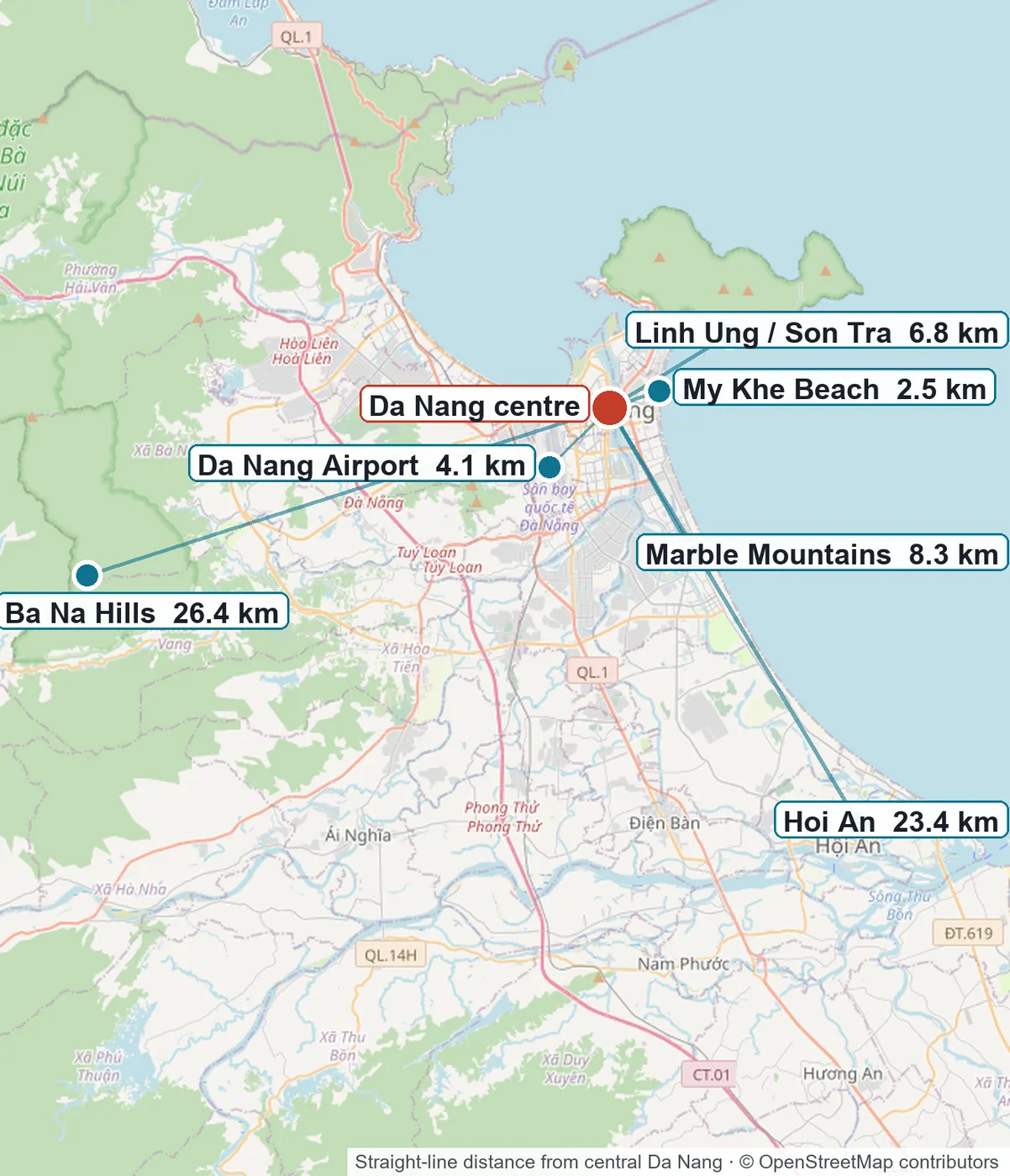
Repacking a suitcase is harder work than any of the sightseeing, so it is worth choosing one hotel and staying in it. Da Nang sits between the two things most people come for, with Hoi An forty minutes south and Ba Na Hills an hour west.
That makes both of them day trips from a single room, and it means your parents come back each afternoon to a bed they already know. It also means the difficult part of the day, which is the middle, always happens somewhere with air conditioning.
2. Landing, and making the first day easy
Da Nang International AirportMap sits inside the city rather than an hour outside it. The beach hotels are fifteen to twenty minutes from the terminal, which means you can check in, shower and be at dinner without another long transfer. On a day that started with a long-haul flight, that matters more than anything else on the itinerary.
Immigration queues build when several wide-bodies land together, and long-haul arrivals often come in late at night or before dawn. If you are landing in the small hours, the guide to late-night arrivals in Da Nang covers what is open, what is not, and how to get to a hotel at three in the morning.
The queue can be skipped
Fast-track products bundle priority immigration with a dedicated counter and, on some versions, a buggy through the terminal. Split across a family of four the per-person cost is modest, and the real benefit is that nobody stands in a line for forty minutes at the end of a fourteen-hour journey.
What is actually included varies a great deal between sellers even when the listing name is identical, so it pays to read the inclusions rather than the title. The comparison is set out item by item in the Da Nang airport fast track guide.
If standing for a long time is difficult
Airport assistance, including a wheelchair through the terminal and onto the aircraft, is free and available on request. The request goes to the airline rather than to the airport, either when booking or before departure.
The deadlines published for it do not agree with one another. Da Nang airport asks for forty-eight hours before arrival or departure. Vietnam Airlines asks for twenty-four hours through a ticket office or the call centre, and thirty-six hours through the online form. Since the three numbers differ, working to the earliest of them clears all three.
One thing is worth knowing in advance: Vietnam Airlines states plainly that cabin crew do not help with eating, do not accompany passengers to the lavatory and do not administer medication. They are trained in first aid and nothing beyond it. If help of that kind may be needed during the flight, a family member needs the neighbouring seat. Terminal numbers are 0905 920 019 for the domestic building, staffed around the clock, and +84 905 796 797 for international.
3. Dawn on My Khe, when the beach belongs to the city
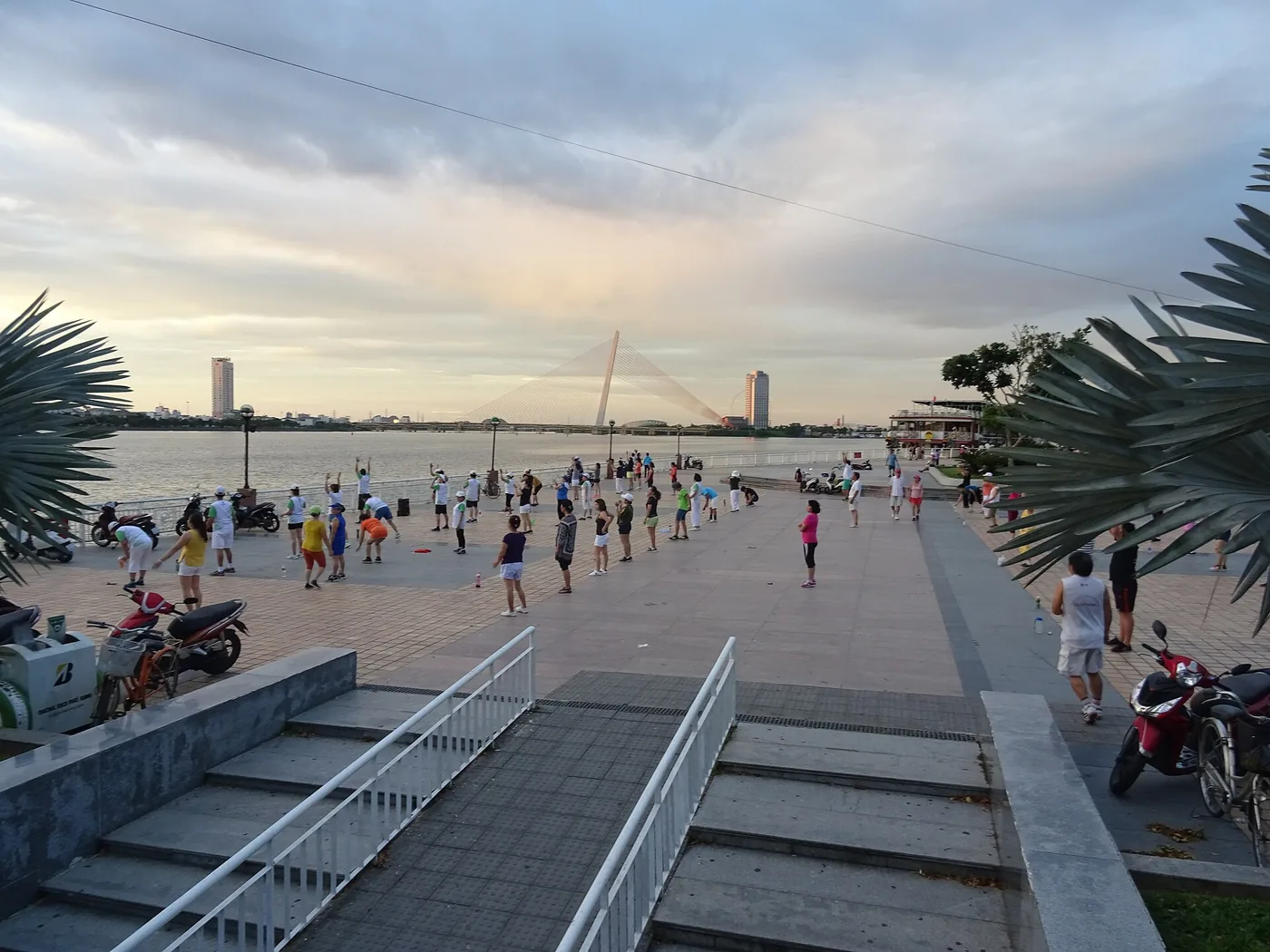
Before the sun is up, several hundred people are already on My Khe Beach. Some are swimming, some are walking the waterline, and others are working through exercise routines in groups on the sand while fishing boats come in behind them. None of it is staged for visitors. It is simply what this city does with the first hour of daylight.
The habit rests on a long-held local belief that early-morning seawater is good for the circulation and for general health, and it holds all year rather than only in the warm months. Cloudy mornings draw a crowd too.
What time to walk out
| Time | The beach |
|---|---|
| 04:50–05:20 | Still dark, and people are arriving |
| 05:20–05:35 | Sunrise. In summer it lands around half past five |
| 05:30–06:30 | The busiest stretch, with swimmers and exercise groups together |
| 06:30–07:30 | The crowd thins and the sand goes quiet |
From a beach-road hotel this is a walk rather than a taxi ride, which is the whole argument for staying on that side of the city. Arrive at half past five and you get the sunrise and the crowd in the same twenty minutes. The beach itself is covered in more detail in the My Khe Beach guide.
Jet lag stops being a problem
Coming from Europe or North America, most people wake somewhere between three and five in the morning for the first few days, and older travellers often take longer to shift than their children do. In a city that starts at nine that is three dead hours in a dark room.
Here it is simply an early start. Walk out at five, sit on the sand while it gets light, eat breakfast at seven when the noodle shops are at their best, and the body clock corrects itself in daylight rather than in bed. Whatever else you plan, put the beach in on the first morning.
Going into the water
Lifeguards work published hours on the city beaches, and there is a supervised evening swimming window from seven until ten at night. The residents who swim at dawn mostly stay in chest-deep water close to shore rather than going out.
| Months | Sea | Swimming |
|---|---|---|
| February–March | 23–24°C | Comfortable for wading |
| April–May | 26–28°C | May brings the year’s steepest rise |
| June | Around 29°C | The calmest, driest of the summer months |
| July–September | 29–30°C | The warmest water of the year |
| October–December | 25–28°C | More days with a heavy swell |
April through September is the easy half of the year for getting in, and June in particular tends to be calm as well as warm. From autumn onward the sea can run a strong swell on days that look perfectly fine from the promenade, so it is worth swimming near a lifeguard station and reading the flags. Conditions beach by beach are set out in the guide to Da Nang’s beaches.
4. Breakfast, and the shops that are only open for it
Come back from the beach and it is time for the best meal of the day here. Da Nang’s noodle and congee shops open around half past five and stop when the day’s pot is finished, usually somewhere around ten. Many of them do nothing else, so a place you noticed yesterday afternoon may well have been shut when you walked past it.
Breakfast suits an older group better than any other meal in this city. The rooms are not yet hot, the fans are enough without air conditioning, and there are seats free.
What people eat in the morning
| Dish | What it is | Chewing |
|---|---|---|
| Cháo | Rice porridge simmered until the grains dissolve. Chicken and duck are the usual versions | Almost none |
| Bún chá cá | A clear fish-cake noodle soup, and the most common breakfast in the city | Light |
| Mì Quảng | Thick noodles with very little broth. The dish Da Nang is known for | Moderate |
| Phở | Rice noodle soup with beef or chicken | Light |
| Bánh canh | Thick, soft noodles in a heavier broth | Light |
Congee is the gentlest thing on the table. The rice is cooked until nothing is left to chew, and one of the city’s better-known duck congee shops has been picked up in the Michelin Guide’s Da Nang selection. It uses a local duck breed from Cam Nam island, simmered with rice, mung bean and job’s tears in duck stock.
One version to approach with more care is cháo lòng, made with pork offal. It is a favourite locally and divides visitors sharply. Chicken or duck congee is the safer first bowl.
Check the hours before you walk out
| Type of place | Hours |
|---|---|
| Morning noodle and congee shops | Open about 5:30, finished around 10:00 |
| All-day noodle shops | Roughly 6:00–22:00 |
| Cafes | From about 7:00 |
| Beach road seafood | Open at 10:00 |
The morning trade and the evening trade hand over at ten o’clock. Walk out at half past nine and you arrive after the noodle shops have sold out and before the seafood places have unlocked the door. Between seven and eight is the sensible window, and it also gets you back to the hotel before the worst of the heat.
Coffee, and how strong it is
Vietnamese coffee is served short, very strong and usually sweetened with condensed milk. It is a great deal more intense than most visitors expect, and a small cup is plenty for a first try.
Ask for it with ice, or with less milk, and both are understood everywhere. There is a growing set of quieter cafes with proper seating and air conditioning, which makes them useful again later in the day. The Da Nang coffee guide covers where to go, and the Da Nang food guide covers the rest of the city’s cooking.
The morning market
Markets are at their best in the same window, before the heat and while the produce is still coming in. Even without buying anything it is worth half an hour, and the fruit is a good reason to buy something.
Mango, mangosteen, dragon fruit and rambutan are all in the stalls depending on the month, and vendors will peel and cut for you if you ask. Take it back to the hotel for the afternoon. The guide to Da Nang’s markets and shopping has the individual markets.
5. Son Tra and the Linh Ung Pagoda, with the widest view in the city
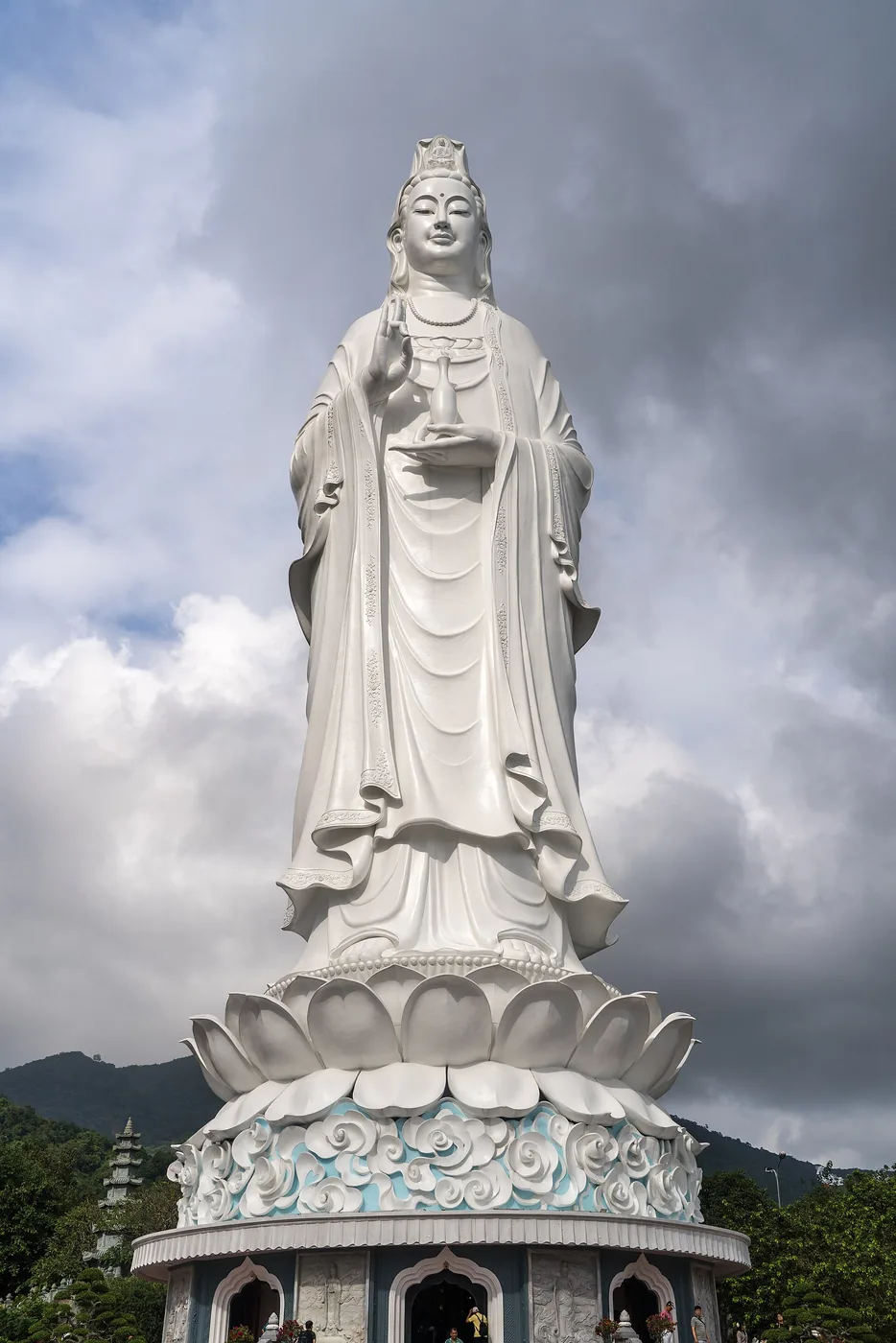
The Son Tra peninsula runs out into the sea northeast of the city, and the Linh Ung Pagoda sits partway up it. From the courtyard the whole of Da Nang Bay opens out, which is the broadest view anywhere in the city, and a white statue of the Lady Buddha stands facing the water above the temple buildings.
The grounds themselves are flat, paved and planted with trees, so there is shade to sit in. Come in the morning and the light is still soft, the coach groups have not arrived, and the courtyard is quiet enough to hear the bells.
Ask the driver for the upper car park
There are two car parks at the pagoda. The lower one leaves you with a flight of steps up to the temple level. The upper one is on the temple level itself, so you step out of the car and walk straight in.
Telling the driver which one you want, before you set off rather than on arrival, is the single most useful thing on this page. If steps are hard on your parents’ knees, ask for the upper gate, which is cổng trên in Vietnamese, and the driver will know exactly what you mean.
The monkeys, and the road
Son Tra is a forested headland with a resident population of wild macaques, and they are often on the roadside. They are used to people and will come close to anyone holding food. Keep hands and food inside the vehicle and there is nothing to it.
The road up is steep with tight bends, and although a great many visitors ride it on a scooter, a car is the better call with parents aboard. There is more on the headland in the Son Tra peninsula guide and on the temple in the Lady Buddha and Linh Ung Pagoda guide.
6. Marble Mountains, where a lift goes most of the way up
🧍 Da Nang solo: bike taxi fares, meals for one and a three-day timetable →
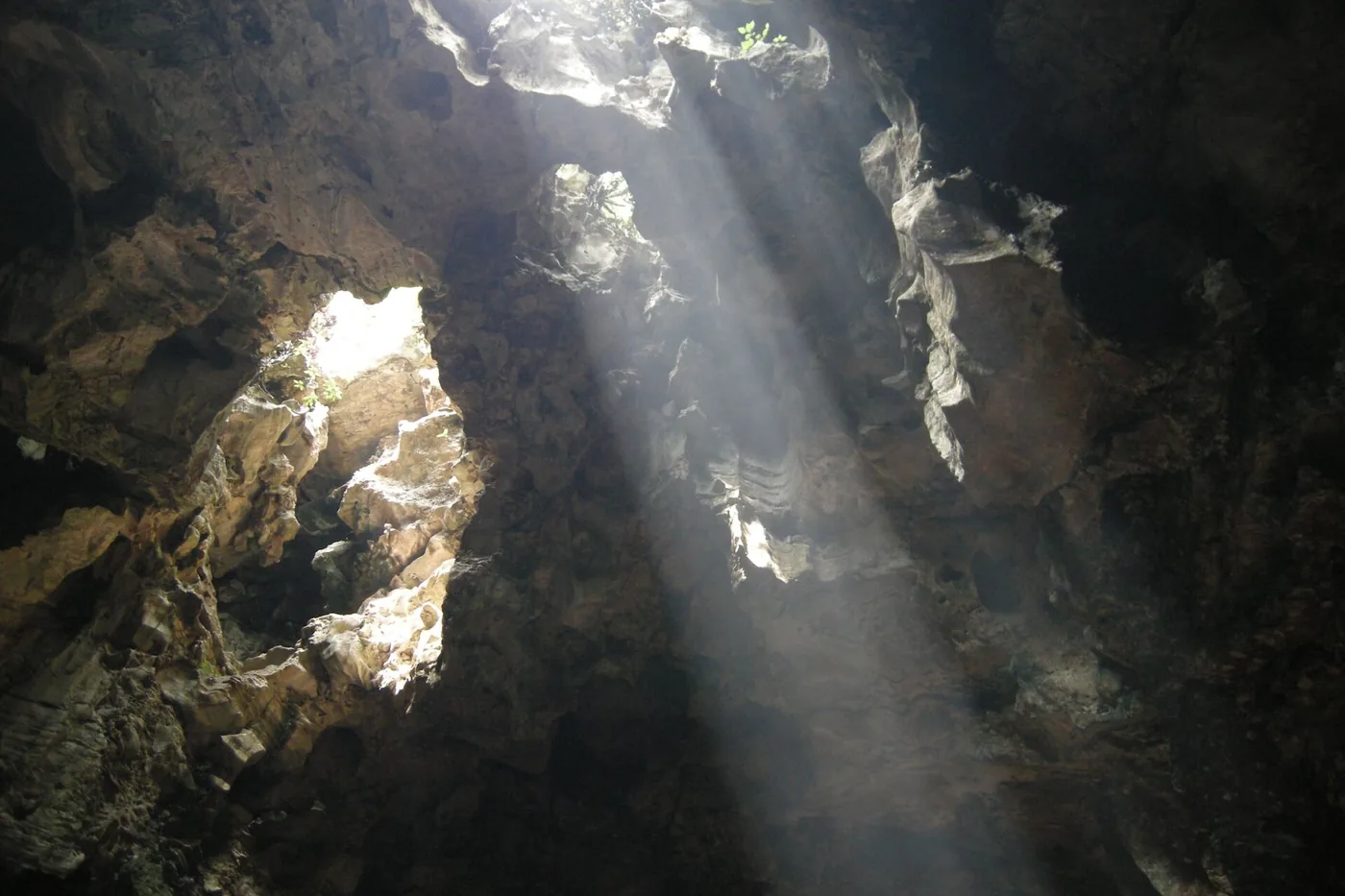
Twenty minutes south of the city, the five limestone and marble outcrops of the Marble MountainsMap rise straight out of flat ground. The one you can climb is Thuy Son, and on top of it are pagodas, viewpoints and a set of caves. The best of them is Huyen Khong, a high chamber where holes in the roof drop columns of light onto the shrine below.
From the terraces the coastline runs north in one unbroken line back toward the city. At the foot of the hill, stone carvers have worked the marble for more than four hundred years, and their workshops still line the road.
There is a lift, and it is not a detour
The stairs to the top run to a hundred and fifty-six steps from the western gate and a hundred and eight from the eastern one. Beside the eastern gate there is a glass lift instead. It stands thirty-four metres, carries up to 1,350 kilograms, and the site’s management put it in specifically for older visitors, children and pregnant women.
The lift removes almost all of the climbing. What it does not remove is the ground on top, which is uneven stone paths and short flights between one shrine and the next. If knees are a concern, Huyen Khong cave alone is worth the trip and the far viewpoints can be skipped without missing the point of the place.
| Detail | |
|---|---|
| Hours | 07:00–17:00 daily |
| Thuy Son entry | 40,000 VND |
| Lift | 15,000 VND per trip |
| Am Phu cave | 20,000 VND, ticketed separately |
The gates close at five, so a late-afternoon visit runs out of daylight and out of time. Morning works better, and it pairs naturally with lunch nearby and an afternoon back at the hotel. Cave by cave, it is all in the Marble Mountains guide.
What to wear
These are working temples, so shoulders and knees should be covered. Something with sleeves that also covers the knees is the practical answer, and it gets used at Linh Ung and on Ba Na as well.
Footing matters more than usual. Cave floors are worn smooth and stay damp year-round, and the stone steps are polished from use, so shoes with some grip are worth more than they sound.
7. Ba Na Hills, twenty minutes seated to the top of a mountain
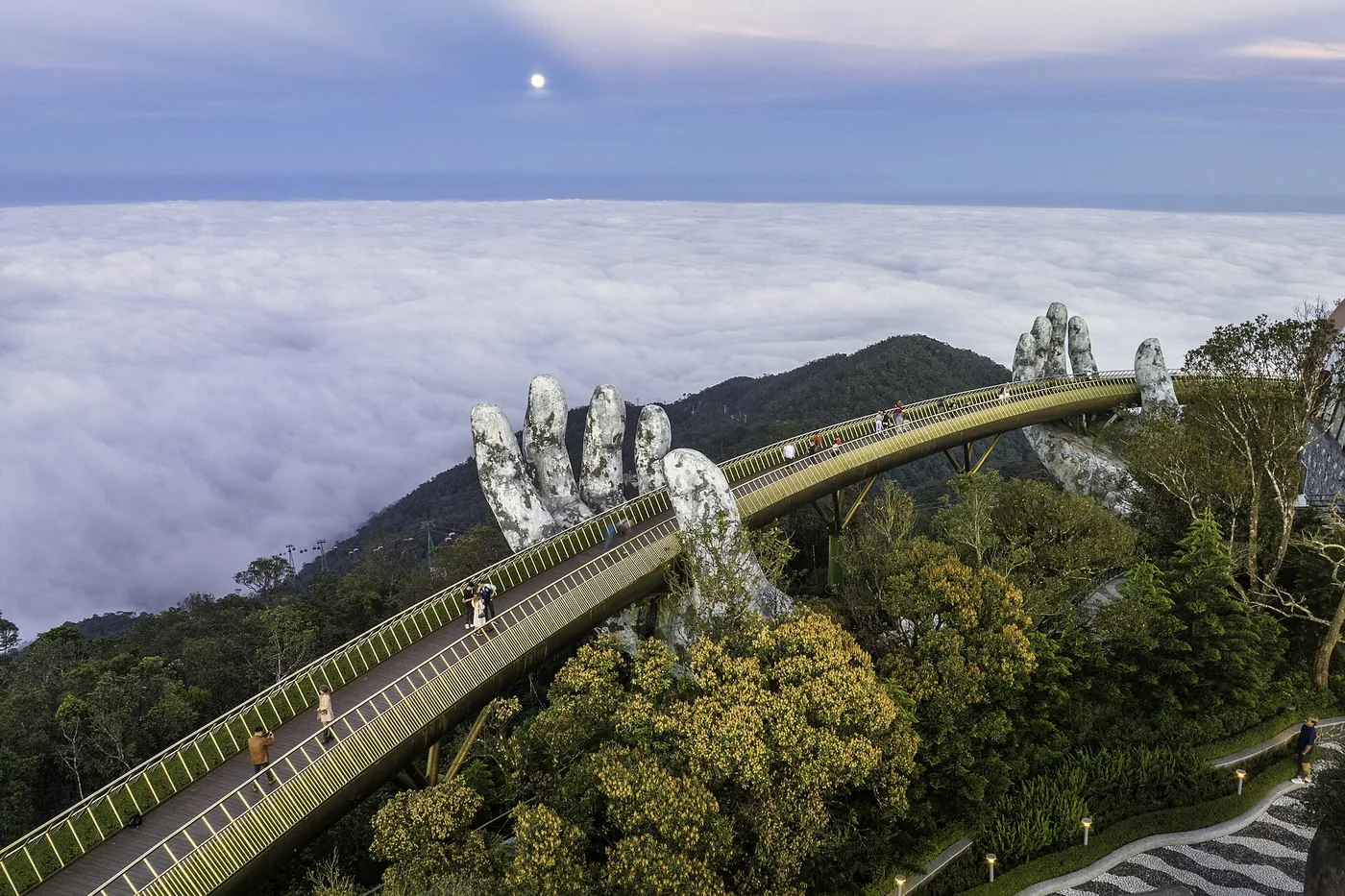
Twenty-five to thirty kilometres west of the city, and forty-five to sixty minutes by road, Ba Na HillsMap sits on a summit at 1,487 metres. There is a French-styled village up there, formal gardens, and the Golden Bridge, the walkway held up by a pair of enormous stone hands that has been on the cover of most things written about Vietnam in the last few years.
You get up there in a cable car, and the ride is fifteen to twenty minutes over jungle and waterfalls. As a way to gain more than a kilometre of height while sitting in an upholstered seat, it takes some beating.
The top is flatter than people expect
Step out at the summit and the French village opens up, and that part is broadly level, paved and full of places to sit. Between the garden level and the upper gardens there is a funicular, and it is included in the entrance ticket with no cap on how many times you ride it. Nobody has to walk up to the flowers.
What the summit does have is steps and escalators between one zone and the next, and less shade than you would want in the middle of the day. If long walking is difficult, the Golden Bridge and the village are the part worth having, and the amusement halls can be skipped without regret.
It is markedly cooler up there than in the city, and cloud rolls through the site for parts of most days. A light layer is worth carrying even in high summer.
| Detail | |
|---|---|
| Hours | 08:00–22:00 daily, opening nearer 07:00 in peak season |
| Cable car | 15–20 minutes, ten-person cabins |
| Included | All cable car lines return, unlimited funicular, the Golden Bridge and gardens |
| Entry | 1,000,000 VND, and 800,000 VND from age 70 |
There is a separate fare band from seventy, so bring a passport to the ticket window. Beyond that, the table argues for going up early: mornings are clearer, the cloud tends to sit lower later on, and the Golden Bridge is close to empty before the coaches arrive. Which cable car line to take, and how the crowds move through the day, are covered in the complete Ba Na Hills guide.
8. Giving the middle of the day back
From half past eleven the light gets hard and the pavements give the heat back. Keep pushing through it and the evening is gone before it starts. Two or three hours indoors, then back out when it eases, is the difference between a good week and an exhausting one.
The Museum of Cham Sculpture
The Museum of Cham SculptureMap stands beside the river in the middle of town, in a French colonial building from the early twentieth century arranged around open courtyards. It holds the largest collection of Cham stone sculpture anywhere, carried down from the temple sites of the surrounding region.
The floors are flat, the route is paved throughout, and the whole circuit is a little over a kilometre and takes thirty to forty-five minutes at an unhurried pace. Only some galleries are air-conditioned and the rest are open to the courtyards, so late morning or late afternoon is more comfortable than the middle of the day.
Every piece is labelled, which makes it a place to move slowly rather than a place to tick off. The Cham Museum guide sets out what to look for.
An afternoon massage
Massage is inexpensive here by any standard and the city is full of places offering it. Sixty minutes for feet and ninety for a full body are the standard formats, and plenty of places take walk-ins. After a morning on your feet it resets the day.
Say at the start how much pressure you want. The default here is firm, and asking for something gentler is completely normal and immediately understood. The Da Nang massage and spa guide covers what to expect and what to tip.
When it rains
Late summer into autumn brings serious rain to this coast. More often than not it arrives as a couple of hours of downpour rather than a washed-out day, so moving indoors for that stretch keeps the plan intact.
The heavier weather also tends to come in the afternoon, which is when you wanted to be inside anyway. Places that work in bad weather are collected in the guide to Da Nang when it rains.
9. The seafood restaurants open at ten
Along the beach road there is a run of seafood restaurants with tanks at the front. They open at ten in the morning and stay open until the last table leaves, which is the exact hour the breakfast shops finish. The city’s kitchens hand over at ten and it is worth knowing which side of that line you are on.
The usual system is that you choose from the tanks, staff weigh what you picked, and it is cooked to order. Older visitors tend to enjoy this part more than their children expect, because it is a market as much as a meal.
Ordering without surprises
| How it works | |
|---|---|
| Pricing | By weight, from the tank. Prices are posted per kilogram |
| Cooking | Steamed, grilled or stir-fried, and chilli can be left out |
| Portions | Tell staff how many are eating and they will size the order |
| Seating | Most places have an indoor room as well as tables on the sand |
Check the weight before it goes to the kitchen. Prices are per kilogram, so a large crab or fish adds up faster than it looks in the tank, and staff are entirely used to being asked. Saying how many people are eating is usually enough for them to pick sensibly on your behalf.
Tables on the sand have the view and the heat, and both are strongest in the late afternoon. Ask whether there is an indoor room, and if there is not, go after dark instead. Individual restaurants are in the Da Nang seafood guide.
Herbs and heat
Vietnamese cooking uses a lot of fresh herbs, and coriander in particular divides people. Asking for a dish without it works everywhere and causes no offence at all.
Chilli generally comes on the side rather than in the pot, so a dish is only as hot as you make it. Da Nang seasons more assertively than Hanoi or Saigon, which is worth knowing on the first night. Table manners and tipping norms are in the Vietnam etiquette guide.
10. The evening happens on the river
After dark the Han River is the centre of the city. The bridges are lit in different colours, the promenades on both banks fill up with families, and boats work up and down the middle of it. An hour on one of those boats is the least demanding evening on offer and the one most people remember.
Cruises come in sixty and ninety minute versions. The ninety-minute boats typically leave at eight, and the sixty-minute boats at half past eight and nine.
Timing the Dragon Bridge
The Dragon BridgeMap breathes fire and then water at nine o’clock on Friday, Saturday and Sunday. You can watch from the bridge itself or from a boat, but if you want it from the water you need a departure that is still afloat at half nine.
A six o’clock cruise is back at the pier by half seven and misses it entirely. Read the return time rather than the departure time when you book. Piers and operators are covered in the Han River night cruise guide, and the show itself in the Dragon Bridge fire show guide.
Watching from the bank instead
The bridge deck and the nearest stretch of promenade get very crowded before the show, and holding a place at the front means arriving half an hour early and staying on your feet for it.
If standing in a crush is not appealing, the far bank has room and a clear line of sight. It is also drier: the water jets carry, and people on the bridge itself get soaked most weeks. Check which way the dragon is pointing before choosing a spot.
11. Hoi An, where the hour you arrive sets how far you walk
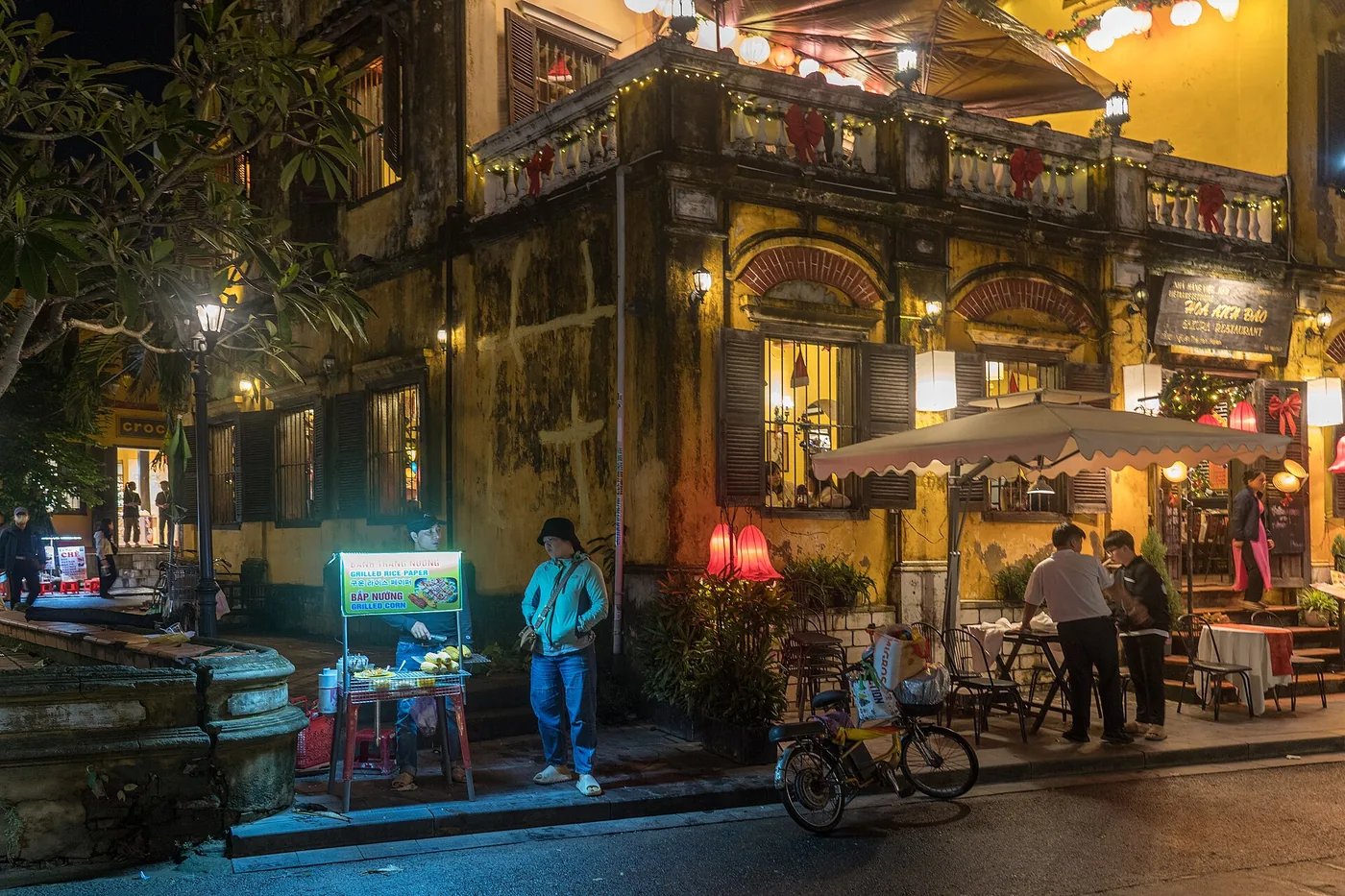
Thirty kilometres south of Da Nang, Hoi An’s old townMap is about forty minutes by road. Two-storey timber shophouses, assembly halls and a covered bridge survive along a handful of riverside lanes, and after dark the whole of it is hung with silk lanterns. Almost everyone staying in Da Nang gives it a day.
If you take one thing from this section, take the timetable.
When cars can get close, and when they cannot
| Area | Pedestrian hours |
|---|---|
| The old town | 09:00–21:30 in summer, 09:00–21:00 in winter |
| Phan Chau Trinh street | 17:30–21:30 in summer, 17:30–21:00 in winter |
Inside those hours no cars or motorbikes enter the protected lanes. Arrive after nine and you are set down at the edge and walk in. Arrive before nine and a car gets you a great deal closer to the middle.
That single fact reshapes the day. Go early, see the town before it heats up, drive back to Da Nang for the afternoon, and return in the evening for the lanterns. If two round trips sounds like too much, one night in Hoi An removes the problem entirely, and the Hoi An accommodation guide sets out which part of town to sleep in.
Electric shuttles and boats
Small electric vehicles work the streets around and through the old town, seating anywhere from four to fifteen, and they run until close to ten at night. During pedestrian hours they are the way to cut the distance on foot.
On the river, sampans take passengers along the waterfront, and these are the boats that carry the paper lanterns after dark. Sitting on the water looking back at the town is a gentler hour than walking the lanes in a crowd.
Out at Cam Thanh, in the water coconut palms, the round basket boats run forty-five minutes to an hour and seat three adults with a rower. Life jackets are provided. Getting in and out is the awkward part, since the boat moves under you, and operators note that it is not recommended for anyone with limited mobility. If that is a concern, the river sampans are the steadier choice. The town is covered in the Hoi An travel guide and the journey in the Da Nang to Hoi An transport guide.
The old town ticket
Entry to the protected area is ticketed, at 120,000 VND or 80,000 VND depending on how many of the heritage houses and halls are included. It stays valid for three days from first use.
That three-day window is more useful than it looks with parents along, because it means you do not have to see everything in one push. Use half of it in the morning, come back for the evening, and keep the rest for another day. What is worth going inside is listed in the guide to things to do in Hoi An.
12. Where to stay, and what to ask before booking
Stay in one place. Da Nang is central enough that both of the big day trips work from a single room, and the effort saved on packing is worth more than any hotel upgrade. Within the city, though, the districts are quite different from one another.
| Area | What it is like | Suits |
|---|---|---|
| My Khe beach | Seven kilometres of sand with hotels packed along the road behind it. Restaurants and shops within walking distance | Walking out to the beach at dawn |
| Non Nuoc | Further south and quieter, dominated by large resorts where most things happen inside the grounds | Long afternoons at the hotel |
| Hai Chau | The city centre, with markets and restaurants close by and the riverfront promenade alongside | Walking out to dinner |
My Khe wins on one specific point for this trip, which is that the dawn beach is a walk rather than a journey. Non Nuoc is closer to the Marble Mountains and better if the plan involves long rests, and Hai Chau puts the cruise piers and the markets on your doorstep.
Four questions worth asking
Room floors, lift positions and bathroom thresholds are not in any listing, and hotels answer readily when asked directly by email before booking.
Ask whether lower-floor rooms are available, how far the room is from the lift, whether the bathroom has a step up into it, and what time breakfast starts. That last one matters more than it sounds, because a hotel that starts serving at seven fits the morning described on this page and one that starts at eight does not. The districts are compared in more detail in the guide to where to stay in Da Nang.
13. Three days and four days, laid out
Fitted to the hours in the first section, the plan comes out like this. One substantial thing per day, and the middle of every day left empty on purpose.
Three days
| Day | Morning | Middle | Evening |
|---|---|---|---|
| 1 | Arrive, settle in | Rest | Seafood on the beach road, walk by the river |
| 2 | Dawn beach, breakfast, Linh Ung Pagoda | Massage or the hotel | Han River cruise |
| 3 | Marble Mountains | Lunch, then the airport |
On three days, choose either Ba Na Hills or Hoi An rather than attempting both. Each one takes most of a day, and doing them back to back removes every rest from the trip.
Four days
| Day | Morning | Middle | Evening |
|---|---|---|---|
| 1 | Arrive, settle in | Rest | Seafood on the beach road |
| 2 | Dawn beach, breakfast, Linh Ung Pagoda | Cham Museum | River cruise and the Dragon Bridge |
| 3 | Ba Na Hills, leaving for the 08:00 opening | Lunch on the summit | Back early, massage |
| 4 | Hoi An, arriving before 09:00 | Lunch, then back to Da Nang | Airport |
Ba Na Hills and Hoi An sit on opposite sides of the city, one west and one south, so combining them means crossing town twice in a day. Splitting them across two days costs nothing and saves a couple of hours in the car.
Hiring a car by the day makes all of this easier, and because it is charged by time rather than distance, it starts to make sense as soon as a day has three or more stops in it. Other lengths of trip are laid out in the Da Nang itinerary guide, and costs in the Da Nang travel budget guide.
14. What to bring
It is hot and humid, so the packing list is short. A few things are worth carrying from home rather than hunting for on arrival.
| Item | Why |
|---|---|
| Regular medication | Matching a specific formulation locally is awkward. Bring a copy of the prescription |
| A light layer | The Ba Na summit is cool, and indoor air conditioning is set low |
| Shoes with grip | Cave floors and temple steps are worn smooth and often damp |
| Hat and sun cream | The sun is strong well before midday |
| Passport | Ba Na Hills has an age-based fare band, and it is checked at the window |
| Electrolyte sachets | Easier than working out which local drink does the same job |
Insurance and staying in touch
Travel insurance is the one piece of admin worth doing early. Upper age limits, medical screening requirements and premiums vary enormously between insurers and between countries, so check what is available for your parents’ ages before booking anything non-refundable.
Read what the policy actually covers for hospital treatment abroad, and note what documents a claim needs. Almost every clinic here works on payment first and reimbursement later, so the paperwork matters more than the card.
For phones, an eSIM is the least trouble if the handset supports it, and plenty of older handsets do not, in which case a physical SIM is the answer. Check before leaving rather than at the airport. The options are compared in the Vietnam eSIM and SIM card guide.
Carry some cash. Markets and small noodle shops are cash-only, and the smallest of them will not have change for a large note. Currency and payment are covered in the Vietnam money guide, and the full list in the Da Nang packing list.
15. If somebody feels unwell
It rarely comes to anything, but knowing where to go removes a layer of worry from the trip. Da Nang has private hospitals used to treating foreign patients in English.
| Where | |
|---|---|
| Vinmec Da Nang International HospitalMap | Emergency department open around the clock, including weekends and public holidays. On 30 Thang 4 street in Hai Chau district |
| Family Medical Practice | A clinic aimed at foreign patients, with consultations in English. The right call for ordinary travel complaints |
| Hoan My Da Nang | A private hospital, also open around the clock |
The Vinmec emergency line is 0236 3711 111. Two of the three run overnight, so there is somewhere to go at three in the morning, which is usually when this sort of thing happens.
How payment works
You pay at the point of treatment, by card or in cash, and claim it back from the insurer afterwards. That makes the receipt and the medical report the two things you must not leave without.
Reports are usually issued on request rather than automatically, so ask before the consultation ends. Some insurers want the report in English, so it is worth knowing what yours requires before you travel rather than discovering it from a hotel room.
Pharmacies
Pharmacies are everywhere, marked with a green cross, and ordinary remedies for an upset stomach, a headache or a cold are easy to buy without a prescription.
Packaging is in Vietnamese, which makes matching a familiar medicine harder than it needs to be. Bring what is taken regularly, and carry a written note of the drug names and doses in case anyone needs to read it.
Heat, more often than anything else
Far more common than illness is simply being worn down by the heat, and the answer is shade, a seat and water taken slowly rather than a hospital.
Keep an electrolyte sachet or a cold drink in the bag and stop before anyone says they need to. Sticking to the shape of the day in the first section, which puts everybody indoors through the worst of it, prevents most of this from happening at all.