
The People Who Lost Their Names: How One Surname Swallowed Vietnam Over 800 Years
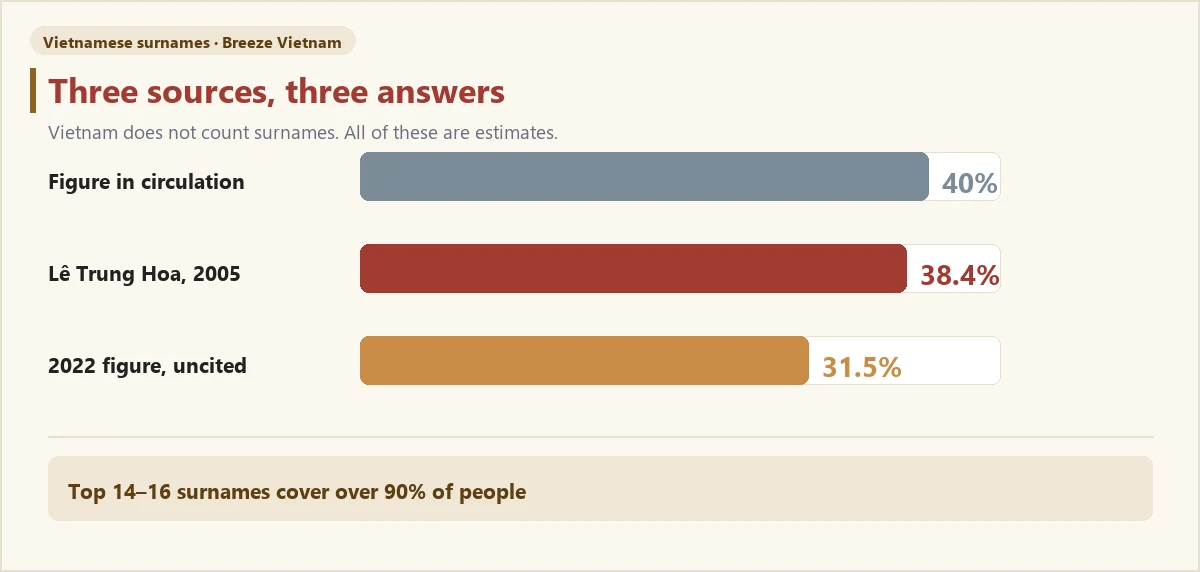
Somewhere between three and four Vietnamese people in ten answer to Nguyen. No government body has ever counted, so every figure you will read is an estimate. How the name spread this far starts with a record from 1232.

The name you will read a dozen times before lunch
Spend three days in Vietnam and you will read the name Nguyen more often than you read any road sign. It is on the badge of the woman who checks you in. It is on the laminated card clipped to the taxi driver’s sun visor. It was on the street sign you walked past on the way to breakfast.
At first it looks like coincidence. Then you fly to the next city and it happens again. Your guide is a Nguyen. So is the man who runs the noodle place. So is the airline agent who prints your boarding pass.
Roughly one person in three answers to it, and by some counts closer to four in ten. Nothing in the English-speaking world comes close. Smith, the most common surname in the United States, was carried by 0.8 percent of Americans in the 2010 census. Nguyen sits about forty times higher in its own country.
So the obvious question arrives on day two, usually while you are staring at a hotel guest list with four Nguyens on it: how did one name swallow an entire country?
Why the name alone will not find anybody
Hotel front desks run into this constantly. A guest gives a surname, the clerk scans the list, and there are three matches. The clerk asks for the rest of the name, because the surname carries almost no information.
This is also why nobody in Vietnam is addressed by their surname. Call out “Nguyen” in a crowded room and you will get a lot of eye contact and no useful result.
If a receptionist asks you to repeat yourself after you give a surname, they heard you fine. Give the last one or two syllables of the full name instead and the search ends immediately.
The short answer, before the long one
People did not choose this name. For most of the families who carry it, somebody else made the decision, and often not kindly.
The story runs about eight hundred years. Dynasties rose, and every time one did, some families were stripped of their surname, some were handed a new one as a reward, and some quietly buried the old one to stay alive. Nguyen collected all three groups.
If you are planning the whole trip, the Vietnam travel guide puts the pieces in order.

Nobody has actually counted
You have probably seen the figure “40 percent” somewhere. Follow it back to its source and the trail stops.
Vietnam does not count surnames. The household registration system tracks individuals, not name distributions, and the Ministry of Public Security’s national population database has never published a surname breakdown. There is no official number to cite, because nobody in government has ever produced one.
Everything in circulation is therefore an estimate by a researcher. And the estimates disagree with each other by a wide margin.
Even second place is disputed
Everyone agrees Nguyen is first. Below that the rankings shuffle.
The 2005 work puts Tran second and Le third. The other table reverses them, with Le second and Tran third. That is not a rounding difference, it is a swap.
From fourth place down the order is broadly stable, though the percentages still move by a point or two depending on which table you open.
Every percentage in this article is an estimate. None of them is a government figure. We have noted which source each one comes from so you can weigh it yourself.
One thing the sources do agree on
Whichever table you use, the top fourteen to sixteen surnames cover more than 90 percent of the population.
In a country of over one hundred million people, a list you could write on a napkin accounts for nearly everybody. Several hundred other surnames exist, and together they share what is left.
That concentration, more than the headline percentage, is the thing worth holding on to. It is the fingerprint of a very specific history.
In 1232 a family lost its name
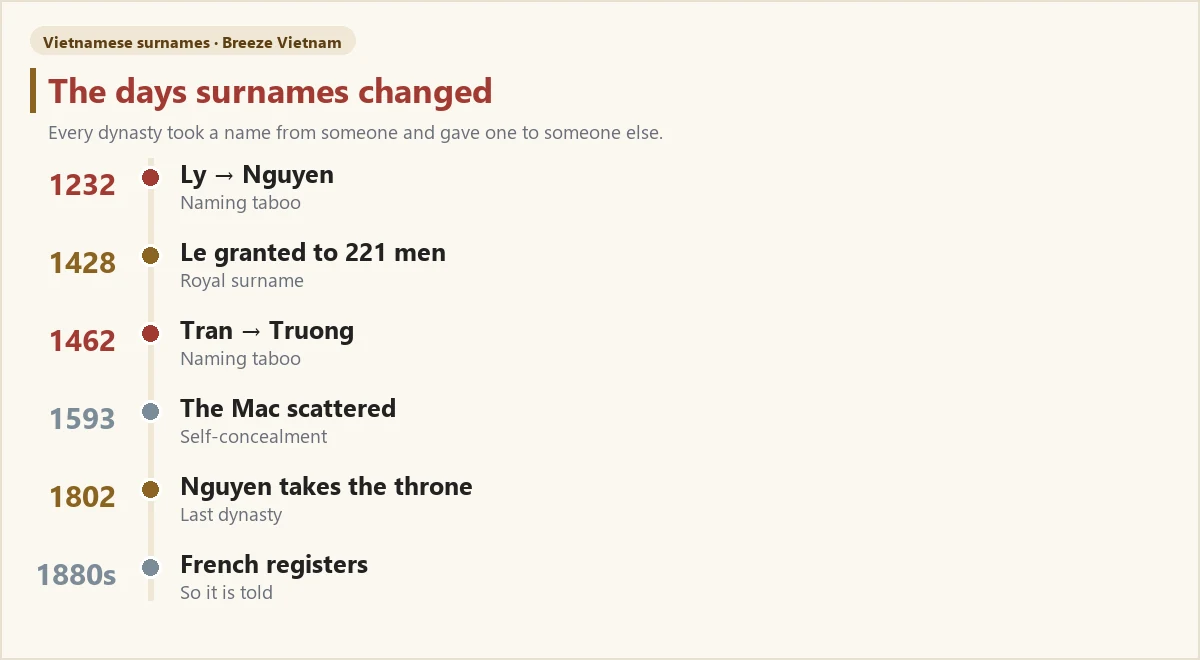
The first reason Nguyen spread is not a happy one. It begins in the months after the Ly dynasty collapsed and the Tran dynasty took the throne.
The man holding actual power was Tran Thu Do. He set about securing the new dynasty, and part of that work was erasing the old one.
The instrument he used was naming taboo, an old East Asian practice in which the characters in a superior’s name are forbidden to everyone below him. The grandfather of the reigning Tran emperor was named Tran Ly.
Because that name contained the character Ly, everyone who carried Ly as a surname had to give it up. The replacement they were assigned was Nguyen.
What happened at the ancestral hall
There is a heavier event attached to this order. The histories record a massacre at Thai Duong in Hoa Lam, at the ceremony where the Ly clan made offerings to the Ly emperors who had come before.
Those who survived changed more than their surname. They changed their given names too. The Ly ancestral shrine was pulled down, and the rites were moved to Dinh Bang.
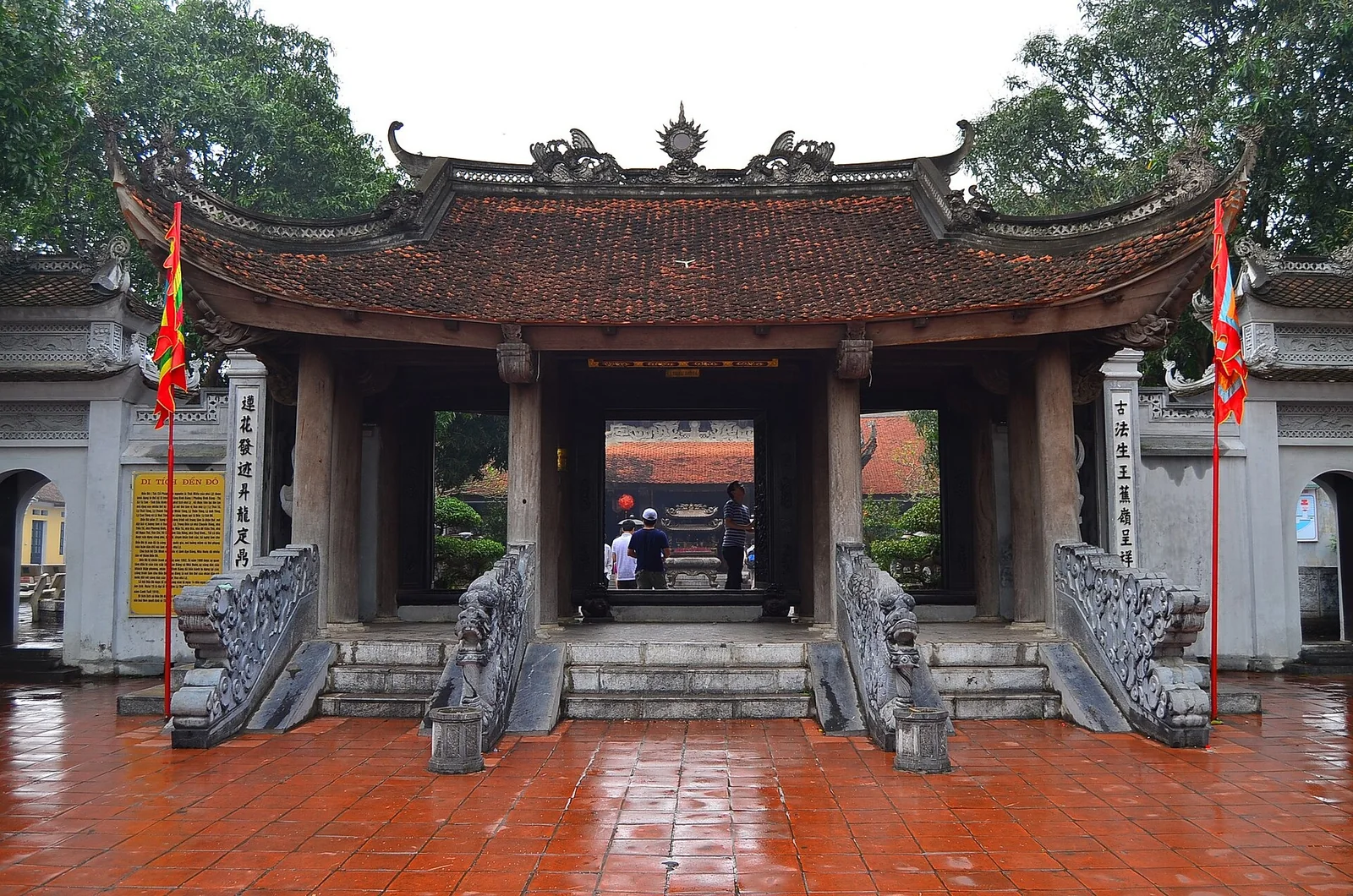
The temple that holds the eight Ly emperors still stands there, about an hour outside Hanoi by car.
Đền Đô, the Ly dynasty templeMap
Where the record survives
Two Vietnamese chronicles carry the account: the Đại Việt sử ký toàn thư and the Khâm định Việt sử Thông giám Cương mục. The second was compiled by the national historians of the Nguyen dynasty.
Which produces a small irony. The Nguyen dynasty’s own scholars wrote down the story of how the Nguyen surname had multiplied centuries before their family took the throne.
Changing a surname breaks the family record
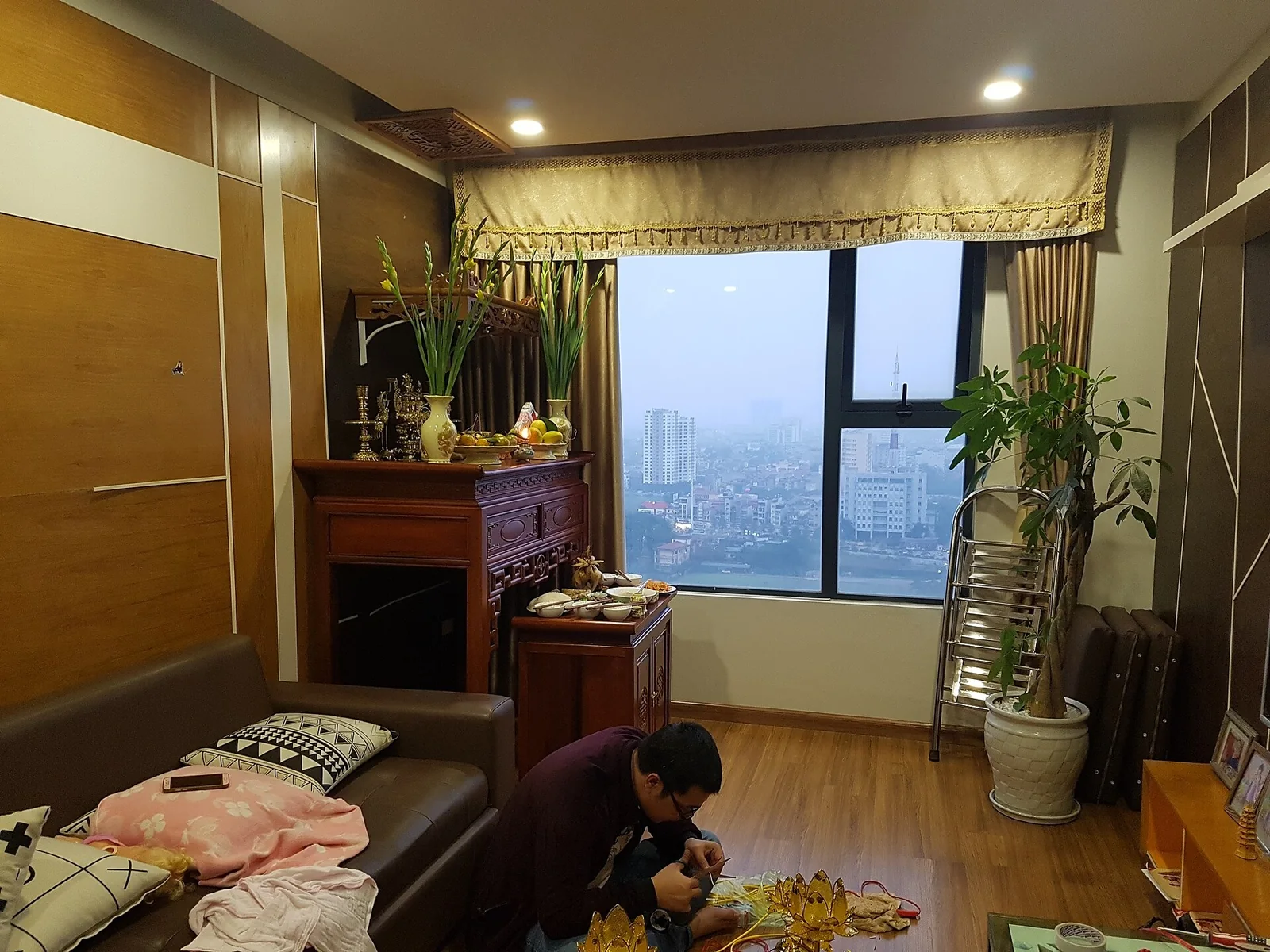
Vietnamese families keep a genealogy and make offerings to ancestors. Walk into a home or a small restaurant and you will usually see the altar, with incense burning on it. That practice has not faded.
A forced change of surname cuts that record in half. The ancestors on one side of the change and the descendants on the other become, on paper, unrelated.
Families who lost their name hid their genealogies or passed them down by word of mouth. A few generations of that and the memory thins out.
It is why most people named Nguyen today have no idea what their family was called before.
The imperial city in Hue still has the compound where those chronicles were compiled. Knowing what was written there changes how the buildings read.
And then it kept happening
If 1232 had been a one-off, Nguyen would be common rather than overwhelming. Mass surname changes turn out to be a recurring feature of Vietnamese history.
Every time a dynasty turned over, the new court handed its own surname to the men who had helped it win, while the losing side quietly buried theirs.
One was an honour and the other was survival, and they pushed in the same direction. The number of surnames in circulation kept shrinking.
Winning a war could earn you the king’s name
The 1428 grant runs in the opposite direction. After Lê Thái Tổ drove out the Ming armies and founded his dynasty, he gave his own surname to the men who had fought beside him.
It went to 221 men. Each one passed it to every descendant, so within a few generations the Le surname had multiplied enormously from a single afternoon’s decision.
The practice had a name and a purpose. Granting the royal surname rewarded a man and tied him to the throne at the same time. It is considerably harder to rebel against a family you have just been formally adopted into.
The Nguyen dynasty did the same thing later. So among today’s Nguyens are families who were something else entirely until an emperor decided otherwise.
The Tran were on the receiving end too
The 1462 order is the detail that stops this from being a story about one surname. The clan that stripped the Ly of their name had its own name stripped 230 years later.
The justification was identical. The empress dowager’s name contained the character Tran, so Lê Thánh Tông ordered everyone carrying Tran as a surname to become Truong.
Truong sits inside the top ten Vietnamese surnames today. How much of that is descended from families renamed in 1462 is not something anyone can calculate.
The Mac chose to disappear
What happened after 1593 was different in kind. No order came down. The descendants of the fallen Mac dynasty simply scattered and stopped using the name.
Some went north into the mountains. Some changed their surname and moved south. A portion of them picked Nguyen, precisely because it was already the name least likely to attract attention.
Hiding inside a common surname was the safest move available, and every family that did it made the surname more common still.
Then Nguyen became the name of the throne
In 1802 Nguyễn Ánh unified the country and took the throne under the reign name Gia Long. The dynasty he founded was the last one Vietnam would have.
It lasted until 1945. The French arrived partway through and took the real power, but the throne itself stayed in Nguyen hands to the end.
That is more than 140 years of Nguyen as the royal surname. Over that stretch the name came to signal authority and legitimacy. A man seeking office, or trying to establish himself in trade, had an easier time carrying it.
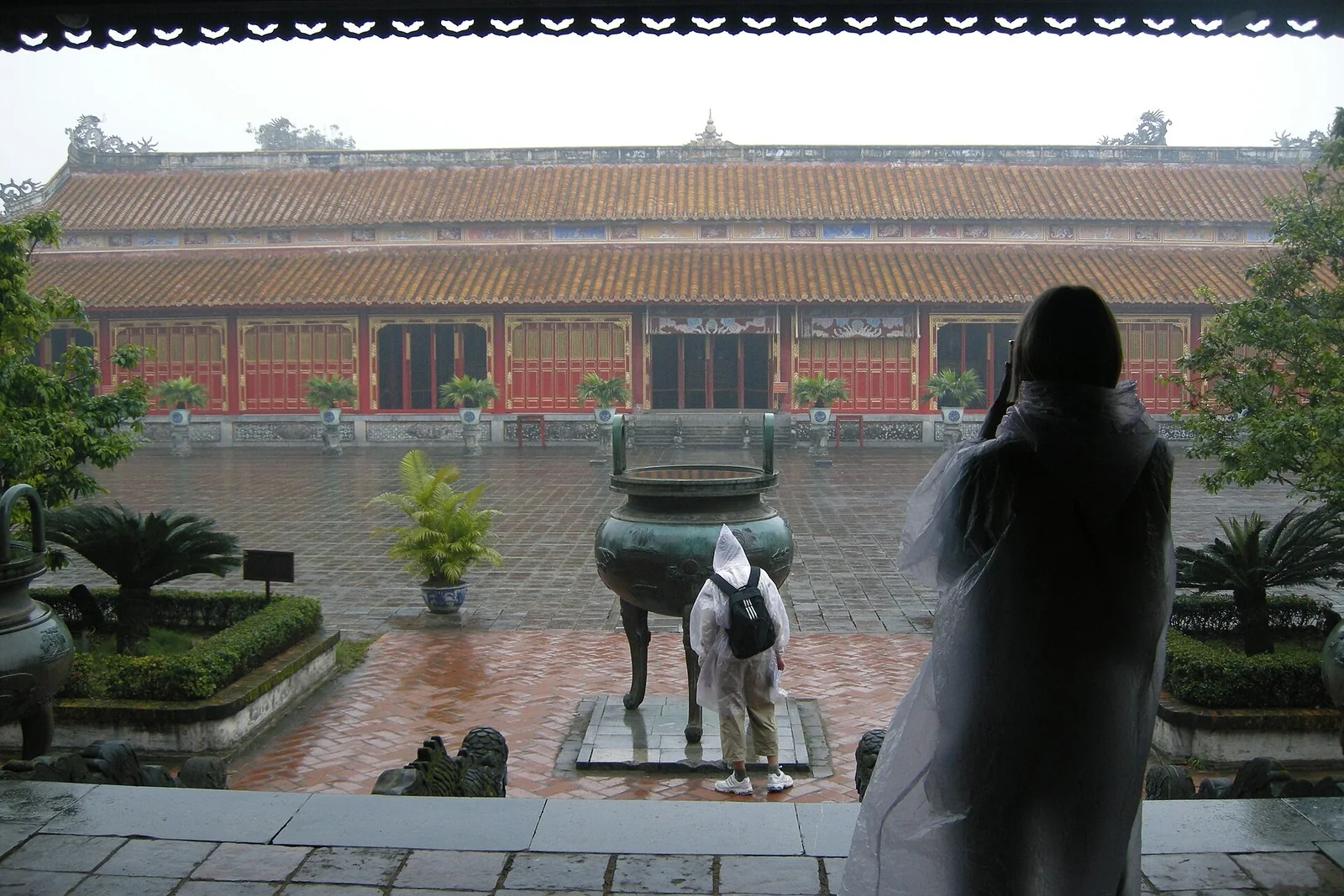
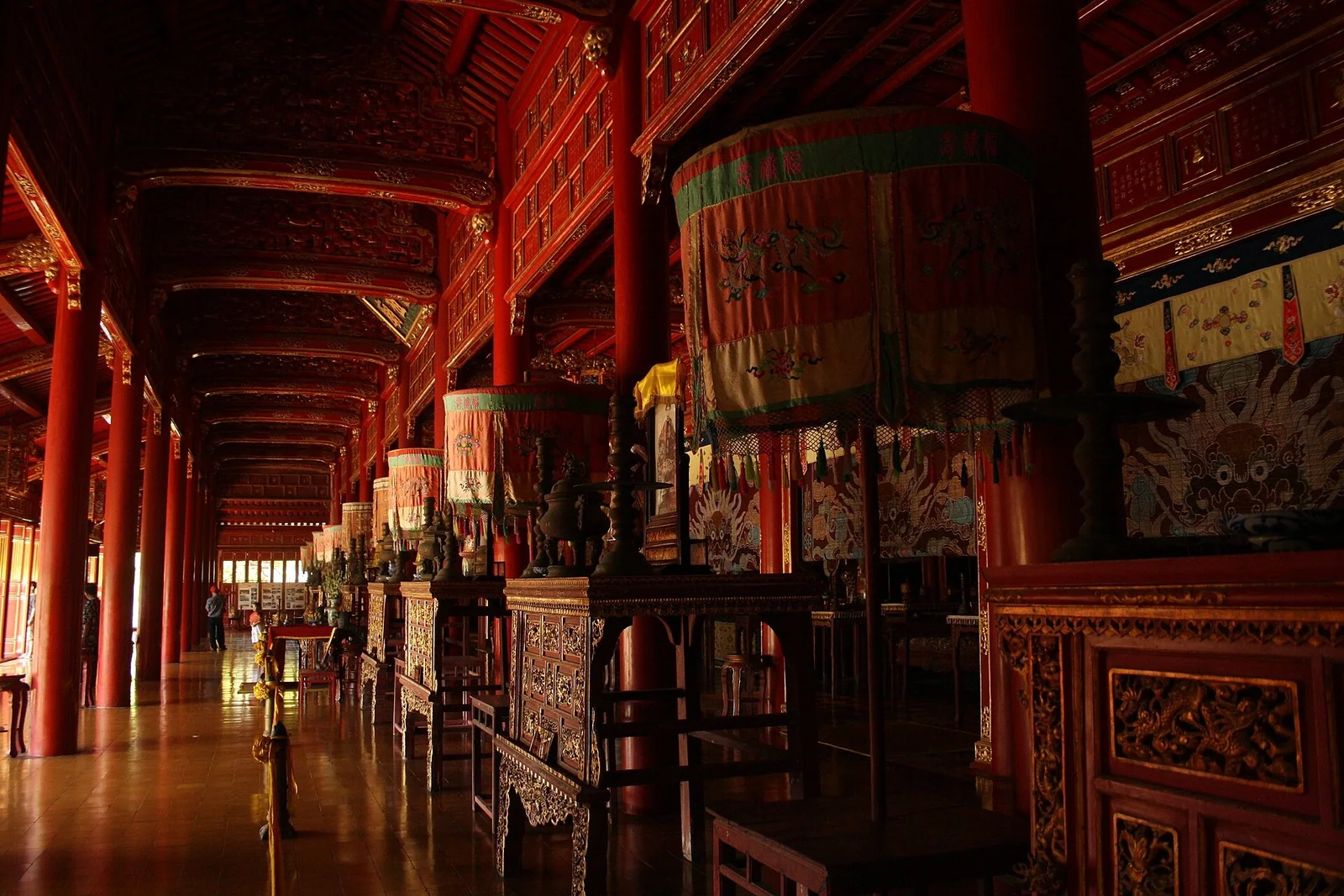
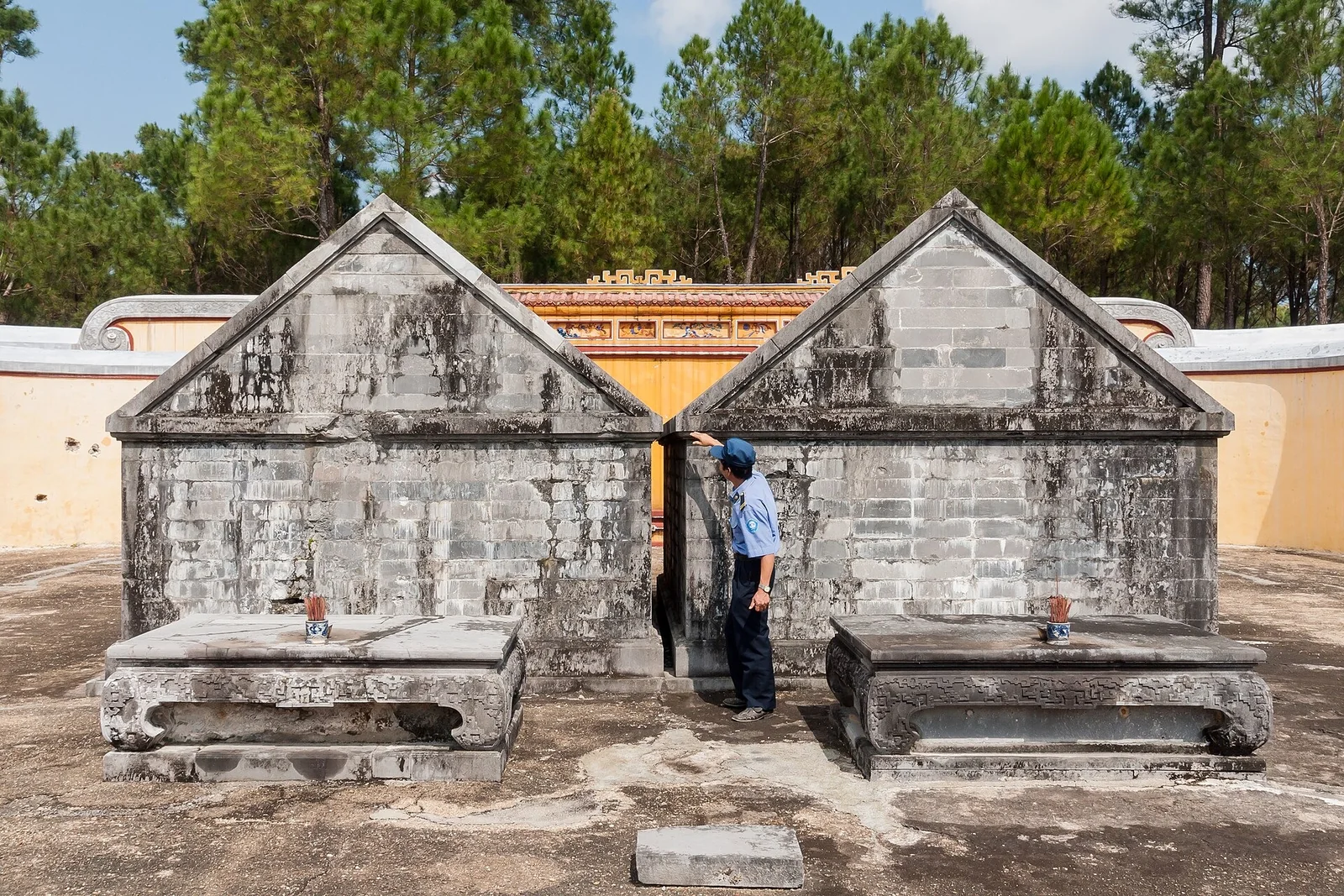
Hue is where you can still see this directly. Inside the imperial city, the Thế Miếu holds the ancestral tablets of the Nguyen emperors, and Gia Long’s tomb sits out beyond the city.
Thế Miếu, Hue Imperial CityMap
The royal descendants use a different surname
Here the story takes an odd turn. Direct descendants of the Nguyen emperors do not use Nguyen at all. They use Tôn Thất, and the women of those families traditionally use Tôn Nữ.
Almost every Vietnamese surname is one syllable. These are two, which was the point. The compound name marked the family as royal and set it apart from the ordinary Nguyens.
That creates a quiet hole in the statistics. Tôn Thất and Tôn Nữ are counted separately, so the actual Nguyen bloodline is wider than any percentage you will read.
The last step is credited to the French, with caution
From the 1880s the colonial administration began building modern civil registers. Every person needed a fixed surname written into a book.
A great many rural Vietnamese had never used one. The story goes that registrars assigned surnames during that process, and that the surname most often assigned was Nguyen.
This part is repeated everywhere but is hard to verify in period documents. It is a different kind of claim from the dynastic orders above, which are dated and recorded in the chronicles. Read it as tradition rather than as fact.
How to actually get around the citadel and the tombs is in the Hue travel guide.
Which part of the name is the surname
The surname comes first, the way it does in Korea, China and Japan. That much is straightforward.
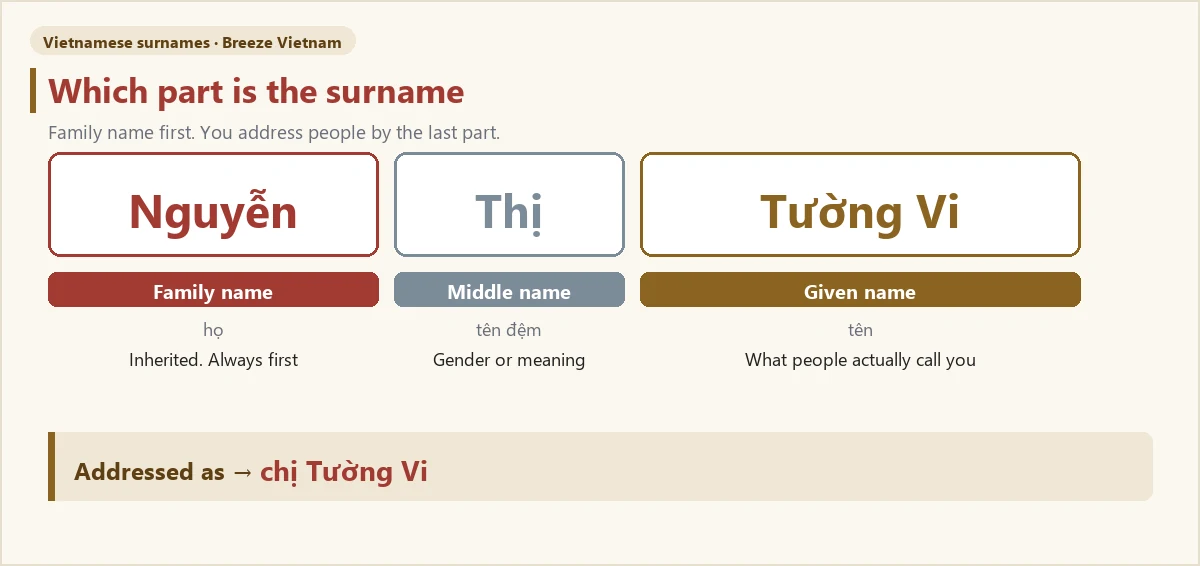
What trips people up is the middle. A Vietnamese name has three parts rather than two: family name, middle name, given name.
Take Nguyễn Thị Tường Vi. Nguyễn is the family name, Thị is the middle name, and Tường Vi is the given name. The part you actually use when speaking to her is Tường Vi, at the end.
The middle name used to announce your gender
In the older convention the middle slot held one of two characters: Thị for women, Văn for men.
It let anyone reading a name know whether it belonged to a man or a woman, which mattered in a language where given names are frequently unisex. You will see both characters constantly in the names of older Vietnamese.
Fewer families do this now. Parents pick a middle name for its meaning instead. Minh is bright, Ngọc is jade, Đức is virtue, Bảo is treasure, and Quỳnh is the flower that opens at night.
The slot exists because there were too many duplicates
The middle name does other work as well. With only a dozen or so surnames in circulation, family name plus given name produces collisions constantly.
A third slot spreads people out. It can also mark a generation within a family, or honour an ancestor by reusing a character from their name.
Some people carry two middle names, which is why a Vietnamese name is sometimes three parts and sometimes four. The structure is fixed at both ends and flexible in the middle.
You address people from the back
Vietnamese people are called by their given name in every setting, including formal ones. Your bank manager, your doctor and the customs officer are all addressed by the last part of the name.
Surnames are simply not used for address. Given how few of them there are, using one would communicate almost nothing.
What carries the politeness instead is a particle placed in front of the given name, which encodes relative age and relationship.
The particle carries the politeness. You use anh for a man somewhat older than you and chị for a woman somewhat older, em for anyone younger, and ông or bà for someone of your grandparents’ generation. The particle changes with the relationship, not with the name.
The middle name drops out when speaking
Nobody says Thị out loud. Nguyễn Thị Tường Vi is addressed as Tường Vi, and with the particle attached it becomes “chị Tường Vi”.
If the given name is a single syllable you use that single syllable. A badge reading Linh means you say Linh.
The written form and the spoken form of a Vietnamese name are genuinely different things, and the gap between them catches out a lot of visitors.
Where foreigners usually slip
If you are in the habit of greeting people by surname, this is where it misfires. Addressing someone as “Mr Nguyen” produces a small pause.
It is not offensive and it is not wrong exactly. It is just a construction nobody uses, so it lands strangely. The given name is the natural choice.
When you cannot tell where the given name starts, use the final one or two syllables. That is correct far more often than not.
Forms of address and greetings are covered further in Vietnamese etiquette and tipping.
A wife does not take her husband’s name
Vietnamese women keep their own surname after marriage. Legally nothing changes on the wedding day.
The civil code does contain a route to adopting a spouse’s surname, but it exists for marriages involving a foreign national whose home country requires it. Inside Vietnam it is essentially unused.
So the normal state of a Vietnamese household is two surnames. A woman named Tran who marries a man named Nguyen remains a Tran for the rest of her life.
For visitors from countries where the wife’s name changes, this takes a moment to adjust to. It is also why a family booking can show up with two different surnames on it and nothing is wrong.
Children take the father’s name
The wife keeps her surname, and the children take their father’s. The line runs through the men, generation after generation.
This is the mechanism that keeps Nguyen from shrinking. No new surnames enter the pool, and the existing ones simply propagate.
Some modern parents include both surnames, arranging the name as father’s surname, mother’s surname, middle name, given name. The mother’s surname effectively becomes a second middle name. On documents, the surname is still the father’s.
Except in the villages where it isn’t
Out at Sơn Đồng, west of Hanoi, the local custom works differently. Sons receive the father’s surname as normal. Daughters are registered with the father’s middle name as their surname.
Brother and sister therefore appear on paper to belong to different families. Keep that in mind, because this custom comes back later in this article, and it is currently causing real administrative trouble.
If you ever need to establish a family relationship on Vietnamese paperwork, do not rely on matching surnames. Spouses never match, and siblings sometimes don’t either.
The beach road is named after a person
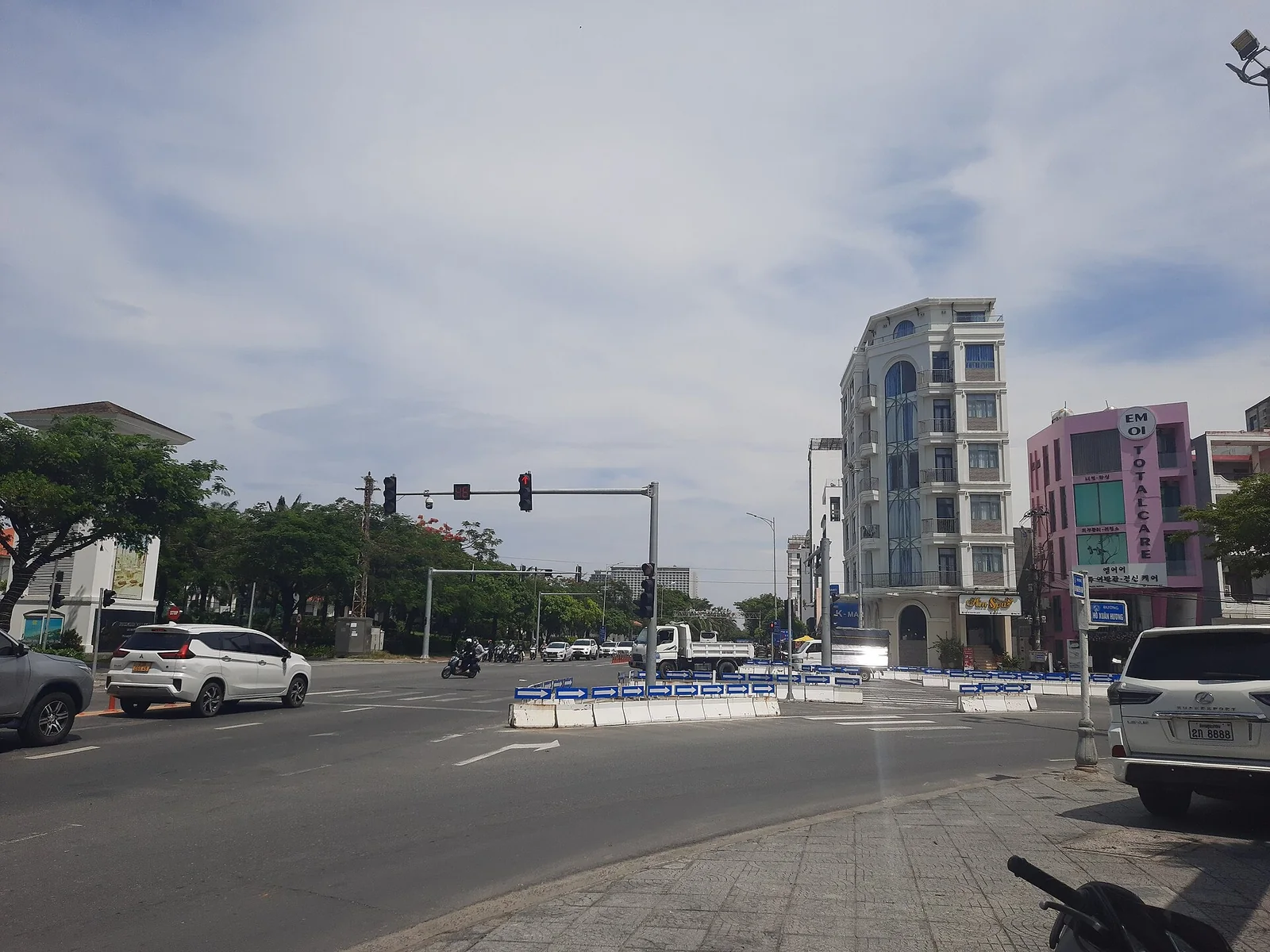
The main road along My Khe beach in Da Nang is called Võ Nguyên Giáp. Book a beachfront hotel there and that name goes into your address.
There is a catch in it. The Nguyen sitting in the middle of that road name is not the surname this article is about.
In Võ Nguyên Giáp the family name is Võ, at the front. Nguyên occupies the middle slot. And the spelling differs: the surname is Nguyễn, with a tilde, while the general’s middle name is Nguyên without one. Different words entirely.
Võ Nguyên Giáp road, Da NangMap
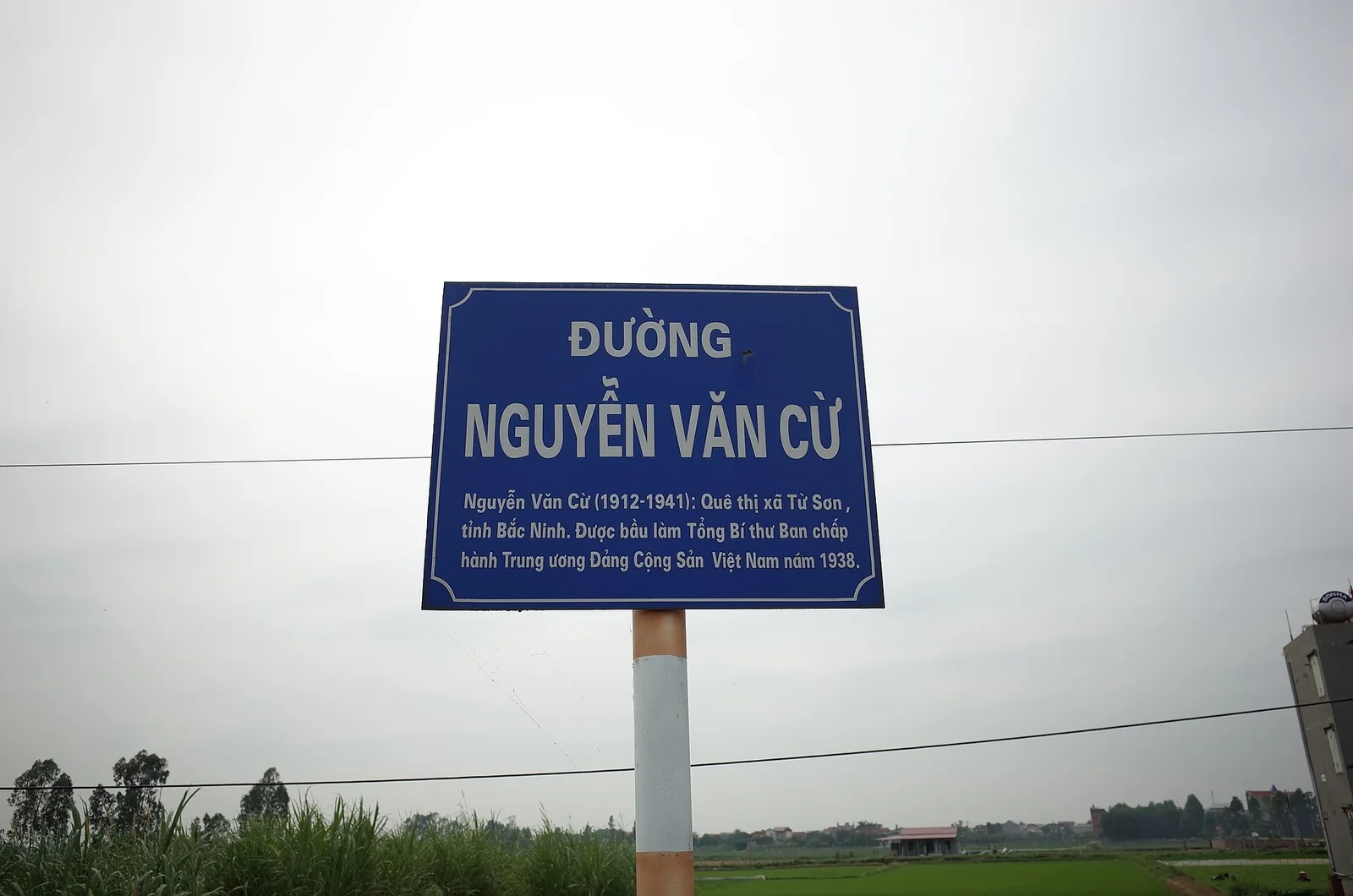
Vietnamese streets are almost all named after people
That is simply how street naming works here. Figures from history get roads, and the result is that walking across a city means walking through several dozen personal names in an afternoon.
The pedestrian street in central Ho Chi Minh City is Nguyễn Huệ, and that one is a genuine Nguyen. It was the birth name of the Tay Son emperor known as Quang Trung.
Nguyễn Huệ Walking StreetMap
Now hold those two facts together. The man who ended Quang Trung’s dynasty and took the throne himself was Nguyễn Ánh, later Gia Long. Two men who fought a war against each other share the surname, and both have roads named after them in the same cities.
The same street name exists in every city
Because the names come from national history, they repeat. There is a Nguyễn Huệ in Hanoi, in Hue, in Nha Trang and in most towns of any size.
This is a practical problem rather than a trivia point. Give a driver a street name with no district and no city and you may end up somewhere else entirely.
When you type an address into a ride-hailing or delivery app, include the district and the city, not just the street. Some cities contain two roads with the same name.
Routes through the centre, including Nguyen Hue, are in the Ho Chi Minh City guide.
For choosing a hotel along that road, see where to stay in Da Nang.

Borrowed from Chinese, yet far more concentrated
Most Vietnamese surnames came from Chinese characters, and yet Vietnam has fewer surnames than China and far more crowding at the top.
A little over a thousand surnames have been recorded in Vietnam. China has roughly six thousand. That is a six-fold gap in a country with a fraction of the population.
The concentration widens the gap further. In China the top hundred surnames cover around 90 percent of people. In Vietnam the same job is done by fourteen to sixteen.
Same character, different sound
The character behind Nguyen is 阮. A Mandarin speaker reads it as Ruan, a Korean speaker as Wan, and a Vietnamese speaker as Nguyễn. One character, three unrecognisably different sounds.
Tran works the same way. 陳 is Chen in Mandarin, Jin in Korean, Trần in Vietnamese. The characters travelled across the region centuries ago and each language wrapped its own pronunciation around them.
Written out in characters, the Vietnamese surname list looks instantly familiar to anyone who reads Chinese, Japanese or Korean: 阮 黎 陳 范 黃 武 潘 張 裴 鄧 杜 吳 胡 楊.
Does that mean shared ancestry
Naturally people ask whether a Vietnamese Nguyen and a Chinese Ruan are branches of one family. The answer depends on the family.
Some Vietnamese lineages did migrate from China and record it in their genealogies. Many others are entirely local families who adopted a Chinese character as the written form of a name they already had.
For Nguyen specifically, most people carrying it today acquired it through the dynastic events described above, not through descent from anyone in China.
The minorities are a separate story
Vietnam recognises 54 ethnic groups. The Kinh majority accounts for the large bulk of the population, and the other 53 groups share what remains.
Many of those groups had no Chinese-style surname at all until civil registration required one. Whole villages sometimes ended up with the same surname as a result of a single registration exercise.
If you travel in Sapa or Ha Giang and notice that surnames cluster even harder than they do in the cities, that is the reason.

Nguyen is in the US census rankings too
The pattern travels. Open the United States Census Bureau’s 2010 surname tabulation and it reproduces itself almost exactly.
Nguyen is the 38th most common surname in the United States. In the 2000 census it stood at 57th, so it climbed nineteen places in a decade.
The more striking part is what sits below it. Keep reading down the list and Vietnamese surnames appear in very nearly the same order they hold at home.
Nguyen sits at 38. Tran follows at 132, Le at 277 and Pham at 370, and further down come Huynh, Phan, Vo and Vu. Line that up against the ranking at home and the order barely moves.
Migration copied the ranking across
That the home ranking survives the journey is less obvious than it looks. It only happens when emigration draws evenly from the whole country.
Where migration comes from one province or one community, the diaspora ranking looks nothing like the national one. Vietnamese emigration was broad enough that the proportions carried over more or less intact.
Australia shows the same effect more strongly, with Nguyen inside the national top ten. In France it sits in the fifties.
Which is where the numbers go wrong again
Some international write-ups put the worldwide total above 80 million people. Others state that Nguyen accounts for about 15 percent of Vietnam’s population.
That 15 percent matches none of the estimates covered earlier and comes with no explanation of what was counted. It is the kind of figure that gets repeated because it looks precise.
When you meet a percentage for this surname, check who counted, when, and what they counted. This particular name attracts unsourced statistics more than most.
It is one syllable, not three
Six letters, one syllable. That is the single most useful thing to know about saying this name, and it is where nearly every English speaker goes wrong.
Nguyen is not “nuh-goo-yen” and it is not “en-guy-en”. The whole thing is produced in a single beat, the way “win” is.
The standard English approximation is to say “win”, then put the ng sound from the end of “sing” on the front of it. That gives you something close to “ngwin”, which is near enough that people will recognise it immediately.
North and south do not agree
What you hear in Hanoi is not what you hear in Ho Chi Minh City.
In the north the tone rises and breaks at the end, so it sounds a little like a question. In the south the syllable closes on an ng and the tone dips down before levelling.
Neither is more correct. They are regional, the same way English vowels are.
Vietnamese diaspora families often gave up
Many Vietnamese families abroad long ago stopped correcting people. In the United States you will hear Nguyen pronounced “win”, “new-yen” and “ner-gwen” from the families themselves, depending on how much of a fight they felt like having in 1985.
So if you are dealing with a Vietnamese-American colleague, ask them rather than assuming. The name in Vietnam and the name on a California driver’s licence have diverged.
Nobody expects a visitor to get the tone right. Compressing it into one syllable is the whole win. That alone puts you ahead of most foreigners who try.
One village is still trying to get its name back
Surname changes are not a closed chapter. About an hour from Hanoi, in Hưng Yên province, there is a place still arguing about it with the government.
Three adjoining villages in Liên Khê commune, Khoái Châu district, are called Cẩm Khê, Bối Khê and Cẩm Bối. Around a thousand people there carry the surname Đỗ.
The villagers say Đỗ is not their surname at all.
Liên Khê commune, Hưng YênMap
A character added about 700 years ago
Local tradition holds that ancestors put Đỗ in front of the real surname roughly seven centuries ago in order to hide who they were. The true family name, they say, is the character that follows it.
The men’s names in these villages therefore begin with two syllables: Đỗ Tràng, Đỗ Văn, Đỗ Bá, Đỗ Quang, Đỗ Đình, Đỗ Trí, Đỗ Đắc, Đỗ Khoa, Đỗ Trọng.
The evidence the villagers point to is what happened with daughters. Girls were never given the Đỗ prefix. They were named from the real surname instead, producing names like Tràng Thị Xuân and Văn Thị Thu. Only the men were disguised.
Seven hundred years puts this in the 1300s, which overlaps neatly with the dynastic upheavals described earlier in this article. It is oral tradition rather than a chronicle entry, but the timing fits.
The applications started in 2002
The Đỗ Tràng family moved first, filing in 2002 on behalf of more than 300 households. The Đỗ Bá family followed with around 200. Eventually all nine lineages submitted paperwork.
The provincial justice department allowed a trial correction for two individuals. Everyone else is waiting.
The waiting has consequences. Roughly 300 women could not obtain identity cards while their household records sat unresolved, and some students hit obstacles sitting university entrance exams as a result. A disguise adopted seven centuries ago is currently interfering with somebody’s university application.
Hanoi has villages doing the same thing
Sơn Đồng, Tân Lập and Cộng Hòa communes all run variations on the custom where daughters do not take the father’s surname.
The question of what a Vietnamese surname actually is has not been settled. It is not a historical curiosity. It is sitting in a filing cabinet in a district office right now.
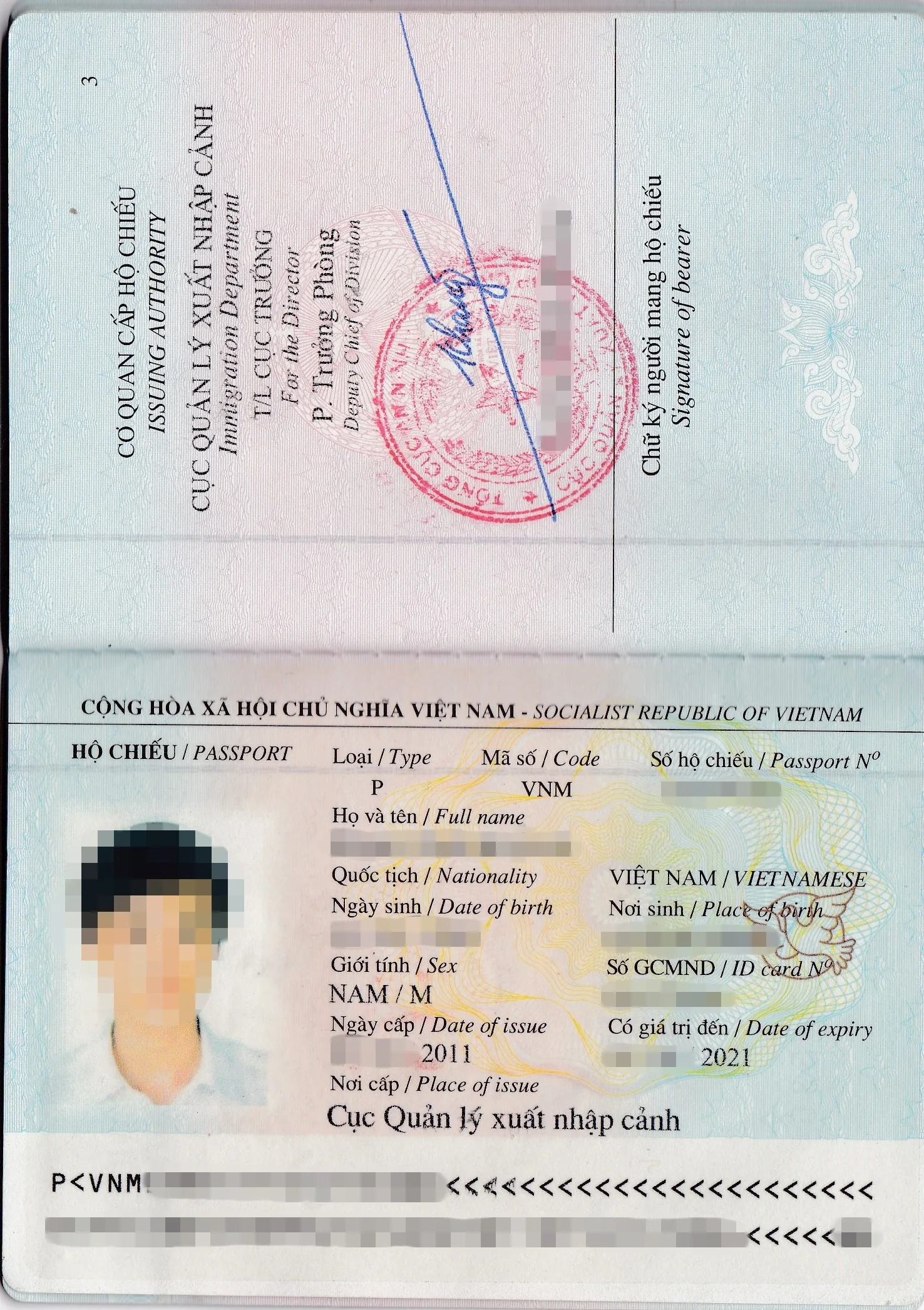
The passport has two boxes and the name has three parts
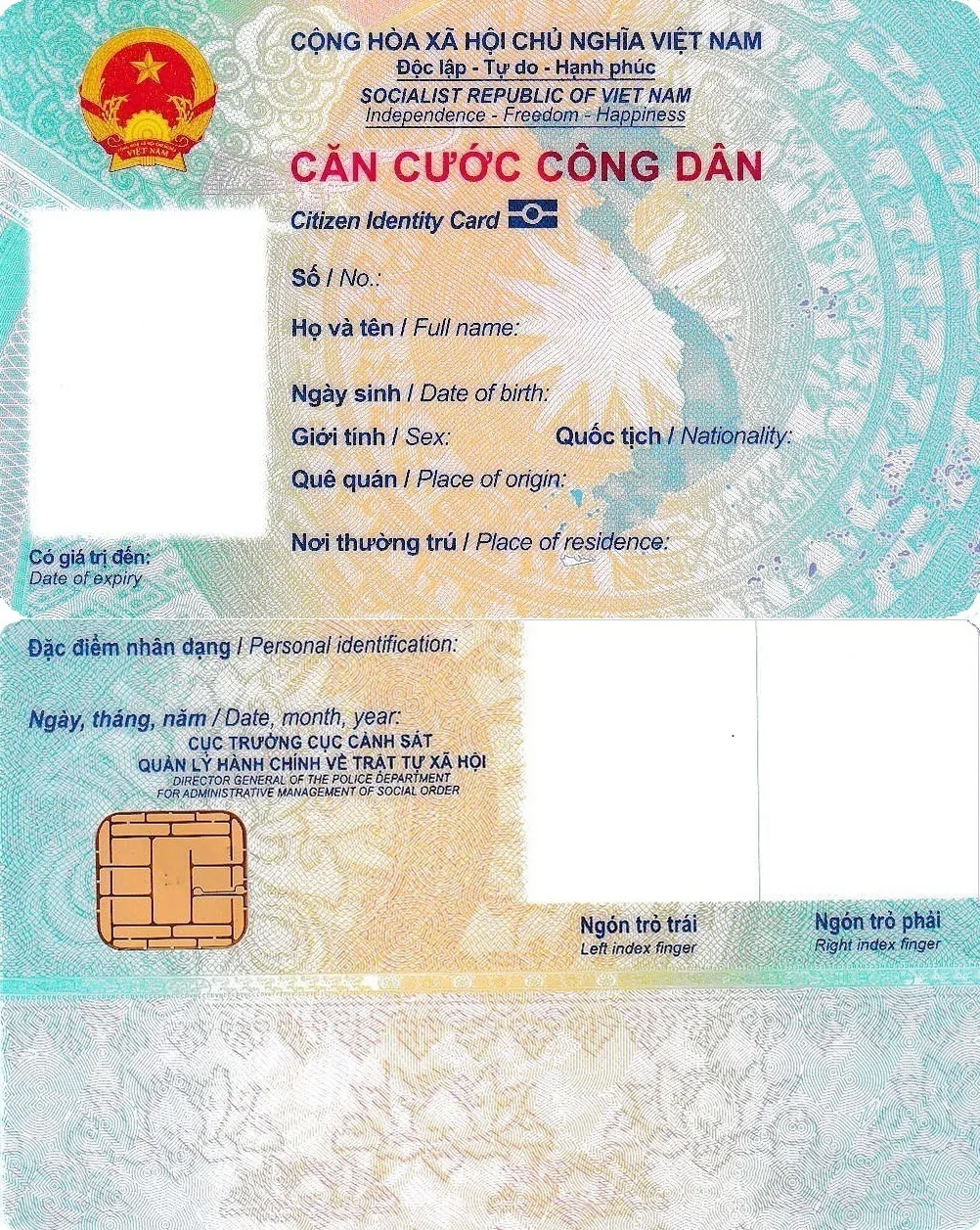
A Vietnamese name has three components. International travel documents have two fields. That mismatch produces real problems at check-in desks.
ICAO standards split a name into SURNAME and GIVEN NAMES. A Vietnamese passport prints family name, middle name and given name in sequence, with nothing marking which is which.
So when a Vietnamese traveller books a flight, working out what goes where is a genuine question rather than a formality.
How to fill the fields
Put only the first element in the surname box. For Nguyễn Thị Tường Vi that is Nguyễn, and nothing else. Everything after it, middle name and given name together, goes into the given names box in exactly that order: Thị Tường Vi. Do not reorder what the passport prints, however tempting it is to move the given name to the front.
Qatar Airways maintains a dedicated page explaining how to enter Vietnamese names. An airline building a help page for one nationality’s naming convention tells you how frequently this goes wrong.
What happens when it is wrong
A name that does not match the passport can mean being refused boarding. At the very least it means a long conversation at immigration.
If you are booking travel on behalf of a Vietnamese friend or colleague, work from a photograph of the passport rather than from what they tell you over the phone.
The same rule applies to the Vietnamese e-visa application. Copy the spelling from the machine-readable zone at the bottom of the passport and you cannot get it wrong.
At the hotel, lead with the given name
Checking in, offering the surname first will usually fail. The reason is the one this whole article has been about.
Show the full name on the booking confirmation, or say the last part of it. Either works immediately.
Eight hundred years in a name badge
The Nguyen on the receptionist’s badge is not simply a common name. It is where families stripped of a surname in 1232, officers handed one as a reward in 1428, survivors of a fallen dynasty in 1593, and villagers registered by colonial clerks in the 1880s all ended up.
Their descendants run the hotels and drive the taxis and cook the noodles. Ask one of them their name and you will usually get the last syllable or two. That part is the one that actually belongs to them.
Copying the spelling straight from the passport is covered in the Vietnam e-visa guide.
What customs actually stops at the border is in what is illegal in Vietnam.