
Hanoi to Ninh Binh Day Trip: The Complete Guide to Trang An, Tam Coc & Mua Cave
Vietnam’s ‘Halong Bay on land’ is the best day trip from Hanoi — limestone karsts, hidden river caves, a 500-step viewpoint and a 1,000-year-old capital. Here’s exactly how to do it, what each site is really like, and how to fit the best of it into one day.
| Distance | ~95 km south of Hanoi (1.5–2 hr each way) |
|---|---|
| Easiest | A guided day tour — transport, boat, lunch & tickets sorted |
| DIY | Limousine van from the Old Quarter (~US$6–10), then a driver or bike |
| The three icons | A karst boat ride (Trang An or Tam Coc) · the Mua Cave viewpoint · Hoa Lu |
| Boat to pick | Trang An = longer, caves & temples · Tam Coc = rice fields, shorter |
| Day-trip window | Leave Hanoi ~7am, back by ~6:30pm |
1. Why Ninh Binh — and the short answer
2. Getting from Hanoi to Ninh Binh
3. Trang An vs Tam Coc: which boat ride?
4. Trang An in depth: the three boat routes
5. Tam Coc in depth: caves, rice fields & Bich Dong
6. Mua Cave (Hang Mua): the climb & two viewpoints
7. Hoa Lu: where Vietnam was first unified
8. Bai Dinh: the pagoda of records
9. Beyond the big sights
10. What to eat: goat meat & crispy rice
11. Sample itineraries
12. Tickets, costs & when to go
13. Day trip vs overnight, and final tips
1. Why Ninh Binh — and the short answer
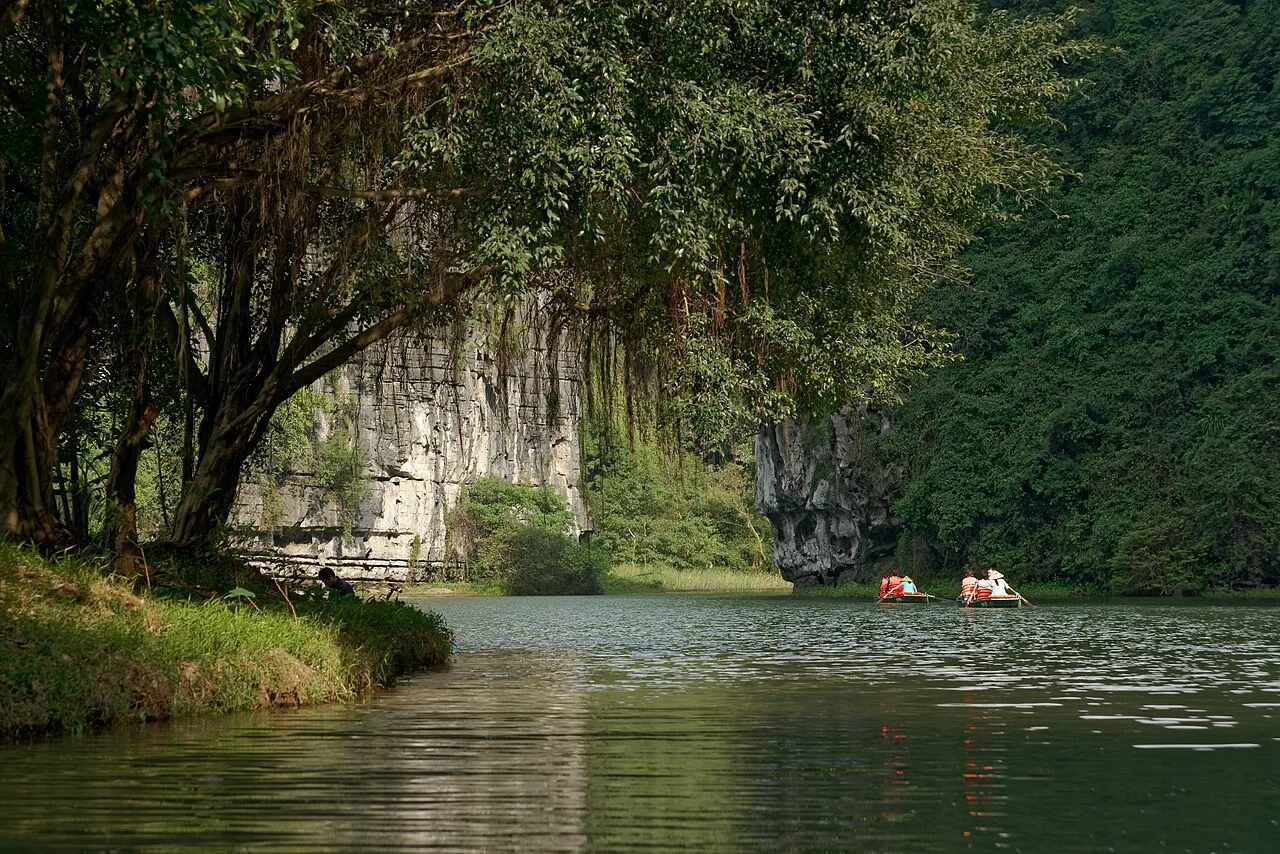
Ninh Binh sits about 95 km south of Hanoi — 1.5 to 2 hours by road — and it is, for most people, the single best day trip you can make from the capital. In one loop you get towering limestone karsts rising straight out of rice fields, hand-rowed boats that disappear into flooded caves, a clifftop viewpoint with one of the great panoramas in Vietnam, and the thousand-year-old capital where the country was first unified. UNESCO lists the whole Trang An complex for both its scenery and its history — one of the few mixed World Heritage sites in Asia.
People call it “Halong Bay on land,” and the comparison is fair — same dramatic karst, but threaded by rivers instead of sea, and reachable as an easy day trip rather than an overnight cruise. If you only have a few days in the north, this is the half-day-plus that punches hardest.
The short version of how to do it:
- Get there by guided tour (everything handled), a cheap limousine van (independent), a private car (your own pace) or the train (slow). Leave Hanoi around 7am.
- Do one boat ride — Trang An for caves and temples, or Tam Coc for rice-field scenery. This is the decision that shapes your day; we settle it below.
- Climb Mua Cave for the viewpoint, see Hoa Lu for the history, and eat the local goat meat. That trio plus one boat is the classic full day.
2. Getting from Hanoi to Ninh Binh
There’s no wrong way down — just trade-offs between price, comfort and how much you want to plan. The honest comparison:
| Option | Price (one way) | Time | Best for |
|---|---|---|---|
| Guided day tour | ≈ US$25–55 (all-in) | door to door | Zero planning; transport, boat, lunch & tickets included |
| Limousine van | ≈ $6–10 | 1.5–2 hr | Independent travellers; comfy 9–16 seat shuttle |
| Private car + driver | ≈ $60–90 (vehicle) | 1.5 hr | Families/groups, full flexibility |
| Public bus | ≈ $3–5 | 2–2.5 hr | Rock-bottom budget; from Giap Bat station |
| Train | ≈ $4–8 | 2.5 hr | Rail fans; slowest, drops you in Ninh Binh city |
The two sensible day-trip choices are a tour or a limousine van. A limousine van is the independent traveller’s pick — modern 9–16 seat shuttles with leather seats and air-con that leave Map the Old Quarter roughly hourly and drop you directly in Tam Coc or Ninh Binh city in about 1.5 hours. Reputable operators include Trang An Limousine, Duy Khang and X.E. — book a day ahead in high season and confirm whether the drop-off is Tam Coc (handy for the sights) or Ninh Binh city (a few km further).
A guided tour removes every decision: hotel pickup, a guide who runs the boat and tickets, a goat-meat lunch, and a fixed loop of Hoa Lu + a boat + Mua Cave (some add Bai Dinh). It’s the most popular way precisely because the day is tightly timed and a guide keeps it moving.
Going fully independent? Take a van down, then hire a xe om (motorbike taxi) or rent a scooter to link the sites, which sit 5–10 km apart. You’ll want mobile data for maps and ride-hailing — see our Vietnam eSIM guide and the Grab & ride-app guide — and cash, since every boat fee and ticket is paid on the spot (money guide). An eSIM you set up before you fly has you online the moment you land, with no SIM queue:
3. Trang An vs Tam Coc: which boat ride?
You almost certainly won’t do both well in a single day, so this is the call that defines your trip. Both are hand-rowed boat journeys through the same staggering karst, but the experience is genuinely different.
| Trang An | Tam Coc | |
|---|---|---|
| Length | ~2.5–3.5 hr | ~1.5–2 hr |
| What you see | Long flooded caves, temples, a film set, wide valleys | Rice fields along the Ngo Dong river, three caves |
| Caves | Up to 9 (you row right through them) | 3 (Hang Ca, Hai, Ba) |
| Feel | Epic, polished, more “wow” | Rural, intimate; famous foot-rowing |
| Boat ticket | 250,000 VND (set route, shared boat) | ~120,000–150,000 VND + entry 100,000 |
| Crowds | Huge site, disperses well | Smaller; the river can feel busy |
Choose Map Trang An if you want the full, cinematic experience — longer, more caves, ancient temples and the Kong: Skull Island film set. It’s the more impressive, more “complete” Ninh Binh boat ride, and the one most first-timers should pick. Choose Map Tam Coc if you’re short on time, want the classic golden-rice-field photo, or like a shorter, more rustic trip — and it’s the obvious pick during rice-harvest season.
4. Trang An in depth: the three boat routes
Trang An isn’t one trip — it’s a UNESCO complex of 48 caves and dozens of temples, and you pick one of three set routes at the pier (each a 2.5–3.5-hour loop on a shared 4–5 person sampan). Knowing the difference matters, because they’re genuinely distinct days out.
- Route 1 — the caves. The classic and most popular: nine flooded caves (Dark Cave, Bright Cave, Wine-making Cave, Ba Giot, Seo, Son Duong and more) plus three temples — Trinh Temple, Tran Temple and the Khong Palace. The most cave-rowing of the three; pick it if the limestone tunnels are what you came for.
- Route 2 — history & King Kong. Fewer caves, more story: Tran-dynasty temples (Suoi Tien), the Vu Lam royal palace site, and the restored Kong: Skull Island film set with its thatched “native” village. The most direct route to the movie locations — and therefore usually the busiest.
- Route 3 — the long cave. Added in 2017 and the quietest: it includes Cloud Cave (Hang Vang), the longest cave here at over 1 km of rowing in the dark, plus Fairy Stream, Earth Cave and the Vu Lam palace, ending again at the Kong set.
The boats are hand-rowed and weave between sheer karst walls before ducking, sometimes within centimetres, into water caves dripping with stalactites — you’ll want to lower your head. There’s a small disembark at the temples to walk around. For most day-trippers, Route 1 (caves) or Route 3 (the long cave, fewer crowds) is the sweet spot; choose Route 2 if the Kong set is a must.
5. Tam Coc in depth: caves, rice fields & Bich Dong
Tam Coc means “three caves,” and that’s exactly what the boat threads through, rowing up the Ngo Dong river between cliffs and — for much of the year — vivid green or gold rice paddies. The round trip is about 1.5–2 hours.
- Hang Ca — the longest and most impressive of the three, a ~125 m tunnel of cool air and stalactites.
- Hang Hai — shorter, with its own dripstone formations.
- Hang Ba — the smallest and quietest, low enough that you instinctively duck.
The signature here is the foot-rowing: many Tam Coc boatwomen row with their feet, a local technique you’ll see nowhere else. The other signature is the rice — the paddies that line the river are at their most spectacular during the harvest from late May to mid-June, when they turn brilliant gold (the village even holds a rice-season festival). Outside that window the valley is still beautiful, just green or, post-harvest, bare.
Right beside Tam Coc, don’t skip Map Bich Dong — a serene three-tier pagoda built into a cliff face, reached over a little stone bridge and through a cave, and free to enter. It’s a 10-minute add-on that most rushed visitors miss.
6. Mua Cave (Hang Mua): the climb & two viewpoints
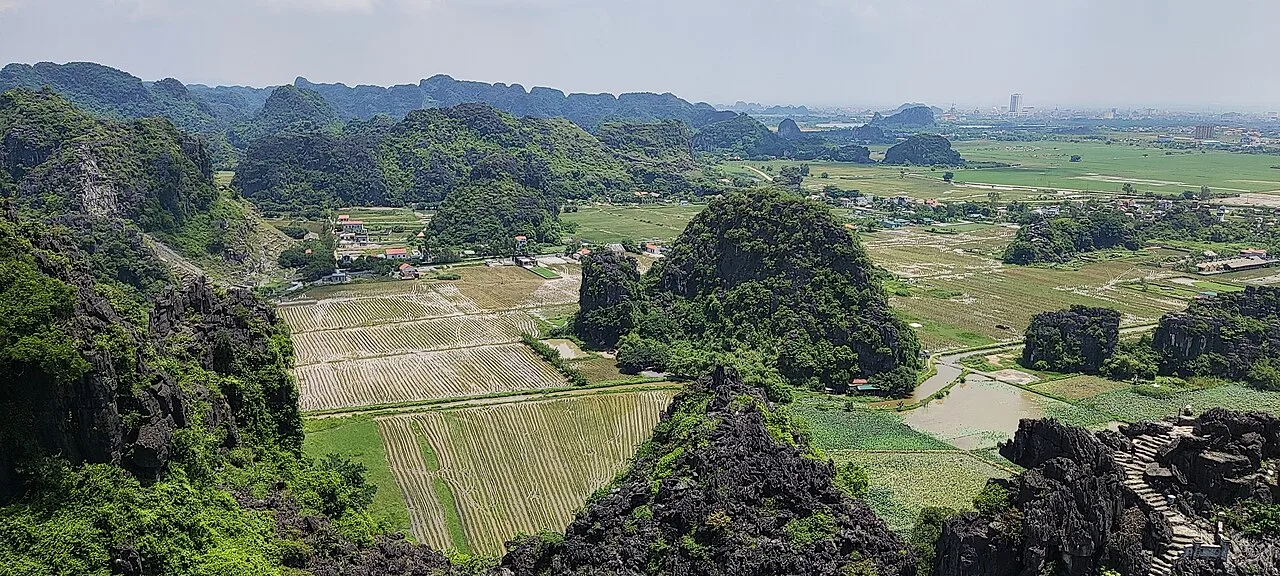
The “cave” at Map Hang Mua is a minor side-show — what you climb for is the ridgeline above it. From the base, a staircase of roughly 500 uneven stone steps, lined with carved dragons, switchbacks up Ngoa Long (“Lying Dragon”) mountain. It’s a sweaty 20–30 minutes in the heat, but it delivers what is, for many, the defining image of Ninh Binh.
There are actually two viewpoints at the top. One ridge ends at a large dragon statue looking out over the Tam Coc valley — the Ngo Dong river snaking in great loops through the rice fields below, walled by karst peaks. The other path leads to a small pagoda and tower with a different angle over Trang An. Do both if your legs allow; the dragon side is the famous shot.
At the base, a lotus pond blooms in summer, with photogenic wooden walkways — local farmers harvest the lotus seeds, and in season it’s a sea of pink. Entry is around 100,000 VND.
7. Hoa Lu: where Vietnam was first unified
Before Hanoi, there was Map Hoa Lu. In the 10th century this was the capital of Dai Co Viet — the first independent Vietnamese state after a thousand years of Chinese rule — under the Dinh and Early Le dynasties (968–1010), before the capital moved to Thang Long (Hanoi) in 1010. Ringed by karst mountains that served as natural city walls, it was a fortress capital.
What survives today is compact but meaningful: two restored temples set among the cliffs. One honours King Dinh Tien Hoang, the warlord who ended a period of civil war and unified the country; the other honours King Le Dai Hanh, who repelled a Song-dynasty invasion. The carved stone and ancient courtyards reward a slow look, and a guide (or our notes here) turns it from “old temples” into the origin story of the nation.
It’s quick to see — 45 minutes to an hour — which is exactly why it pairs so well with a boat ride and Mua Cave rather than being visited alone. Entry is a token 20,000 VND.
8. Bai Dinh: the pagoda of records
If your day has room, Map Bai Dinh is the biggest Buddhist temple complex in Vietnam — and a collector of superlatives. The headline numbers: a 100-tonne, 10-metre bronze Sakyamuni Buddha (the largest in the country), the tallest gilded bronze Buddha in Asia, the biggest bell, and the longest corridor of arhat statues in Asia — 500 unique stone arhats lining a covered walkway that runs for roughly 3 km.
There are really two Bai Dinhs. The ancient pagoda is a quiet 1,000-year-old cave temple up the hillside, founded in the Dinh era. The new complex below it, finished in the 2010s, is vast, modern and frankly monumental — impressive in scale but a different mood from the old cave shrine. It’s so large you take an electric buggy (~60,000 VND) between the gate and the temples.
9. Beyond the big sights
If you have a second day, escape the crowds — Ninh Binh has a quieter back catalogue most day-trippers never reach:
- Map Thung Nham Bird Garden — an eco-park with a boat trip to a wetland where thousands of storks and egrets roost at dusk; caves and a “thousand-year tree” too (≈150,000 VND).
- Map Van Long Nature Reserve — the largest wetland reserve in the north, a glassy, silent lagoon poled by tiny boats, home to the rare Delacour’s langur. Another Kong location, and gloriously uncrowded (entry 20,000 + boat 60,000).
- Map Am Tien Cave (the “Valley of Silence”) — a hidden emerald pond ringed by cliffs, reached through a cave gate; serene and dramatic.
- Map Cuc Phuong National Park — Vietnam’s oldest national park, with a 1,000-year-old tree, a primate rescue centre and (in April) a famous butterfly season; a full day in itself, ~45 min further out.
None of these fit a single day on top of the big three — they’re the reason to consider an overnight, which we cover below.
10. What to eat: goat meat & crispy rice
Ninh Binh has its own emphatic cuisine, built on the limestone landscape, and skipping it is a missed half of the trip. Two specialties define the region:
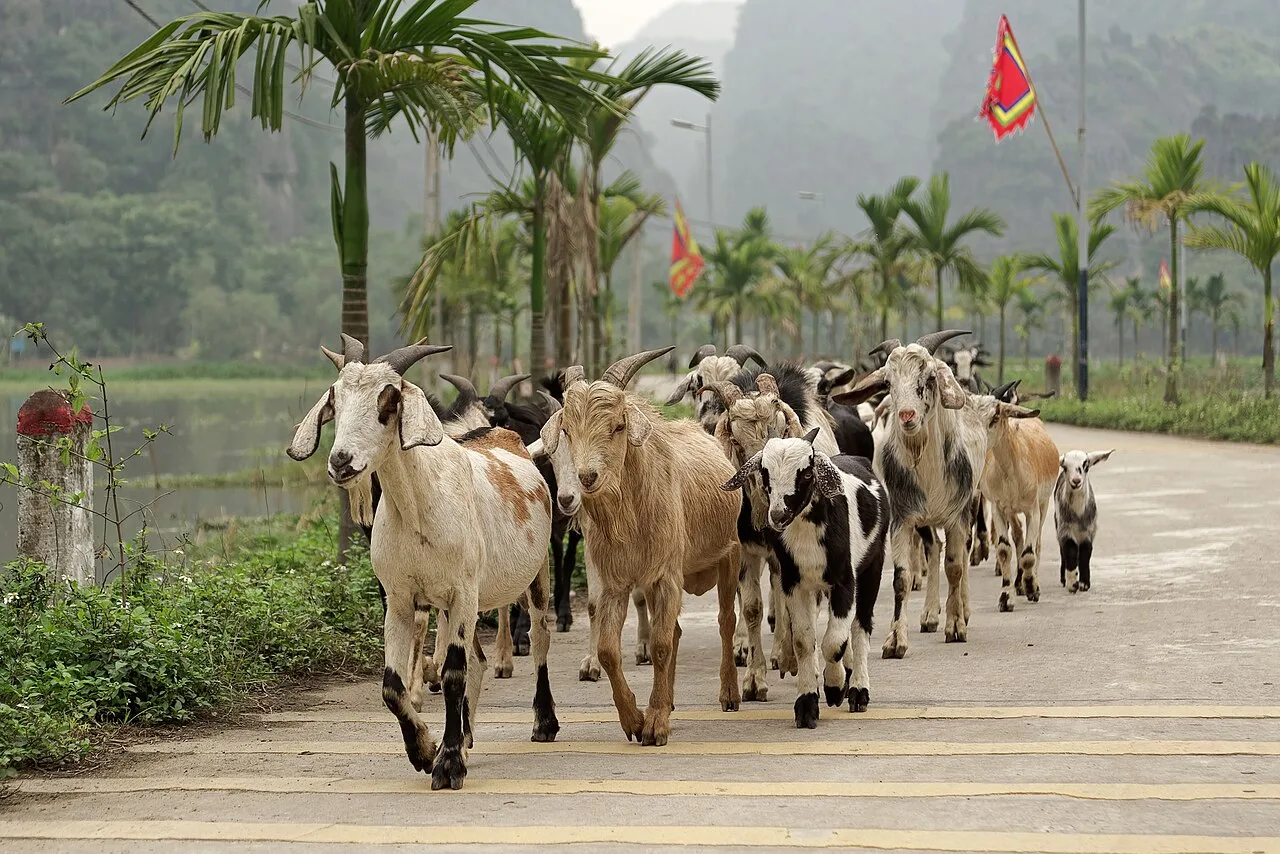
- Mountain goat (thit de nui) — the local icon. The goats range over the karst eating wild herbs, which gives the meat a firm texture and faint herbal aroma. It comes a dozen ways: de tai chanh (rare goat “carpaccio” with lime and herbs), five-spice grilled goat, ginger-steamed goat, goat hotpot, even goat spring rolls. Almost every local restaurant does it.
- Crispy rice (com chay) — glutinous rice pressed thin, sun-dried and deep-fried to a golden cracker, then served under a savoury goat-or-beef gravy. Crunchy, rich and uniquely local; you’ll also see it sold in bags as a snack to take home.
Round it out with oc nui (mountain snails), rice-field fish, and ruou Kim Son (a strong local rice wine). On a tour, the goat-and-com-chay lunch is usually included; independently, look for busy goat restaurants near Tam Coc and Hoa Lu. Hungry for the bigger picture of Vietnamese regional food? Our city guides go deep — start from the Vietnam travel guide.
11. Sample itineraries
How the day actually stacks up, depending on your energy and how you’re travelling.
The classic day (most tours)
- 7:00–9:00 — leave Hanoi; arrive Ninh Binh.
- 9:00–10:00 — Hoa Lu ancient capital.
- 10:00–13:00 — Trang An boat (Route 1 or 3), then a goat-meat & com-chay lunch.
- 14:00–15:30 — Mua Cave climb for the viewpoint.
- 15:30–18:30 — drive back to Hanoi.
That loop is exactly what the day tours run, with the transport, boat, tickets and a goat-meat lunch all handled — the easiest way to do it:
The active / independent day
- Van down early, rent a scooter, and self-pace: Tam Coc + Bich Dong by boat at opening (fewer crowds), cycle the rice-field lanes, Mua Cave late afternoon for golden light, lunch in between. Skip Hoa Lu if you’d rather go slow.
The 2-day (if you can swing it)
- Day 1: Trang An, Hoa Lu, Mua Cave at sunset, stay in a karst-view homestay.
- Day 2: Tam Coc & Bich Dong at dawn, then Bai Dinh or the quiet Van Long / Thung Nham before heading back.
Swap the order to chase cooler temperatures and softer light — many people do Mua Cave first thing or last, not midday.
12. Tickets, costs & when to go
Costs are low. A full guided tour is roughly US$25–55 with transport, boat, tickets and lunch. Independently, a day comes to well under $40. Site-by-site entry (2026):
| Site | Ticket | Notes |
|---|---|---|
| Trang An | 250,000 VND | Includes the 2.5–3.5 hr boat; pick a route at the pier |
| Tam Coc | ~120,000 boat + 100,000 entry | Per boat seats ~4; tip the rower |
| Mua Cave | 100,000 VND | The viewpoint climb + lotus pond |
| Hoa Lu | 20,000 VND | Optional guide ~200,000 |
| Bai Dinh | Free entry | Buggy ~60,000; guided tower extra |
| Bich Dong | Free | Beside Tam Coc |
| Thung Nham / Van Long | ~150,000 / 20,000+60,000 | For an overnight |
When to go: Ninh Binh is good year-round, but the calendar rewards timing. Late May to mid-June is the famous rice harvest, when Tam Coc glows gold — the most photogenic window. February to April is cool, green and comfortable, and overlaps the big Trang An and Bai Dinh festivals (lunar new-year season). Summer is hot but the lotus blooms at Mua Cave; September–November can bring rain that makes the Mua steps slick. Our best time to visit guide breaks the seasons down.
13. Day trip vs overnight, and final tips
A day trip genuinely covers the headline sights — one boat, Mua Cave and Hoa Lu, back in Hanoi for dinner. It’s how most people see Ninh Binh and it works.
But an overnight changes the trip entirely: a homestay among the karsts, both boat routes, the rice fields at golden hour and the quiet reserves (Van Long, Thung Nham) without a clock running. If your schedule can spare even one night, Ninh Binh repays it generously — and the homestays are a highlight in themselves. For where it fits in a longer northern loop, see our Hanoi guide and North Vietnam guide.
Final practical tips:
- Start at 7am. It beats the heat on the Mua steps and the crowds on the boats.
- Carry small VND notes. Boat tickets, Mua entry, tips and drinks are cash-only on the ground — see our money guide.
- Wear grippy shoes for the ~500 steps; bring water and sun cover.
- Tip the rower 20,000–50,000 VND — it’s customary, and these are hard-working locals.
- Pick your boat by the season: Trang An any time; Tam Coc especially in rice season.
- Visa & data: the same as anywhere in Vietnam — check our visa guide and set up an eSIM before you fly.
🎡Things to Do5
🚇Getting Around2
🧭Travel Tips2
🧭Vietnam-wide essentials145
Hanoi → Ninh Binh day trip: FAQ
Planning the north? See our complete North Vietnam travel guide →