1. Why take the train instead of the bus or a taxi
The railway between Da Nang and Hue is widely called the most beautiful stretch in Vietnam. The track clings to the seaward cliffs of the Hai Van Pass — and cars simply can’t see it, because they shoot straight through the Hai Van tunnel below the mountain. Only motorbikes and some tour vehicles go over the top, and even they don’t reach the coastal ledges the line was carved into. In other words, the train is just about the only way to actually see this coastline.
It’s roughly 103 km and takes 2.5 to 3.5 hours. A car through the tunnel does it in about 1 hour 45 — so yes, the train is slower. But you trade that extra ninety minutes for a high view back over Da Nang Bay, a run of short French-era tunnels, and the crescent sweep of Lang Co lagoon on the far side. Crack the window and you get the sea air, too.
💡 Bottom line: if you’re tight on time, the car is faster — but if the journey is part of the trip, take the train. For photographers it’s a no-brainer. The smartest plan of all is to do one direction by train and the other over the Hai Van Pass by car or bike, so you see both the summit views and the clifftop railway.
This guide is the deep dive on the train leg from our Da Nang travel master guide. Which train, which seat, how to book — it’s all below.
2. Two kinds of train: heritage tourist vs regular express
Two very different trains run this stretch. The choice comes down to: do you want the experience, or do you want to save money?
Heritage tourist train (HD)
Regular Reunification Express (SE)
What it is
The “Connecting the Central Heritage” service, launched 2024, in refurbished vintage-style carriages
A leg of the daily Hanoi–Ho Chi Minh City mainline train
Atmosphere
Live Hue traditional music (Ca Hue), a food coach with Hue dishes, a ~10-min photo stop at Lang Co
A no-frills local train — snack cart, mixing with Vietnamese travellers
Fare
~180,000–460,000 VND by class/day
Soft seat ~80,000–150,000 VND ($3–6)
Seats
Assigned soft seat / premium / VIP; orientation may be fixed
Soft seat, 4-berth soft sleeper, 6-berth hard sleeper — you pick your seat
Frequency
About two services a day (morning + afternoon)
More frequent across day and night
Best for
The experience and the photos, with time to spare
Cheap and flexible, or when the heritage train is sold out
How to choose: if this leg is a highlight of your trip, the heritage train’s atmosphere earns its price. If it’s just a hop to Hue, the regular SE is far cheaper and lets you pick a right-hand window seat yourself. The scenery is identical on both — the regular train just skips the live music and the new carriages.
3. Timetable: when it leaves and arrives
Going Da Nang→Hue (northbound), you want a daytime departure to actually see Hai Van. Night trains run this leg too, but you’ll see nothing — so always pick a daytime train here.
Heritage tourist train (Da Nang → Hue)
HD2 (morning): departs Da Nang ~07:45 → arrives Hue ~11:30
HD4 (afternoon): departs Da Nang ~14:20 → arrives Hue ~17:30
The other direction (Hue → Da Nang) is served by HD1 & HD3
Regular Reunification Express (SE)
Several SE trains pass through this section each day. Choose one that leaves Da Nang in the morning or around midday and you’ll cross Hai Van in daylight. Exact times shift by season, so the most reliable move is to search “Da Nang → Hue” for your date on a booking site or the app.
💡 Take the morning train: an early service (like HD2) gets you to Hue around lunchtime with half a day left for the Citadel and tombs. The afternoon train lands you in Hue near dinner — perfect if you’re staying the night.
4. Fares and seat classes
The price swings with which train and which seat — but it’s a short leg, so none of it is expensive.
Seat
Rough fare (one way)
Feel
Regular SE soft seat
~80,000–150,000 VND ($3–6)
Best value. Air-con, reclining seat
Regular SE soft sleeper (4-berth)
A bit more
Overkill for a short daytime leg, but comfy if you want to lie down
Heritage soft seat
~180,000 weekday / ~210,000 VND weekend
New carriage + live music included
Heritage VIP
~395,000 weekday / ~460,000 VND weekend
The roomiest seats (introduced April 2026)
From March 2026 the heritage train also added a premium soft-seat carriage with just 32 seats instead of 56, so there’s noticeably more legroom. Prices vary by seller and season, so confirm at the booking step. In the context of your whole trip budget, this leg is cheap at any class. 👉 Check live prices & seats on Klook
5. ⭐ Which side to sit on for the sea views
This is the single most important thing here. Going Da Nang → Hue, sit on the right-hand side (in the direction of travel) for the sea and the coast. Going the other way, Hue → Da Nang, sit on the left.
Direction
Sea / coast side
Da Nang → Hue (northbound)
⭐ Right
Hue → Da Nang (southbound)
Left
⚠️ One catch: Da Nang station is a dead-end terminus. A train arriving from Hanoi or Ho Chi Minh City has its engine swapped to the other end at Da Nang, which means your seat’s facing direction flips. If you board fresh at Da Nang, no problem. But if you’ve already been riding from further south, “the right side” can reverse after Da Nang — so once you’re settled, double-check which window the sea actually appears in.
On regular SE trains you choose your seat, so a right-hand window is easy to grab. On heritage trains seats can be assigned and fixed, so ask specifically for a “right-hand window” when booking, or check the window seat numbers. In peak season the good seats go first.
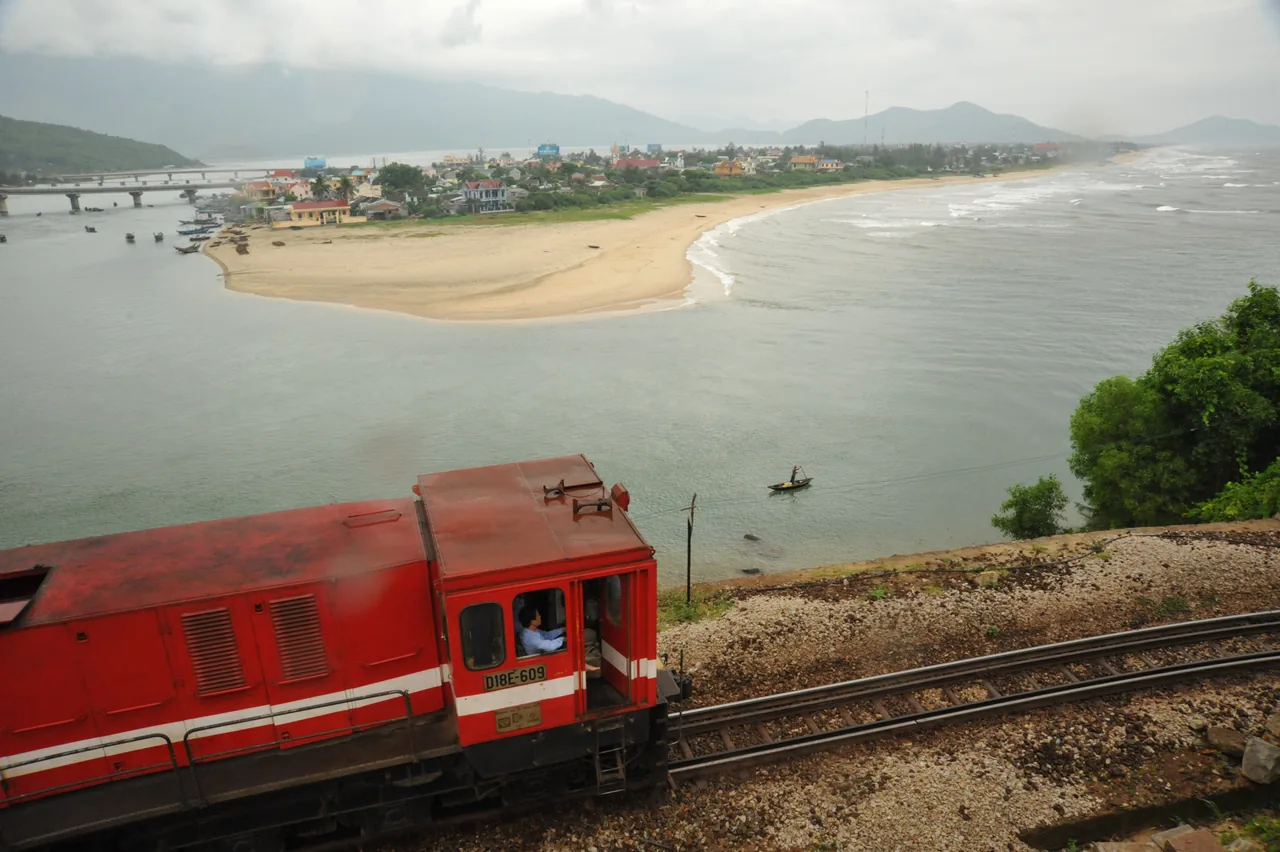
Lang Co lagoon below the Hai Van Pass — the crescent bay the train skirts on its way to Hue. Photo: Andre Hospers, CC BY 4.0, via Wikimedia Commons.
6. What you’ll see out the window
You start through the city, then the blue of Da Nang Bay opens up on your right. The train climbs the seaward face of the Hai Van mountains; look back and the whole Da Nang skyline and beach spread out behind you.
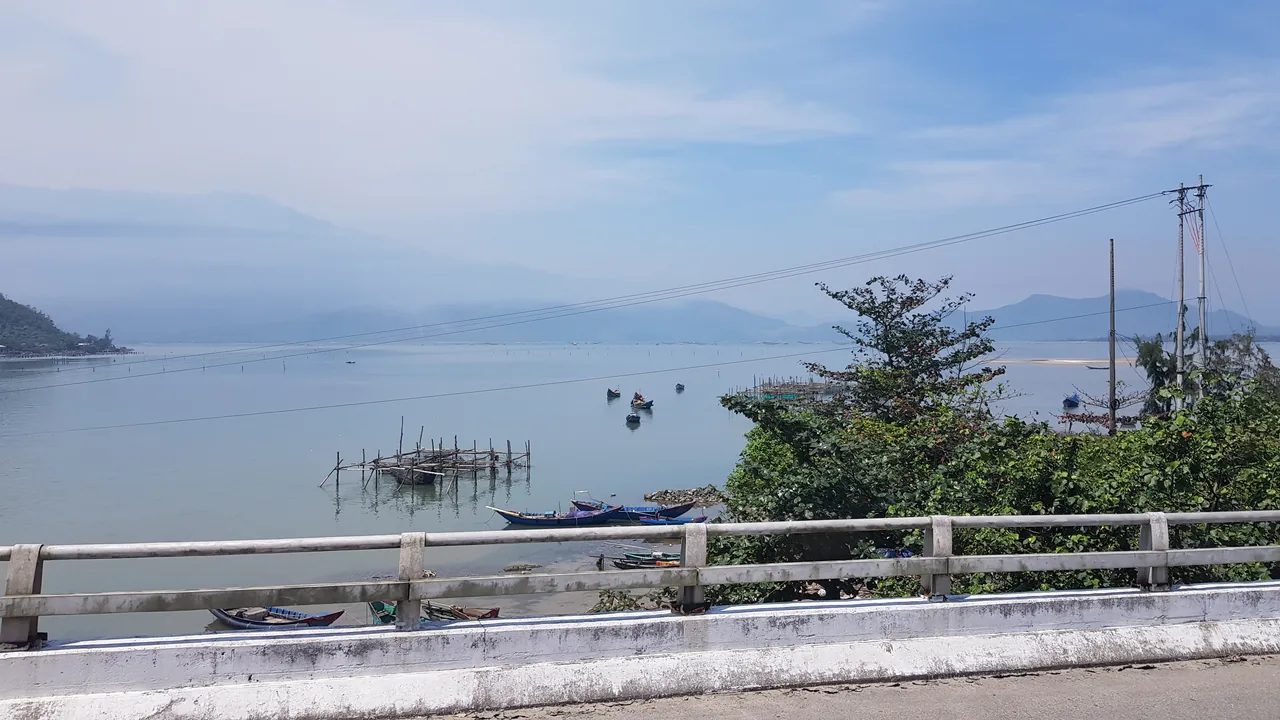
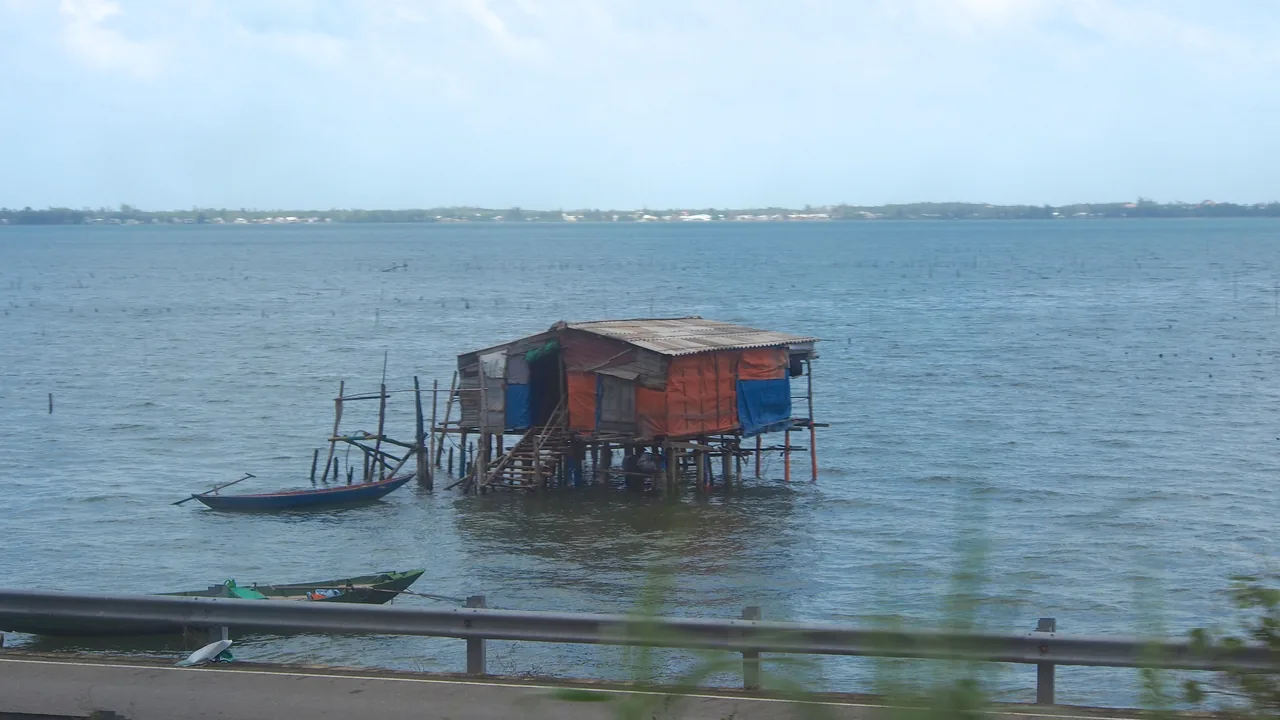
Then come the short French-era tunnels, one after another — a few seconds of dark, then the sea bursts back into view. That rhythm is oddly addictive. Cresting the pass and starting down the far side, you meet the crescent bay and lagoon of Lang Co: still water under misty mountains, fishing boats, and stilt houses and basket boats dotted across the shallows.
Closer to Hue the scene shifts again — endless rice paddies, water buffalo, small villages sliding past the glass. Have your camera or phone out early; the best shots arrive without warning.
It comes down to booking cheap versus booking easy.
1. Official (book direct)
Vietnam Railways’ official site dsvn.vn or the “Đường sắt Việt Nam” app let you book at the official base fare. The downsides: foreign-issued cards often fail at checkout, and the English interface is clunky.
2. Agents (easiest)
Resellers like Baolau and 12Go, or Klook and KKday, take foreign cards reliably and let you compare seats and times at a glance — you pay a small markup for peace of mind. Worth it especially for the heritage train or a window seat in peak season.
💡 In peak season (summer, public holidays, Tết) the good seats sell out fast. Once your date is set, book early. Screenshot the QR/PDF ticket you’re emailed, and bring your passport to show at the station.
It’s at 202 Hải Phòng, about 2 km west of the city centre. From hotels around the Han River or My Khe beach it’s roughly 10 minutes by Grab and costs very little. Arrive 30–40 minutes before departure to check your ticket and find the platform.
It’s at 2 Bùi Thị Xuân, on the southwest edge of central Hue. The Perfume River and the Citadel aren’t far — from a riverside hotel you can walk, or it’s a few minutes by Grab. A handy spot to start sightseeing the moment you step off.
If you’re staying in Hoi An, know this up front: Hoi An has no train station. The nearest one is Da Nang’s.
So to go Hoi An → Hue by train, you first travel from Hoi An to Da Nang station by car (about 45 minutes to an hour), then board. A Grab car, a hotel pickup or a private car all work. Factor that transfer in — catching the morning HD2 means leaving Hoi An quite early, so leave yourself plenty of time.
💡 Starting from Hoi An, the “Hoi An → Da Nang station → Hue” shuffle can feel like a lot. In that case it’s worth comparing a private car straight from Hoi An to Hue over the Hai Van Pass (see “Train vs car” below).
Stilt fishing houses and basket boats on the lagoon, a typical view from the train window. Photo: Clay Gilliland, CC BY-SA 2.0, via Wikimedia Commons.
10. Train vs car, bus & limousine van
The train isn’t the only way over to Hue. The right answer depends on what you want.
Option
Time
Upside
Downside
Train
2.5–3.5 h
Coastal views, little motion, you can walk around
No stopping for photos (except the heritage Lang Co halt)
The smartest move is to mix them. Take the train one way for the clifftop railway, and a private car the other way over the top of the Hai Van Pass — stopping at the Hai Van Quan gate, the Lang Co viewpoint and Lap An lagoon for photos. Same mountain, two completely different angles.
🚐 A private car stops at the Hai Van Pass, which the train tunnels straight throughSee on Klook →See on KKday →See on Trip.com →Affiliate link — we may earn a commission at no extra cost to you.
11. Good things to know before you board
Window seat, right side (Da Nang→Hue). See “which side” above. Windows can be grimy, so for truly clean shots, the heritage train’s Lang Co stop or a door vestibule is better.
Bring motion-sickness tablets if you’re prone. The Hai Van section is winding and rocks a fair bit — less than a bus, but still.
Water and snacks. The heritage train has a food coach and regular trains have a cart, but choice is limited. Buy your favourites before boarding.
Toilets on regular SE trains are basic. Tissues and wet wipes are a good idea.
Luggage goes on the overhead rack or the racks at the carriage ends. There’s no strict weight limit, but keep a big case where you can see it.
You’ll want data on arrival to call a Grab — install an eSIM beforehand and you’re online the moment you step off.
12. Once you reach Hue: what to do
Hue was the old imperial capital of the Nguyen dynasty. Just working outward from the station fills a full day.
The Imperial Citadel — a walled city on the north bank of the Perfume River, modelled on Beijing’s Forbidden City. Hue’s centrepiece.
The royal tombs — of emperors Tu Duc, Minh Mang and Khai Dinh, scattered around the outskirts; a Grab or a half-day tour makes them easy.
Thien Mu Pagoda and a Perfume River boat — especially lovely near sunset.
Full routes and ticket prices are in our Hue day-trip guide. If you came on a morning train you can make it a day trip and ride back to Da Nang late afternoon — but to do the tombs justice, stay a night in Hue. See our full list of day trips from Da Nang too.
Nothing complicated — but these three things are much easier handled before you go.
eSIM — you’ll want data to call a Grab, check maps and pull up your ticket on arrival. Install it in advance and it switches on the moment you land.
Travel insurance — even a short hop is more relaxing with one policy covering your whole Vietnam trip.
Check the season — look at the best time to visit and the dry vs rainy split before fixing a date. In the wet months (roughly Sept–Dec), mist can hide the views on some days.
📶 There is no wifi on the train and the coast has long dead stretchesSee on Yesim →See on Saily →See on Airalo →Affiliate link — we may earn a commission at no extra cost to you.
🛡️ Delays and missed connections are the claims that actually get used hereSee on SafetyWing →Affiliate link — we may earn a commission at no extra cost to you.
About 2.5 to 3.5 hours, depending on the train and stops. The heritage tourist train pauses around 10 minutes at Lang Co for photos, so it runs a touch longer. A car through the tunnel does it in roughly 1 hour 45 — but you miss the coastal scenery.
Q. How much is a ticket?
A regular Reunification Express (SE) soft seat is cheapest at about 80,000–150,000 VND (~$3–6). The heritage tourist train runs roughly 180,000–460,000 VND depending on class and day of week.
Q. Do I need to book in advance?
In peak season (summer, public holidays, Tết) and for the heritage train or a good window seat, yes — book ahead. Off-peak, regular trains often have same-day tickets, but reserving guarantees the seat you want.
Q. Which side should I sit on for the sea?
Da Nang→Hue (northbound), the right-hand side; Hue→Da Nang (southbound), the left. Because Da Nang is a dead-end terminus, a train coming from further south may flip direction there — so once seated, check which window the sea is actually on.
Q. Heritage train or regular train — which is better?
For the experience and photos, the heritage train (new carriages, live music, Lang Co stop) earns its price. For a cheap, flexible ride where you pick your own seat, the regular SE is better — and the scenery is exactly the same.
Q. Can I pay with a foreign card on dsvn.vn?
The official site uses the base fare, but foreign-issued cards frequently fail. If yours doesn’t work, use an agent like Baolau, 12Go, Klook or KKday — they take foreign cards reliably and make seat selection easy.
Q. Can I catch the train directly from Hoi An?
No — Hoi An has no station. You travel about 45 minutes to an hour by car to Da Nang station first, then board. If that feels like a hassle, also compare a private car from Hoi An to Hue over the Hai Van Pass.
Q. Train or car — which is better?
Train for the coastal views and comfort; private car for speed and stopping where you like for photos. The best option is one direction by train and the other by car over the Hai Van Pass.
Q. Is the train shaky enough to cause motion sickness?
The Hai Van section is winding and does rock, though less than a bus and with open views that help. If you’re prone to it, bring tablets and look at the far horizon.
Q. Is there a luggage limit?
No strict weight limit. Put large bags on the overhead rack or the racks at the carriage ends, and keep valuables close to you.
Q. Is it OK to travel with kids?
Yes — it suits families well. You can walk around, there are toilets, and it’s more comfortable than a bus. Pack plenty of snacks and water for little ones.
Q. How do I get from Hue station into town?
Hue station is on the southwest side of the centre, not far from the Perfume River and Citadel. From a riverside hotel you can walk, or it’s a few minutes by Grab.