
Marble Mountains Da Nang: Tickets, the Elevator, and the Am Phu Cave Ticket Trap
Everything you need for Ngu Hanh Son’s cave temples, pagodas, and viewpoints, done right in half a day
| What & where | Cave-temple mountain cluster (Ngu Hanh Son), 9 km southeast of central Da Nang, on the road to Hoi An |
|---|---|
| Main entry price | 40,000 VND (~US$1.50) |
| Am Phu Cave ticket | 20,000 VND, separate from the main gate |
| Elevator price | 15,000 VND one-way / 30,000 VND round-trip |
| Hours | Official baseline 7:00-17:00 daily; some visitor reports note 17:30 closing in peak season |
| Time needed | 2-3 hours, not a full day |
| How to get there | Grab/taxi, ~20 min, ~80,000-120,000 VND from central Da Nang |
| One killer tip | Buy the Am Phu ticket at its own booth before you climb; it’s not included with the main entrance |
1. Is Marble Mountains Worth Visiting?
2. A Short History: A Royal Name, a French Nickname, and a War
3. Tickets & Prices 2026
4. Elevator or the 156 Steps? The Honest Decision
5. Huyen Khong Cave: The Cathedral of Light
6. Am Phu Cave: Heaven and Hell (The Separate-Ticket Cave)
7. The Pagodas: Tam Thai and the Third Linh Ung
8. The Viewpoints: Vong Hai Dai and Vong Giang Dai
9. Non Nuoc Stone Carving Village: 400+ Years at the Mountain’s Foot
10. Getting There: From Da Nang, Hoi An, and the Airport
11. How to Plan Your Visit: Pairings and Timing
12. Best Time to Visit and What to Wear
13. Practical Tips and Honest Warnings
1. Is Marble Mountains Worth Visiting?
🌅 Da Nang with older parents: a day that starts on the beach before sunrise →
🚗 Hiring a car and driver in Da Nang: how it is priced and when it beats Grab →
Yes, but budget half a day, not a full one. Two to three focused hours is enough to walk the cave temples, take (or skip) the elevator, catch the coastal viewpoint, and browse the carving village at the base. The site sits barely twenty minutes from central Da Nang and directly on the road to Hoi An, so it costs you almost no extra travel time to fold into whatever else you’re doing that day.
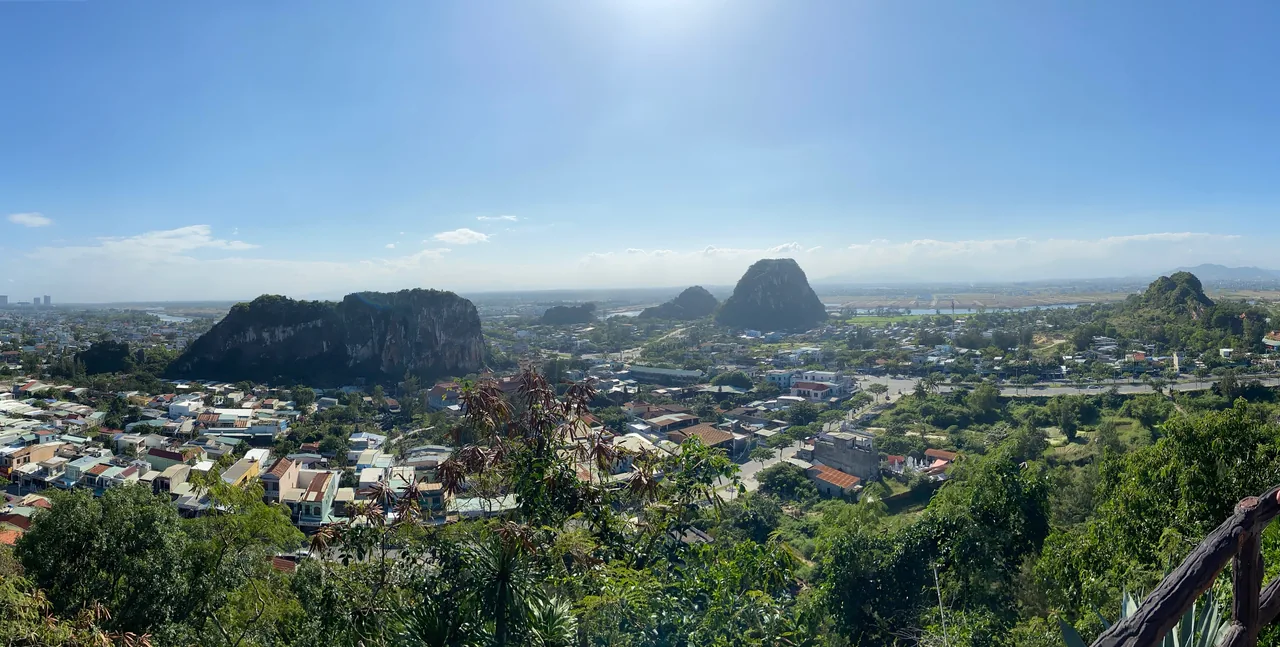
“Marble Mountains” is the tourist name for Ngu Hanh Son, which translates to “Five Element Mountains.” Five marble and limestone hills rise abruptly out of an otherwise flat coastal plain, each named for one of the five elements of Vietnamese cosmology: Thuy (Water), Kim (Metal), Moc (Wood), Hoa (Fire, technically split into two peaks, Am Hoa Son and Duong Hoa Son), and Tho (Earth). Only Thuy Son has been developed for visitors, with the caves, staircases, viewpoints and elevator this guide covers; the other four are smaller and largely untouched. When locals or guidebooks say “Marble Mountains,” they mean Thuy Son. Map
The site sits about 9 km southeast of central Da Nang, right next to Non Nuoc Beach, on the coastal road toward Hoi An. One quick note for anyone cross-checking older guides: after Vietnam’s nationwide province consolidation on 1 July 2025, Da Nang City absorbed the whole of Quang Nam Province, and the old Ngu Hanh Son District was folded into a larger Ngu Hanh Son Ward. The site itself hasn’t changed, just the paperwork around it.
Don’t expect a mountain in the Ba Na Hills sense. Thuy Son’s summit is only around 108 m, a fraction of Ba Na’s 1,487 m, so this is a walk (or a short elevator ride) through caves and gardens, not a cable-car resort in the clouds.
Opinions on Marble Mountains are mildly split, and both sides have a point. Fans love the cave-temple atmosphere, the natural skylights, and the coastal panorama for a ticket that costs less than a coffee. Critics find the stone-carving sales pitch at the base a little relentless and say two hours covers it comfortably. Both are right. This guide is built around doing it in the efficient two to three hours it actually deserves, no more.
Think of it as the compact, cultural counterpart to Da Nang’s other big “mountain” day: Ba Na Hills is a full cable-car theme park that eats a whole day, while Marble Mountains is a half-day stop you can slot in on the way to somewhere else. Plenty of travelers end up doing both, just on different days.
2. A Short History: A Royal Name, a French Nickname, and a War
Emperor Minh Mang named these hills Ngu Hanh Son in 1825, reading the five elements of Vietnamese cosmology into the five peaks; the English name “Marble Mountains” came later, coined by French colonists after the marble that local artisans quarried and carved at the mountain’s base.
That carving tradition is older than the name. Stonework here goes back to the late 1600s (more on the modern carving village below), meaning artisans have shaped marble and limestone from these hills for well over 400 years.
Decades of quarrying eventually took their toll, and the mountains themselves are now a protected site: cutting stone directly from Ngu Hanh Son is banned. The carvings sold at the base today are still handmade by the same families using the same skills, just with raw stone trucked in from elsewhere in Vietnam, mainly around Thanh Hoa and Nghe An, or imported.
The mountain’s hidden cave network also has a darker chapter. Thick limestone and hard-to-spot entrances made it a natural place to disappear, and both Am Phu Cave and Huyen Khong Cave served as a field hospital and shelter for Viet Cong forces during the Vietnam War, reportedly within earshot of the American air base and China Beach on the other side of the mountain. US Marine units searched and fought through the area in the late 1960s, especially in 1968. Map
3. Tickets & Prices 2026
Thuy Son’s main entrance costs 40,000 VND (about US$1.50) for adults and children 6 and up, Am Phu Cave is a separate 20,000 VND ticket that is not included in that price, and the elevator runs 15,000 VND one-way or 30,000 VND round-trip. That middle fact catches a surprising number of first-time visitors off guard.
| Item | Price (2026) | Notes |
|---|---|---|
| Thuy Son main entrance | 40,000 VND (~US$1.50) | Adults and children 6+ |
| Children under 6 | Free | – |
| Vietnamese student ID | 10,000 VND | Locals/students only |
| Am Phu (Hell) Cave | 20,000 VND | Separate ticket booth, on top of main entrance |
| Elevator, one-way | 15,000 VND | Optional |
| Elevator, round-trip | 30,000 VND | Optional |
The main ticket covers Thuy Son’s caves (except Am Phu), the pagodas, and the viewpoints. It does not cover the elevator, which is an optional convenience, or Am Phu Cave, which is a separate site near the base.
The official baseline is 7:00 to 17:00 daily; some visitor reports mention a 17:30 closing during busier stretches, so treat 17:00 as the safe cutoff and don’t count on staying later. There’s no confirmed 2026 price increase beyond normal year-to-year consistency with 2025, so treat the numbers above as current official rates, and keep in mind that festival periods like Tet can shift hours slightly.
4. Elevator or the 156 Steps? The Honest Decision
Take the elevator up and walk down. For 15,000-30,000 VND you skip roughly 156 stone steps on the way up, arrive at the top without being drenched in sweat, and still get a shaded, interesting walk down past carved inscriptions and small shrines that most people rush by on the way up.
Who should basically always take the elevator: anyone visiting between 10:00 and 14:00, when the stone steps radiate heat; travelers with knee issues; families with small kids (strollers won’t survive the summit paths regardless, but skipping the climb still helps); and anyone genuinely short on time.
Who can happily walk both directions: early risers who arrive before 8:30, ahead of the heat, and anyone who actually enjoys the climb as part of the experience. The steps themselves pass carved reliefs and small shrine nooks worth a slow look.
Either way, wear grippy shoes. The steps are uneven natural stone and get slippery when wet, whether from rain or just tropical humidity.
5. Huyen Khong Cave: The Cathedral of Light
Huyen Khong is the largest and most photographed cave at Marble Mountains, where a collapsed section of ceiling lets natural daylight pour straight down onto the Buddhist shrines and altars below. The light show peaks roughly mid-morning to early afternoon, when the sun sits high enough to angle straight through the opening.
Multiple shrines and Buddha statues are positioned to catch that light, and the cavern is large enough to feel like a genuine stone temple rather than a tunnel you duck through. Map
It’s cool, echoing, and atmospheric even with a crowd inside, and incense smoke drifting through the light beams is the photo everyone leaves with.
Huyen Khong is included in the main ticket, no separate fee required. Nearby, four smaller caves, Tang Chon, Van Thong, Linh Nham, and Hoa Nghiem, are worth a glance if you have time, but none come close to Huyen Khong’s scale, so don’t feel obligated to track down every one.
6. Am Phu Cave: Heaven and Hell (The Separate-Ticket Cave)
Am Phu, or “Hell,” Cave is Da Nang’s longest natural cave at roughly 300 m, and it needs its own 20,000 VND ticket separate from the main gate. A path descends into a dim, narrow “hell” section lined with carved depictions of punishment for sinners, then climbs back up toward a bright “heaven” opening with a view over the coast.
Bring a phone flashlight. Unlike Huyen Khong’s naturally lit cavern, sections of Am Phu are genuinely dark.
The descent is narrow with a low ceiling in spots, so it’s not ideal for anyone uneasy in tight, dark spaces, and it’s generally not recommended for kids under about 8.
If you skipped the history section above: this cave, along with Huyen Khong, sheltered a Viet Cong field hospital during the Vietnam War. Knowing that as you walk through adds real weight to what otherwise plays as a slightly kitsch “hell house” theme.
Budget 20 to 30 minutes round trip. It’s a memorable, strange contrast to the serene pagodas waiting above.
7. The Pagodas: Tam Thai and the Third Linh Ung
Thuy Son holds two major working temples, Tam Thai Pagoda and Linh Ung Pagoda, and this particular Linh Ung is one of Da Nang’s three Linh Ung pagodas (the other two are the famous seaside one on the Son Tra Peninsula and the one at Ba Na Hills’ summit), a fact most visitors never realize until they’re standing in front of it.
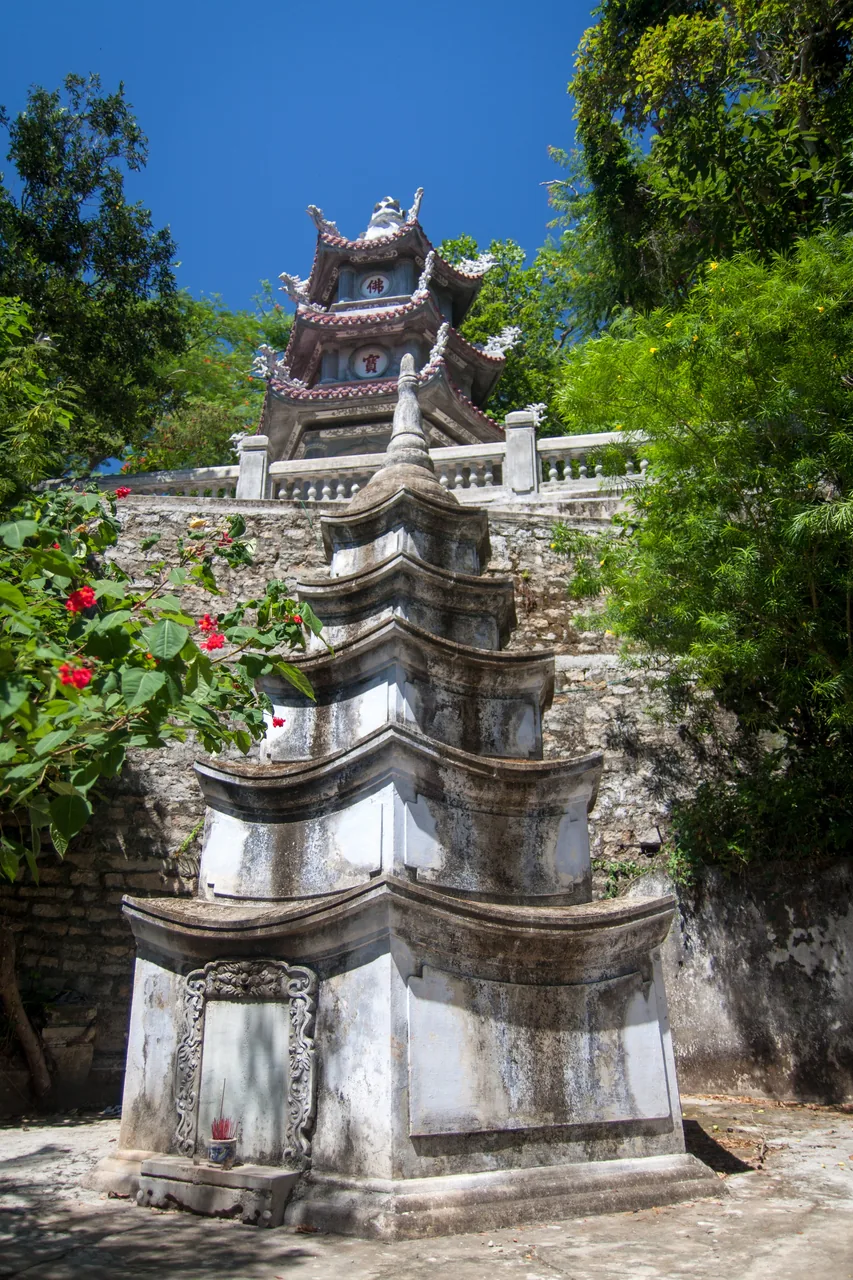
Tam Thai Pagoda, founded in 1630 and renovated in 1946 and again in 1975, still uses its traditional three-gate entrance, one door each for monks, women, and men. The courtyard holds a giant Maitreya, the “laughing Buddha,” surrounded by bonsai and frangipani trees. Centuries of continuous worship make this a living temple, not a museum piece. Map
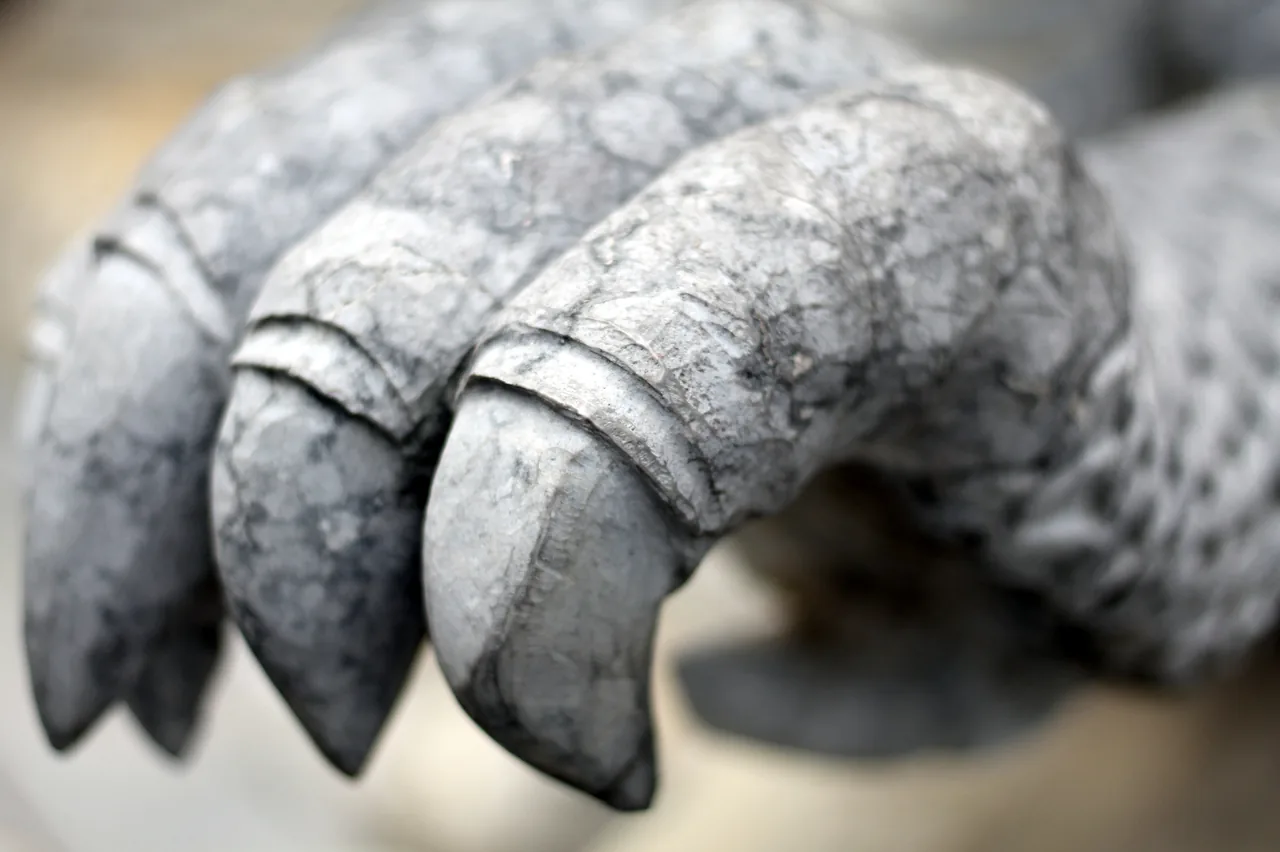
Linh Ung Pagoda here is smaller and quieter than its famous namesake on Son Tra, but shares the name and lineage. Dragon-carved guardian statues and stone gate details reflect the same Non Nuoc carving tradition covered later in this guide. Map If you want to see the well-known Lady Buddha original, that’s on Son Tra Peninsula; a third Linh Ung, mentioned only in passing here, sits at the top of Ba Na Hills.
Both pagodas are active places of worship, so cover shoulders and knees and keep your voice down near the altars.
8. The Viewpoints: Vong Hai Dai and Vong Giang Dai
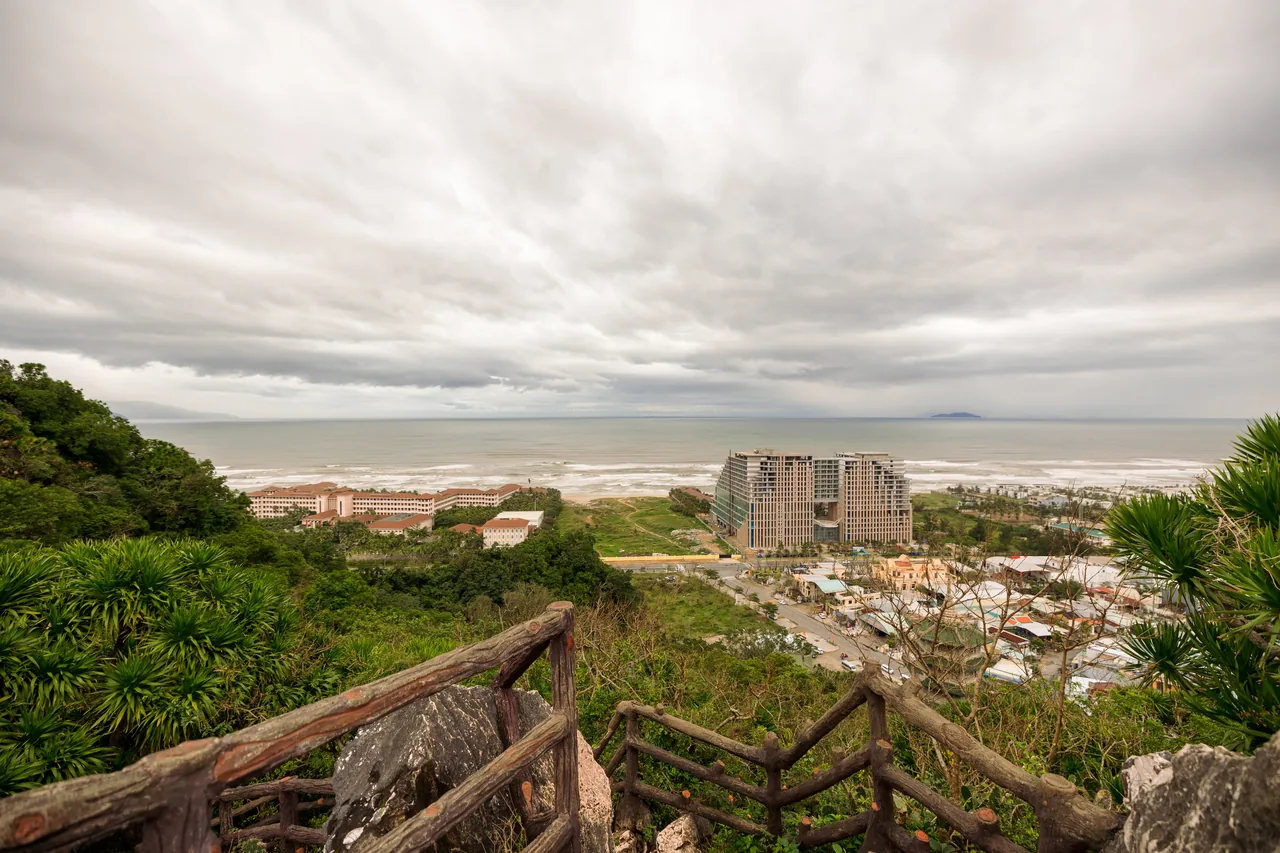
Vong Hai Dai, the “sea-watching pavilion,” is the classic panorama over Non Nuoc Beach and the South China Sea, while Vong Giang Dai, the “river/mountain-watching pavilion,” faces the other direction toward the Han River side and the karst peaks of Marble Mountains’ sister hills. They’re a short walk apart, so do both if you have 15 spare minutes.
Vong Hai Dai Map is the busier and more photographed of the two. Aim for morning or late afternoon light; midday sun washes out photos and makes standing on open stone genuinely uncomfortable.
Thuong Thai Peak is the actual high point in this area, a short, slightly steep scramble past the main viewpoints. It’s worth the extra few minutes if you’re not pressed for time and want the widest possible view. Map
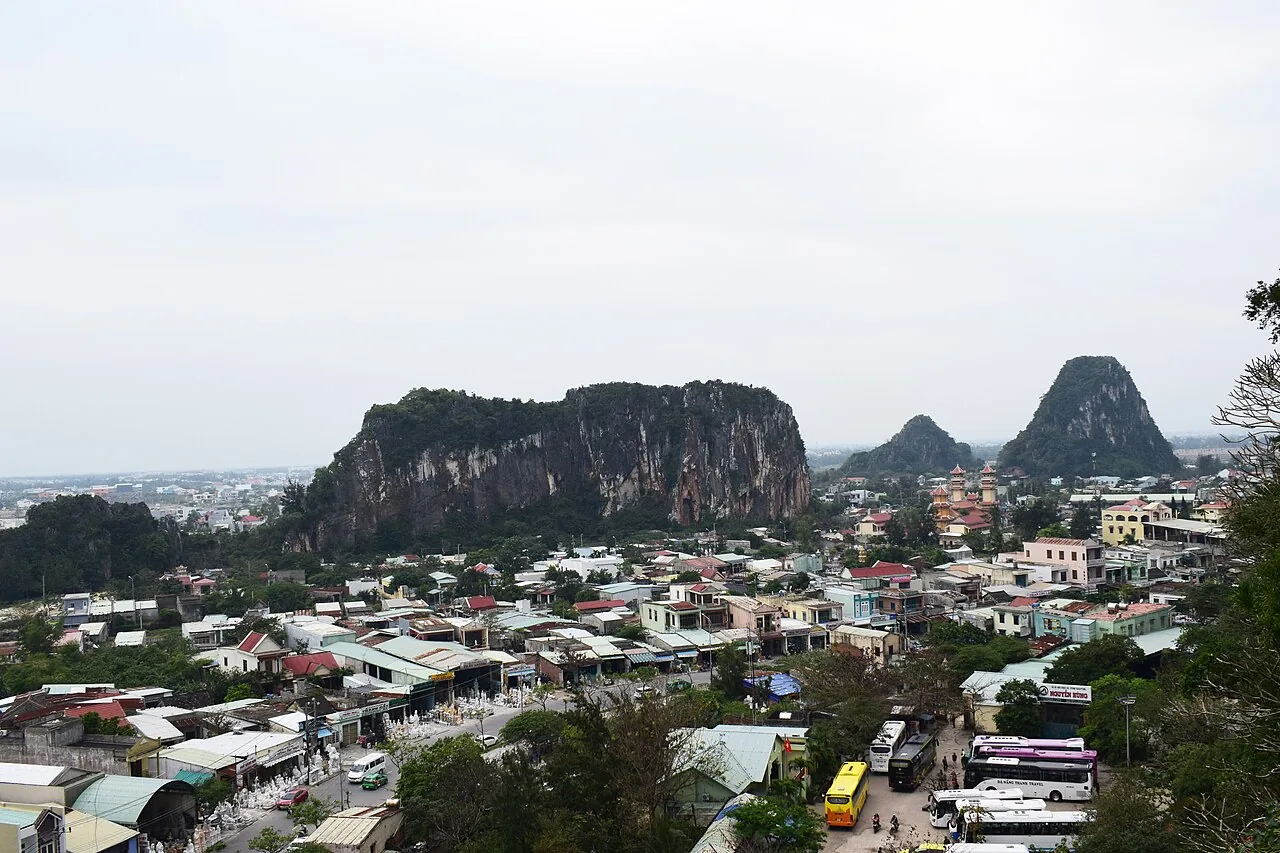
On a clear day you can trace the full curve of Non Nuoc Beach, the mouth of the Han River, and, in very clear conditions, the outline of Son Tra Peninsula to the north.
9. Non Nuoc Stone Carving Village: 400+ Years at the Mountain’s Foot
At the base of the mountains sits Non Nuoc Stone Carving Village, one of Vietnam’s oldest and largest stone-carving communities, nearly 500 workshops strung along winding lanes, practicing a craft that traces back to the late 1600s and earned National Intangible Cultural Heritage recognition in 2014.
Local tradition credits the craftsman Huynh Ba Quat with bringing stone-carving techniques from Thanh Hoa in the late 17th century. Early output was practical: mortars, millstones, tombstones. Map
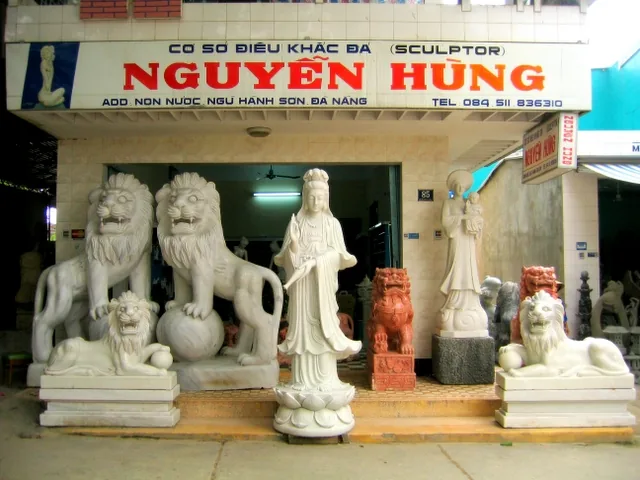
The craft’s golden age came under the 19th-century Nguyen Dynasty, when Non Nuoc artisans won royal commissions for palaces, temples, and imperial tombs, and some carvers even received official court titles.
Today the village ranges from small family stalls to warehouse-sized showrooms stacked with lions, Buddhas, and garden statues, some pieces weighing hundreds of kilos and shipped internationally. It’s worth a browse even if you have zero intention of buying; the craftsmanship on display is genuinely impressive.
Since the mountains themselves are protected, nearly all the raw stone worked here today comes from other Vietnamese provinces or is imported, not quarried from Ngu Hanh Son.
10. Getting There: From Da Nang, Hoi An, and the Airport
Marble Mountains sits about 9 km southeast of central Da Nang, roughly 20 minutes by car, and almost exactly on the route between Da Nang and Hoi An, which makes it one of the easiest “free” stops on your entire trip.
| From | Distance / Time | Typical Grab/Taxi Cost |
|---|---|---|
| Central Da Nang (Han River area) | ~9 km, ~20 min | ~80,000-120,000 VND (~US$3-5) one-way |
| Da Nang Airport (DAD) | ~11-12 km, ~20-25 min | Similar range to city center |
| Hoi An Ancient Town | ~18-20 km, ~25-30 min | On the direct road, a natural stop rather than a separate trip |
Da Nang Airport (DAD) Map connects easily if you’re coming straight off a flight; see getting from Da Nang Airport into the city for the full breakdown, and Grab vs. the local ride apps if you’re not sure which one to open first.
Because the site sits almost exactly on the direct road, it fits naturally into a Da Nang-Hoi An transfer or a dedicated Hoi An day trip, rather than requiring its own round-trip from the city.
You’ve got three realistic ways to get here: a one-way Grab or taxi (cheapest and most flexible, though as with any single stop, it’s worth confirming your return plan since Grab availability right at the gate can thin out during quiet hours); a booked round-trip private car that waits for you (the best option if you’re combining this with Hoi An or the airport, since there’s no waiting around for a return ride); or a half- or full-day guided tour that bundles Marble Mountains with Hoi An or Son Tra (zero logistics, fixed schedule). Before any Da Nang taxi or rental booking, it’s worth skimming common Vietnam tourist scams so you know what a fair fare looks like.
11. How to Plan Your Visit: Pairings and Timing
The two best pairings are Non Nuoc Beach right next door and a Da Nang-Hoi An transfer, since the site sits basically on the road between the two; trying to squeeze in Ba Na Hills the same day is technically possible but exhausting, since Ba Na alone runs 6 to 8 hours.
Non Nuoc Beach Map is the single most popular local combo: climb, then swim. Bring swimwear and see Da Nang’s best beaches for the full rundown on Non Nuoc and its neighbors.
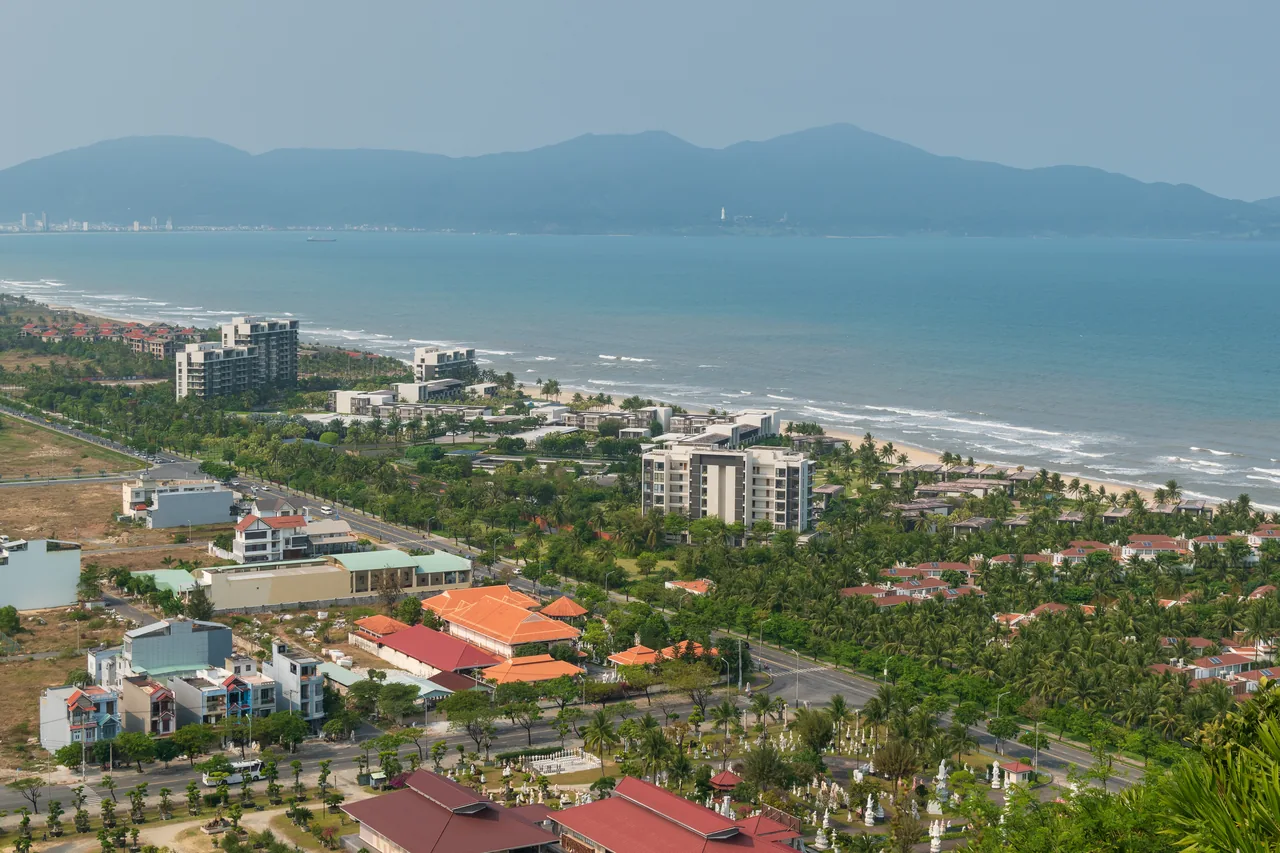
For Hoi An, fold Marble Mountains into a transfer or a Hoi An day trip rather than making a dedicated round-trip from the city center, since it’s almost exactly on the way.
Da Nang effectively has two “mountain” days, and they’re not really comparable: Marble Mountains is a half-day cultural and nature stop at 2-3 hours, while Ba Na Hills (Map) is a full-day cable-car theme park. Most multi-day visitors end up doing both, just on separate days rather than choosing one over the other.
For a culture-focused half-day, some travelers pair Marble Mountains with the Cham Sculpture Museum, stacking two very different slices of Da Nang’s Buddhist and Cham heritage back to back.
| Stop | Time |
|---|---|
| Thuy Son caves + pagodas | 60-90 min |
| Am Phu Cave | 20-30 min |
| Viewpoints | 15-20 min |
| Non Nuoc village browse | 20-40 min |
| Total realistic visit | 2-3 hours |
If you’re mapping out the rest of the trip, a Da Nang 3-4 day itinerary and the best day trips from Da Nang both slot Marble Mountains in naturally, and Da Nang tours worth booking covers what else deserves a spot on your list.
12. Best Time to Visit and What to Wear
Arrive at opening, around 7:00-7:30, or after 15:30, both to dodge the heat (there’s very little shade on the stone paths) and the tour-bus crowd that peaks roughly 9:30 to 13:00.
This is an outdoor, largely shade-free site, so the season you visit matters. Check Da Nang’s best time to visit and Da Nang’s dry and rainy seasons for the full picture: roughly February through August is dry, September through January is rainy. Rain makes the stone steps slick and can leave the caves dripping.
What to wear: closed, grippy shoes (skip the flip-flops, the stone floors get wet and uneven, especially inside the caves); modest clothing for the pagodas, shoulders and knees covered; a hat and water for the shade-free viewpoint stretches; and a light layer, since the caves run noticeably cooler than the open paths.
Families take note: strollers do not work on the summit paths, the stone is too uneven. The elevator plus a baby carrier is the realistic option for very young kids, and Am Phu Cave’s tight, dark sections aren’t a great fit for anxious children or anyone claustrophobic.
13. Practical Tips and Honest Warnings
Budget two to three hours, expect a persistent but polite sales pitch at the stone-carving stalls near the base, and remember that Am Phu Cave is a separate ticket: those three things catch more first-time visitors off guard than anything else at Marble Mountains.
Bottom line: Marble Mountains earns its spot on a Da Nang itinerary for the atmosphere, the history, and the price. Don’t let any guide, including this one, talk you into spending a whole day here. Two to three focused hours is the right amount for almost everyone.
🌆 The Complete Da Nang Guide Library
- Da Nang Travel Guide 2026: The Complete Plan (Flights, Weather, Hotels, Food & More)
- The Perfect Da Nang Itinerary: 3 to 4 Days, Planned Day by Day
- The Best Day Trips from Da Nang: Where to Go Beyond the City
- How Much Does a Da Nang Trip Really Cost? A Real Budget Breakdown
- The Best Time to Visit Da Nang: A Month-by-Month Breakdown
- Da Nang Airport to the City & Hoi An (2026): Grab, Taxi & Transfer Guide
- Da Nang to Hoi An: Taxi, Grab, Bus or Bike — What’s Best?
- Things to Do in Da Nang: The Attractions Actually Worth Your Time
- Da Nang Activities: The Tours & Experiences Worth Booking
- Ba Na Hills & the Golden Bridge: The Complete Guide (Tickets, Cable Cars, One-Day Plan)
- Son Tra & the Lady Buddha: Da Nang’s Best Sunset Viewpoint
- The Cham Sculpture Museum, Da Nang: Is It Worth a Visit?
- Da Nang’s Best Beaches: Which One Is Right for You?
🎡Things to Do52
🍜Food8
🏨Where to Stay6
🚇Getting Around9
🧭Travel Tips21
🧭Vietnam-wide essentials56
Marble Mountains FAQ
Main entry is 40,000 VND. Am Phu Cave is a separate 20,000 VND ticket, not included with the main gate. The elevator adds 15,000 VND one-way or 30,000 VND round-trip if you’d rather skip the 156 steps.
Yes for most people. For 15,000-30,000 VND it skips roughly 156 stone steps, which matters most in midday heat. The best approach is elevator up, then walk down for the view and the shaded, carved path.
Two to three hours covers the caves, pagodas, viewpoints, and Am Phu Cave comfortably. It’s a half-day stop, not the full-day trip many guides make it out to be.
No. Am Phu Cave requires its own 20,000 VND ticket at a separate booth near the base, on top of the 40,000 VND Thuy Son entrance. It’s the single most common ticketing surprise here.
It’s about 9 km, 20 minutes by Grab from central Da Nang, roughly 80,000-120,000 VND one-way. It also sits almost exactly on the Da Nang-Hoi An road, making it an easy stop either direction.
Arrive at opening, around 7:00-7:30, or after 15:30. Both windows dodge the midday heat on the shade-free stone paths and the roughly 9:30-13:00 tour-bus crowd surge.
With the elevator, yes for most. Strollers don’t work on the uneven summit paths, and Am Phu Cave’s tight, dark sections aren’t ideal for very young or anxious visitors, so plan around that one cave if needed.
Closed, grippy shoes, no flip-flops, since stone floors get wet and uneven in the caves. Bring modest clothing for the active pagodas (shoulders and knees covered) and a hat for the shade-free viewpoints.
Marble Mountains is a compact half-day cultural and nature site, 2-3 hours, topping out around 108 m. Ba Na Hills is a full-day cable-car theme park at 1,487 m. Most multi-day visitors do both, on separate days.
Emperor Minh Mang named the five peaks Ngu Hanh Son, ‘Five Element Mountains,’ in 1825. French colonists later nicknamed them Marble Mountains after the marble carved by local artisans at the base.
Huyen Khong Cave is naturally lit through a skylight opening, so no. Am Phu Cave has genuinely dark stretches, so a phone flashlight is worth carrying if you’re heading in there.
Yes, and it’s the most popular local pairing. Non Nuoc Beach sits right beside the mountains, so a swim after the climb is an easy add-on with no extra travel time.
Yes, for the pagodas. Tam Thai and Linh Ung are active temples, so cover shoulders and knees, the same standard you’d follow at any working Buddhist site in Vietnam.