
Nha Trang Travel Guide: Islands, Diving, Mud Baths & the Dry-Season Beach City
Vietnam’s most activity-packed beach city — area-by-area guidance, a month-by-month season table, and a three-tier budget.
| Best for | Snorkeling & diving, island-hopping, water parks, mud baths, and a lively urban beach with nightlife |
|---|---|
| Best months | Mar–Aug for beach & diving (Feb is driest); avoid Oct–Nov (wettest, rough seas, tours cancelled) |
| Airport | Cam Ranh (CXR), ~30–35 km / 45–60 min south of the city — there is no city airport |
| How long | 3–4 days for the city itself; 5+ if you add a Cam Ranh resort or day trips |
| Signature experiences | Hon Mun reef, VinWonders + the sea-crossing cable car, and Thap Ba mud baths |
| Where to stay | Tran Phu beachfront (convenience) · Cam Ranh/Bai Dai (resorts) · downtown (budget) |
| Daily budget (per person) | Budget ~450,000đ / ~US$17 · Mid ~1.6M đ / ~US$60 · Luxury ~5.6M đ+ / ~US$215+ |
| Good to know | Long dry season when Da Nang is wet; US/UK/Canada/Australia IDPs are not valid to ride a scooter here |
1. At a glance: is Nha Trang for you?
2. Nha Trang vs Da Nang vs Phu Quoc — which beach?
3. How Nha Trang is laid out — the areas
4. Where to stay — area by area
5. Islands & the sea — Hon Mun, VinWonders, boats & diving
6. Mud baths & mineral springs
7. Culture & history
8. Inland nature & waterfalls
9. What to eat — Nha Trang specialties
10. Coffee, dessert & cafés
11. Nightlife
12. When to go: season & weather
13. Festivals & events
14. Budget: how much a Nha Trang trip costs
15. Getting there: airport, trains & routes
16. Getting around: Grab, taxis & scooters
17. Day trips from Nha Trang
18. Suggested itineraries (area by area)
19. Safety & health
20. Practical basics
21. Common mistakes to avoid
22. Final planning checklist
1. At a glance: is Nha Trang for you?
🍜 What to eat in Nha Trang: the dishes, the prices and where the shops are →
🏖️ Things to do in Nha Trang: how a day divides, with fares and travel times →
🚕 Cam Ranh airport to Nha Trang — every fare, and what still runs after midnight →
🧖 Nha Trang mud baths compared — five venues, what the price really covers →
⛵ Nha Trang island hopping — party boat vs speedboat, the four islands and what it really costs →
🎟️ VinWonders tickets explained — full-day vs after-4pm, and what the cable car includes →
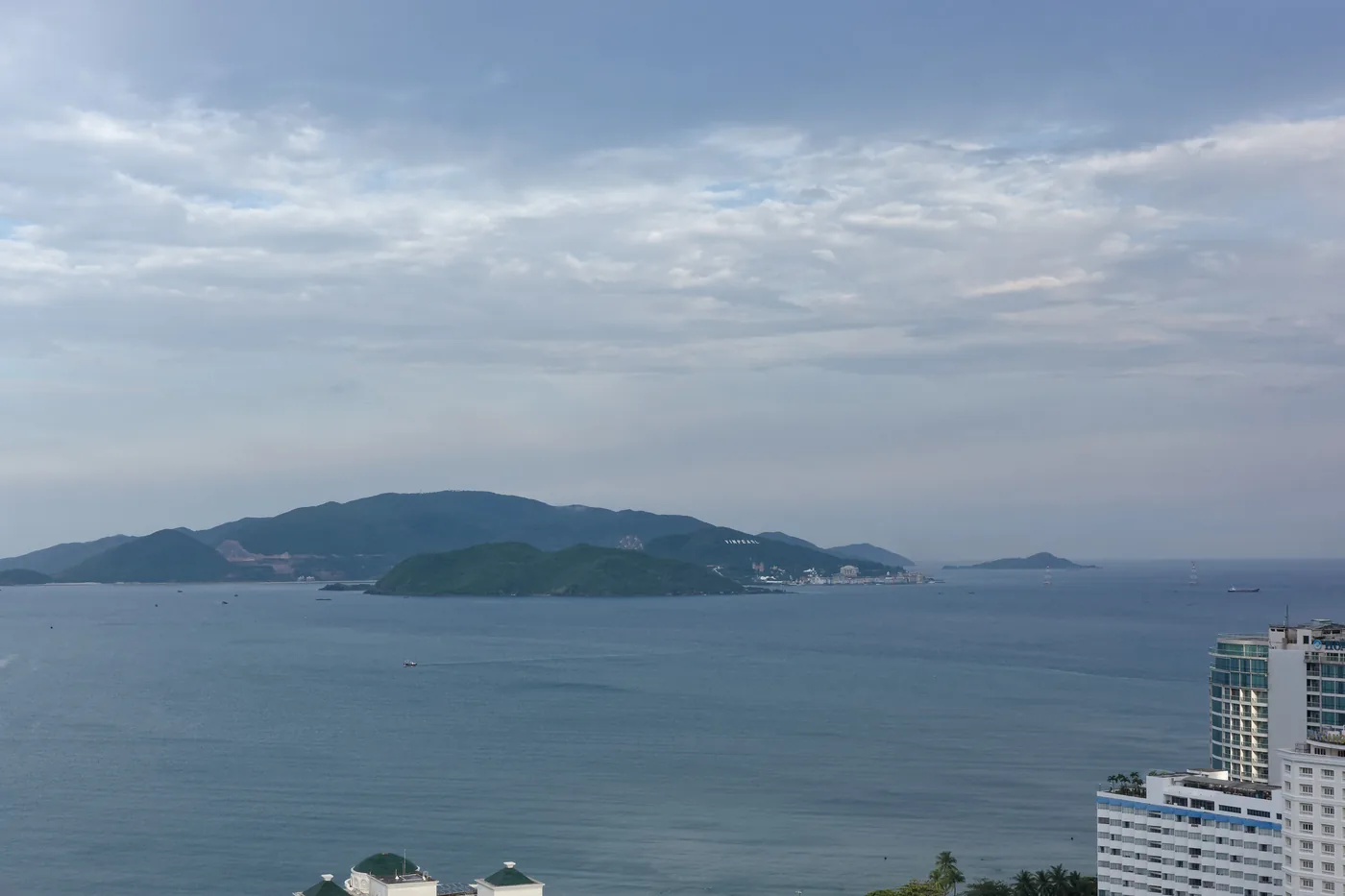
Nha Trang is Vietnam’s most activity-dense beach city: the country’s best snorkeling and diving off Map, back-to-back island-hopping, a giant island water park at VinWonders, therapeutic mud baths, and a long curving city beach backed by real nightlife. Its quiet superpower is timing — a long dry season from roughly January to August keeps it sunny here while Da Nang and Hoi An to the north are getting rained on.
Think of it as the place you come to do things on and in the water rather than to disappear onto an empty sandbar. If pristine seclusion is the goal, that is Phu Quoc‘s role; Nha Trang trades some of that calm for energy, infrastructure, and sheer choice.
| Come here for | Look elsewhere if you want |
|---|---|
| Snorkeling & diving, island-hopping, water parks | Empty, pristine sand with the softest beaches → Phu Quoc |
| A walkable urban beach with bars, tours & nightlife | Culture and day-trips on your doorstep → Da Nang / Hoi An |
| Reliable sun in Feb–Aug when central Vietnam is wet | A calm resort cocoon with nothing to organize |
| Mud baths, great seafood, and strong value for money | To avoid crowds entirely in peak summer or at Tet |
It also wears its history lightly. A Soviet-era link at nearby Cam Ranh and decades of charter flights have made Nha Trang unusually Russian- and Korean-heavy, so you will see Cyrillic on shopfront signs and Korean BBQ a block from the sand. For the wider picture, see the Southern Vietnam hub and the Vietnam master guide; for entry paperwork, the visa guide and 2026 entry rules.
2. Nha Trang vs Da Nang vs Phu Quoc — which beach?
Choose Nha Trang for activities and water sports, Da Nang as the best all-rounder, and Phu Quoc for quiet island-resort beaches. All three make excellent bases; the right pick comes down to whether you value things-to-do density, nearby culture, or pure sand-and-seclusion.
| Nha Trang | Da Nang | Phu Quoc | |
|---|---|---|---|
| Best for | Activities, snorkel/dive, island-hopping, nightlife | All-rounder: beach plus nearby culture | Quiet, pristine-beach resort escape |
| The beach | Long urban city beach, lively | Long clean beach, calmer | Softest sand, most secluded |
| Nearby draws | Islands, VinWonders, mud baths | Hoi An, Marble Mountains, Ba Na Hills | The island itself, cable car, safari |
| Vibe | Busy, urban, party-friendly | Balanced city-beach | Relaxed, resort-led |
| Weather edge | Driest Feb–Aug (sunny when the north is wet) | Wet Sep–Dec | Dry Nov–Apr, wet May–Oct |
The seasons are the underrated tiebreaker. Nha Trang and Da Nang sit on opposite rainfall calendars, so if you are travelling in spring or summer and want a near-guaranteed dry beach, Nha Trang usually wins; come autumn, the advantage flips. There is no wrong answer, and plenty of travelers pair two coasts on one trip, flying between them in about an hour.
3. How Nha Trang is laid out — the areas
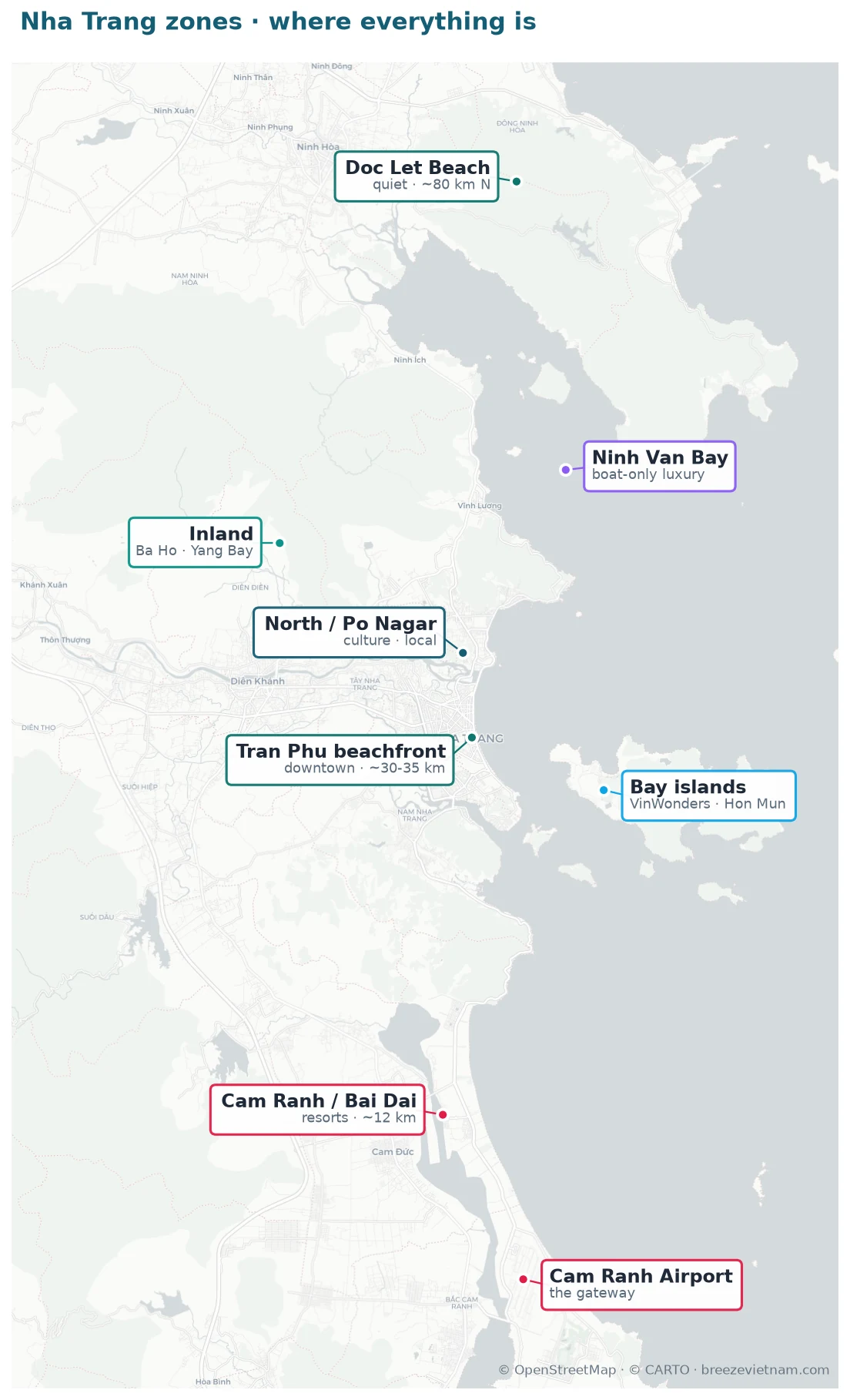
Nha Trang is easy to read: one beachfront boulevard, Tran Phu, runs the length of a long curving city beach, with the tourist core packed into the blocks just behind it and everything else radiating out from there. The Map marks the northern edge, the airport lies well to the south, and some of the best beaches and resorts sit beyond both ends of the city.
Map is the heartbeat: a several-kilometre, palm-lined strip with high-rises stacked behind the sand. The modern Map near the river mouth is a favourite sunset spot, while the older Map crosses toward the Map on the cultural north side. At the southern end, the Map and Vinpearl Harbour are where the cable car and boat tours depart.
| Zone | Character | To CXR airport |
|---|---|---|
| Central Tran Phu beachfront | Main strip; walkable hotels, bars & tours; energetic | ~30–35 km |
| North Nha Trang / Xom Bong / Po Nagar | Older, local, cultural; quieter beach walk north | ~35–40 km |
| Offshore islands (Hon Tre, Hon Mun, Hon Tam…) | VinWonders, snorkel reefs, a mud-bath island | Via the Cau Da piers |
| Map | New-build 5★ resort strip, long calm shallow beach | ~12 km (closest) |
| Map | Boat-access ultra-luxury hideaways | ~60 min drive + boat |
| Map | Quiet white-dune shallow beach, few resorts | ~80+ km |
Two things trip people up. First, Cam Ranh is closest to the airport yet about 45–60 minutes from the city’s nightlife and tour piers, so a resort there trades convenience for seclusion. Second, the islands are a world of their own — Map alone holds the VinWonders park and the sea-crossing cable car, while Map is the marine reserve everyone comes to snorkel.
4. Where to stay — area by area
🏨 Where to stay in Nha Trang — the 5 zones compared, hotel by hotel →
Base yourself on Tran Phu for walkable convenience, at Cam Ranh/Bai Dai for resort seclusion and the shortest airport hop, or downtown for the cheapest beds. Lodging splits cleanly by zone, and the real question is how much you value walking to tours and bars versus waking up on a quiet resort beach.
| Stay here for… | Zone | Trade-off |
|---|---|---|
| Walk-everywhere convenience | Central Tran Phu | Busy; some street noise |
| Resort seclusion + fast airport | Cam Ranh / Bai Dai | ~45–60 min to city nightlife |
| Cheapest beds & local food | Downtown (Biet Thu / Hung Vuong) | A few blocks off the sand |
| Ultra-luxury isolation | Ninh Van Bay | Boat-access only; you stay put |
| Uncrowded escape | Doc Let | Far from everything |
| An all-in-one island bubble | Hon Tre (Vinpearl) | Cut off from the mainland scene |
Central Tran Phu beachfront
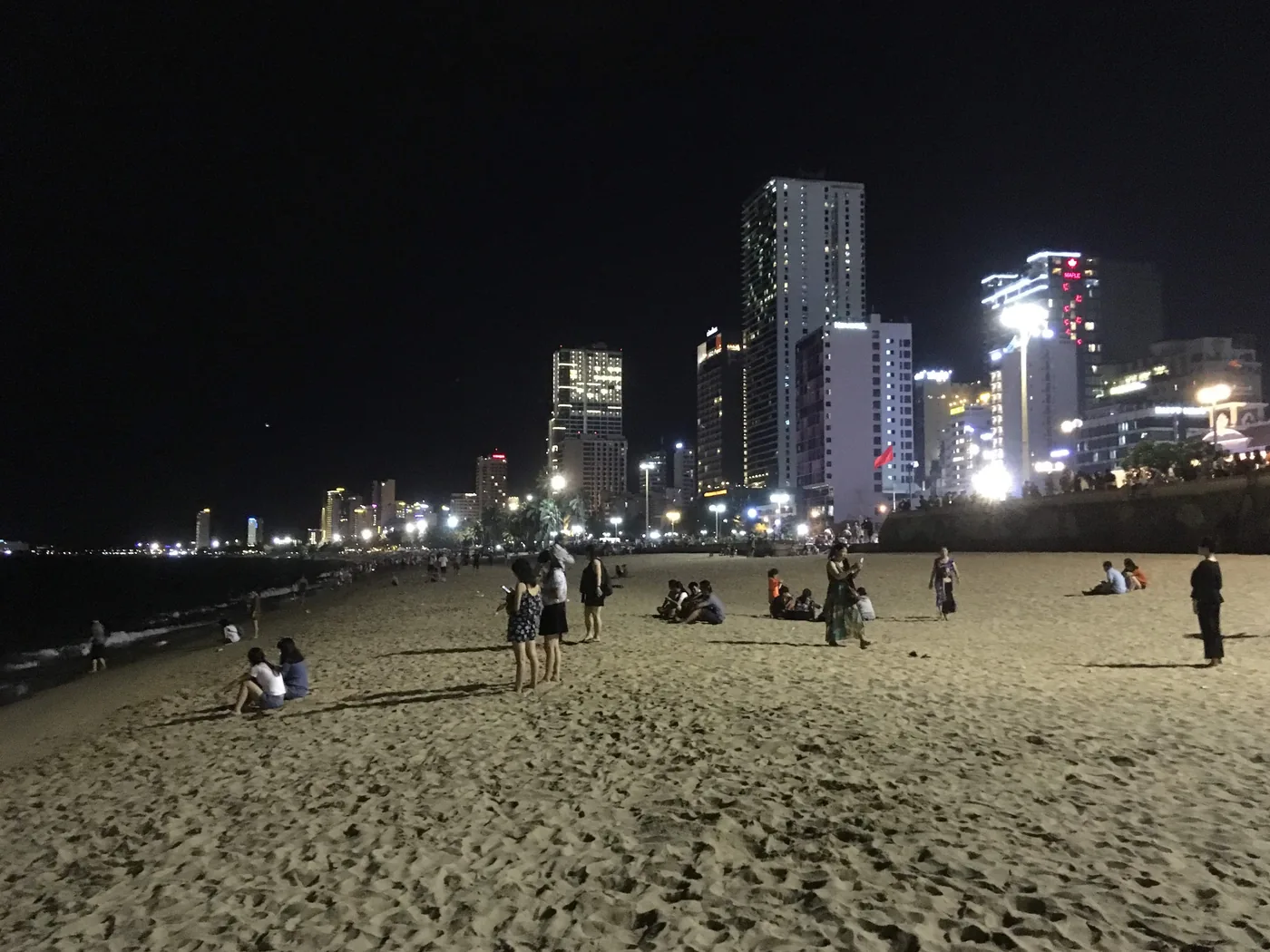
This is the default for first-timers, groups, and anyone who wants to walk to the beach, tours, and bars. It runs the full ladder from hostels to 5★ towers, and staying here means you never budget for a taxi to dinner. The trade is atmosphere: it is the busiest, most built-up stretch of the city.
Cam Ranh / Bai Dai Map
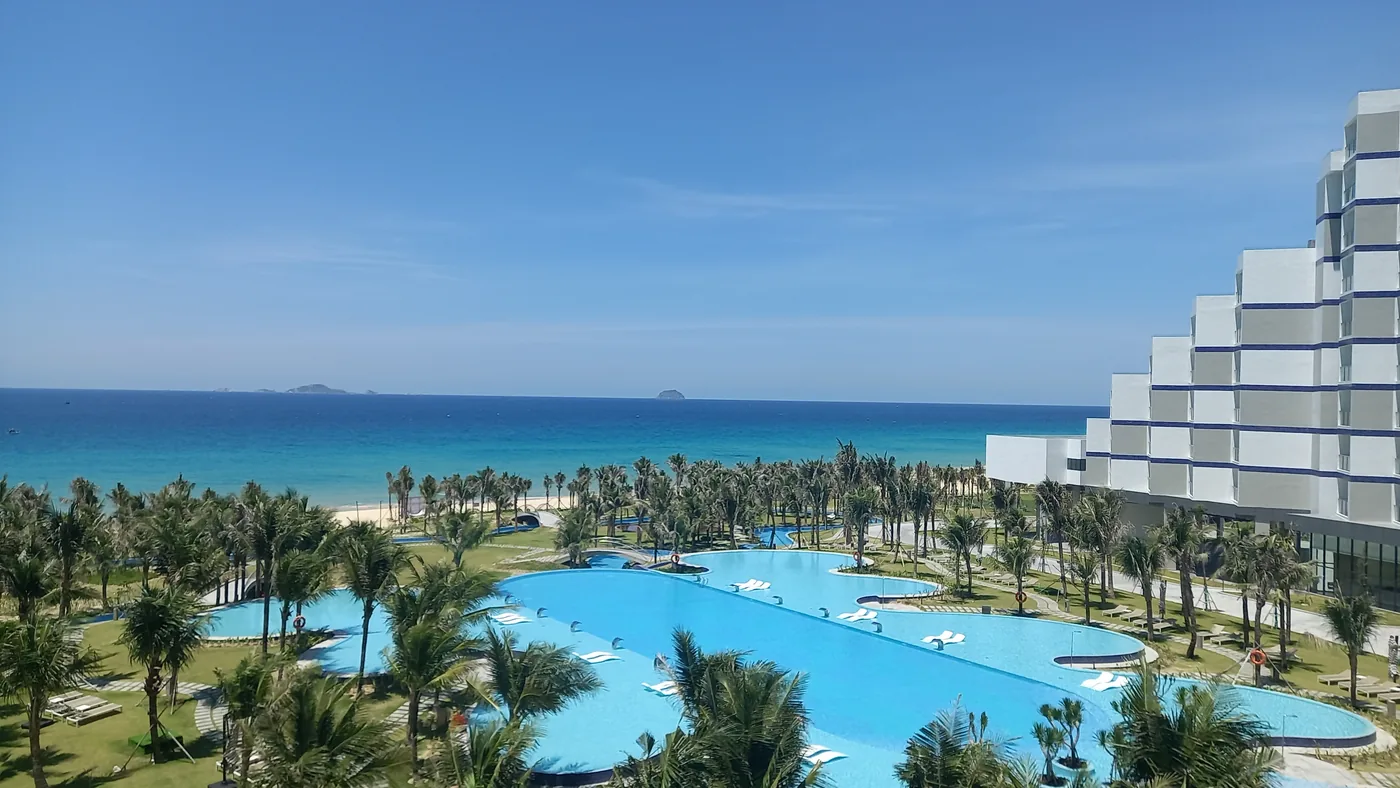
The new-build resort strip along is where families and honeymooners go for a long, calm, shallow beach and polished 5★ service. It is only ~12 km from the airport (about 15–20 minutes), the closest of any zone, but expect a 45–60 minute transfer whenever you want the city’s restaurants and nightlife.
Downtown budget (Biet Thu & Hung Vuong)
A few blocks back from the sand, the Biet Thu and Hung Vuong lanes hold the densest cluster of hostels, cheap guesthouses, and local eateries. You lose the sea view but keep an easy walk to the beach, and this is where your money stretches furthest — see the money & costs guide for what to budget.
Ninh Van Bay — ultra-luxury Map
Reached only by boat across the bay, is home to hideaway resorts such as Six Senses, An Lam, and L’Alya. This is a stay-put cocoon: you arrive, and the outside world essentially stops until you leave.
Doc Let & Hon Tre island Map
to the north suits an uncrowded, do-nothing escape, though it is far from the city and thin on resorts. On Map, the Vinpearl complex is an all-in-one island bubble with the theme park at your doorstep — brilliant for families, but deliberately sealed off from the mainland scene.
5. Islands & the sea — Hon Mun, VinWonders, boats & diving
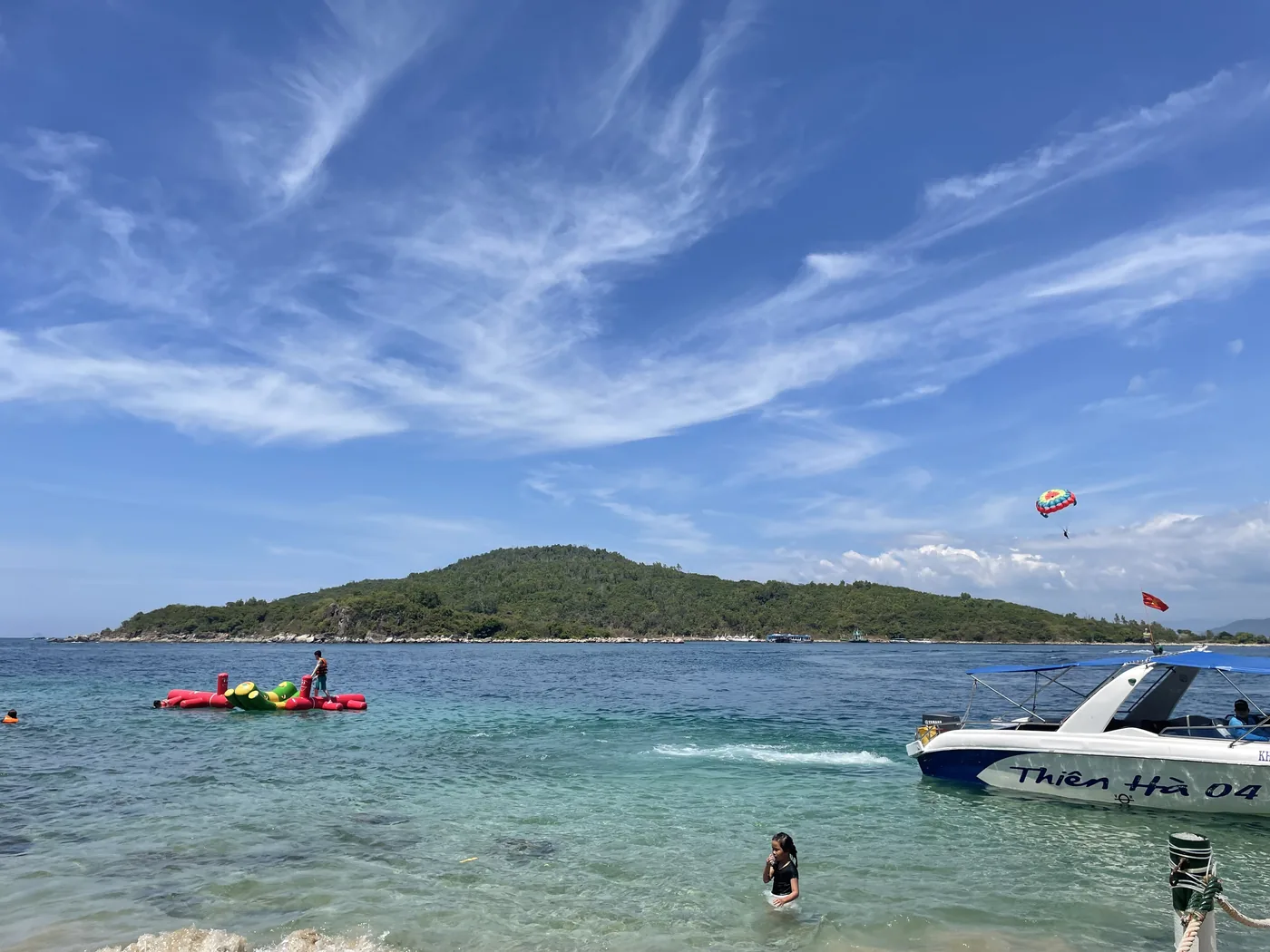
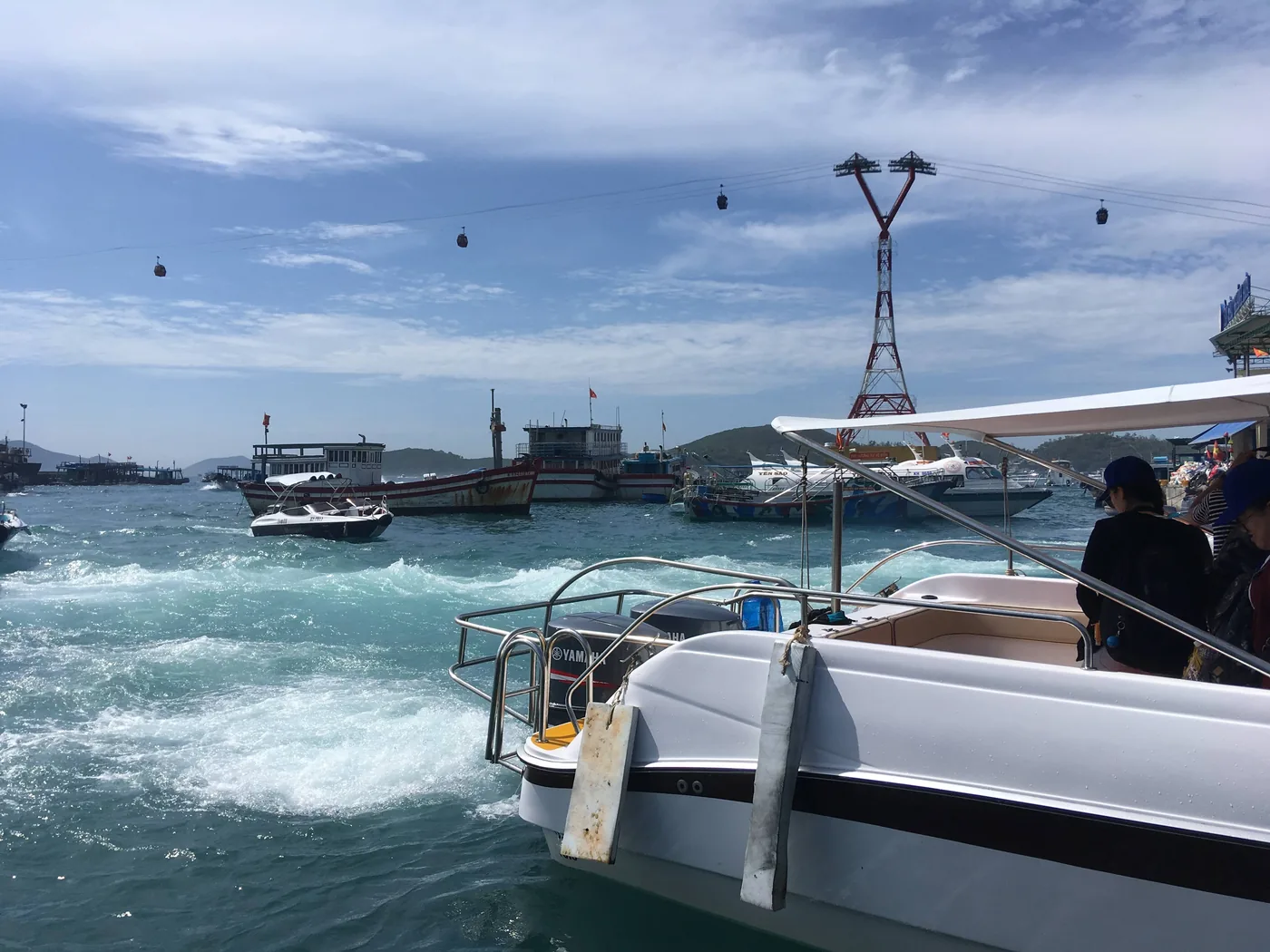
The islands are the reason most people come: snorkel the reef at Hon Mun, ride the world-class sea-crossing cable car to VinWonders on Hon Tre, and pick a boat tour that matches your energy — party boat or calmer speedboat. Everything launches from the Cau Da / Vinpearl Harbour piers at the city’s southern end.
Hon Mun — snorkeling & the marine reserve Map
was Vietnam’s first Marine Protected Area, and it still holds the country’s richest reef, with hundreds of coral and reef-fish species around it. It sits ~14 km southeast, roughly 30–45 minutes by boat from Cau Da, and there is a small reserve fee of about 22,000đ per adult (confirm on the day). Bring reef-safe sunscreen — the water is the point here.
VinWonders + the sea-crossing cable car Map
on Hon Tre is an integrated theme park — rides, a large water park, the Neptune aquarium, and evening shows — and a genuine full-day outing, especially with kids. Getting there is half the fun: the Map is one of the world’s longest over-sea cable cars, gliding across the bay in about 8–10 minutes with sweeping views (a speedboat covers the same crossing in 7–10 minutes when high winds pause the cabins). Budget an adult ticket in the ~950,000–1,050,000đ range (about US$40), with cheaper after-4PM entry; note that prices are set to rise after a major February 2026 upgrade adds new rides and a revamped aquarium, so confirm the current rate when you book.
Diving Hon Mun — read this first
Diving here comes with an important caveat. After the reef suffered heavy coral loss, authorities restricted diving, swimming, and boating around Hon Mun in mid-2022 to let it recover; some operators now run limited dives in permitted zones, but the rules have shifted repeatedly. Confirm the current situation locally before you book, and treat anyone promising a guaranteed ‘reopened, dive-anywhere’ experience with caution. The longest-running PADI operator, Rainbow Divers, is a sensible first call, with single dives from around US$50.
Boat tours — party boat vs speedboat
The classic day out is a four-island loop, typically combining Hon Mun for snorkeling with an aquarium stop and a beach or two. Two very different styles exist, and it pays to know which you are buying.
| Budget group / party boat | Premium speedboat | |
|---|---|---|
| Price | ~US$10–20 incl. lunch | ~US$40–50 |
| Vibe | Live music, floating bar, cheap wine, social | Calmer, smaller groups, faster |
| Pace | Slower, more people | More time in the water, less waiting |
| Not included | Drinks, aquarium (~60,000đ), some beach fees (~30,000đ), watersports | |
One reassurance on safety: following a fatal boat capsizing in Ha Long Bay in the far north in July 2025 — roughly 1,200 km from here, not in Nha Trang — Vietnam tightened boat rules nationwide. Nha Trang Bay departures are now weather-gated by the port authority and barred when forecasts turn bad, with life jackets worn for the whole voyage and a boarding briefing. Skip any tour that leaves in a storm or high wind, and choose licensed operators.
6. Mud baths & mineral springs
A soak in warm mineral mud is Nha Trang’s signature spa ritual, and the main decision is simply how much comfort and privacy you want. All of the venues cluster around the city’s northern and inland edges; prices below are starting points and shift often, so treat them as ‘from ~’ and confirm on site.
| Venue | Style | From (per person, approx.) |
|---|---|---|
| Map | The oldest and best known; communal, no-frills | ~120,000đ communal; private-for-two ~500,000đ |
| Map | Scenic, riverside, more upscale | from ~170,000đ; packages to ~500,000đ |
| Map | Central and indoor, convenient | from ~250,000đ |
| Map | Egg-shaped tubs, hillside, infinity pool | from ~350,000đ |
| Map | Luxury, ocean-view, north Pham Van Dong | premium (verify current rate) |
For a first mud bath, Thap Ba is the atmospheric classic and sits handily near the Po Nagar side, while I-Resort trades a little authenticity for prettier grounds and a riverside setting. Go in the morning to beat tour groups, rinse off well afterward, and keep the mud out of your eyes.
7. Culture & history
Beyond the beach, Nha Trang holds a genuinely old soul: 1,000-year-old Cham towers, a hilltop white Buddha, a French Gothic cathedral, and the legacy of Alexandre Yersin, the doctor the city still cherishes. A half-day is enough to string the highlights together.
Po Nagar Cham Towers Map
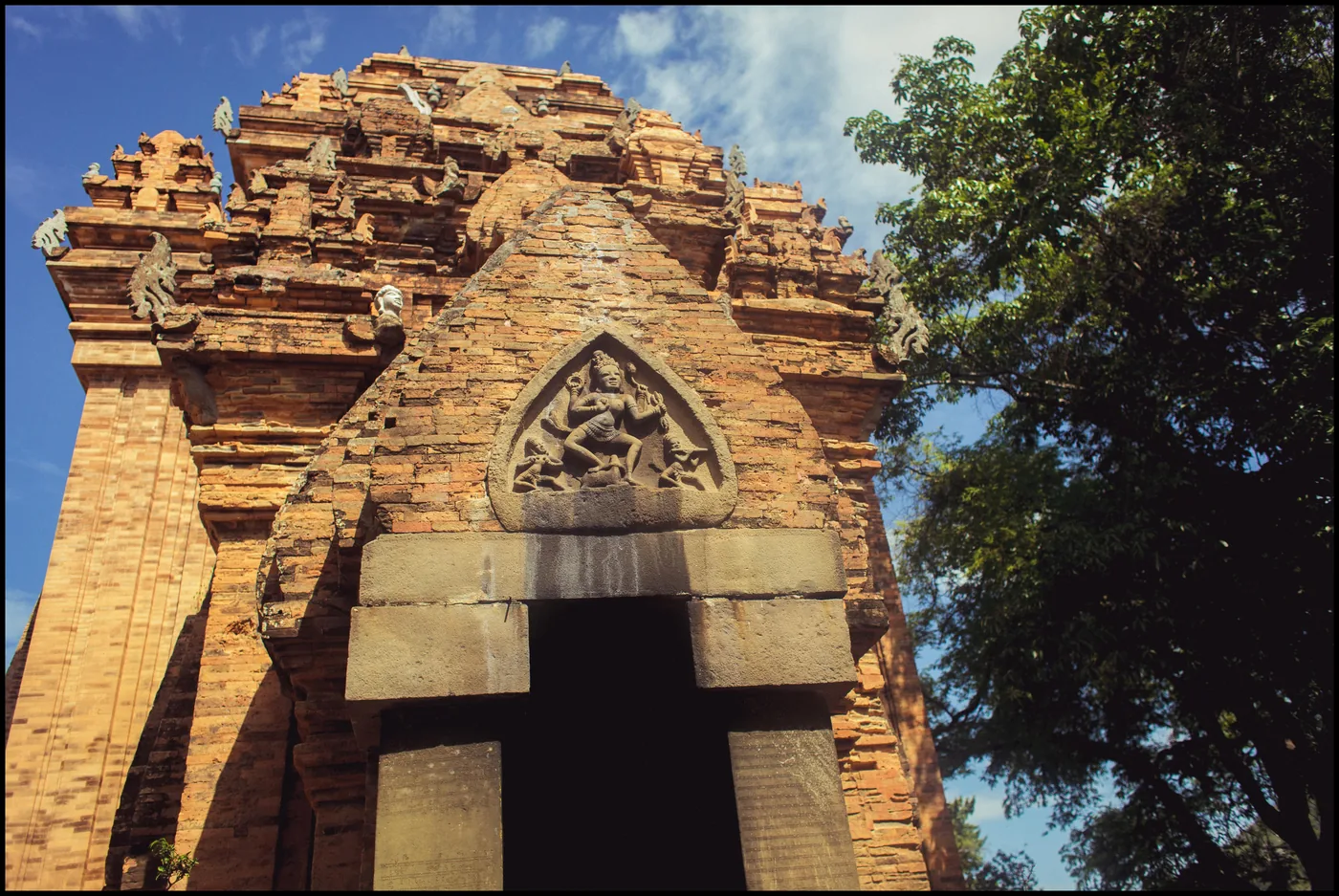
The are the city’s top heritage site — a 7th-to-12th-century Cham Hindu complex on a hill above the Cai estuary, still used for active worship of the goddess Yan Po Nagar. Entry is about 30,000đ, it opens roughly 6AM–6PM, and it takes around an hour. Dress modestly (shoulders and knees covered), remove your shoes inside the towers, and borrow one of the free sarongs at the gate; see the temple etiquette guide for more.
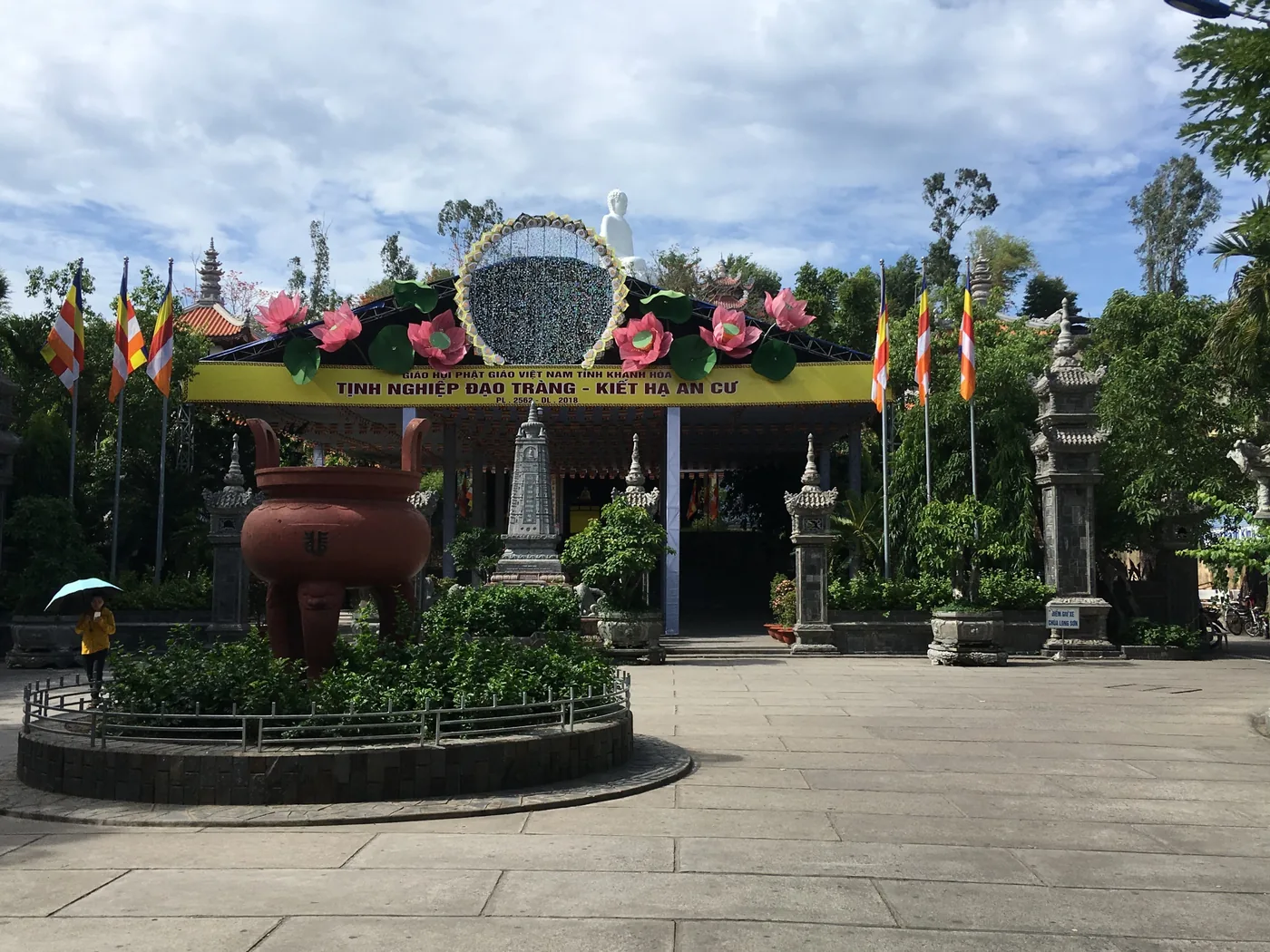
Long Son Pagoda & the White Buddha Map
is free (donation boxes only) and rewards the 152-step climb to a 24-metre seated white Buddha with city and sea views. Be alert here: fake ‘guides’ and badge-wearing touts pose as monks’ helpers, sell overpriced postcards as bogus ‘tickets’, and press aggressive donations. Use only the official donation boxes and decline any guide up front.
Nha Trang Cathedral Map
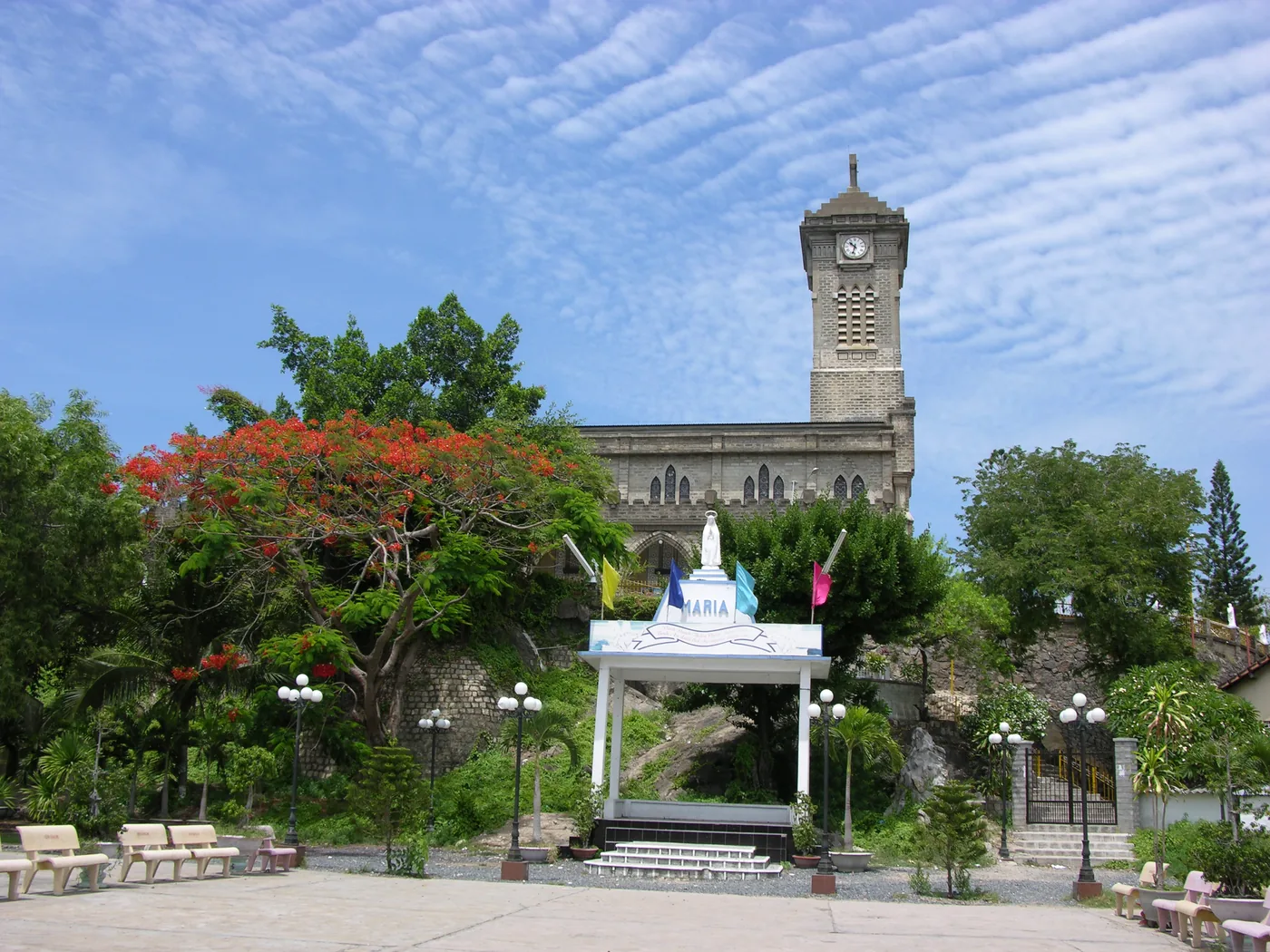
The (also called the Stone Church, French Gothic, 1928–33) is free to visit near the train station, though entry may be limited during Mass — dress modestly and check the schedule.
Alexandre Yersin Museum Map
The at the Pasteur Institute honours the scientist who identified the plague bacillus and founded the local institute, and who remains a beloved figure here. Tickets are only a few thousand to ~28,000đ, but note the gotcha: it is closed Saturday and Sunday, so plan a weekday visit.
Dam Market Map
is the city’s biggest market, set in an iconic circular building. Come for dried seafood, sweet-spicy dried squid, and street-food stalls — and bargain, because tourist mark-ups are common.
8. Inland nature & waterfalls
When you have had enough sun, the hills behind Nha Trang deliver waterfalls, hot springs, and a cool cloud forest, all within a day’s drive. Most need a car or an organized tour, and shoes with grip help on wet rock.
| Spot | What it is | Distance / notes |
|---|---|---|
| Map | Three-tier jungle falls with swimming pools; light trek | ~25 km N; entry ~100,000–185,000đ (confirm on site) |
| Map | Waterfalls, hot springs, Raglai ethnic shows | ~45 km SW; from ~170,000đ, rides extra; full day |
| Map | Cool cloud forest at ~1,500 m; Yersin’s mountain house | Winding road, own car; free (falls ~10,000đ); bring a jacket |
| Map | Quiet white-sand beach day trip | ~49 km N; ~1–1.5 h, often paired with Ba Ho |
Ba Ho is the easy crowd-pleaser and combines neatly with Doc Let for a beach-and-falls day. Hon Ba is the wild card — a foggy, temperate escape where the temperature can drop sharply, so it is best for drivers who do not mind a slow mountain road.
9. What to eat — Nha Trang specialties
Nha Trang’s food is coastal and specific: jellyfish-and-fishcake noodle soup, grilled pork rolls from nearby Ninh Hoa, and mountains of fresh seafood — just watch the prices at floating restaurants. Skip the generic tourist menus and chase the local dishes below.
| Dish | What it is | Price / where |
|---|---|---|
| Bún sứa / bún cá dầm | The icon: jellyfish + fishcake vermicelli in a clear, sweet fish broth | ~30,000–50,000đ; Map, Map |
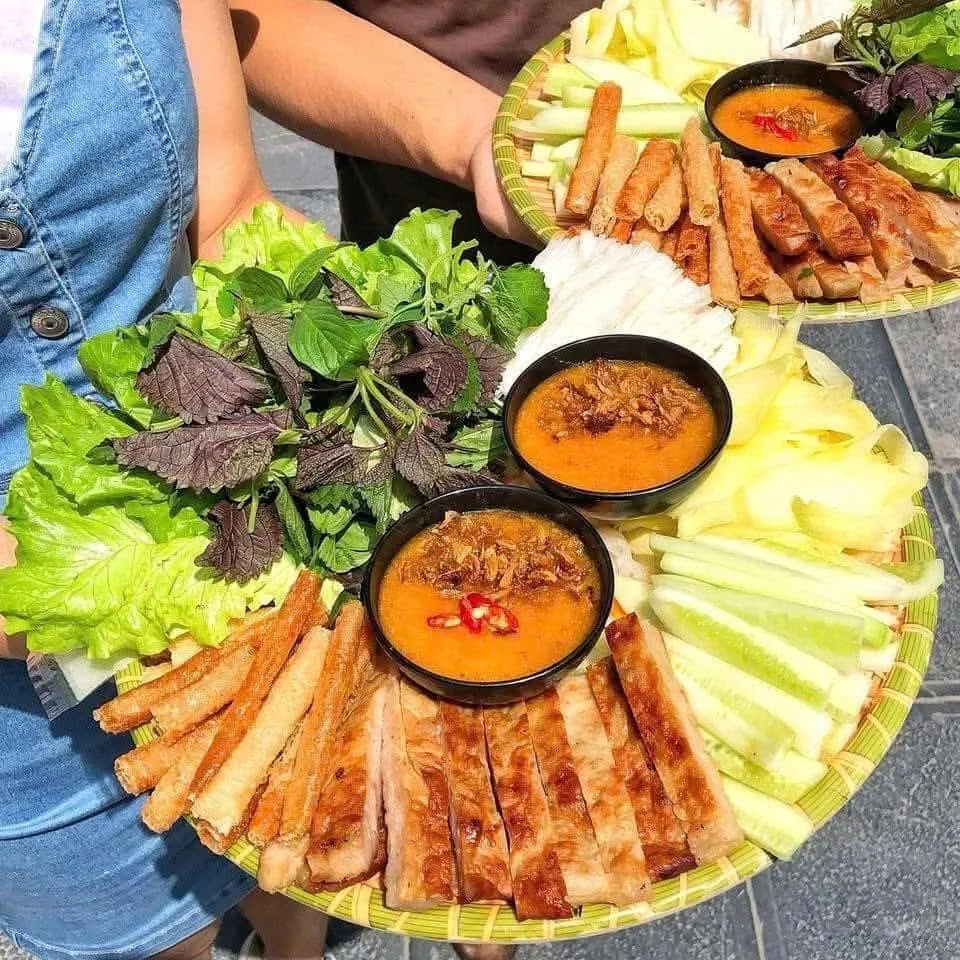
| Nem nướng Ninh Hòa | Grilled pork rolls, DIY with rice paper, herbs & crisp wafers | ~40,000đ/plate; Map |
| Bánh căn | Mini clay-pot rice pancakes with egg, shrimp or squid | ~15,000–40,000đ |
| Bánh xèo mực | Squid pancake — the local twist on bánh xèo | ~25,000–40,000đ |
| Bánh canh chả cá | Thick noodles with fish cake in sweet fish broth | ~20,000–50,000đ |
For seafood, eat where locals do — the Vinh Luong fishing village to the north or the Cau Da docks — rather than only along Tran Phu. Khanh Hoa is also Vietnam’s bird’s-nest capital, eaten as a sweet tonic soup, though prices vary wildly, so ask before you commit.
Watch the seafood-price scam
Floating eateries (bè nổi) have a real history of overcharging — one case billed boxfish at about 3.5 million đ per kilo, and venues have been fined heavily. Protect yourself: confirm the price per kilo in writing before ordering, watch your catch weighed, and prefer busy local spots. See the scams guide for the full playbook.
Dietary options
Nha Trang’s Russian and Central-Asian visitors mean genuine variety: halal restaurants (some with a prayer room), Indian, Turkish, and Uzbek kitchens, plus chay (vegetarian) spots near the pagodas. One practical note — tap water is not potable, so stick to bottled; factory-made tube ice is generally safe.
10. Coffee, dessert & cafés
Vietnam’s coffee culture is at full strength here, and Nha Trang adds a couple of local riffs worth seeking out. Start with a cà phê sữa đá — strong robusta phin drip over ice with sweet condensed milk — then branch out.
| Order this | What it is |
|---|---|
| Cà phê muối | Salt coffee: a salted-cream layer over drip coffee, sweet-savoury and addictive |
| Cà phê dừa | Coconut coffee, blended with coconut cream — dessert in a glass |
| Kem bơ | Avocado ice cream, a creamy Vietnamese classic |
| Chè | Sweet layered dessert soups with beans, jelly and coconut |
Seaside cafés along Tran Phu are convenient for a view, but the better-value, more characterful spots hide a block or two inland. An iced coffee runs roughly 12,000–45,000đ depending on how polished the café is.
11. Nightlife
🌃 Nha Trang after dark: when the night market, rooftops and beach clubs close →
Nha Trang has the busiest beach nightlife on Vietnam’s central-south coast — beach clubs, rooftop bars, and late-night spots concentrated along and just behind Tran Phu. It is more sociable than sophisticated, and easy to dip into for one drink or stay out until dawn.
The scene runs from breezy beachfront lounges and rooftop bars with bay views to the louder clubs around the Map core. Sunset drinks near the beach, then a rooftop, then a club is the natural progression, and many island ‘party boats’ effectively start the night early out on the water.
A few sensible habits: agree prices before ordering bottle service, keep an eye on your tab, and carry your bag on your road-side shoulder late at night, as opportunistic phone- and bag-snatching does happen along Tran Phu after dark. Use Grab or Green SM to get home rather than flagging an unmarked taxi.
12. When to go: season & weather
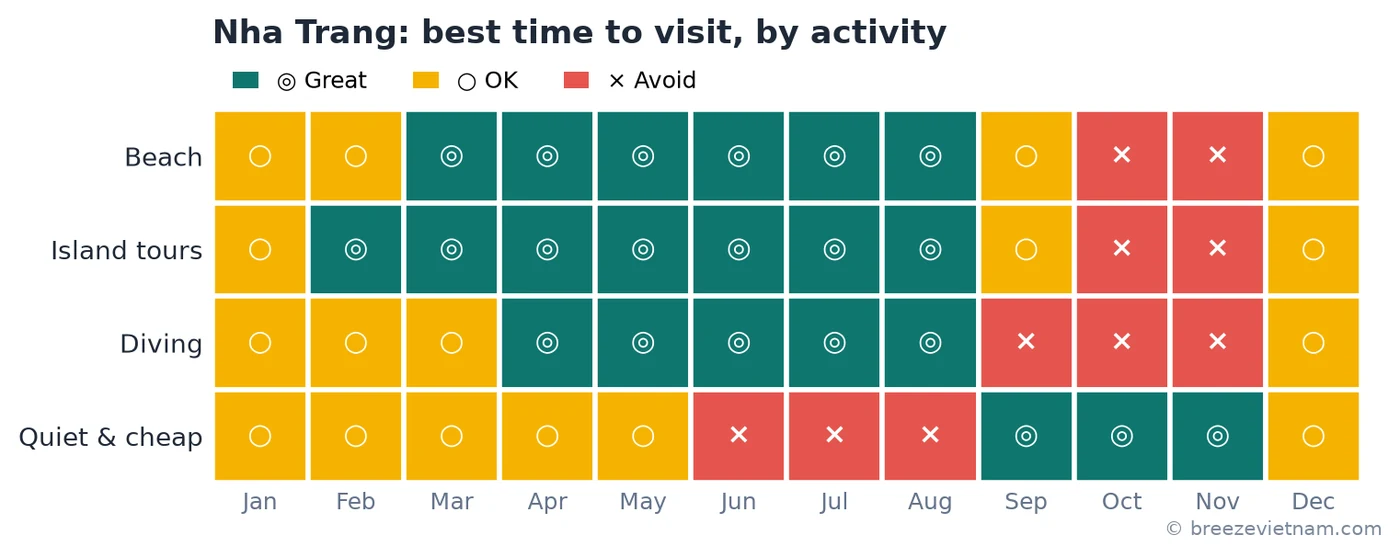
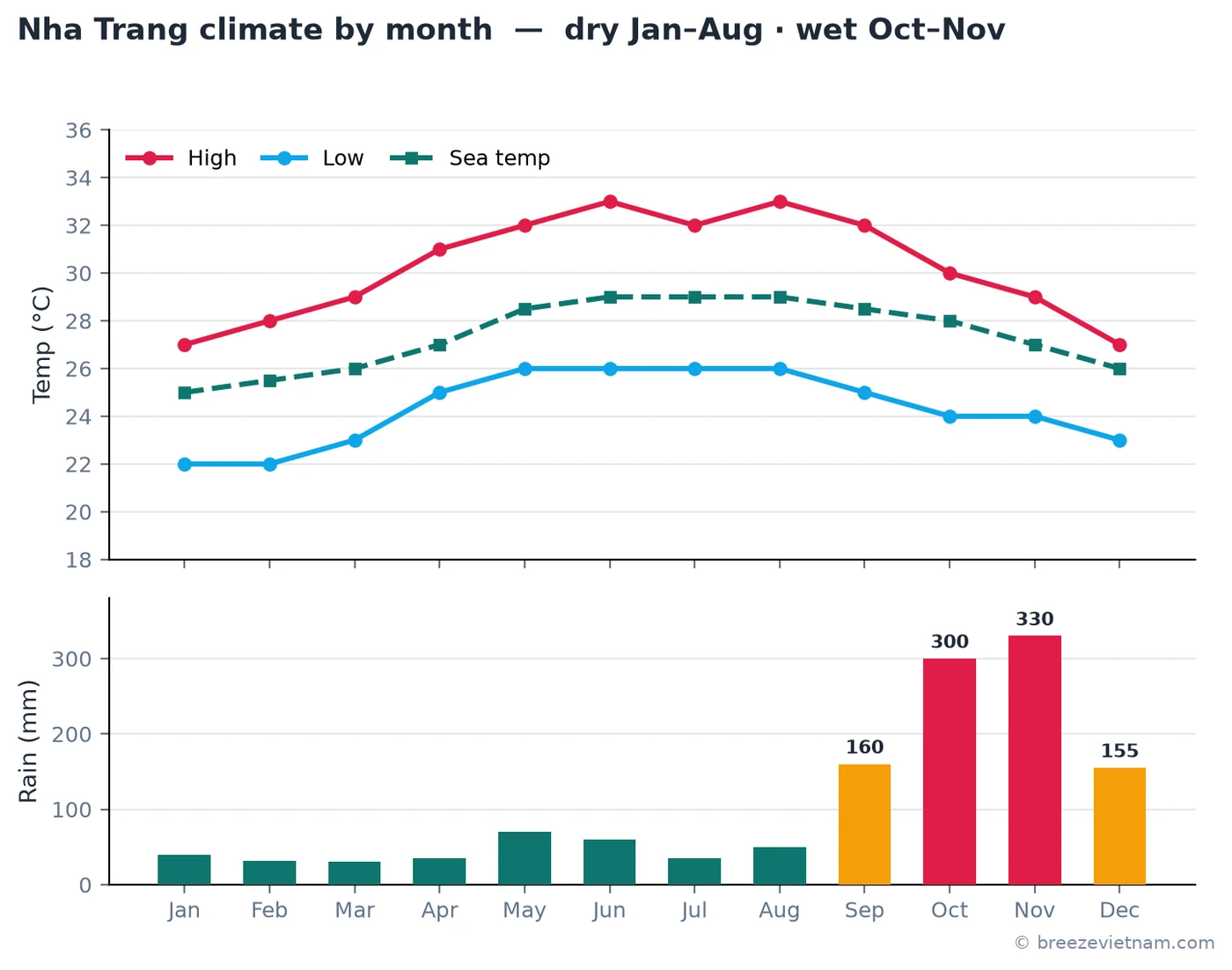
The best time to visit Nha Trang is the long dry season from January to August, with April to July the sweet spot for a warm sea, calm island crossings and the clearest diving. This is what sets the city apart from the rest of central Vietnam: while Da Nang and Hue are being soaked in autumn, Nha Trang stays sunny for most of the year. The flip side is a short, intense wet season from September to December, with October and November taking roughly half the annual rain.
As the climate chart shows, temperatures barely dip below beach weather all year, and the rainfall curve stays flat for eight months before spiking hard in autumn. The best-time heatmap makes the planning rule obvious at a glance: nearly everything peaks across the dry months, and October to November is the window to work around.
Month-by-month at a glance
Figures below are long-term climate normals (treat them as approximate). Sea temperature stays swimmable all year, so the real variable is rain and crowds, not cold.
| Month | Avg high / low | Sea | Rain (approx) | What it’s like |
|---|---|---|---|---|
| Jan | 27° / 22° | 25° | ~40 mm | Cool and dry, low crowds except around Tet; Russian winter peak. |
| Feb | 28° / 22° | 25.5° | ~15-49 mm | The driest, sunniest month. Excellent all round. |
| Mar | 29° / 23° | 26° | ~30 mm | Dry and warming; the shoulder before summer prices. |
| Apr | 31° / 25° | 27° | ~35 mm | Hot and dry, calm sea; dive season opens. |
| May | 32° / 26° | 28.5° | ~70 mm | Peak beach weather begins; hot but reliably sunny. |
| Jun | 33° / 26° | 29° | ~60 mm | Hottest month, best dive visibility; domestic peak. |
| Jul | 32° / 26° | 29° | ~35 mm | Beach and dive peak; the Korean summer high season. |
| Aug | 33° / 26° | 29° | ~50 mm | Still beach-and-dive prime, rain low. |
| Sep | 32° / 25° | 28.5° | ~160 mm | Shoulder: rain starts, crowds thin, prices soften. |
| Oct | 30° / 24° | 28° | ~300 mm | Wet, with flood risk. Island tours often cancel. |
| Nov | 29° / 24° | 27° | ~330 mm | Wettest month; typhoon and flood risk. Best avoided. |
| Dec | 27° / 23° | 26° | ~155 mm | Rain easing; Russian and New Year arrivals climbing. |
Best months by activity
| You want… | Go | Avoid |
|---|---|---|
| Beach and swimming | Mar-Aug (sweet spot Apr-Jul) | Oct-Nov |
| Island-hopping / calm sea | Feb-Aug | Oct-Nov (rough seas, frequent cancellations) |
| Diving Hon Mun | Apr-Aug (visibility often >20 m Apr-Jun) | Wet season |
| Lowest prices / fewest crowds | Sep-early Nov | Tet, Jun-Aug, Apr 30-May 1 |
Typhoons, sun and crowds
The storm and flood season runs September to December, peaking late October to November. For scale: Typhoon Damrey struck on 4 November 2017, and Khanh Hoa was the worst-hit province, with heavy local damage and tens of thousands evacuated near Nha Trang. If you must travel in that window, keep plans flexible and watch forecasts.
Sun is the constant threat the rest of the year. The UV index sits in the very-high-to-extreme band (9-11+) more or less year-round, worst at midday from March to September, so a hat, a rash guard and reef-safe sunscreen for Hon Mun are not optional.
On crowds: the domestic peak is summer (June-August) plus Tet and the Apr 30-May 1 holiday, while Russian charter travellers keep the beaches busy right through the wet months (November-March). Korea is the single largest source market, summer-heavy but present all year, so Nha Trang is rarely truly empty. For the national picture, see the best time to visit Vietnam guide.
13. Festivals & events
Nha Trang’s calendar is anchored by the Sea Festival in summer and the Thap Ba Ponagar Festival in spring, both of which are worth timing a trip around. Most events fall inside the dry season, so they rarely clash with bad weather.
| Event | When | What it is |
|---|---|---|
| Nha Trang-Khanh Hoa Sea Festival (Festival Biển) | Around Jun-Jul (held roughly every year or two, check the next edition) | The city’s flagship celebration: street parades, beach concerts, kite and watersport displays along Tran Phu. |
| Thap Ba Ponagar Festival | Lunar 20-23 of the 3rd month (~Apr-May) | The region’s biggest religious festival, honouring the goddess Yan Po Nagar at the Map. |
| Cau Ngu (Whale Worship) | ~2nd-3rd lunar month (~Feb-Mar) | Fishing-community rites for a safe, bountiful season, with processions and boat ceremonies. |
| Tet (Lunar New Year) | ~mid-Feb (2026 around 17 Feb; confirm each year) | Dry weather but the priciest, busiest stretch, with some closures. Book far ahead. |
The Sea Festival dates shift, so do not assume a strict two-year cycle; check the specific edition before you build a trip around it. Ponagar is the one to catch if you want ceremony over spectacle: it turns the ancient Cham towers into a living place of worship rather than a monument.
14. Budget: how much a Nha Trang trip costs
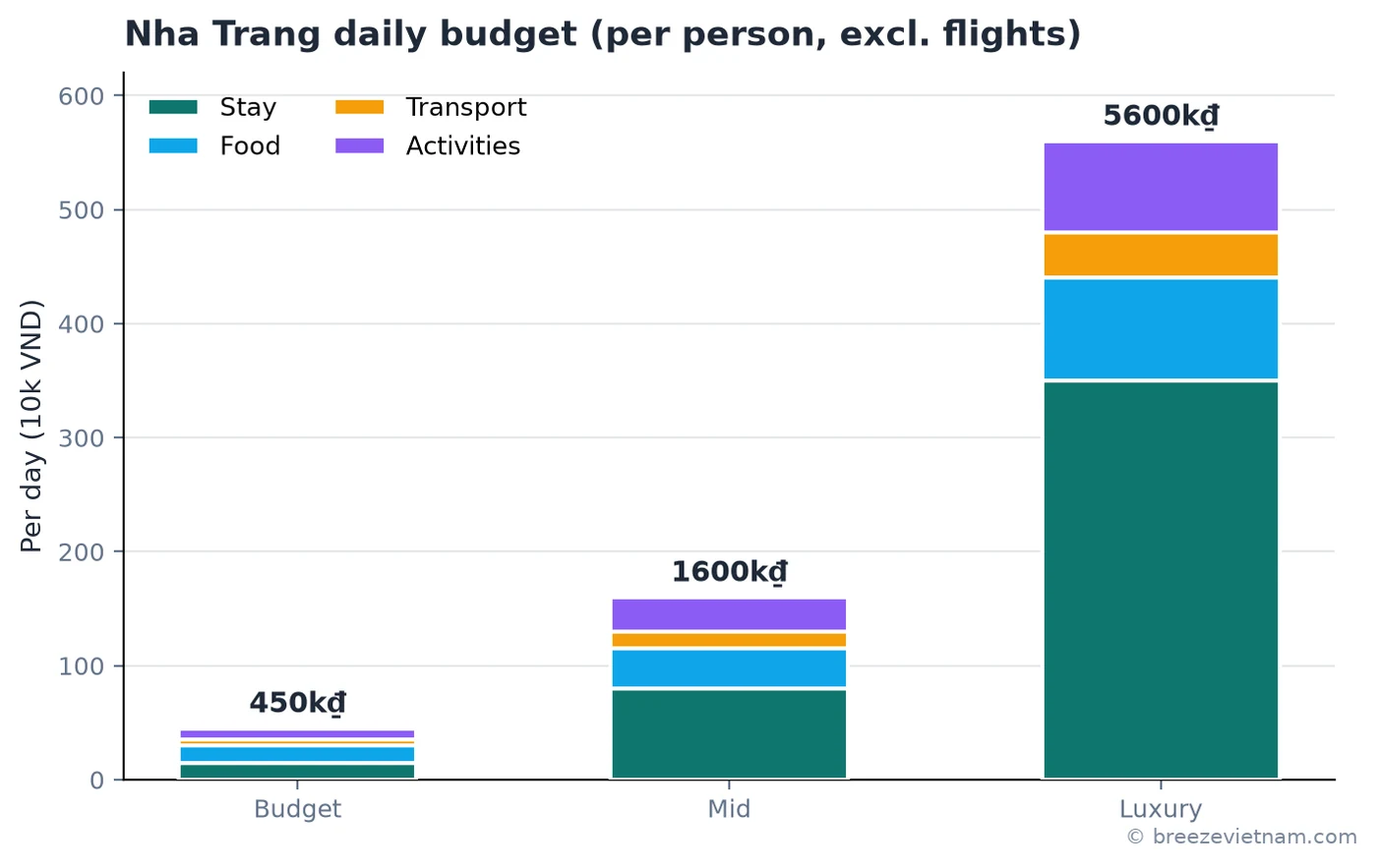
Plan on roughly US$17-20 a day for backpacker Nha Trang, US$60-65 for a comfortable mid-range trip, and US$215+ a day for five-star and resort travel, before flights. The city spans the full range: hostel dorms and 30,000-dong noodle bowls at one end, Cam Ranh beach resorts and private island tours at the other. All prices below are approximate and volatile; treat them as planning anchors, not quotes, and always confirm on the ground. The rate used here is roughly 26,000 dong to the US dollar (mid-2026).
As the budget chart shows, the biggest lever between tiers is accommodation, not food. Eating well stays cheap at every level; where you sleep is what moves the daily total.
Daily spend per person (excluding flights and intercity travel)
| Style | Stay | Meals | Transport | Activities | Daily total |
|---|---|---|---|---|---|
| Budget | Dorm / cheap ~150k | ~150k | ~50k | ~100k | ~450,000đ (~US$17-20) |
| Mid-range | 3★ shared ~800k | ~350k | ~150k | ~300k | ~1,600,000đ (~US$60-65) |
| Luxury (floor) | 5★ / resort 3,500k+ | ~900k | ~400k | ~800k | ~5,600,000đ+ (~US$215+) |
The luxury figure is a floor: a Cam Ranh resort stay with private tours can easily push US$350-500+ per person per day.
What things cost
| Item | VND | ~USD |
|---|---|---|
| Hostel bed | 100-235k | $4-9 |
| 3★ hotel (room) | 420k-1.54M | $16-59 |
| 5★ city hotel | 2.6-4.4M | $100-170 |
| 5★ Cam Ranh resort | 4.9-7M+ | $188-270+ |
| Street noodle bowl | 30-80k | ~$1-3 |
| Banh mi | 12-20k | <$1 |
| Mid-range meal | 100-250k | $4-10 |
| Seafood dinner | 250-500k | $10-19 |
| Local beer (shop) | 15-33k | <$1.50 |
| Coffee | 12-45k | <$2 |
| Bottled water | 5-10k | <$0.50 |
| Grab across town | 40-90k | $1.50-3.50 |
| CXR → city taxi | ~385k (bus ~70k) | ~$15 ($2.66) |
| Island group tour | 400-650k | $16-25 |
| Thap Ba communal mud bath | from ~120k | ~$5 |
| I-Resort mud bath | from ~260k (VIP 350-500k) | $10-19 |
| VinWonders adult | ~950k-1.05M | ~$40 |
| Tourist eSIM / data | 150-250k | $6-10 |
Sample trip totals (on-ground, add flights)
| Trip | Budget | Mid-range | Luxury |
|---|---|---|---|
| 4 days | ~1.8M / ~$70 | ~6.4M / ~$245 | ~22.4M / ~$860+ |
| 5 days | ~2.25M / ~$87 | ~8M / ~$310 | ~28M / ~$1,075+ |
Money on the ground
Nha Trang runs on cash for anything small; cards are reliable only at hotels and mid-range-and-up restaurants. Carry 500,000-1,000,000 dong a day and top up at ATMs as you go. VPBank and ACB machines are fee-free for foreign cards (VPBank allows large single withdrawals), while most banks charge roughly 22,000-55,000 dong per withdrawal; avoid TPBank, which added a ~3.3% fee in mid-2025.
Change money at gold or jewellery shops and banks rather than the airport, and skip anything resembling a street “better rate” pitch. Tipping is not mandatory but is appreciated in dong. For the wider picture on cards, ATMs and exchange, see the Vietnam money & payments guide.
15. Getting there: airport, trains & routes
🏞️ Datanla Falls and the alpine coasters: which ticket and when the counters close →
You reach Nha Trang through Cam Ranh International Airport (CXR), about 35 km south of the city; there is no airport in town, so a “Nha Trang Airport” on any booking site is CXR. The transfer in takes roughly 40-60 minutes along the coastal Nguyen Tat Thanh Boulevard. CXR has a domestic terminal (T1) and an international terminal (T2, opened 2018), and is expanding toward 8-10 million passengers a year by 2030.
The route map is Korea-heavy: around 19 daily flights from Seoul, Busan, Daegu and Cheongju, plus services from China (Guangzhou, Chengdu), resumed Russian charters (Azur Air from March 2025 across 11 cities), Kazakhstan (Air Astana), and new Bangkok and Phnom Penh links in 2026. Hanoi is fly-only (~1h50); from Ho Chi Minh City you can fly, take the train or ride a sleeper bus.
Airport to city
Prices are one-way and approximate. Note there is no rideshare curb pickup at CXR: for Grab or Green SM you walk out to the car park to meet the driver, and late-night availability is thin.
| Option | Price (one-way) | Notes |
|---|---|---|
| Bus #18 “Dat Moi” | ~65,000đ | ~05:30-19:30, roughly every 30 min, cash, boards at the front of the terminal. |
| Grab / Green SM car | 250,000-400,000đ | Meet the driver in the car park, not at the curb; thin late at night. |
| Metered taxi | 350,000-450,000đ | Use only genuine Mai Linh or Vinasun. |
| Private pre-booked transfer | 300,000-600,000đ+ | Fixed price, name-board pickup; easiest with luggage or a late arrival. |
Coming overland Map
is a colonial-era station right in the centre (17 Thai Nguyen St, about 1.5 km from the beach), which makes the train unusually convenient here. The Reunification Express from Ho Chi Minh City even won “World’s Best Train Journey 2025”; book on baolau or dsvn.vn up to about 60 days ahead.
| From | Options | Time / notes |
|---|---|---|
| Ho Chi Minh City | Fly / train / sleeper bus | Fly ~1h; train ~7.5-8h (411 km, soft-seat from ~$30, soft-sleeper up to ~$90, VIP ~$120); bus ~8-11h. |
| Da Nang | Fly / scenic coastal train | Fly ~1h; train ~9-12h (take a daytime service for the Hai Van coastal views). |
| Hanoi | Fly only | ~1h50 direct; the train (~24-30h) is not worth it. |
| Map | Bus | 3-4h over the scenic Khanh Le (Omega) Pass, 135 km; FUTA ~150-170kđ. No train or flight. |
| Map | Bus / train | Bus ~4-6h or train ~3h50. |
16. Getting around: Grab, taxis & scooters
Use Grab for almost everything: it gives a transparent, pre-agreed fare for both cars and motorbikes and sidesteps the taxi-meter games. Green SM (Green SM), VinFast’s electric taxi and e-bike fleet, is an honest metered alternative at about 15,500-20,000 dong per km. The central zone (Tran Phu, Biet Thu, Hung Vuong) is compact and flat, so you will often just walk.
| Mode | Cost | Notes |
|---|---|---|
| Grab (car / bike) | ~40-90k across town | Default choice; fare fixed in-app before you ride. |
| Green SM / Green SM | ~15,500-20,000đ/km | Electric, honest meter; app or street hail. |
| Mai Linh / Vinasun taxi | Metered | The only two street-taxi brands to trust (green / white). |
| Scooter rental | ~100,000-180,000đ/day | Average ~150k; +20-30% in peak season. |
| City bus | 7-20k | Cheap but slow; most visitors skip it. |
How Grab and Green SM compare is covered in the Grab vs Green SM guide.
Watch the taxi meters
Genuine meters read in thousands with the last three zeros dropped, so “64.0” means 64,000 dong. The scams to know: copycat brands with lookalike names (a “Mai Lin” or “Vina Sun” one letter off) and rigged fast meters. Board an exact “Mai Linh” or “Vinasun” car, or just use an app. A short in-city hop quoted over ~200,000 dong is a red flag.
Scooters and the IDP trap (read this if you hold a US, UK, Canadian or Australian licence)
This is the single most misunderstood rule in Vietnam, and it matters for insurance, not just fines. Vietnam recognises only the 1968 Vienna Convention International Driving Permit. The 1949 Geneva IDP is not valid here, which means US, Canadian, Australian and UK IDPs are legally useless: police treat you as having no licence.
| Your country | IDP type | Legal to ride? |
|---|---|---|
| South Korea | 1968 (plus bilateral recognition) | Yes |
| Japan, most of the EU | 1968 Vienna | Yes |
| USA, Canada, Australia, UK | 1949 Geneva | No — not recognised |
Riding without a valid licence risks a fine of roughly 2-4 million dong, up to a 7-day impound, and, crucially, a voided travel-insurance claim if you crash. If your IDP is not the 1968 type, hire a Grab bike or a driver instead. When you do rent, photograph every existing scratch, test the brakes, and never surrender your passport as a deposit; leave a copy or a cash deposit instead.
17. Day trips from Nha Trang
The best day trips split into two moods: cool highlands (Da Lat) or quiet coast and jungle (Doc Let, Ba Ho, Yang Bay, Hon Ba). Da Lat and Mui Ne are big enough to deserve their own trips and get full guides of their own; treat them here as onward legs or long days, not deep-cover stops. The vehicles, fares and departure times for that drive are in how to get from Nha Trang to Da Lat.
| Destination | Distance / time | Why go | Note |
|---|---|---|---|
| Map | ~135 km / 3-4h | Cool-climate highlands, pine forests, French-era villas over the Khanh Le Pass. | Better as an overnight; sea-to-mountains in one drive. |
| Map | ~49 km N / 1-1.5h | Quiet white-dune shallow beach, few resorts; a proper escape. | Often combined with Ba Ho. |
| Map | ~25 km N / ~40 min | Three-tier jungle falls and pools, a light trek and a swim. | Entry conflicted (~100,000-185,000đ, confirm on site); wear grippy shoes. |
| Map | ~45 km SW | Waterfalls, hot springs and Raglai ethnic shows. | From ~170,000đ, rides extra; a full day by car or tour. |
| Map | ~60+ km / winding | Cool cloud forest at ~1,500 m and Yersin’s mountain house. | Free (Suoi Nguon falls ~10,000đ); own car, bring a jacket, expect fog. |
| Map | ~220 km / 4-6h | Red-and-white sand dunes, kitesurfing. | An onward leg, not a comfortable same-day round trip. |
If you only have one spare day and want contrast, take Da Lat overnight; if you want the beach without the crowds, Doc Let paired with Ba Ho makes an easy, cheap northern loop.
For Da Lat on its own, our Da Lat travel guide covers the flights, the measured drive times, the official ticket prices and the weather month by month.
For Mui Ne and Phan Thiet on their own, our Mui Ne and Phan Thiet guide covers both dunes with their prices, the measured drive times, the train days and where along the strip to stay.
18. Suggested itineraries (area by area)
Two to three full days covers Nha Trang’s headline sights; a fourth day lets you add a mud bath, a second island or a highland detour without rushing. The itineraries below are built around the city’s areas: the central Tran Phu strip for beach and nightlife, the offshore islands for snorkelling and VinWonders, the north for culture, and Cam Ranh or Ninh Van for resort downtime.
Classic 3 days / 2 nights (first-timer) Map
| Day | Morning | Afternoon | Evening |
|---|---|---|---|
| 1 | Settle in on the Tran Phu beachfront; swim, orient yourself. | and Long Son Pagoda in the north. | Seafood dinner, then bars along the central strip. |
| 2 | Island-hopping boat tour: Map snorkelling plus stops. | Continue the tour (aquarium / beach island). | Bun sua and nem nuong near Map. |
| 3 | Thap Ba or I-Resort mud bath. | Cafe crawl, last beach hours, souvenirs. | Depart, or a sunset drink at Map. |
Relaxed 4 days / 3 nights Map
| Day | Focus |
|---|---|
| 1 | Arrive, beach, orientation walk of the central zone; Yersin Museum (weekday only, closed Sat/Sun). |
| 2 | Full island-hopping day, snorkelling at Hon Mun. |
| 3 | via the sea-crossing cable car (a full day). |
| 4 | Culture morning (Po Nagar, cathedral, Dam Market) and a mud bath before flying out. |
Family (base near the beach)
| Day | Plan |
|---|---|
| 1 | City beach and pool; short walk on the promenade; easy dinner. |
| 2 | VinWonders all day (rides, water park, Neptune aquarium). |
| 3 | Gentle island / calm-water snorkel tour; mud bath in the afternoon (kids love the egg tubs at 100 Egg). |
| 4 | Doc Let or Bai Dai shallow beach day, or a slow resort morning before departure. |
Honeymoon (Cam Ranh / Ninh Van) Map
| Day | Plan |
|---|---|
| 1 | Land at CXR, transfer 15-20 min to a resort; long calm beach, spa. |
| 2 | Private speedboat island day or a couples’ mud-and-spa afternoon. |
| 3 | Optional boat over to a Map hideaway for total seclusion. |
| 4 | Slow resort morning; one dinner in the city if you want energy and lights. |
One honeymoon caveat worth planning around: Cam Ranh and Bai Dai are 45-60 minutes from the city’s nightlife and tours, so pick seclusion or buzz deliberately rather than commuting back and forth.
Diver
| Day | Plan |
|---|---|
| 1 | Arrive, gear check and briefing with a licensed PADI operator; city night. |
| 2 | Two-tank day at Hon Mun (confirm the current permitted-zone rules first, see the islands section). |
| 3 | Second dive day or a fun snorkel; mud bath to recover. |
| 4 | Surface interval before flying: culture, cafes, no dives within 24h of your flight. |
19. Safety & health
Nha Trang is a safe, well-trodden beach city; the real risks are rip currents on the main beach, seasonal jellyfish, and a handful of persistent tourist scams rather than violent crime. A little awareness handles nearly all of it. Travel insurance is strongly recommended because watersports, boats and private-hospital costs are exactly the things that get expensive fast.
| Risk | What to know | What to do |
|---|---|---|
| Rip currents | Well-documented on the main city beach. | Obey the flags (RED = no swimming). If caught, swim parallel to shore, not against the pull. |
| Jellyfish (Apr-Aug) | “Fire jellyfish” stings in the warm months. | Rinse the sting with vinegar for 15 min; do not rub with fresh water or sand. |
| Boats | Nha Trang Bay departures are now weather-gated and life-jacketed after a nationwide tightening in 2025. | Choose licensed operators, confirm life jackets, avoid any boat in storm or high wind (Oct-Nov). |
| Bag / phone snatching | Happens along Tran Phu at night. | Carry bags on the road-side shoulder; never leave belongings on the beach. |
Scams to sidestep
| Scam | Defence |
|---|---|
| Floating-seafood overcharging (billed by the kg) | Confirm the price per kg in writing, watch it weighed, prefer busy local spots. |
| Jet-ski / watersport “damage” claims | Jet-skis are banned at the main public beach; only rent at the islands or Bai Dai, and photograph the craft first. |
| Taxi meter tricks / copycat brands | Use Grab, or board only genuine Mai Linh / Vinasun. |
| Long Son “guide” and fake-ticket touts | Entry is free; use official donation boxes only and decline guides up front. |
| Island-tour bait-and-switch, spa add-ons, motorbike deposit | Read what is and isn’t included; never hand over your passport. |
For the full national rundown, see the Vietnam scams to avoid guide.
Medical & emergencies Map
(42A Tran Phu) runs 24 hours to a JCI standard; Hospital 22-12 in the city has translators, and pharmacies (nha thuoc) are everywhere. Tap water is not potable, so drink bottled; factory tube ice (da vien) is generally fine.
| Service | Number |
|---|---|
| Police | 113 |
| Fire | 114 |
| Ambulance | 115 |
| Search & rescue | 112 |
There is no single 911-style line and English is not guaranteed, so have your hotel or a Vietnamese speaker help in a real emergency.
20. Practical basics
The essentials: pay in cash, get a Viettel eSIM for island coverage, pack a plug adapter, and don’t be surprised by all the Russian signage. A few small preparations make Nha Trang friction-free.
Connectivity
Viettel has the best coverage (~95%, including the islands and Cam Ranh bay); Vinaphone and Mobifone are the alternatives. A tourist data plan runs about 150,000-250,000 dong, and an eSIM through Airalo, Klook or Trip.com lets you connect before you land. The full setup, including how eSIMs work, is in the Vietnam eSIM & SIM guide.
Power, money, dress
| Topic | What to know |
|---|---|
| Plugs | 220-230V, 50Hz, types A/C/F. UK and US devices need an adapter. |
| Cash | Cash-first city; carry 500k-1,000k/day, use VPBank/ACB ATMs to avoid fees (see the budget section). |
| Temple dress | Cover shoulders and knees; Po Nagar lends robes. More in the Vietnam etiquette guide. |
The Russian factor
Russian presence is high and rising (80,000+ Russian visitors in the first four months of 2025, and a revived “Russian Street”), a legacy of Cam Ranh’s Soviet-era base and today’s charter flights. In practice, signage is often trilingual (Vietnamese, English and Russian) and you’ll find Russian and Central-Asian restaurants near Tran Phu. English is widely understood in the tourist core, so this is local colour, not a barrier.
21. Common mistakes to avoid
Most spoiled Nha Trang trips come down to a few avoidable errors, and every one is easy to design around.
| Mistake | Do this instead |
|---|---|
| Visiting in Oct-Nov and losing island tours to rough seas. | Come Feb-Aug for calm crossings; keep autumn plans flexible. |
| Expecting a quiet, pristine island. | Nha Trang is an urban activity-and-party beach; for softest-sand seclusion, choose Phu Quoc. |
| Basing at Cam Ranh / Bai Dai then commuting an hour for nightlife (or vice versa). | Pick seclusion or buzz deliberately, match the base to your trip. |
| Flatly assuming Hon Mun diving is fully open. | It’s been restricted since 2022; confirm current permitted-zone rules before booking. |
| Renting a scooter on a 1949 (US/UK/CA/AU) IDP. | Not legal here; hire a Grab bike or a driver. |
| Ordering floating seafood without a price per kg. | Confirm in writing and watch it weighed. |
| Assuming “Nha Trang Airport” is in town. | It’s CXR, ~35 km south; budget 40-60 min. |
| Skipping travel insurance for boats and watersports. | Buy cover; it’s exactly where costs spike. |
22. Final planning checklist
Before you go, run this quick checklist, then use the regional hub to slot Nha Trang into a wider trip.
- Timing: aim for the dry season (Apr-Jul sweet spot); avoid Oct-Nov. Check your dates against Tet.
- Entry: confirm your visa or e-visa and current arrival rules in the Vietnam visa and 2026 entry rules guides.
- Airport: it’s CXR, ~35 km south; pre-book a transfer if arriving late.
- Connectivity: sort an eSIM before departure.
- Driving: only ride if you hold a valid 1968 IDP; otherwise use Grab.
- Money: bring a fee-free card, plan on cash daily.
- Islands: book snorkelling / VinWonders early in peak season; check the Hon Mun dive status.
- Cover: buy travel insurance for boats and watersports.
Nha Trang is one node on Vietnam’s south-central coast. To pair it with other destinations and see where it fits, start from the Southern Vietnam travel guide, or zoom out to the complete Vietnam guide.
🌧️ Travelling in the rainy months? See our honest guide to Nha Trang in September–November — rain, sea safety & the typhoon truth.
🏖️ The Nha Trang Guide Library
🗓️ Going in February? February has the least rain of any month here, and the Tet holiday decides what you pay. See Nha Trang in February.
🗓️ Going in March? March is when the swell settles and the water warms enough to stay in for hours. See Nha Trang in March.