
Cu Chi Tunnels: You Buy Two Tickets, and Two Sites to Choose From
Foreign visitors buy two tickets: 35,000 dong for site entry and 100,000 dong for the guide service, 135,000 in total. The tunnels are preserved at two separate sites 13km apart, and which one you pick shapes the day.
| Price | Foreign visitors pay 35,000 dong entry plus 100,000 for the guide, 135,000 total. |
|---|---|
| Vietnamese | 35,000 dong, with half price for ages 7 to 16 and students. |
| Two sites | Ben Dinh and Ben Duoc, 13km apart from each other. |
| Distance | From Ben Thanh Market it is 47.6km to Ben Dinh and 57.7km to Ben Duoc. |
| Hours | Open 07:00 to 17:00 every day, including public holidays and Tet. |
| Evening | Ben Duoc runs one night programme a month at 399,000 dong. |
1. Foreign visitors buy two tickets
2. There are two sites, not one
3. It is 47.6km and 57.7km from the centre
4. Going by public bus
5. Why the tunnels are here
6. The underground section
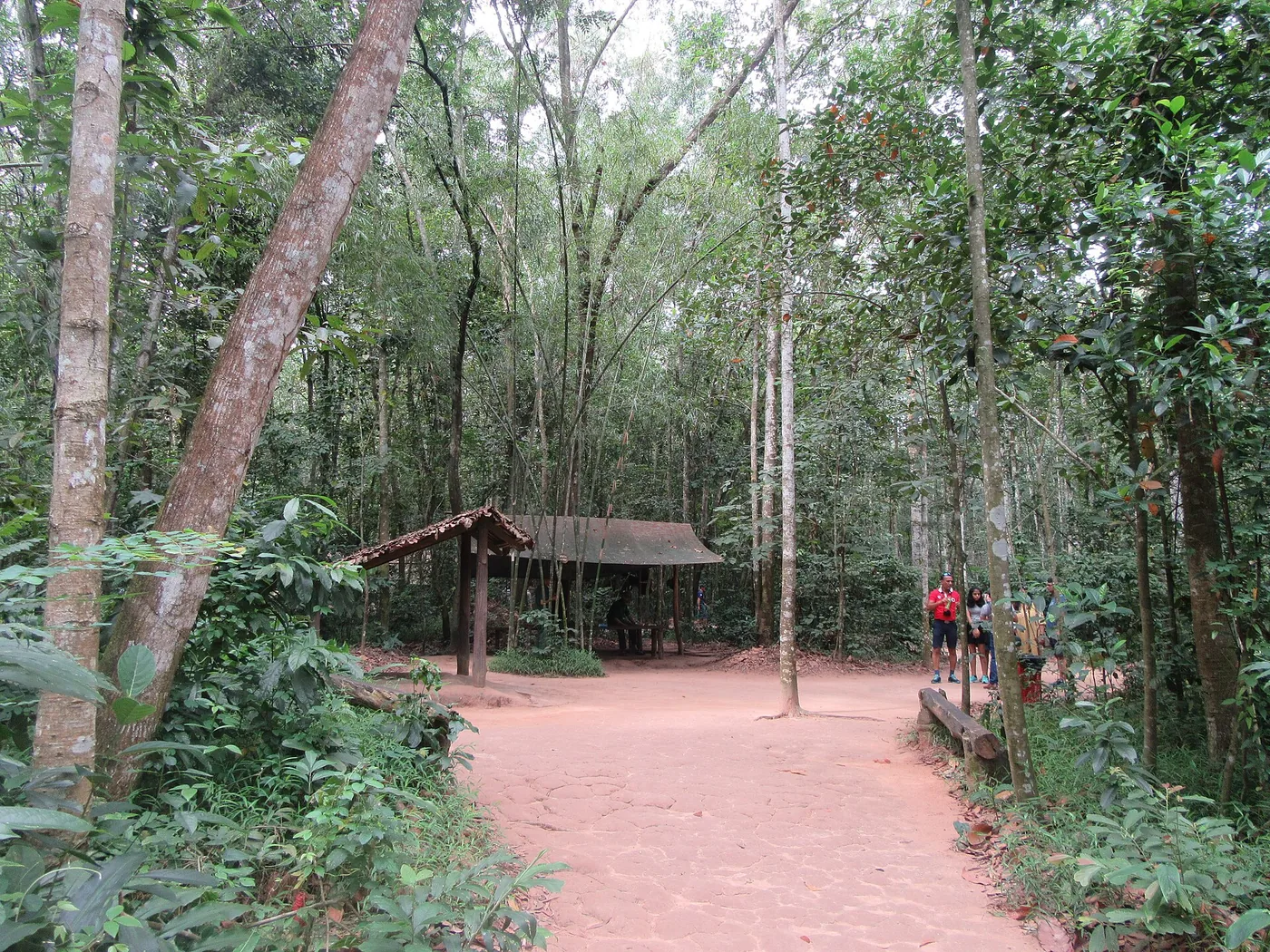
7. What there is above ground
8. The memorial temple at Ben Duoc
9. The shooting range is charged separately
10. How long the visit takes
11. One night a month at Ben Duoc
12. What to wear and bring
13. Visiting with children
14. Combining it with the Mekong
15. Eating, sleeping and facilities on site
16. Assumptions worth correcting
17. Two worked timetables
18. Practical notes
1. Foreign visitors buy two tickets
The price at Cu Chi is not a single line. Foreign visitors pay 35,000 dong for site entry and 100,000 dong for the guide service, which comes to 135,000 dong. The guide element rose from 90,000 to 100,000 dong on 1 February 2026.
Not knowing that structure is why the amount at the counter surprises people. When a tour lists “entrance included”, it is worth confirming that both lines are covered.
The price table
| Item | Amount | Note |
|---|---|---|
| Site entry, foreign visitor | 35,000 dong | Operator’s published notice |
| Guide service, foreign visitor | 100,000 dong | In force from 1 February 2026 |
| Foreign total | 135,000 dong | Per person, per visit |
| Vietnamese visitor | 35,000 dong | Half price for ages 7 to 16 and students |
Three things to settle first
- Which site. Ben DinhMap and Ben DuocMap are 13km apart.
- What time you leave. The site opens at 07:00 and closes at 17:00.
- Whether you want the shooting range. It is separate and charged by the round.
The wider city plan sits in the Ho Chi Minh City travel guide and the regional route in the southern Vietnam guide. This page covers only Cu Chi.
2. There are two sites, not one
The tunnels are preserved in two separate places, and they are not interchangeable.
Side by side
| Item | Ben Dinh | Ben Duoc |
|---|---|---|
| Address | Ben Dinh hamlet, Nhuan Duc | Phu Hiep hamlet, An Nhon Tay |
| Original role | Cu Chi district party base | Saigon-Cho Lon-Gia Dinh military region command base |
| Size | Compact visitor circuit | Grounds of about 100 hectares |
| Character | Passages widened for visitors | Memorial temple and large open grounds |
| National heritage listing | 2004 | 1979 |
Which one tours use
Most trips from the city go to Ben Dinh. It is about ten kilometres closer and the circuit is shorter, which fits a half day.
Ben Duoc has the wider grounds and the memorial temple, whose wall carries 45,666 names. If you have time and want the quieter of the two, that is the one.
Can you do both in a day
You can, but there is little reason to. They are 13km apart and each takes around two hours. Add the return trip from the city and the day becomes mostly driving.
Pick one, and put the remaining time into the city or towards the Mekong. The displays at the two sites are broadly similar, which is the other reason.
3. It is 47.6km and 57.7km from the centre
Distances set the shape of the day. These are measured from Ben Thanh Market.
Distance and time
| Route | Distance | Clear roads |
|---|---|---|
| Ben Thanh MarketMap to Ben Dinh | 47.6km | 44 min |
| Ben Thanh Market to Ben Duoc | 57.7km | 56 min |
| Ben Dinh to Ben Duoc | 13km | about 20 min |
Those times assume clear roads. In practice, getting out of the city takes longer, and one hour thirty to two hours each way is the figure most operators use.
Why the morning is better
The site opens at 07:00 and closes at 17:00. Arriving in the morning avoids the worst of the heat and, usually, the arrival of the larger groups.
Leave after lunch and you arrive around 14:00; spend two hours on the visit and the return runs into the evening traffic.
Going by taxi
A taxi on its own is quoted at roughly 500,000 dong one way. Once you add the return and the waiting time, hiring a car for the day is not far off in price.
Ride-hailing charges more for out-of-town runs. The apps are explained in the Grab and Green SM guide.
4. Going by public bus
Buses work and cost very little, but there are several changes. These are the routes the operator publishes.
To Ben Duoc
- From Ben Thanh, take bus 13 to Cu Chi bus stationMap.
- At Cu Chi, change to bus 79, which reaches Ben Duoc.
- Starting at Cho Lon station instead, take bus 94 to Cu Chi and then 79.
To Ben Dinh
- From Ben Thanh, take bus 13 to An Suong stationMap.
- Change to bus 122 for Tan Quy station.
- Change again to bus 70, which reaches Ben Dinh.
That is three changes for Ben Dinh. The fare is minimal, the time is not, and headways make the total unpredictable.
Driving yourself
The route the site publishes runs out along Truong Chinh, through the An Suong junction and Hoc Mon, then onto provincial road 15. It is close to a single line out of the city, and without traffic it beats the bus by hours.
Going by boat
There is a river route from Bach Dang pierMap up the Saigon RiverMap. The operator’s own page lists it and notes that the cost is still high.
On the boat the journey becomes part of the visit, and the landing point is close to the site. It is a choice for people with time and budget to spare.
5. Why the tunnels are here
A little background makes the displays legible. What follows is the factual outline.
The ground
The soil here is clay mixed with laterite. In the dry season it sets hard and resists collapse, which allowed passages to hold without heavy shoring.
Proximity to the river mattered too. The operator’s description of Ben Dinh notes that the site sits beside the Saigon River, which offered a withdrawal route when sweeps came through.
How it grew
Digging began in 1946, at first as short village stretches. Through the 1960s the village sections were joined until they formed a single network.
The length usually cited is more than 200km. Depths run from 3 to 12 metres across three levels, so a collapse on one level did not take out the others.
What was down there
Not only passages. Meeting rooms, kitchens, medical space and stores were built into the system, and the reconstructions above ground show that arrangement.
The kitchen dispersed smoke through several outlets rather than one, and that design is among the reconstructions you can walk through.
6. The underground section
The part everyone comes for is the stretch you walk through underground. Some of it is worth knowing before you go in.
The visitor section is widened
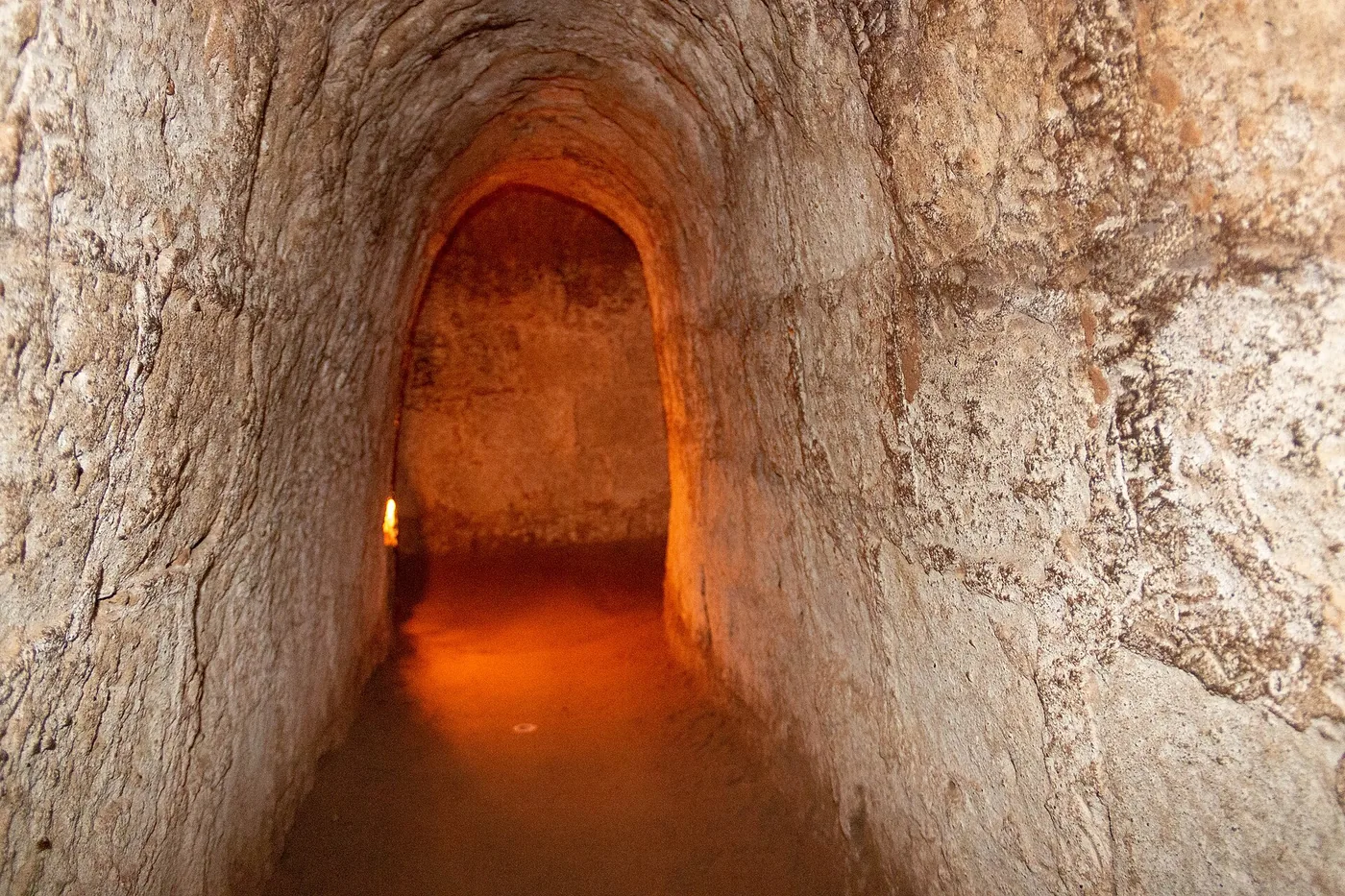
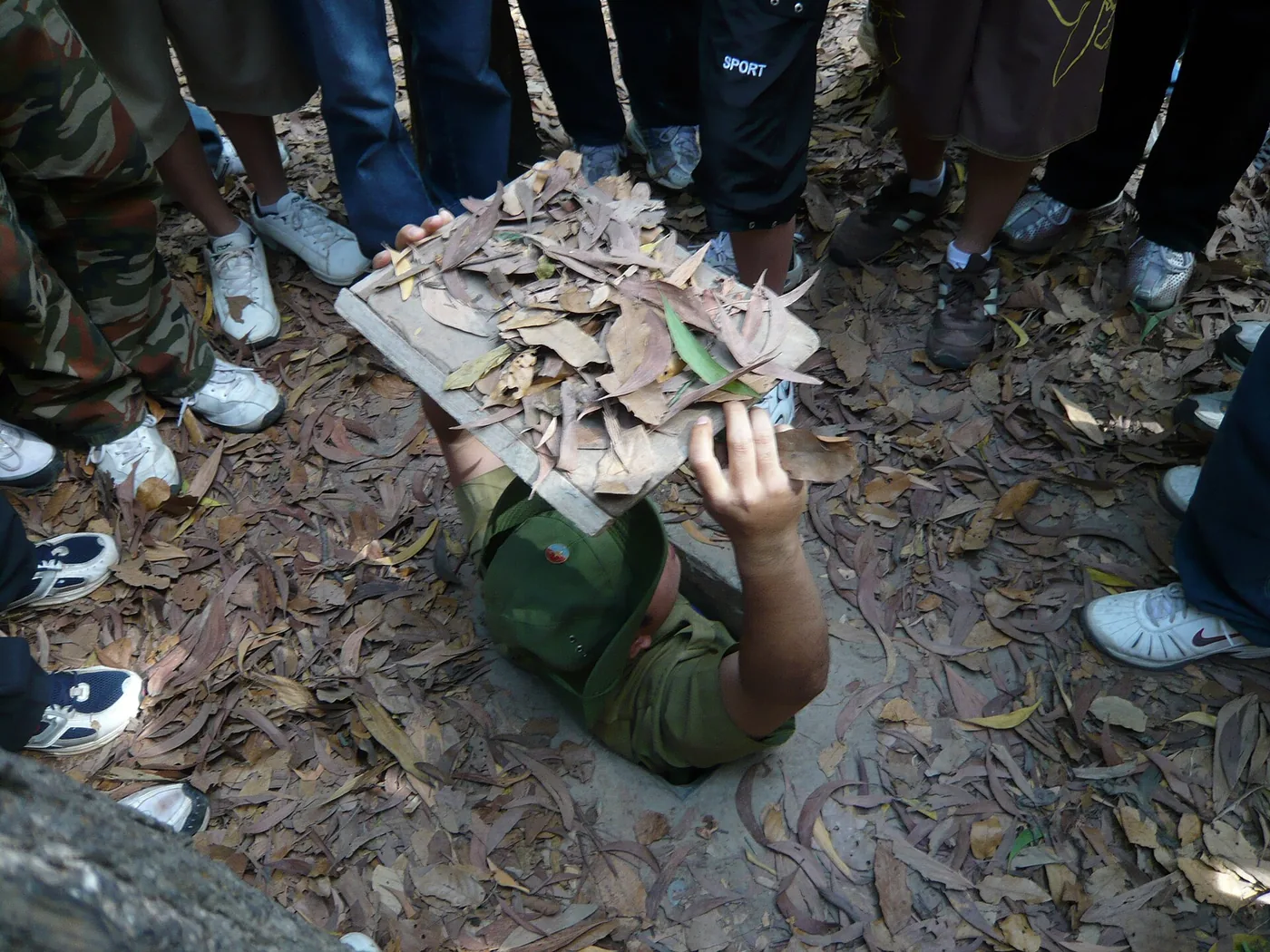
What you enter is not the original dimension. It has been enlarged so that visitors can pass, and the operator states this openly.
It is still tight. There are stretches where you bend or crawl, and although there is lighting it is dim. If you are claustrophobic or your knees are unreliable, take the short option.
You can come out early
Exits to the surface are spaced along the route. Ask the guide where they are before you go down; knowing that makes the whole thing easier.
In summer the tunnel is hot and humid rather than cool. Carry water and wear something you do not mind getting dirty.
How long it takes
The underground stretch itself runs 10 to 20 minutes depending on which section you take. Queues form when several groups arrive together, since it is single file.
Bags are a problem in there. Leave the large one on the bus or at the hotel and take something small.
7. What there is above ground
You spend more time above ground than below it. The sequence differs slightly between the two sites, but the components are the same.
The main areas
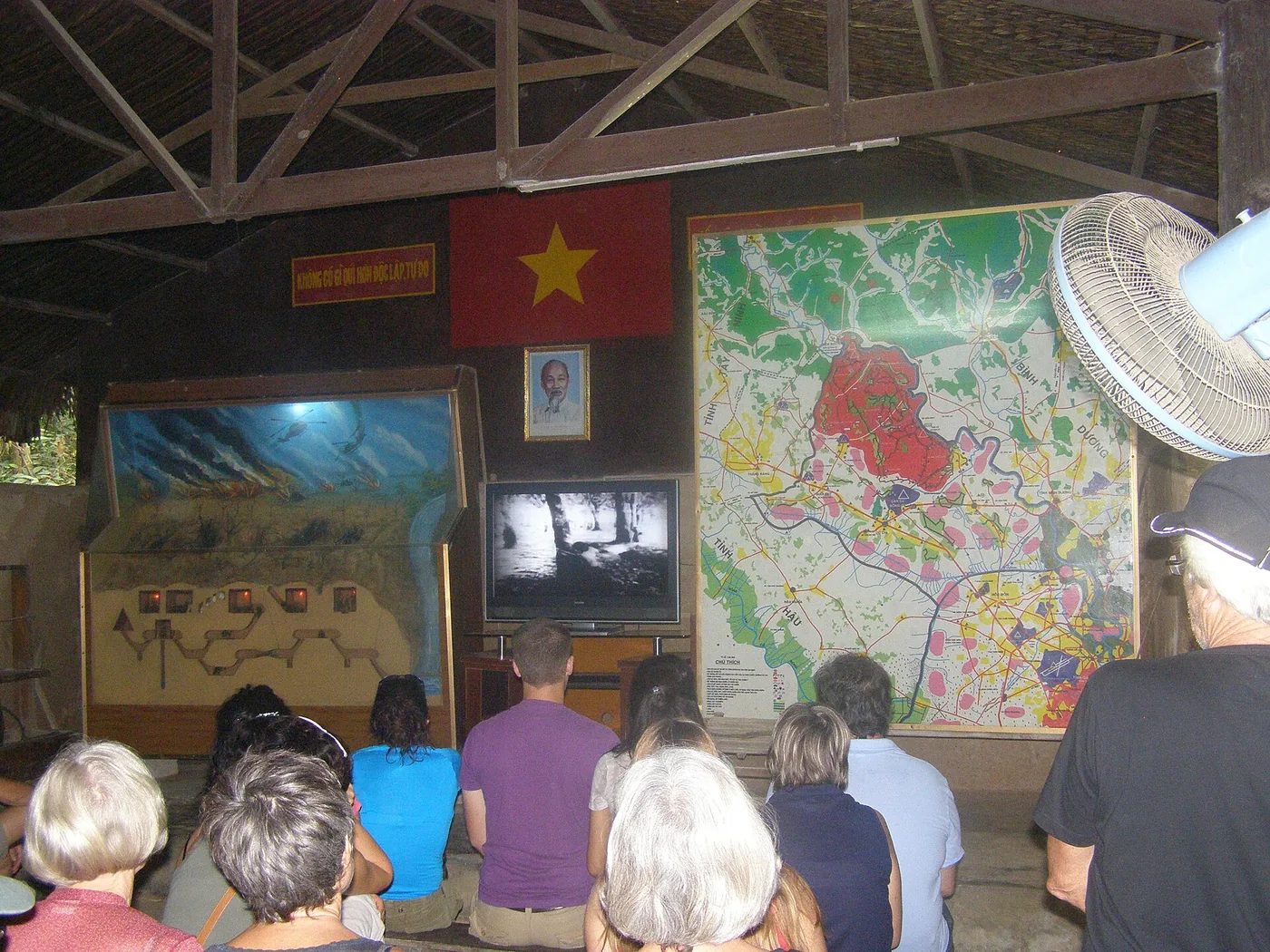
- Screening room. A documentary, usually early in the visit.
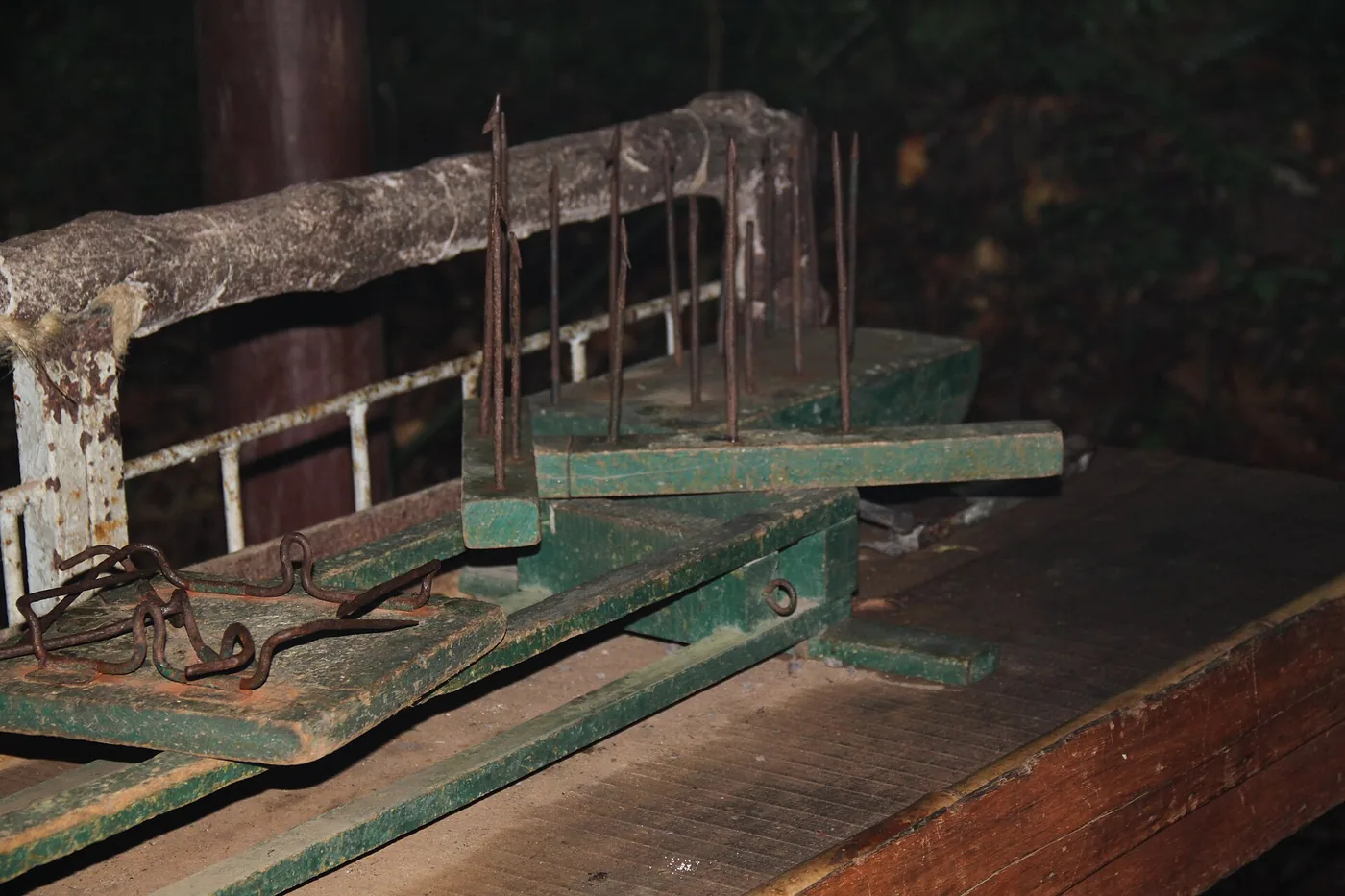
- Trap displays. Replicas of several designs with explanatory boards.
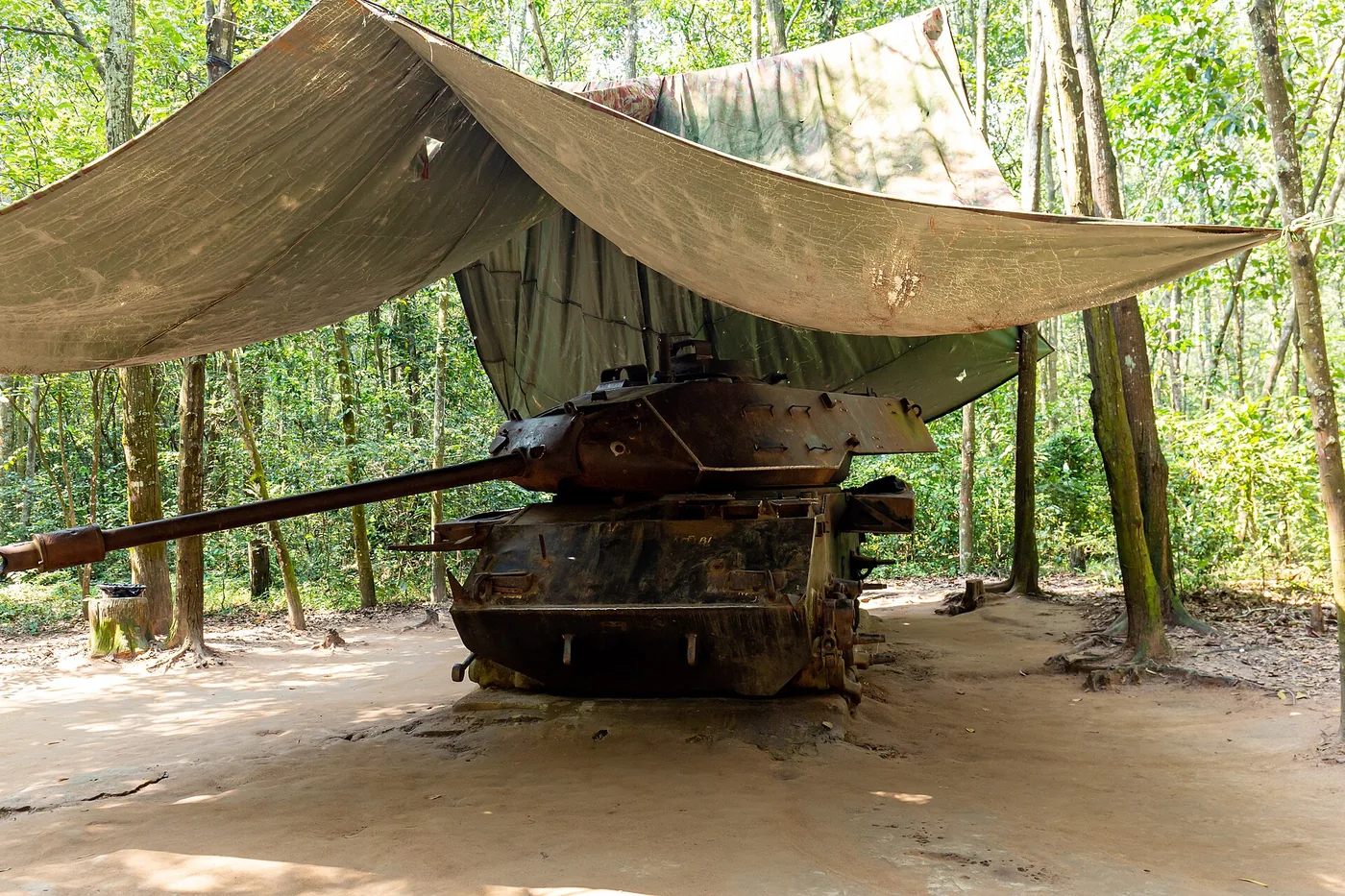
- Tank wreck. Left in the open.
- Reconstructed underground rooms. Meeting room, kitchen, medical space.
- The smoke-dispersing kitchen. Built so cooking smoke did not give away a position.
The guide service
The foreign ticket includes a guide who walks the group through the areas and explains how to enter the tunnel section.
The commentary is delivered from the site’s perspective. Visitors listen, look at the displays and form their own view.
The reconstructions
The rooms rebuilt above ground are worth more time than they usually get. The meeting room, the field clinic and the store all show how a space three metres underground had to be arranged.
Mannequins and props are used, which some visitors find dated. Read them as diagrams of how the space worked rather than as scenes.
Photography
Most areas allow photographs. The underground stretch is difficult, being dark and narrow, and stopping is awkward with people behind you.
At the memorial temple and similar spaces, follow the posted instructions.
8. The memorial temple at Ben Duoc
This exists only at Ben Duoc, and the character of the visit there is different enough to describe separately.
What is there
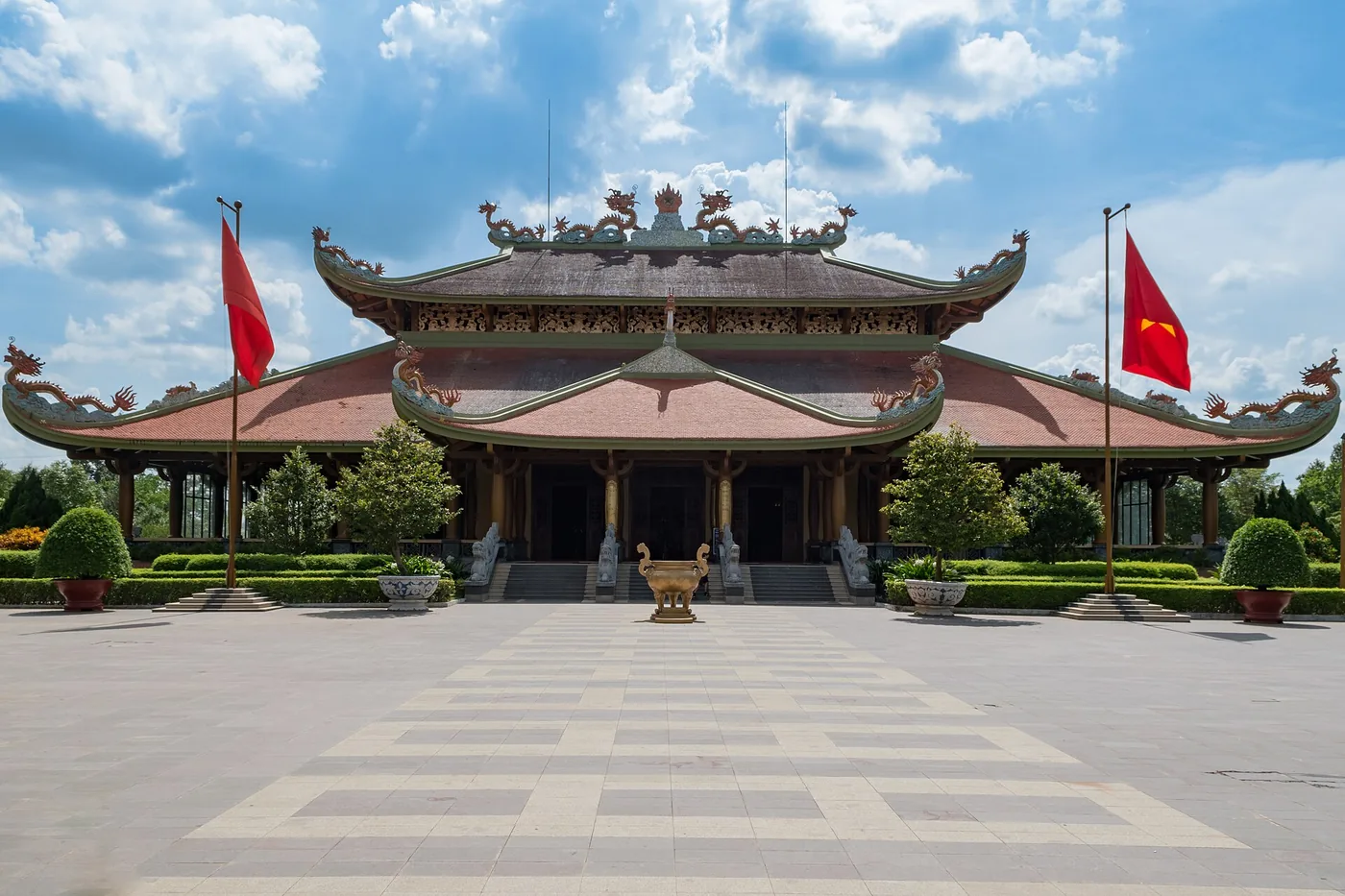
The memorial templeMap carries 45,666 names on its wall. The triple gate follows the form of a traditional village communal house.
It comes first on the circuit. With grounds of roughly 100 hectares, the walking distance at Ben Duoc is longer than at Ben Dinh.
Visiting it
Walk quietly and follow the posted instructions. Notices about footwear and headwear appear in places.
It fills up when the coach groups arrive. Early morning is comparatively quiet.
The reconstructed liberated zone
The same site includes an area reconstructing wartime village lifeMap. It is ticketed separately, so check at the counter.
It is open ground with little shade. In the middle of the day it is hard work, so bring a hat and water.
9. The shooting range is charged separately
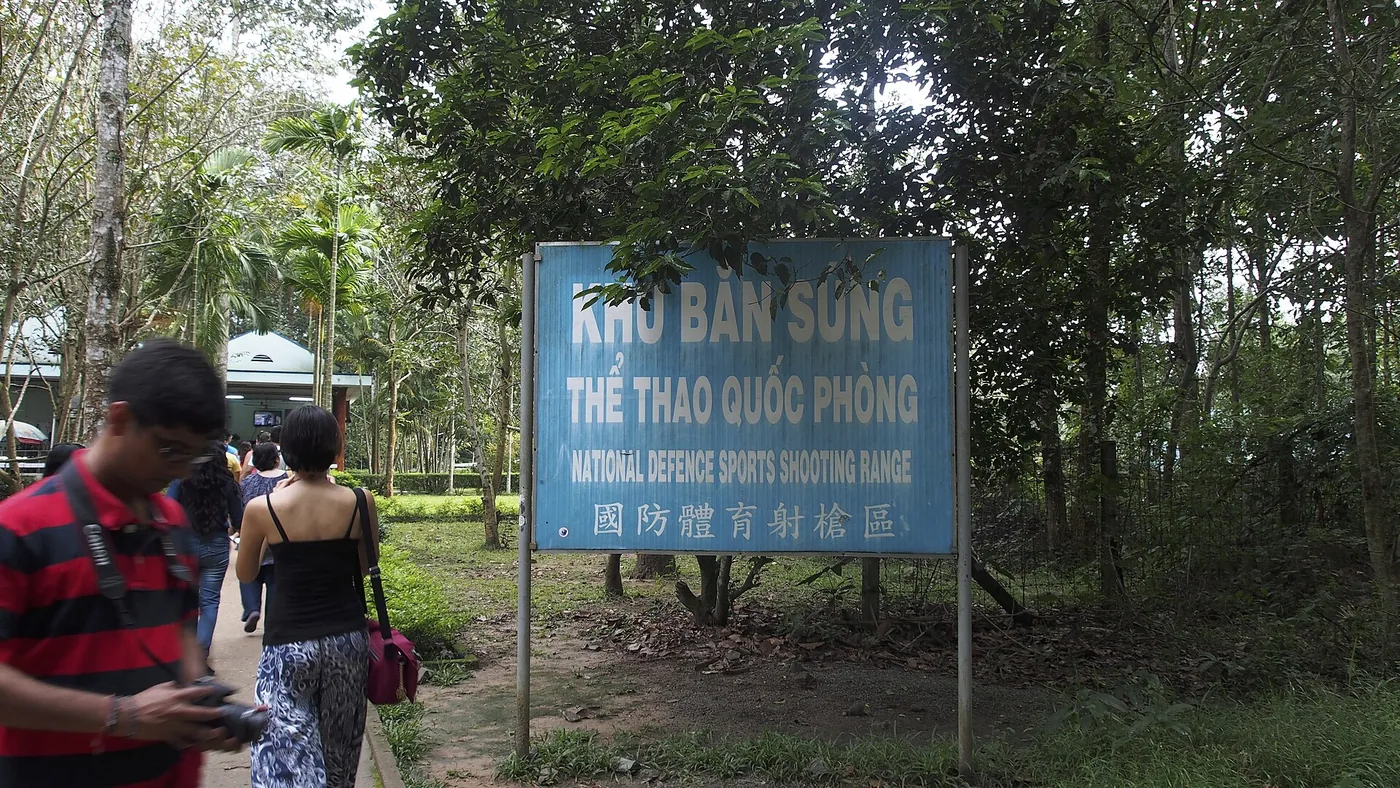
There is a live-fire range inside the site. It is not part of the visit and is priced by the round.
Price per round
| Weapon | Per round |
|---|---|
| K54 | 20,000 dong |
| Colt 45, K59, revolver | 25,000 dong |
| AK, carbine | 30,000 dong |
| AK, M16 | 35,000 dong |
| M16 | 40,000 dong |
There is usually a minimum number of rounds. Ask at the counter what the minimum is before deciding. After choosing, you get a safety briefing and fire only from the marked position.
Paintball
Paintball runs at 3,000 dong per round plus a service charge of 50,000 dong per person for 60 minutes, covering equipment and supervision. It works for groups.
The noise
This is live fire and it is loud across the site. If you are bringing children or are sensitive to noise, know that before you arrive.
Skipping the range takes nothing away from the visit; you simply carry on to the next area. In a group it means waiting, so use the time for the shop or a shaded seat.
10. How long the visit takes
Knowing the segments makes the day easy to build.
By segment
| Segment | Approximate time |
|---|---|
| Documentary screening | 15-20 min |
| Above-ground displays and reconstructions | 40-60 min |
| Underground stretch | 10-20 min |
| Shooting range | Optional, 20-30 min |
| Ben Duoc memorial temple | 20-30 min |
Ben Dinh comes to about two hours. Ben Duoc, with the larger grounds, takes two and a half to three.
When it is busy
Groups from the city arrive in the middle of the morning and again in the early afternoon. Because the tunnel is single file, that is when queues appear.
Opening is at 07:00, so an early arrival gets you the screening room and the tunnel without waiting.
If you are short of time
The screening room and the tunnel alone can be done inside an hour. The travel is what you cannot compress: two to three hours return regardless.
11. One night a month at Ben Duoc
Ben Duoc runs an evening visiting programme. It is a completely different outing from the daytime one.
How it works
| Item | Detail |
|---|---|
| Where | Ben Duoc |
| How often | One night per month |
| Time | 18:00 to 20:40 |
| Price | 399,000 dong |
| Booking | Phone, the official page, online ticketing |
The date changes every month, so check that month’s notice and book ahead.
Getting back afterwards
It finishes at 20:40 and the city is 57.7km away. Arrange the car before you go rather than after the programme ends.
The site has homestays, rooms, tents and a restaurant, and the operator mentions them in the same announcement for exactly this reason.
What it is not
It is not a light show or a re-enactment with effects. The operator describes an open stage under the moon with narration and music, which sets the expectation correctly.
Group rates
Schools, institutions, organisations and larger family bookings have a discount programme. Give the numbers when you enquire.
12. What to wear and bring
The visit alternates between open ground and a tunnel, which narrows the packing list.
Clothing
- Clothes you do not mind marking. You brush the walls and floor underground.
- Trainers. Dirt paths and steps; sandals are awkward.
- Long trousers. There are grassy stretches and mosquitoes.
- A hat. The open areas have little shade.
What to carry
- Water. The tunnel is hot and humid.
- Repellent. Needed in the wooded sections.
- Cash. Easier at the range and the kiosk.
- A small bag. Large packs snag in the passage.
Timing your clothes
You will be dusty by the end. If the trip is followed by something else in the city, plan a shower or a change rather than going straight on.
What to leave
Suitcases and bulky luggage are a problem underground. Leave them at the hotel.
After rain the paths are slippery, so footwear matters more in the wet season. Currency and payment are covered in the Vietnam money guide.
13. Visiting with children
Families do this trip often, but the segments differ in difficulty, so decide a few things in advance.
The tunnel
It is narrow and dark. A child who does not want to go in can wait above and meet you at an exit; ask the guide where those are.
Smaller children often find the passage easier than adults do. The issue is usually the dark and the enclosure, not the size.
The noise
The range is audible across the site. With a noise-sensitive child, start with the areas furthest from it.
The displays
Trap replicas and a tank wreck are on show, and the subject is a war. Decide in advance how much you want to explain, according to the child’s age.
Heat and timing
The open areas are large and unshaded. A morning visit finished inside two hours suits children best. Vietnamese pricing gives half price for ages 7 to 16.
14. Combining it with the Mekong
Cu Chi and the Mekong Delta are often sold as one day. Here is what that day actually contains.
The driving
| Leg | Distance | Clear roads |
|---|---|---|
| City to Ben Dinh | 47.6km | 44 min |
| Cu Chi towards My ThoMap | about 100km | 1 h 30 min or more |
| My Tho back to the city | 70.3km | 56 min |
That is three legs, and with traffic you spend four to five hours in the vehicle. Actual time at each place is around two hours.
Splitting it
With three days or more, split them. Cu Chi in the morning and the city in the afternoon makes for a much easier day.
If the schedule forces one day, pick a tour with an early departure and check the stated return time.
The same direction
Cu Chi lies northwest of the city; the Mekong lies southwest. Combining them means crossing the city or taking a wide detour around it.
Continuing northwest instead leads to Tay Ninh and its Cao Dai temple, which is sold as a full-day trip from the city with Cu Chi.
If you only want one war-related site
Some visitors find the museum in the city covers the subject more directly and in less time, since it needs no travel. Cu Chi adds the physical experience of the tunnel, and it uses up half a day in driving.
Another pairing
Cu Chi in the morning and the War Remnants MuseumMap or Ben Thanh MarketMap in the afternoon works well. Evening seafood across the canal is covered in District 4 seafood street.
15. Eating, sleeping and facilities on site
Most people come out for the day, but the site itself has facilities.
Inside the site
| Facility | Detail |
|---|---|
| Homestay | By the river, 400,000 to 1,200,000 dong a night |
| Tents | About 300,000 dong, pitched in advance |
| Restaurants | At both Ben Dinh and Ben Duoc |
| Other | Swimming pool, bicycles, electric buggies, kayaks, prawn fishing |
These matter if you are attending the night programme or spending an extra day in the area. Ordinary hotels nearby run 250,000 to 700,000 dong.
Staying in the city
Most visitors stay in the city and come out in the morning. Areas and prices are in where to stay in Ho Chi Minh City.
Food
Besides the site restaurants, some tours include a stop on the way. Confirm before booking whether a meal is part of the price.
Inside the site, boiled cassava is served in places as a reconstruction of wartime rations, handed round in small portions with tea. It is not a meal, so plan lunch separately.
Toilets and kiosks
There are toilets and kiosks in the above-ground areas selling water and snacks. Use them before you go into the tunnel.
16. Assumptions worth correcting
Things that are useful to check before you book.
There is a single entrance fee
Foreign visitors pay 35,000 dong entry and 100,000 dong for the guide, 135,000 in total.
Ben Dinh and Ben Duoc cost different amounts
They do not. What differs is location, size and historical role, not the price.
The tunnel is the original size
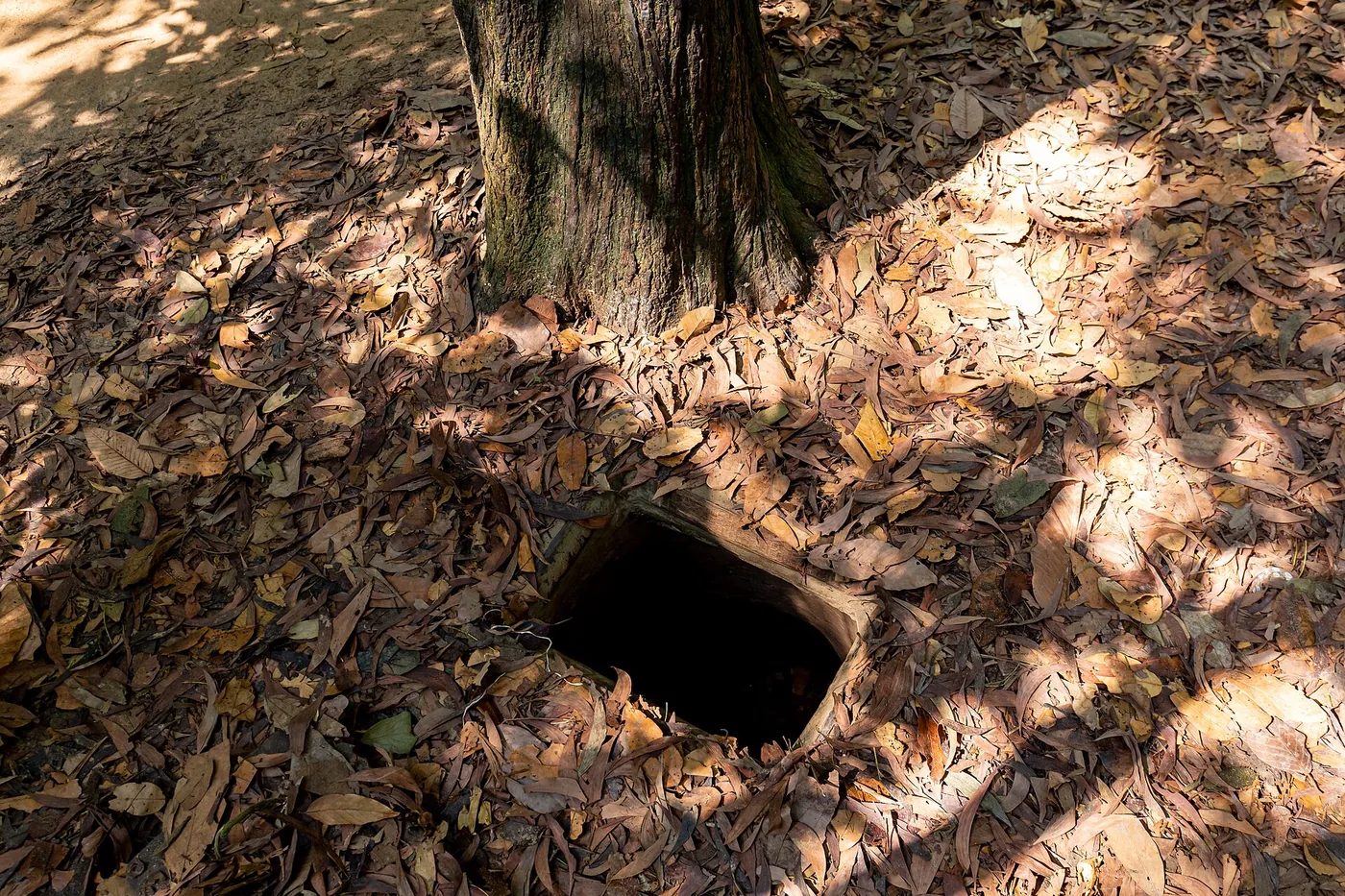
The visitor section has been widened. Original-size entrances are displayed separately above ground for comparison.
Shooting is included
It is not. Rounds cost 20,000 to 40,000 dong depending on the weapon.
An afternoon is enough
The site closes at 17:00 and the drive is one to two hours each way, so an afternoon departure leaves too little time.
The night programme runs every night
Once a month, on a date that changes, and it needs booking.
17. Two worked timetables
Putting the times and distances in order gives these two days.
A half day at Ben Dinh
| Time | What happens |
|---|---|
| 07:00 | Leave the city |
| 08:30 | Arrive, screening room and above-ground displays |
| 09:30 | Underground section |
| 10:30 | Shooting range or a break |
| 11:00 | Depart |
| 12:30 | Back in the city |
A full day taking in Ben Duoc
| Time | What happens |
|---|---|
| 07:00 | Leave the city |
| 08:30 | Arrive, memorial temple |
| 09:30 | Displays and underground section |
| 11:30 | Lunch at the site restaurant |
| 13:00 | Depart |
| 14:30 | Back in the city |
Both assume clear roads. At weekends and on holidays the exit from the city can add half an hour or more.
How to build the wider itinerary is in the Ho Chi Minh City travel guide, and intercity options in the guide to getting around Vietnam.
18. Practical notes
Small things that make a difference on the day.
Addresses
Addresses mix the older “Cu Chi district” label with the newer administrative naming. In map apps, searching the site nameMap is more reliable.
Heat
Afternoon temperatures in the south sit around 33C, and the open areas have little shade. The tunnel is not the escape it sounds like: it is humid rather than cool.
Weather
Much of the visit is outdoors. The southern wet season runs May to October with rain usually arriving in the afternoon, which is one more argument for a morning trip.
Weekends
Domestic visitors fill the site at weekends and on public holidays, lengthening the tunnel queue and filling the car park. Weekday mornings are the quietest. It opens during Tet, though the roads out of the city are slow then.
Connectivity
Signal drops in places out of town. If you plan to call a car through an app for the return, check your data first; eSIM options are in the Vietnam eSIM guide.
Cash and cards
The ticket counter takes cash reliably; the range and kiosks are cash in practice. Bring small notes, since change for large ones is not always available.
Common problems
People report being offered goods or asked for extra fees near the entrance. Buy tickets at the counter and remember the guide is part of the ticket. If a tip is requested, you are not obliged to pay one. Types of scam are listed in the Vietnam tourist scams guide.
Language and etiquette
Guides usually work in English. If you need another language, check when booking the tour, because the site assigns guides without a language guarantee. General etiquette is covered in Vietnam etiquette and tipping.
🎡Things to Do22
🍜Food3
🏨Where to Stay9
🚇Getting Around4
🧭Travel Tips10
🧭Vietnam-wide essentials116
Cu Chi Tunnels: common questions
Foreign visitors pay 35,000 dong for site entry and 100,000 dong for the guide service, 135,000 dong in total. The guide element rose to 100,000 dong on 1 February 2026. Vietnamese visitors pay 35,000 dong, with half price for ages 7 to 16 and students.
With limited time, Ben Dinh: it is 47.6km from the city and the circuit is shorter. Ben Duoc is 57.7km away, has grounds of about 100 hectares and the memorial temple. The price is the same at both.
You can, but it is rarely worth it. They are 13km apart, each takes about two hours, and with the return drive the day becomes mostly travel.
07:00 to 17:00 every day, including public holidays and Tet. Since the drive is one to two hours each way, a morning start works best.
The visitor section has been widened so people can pass, but there are still stretches where you bend or crawl, and it is dim. Exits to the surface are spaced along the route, so ask where they are before going down.
No. Rounds cost 20,000 to 40,000 dong depending on the weapon. Paintball is 3,000 dong a round plus a 50,000 dong service charge per person for 60 minutes.
Yes. For Ben Duoc take bus 13 to Cu Chi station and change to 79. For Ben Dinh it is buses 13, 122 and 70, which means three changes and a long journey.
One night a month at Ben Duoc, from 18:00 to 20:40, at 399,000 dong. The date changes monthly, so check that month’s notice and book ahead.
Yes, with caveats. The tunnel is narrow and dark and the shooting range is audible across the site. A child who prefers not to go down can wait above and meet you at an exit.
Those tours exist, but the three driving legs put four to five hours in the vehicle. With three days or more, split them across two.