
Datanla Falls and the Alpine Coasters, Da Lat: Which Ticket to Buy and When Each Counter Closes
Entry to Datanla does not include the alpine coaster, the zipline or the canyoning trip, and each of those stops selling at a different hour of the day. This is what the operator currently publishes, checked against its own booking system, so you know what you can still buy when you arrive.
| How many tickets | Entry and rides are sold separately. Only Coaster 3 has entry built in. |
|---|---|
| Entry | 80,000 dong for adults, 50,000 for children. |
| Two coasters | Coaster 1 runs 1,200m, Coaster 3 runs 2,400m. |
| With children | Coaster 3 costs only 10,000 dong more than Coaster 1 plus entry. |
| Closes first | Canyoning departs between 8am and 11am and nothing later. |
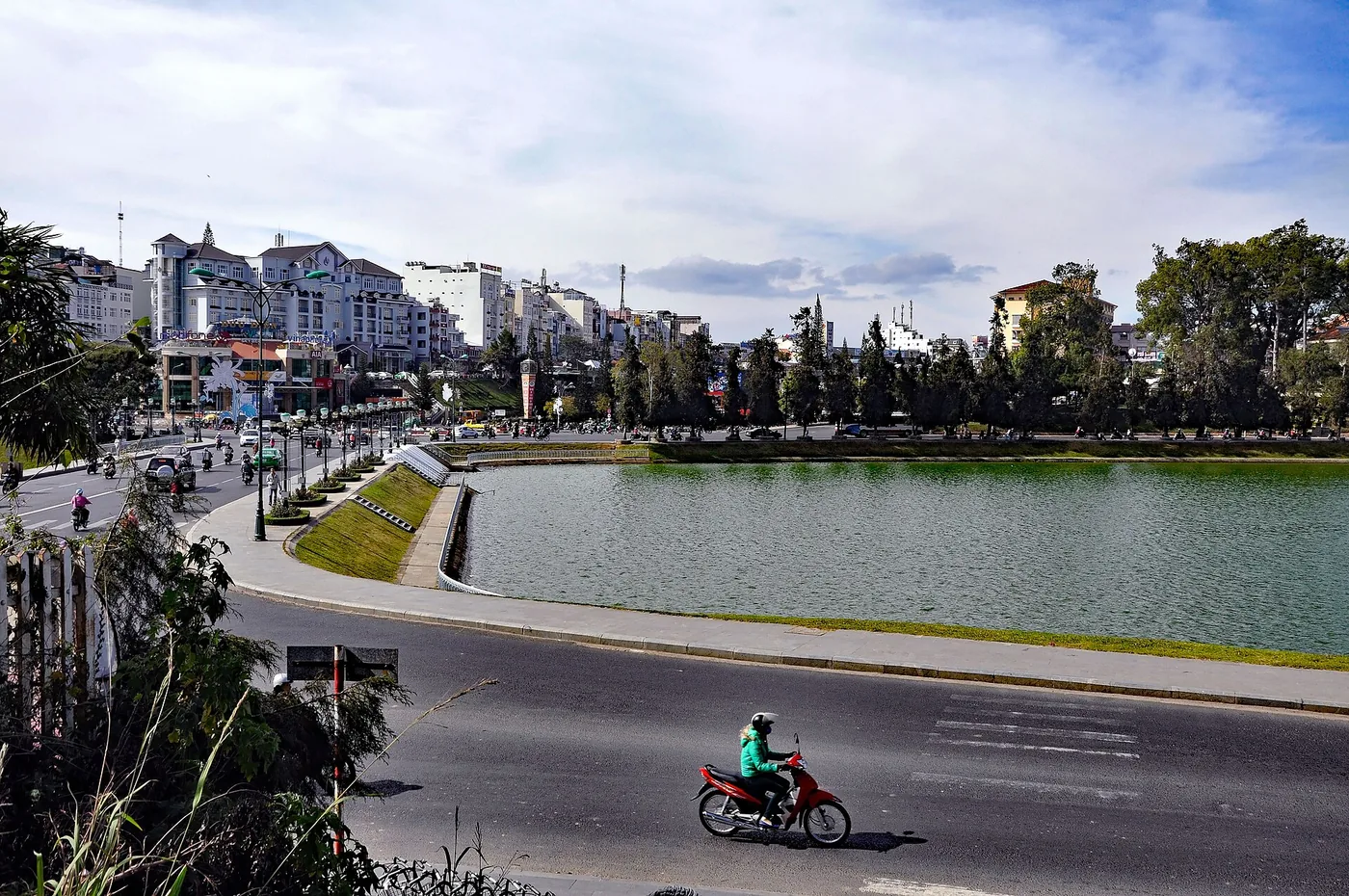
| Getting there | Nine minutes by car from Xuan Huong Lake, on the road up from the airport. |
1. You buy two tickets at Datanla, not one
2. Where Datanla sits, and why that helps
3. The road there is still under repair
4. What the entry ticket alone gets you
5. Coaster 1 and Coaster 3 are not the same ride
6. With a child, the maths flips to the long coaster
7. Every activity stops selling at a different hour
8. Check the combo maths before you buy one
9. The high rope course runs about two hours
10. The zipline is two spans, not one
11. Canyoning takes most of a day
12. The safety record, and why the rules look like this
13. With small children there are two other options
14. The operator’s own pages do not always agree
15. What rain does to the visit
16. How long to allow, and what to pair it with
17. What a day at Datanla costs
1. You buy two tickets at Datanla, not one
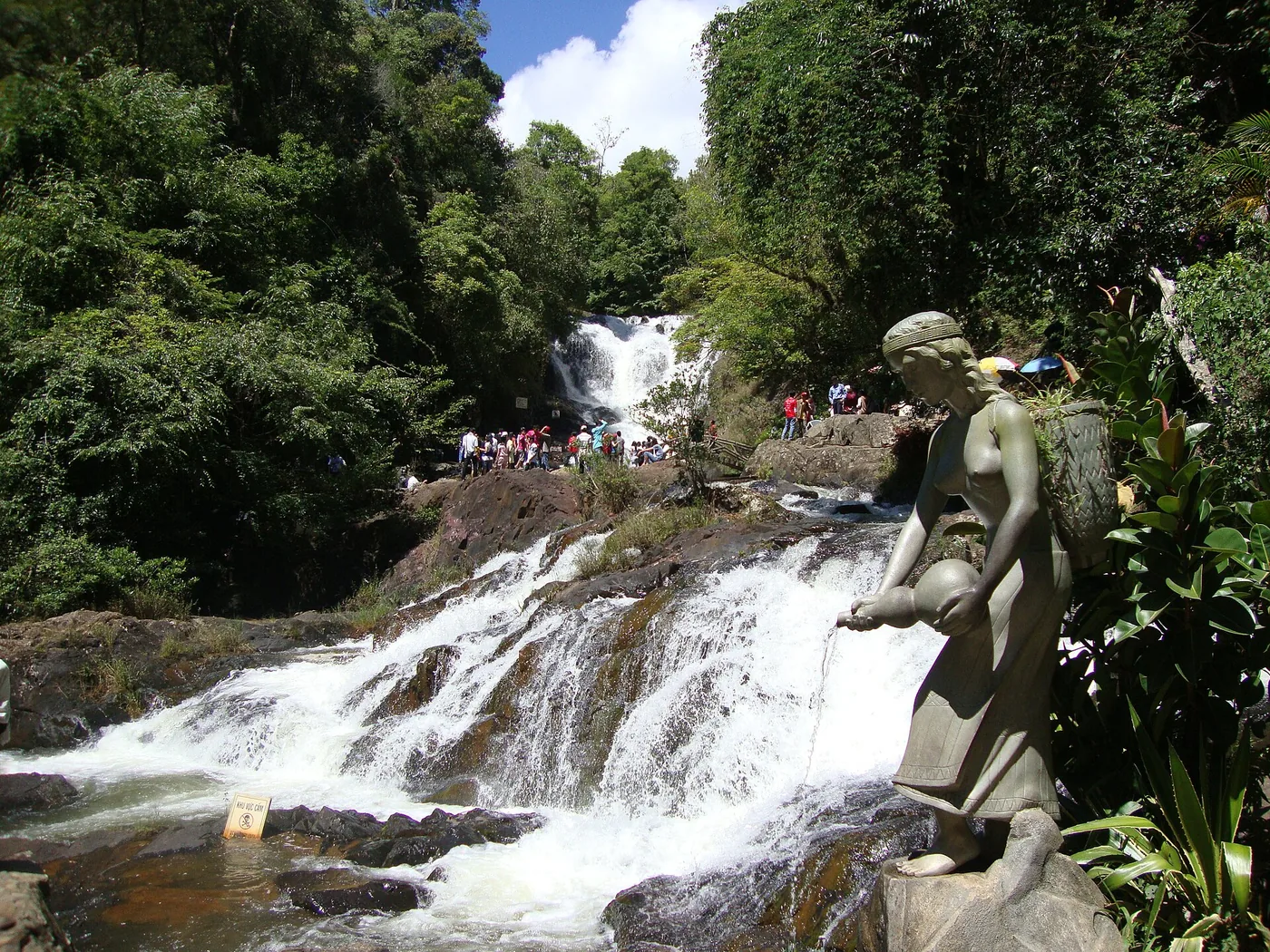
Entry to Datanla FallsMap does not include the alpine coaster. The gate ticket lets you walk down to the falls. Riding the rail is a second purchase, and the operator says so plainly in its own activity notes.
There is one exception, and it is the part people get wrong at the counter. The return ticket for Coaster 3 already includes entry. So Coaster 1 means two tickets and Coaster 3 means one, inside the same gate, on the same afternoon.
Start by deciding what you actually want
| If you came to | Buy | Adult |
|---|---|---|
| see the falls and leave | entry only | 80,000 dong |
| ride the short track once | entry + Coaster 1 | 210,000 dong |
| ride the long track | Coaster 3 return | 250,000 dong |
| spend the day on something bigger | zipline or canyoning | from 1,000,000 dong |
The spread looks wide but the decision underneath it is small. Walking costs one ticket. Riding costs two, unless you take the long coaster. Everything above that is a half-day or full-day programme with its own booking rules, and those are covered further down.
Time matters as much as money here. The gate stays open into the late afternoon, but individual counters stop selling at different hours, and by mid-afternoon several of them are shut. That single fact decides more Datanla visits than the price list does.
2. Where Datanla sits, and why that helps
Datanla is on National Route 20, partway down the Prenn PassMap, on the road that leaves Da Lat heading south. From Xuan Huong LakeMap in the centre of town it is a nine-minute drive. No other waterfall around Da Lat is anywhere near that close.
The second piece of geography is more useful. Datanla sits on the road up from Lien Khuong AirportMap. The full airport run into town takes about thirty-three minutes and the falls are twenty-seven minutes along it. Arriving or leaving, the detour adds almost nothing to the drive.
Driving times from around town
| From | Distance | By car |
|---|---|---|
| Truc Lam Monastery | 2.6km | 4 min |
| Intercity bus station | 3.7km | 5 min |
| Robin Hill cable car station | 4.0km | 6 min |
| Da Lat Market | 6.3km | 8 min |
| Xuan Huong Lake | 7.4km | 9 min |
| Lien Khuong Airport | 24.7km | 27 min |
How to get out there
Booking a Grab or a Green SM car is the simplest option, and because the ride is under ten minutes each way there is no reason to hold a car while you are inside. The one catch is coming back: few cars idle at the entrance, so expect a short wait for a driver to accept. Our guide to Grab and Green SM in Vietnam covers how the apps behave outside the big cities.
Plenty of visitors ride out on a rented scooter. This is a mountain pass with continuous curves and heavy vehicles on it. If Da Lat is where you are learning to ride, get comfortable on the flatter streets around the lake before you take this road.
The third option is a half-day car tour. Datanla, Truc Lam MonasteryMap and the cable car are commonly sold as one loop, which works because all three are within ten minutes of each other on the same side of town.
3. The road there is still under repair
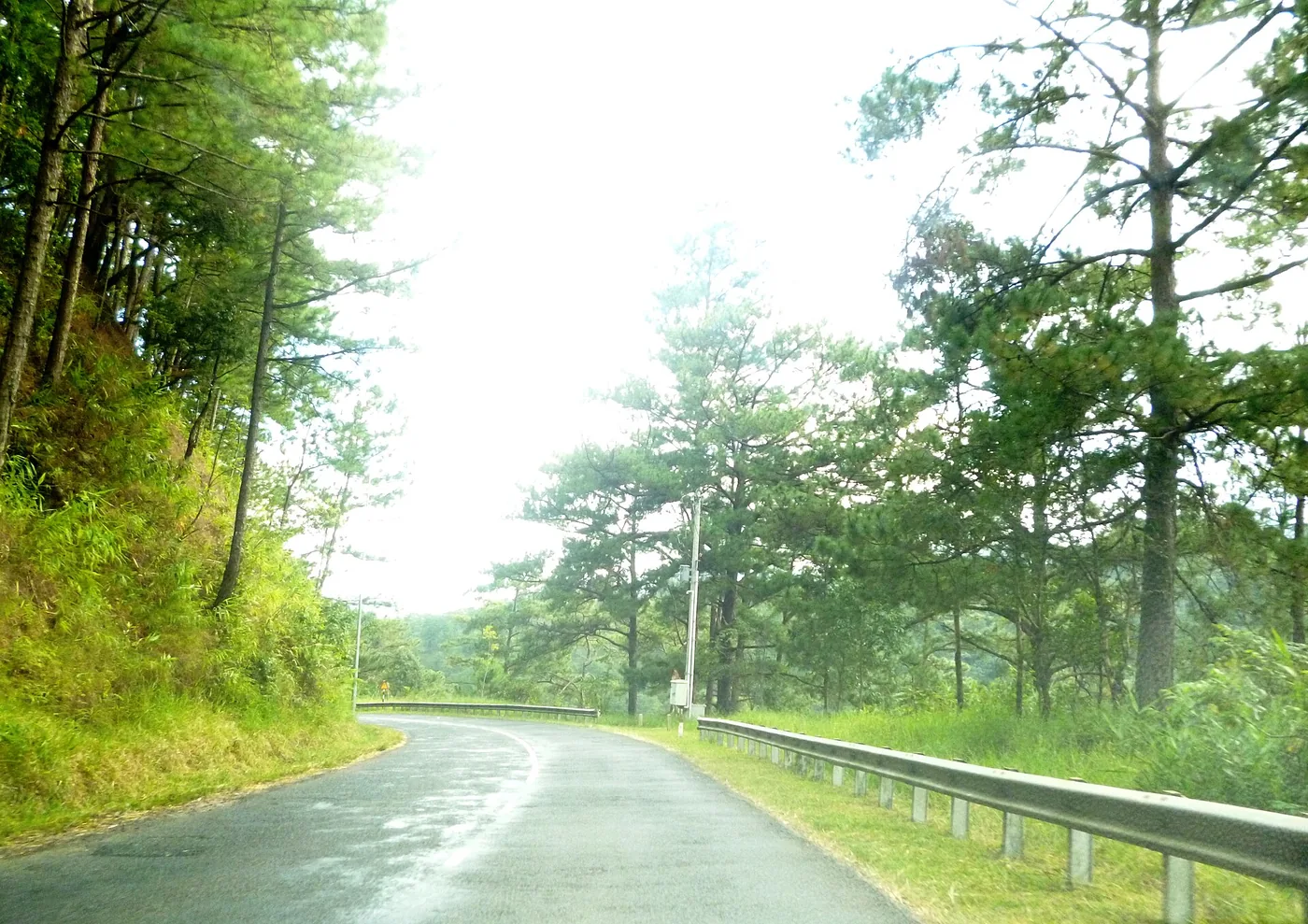
The Prenn Pass was rebuilt recently. A road that used to be seven metres wide was widened to fourteen and given four lanes, and during construction the pass was closed outright before reopening section by section.
Then the slope failed. Heavy rain in late 2025 brought down a reinforced retaining wall into the valley and left a long crack across the carriageway. Traffic was let back through without trucks, and further closures followed while crews worked on the damage.
The repair zone is directly outside Datanla
The awkward part for visitors is where that work sits. Earlier this year the section from the foot of the pass up to the entrance of the Datanla tourist area was closed to traffic outright. Through the summer a stretch of roughly four hundred metres, from the Datanla bridge to the entrance, remained under traffic control while crews cut back the slope above it.
Two things follow from that. Your transfer can take longer than the map suggests, and if control is in force that day the driver has to go around by the Mimosa Pass or the Sacom Pass, which turns a nine-minute run into more than half an hour.
It costs nothing to ask your hotel or driver about the pass on the morning you go, and it is worth doing after heavy rain in particular. Our Da Lat travel guide has the wider picture of how the city connects to the airport and the coast.
4. What the entry ticket alone gets you
Entry on its own is enough to see the waterfall. The area the operator keeps open is called Waterfall 1, and the path down to it through the forest is included in the gate price.
The walk runs about a kilometre and takes in roughly two hundred steps. Going down is pleasant. Coming back up is the part people underestimate, especially in the afternoon heat or with a small child to carry. If that sounds like your group, the coaster return ticket is doing more than providing a thrill.
What the falls actually look like
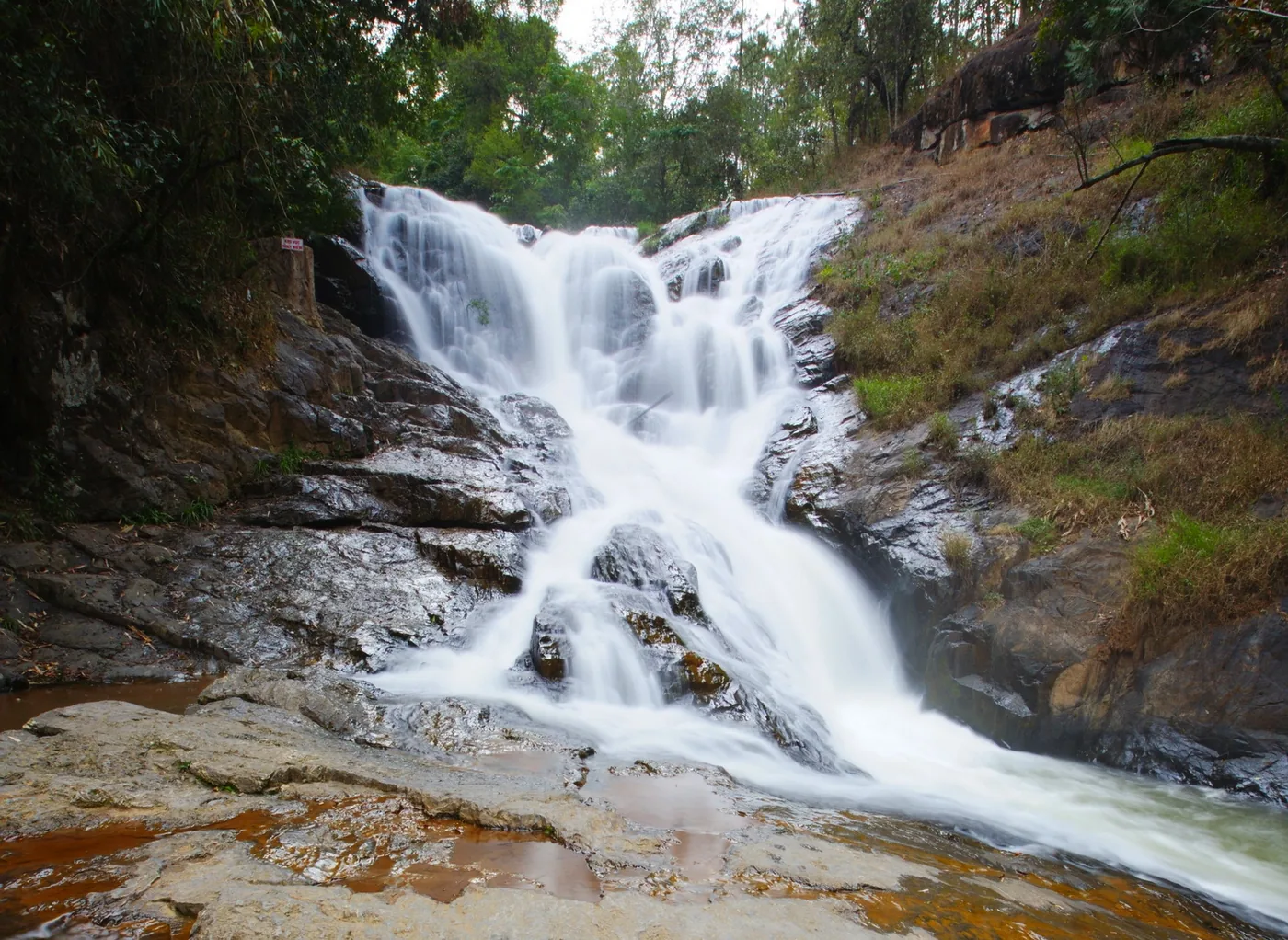
The water drops over rock from a little over twenty metres and keeps going below that. The full watercourse is usually described as seven tiers. The operator opens two of them, Waterfall 1 and Waterfall 3, and the rest are only reachable on a guided programme.
The clear pool below the main drop is known locally as the Fairy Stream. The deep pool above it has a much less inviting name, roughly the Death Abyss. That name is not decoration, and the safety section further down explains where it comes from.
The name of the falls comes from the local K’Ho language and is usually rendered as water under leaves, a reference to a stream that stayed hidden under the forest canopy.
5. Coaster 1 and Coaster 3 are not the same ride
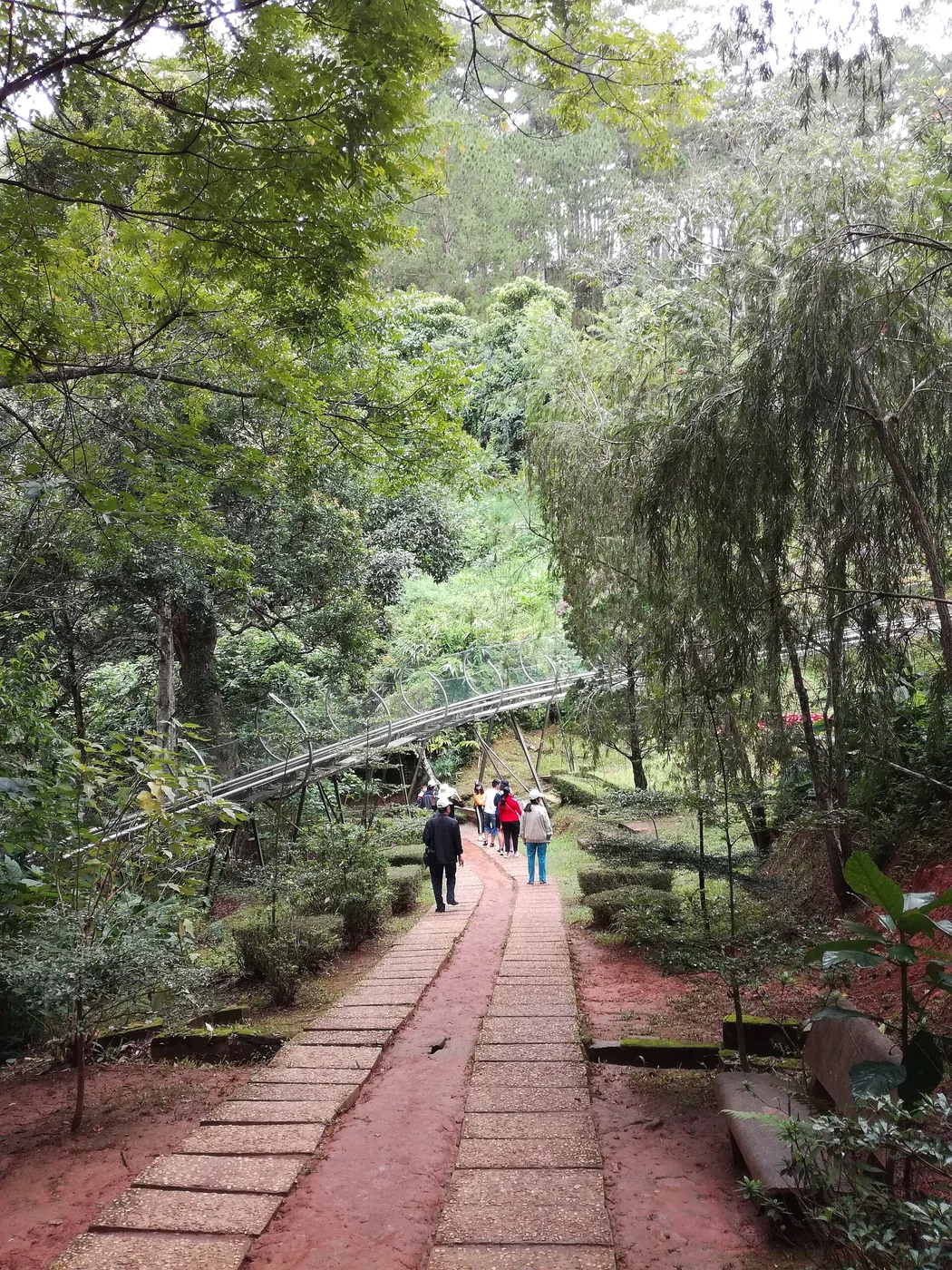
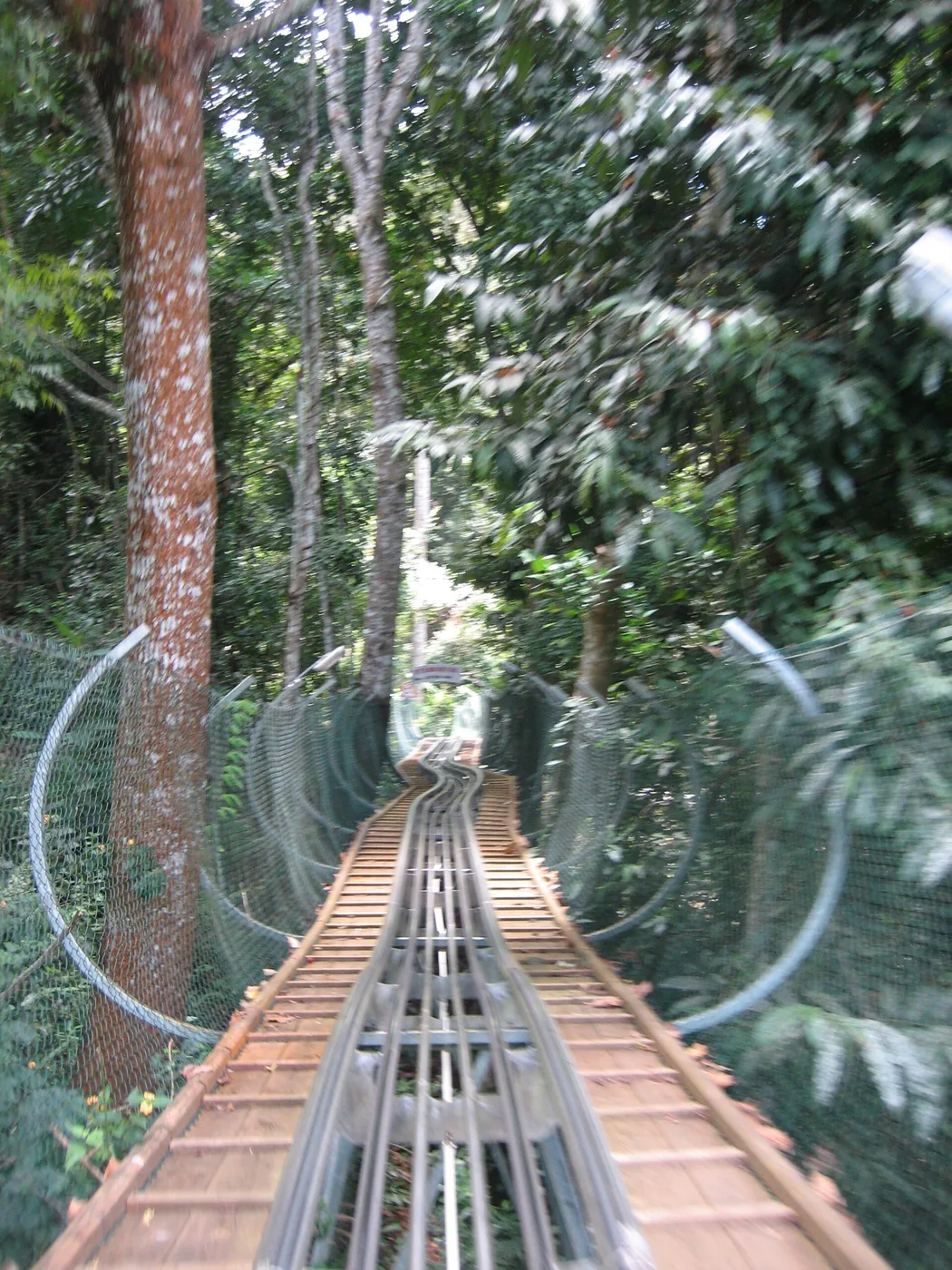
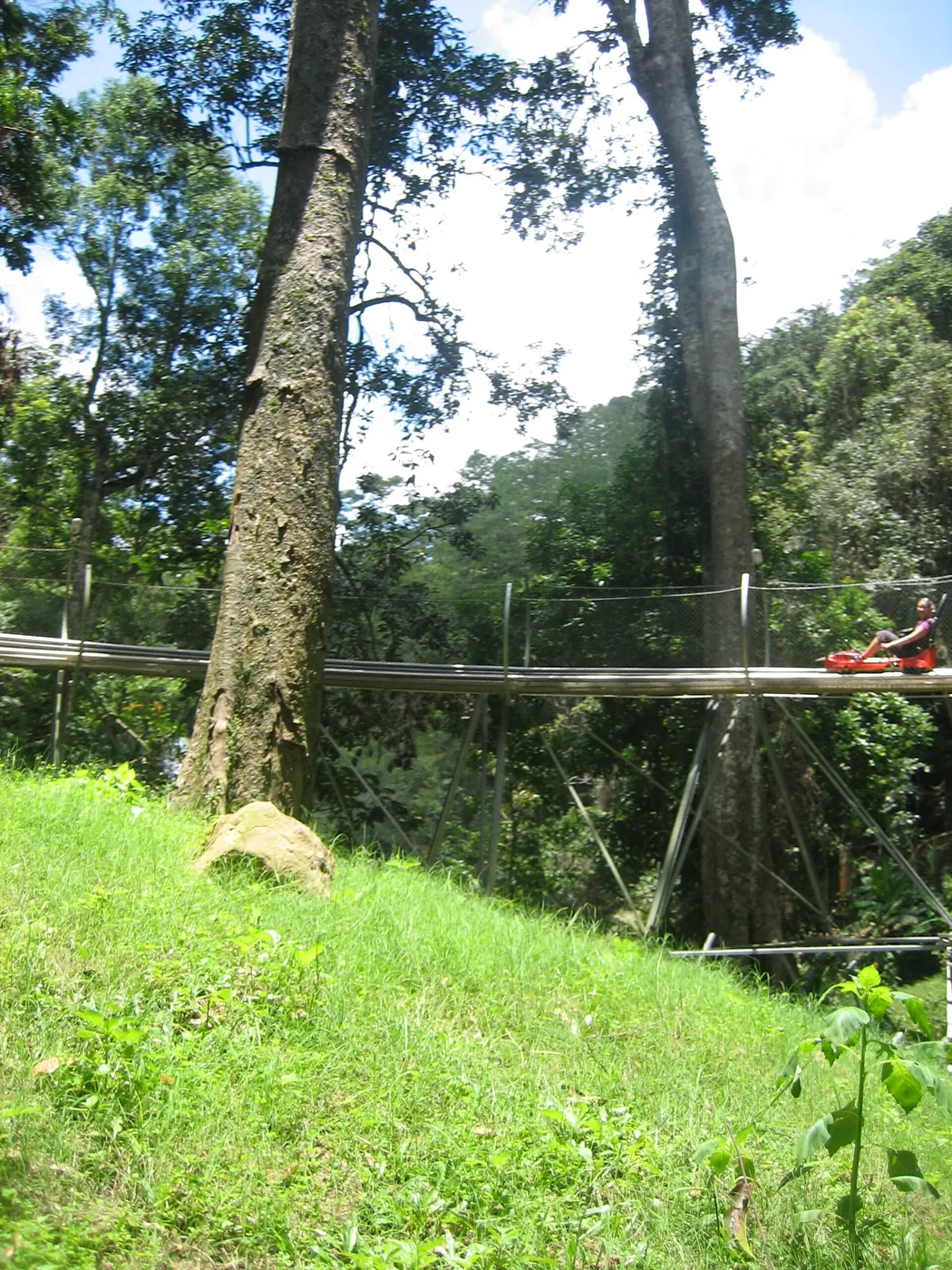
There are two coasters and they differ in length and in what the ticket covers. Coaster 1 runs 1,200 metres. Coaster 3 runs 2,400 metres, and the operator advertises it as the longest track in Southeast Asia.
Up to two people share a car. You brake yourself with a hand lever, so a nervous rider can crawl down, and the system brakes automatically if you close on the car ahead. Small children ride with an adult.
The ticket structure differs too
| Ticket | Adult | Child | Entry |
|---|---|---|---|
| Coaster 1, one way | 110,000 dong | 80,000 dong | bought separately |
| Coaster 1, return | 130,000 dong | 90,000 dong | bought separately |
| Coaster 3, return | 250,000 dong | 150,000 dong | included |
A one-way ticket puts you on the rail going down and on the steps coming back. The return costs twenty thousand dong more. Unless you actively want the climb, buy the return at the counter rather than deciding at the bottom.
The two coasters also end in different places. Coaster 1 stops at Waterfall 1. Coaster 3 carries on to Waterfall 3, lower down. If you want time standing in front of falling water, take the first. If the ride itself is the point, take the second.
The camera rig is on the Coaster 3 track. It shoots automatically as you pass, and afterwards you find your own frames by face recognition at the booth. Being photographed is free. A print costs 90,000 dong and includes the digital file.
6. With a child, the maths flips to the long coaster
Adults and children face different arithmetic here, and it is worth doing before you reach the window.
For an adult, Coaster 1 return plus entry comes to 210,000 dong against 250,000 for Coaster 3. Forty thousand dong doubles the length of the track, which is a fair deal but not an obvious one.
For a child the same gap is ten thousand dong. Coaster 1 return plus entry is 140,000; Coaster 3 is 150,000. If you are travelling with children, the long coaster is effectively the default.
The same combinations side by side
| Combination | Adult | Child |
|---|---|---|
| Entry only, walking down | 80,000 dong | 50,000 dong |
| Coaster 1 return + entry | 210,000 dong | 140,000 dong |
| Coaster 3 return | 250,000 dong | 150,000 dong |
Child pricing here is set by height rather than age, which is normal across Da Lat attractions and catches families out. Very small children enter free; above that threshold the child rate applies. There is a senior rate from sixty, and staff ask for photo identification, so carry a passport rather than a photocopy.
One consequence is worth knowing in advance. A child small enough to enter free is still tall enough to ride the coaster, because the ride threshold sits below the free-entry threshold. The reverse is true higher up the price list: children old enough to pay a child fare are generally too short for the rope course, the zipline and the canyoning trip.
7. Every activity stops selling at a different hour
This is the detail that ruins more Datanla afternoons than anything else. The site is open late, but each counter closes on its own schedule, and by mid-afternoon the list of things you can still buy has shrunk considerably.
When each counter stops
| Activity | Last accepted | Note |
|---|---|---|
| Canyoning | departs 8am to 11am | the first to close |
| High rope course | 8am to 2pm | the course takes two hours |
| Zipline | 8am to 3.30pm | same for the net playground |
| Falls and coasters | 7.15am to 4.30pm | same for the karts |
Put plainly: leave your hotel after lunch and canyoning is already gone. Arrive after two and the rope course has closed. Arrive after half past three and you are down to the waterfall and the coasters, which is a perfectly good afternoon but not the one you may have planned.
Arrive in the morning and everything is open. If Datanla is a real item on your itinerary rather than a stop on the way to the airport, put it early and keep the town for later in the day.
A quiet day does not extend the cut-offs
Cut-offs do not move when the site is empty, because they are set by how long each programme runs rather than by demand. Canyoning takes five to six hours, so an 11am departure is already the last one that finishes in daylight.
8. Check the combo maths before you buy one
The operator sells three two-activity combos and advertises savings of up to 260,000 dong. Two of them are genuine. One is not, and the reason is visible in the operator’s own price list.
The three combos against buying separately
| Combo | Combo price | Bought separately | Difference |
|---|---|---|---|
| High rope + Coaster 3 | 650,000 dong | 610,000 dong | combo costs 40,000 more |
| Zipline + Coaster 3 | 1,050,000 dong | 1,250,000 dong | saves 200,000 |
| Zipline + high rope | 1,200,000 dong | 1,360,000 dong | saves 160,000 |
The first line is not a trap so much as a leftover. The combo page prices the rope course at 460,000 dong, which is what it used to cost. The current activity page and the booking system both list it at 360,000. The discount was calculated against the old figure and never recalculated.
The other two combos hold up. They are built around the zipline, where the underlying prices are high enough that the discount is real money. If you were going to do the zipline and the rope course anyway, the combo is the better buy.
Discounts do not stack. The rope course has a student rate, and it cannot be combined with a combo, so a student is usually better off asking for the student price on its own.
9. The high rope course runs about two hours
This is a set of rope bridges, beams and platforms strung between trees, with your feet off the ground for the whole circuit. There are more than sixty elements.
They are grouped into five levels and the levels climb. The first is barely above head height and exists to get you used to the harness. The last has a Tarzan jump from fifteen metres and finishes on a zipline. There is a two-hundred-metre zipline through the pines partway through.
Worth knowing before you commit
- Time. Two hours. The counter stops at 2pm.
- Clothing. Closed-toe shoes are compulsory and hats are not allowed.
- Height. The minimum is well above child-fare height, so younger children cannot do this one.
- Students. A student rate is available on presentation of a card.
The price is 360,000 dong per person. It sits well below the zipline and canyoning trips and well above the coaster, and it asks more of you physically than anything else at Datanla short of the canyoning. Families should check the child’s height before making the trip out, not at the counter.
10. The zipline is two spans, not one
The zipline is sold as 1,500 metres and that figure is the sum of two spans. The first runs a thousand metres, the second five hundred.
The sequence is fixed. You cross above the forest on the long span, take the shorter one down to Waterfall 3, spend some time at the falls, and then ride Coaster 3 back up to the start. That return leg is part of the zipline ticket rather than an extra purchase.
Who cannot take part
The operator publishes exclusions. Cardiovascular conditions, high blood pressure and neurological conditions rule you out, as does pregnancy. There is a weight range with a floor as well as a ceiling, so being very light is also a bar. Nothing may be held in your hands on the line, so phones go away before you clip in.
The price is 1,000,000 dong. A 360-degree video of the run is sold separately at 250,000 dong and handed over within a few minutes of finishing. Add the video and you are spending roughly five times the cost of the coaster, which is worth deciding before you walk in rather than at the booth.
If ziplines are the reason you are considering Datanla, it is worth knowing what the same money buys elsewhere in Vietnam. The Dark Cave in Quang Binh bundles a zipline with a mud bath and kayaking at a much lower price. Our Phong Nha caves guide has the comparison.
11. Canyoning takes most of a day
This is the programme Datanla is best known for internationally. You descend the waterfalls on ropes. The operator describes six tiers and puts the whole trip at five to six hours.
What the course consists of
It opens with an eighteen-metre rock abseil. Then a forty-metre zipline crosses above a fourteen-metre fall, followed by a natural water slide down the rock. The centrepiece is a twenty-five-metre waterfall descent. There is a stretch of swimming through the gorge as a breather, and it finishes with a thirteen-metre descent through a narrow chute that the guides call the washing machine.
Note what is not on that list. There is no jump. Every element is an abseil, a slide or a swim. That is directly relevant to the safety history further down this guide.
Booking and departure
- Departures. Between 8am and 11am, and nothing after that.
- Notice. Two hours before departure. This is not a walk-up activity.
- Meeting points. The Dalattourist travel centre at 01 Le Dai Hanh in townMap, or the Datanla site itself.
- Bring. Grippy trainers, quick-drying clothes, sunscreen. Leave everything else behind.
The price is 1,886,000 dong. The operator asks you to eat breakfast beforehand, which is not a throwaway line when you are in and out of cold water for five hours. Cardiovascular and neurological conditions are an exclusion here as well.
No experience or prior training is required. The trip is built for first-timers and the equipment briefing happens before departure.
12. The safety record, and why the rules look like this
Datanla has a history that shaped the rules now in force, and it is the reason the canyoning course looks the way it does.
What happened
The best-known incident happened in February 2016, when three British travellers, two women aged nineteen and twenty-four and a man of twenty-four, died descending the falls. The company that took them was not licensed to run adventure trips and was later fined. A British coroner found the group had not been warned that a further waterfall lay only metres beyond the pool where the natural slide ended.
There was a fatality involving a Polish visitor and a Vietnamese guide the following year. In 2018 a South Korean visitor died jumping from around nine metres, after which the provincial authorities suspended jumping and adventure activities at the site. The absence of any jump from the current canyoning course follows directly from that decision.
How it is regulated now
The provincial culture, sports and tourism department certifies operators for adventure tourism, assessing equipment, rescue capability, safety procedures and guiding staff. It also names the sites where those activities may run, and Datanla is one of them.
For a visitor the practical check is simple. Programmes sold inside the gate are run by the site operator. Anything sold on the street at a noticeably lower price deserves a direct question about where it departs from and where it enters the water. Common approaches are set out in our guide to tourist scams in Vietnam.
Parts of the watercourse are fenced and signposted as off limits, including the deep pool above the main drop. Those signs are the outcome of the incidents above, not a formality.
13. With small children there are two other options
Height limits keep young children off the rope course, the zipline and the canyoning trip. Two other activities inside the gate are built for them.
Wonder Webs
A climbing net structure strung between trees. Any child steady on their feet can go in, and adults go in with them. Adults and children pay the same. The counter closes at 3.30pm.
Pine karts
Small off-road karts on a forest trail. Two laps come to 1,200 metres and a run lasts about ten minutes once the briefing is done. Because each driver goes solo there is an age floor, and it is twelve, so this is not one for younger kids.
Both are 150,000 dong, which is about the price of a coaster return. With two or three children that adds up quickly, and it is worth comparing against simply riding the coaster several times.
For more of Da Lat with children, the Crazy HouseMap and the old railway stationMap are both in town and both quick visits. Prices and hours for those are in our Da Lat travel guide.
14. The operator’s own pages do not always agree
Open several pages of the operator’s website and the same item sometimes carries different numbers. Knowing that in advance saves an argument at the counter.
Opening hours
The destination page gives 7.30am to 4.30pm. The notice attached to ticket purchase gives 7.15am to 5pm with last admission at 4.30pm. The individual activity pages mostly start at 7.15am. In practice the number that governs your day is the 4.30pm cut-off, and everything else is noise.
The rope course price
The Vietnamese and English pages and the booking system all price the high rope course at 360,000 dong. The Korean-language version of the same page still shows 460,000, which was the rate until the end of last year. If you are reading the site in a language other than Vietnamese, cross-check against the booking page before you budget.
Participation rules
The activity pages and the combo pages state different requirements for the same rides. One lists height only; the other adds age and body measurements. What actually decides it is whether the harness fits, so if you are tall, heavy or broad, ask at the counter rather than relying on the website.
Resellers add their own drift. Some listings still describe a jump as part of the canyoning course, which the operator no longer includes. Book against what the operator publishes today.
15. What rain does to the visit
Da Lat’s wet months run from April to October. September is the wettest by a wide margin, with rain falling on most days of the month. The dry stretch is November to March.
Rain changes the waterfall itself
In the wet season the volume rises, the noise carries further and the spray spreads across the lower rocks. It photographs better. It also makes the steps slick, and if the river comes up far enough the water-based programmes stop.
In the dry months the flow thins out and the falls lose some of their scale, but the paths are dry and the light is better. It is the easier season for the coaster.
Deciding on a wet morning
Light rain does not usually stop the falls or the coasters, though heavy rain can pause the rail while the track is slick. Canyoning and the zipline are far more weather-sensitive, so if you have booked either, confirm on the morning.
Da Lat weather also turns within the day, with clear mornings giving way to afternoon showers more often than not. Outdoor programmes belong in the morning here, which happens to match the counter cut-offs.
16. How long to allow, and what to pair it with
The falls and a coaster ride take about two hours, including time at the bottom for photographs. Walking down and back instead of riding adds roughly thirty minutes.
Add a rope course or a zipline and you have committed a half day. Canyoning is a full day and does not combine with anything.
What is nearby
| Pair with | From Datanla | Note |
|---|---|---|
| Truc Lam Monastery | 4 min by car | free to enter |
| Robin Hill cable car | 6 min by car | pauses for an hour at midday on weekdays |
| Tuyen Lam Lake | 11 min by car | or ride the cable car down to it |
| Prenn Falls | 7 min by car | further down the same pass |
The natural loop is Datanla, the cable carMap and Truc Lam Monastery, all within ten minutes of one another and comfortably done in a morning. Because the cable car stops for an hour at lunchtime on weekdays, do Datanla first and ride afterwards.
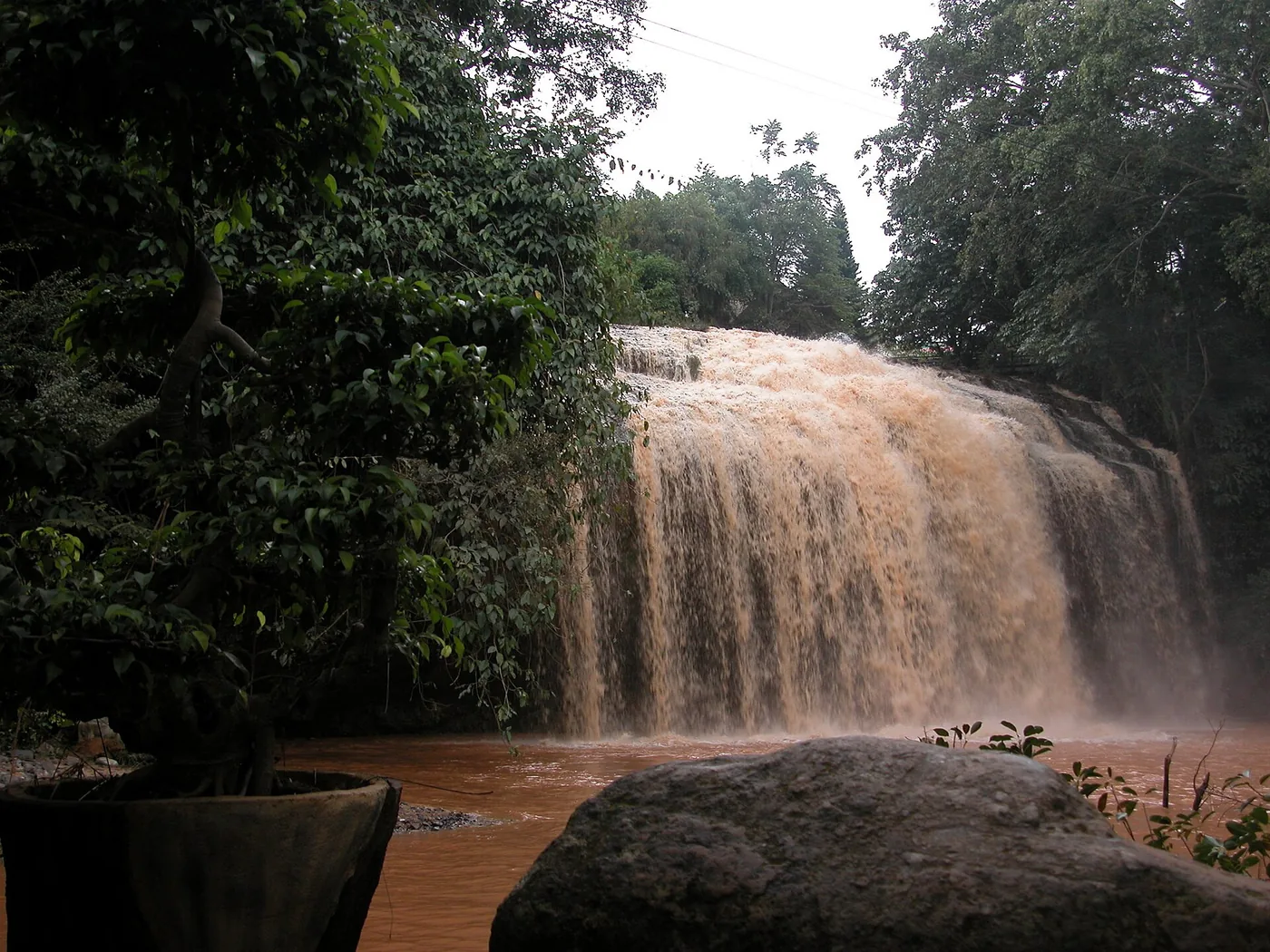
Whether to add Prenn FallsMap is a matter of taste. It is close, but two waterfalls back to back start to blur, and Datanla is the one with somewhere to spend your time.
Lang BiangMap pulls the other way, north through town, and pairs badly with Datanla on the same day. Give it its own morning.
17. What a day at Datanla costs
Everything below is the operator’s published price, and the counter and the booking page agree.
Cost by the kind of day you want
| The day | Adult | Time |
|---|---|---|
| Falls on foot | 80,000 dong | 2 hours |
| Coaster 3 return | 250,000 dong | 2 hours |
| Coaster 3 + high rope | 610,000 dong | half day |
| Zipline + Coaster 3 | 1,050,000 dong | half day |
| Canyoning | 1,886,000 dong | full day |
Photo prints and the zipline video sit on top of those figures. Both are optional and being photographed costs nothing.
Paying
Cash is the safe assumption at the counters. Card acceptance varies by activity. Change money in town rather than at the site; our Vietnam money and currency guide covers where the rates are reasonable.
Booking ahead saves the queue, which matters at weekends and on Vietnamese public holidays when the approach to the Datanla ticket officeMap backs up. Pre-booked tickets are checked at the entrance and nothing more.
For the rest of a Da Lat budget, our guide to where to stay in Da Lat and the Da Lat travel guide fill in accommodation and the other entry fees around town.
🎡Things to Do22
🍜Food3
🏨Where to Stay9
🚇Getting Around4
🧭Travel Tips10
🧭Vietnam-wide essentials116
Datanla Falls: frequently asked questions
No. Entry and the coaster are separate purchases. The one exception is the Coaster 3 return ticket, which has entry built in, so that single ticket is all you need. Coaster 1, one way or return, always requires an entry ticket alongside it.
Coaster 3 is twice the length at 2,400 metres against 1,200. It costs an adult 40,000 dong more than Coaster 1 return plus entry, and a child only 10,000 dong more, so with children it is the obvious choice. Coaster 1 has one advantage: it stops at Waterfall 1, closer to the main drop.
It depends how late. Canyoning departs by 11am at the latest. The high rope course stops accepting people at 2pm and the zipline at 3.30pm. The falls and the coasters run until 4.30pm. Arrive late in the afternoon and those are your options.
The operator asks for no previous experience or specific fitness training and briefs you on the equipment before departure. Cardiovascular and neurological conditions are an exclusion, the trip runs five to six hours, and you are asked to eat breakfast first. Book at least two hours before departure.
Yes, within limits. Small children ride the coaster with an adult and the net playground takes anyone steady on their feet. The high rope course, the zipline and the canyoning all have height minimums that exclude younger children, and the karts start at twelve.
About a kilometre with roughly two hundred steps, so fifteen to twenty minutes down and longer coming back. It is included in the entry ticket at no extra cost. If knees are a consideration, buy the coaster as a return.
Not on its own. The falls and a coaster ride fill about two hours. Truc Lam Monastery and the cable car are both within ten minutes and the three together make a comfortable morning. Canyoning is the exception: that is a whole day.
Landslide repairs have run along the section outside the Datanla entrance, and earlier this year that stretch was closed to traffic. Full closures are uncommon, but when traffic control is in force drivers detour via the Mimosa or Sacom passes, which takes much longer. Ask at your hotel after heavy rain.