
Phu Quoc Airport: arriving, getting out, and how far your hotel really is
Phu Quoc International is small and quick to clear. The island around it is not: the drive to your hotel runs from 10 minutes to 45. Below, in order: where you are staying and what that changes, the visa waiver that covers every passport, the pre-arrival form you have to file before you fly, every way out of the terminal and what it costs, car hire, lounges and the direct routes.
| The airport | Phu Quoc International (PQC), at Duong To in the middle of the island. Domestic and international flights use separate terminals. |
|---|---|
| To your hotel | Long Beach 10 minutes, Duong Dong 15, An Thoi 23, Sunset Town 28, Ong Lang 27, Grand World 40, Ganh Dau 45. |
| Cheapest way out | Grab, from 70,000 dong. The VinBus to Grand World and Sunset Town costs nothing at all. |
| The visa | Phu Quoc waives it for 30 days for every nationality, as long as you fly straight to the island. |
| Before you fly | The pre-arrival declaration is compulsory and free. The form opens 3 days before your flight. |
| Car hire | The one place in Vietnam where driving yourself makes sense. From about US$11 a day, and you need an International Driving Permit. |
| Lounges | Three, all on Priority Pass, all selling entry at the door from US$18. |
1. Phu Quoc Airport: what to know before you land
2. Work out where you are staying before anything else
3. The 30-day waiver: Phu Quoc is its own visa case
4. The pre-arrival declaration you have to file before you fly
5. From the aircraft steps to the kerb
6. Grab: where it works, and where it does not
7. Metered taxis and Green SM
8. The free VinBus, and the ordinary island buses
9. Booking the car before you fly
10. Renting a car and driving yourself
11. Choosing where to stay by the drive from the airport
12. The three lounges and what they cost at the door
13. Which cities fly here without a change
14. Sun PhuQuoc Airways, the island airline
15. The airport itself, briefly
16. Flying out: how early to leave for the airport
17. One more thing: Phu Quoc is in An Giang province now
1. Phu Quoc Airport: what to know before you land
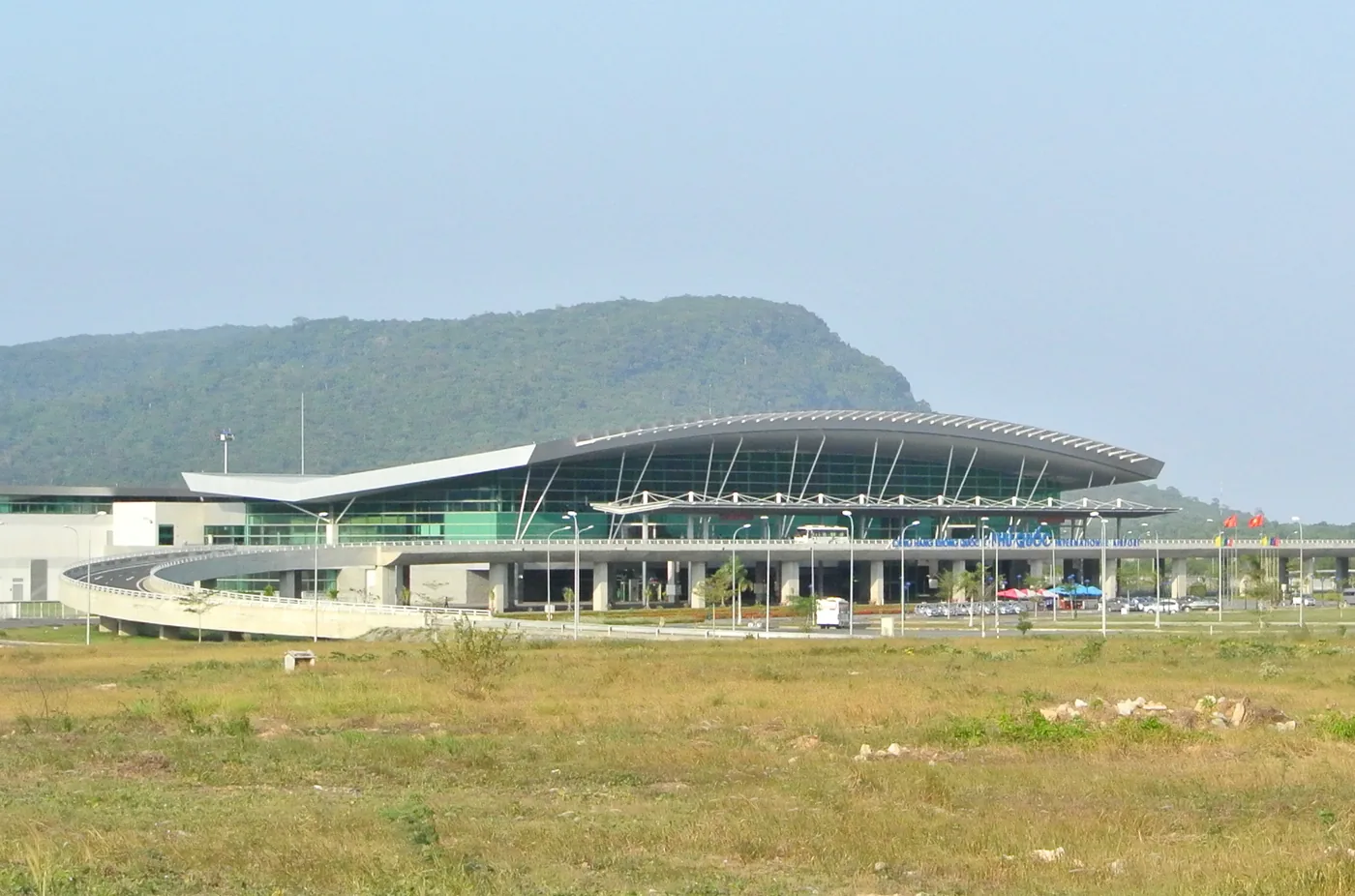
Phu Quoc International AirportMap (PQC) sits at Duong To, in the middle of the island, and the drive to your hotel takes anywhere from 10 minutes to 45 depending on which beach you booked. That spread is the whole of the arrival problem here, and most people discover it at the kerb rather than before they book.
The airport part is easy. It is small, the walk from the aircraft to the baggage belt is short, and there is one road out. What takes the time is the island. Phu Quoc covers 589 square kilometres, the hotels are strung along both coasts, and a car to the far tip takes a bit over four times as long as a car to Long BeachMap, and is priced to match.
Domestic and international flights use separate terminals. They stand next to each other, so this only matters if you are connecting off a Hanoi or Ho Chi Minh City flight onto an international departure, or the other way round. Plan for a walk between two buildings, not a walk between two gates.
Two things to settle before you fly
The first is the pre-arrival declaration. Everyone landing at Phu Quoc on an international flight has to file it. The official portal is free, the form opens 3 days before departure, and if you skip it you will be standing in the arrivals hall filling it in on your phone while the passengers who did it walk past you.
The second is your ride. Grab is quick and cheap around the airport and Duong DongMap. At the northern and southern ends of the island it is slow and sometimes absent, and those ends are exactly where the quieter resorts are.
The visa rule that covers every passport
Phu Quoc waives the visa for 30 days for every nationality, as long as you fly straight to the island. There is no country list and no fee. If your passport normally needs a Vietnamese visa, that sentence is the most useful thing on this page, and there is a full section on it below.
How the rest of this page is ordered
Where you are staying comes first, because every other answer depends on it. Then the paperwork. Then the ways out of the terminal, cheapest first. Then car hire, hotels, lounges, and the flights themselves. The runway lengths and the building work are near the end, which is where they belong. What to do once you have dropped the bags is a different question, and it is answered in the main Phu Quoc guide.
2. Work out where you are staying before anything else
The cost of your ride, the wait for it, and whether a driver will take the job at all follow from one thing: which part of the island your hotel is on. Book the room first, then read the rest of this page with that answer in front of you.
These are driving distances and times from the terminal, measured along the island roads rather than in a straight line. They are free-running times, on a clear road with nothing in the way. On a high-season evening, or on any route that takes you through Duong Dong, add to them.
| Where you are going | Distance | By car |
|---|---|---|
| Long Beach (Bai Truong) resort strip | 6 km | 10 minutes |
| Duong Dong centre | 10 km | 15 minutes |
| Bai Sao | 18 km | 25 minutes |
| An Thoi town | 19 km | 23 minutes |
| Ong Lang | 20 km | 27 minutes |
| Sunset Town and the cable car station | 21 km | 28 minutes |
| Ham Ninh | 25 km | 31 minutes |
| Grand World and Bai Dai | 32 km | 40 minutes |
| Ganh Dau (north-western tip) | 37 km | 45 minutes |
The island splits into three
The middle is the airport, Long Beach and Duong Dong. Everything here is a short hop, and it is where the supply of cars sits. The south is An Thoi townMap and Sunset Town, under half an hour down a good road and the departure point for the boats out to the An Thoi archipelago. The north starts just above the town and runs up the west coast through Cua Can to Ganh DauMap at the tip.
Look at Ong LangMap and An Thoi in the table. Almost the same distance from the terminal, almost the same driving time, and they lie in opposite directions. People book one thinking it is close and the other thinking it is far, and they are wrong both ways.
The north usually means Grand World, not the tip
The word north does a lot of unhelpful work here. Most people who book the north are booking Grand WorldMap and the Bai Dai coast, and that is 40 minutes from the terminal. The 45-minute figure belongs to Ganh Dau, right out at the north-western tip, and far fewer people are staying there.
The difference matters at the booking stage, because the north has picked up a reputation for being remote that only the last few kilometres of it deserve. Grand World is half an hour further out than Long Beach, and that is the whole of the difference.
The east coast is the side nobody plans for. Ham NinhMap is about 31 minutes out, which puts it between Ong Lang and Grand World in driving time while sitting on the opposite shore from almost everything else in the table.
Why Ganh Dau takes as long as it does
Ganh Dau is 37 km out and takes 45 minutes, and the distance is not really the reason. The road from the airport goes north through Duong Dong first, so you cross the busiest few kilometres on the island before the journey proper starts, and then follow the west coast all the way up to the tip.
That routing has a second effect, on price rather than on time. A driver going that far up knows he is unlikely to pick anyone up on the way back, so the fare you are quoted covers his return leg as well as your trip.
A rule of thumb
If your hotel is on Long Beach, in Duong Dong, or anywhere between the two, do not pre-book anything. Walk out and take whatever is at the kerb. If it is north of Ong Lang, at the far southern tip, or if you land late in the evening, arrange the car in advance and stop thinking about it.
🏖️ Long Beach
10 minutes from the airport, and the part of the island where Grab works best.
🏘️ Duong Dong
15 minutes. The working town, and the shortest wait for a car after Long Beach.
🌇 Sunset Town
28 minutes. The cable car station and the evening show are at this end, and the free bus serves it.
🌴 The northern resorts
40 minutes out to Grand World and Bai Dai, and Grab rarely comes that far.
3. The 30-day waiver: Phu Quoc is its own visa case
Phu Quoc exempts visitors of every nationality from the Vietnamese visa for up to 30 days, provided you arrive on the island directly and stay on it. This is the island rule, and it is the reason people on passports that normally need a visa can book a Phu Quoc holiday the same week they think of it.
The condition is the part to read twice. It is a Phu Quoc exemption, not a Vietnam one. Arrive directly, spend your time on the island, fly out again, and you need nothing. Decide halfway through that you want a few days in Ho Chi Minh City and the exemption does not carry you there.
That is worth knowing at the booking stage, because a cheap fare into Ho Chi Minh City with a domestic hop down to the island is not the same trip in immigration terms as a direct international arrival at PQC. The routing decides which rule you are travelling under.
The country-wide exemptions are separate, and longer
Several nationalities already have a visa exemption for the whole of Vietnam, and where one applies it is the better of the two, because it is not tied to the island.
| Passport | What applies |
|---|---|
| Russia | 45 days, anywhere in Vietnam |
| South Korea | 45 days, anywhere in Vietnam |
| Japan | 45 days, anywhere in Vietnam |
| Every nationality | 30 days, Phu Quoc only, arriving directly |
The e-visa, if 30 days on one island is not enough
The e-visa is issued online at evisa.immigration.gov.vn. It is single entry and valid for up to 90 days, and Phu Quoc is one of the listed entry points, so you can use it to land at PQC. Take this route if you want longer than a month, or if the island is one leg of a longer trip through the country.
Apply in good time rather than the night before. It is an online application with a processing period, not a stamp you collect on arrival, and the documents it asks for are worth reading through before you start.
The waiver does not replace the declaration
Whichever of these you are travelling on, you still have to file the pre-arrival declaration. People assume the waiver means there is no paperwork at all, and that assumption is what leaves them typing into a phone in the arrivals hall. The next section is about that form.

4. The pre-arrival declaration you have to file before you fly
Everyone arriving at Phu Quoc on an international flight has to submit a pre-arrival declaration, it is compulsory, and on the official portal it is free. The address is prearrival.immigration.gov.vn. Nothing else is the official site.
The form opens 3 days before your flight. You cannot do it a month in advance, which is the usual reason people forget: it is not something you can tick off when you book. Put a reminder in your phone for the day the check-in email arrives and do both at once.
When you finish, the portal issues a QR code. Screenshot it. Do not rely on being able to open an email at the immigration desk, because a phone that has just come off flight mode in a building full of arriving passengers is not a phone you want to be depending on.
What the form asks for
- Your passport, with at least 6 months of validity left on it
- Your flight details
- The address of where you are staying in Vietnam
- An email address that works
The accommodation address is the one that catches people out. Have the hotel name and its full street address saved somewhere you can copy from, rather than trying to remember it while a form times out.
- Three days before the flight, open the official portal.
- Enter your passport details, your flight and the address you are staying at in Vietnam.
- Submit the form and wait for the QR code to come back.
- Screenshot the QR code, so it is on your phone whether or not you have a signal.
- Show it at passport control when you land.
Do not pay anyone for this
There are sites that will file the declaration for you and charge for the service. They are not required, they are not official, and some of them are designed to look as though they are. The government portal costs nothing, the form is in English, and it takes a few minutes. If a page is asking for a card number to submit a free declaration, you are on the wrong page.
If you forget
It is not a disaster. You fill it in on your phone after landing, before you can join the immigration queue. The cost is time, at the one point in the journey where everyone around you is moving and you are not. When several flights have landed together, that can be a long wait on your feet.
It is separate from your visa position
The declaration and the visa are two different things. The 30-day island waiver does not exempt you from the form, and neither does a 45-day national exemption or an e-visa. Everyone files it.
5. From the aircraft steps to the kerb
Clearing PQC is short: immigration, bags, one door. There is no train between concourses and no long connector to walk, which is the compensation for an airport that cannot do everything a big one does.
Have three things in your hand before you leave the aircraft: passport, the declaration QR, and the address of your hotel. That is the whole arrival kit. Everything else can stay in the bag.
Immigration is where the QR gets scanned. If you filed the declaration properly this is quick. If you did not, this is where you stop and do it. Queues here are driven by how many aircraft landed in the same half hour rather than by how many desks are open, so two flights arriving together makes more difference than anything you can control.
Check which building you are in
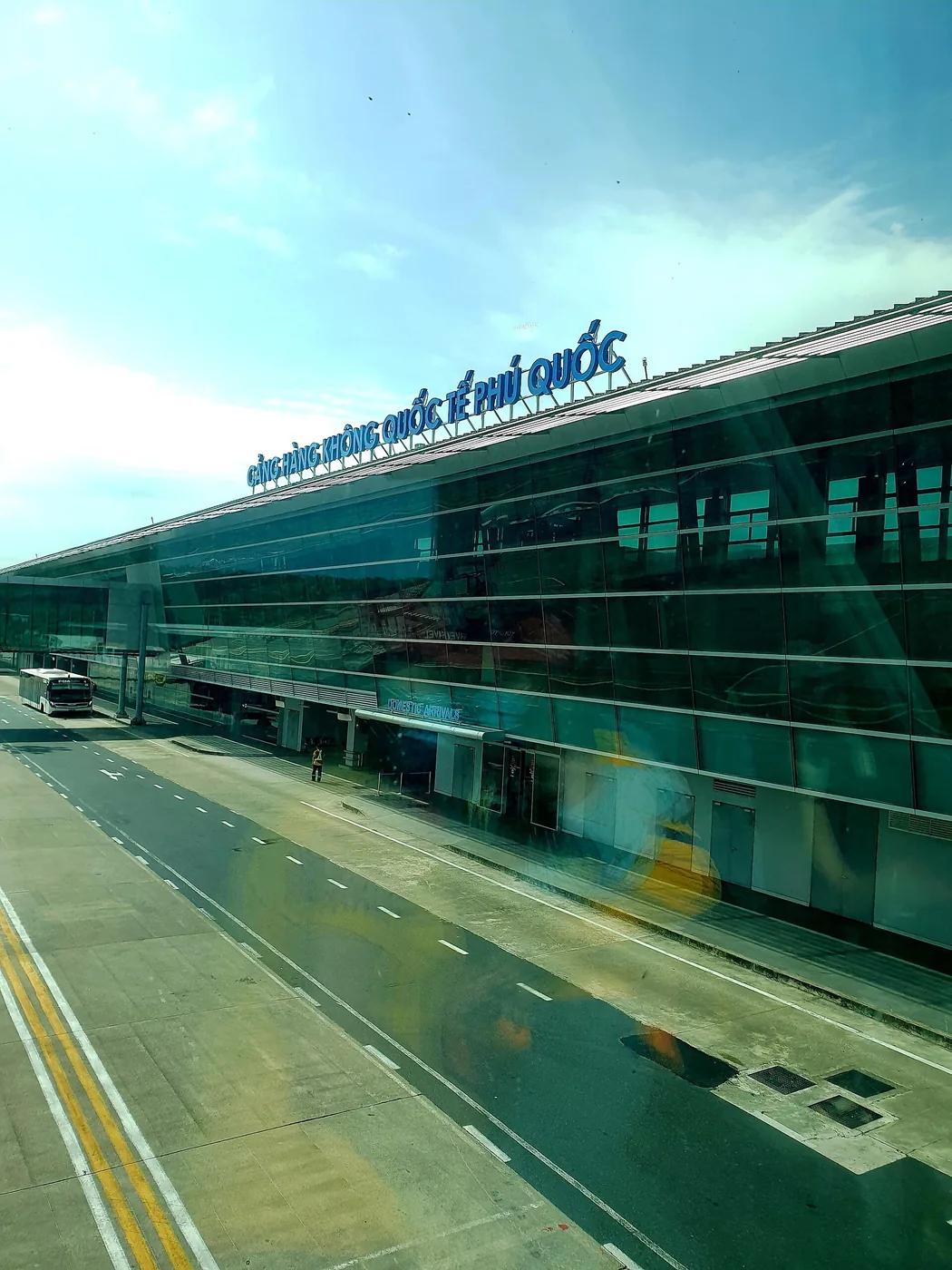
Domestic and international arrivals are separate terminals, and the signage on the frontage tells you which one you have come out of. It matters when someone is meeting you, because a driver waiting outside the wrong building is a driver you will not find. If you have booked a transfer, the confirmation will name a meeting point. Read it before you walk.
What is waiting outside
Once you are through the door you have the usual set: taxis at the rank, drivers holding names for pre-booked cars, the bus stop, and whatever your ride-hailing app can see. The section below goes through each of these and what they cost, because the gap between the cheapest and the most expensive way to reach the same hotel is wide.
Ignore anyone who approaches you inside the building offering a car. The legitimate options are all outside at the kerb, on a rank, or holding a printed name.
Have the hotel address written down in Vietnamese
Ride-hailing apps handle this for you, because you pick the destination from a map. A metered taxi does not. Resort names on the northern and southern coasts are long, several of them sound alike, and the driver may know the place by the road rather than the brand. A screenshot of the address, in Vietnamese, settles it in one gesture.
6. Grab: where it works, and where it does not
Grab is the cheapest sensible way out of the airport, at roughly 70,000 to 200,000 dong depending on how far you are going. The low end of that is the run to Long Beach. The high end is the top or the bottom of the island.
The app works the way it does everywhere else in Vietnam: you set the destination, the fare is fixed before you accept, and you pay in cash or by card in the app. Nothing is negotiated and nothing is metered, which removes the one part of arriving somewhere new that people dislike most.
What is different on Phu Quoc is supply. The drivers are concentrated around the airport, Duong Dong and Long Beach, because that is where the work is. Order a car for that middle stretch and one turns up in 5 to 10 minutes.
Where the app runs out of cars
Head north or south and the picture changes. Waits of 15 to 20 minutes are normal at the two ends of the island, and at quiet hours a request can sit there and find nobody at all. Drivers see a long job with no fare on the way back and decline it.
This is not an occasional glitch. If your hotel is at Ganh Dau or right at the southern tip, plan on the assumption that Grab may not come, and treat it as a bonus if it does.
Ordering it before you walk out
Get connected before you leave the building. An eSIM activated before you fly is the simplest way to manage that, and it means you can put the request in as the belt starts rather than after you have walked out into the heat with a suitcase. Those few minutes are the difference between walking straight to a car and standing at the kerb watching other people leave.
Going the other way
Grab is also the cheap way back to the airport, with the same catch in reverse and worse. From the north or the south, at six in the morning, the app is the least reliable it ever gets. For an early departure from either end of the island, book a car the night before through your hotel or a transfer service.
7. Metered taxis and Green SM
A metered taxi from the airport runs to about 180,000 to 250,000 dong for the ordinary runs, so you are paying a premium over Grab for the convenience of not opening an app. For a family with luggage arriving at an awkward hour, that is often a fair trade.
The taxi rank is outside the terminal and there is no hunting involved. The companies you will see are Mai Linh, Vinasun, Phu Quoc Taxi and Saigon Taxi. These are the established operators, they use meters, and the cars are liveried and numbered.
The rule is the same as anywhere in Vietnam: use the rank, and check the meter is running when you pull away. If a driver wants to agree a flat price instead, that is not automatically a scam, but you should know what the metered fare would have been before you say yes. The range above is what you are measuring against.
Green SM
Green SM runs VinFast electric cars and has been operating on Phu Quoc for a few years now. The cars are new, quiet and air-conditioned to a standard that matters more than it sounds after a long flight, and the app carries a dedicated airport package as well as ordinary point-to-point fares.
Prices sit between Grab and the metered taxis in practice, and the fleet is more consistent than either. The cars are green and hard to miss at the rank, and you can order one in the app the way you would a Grab.
Which to take
If you are going somewhere in the middle of the island and you have a working data connection, Grab is cheaper and there is no reason not to use it. If you are tired, travelling with children, or heading somewhere your app cannot find a car for, take what is on the rank and stop optimising. The difference between the cheapest and the most expensive option here is smaller than the price of one dinner.
8. The free VinBus, and the ordinary island buses
There is a bus from the airport that costs nothing. VinBus runs an electric shuttle to Phu Quoc United Center, the resort complex at the southern end that contains Grand World and Sunset Town, and passengers are not charged for it.
That is a genuinely useful piece of information for a specific group of people and no use at all to everyone else. If you have booked one of the hotels inside that complex, you can get from the terminal to your accommodation for nothing, in a modern air-conditioned bus, on a route that exists precisely to carry you. If you have booked anywhere else, it does not go there.
The catch is what a free service always costs, which is flexibility. It runs to its own timetable rather than yours, and with luggage and a long flight behind you, waiting for a departure can undo the saving in a way that feels worse than the money.
The ordinary buses
Phu Quoc also has conventional public buses, with fares in the 15,000 to 40,000 dong range. They serve the island rather than the airport specifically, they are not built around arriving passengers, and luggage space is whatever is left.
They are a reasonable way to move around once you are settled and travelling light. As a way of getting from a late-night arrival to a hotel on the far coast with two suitcases, they are not. Most visitors use them for a day out, not for the transfer.
Who should actually take the bus
Take the VinBus if you are staying at the United Center, travelling light, and not landing at an unsociable hour. Take the public buses later in your trip if you want to get somewhere cheaply and are not in a hurry. In every other case the 70,000 dong for a Grab buys back an hour of your first day, and the first day is the one people remember.
9. Booking the car before you fly
A pre-booked transfer costs roughly US$14 to US$76 depending on the distance and the size of the vehicle, which is more than a Grab and less than most people expect. Klook and KKday both sell them for Phu Quoc, and Kiwitaxi sits in the middle of the range at around US$40 to US$60.
What you are buying is not transport. Transport is available at the kerb for less. What you are buying is certainty: a named driver, a fixed price agreed in your own currency before you left home, and a person standing in arrivals with your name on a board whatever time the flight actually gets in.
The price spread across that range is mostly distance and vehicle. A car to Long Beach is at the bottom. A seven-seater to Ganh Dau at midnight is at the top. If you compare a quote against the Grab range in the earlier section, you can see exactly what the certainty is costing you on your particular route.
When it is worth it
It is worth it when the app is unreliable, which on this island means the far north and the far south. It is worth it for a late arrival, when the pool of drivers thins out. It is worth it with small children, when standing at the kerb is not a neutral activity. And it is worth it if this is your first time in Vietnam and you would rather spend the first hour looking out of a window than solving a problem.
When it is not
If you land in daylight and your hotel is on Long Beach or in Duong Dong, pre-booking is money spent on a problem you do not have. Cars are plentiful, the drive is 10 to 15 minutes, and the app will have one with you before you have finished putting your passport away.
What to check before you pay
Confirm three things. That the vehicle takes your actual luggage, not your hypothetical luggage. That the meeting point names the correct terminal, because international and domestic arrivals are separate buildings. And that the booking has a free cancellation window, because flight times move and yours might.
Also check the waiting time included after landing. A transfer that only holds the driver for 30 minutes after the scheduled arrival is thin cover for a flight that is delayed and then meets a full immigration hall.
10. Renting a car and driving yourself
Phu Quoc is the one place in Vietnam where hiring a car and driving it yourself is a sensible idea. Rates start from around US$11 a day through Localrent, which is less than two airport transfers.
On the mainland the normal arrangement is a car with a driver, and there are good reasons for that. Traffic in Ho Chi Minh City and Hanoi is a skill rather than a set of rules, parking is a negotiation, and a foreign driver adds risk without adding much freedom.
The island is a different problem. There is essentially one road running the length of it, traffic is light, and you can count the traffic lights. Add in a coastline where the things worth seeing are 20 or 30 km apart and a taxi ride to each one adds up fast, and the case for a car makes itself.
You need an International Driving Permit
This is not optional and it is not a formality. Your home licence alone does not entitle you to drive in Vietnam. The IDP is issued in your own country before you travel, usually by the national motoring organisation, and it has to be carried together with the licence it is based on.
Get it at home. It cannot be arranged on the island, rental firms can ask for it, and it is the document that matters if anything goes wrong with the car while you have it.
What driving here is actually like
Slower than you expect and easier than you fear. The main road is in good condition for most of its length, the surface deteriorates towards Ganh Dau and around the building sites, and the traffic you share it with is mostly motorbikes that will pass you on both sides without warning.
Drive as though anything might come out of a side turning, because it might. At night the northern stretches are unlit and there is no pavement, so people and bikes appear at the edge of your headlights. Plan to do the long drives in daylight.
Picking the car up
Some companies deliver to the airport and some want you to collect in Duong Dong, which changes the shape of your first day. If the plan was to drive straight from the terminal to VinWonders, that difference matters. Check the fuel policy, photograph the car from every angle before you drive it, and make sure you know what the insurance actually covers. A scratch on a hire car is a conversation you want to have with photographs rather than from memory.
11. Choosing where to stay by the drive from the airport
On an island where hotels can be 45 minutes apart, the distance from the terminal is a genuine feature of the room you are booking, not a detail. Here is what each area costs you in driving time, and what you get in return.
None of these is the right answer. A first visit and a fifth visit want different things, and so do a week and a weekend. What follows is the trade in driving time, and what each area is actually like to stay in is a separate question with its own page.
Long Beach, 10 minutes
The closest and the busiest. A long west-facing strip with the widest range of hotels on the island, restaurants you can walk to, and a sunset every evening that you do not have to drive anywhere to see. Cars are abundant, so getting in and out is never a planning exercise.
The trade is that it is developed and it is not quiet. If the picture in your head is an empty beach, this is not it.
Duong Dong, 15 minutes
The town. Working fishing boats, restaurants aimed at people who live here, and prices to match. The night marketMap runs in the evening, and Dinh CauMap stands on the rocks at the river mouth, so there is somewhere to walk to after dinner. Good if you want a place with a life of its own around your hotel, and you do not mind that the swimming is better elsewhere.
Ong Lang, 27 minutes
North of the town, and quieter by a wide margin. Smaller properties, more space between them, and beaches without much on them. It looks close on a map and it is close to half an hour in the car, so budget for the fact that going out to dinner is a decision rather than a stroll.
An Thoi and Sunset Town, 23 to 28 minutes
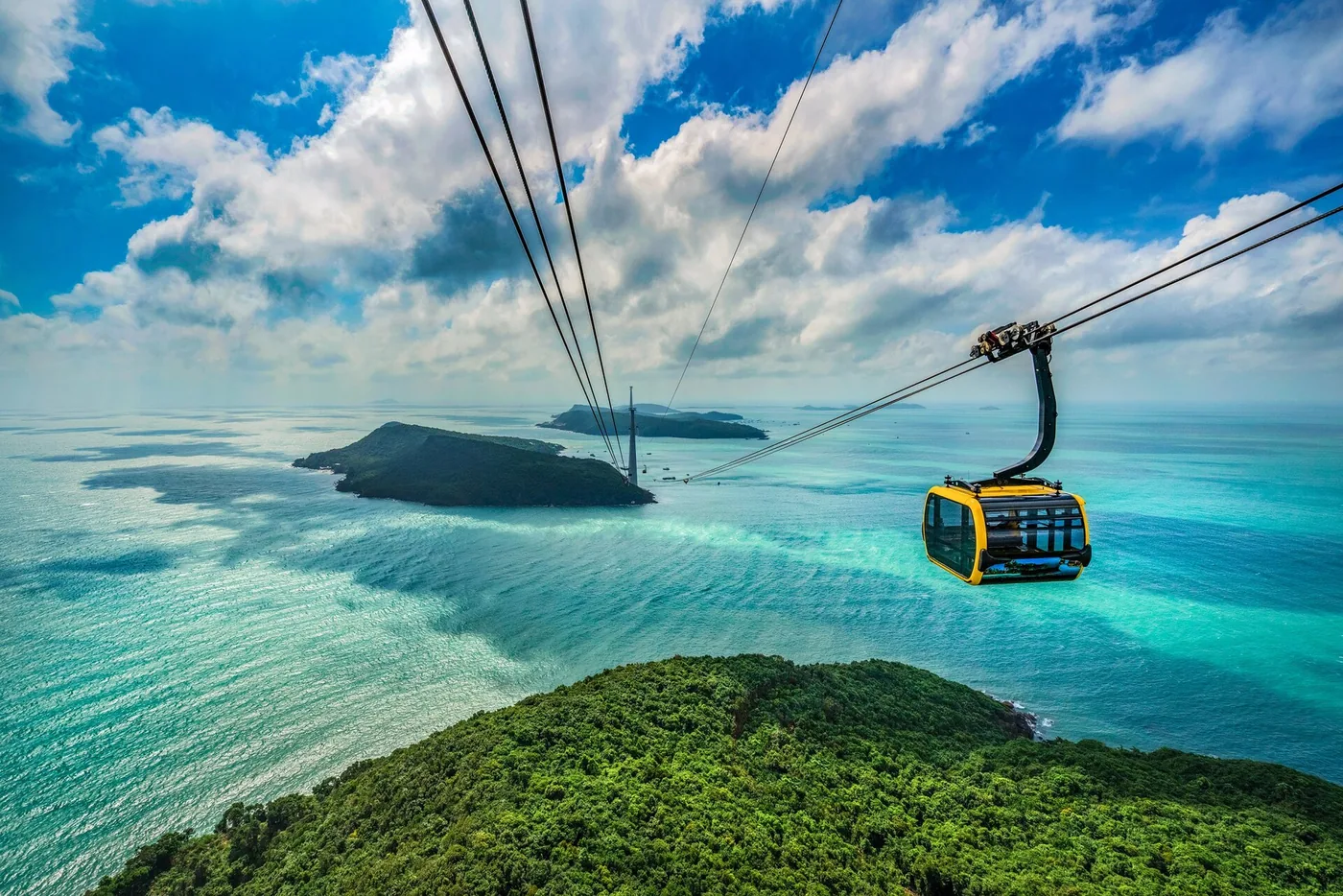
The southern end, and the most built. Kiss Bridge, the evening show, the cable car out to Hon ThomMap, and the ferries to the islands off the southern tip all sit within a few minutes of each other. If your trip is built around those, staying here removes an hour of driving from every day.
Bai SaoMap, over on the eastern side, is 25 minutes from the terminal and closer still to An Thoi. A room at this end puts the best known beach on the island within an easy drive rather than a day out.
It is also the end of the island the free VinBus serves, which is a real saving on a family arrival.
Grand World and Bai Dai, 40 minutes
This is what most people mean when they say they are staying in the north. A run of large resorts along the Bai Dai coast with an entertainment complex attached, and the free airport bus serves this end of the island.
Forty minutes each way is a real cost on a short trip, and it is far enough that you will not be going back to the room between things. On a week, with a car, it barely registers.
Ganh Dau, 45 minutes
The north-western tip, past everything else. The transfer is the most expensive on the island in both directions and ride-hailing apps are least dependable here. In exchange you get the emptiest coast and the sense of having actually gone somewhere.
Book this end with your eyes open. Arrange the car in advance, both ways, and treat the resort as the destination rather than as a base for exploring. If the safari park is on your list, work out where it sits relative to your hotel before you book rather than after.
12. The three lounges and what they cost at the door
PQC has three lounges, all of them on Priority Pass, and all three sell entry at the door to anyone who wants to pay. You do not need a business class ticket or a card, and walk-in prices start at US$18.
That matters more at a small airport than at a large one. There is not much landside, the seating in the departure hall is rows of chairs, and there is nowhere else to disappear to if you are 3 hours early because the only car you could get left at a particular time.
| Lounge | Terminal | Walk-in from |
|---|---|---|
| The SENS Leisure Lounge | International | US$29 |
| SH Premium Lounge 1 | Domestic | US$18 |
| SH Premium Lounge 2 | Domestic | US$21 |
In the international terminal
The SENS Leisure Lounge is the international one, and there are two conditions attached to it. It is for departing international passengers only, and a walk-in entry covers you for up to 3 hours. For a flight to Seoul or Singapore with a long wait behind it, that window is usually enough. For a much longer wait, check the clock before you pay.
In the domestic terminal
SH Premium Lounge 1 and SH Premium Lounge 2 are both in the domestic building, at US$18 and US$21 respectively. The gap between them is small enough that most people simply take whichever is nearer their gate. They are the ones to use when you are connecting off an international arrival onto a Hanoi or Ho Chi Minh City flight and have time to fill.
Children
One child under 5 goes in free with each adult. From 5 to 12 a child ticket is required. Two adults with a toddler each therefore pay for two entries, while two adults with a 7-year-old pay for three.
Priority Pass
All three lounges are in the Priority Pass network, so a card that came with your bank account or credit card may well cover this airport. Check the app before you pay at the door, because that is the sort of benefit people carry for years without using.

13. Which cities fly here without a change
Phu Quoc has direct international flights from Seoul, Busan, Taipei, Taichung, Kaohsiung, Bangkok and Singapore, plus a large charter programme from Russia in winter. Everyone else connects, usually through Hanoi or Ho Chi Minh City.
The list has grown quickly, which is worth knowing because it means route information more than a season old is unreliable. Airlines have added Phu Quoc, dropped it, and added it again, and the island now has an airline of its own flying some of these routes. Schedules also thicken and thin with the time of year you travel.
| From | Airlines |
|---|---|
| Seoul Incheon | Korean Air, Eastar Jet, Jeju Air, T'way, Sun PhuQuoc Airways |
| Busan | Sun PhuQuoc Airways |
| Taipei Taoyuan and Taichung | STARLUX, VietJet |
| Kaohsiung | Sun PhuQuoc Airways |
| Bangkok | Thai AirAsia, Thai VietJet |
| Singapore Changi | Scoot, VietJet, Sun PhuQuoc Airways |
Nothing from Japan
There is no direct flight from Japan to Phu Quoc. Travellers from Tokyo or Osaka connect through Hanoi, Ho Chi Minh City, Taipei or Bangkok. That is a real cost in a short holiday, and it is the single biggest gap in the route map.
The Taipei and Bangkok connections are often the better of the four, because both have direct services onwards to the island and neither requires a domestic transfer inside Vietnam. If the extra leg is what puts you off, weigh the island against what Da Nang offers instead before you commit.
The charters from Russia
In winter Phu Quoc takes charter flights from a long list of Russian cities, not just Moscow: Barnaul, Blagoveshchensk, Vladivostok, Yekaterinburg, Irkutsk, Kazan, Krasnoyarsk, Novokuznetsk, Novosibirsk, Samara, Ufa and Khabarovsk all appear on it. The flights are sold as packages by tour operators including FUN&SUN, Anex, Intourist, PEGAS and Coral Travel, and flown by AZUR air, VietJet, Ikar and Sun PhuQuoc Airways.
Aeroflot also serves the island from Sheremetyevo. Do not plan around any specific city until the season is confirmed, because the programme is rebuilt every year and cities come and go.
Connecting through Hanoi or Ho Chi Minh City
If you connect onto a domestic flight, remember that Phu Quoc puts domestic and international arrivals in different buildings. Allow more time than a same-terminal connection would need, and check whether your bags are tagged through or whether you are collecting them and checking in again. The stop is also an opportunity: a few days in Ho Chi Minh City at one end of the trip turns a beach week into a wider run through the south of the country.
14. Sun PhuQuoc Airways, the island airline
Sun PhuQuoc Airways is Vietnam's first airline built purely around leisure travel, and its name tells you where it is based. It belongs to Sun Group, which is also behind Sunset Town, the cable car and the airport expansion.
Its flights carry the prefix 9G. The first commercial service, 9G1203, flew from Noi Bai in Hanoi down to Phu Quoc with an A321 seating 220 passengers, which is a fair description of the whole operation: a mainstream narrow-body fleet pointed at holiday destinations rather than business routes.
Domestically it links Phu Quoc with Hanoi and with Ho Chi Minh City, and it also flies between Hanoi and Ho Chi Minh City. Internationally it serves Taipei, Seoul, Busan, Kaohsiung and Singapore.
Why it matters to your booking
Look at that international list against the route table above and you can see what the airline has changed. Busan and Kaohsiung reach Phu Quoc directly because this airline flies them. On Seoul, Taipei and Singapore it is one more operator on a route that already existed, which in practice means more seats and more competitive fares.
For anyone in Korea or Taiwan, this is the difference between a direct flight and a connection through Ho Chi Minh City with a domestic leg on the end of it.
What to expect from it
It is a young airline with a small fleet, which cuts both ways. The aircraft are new. The network is thin enough that a cancellation has fewer alternatives behind it, so if your trip has no slack in it, consider whether the connecting option on a larger carrier is worth the extra hours.
Booking works the way it does with any Vietnamese carrier: fares are low, baggage is extra, and the difference between the headline price and what you actually pay depends on how much you are carrying.
15. The airport itself, briefly
Phu Quoc International has two runways and is being rebuilt around them. The specifications matter to you only through their consequences, so here they are quickly.
The first runway, 10R/28L, is 3,000 m of asphalt. The second, 10L/28R, is 3,300 m of concrete. Between them they let the airport take an A350 or a B747, and the field is being upgraded towards ICAO code 4E, the category that covers the large wide-bodies.
The practical consequence is straightforward: Phu Quoc can accept long-haul aircraft. An island that can only take narrow-bodies stays a regional destination forever, and the runway is the reason the charter operators can put wide-bodies onto it from the far side of Russia.
The building work
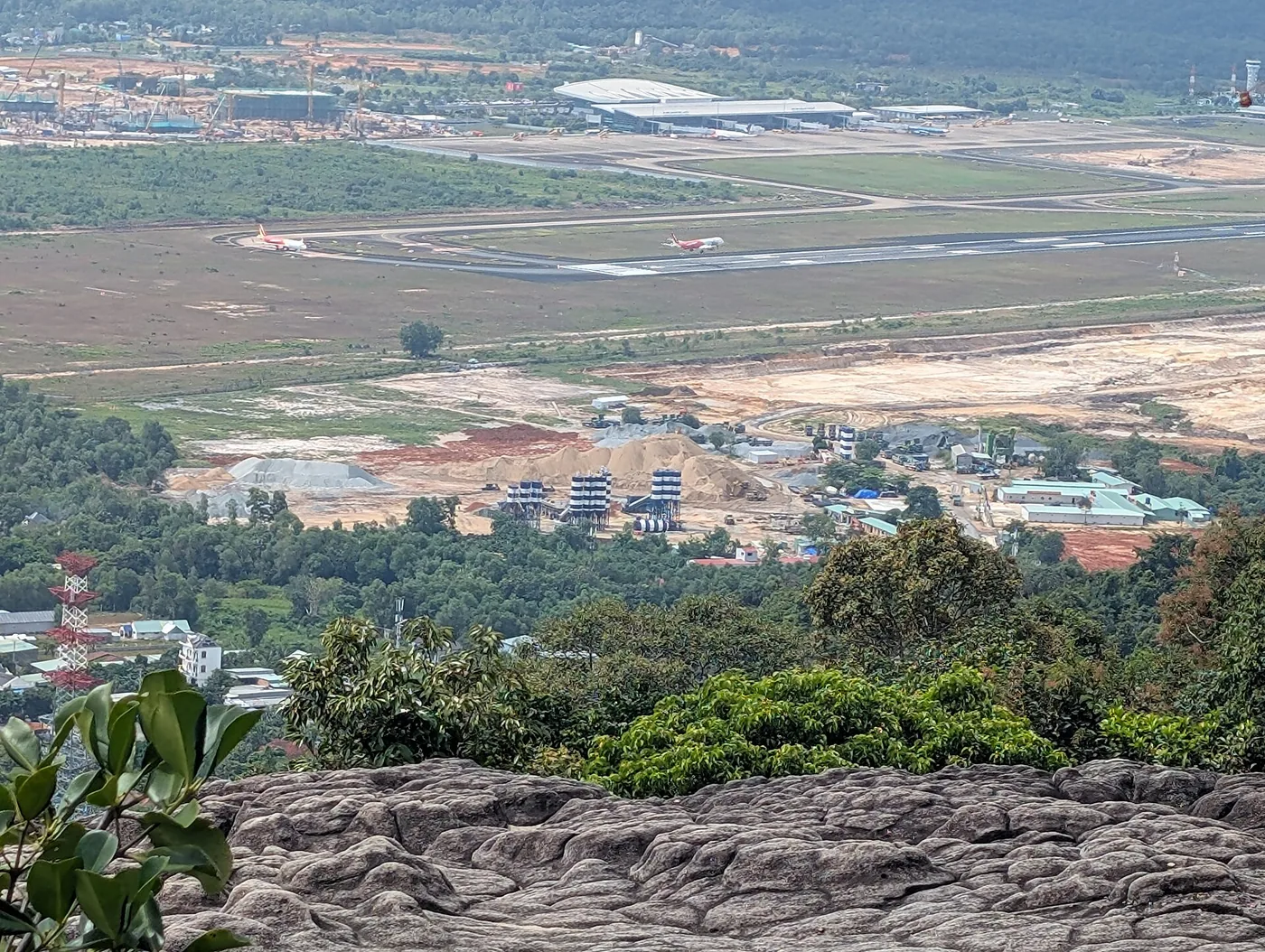
Sun Group is developing the airport together with Changi Airports International, the overseas arm of the Singapore operator. The plan adds a second terminal, T2, and a separate VVIP terminal, ahead of the APEC summit the island is due to host.
That is why an aerial photograph of PQC shows cranes and sand as prominently as it shows aircraft. A large construction site sits alongside the working airport, and it will be there for a while.
What that means while you are travelling through it
Building work moves things. Kerbside pick-up points, the walk between the two terminals, and where the taxi rank sits are all things that can be different from what a guide written a year ago describes.
So read the signs rather than your memory, and if you are meeting someone, agree a landmark inside the building rather than a spot on the forecourt. Add a few minutes to whatever you had budgeted for the walk.
Why it is being expanded at all
Passenger numbers here have grown a great deal in a short time, and the terminal that exists was not built for the traffic it now handles. Add an international summit and an island being developed hard at both ends, and the expansion is the obvious answer. For a visitor it means a few years of construction followed by a much larger airport.
16. Flying out: how early to leave for the airport
Work backwards from the drive, not from the flight. At PQC the terminal is the short part of a departure and the road is the long one, which is the reverse of what most travellers are used to.
Take the driving time from the table near the top of this page, add a margin for a high-season evening or for the stretch through Duong Dong, and then add whatever your airline asks for at check-in. From Long Beach that arithmetic is comfortable. From the far north on an international departure it means an early start.
International check-in closes well before departure, and it closes on time. An airport this size has no capacity to absorb a passenger who arrives late, and there is no second flight an hour behind yours to be moved onto.
Book the car the night before
This is the part people get wrong in the other direction. Grab is easy at the airport because that is where drivers wait. Grab at seven in the morning at a resort 30 km up the coast is a different proposition, and a car that never comes is a flight that is missed.
Ask the hotel to arrange it, or book a transfer. Either way, settle it the night before rather than over breakfast.
Check which building
Departures are split the same way arrivals are. A domestic hop to Ho Chi Minh City and an international flight to Singapore leave from different terminals, so tell the driver which one you want rather than saying the airport and hoping.
If you end up there early
This is exactly what the lounges are for, and why the walk-in prices in the earlier section are useful. If your only practical car left at an awkward hour, US$18 to US$29 buys somewhere to sit, air conditioning, wi-fi and food for the wait. On a day that started with a long drive that is money well spent.
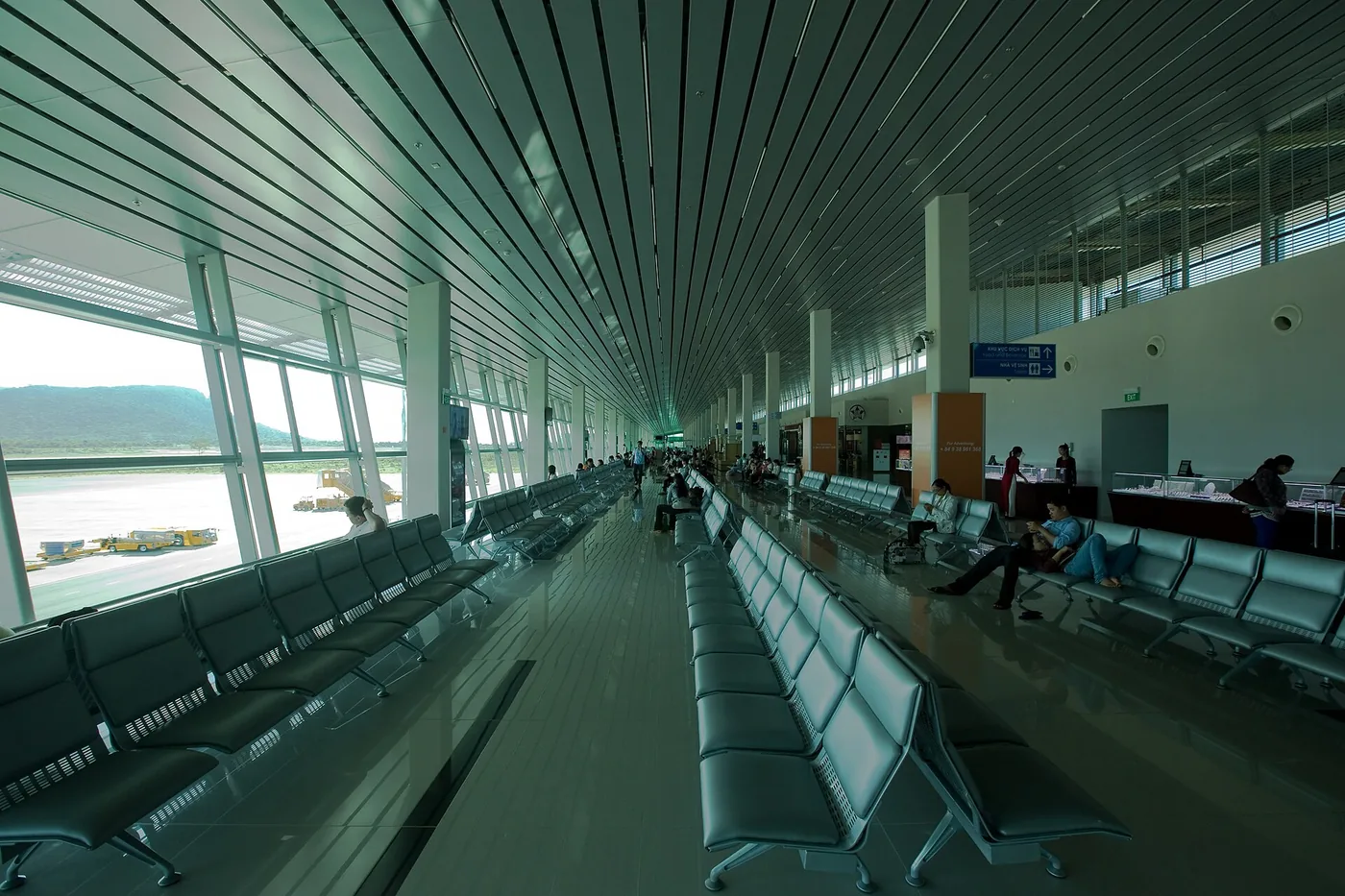
The alternative is the departure hall, which is rows of seats and a glass wall. It is perfectly civilised for 40 minutes and a long time for 3 hours.
17. One more thing: Phu Quoc is in An Giang province now
Phu Quoc is a special zone within An Giang province. It used to be part of Kien Giang, and Kien Giang no longer exists as a separate province: it was merged into An Giang.
This is recent enough that a great deal of published material has not caught up. Guidebooks, hotel listings, booking confirmations and official-looking forms still say Kien Giang, and you may well see both names in the same week.
It changes nothing about your trip except what you write down. If a form asks for the province, An Giang is the current answer, and if a booking still shows Kien Giang it is out of date rather than wrong about the location.
The names on addresses
The island covers 589 square kilometres and is divided into two wards, Duong Dong and An Thoi, and six communes: Duong To, Ham Ninh, Cua Duong, Bai Thom, Ganh Dau and Cua Can. The airport is in Duong To, which is why some addresses and taxi apps show that name rather than Duong Dong.
You will see these names on road signs and in hotel addresses, and they are more useful for navigation than resort names are. A driver who has never heard of your hotel will know which commune it is in.
Why it is worth 30 seconds of your attention
Mainly because of the pre-arrival declaration. That form wants the address of where you are staying in Vietnam, and copying the address off the hotel booking is the quickest way to fill it in correctly. If the booking uses the old province name, the hotel is still in the same place and the form will not object, but it is better to know which is which than to wonder at the desk. Everything past the airport, from drive times across the island to what a day here actually costs, sits in the full island guide.