
Da Nang Solo: Bike Taxi Fares, Where One Person Can Eat, Which Area to Sleep In and a Three-Day Timetable
A lot of what Da Nang sells is priced per person. Transport, food and rooms are sorted on that basis here, with a three-day timetable at the end.
| Getting around | A bike taxi carries one passenger, so the same trip costs roughly half what a car costs. |
|---|---|
| Buses | City bus 01 to Hoi An runs 05:30 to 18:00 every 20 minutes and costs 8,000 to 15,000 dong by section. |
| Eating | Mi quang and bun cha ca arrive as single bowls, while banh xeo and seafood are laid out for two or more. |
| Beach | Lifeguards are on duty from 04:30 to 19:00, and only two stretches stay open for swimming after that. |
| Rooms | A hotel room costs the same whether one or two people sleep in it, so a dorm or a small hotel goes further. |
| Evenings | The Dragon Bridge breathes fire on Friday, Saturday and Sunday nights and on public holidays, at 21:00. |
1. What one person can actually buy here
2. The bike taxi is the one you can only use alone
3. Bus 01 to Hoi An stops running at 18:00
4. Airport to hotel on the day you land
5. Cars and boats are priced whole, so one person pays it all
6. Start with the food that comes in one bowl
7. Banh xeo and seafood arrive sized for two
8. Cafes are built for sitting alone
9. Where to go in the heat and when it rains
10. Sleeping in An Thuong, My Khe or by Han Market
11. Mornings on the beach: sunrise and lifeguard hours
12. Two stretches stay open for night swimming
13. Evenings: the Dragon Bridge and two night markets
14. Easy to book for one: massage, cooking classes, lessons
15. The Marble Mountains open at 07:00 and close at 17:00
16. Son Tra: sort the ride back before you go up
17. Renting a scooter: permits and the helmet fine
18. Hoi An and Ba Na Hills work seat by seat
19. Bags, valuables and moving around at night
20. A three-day timetable and what a day costs
1. What one person can actually buy here
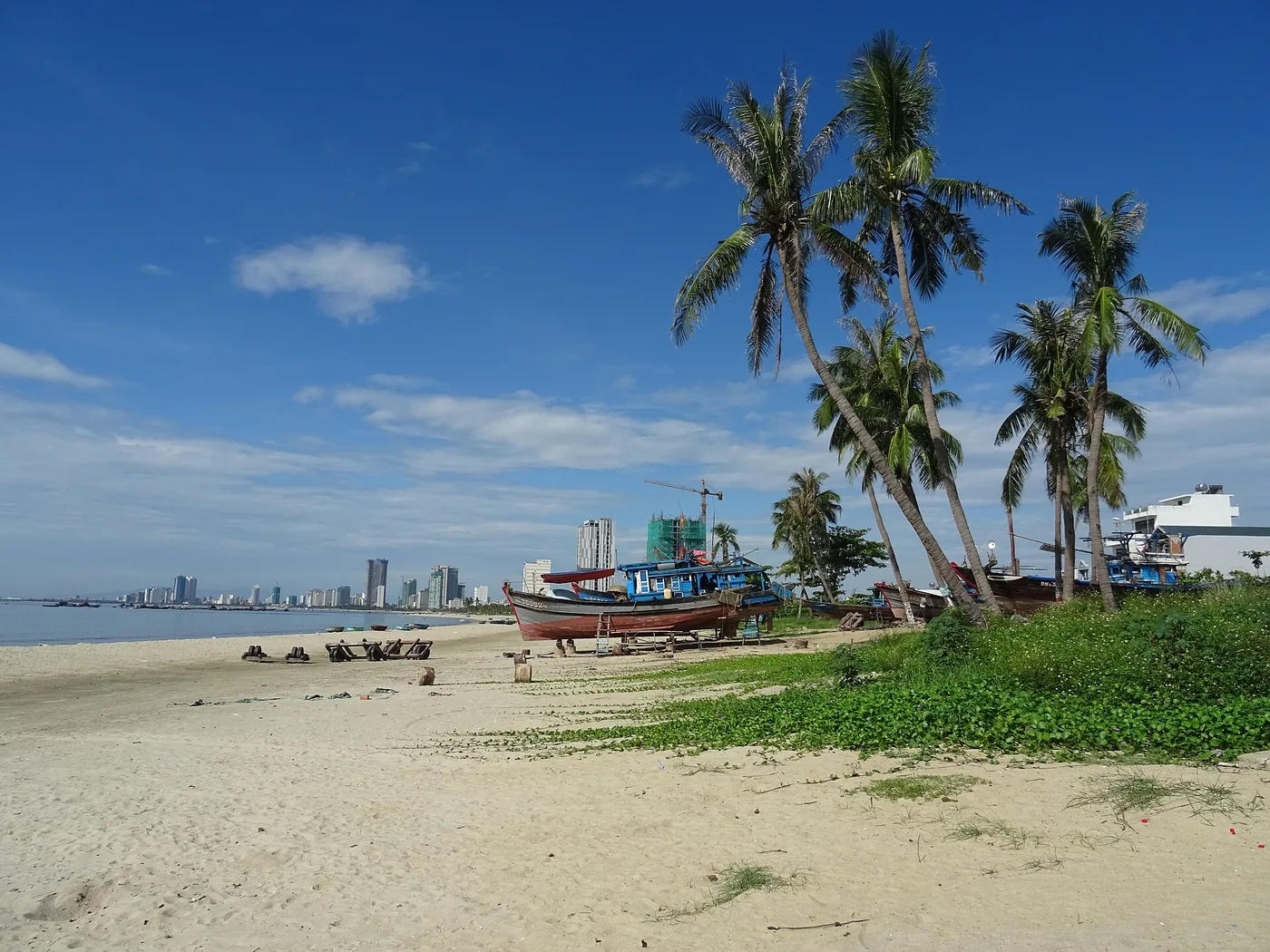
Most of what Da Nang sells is priced per person. A bike taxi carries one rider anyway, noodles arrive one bowl at a time, and massages and classes are counted by head. Very little drops off the list because nobody came with you.
A car with a driver and a boat are priced by the vehicle rather than by the passenger. Avoid both, or swap them for a joined group trip that sells seats, and the arithmetic stays simple. The table is that split.
| What | How it is priced | Travelling alone |
|---|---|---|
| Bike taxi | per person | about half a car fare |
| City bus 01 | per seat | 8,000–15,000 dong |
| A bowl of noodles | per bowl | 25,000–50,000 dong |
| Massage, cooking class | per person | headcount makes no difference |
| Marble Mountains entry | per person | 40,000 dong |
| Hotel room | per room | two people pay the same |
| Car with driver | per car | US$40–80 a day, all of it |
| Seafood | by weight | sold by the kilo, easy to leave half |
The shape of the city does half the work
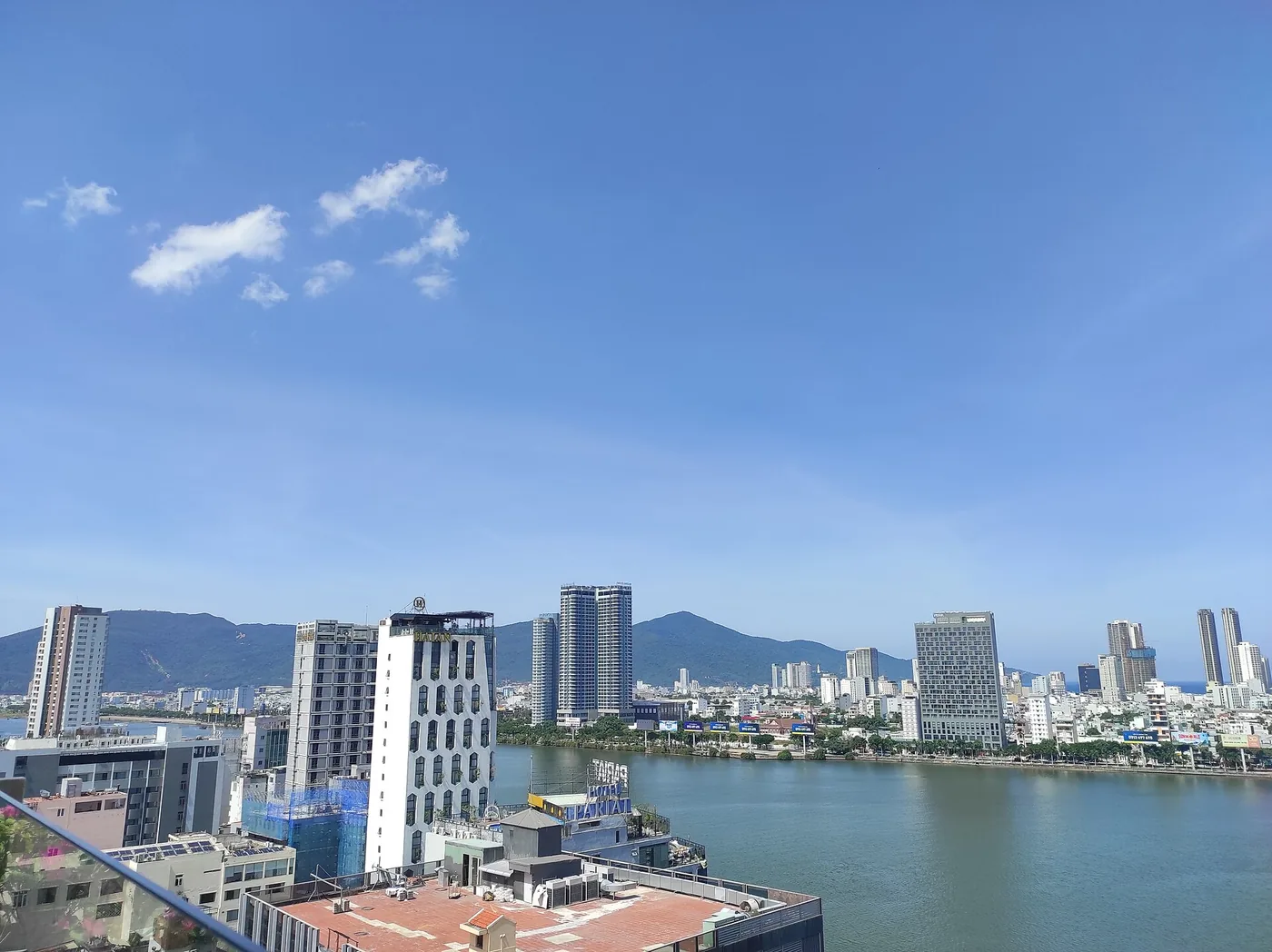
Da Nang sits either side of the Han River, city on the west bank and beach on the east. Several bridges cross it, so wherever you sleep the other side is five to fifteen minutes away. The beach road runs north to south for miles, and people walk it morning and evening.
That means the number of rides you have to book is small to begin with. Early mornings on the sand and evenings on the promenade are walkable, and you only call a bike or a car for the Marble Mountains and Son Tra.
What to settle first
Transport first, then food and a room. The beach morning and the evening run on fixed hours, so they sit in their own sections, and the last two sections are a three-day timetable and a daily budget.
If you are building the trip from scratch, the three and four day Da Nang itinerary and things to do in Da Nang are quicker starting points. City-wide background lives in the Da Nang travel guide.
2. The bike taxi is the one you can only use alone
Grab lists cars and motorbikes as separate buttons. A bike carries one passenger, so a pair has to book two of them, and on your own it is simply the cheapest way to move. The driver brings the helmet.
| Trip | Bike | Car |
|---|---|---|
| 1–3 km, short hop | 15,000–30,000 dong | 30,000–55,000 dong |
| 5–8 km, across town | 35,000–60,000 dong | 60,000–120,000 dong |
| Airport to the city | 50,000–80,000 dong | 90,000–160,000 dong |
| Da Nang to Hoi An (about 30 km) | not advised | 280,000–420,000 dong |
The fare appears before you book and that is what gets charged. Nothing is negotiated, so no Vietnamese is required, and a saved card keeps you out of your wallet. How the apps work is covered in the Grab and Green SM guide.
Worth knowing before you get on
Helmets come from the driver and often only in one size, so adjust the strap before you set off. Wear a backpack on your chest, and gather up loose clothing, which can catch in the back wheel.
Drivers sometimes ring you, almost always because they cannot see where you are standing. Drag the pin to the front of the building or type the building name into the chat and they will find you.
When to switch to a car
Take a car on the day you are moving with a suitcase, when it rains, and late at night going out of town. Arrival day ends up being a car anyway because of luggage. For flights that land in the small hours, arriving late at night in Da Nang sets out what is open hour by hour.
Keep Green SM open next to it
Both Grab and Green SM cover Da Nang well. Keep the two apps open and book whichever is cheaper at that moment. City trips cost a dollar or two, so four or five rides a day barely register.
3. Bus 01 to Hoi An stops running at 18:00
City bus 01 runs from the central bus station in Da Nang to the bus station in Hoi An. Service is 05:30 to 18:00 at 20-minute intervals, and the fare is 8,000 to 15,000 dong depending on where you get on and off.
There are around forty stops, so allow an hour to eighty minutes each way. Travelling alone, the first thing to check on this route is the last departure. It ends at 18:00, so if you want to be in Hoi An when the lanterns come on, the way back has to be decided separately.
| Da Nang to Hoi An | Cost | Time | Note for one |
|---|---|---|---|
| City bus 01 | 8,000–15,000 dong | 60–80 min | last bus 18:00 |
| Tourist shuttle | per seat | about 50 min | fixed departures |
| Grab car | 280,000–420,000 dong | about 45 min | available at night |
| Rented scooter | day rate | about 45 min | licence rules apply |
Fix the return before you go
Hoi An’s old town fills up after dark. If you came by bus you are walking back to the bus station by five, so the simplest split is bus out, car back. Fares and departures for every option are in getting from Da Nang to Hoi An.
Da Nang central bus stationMap4. Airport to hotel on the day you land
Da Nang International Airport sits 4 to 6 km from the centre. Nobody walks it, but the drive to the beach hotels takes ten to twenty minutes. The airport being inside the city is why the afternoon of your arrival day is still usable.
On your own you open the app while holding your own bags, which is why the order matters. Immigration, bags, data, then book the ride. Do it in that order and you are never standing outside working out what went wrong.
| Option | Cost | Note |
|---|---|---|
| Grab car | 90,000–160,000 dong | the answer with luggage |
| Bike taxi | 50,000–80,000 dong | only with a backpack |
| Metered taxi | similar or slightly more | Vinasun and Mai Linh ranks |
| Pre-booked transfer | fixed price | useful for dawn arrivals |
Data before anything else
An eSIM bought in advance means you land and switch profiles. Buying a SIM at the airport also works, but the counter can have a queue and alone you wait in it holding your bags. Plans are compared in the Vietnam eSIM guide, and cash and cards in the Vietnamese dong guide.
If you land before dawn
Plenty of flights reach Da Nang in the early morning. Grab still runs at that hour, but check-in is at 14:00, which leaves six hours or more. You can drop the bag and go straight to the beach, or ask for an early check-in in advance; the hour-by-hour version is in arriving late at night in Da Nang.
The terminal layout is in the airport to city transfer guide, and the way to shorten the queue is in Da Nang airport fast track.
5. Cars and boats are priced whole, so one person pays it all
A car with a driver runs US$40–80 a day, and that price sits on the vehicle rather than the passenger. Split four ways it is cheap; alone you pay the lot. Basket boats and private boats work the same way, priced per boat.
So on your own it is worth swapping those trips for something sold by the seat. The Hai Van pass, My Son and Ba Na Hills all have joined group departures, and those are counted per person.
| Where | By private car | By the seat |
|---|---|---|
| Hai Van pass | one car, half a day | a seat in a jeep or bus |
| My Son | one car, full day | morning group departure |
| Ba Na Hills | one car, full day | return shuttle seat plus entry |
| Hoi An in the evening | one car, both ways | bus or car one way |
When the private car still wins
If a day covers three or more stops and you want to leave things in the boot between them, the car pays for itself even solo. How the rate is built and where it crosses over against several Grab rides is in the Da Nang private car guide. The full list of trips out of the city is in day trips from Da Nang.
6. Start with the food that comes in one bowl
Noodles and rice are the easy end of eating alone here. Mi quang, bun cha ca, bun bo hue, banh canh and com ga all arrive portioned for one. Walk in, point at the menu, sit down.
The 2026 Michelin guide listed one starred restaurant in Da Nang, one green star, 23 Bib Gourmand entries and 23 more in its selected list. A good share of those are small noodle shops, which is why walking into one alone is completely ordinary.
| Place | What it serves | Note |
|---|---|---|
| Bun Cha Ca 109 | fish cake noodle soup | 109 Nguyen Chi Thanh, 06:30–22:00, 25,000–30,000 dong |
| Bun Cha Ca Hon | fish cake noodle soup | Bib Gourmand, over thirty years old |
| My Quang Sua Hong Van | mi quang with jellyfish | Bib Gourmand |
| Bun Bo Hue Ba Thuong | spicy beef noodle soup | 23 Tran Quoc Toan, Bib Gourmand |
| Mi Quang 1A | mi quang | Michelin selected |
| Bun Rieu Cua 39 | crab noodle soup | 39 Le Hong Phong, Michelin selected |
Aim for the morning
Noodle shops open early and close when the pot is finished. Some run to 22:00, as Bun Cha Ca 109 does, but the better known a place is the longer the queue gets after lunch. One person needs one free stool, so busy hours actually seat you faster.
What on the table costs money
The wrapped wet wipe and the bottled water go on the bill once you open them, at 2,000 to 5,000 dong. Leave them alone if you do not want them. The glass of iced tea is usually free.
You pay at the table: raise a hand and they either bring a slip or say the number. Tipping is not part of it. Individual dishes are covered in mi quang, bun cha ca and banh mi, with the full spread in the Da Nang food guide.
Bun Cha Ca 109Map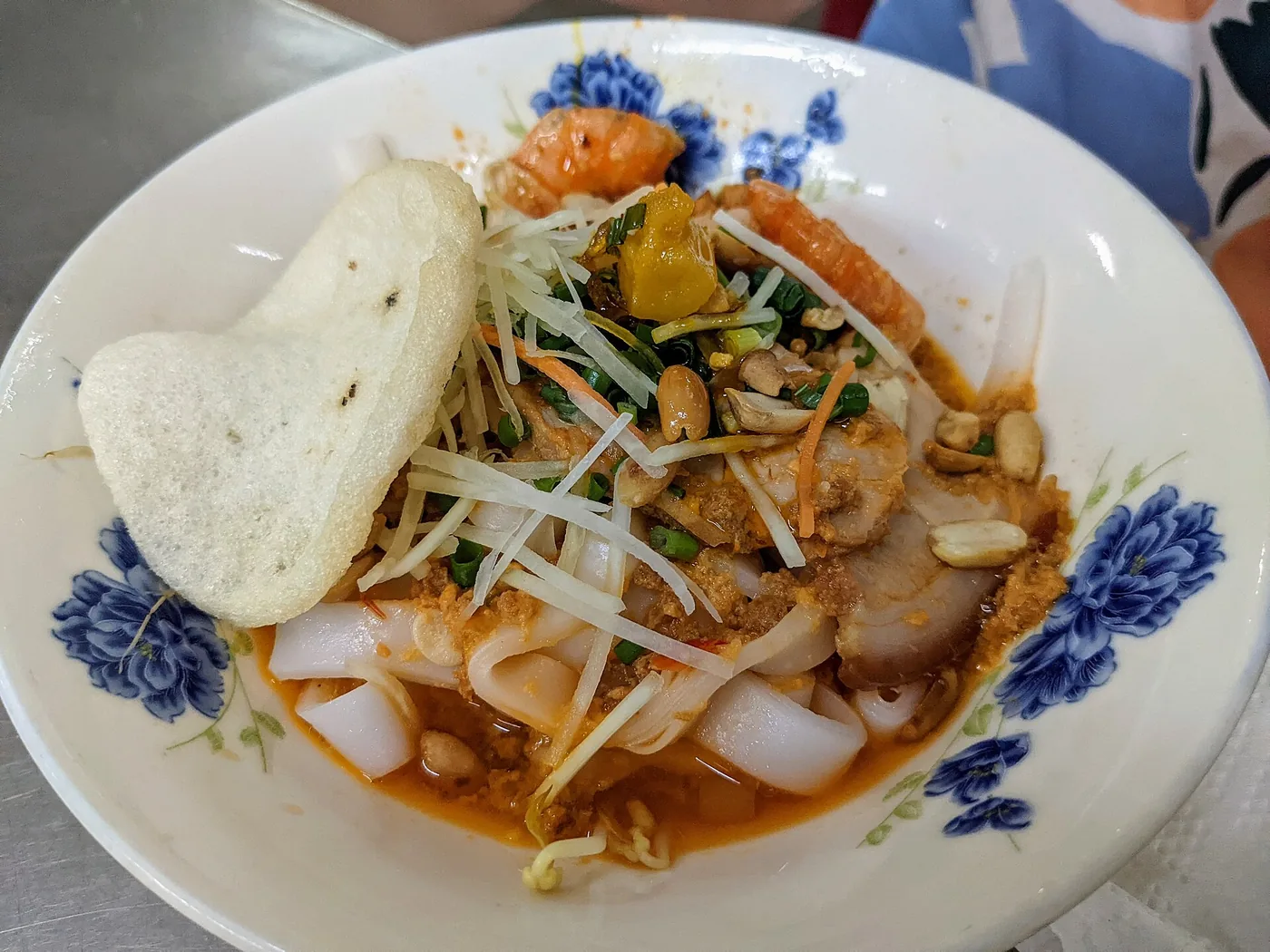
7. Banh xeo and seafood arrive sized for two
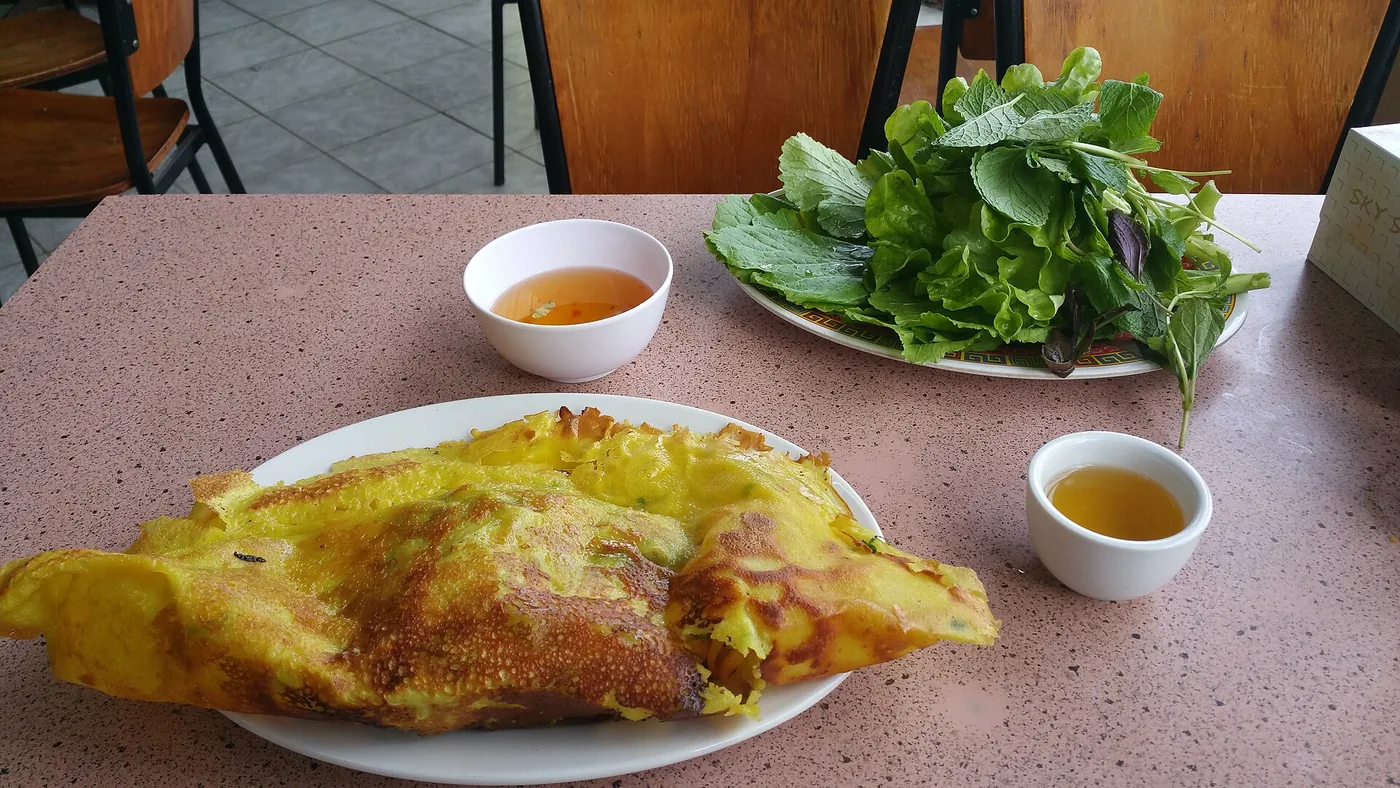
Banh xeo and nem lui come with a plate of greens, rice paper and dipping sauce. Order a single pancake and the table is still laid the same way, so the greens go back untouched. Seafood places pick from the tank and price by weight, which means kilos, and goat and chicken dishes work the same way.
None of that puts the food out of reach. Three approaches cover it.
| What you want | How to get it alone |
|---|---|
| Banh xeo, nem lui | ask whether they do a single portion, then order one |
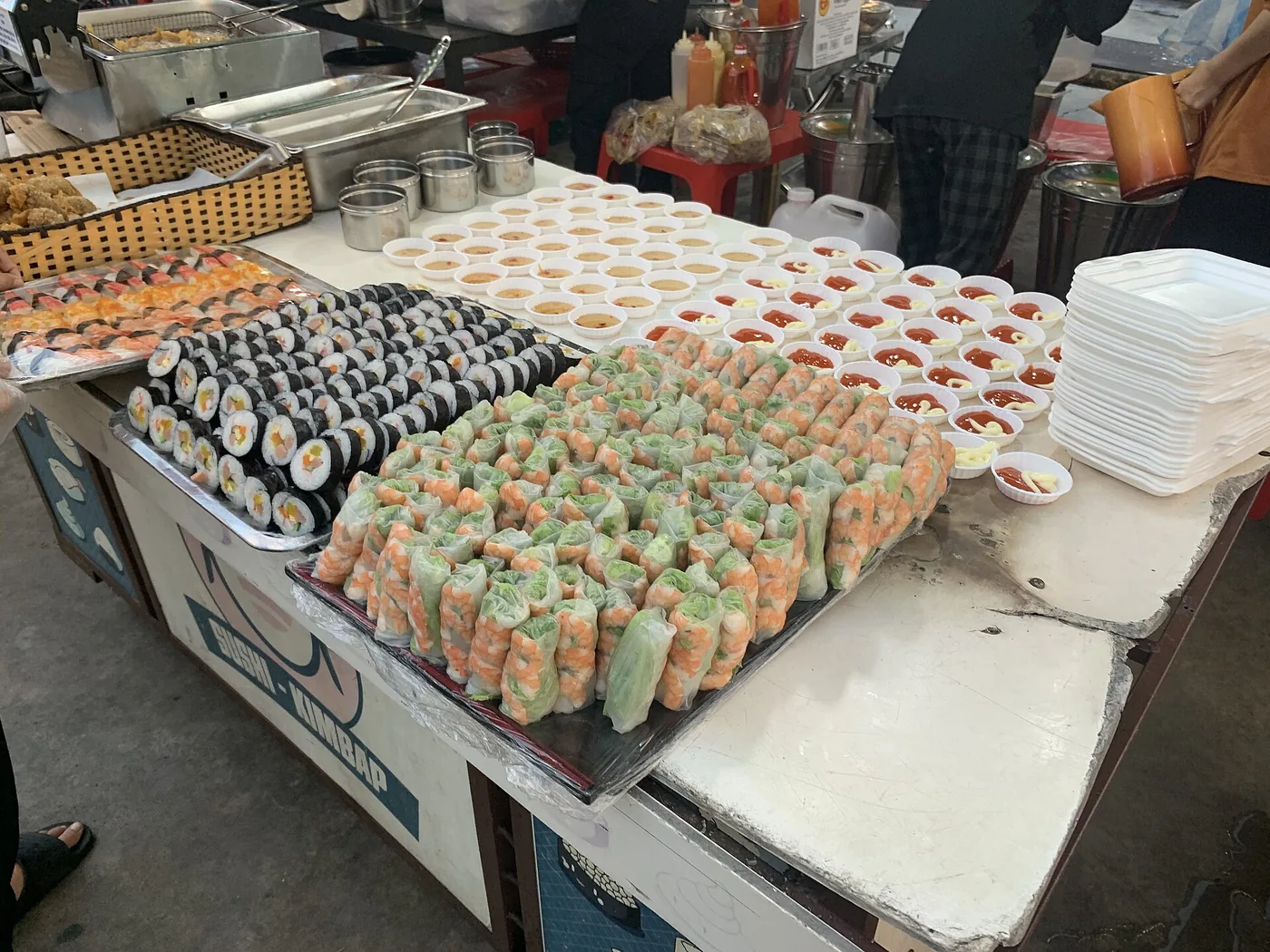
| Seafood | a plate of skewers or clams from a night market stall |
| A bit of everything | a food court like Helio night market, one plate per stall |
| Grilled meat | places that set up a small single burner |
The two night markets answer most of this
Son Tra night market opens at 17:00 and runs to 22:00 or 23:00 on weekdays and to midnight at weekends and on holidays. Helio night market runs 17:00 to 22:30. Both sell by the plate, which is exactly what one person needs to try several things.
A stall plate is roughly 30,000 to 80,000 dong. Skewers are usually counted individually, so two or three is a normal order. Where no price is displayed, ask before you order and there is nothing to argue about later.
How to ask for a single portion
Point at the menu and hold up one finger; that gets you there almost everywhere. Banh xeo is sold by the pancake, so a single one is fine in plenty of places, and some seafood is weighed from 300 grams. If the answer is no, the next place along will say yes. Prices and ordering are in the Da Nang seafood guide, and the pancakes in banh xeo and nem lui.
8. Cafes are built for sitting alone
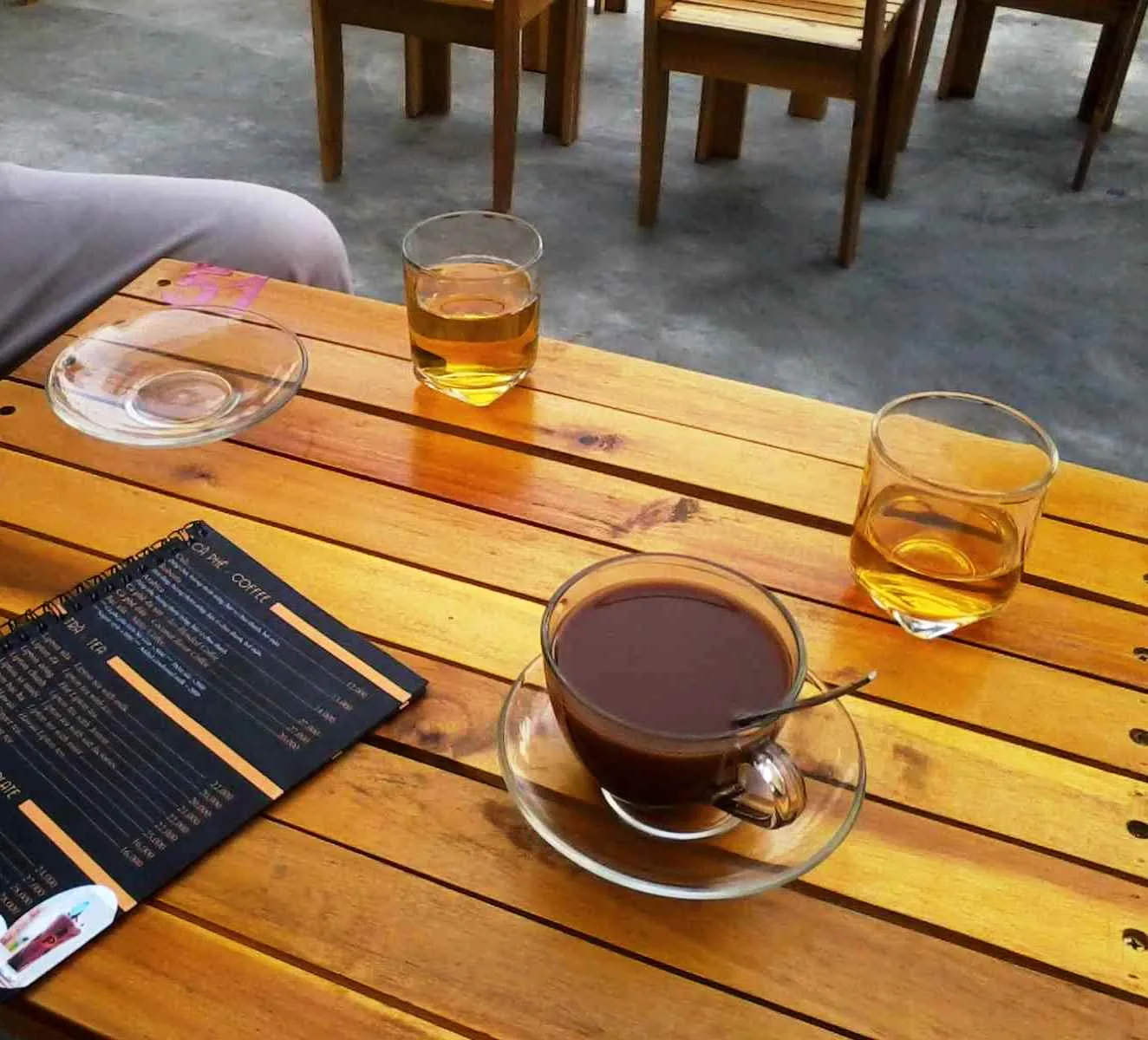
Vietnamese cafes usually bring a glass of iced tea with your coffee and nobody moves you along. Condensed milk coffee runs 25,000 to 45,000 dong, so an afternoon at a table is not an expensive afternoon.
Travelling alone leaves the middle of the day loose. Da Nang is at its hottest from noon to three, so that block belongs indoors, and you go back out when the light drops.
Which cafe to pick
River and beach frontages have the view and fill up first; lanes behind them are quieter but may not have an English menu. If a laptop is coming out, check for sockets and air conditioning and that is enough. The list is in Da Nang cafes.
Many places split indoor and outdoor seating. Outside is fans and street life, inside is strong air conditioning. For a long afternoon, look at the indoor tables first.
What to order
Condensed milk coffee comes over ice. There are local variants like coconut coffee and salt coffee, so on a first visit one of those and one plain black gives you a baseline.
If you are staying to work
For a longer stay with work in it, coworking spaces sell day passes. Rents, internet speeds and coworking rates are set out separately in the Da Nang digital nomad guide.
9. Where to go in the heat and when it rains
There is almost no shade on the sand between noon and three. In the wet months the rain often arrives in a solid hour or two in the afternoon. Deciding in advance where that block goes is what keeps a day from breaking in half.
Indoor places are nearly all priced per person: a museum ticket, an hour of massage, a cup of coffee. Nothing changes because you are one.
| Where | Hours | Cost |
|---|---|---|
| Museum of Cham Sculpture | 07:00–17:00 | 60,000 dong per person |
| Inside Han Market | early morning to evening | free to walk through |
| Indoor water park | check current hours | one ticket |
| Massage | usually 10:00–22:00 | by the hour |
| Cafes | 07:00 to around 22:00 | one drink |
The Cham museum takes about an hour
It holds the stone sculpture of the Champa kingdom and stands in the middle of the city at the western end of the Dragon Bridge. It opens 07:00 to 17:00 and entry is 60,000 dong per person. The galleries are not large, so a full circuit runs about an hour.
Alone you read the labels at your own speed, which is the whole advantage. If My Son is on your list, see the museum first: it is sculpture from the same kingdom, and the site makes more sense afterwards.
When it rains, swap the order
Rain in Da Nang tends to come through in bands rather than sit over the city all day. Beach in the morning and indoors after lunch means a wet day still runs to plan. The options are gathered in what to do in Da Nang when it rains, and the market in Han Market and shopping.
10. Sleeping in An Thuong, My Khe or by Han Market
What changes most for one person is how far you walk at night. If dinner and your bed are on the same few streets, that is one ride you never book. So pick the area first and the room second.
| Area | What it is | Travelling alone |
|---|---|---|
| An Thuong | tourist streets packed with restaurants, bars and small hotels | most of the dorms and small hotels |
| My Khe beachfront | large hotels and resorts | the morning beach is right there |
| Around Han Market | city centre, close to the Dragon Bridge | buses and the market on foot |
| Son Tra slopes | quiet hotels | every trip out has to be booked |
A hotel room costs the same for one guest as for two. That is precisely why a dorm bed or a single room in a small hotel goes further on your own. An Thuong has places like Rom Casa Hostel and The Memory Hostel that run dorms alongside private rooms.
Dorm or private room
Take the dorm if you want people to talk to and the private room if sleep is the priority. When booking a dorm, three things settle it: a lockable locker, a curtain and a socket at the bed, and whether there is a female-only room.
A single in a small hotel is often only a little above a dorm bed. There, look at breakfast, whether there is a lift, and whether the room faces the main road. Bars in An Thuong play music into the evening and street-facing rooms hear it.
On a longer stay you can book the first two nights and settle the rest once you are there. One person needs one room, and one room is usually still available. Areas are compared in where to stay in Da Nang, with hotels and resorts in the Da Nang hotel and resort guide.
An Thuong tourist streetsMap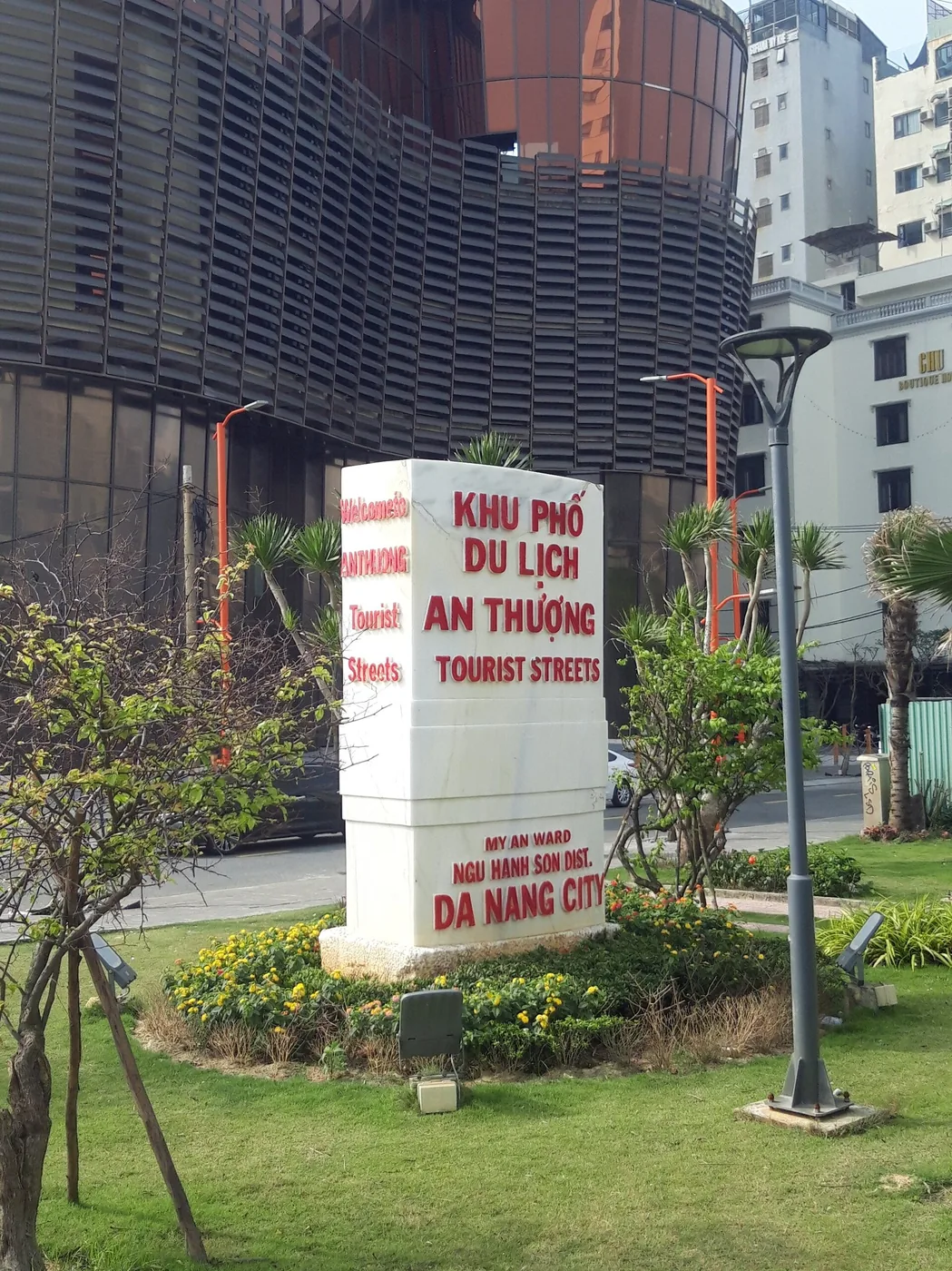
11. Mornings on the beach: sunrise and lifeguard hours
The sun rises in Da Nang at 05:16 on 21 June, 05:33 on 21 August and 06:18 on 15 January. That is close to an hour of difference across the year, so check the date before setting an alarm for sunrise.
Lifeguards work the city beaches from 04:30 to 19:00, which puts them on the sand before first light. That is why the water already has people in it at dawn. In the summer peak the city doubles the number on duty.
| Period | Sunrise | Sunset |
|---|---|---|
| Late June | 05:16 | 18:21 |
| Late August | 05:33 | 18:08 |
| Mid November | 05:50 | 17:13 |
| Mid January | 06:18 | 17:35 |
What to do with your things
The main stretches of My Khe have a bag-minding service at 10,000 to 20,000 dong. Nobody is watching your bag while you swim, so the simple version is to leave anything valuable at the hotel and walk down with a towel and small notes.
The beach itself is free; the umbrella and lounger are what you pay for, so ask the price before you sit. Some stretches have fresh water showers, which is what makes walking back to the hotel practical.
The busiest hour of the day
From before sunrise to about 06:30 is when locals are out in the largest numbers, with separate stretches for swimming, exercising and volleyball. Alone you are unremarkable in that crowd, and in safety terms it is the most populated hour on that beach all day. The beaches are compared in the My Khe guide and the Da Nang beach guide, and sea conditions by month in the best time to visit Da Nang.
12. Two stretches stay open for night swimming
Once the lifeguard shift ends at 19:00 the rule is to come out of the water. Da Nang does run two night-swimming stretches, though: the northern part of Bien Dong Park and My An beach. Both are lit, and lifeguards are on duty there from 19:00 to 22:00.
If an evening swim is the plan, those two are the reference points. Everywhere else has neither lights nor anybody watching, so after dark the sensible version is a walk on the sand.
| Hours | Where | Note |
|---|---|---|
| 04:30–19:00 | main swimming stretches | inside the buoys, lifeguards on duty |
| 19:00–22:00 | north Bien Dong Park, My An | lit night-swimming stretches |
| after 22:00 | walking on the sand | no swimming |
Read the flags and the buoys first
Notices go up and flags are raised because of surf or a rip. Alone, stay in the stretch with a lifeguard standing in it and inside the buoy line. The months when the surf builds are set out by month in the Da Nang rainy season and typhoon guide.
Between September and December the number of rough days climbs, and the swimming stretches are sometimes closed outright. Glancing at the flag colour before you leave the hotel saves the walk.
Evenings without a swim
If you are not going in, the walk is the thing. The My Khe stretch has a wide lit pavement and a steady stream of people on it after dark. Cut back to the river and the Han promenades run along both banks all the way home.
My Khe beachMap13. Evenings: the Dragon Bridge and two night markets
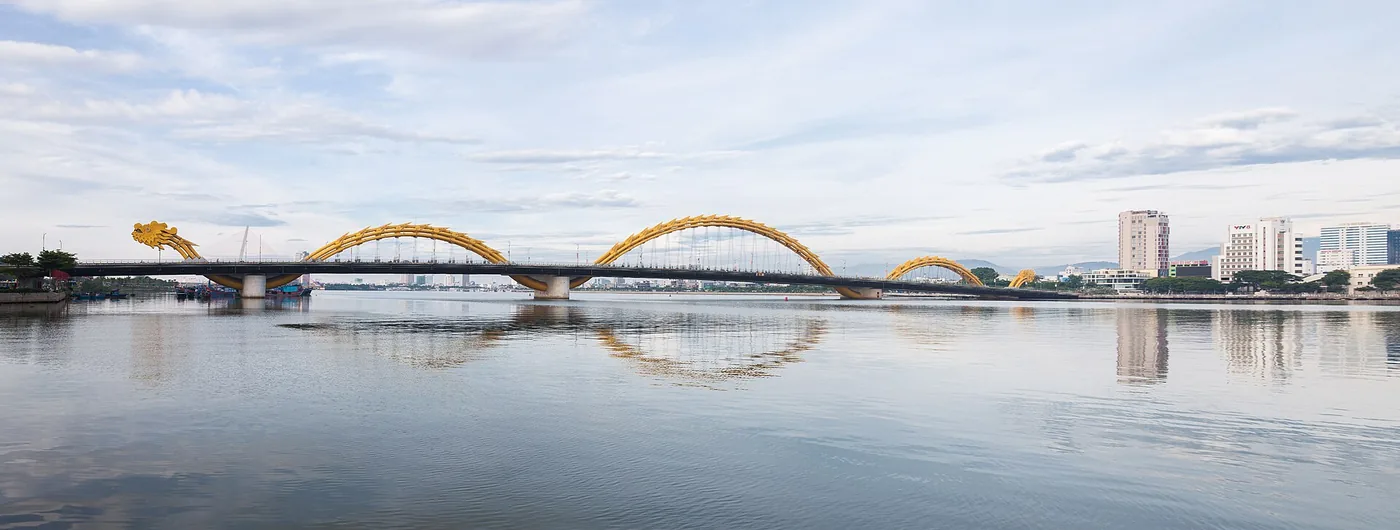
The Dragon Bridge breathes fire on Friday, Saturday and Sunday and on public holidays, at 21:00. On a weekday evening the bridge is simply lit. Not knowing that is how people spend three nights in the city and never see it.
Water follows the fire, so the railing side of the bridge gets sprayed. Alone with a camera, the promenade on the far bank is easier. The crowd builds after 20:30, so anything before that gets you a spot.
| Where | When | Note |
|---|---|---|
| Dragon Bridge fire show | Fri, Sat, Sun and holidays, 21:00 | water follows the fire |
| Son Tra night market | from 17:00 | 22:00–23:00 weekdays, midnight at weekends |
| Helio night market | 17:00–22:30 | 2 Thang 9 street, beside Asia Park |
| Han River promenade | no fixed hours | both banks lit |
How the evening lines up
Eat a plate at a time at the market, walk to the bridge for nine, then follow the river back. Son Tra night market is immediately beside the Dragon Bridge, so the two are a few minutes apart on foot.
Everything jams at once when the show ends. Book a ride then and the driver often cannot get through and cancels. Walk fifteen minutes along the river first and the traffic has cleared by the time you book.
Somewhere to have a drink alone
An Thuong has small bars clustered together and most of them have a counter. A bottle of beer runs 20,000 to 50,000 dong. With a room in the same few streets the walk home replaces the last ride of the day. The venues are listed in Da Nang after dark and the show timings in the Dragon Bridge fire show.
Dragon BridgeMap Son Tra night marketMap
14. Easy to book for one: massage, cooking classes, lessons
Massage and spa treatments are priced per person from the outset. Sixty minutes at a city shop sits at the low end, hotel spas at the high end. Plenty of places take walk-ins, and one person tends to get seen sooner.
Cooking classes, surf lessons and paddleboard lessons are also counted per head. You end up in a group of people from several countries, which makes them useful on a day when some conversation is welcome.
| What | Solo booking | Note |
|---|---|---|
| Massage, spa | yes | by the hour, same day usually fine |
| Cooking class | yes | half a day, often with a market run |
| Surf, paddleboard | yes | cancelled when the sea is up |
| Joined tour | yes | sold by seat, confirm the pickup point |
How a massage shop runs
You pick the length and type from a menu at the door and many places take payment up front. Foot massages come in 30 and 45 minute lengths, which is handy when there is an awkward gap in the day. Tips are not required, though 50,000 to 100,000 dong is common.
Alone it is worth checking whether it is a private room or a curtained bay. Valuables go in a locker or a basket by the bed, but a wallet and passport are easier left at the hotel.
Cooking classes are thicker on the ground in Hoi An
Da Nang has them, but Hoi An has the range. The standard shape is a market visit in the morning and lunch you cooked yourself, which fills a Hoi An day completely. The classes are compared in Hoi An cooking classes, and massage shops in Da Nang massage and spa.
15. The Marble Mountains open at 07:00 and close at 17:00
The Marble Mountains open daily from 07:00 to 17:00, sometimes half an hour later in peak season. Entry is 40,000 dong, the same for Vietnamese and foreign visitors. A lift saves the staircase at 15,000 dong one way or 30,000 dong return, and the Am Phu cave costs another 20,000 dong.
Going up alone means the pace is yours. The upper level is stairs and rock and photographs stretch the time out, but nobody is waiting at the top of them. Two hours covers a full circuit comfortably.
| Item | Cost |
|---|---|
| Entry | 40,000 dong |
| Lift, one way | 15,000 dong |
| Lift, return | 30,000 dong |
| Am Phu cave | 20,000 dong |
Lift or stairs
The lift is at the western entrance to Thuy Son. Step out at the top and the level ground with the pagodas and caves starts immediately; the staircase reaches the same place in 156 steps. Plenty of people use the lift only on the way down, which is why the one-way ticket exists.
There are several caves inside and the floors are wet and slippery. Trainers beat sandals if you are walking them alone, and a phone torch is enough light.
When to climb
Around midday there is little shade and it is hot work. Arrive for the 07:00 opening or after 15:00 and the stairs are manageable. It is about twenty minutes by bike taxi from the centre, on the road running south from My Khe, so it pairs naturally with a beach morning. The caves and routes are in the Marble Mountains guide.
Marble MountainsMap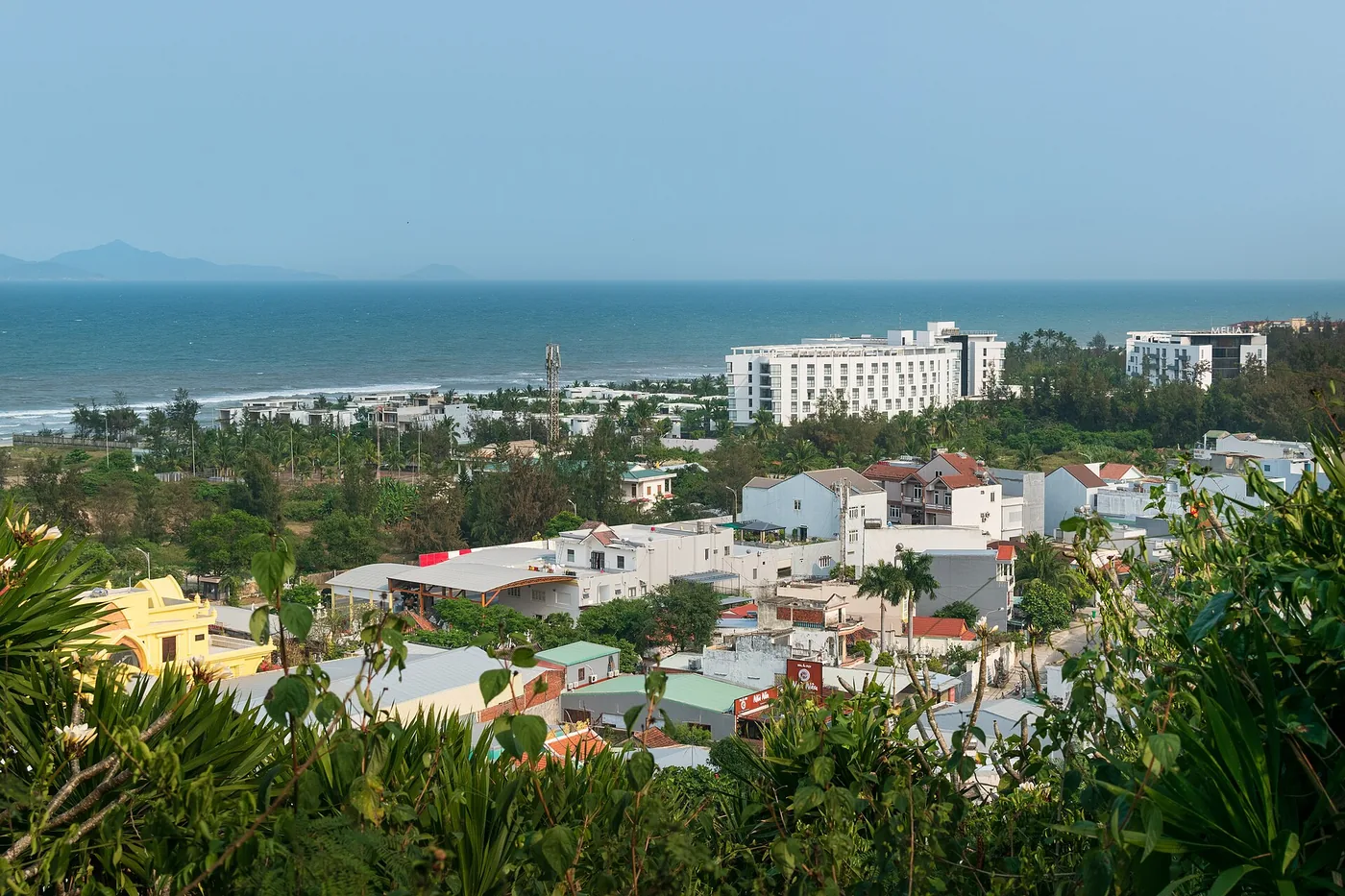
16. Son Tra: sort the ride back before you go up
Linh Ung pagoda on the Son Tra peninsula sits where the whole bay is in view. The grounds are free and the courtyard opens straight out to sea. What catches people out travelling alone is getting back down.
Up at the pagoda the apps sometimes find no cars. There are two ways round it: ride up yourself, or book a car and agree with the driver that he waits and takes you back.
| How | Note |
|---|---|
| By scooter | a long climb, hard work for a first-timer |
| Grab car both ways | agree the waiting time up front |
| Seat on a joined tour | half-day trips pair Son Tra with the Marble Mountains |
| Taxi | can be hard to find for the way down |
What there is to see
Linh Ung is free to enter. A 67-metre statue of the Lady Buddha stands at one edge of the courtyard, and the ground in front of it is the widest view of the bay you will get. Cover shoulders and knees.
Thirty minutes to an hour walks the grounds. Mornings shoot into the sun, so late afternoon is the easier light.
If you meet the monkeys
Macaques live along the peninsula road. Food in your hand brings them over, so keep it in the bag. The pagoda and the viewpoints are mapped in the Son Tra peninsula guide and the Linh Ung pagoda guide.
Linh Ung pagodaMap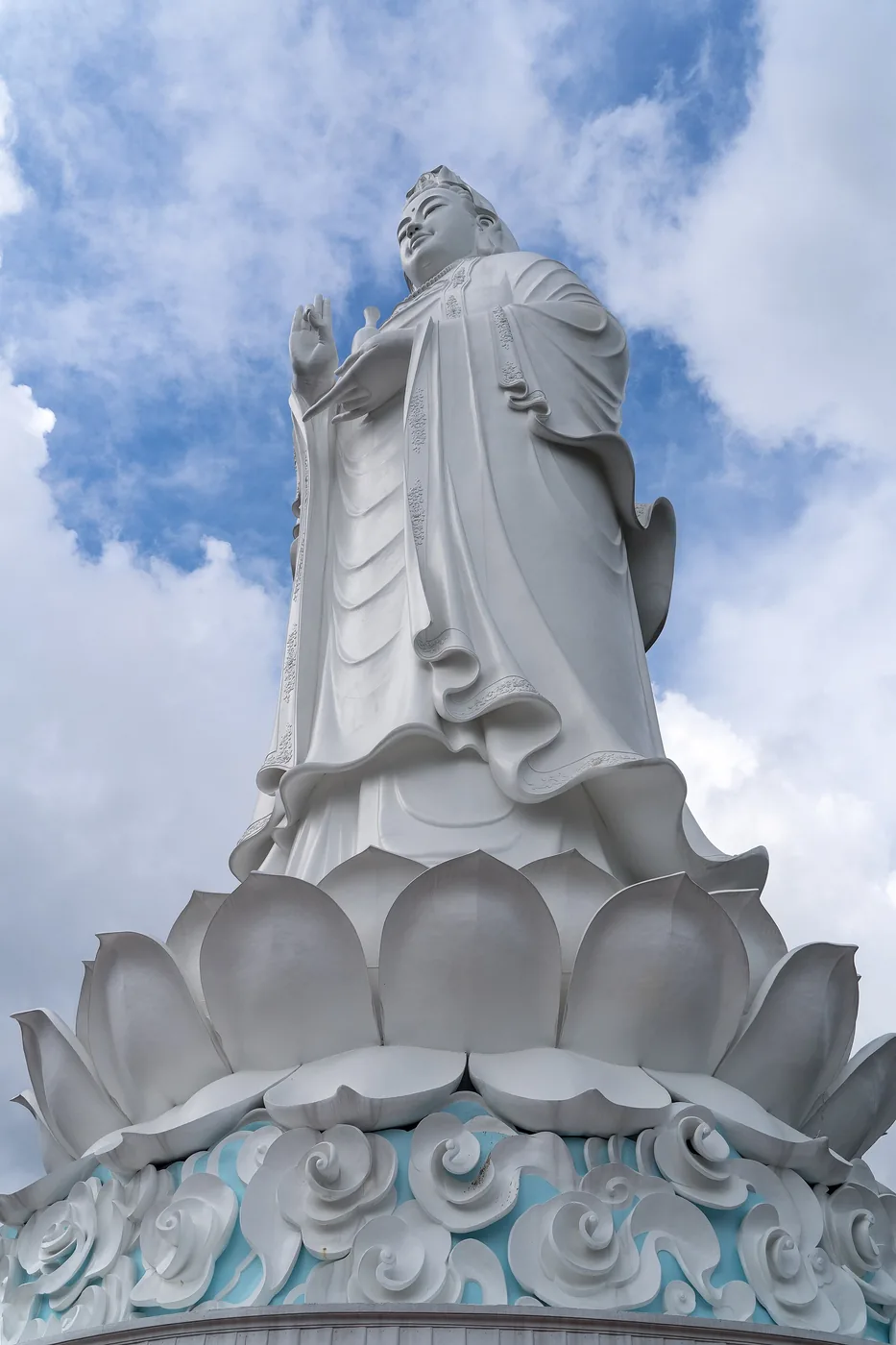
17. Renting a scooter: permits and the helmet fine
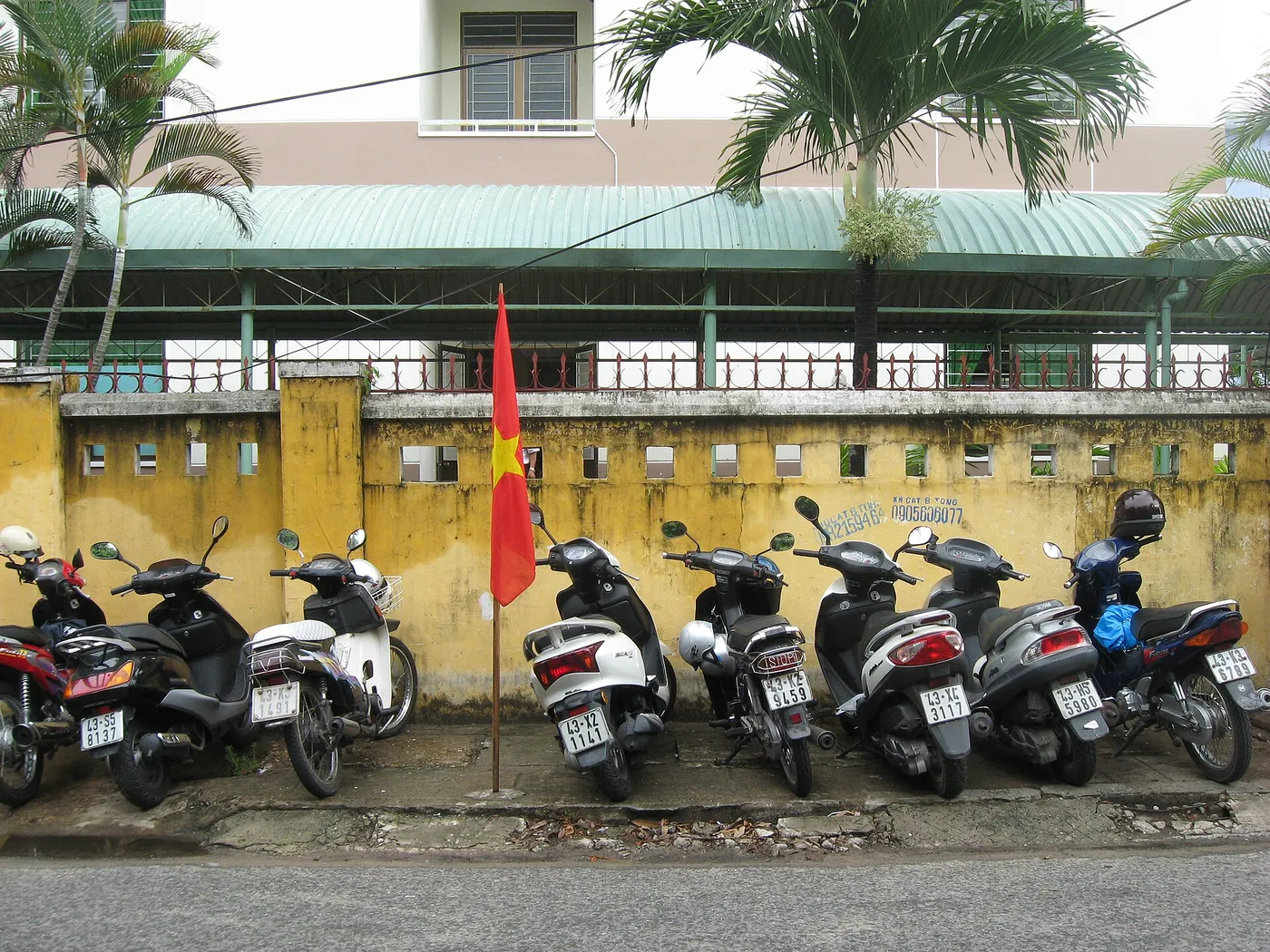
A scooter puts Son Tra, the Marble Mountains and the whole coast road inside one day. Automatics rent at 250,000 to 300,000 dong a day. The paperwork is where it gets awkward.
Riding legally in Vietnam takes a home motorcycle licence and an international driving permit issued under the 1968 Vienna Convention. Vietnam does not recognise permits issued under the 1949 Geneva Convention, and that is the version the United States, the United Kingdom, Canada, Australia and New Zealand issue. Rental shops will still hand over the keys, which is not the same thing as being covered.
| Item | Detail |
|---|---|
| Rental | 250,000–300,000 dong a day for an automatic |
| Paperwork | home licence plus a 1968 convention permit with the motorcycle category |
| Riding without a helmet | 400,000–600,000 dong |
| Who gets fined | rider and passenger both |
What to check when you collect it
Photograph the bike front and back and every scratch and there is nothing to argue about on return. Fill up at a petrol station rather than from roadside bottles, and expect 5,000 to 10,000 dong to park where somebody is watching the bikes.
Some shops ask to hold your passport. Ask whether a copy or a cash deposit will do instead: travelling alone, a passport sitting in a rental shop blocks everything else you might need to do.
Riding alone
Helmets are the law, and under the rules in force since 2025 the fine is 400,000 to 600,000 dong. If you come off, the licence question can be what voids a travel insurance claim, so read the policy wording first. Where to rent and what to check is set out in the Da Nang scooter rental guide.
18. Hoi An and Ba Na Hills work seat by seat
Out of town, the simplest thing to price alone is anything sold by the seat. Hoi An has bus 01 and the shuttles; Ba Na Hills sells the return shuttle seat and the entry ticket separately, so the cost does not move with headcount.
Ba Na Hills sits up in the hills, cooler than the coast and often in cloud. The cable car takes you up to the Golden Bridge and the French village, and it absorbs a full day. The earlier you go up the thinner the crowds.
| Where | How | Note for one |
|---|---|---|
| Hoi An | bus 01 or a shuttle | last bus 18:00, a car back for the evening |
| Ba Na Hills | return shuttle plus entry | sold by seat, so the price holds |
| My Son | morning group departure | easier before the heat |
| Hue | train or a tour seat | the road crosses the Hai Van pass |
Hoi An charges by the building now
Hoi An changed how the old town charges in 2026. Entry to an old house or an assembly hall is 20,000 dong per site, My Son is 40,000 dong and Cham Island is 70,000 dong, with the same price for Vietnamese and foreign visitors.
Walking the streets and looking at the lanterns costs nothing at all. One person usually picks one or two buildings to go inside, so charging per site is the easier arrangement to work with.
Splitting the day
Hoi An works in the afternoon and into the evening; Ba Na Hills works in the morning. Put both in one day and the day becomes travel. What to do in Hoi An is in the Hoi An travel guide, and the day trip north in Hue in a day.
19. Bags, valuables and moving around at night
Alone, nobody watches your bag. Checkout day with an evening flight is where that bites, and both Da Nang and Hoi An have places that store luggage by the hour. Hotel reception will usually hold it too.
Night trips run on the apps. Booking one leaves the plate number and the driver’s details on your phone, which is steadier than flagging something down. The fare is fixed before you get in, so there is nothing to argue about at the other end.
| Situation | What works |
|---|---|
| Bags after checkout | the hotel, or hourly luggage storage |
| Swimming | bag minding at 10,000–20,000 dong, big bags at the hotel |
| Night trips | book through Grab or Green SM |
| Cash | small notes split up, the rest in the room safe |
Have data working before you land
Booking a ride needs a connection. An eSIM bought before departure means you switch profiles on the tarmac. Plans are compared in the Vietnam eSIM guide, and cards and cash in the Vietnamese dong guide.
Small things worth having
Sockets are 220V and take two round pins without an adapter. Insect repellent is worth buying for evening walks in the wetter months, and pharmacies are on most city blocks.
Save your hotel address in Vietnamese. Showing the screen is all it takes, and nothing gets lost in pronunciation.
The usual disputes
A taxi that will not run the meter, change that comes back short, dishes on the table you did not order. The recurring versions are set out in common tourist scams in Vietnam, and the basics of eating and shopping politely in Vietnamese etiquette and tipping. Storage locations are in luggage storage in Da Nang and Hoi An.
20. A three-day timetable and what a day costs
Here is how three days lay out for one person. Beach in the morning, indoors in the middle, river in the evening: keeping that order handles both the heat and the crowds without thinking about either.
| Time | Day 1 | Day 2 | Day 3 |
|---|---|---|---|
| 05:30–07:00 | walk My Khe | swim | sunrise on the sand |
| 07:00–09:00 | a bowl of noodles | mi quang for breakfast | banh mi and coffee |
| 09:00–12:00 | Han Market and the river | Marble Mountains | Ba Na Hills or Hoi An |
| 12:00–15:00 | a cafe out of the heat | 60 minutes of massage | travelling |
| 15:00–18:00 | Son Tra and Linh Ung | cooking class or a lesson | still out |
| 18:00–21:00 | night market, plate by plate | the lit beach stretch | dinner by the river |
| 21:00 | Dragon Bridge (Fri–Sun) | a cafe or a bar | packing |
Where a solo budget actually differs
Food, transport and entry tickets are priced per person already, so they do not move. The room is the one line that does: you carry the whole rate, which against two people sharing works out as double the accommodation. A dorm bed removes that gap entirely.
| Item | Per day | Note |
|---|---|---|
| Breakfast noodles | 25,000–50,000 dong | one bowl |
| Four or five bike taxis | 100,000–200,000 dong | city trips |
| Coffee and water | 50,000–80,000 dong | one cafe stop |
| Night market dinner | 100,000–200,000 dong | two or three plates |
| Dorm bed | low price band | varies by area and season |
How to use the timetable
Day three is deliberately empty in that table, because Hoi An or Ba Na Hills takes all of it. If both are on the list, four days is the honest number.
Days one and two swap around freely. The only fixed points are the massage and the cooking class, which run to booked times, so place those first and fit the rest around them.
Costs by category are in the Da Nang budget guide and what to bring is in the Da Nang packing list. Travelling with family changes the running order, which is covered in Da Nang with elderly parents, Da Nang with kids and Da Nang for couples.
🎡Things to Do52
🍜Food8
🏨Where to Stay6
🚇Getting Around9
🧭Travel Tips24
🧭Vietnam-wide essentials64
Frequently asked questions
Transport, food and accommodation all resolve at the level of one person. A bike taxi carries one rider anyway, noodles and rice come by the bowl, and a dorm bed is charged per head. The beach road and the river promenades connect, so a good share of the day is walking rather than booking rides.
To keep the evening walk short, inside the An Thuong tourist streets works best: restaurants and bars sit within five minutes and most of the dorms and small hotels are there. For a swim every morning take the My Khe beachfront, and for buses and markets take the streets around Han Market.
Noodle and rice shops are full of single diners as a matter of course. One person needs one stool, so busy hours often seat you faster. The only dishes worth asking about first are banh xeo and seafood, which are laid out for a table rather than a person.
The driver brings the helmet and wearing it is the law: riding without one carries a fine of 400,000 to 600,000 dong, applied to rider and passenger alike. Switch to a car in the rain and on any day you are moving with a suitcase.
Only on Friday, Saturday and Sunday and on public holidays, at 21:00. On other evenings the bridge is simply lit. Water follows the fire, so the railing side gets sprayed.
When the lifeguard shift ends at 19:00 you come out of the water. Two stretches are the exception: the northern part of Bien Dong Park and My An beach are lit and staffed from 19:00 to 22:00. Outside those two, night swimming is not a good idea.
City bus 01 runs from Da Nang central bus station to Hoi An bus station from 05:30 to 18:00 at 20-minute intervals, at 8,000 to 15,000 dong depending on the section. The last bus is at 18:00, so staying for the lanterns means booking a car back.
The return shuttle seat and the entry ticket are sold separately, so the price does not change with headcount as long as you avoid chartering a car. It is cooler and cloudier up there than on the coast, so bring a light layer.
A home motorcycle licence plus an international driving permit issued under the 1968 Vienna Convention. Vietnam does not recognise 1949 Geneva Convention permits, which is what the US, UK, Canada, Australia and New Zealand issue. A shop renting to you anyway does not change the legal position or the insurance one.
Female-only dorms are common, and booking rides in the app leaves the plate number and driver details on your phone. Keep evening swims to the two lit and staffed stretches, and walk down to the beach with a towel and small notes rather than everything you own.
Three days covers the city, the beach and the Marble Mountains. Hoi An or Ba Na Hills takes a whole day on its own, so seeing both means planning four.
Food, transport and entry fees are priced per person and do not change. The gap is accommodation, because a hotel room costs the same however many people sleep in it. A dorm bed or a single room in a small hotel closes most of that gap.