
Northern Vietnam Travel Guide: Hanoi, Ha Long Bay, Sapa, Ninh Binh and Ha Giang
Hanoi is the base, and everything else is a round trip from it, anywhere from 3 hours to Ninh Binh up to 14 hours to Ha Giang. Those hours are what set your route, not the map.
| Base | Hanoi, with every other stop reached and returned from in the same trip. |
|---|---|
| Best single month | October, the only month when Ha Long, Sapa, Ninh Binh and Ha Giang all line up. |
| Round-trip driving | Ninh Binh 3-4 hours, Ha Long 4.5-5, Sapa 11-12, Ha Giang 12-14. |
| Shortest trip that works | Five days: two in Hanoi, an overnight cruise, one day in Ninh Binh. |
| Sapa or Ha Giang | Pick one under 12 days, because doing both adds 23-26 hours of road. |
| Budget per person | $305-580 over 5 days, $700-1,250 over 10-12 days, flights not included. |
1. What a trip up here actually looks like
2. How far everything is, in hours rather than kilometres
3. The 2025 provincial redraw, and why your bookings still say the old names
4. Month by month: weather, and the rice calendar that runs alongside it
5. Three ways the weather breaks a northern itinerary
6. Itineraries that fit, and five ways people build ones that do not
7. Hanoi: two days, eight areas, and where to put yourself
8. Ha Long, Lan Ha or Bai Tu Long: picking a bay and a boat
9. Sapa: two nights minimum, and what to do with them
10. Ninh Binh: Trang An or Tam Coc, and how to do it in a day
11. Ha Giang: the loop, the licence problem, and how people actually do it
12. Arriving, and every leg between the five places
13. Where to sleep, region by region
14. Eating in the north
15. What a northern trip actually costs
16. Twelve things older guides still get wrong
17. Where to go from here
1. What a trip up here actually looks like
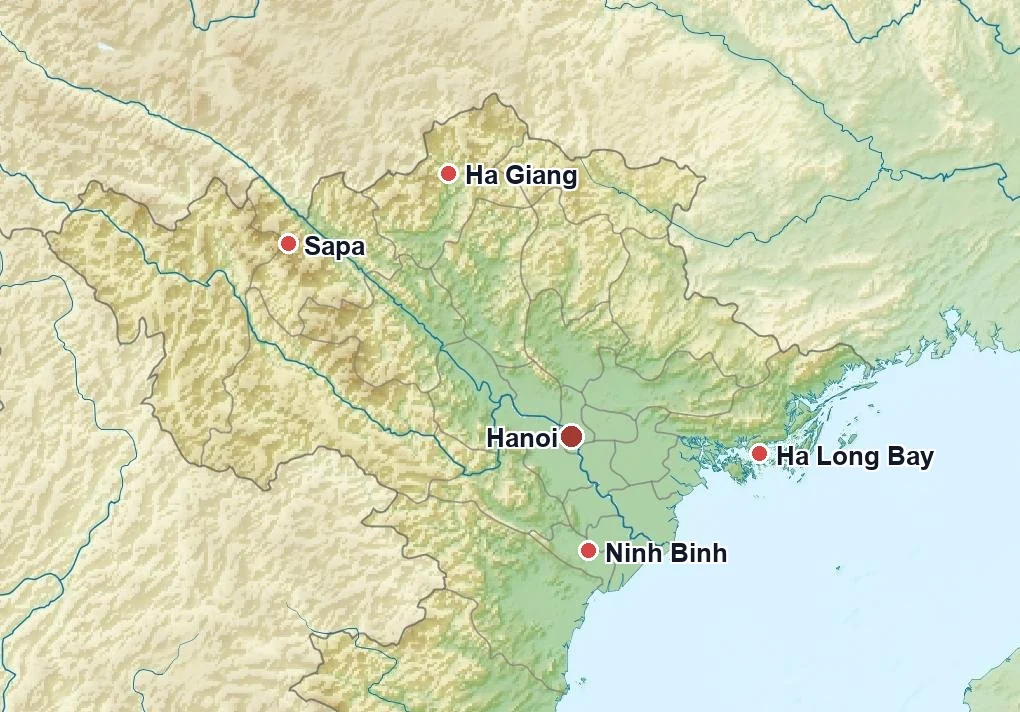
Northern Vietnam is one city plus four separate excursions, and the driving times are what you plan around. Hanoi is where you sleep, eat and start from. Ninh Binh, Ha Long Bay, Sapa and Ha Giang all sit at the end of a road out of Hanoi, and the round trip on that road runs from about 3 hours to about 14. Nothing here is a resort strip where you check in for a week and stop moving. Every day you add to one place is a day you take from another, and the hours in the van are the reason.
That is the whole planning problem, and it is worth getting straight before you look at a single hotel. Two travellers with the same eight days can come home with completely different trips depending on whether they spent 12 hours on the road to Sapa or 5 hours going to Ha Long and back. Neither choice is wrong. But you only get to make it once.
The short version, if you only read one paragraph
Base yourself in Hanoi. Give it two days. Add an overnight boat in Ha Long or Lan Ha Bay, because a day trip means only 4 to 6 hours on the water for 4.5 to 5 hours of driving, and the ratio is poor. Add Ninh Binh, which is close enough at 95 km to do properly as a day trip. Then, if you have more than about seven days, add exactly one of the two mountain regions: Sapa or Ha Giang. If you have twelve days or more, you can have both.
One base, four excursions
Here is the shape of it on paper. Hanoi is roughly in the middle of the four, which is why it works as a base and why you keep coming back to it rather than looping around in a circle.
| Place | What it is | One way from Hanoi | Stay that makes sense |
|---|---|---|---|
| Hanoi | Old Quarter streets, lakes, the food, the arrival and departure point | — | 2 days, split either side of the trip |
| Ninh Binh | Limestone peaks and rice fields with rivers running through caves at the base | 95 km, 1.5-2 hours | A full day trip, or 1 night if you want the light |
| Ha Long Bay | About 1,600 limestone islands in the sea, seen from a boat | 170 km, 2h15-2h30 | 1 night on a boat, which is about 24 hours aboard |
| Sapa | Terraced rice valleys, hill-tribe villages, and Fansipan at 3,143 m | 315 km, 5.5-6 hours | 2-3 days, never one night |
| Ha Giang | A 350 km mountain circuit through the Dong Van karst plateau | 300 km, 6-7 hours | 3-4 days for the loop itself |
Notice that the two mountain regions are not just further away, they are further away by a factor of three. Ninh Binh and Ha Long are both errands you run from a Hanoi hotel room you never check out of. Sapa and Ha Giang are relocations. You pack, you leave, you come back a few days later. Treating all four as if they were the same kind of trip is the single most common way people ruin a northern itinerary.
What the north has that the rest of Vietnam does not
Three things, and they are the honest reasons to come here rather than fly straight to Da Nang or Phu Quoc.
Limestone, in two forms. The same rock that makes Ha Long Bay carries on inland and comes up again around Ninh Binh, where the water is a river rather than the sea and the boats are rowed rather than motored. About 1,600 islands sit in the bay. Inland, the peaks stand in flooded rice fields, and the rivers go straight through the base of them into caves. Seeing both in one trip is easy, because Ha Long is 170 km east of Hanoi and Ninh Binh is 95 km south, and neither takes a full travel day.
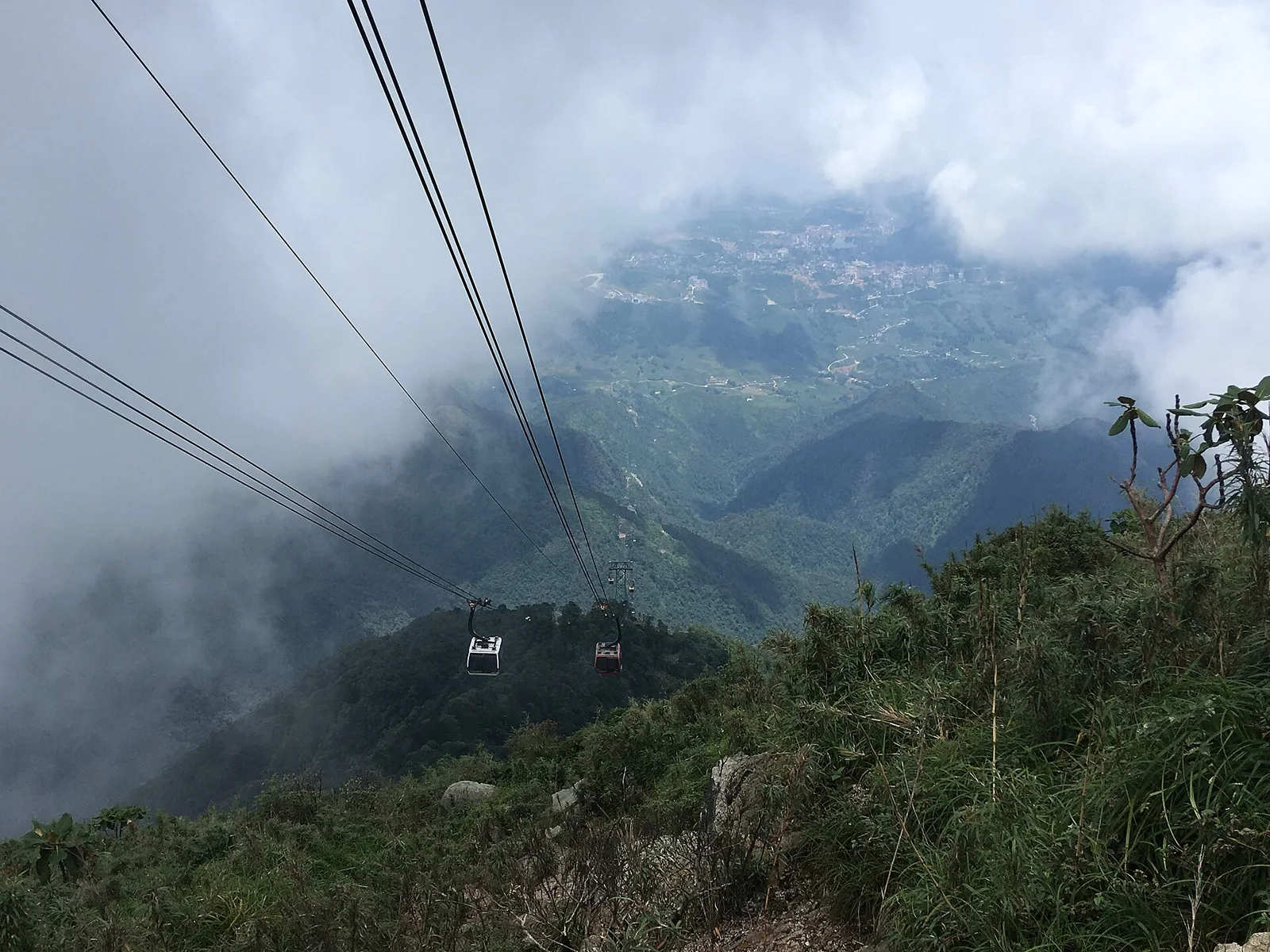
Real mountains with people living on them. Fansipan is 3,143 m and the highest point in Indochina, which is a fact rather than a difficult climb these days, because a cable car covers 6,292 m of horizontal distance and 1,410 m of height in about 15 to 20 minutes. The more interesting part is lower down. The Dong Van karst plateau in Ha Giang has around 17 ethnic minority groups living on it, and roughly 88% of the population there belongs to one of them. The terraced rice you have seen in photographs is farmland, worked on a calendar, which is why the month you visit changes what you see far more than in most places.
A cool season that behaves like a cool season. Hanoi in January and February sits between 10 and 17°C, grey, with drizzle that does not really stop. Sapa gets close to 0°C. This surprises people who packed for Vietnam and got a damp English November. It also means the north has a genuine peak season in autumn rather than the year-round warmth of the south, and prices and crowds follow it.
Who has a good time in the north
People who like moving, looking at landscape, and eating in places with plastic stools. People who are happy with a two-hour van ride as the price of a morning on a boat. People who would rather walk 10 km through rice terraces than lie by a pool. And, specifically, people travelling in autumn, because September through December is when the whole region is at its best at once.
| You will probably enjoy this if | You will probably not if |
|---|---|
| You want landscape and are willing to drive for it | You want to unpack once and stay put |
| You are coming between September and December, or in March and April | You are locked into July or August and want guaranteed boat weather |
| Street food is the point, not a risk to be managed | You need resort food and a swim-up bar |
| You have at least five days on the ground, not counting flights | You have three days and want to see Ha Long and Sapa |
| You are fine with a night on a sleeper bus or a night train | You need a proper bed every single night |
| You want walking, and are happy on uneven stone steps | Stairs are a problem; Hang Mua alone is about 500 of them |
One practical point that sits underneath all of that: northern Vietnam has a lot of stairs, and they are not optional extras. Four of the region’s best-known viewpoints are reached on foot up substantial staircases, and only two of them have an alternative.
| Climb | Steps | Where | Alternative |
|---|---|---|---|
| Lung Cu flag tower | 839 | Ha Giang, the northernmost point of the country | Electric cart, about $0.57 (approx. 15,000 VND) |
| Fansipan upper station to the summit | About 600 stone steps | Sapa, at over 3,000 m | A small funicular |
| Hang Mua | About 500 | Ninh Binh, the view over the valley | None |
| Ti Top Island | About 400 | Ha Long Bay, if your route includes it | None |
That is roughly 2,300 steps across one trip, in humidity, often on uneven stone. None of it is technical and none of it requires equipment, but if stairs are a problem for anyone in your group, plan around Hang Mua and Ti Top specifically, because those two have no cart and no funicular. Everything else here can be done at a flat walk.
Who should look at central or southern Vietnam instead
If your holiday is mostly beach, the north is the wrong half of the country. If you have five days total including flights, you will spend most of them in transit. And if you are travelling in July or August with no flexibility, understand before you book that July to September is peak typhoon risk on the coast, and Ha Long cruises do get cancelled. Our central Vietnam travel guide covers the alternative, and the complete Vietnam travel guide is the place to start if you have not yet decided which end of the country you are flying into.
One more group: people who want to ride a motorbike around the Ha Giang Loop themselves. That is possible, but the licence question is genuinely restrictive and catches a lot of travellers out. It is covered in full further down, and the short answer is that a car licence does not cover you.
The booking that has to happen first
Of everything in a northern itinerary, one item has real scarcity: the overnight cruise. Boats have fixed cabin counts, and October through December is the window everyone else wants as well. The price band is wide: a reliable all-inclusive overnight boat starts around $130 to $160 per person, and 4 and 5 star boats run $180 to $250. Deciding the sailing date first is what lets you choose inside that band rather than take what is left in it.
If you lock in one thing before you fly, make it the boat, and build the rest of the week around the date it sails.
For the journey on its own, how to get from Hanoi to Sapa sets out the pickup times across Hanoi, the 04:00 drop-off on the night services and the 33.4km still left from Lao Cai station.
2. How far everything is, in hours rather than kilometres
Kilometres are misleading in northern Vietnam, so plan in round-trip hours. Sapa is 315 km from Hanoi and Ha Giang is 300 km, a difference of 15 km, and yet one is a comfortable five and a half hour van ride and the other is a six to seven hour haul. The reason is what kind of road it is, and that difference matters far more than the distance on the map.
Here is the table everything else follows from. Read the last column, not the second.
| Destination | Direction from Hanoi | Distance | One way | Round trip |
|---|---|---|---|---|
| Ninh Binh | South | 95 km | 1.5-2 hours | 3-4 hours |
| Ha Long Bay | East | 170 km | 2h15-2h30 | 4.5-5 hours |
| Ha Giang | North | 300 km | 6-7 hours | 12-14 hours |
| Sapa | North-west | 315 km | 5.5-6 hours (8 hours by night train) | 11-12 hours |
Why Hanoi is the only base that works
Look at the directions column. South, east, north, north-west. The four destinations are spread across three quarters of the compass with Hanoi in the middle, and none of them connects usefully to another. There is no road that takes you from Ha Long to Sapa without going back past Hanoi, and no reason to try. Ha Giang has no airport and no train station at all, so every approach to it starts in Hanoi by road.
This is why northern itineraries look like a star rather than a circle, and why you will check into a Hanoi hotel more than once. Ask your Hanoi hotel whether it will hold a bag between stays, and ask at the point of booking rather than on the morning you leave. Where they will, you go to the mountains with a day pack instead of a wheeled suitcase, which matters on a night bus and on a valley path.
Why Sapa is further away and still quicker
The Sapa run uses the Noi Bai to Lao Cai expressway more or less the entire way, so a limousine van covers 315 km in 5.5 to 6 hours. That is an average in the mid-fifties in kilometres per hour once you account for the city crawl at the Hanoi end, which is what expressway driving in Vietnam actually delivers.
Ha Giang has no equivalent road. 300 km takes 6 to 7 hours, which works out around 43 to 50 km/h, and the last stretch is mountain road. That gap of roughly an hour each way does not sound like much until you notice it is an hour each way on a route you are already spending most of a day on.
The practical consequence: Sapa can be done as a road trip in daylight if you leave early, or overnight on the train. Ha Giang is almost always an overnight bus, because a 6 to 7 hour daytime run eats the whole first day of a loop you have only booked three days for.
The 350 km that is not the 300 km
This matters because people budget three days for Ha Giang and then discover that the three days are the loop, and the 300 km approach in each direction is on top. A 3 day, 2 night loop is really five days end to end once you add a night bus out and a night bus back. The 350 km circuit divided over three riding days is around 115 km a day, which sounds gentle and is not, because it is mountain road with stops.
Budget your Ha Giang plan as: night bus (6-7 hours) + loop (3-4 days) + night bus (6-7 hours). If your calendar cannot absorb that, Ha Giang is not the trip for this visit.
What the hours do to a short trip
Put the round trips against the length of the holiday and the arithmetic becomes blunt. A five day trip has 120 hours in it, of which maybe 60 are usable daylight and awake time. Here is what each excursion takes out of that before you have looked at anything.
| Excursion | Hours in transit | Hours actually there | Transit as a share of the excursion |
|---|---|---|---|
| Ninh Binh day trip | 3-4 | 7-8 | About a third |
| Ha Long day cruise | 4.5-5 | 4-6 on the water | About half |
| Ha Long overnight cruise | 4.5-5 | About 24 aboard | About a sixth |
| Sapa, 1 night | 11-12 | Roughly half a day | Most of it |
| Sapa, 3 days | 11-12 | About 48 | About a fifth |
| Ha Giang, 3 day loop | 12-14 | About 72 | About a sixth |
Two rules fall straight out of that table.
Do not day trip Ha Long. Four and a half to five hours of van for four to six hours of water is a bad ratio, and the four to six hours includes the slow crawl out of the harbour past the other boats. Add the night and the same driving gets you 24 hours instead, including the part of the bay that empties out after the day boats leave.
Do not give Sapa one night. Eleven to twelve hours of round-trip travel for half a day on the ground is the worst ratio in the north. If Sapa only fits as one night, take those days and put them into Ninh Binh and a second night on the water instead, and save Sapa for a trip that has room for it.
The return legs, which people forget to plan
Every itinerary above is written as outbound legs, and almost everyone plans them that way. The return legs are where the schedule actually fails, because they all land at awkward times and because nobody books slack against a journey they have already done once.
| Coming back from | You reach Hanoi | What that means for the evening |
|---|---|---|
| Ha Long, after an overnight cruise | Mid to late afternoon | Disembarkation is before lunch, then 2h15-2h30 of road |
| Ninh Binh, on a day trip | Early evening | 1.5-2 hours back, after a full day on your feet |
| Sapa, by day van | Evening | 5.5-6 hours; you will not want to go out |
| Sapa, by night train | Early morning | Arrives around 06:00, but you have not slept properly |
| Ha Giang, by night bus | Early morning | 6-7 hours overnight, after three days on a motorbike |
Read that table as a list of evenings and mornings you should leave empty. The specific mistakes it prevents: booking a restaurant for the night you get back from Sapa, scheduling the Temple of Literature for the morning you step off the Ha Giang bus, and putting an international flight on the day you return from anywhere by road.
The last one is worth saying plainly. Do not fly out on the same day you come back from a mountain region. A single landslide or a mechanical problem on a route with no alternative road turns a comfortable margin into a missed flight, and the north has exactly one road to each destination.
Reading the timings honestly
Every number in that table is a moving vehicle time, not a door to door time. Allow extra time at the Hanoi end for hotel pickups, because a shared limousine van collects from several Old Quarter hotels before it leaves the city, and you may be the first stop on that round or the last. Ask the operator what time they expect to clear Hanoi rather than what time they collect you. Add time at the far end too: the night train reaches Lao Cai at about 06:10, and Sapa town is another 35 km and roughly an hour by shared minibus from the station.
So the honest figure for Hanoi to Sapa by night train is not 8 hours, it is about 9 hours plus the wait, and you arrive at breakfast time without having slept much. That is still often the right call, because it uses a night you were going to spend somewhere anyway. Just do not plan a hard trek for the morning you arrive.
3. The 2025 provincial redraw, and why your bookings still say the old names
On 1 July 2025 Vietnam went from 63 provinces to 34, and two of your four northern destinations ended up inside a differently named province. Nothing about prices, opening hours, boat routes or how you get anywhere changed. What changed is the address on the paperwork, and that is enough to cause confusion when a booking confirmation, an insurance form and a guidebook all disagree with each other.
The legal instrument is National Assembly Resolution 202/2025/QH15, passed on 12 June 2025 and in force from 1 July 2025. The new count is 34 units: 28 provinces and 6 centrally run cities. Hanoi is one of the six and was not touched.
What happened to each place you are going
| The name you know | After 1 July 2025 | What this means for you |
|---|---|---|
| Ha Giang province | Merged into Tuyen Quang province | Ha Giang survives as a city and a region name. Prices and operations unchanged. |
| Lao Cai province (Sapa) | Lao Cai kept its name and absorbed Yen Bai province | The provincial capital moved to Yen Bai City. Sapa and Mu Cang Chai are now in the same province. |
| Ninh Binh province | Ninh Binh kept its name and absorbed Ha Nam and Nam Dinh | Trang An, Tam Coc and Hoa Lu are all unchanged. |
| Quang Ninh province (Ha Long) | No change | Nothing to do. |
| Hanoi | No change | Still a centrally run city. |
Ha Giang is still Ha Giang
This is the one that reads alarmingly and matters least. Ha Giang province was absorbed into Tuyen Quang province, so if you search for “Ha Giang province” in an official register you will not find it. But the loop is still called the Ha Giang Loop, the city you start from is still called Ha Giang, and every operator, bus company and homestay still uses the name. Fares, permits and opening arrangements did not move with the provincial boundary.
The place you might notice it is a form. If an insurance policy, a visa application or a hotel registration asks for a province and offers a dropdown, Ha Giang may not be in it. Tuyen Quang is the answer in that box. Everywhere else, keep saying Ha Giang, because that is what people say.
Sapa’s province kept its name and moved its capital
Lao Cai province survived the merger with its name intact, but it swallowed Yen Bai province next door and the provincial capital shifted to Yen Bai City. Sapa itself sits about 35 km from Lao Cai City, which is where your night train arrives, and that has not changed.
What is genuinely useful about this merger is that Sapa and Mu Cang Chai are now inside one province. Those are two of the best terraced rice areas in the north and they were previously split across a provincial line, which affected how tours and permits were organised. If you see itineraries that combine them, that is why.
Older sources say the provincial capital of Lao Cai province is Lao Cai City. That is now out of date. It is not something a traveller trips over often, but it is a fast way to work out whether a page was written before or after mid-2025, which is a useful test to apply to everything else on that page.
Districts are gone, and that changes addresses
The reform also removed an entire tier of local government. Vietnam used to run province, then district, then commune or ward. The district level was abolished, leaving two tiers: province or city at the top, and commune or ward underneath. In Lao Cai province, the number of sub-units dropped from 152 to 99, made up of 89 communes and 10 wards.
The practical consequence is that written addresses got shorter and, for a while, inconsistent. A homestay in the Muong Hoa valley may have a registered address that no longer matches the one printed on a booking site, or the one a driver has saved. This is not a problem you can fix from home, and it does not need fixing. Use coordinates or the place name, not the administrative address. Drivers in Sapa work from village names, so give them Ta Van or Lao Chai rather than a commune code.
The scale of it is worth seeing in one place, because it explains why the paperwork took a while to catch up.
| Before | After |
|---|---|
| 63 provinces and centrally run cities | 34: 28 provinces and 6 centrally run cities |
| Three tiers: province, district, commune or ward | Two tiers: province or city, then commune or ward |
| Lao Cai province had 152 sub-units | 99, made up of 89 communes and 10 wards |
| Ha Giang was a province | Ha Giang is a city and a region inside Tuyen Quang province |
| Ninh Binh province | Ninh Binh province, now including Ha Nam and Nam Dinh |
Cutting a whole tier of local government out of a country of that size in one step is a large administrative operation, and the visible effects for a visitor are all downstream of it: signage that has not been replaced yet, forms with old dropdown lists, and databases that were populated before July 2025 and have not been refreshed. None of that affects whether your boat sails.
One thing it does affect is searching. If you look for accommodation or transport by administrative area rather than by place name, you can get thin or confusing results, because the area you are searching may not exist under that name any more. Search by the name people use, which is Sapa, Dong Van, Tam Coc, Ta Van, Ha Giang, and the results behave normally.
What a traveller actually notices, and what they do not
| You will notice | You will not notice |
|---|---|
| Dropdown lists on forms that no longer contain Ha Giang province | Any change to ticket prices |
| Addresses on booking confirmations that do not match maps | Any change to opening hours |
| Guidebooks and blog posts written before mid-2025 giving the old province count | Any change to bus, train or boat routes |
| Signage and paperwork in a transitional state | Any change to what the places are called in speech |
The reason this section exists at all is that the merger is a fast reliability check. If a page still tells you Vietnam has 63 provinces, or that Ha Giang is its own province, it was written before July 2025 and has not been revisited. That same page probably also has the old airport bus fare and the old motorbike licence limit, both of which are covered further down and and each of those can turn into an unexpected bill or a police stop rather than just an embarrassment.
The one thing worth doing before you travel
Nothing. There is nothing in the reform for you to do or file before you travel. The only useful action is to stop treating pre-2025 sources as current, and to double check any number you find on an old page against something dated. Entry rules, licence categories and fares in the north have all moved in the last couple of years, and the province count is the easiest tell that a source has not kept up.
4. Month by month: weather, and the rice calendar that runs alongside it
October is the best single month in northern Vietnam, and it is not close. It is the only month when all four destinations are at or near their peak simultaneously: the typhoon season has passed, the bay’s cruise season has started, the Sapa terraces are gold or just cut, and Hanoi is cool, dry and clear. If you can move your dates, move them to October.
If you cannot, the second-best answers are November to December, and March to April, for different reasons. November and December are the best cruise months of the year and the coldest in the mountains. March and April are quiet, mild, and the terraces are flooded rather than green or gold. Every other window involves a real compromise, and it is better to know which one you are accepting.
The full year, across the region
| Period | Hanoi | Ha Long Bay | Sapa and Ha Giang terraces |
|---|---|---|---|
| January-February | 10-17°C, overcast, persistent drizzle | Frequent fog, short visibility | Brown after the cut. Sapa close to 0°C |
| March-April | Mild, still drizzly | Second-best window of the year | April into early May, the fields are flooded |
| May-June | Temperatures climbing | Shoulder season | New green. Ha Giang is flooded too |
| July-August | Hot, heavy rain | Highest typhoon risk, July to September | Deep green, wettest months, landslides |
| September-October | Cool, dry, clear | September is shoulder, October starts the peak | Mid-September to early October is gold |
| November-December | Cool and clear | Best of the year | Late October to early November, Ha Giang buckwheat |
Best window, sorted by what you came for
Most people arrive with one image in their head. Work out which one it is and the date question answers itself.
| What you came for | When | Why that window |
|---|---|---|
| Golden rice terraces in Sapa | Mid-September to early October | The two to three weeks between the grain turning and the harvest |
| Flooded, mirrored terraces | April to early May | Fields are filled with water before transplanting |
| Ha Giang buckwheat flowers | Late October to early November, peak in early November | A single short bloom on the Dong Van plateau |
| Plum and peach blossom in Ha Giang | Spring | Orchard trees, not rice; a different look entirely |
| Ha Long or Lan Ha cruise | October to December, or March to April | Outside typhoon season and outside the worst of the fog |
| Trekking | October to November | Dry paths, cool air, no landslide risk |
| Fewer people | March to April | After the winter, before the summer domestic season |
| Everything at once | October | The only month where all four line up |
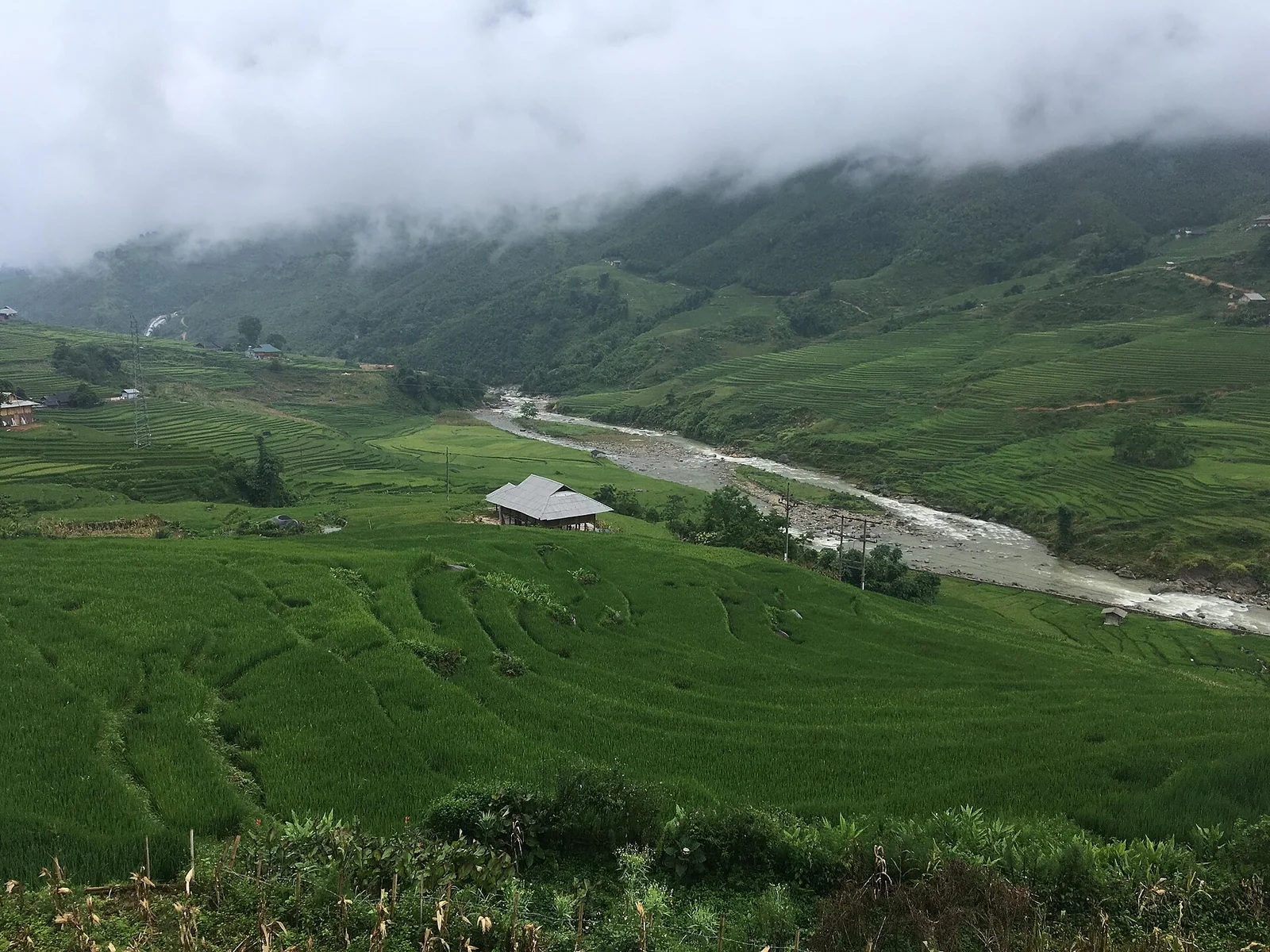
The golden window deserves a note of its own, because two to three weeks is a genuinely tight target, and it is worth understanding why so you do not build a trip around missing it by a fortnight. Terraced rice in Sapa is a single main crop. The grain turns colour as it ripens, the fields go gold, and then they are cut. Once the harvest is in, what is left is stubble, and stubble stays until the next flooding in April. So the gold is not a season, it is the gap between two farming events.
That gap is mid-September to early October in Sapa. Arrive in the last week of September and you are as safe as you can be. Arrive on 20 October and the same valley is brown, and no amount of good weather will change that. This is the one thing in northern Vietnam where being two weeks late is worse than being two weeks early, because early at least gives you deep green.

The Sapa rice calendar in full
If you are picking dates around what the fields look like rather than around temperature, this is the calendar that matters. Nothing else about Sapa changes as much through the year.
| Period | What the terraces look like | Worth going? |
|---|---|---|
| April to early May | Flooded and still, before transplanting | Yes, if you want water and reflections rather than green |
| May to June | New green shoots coming through | Yes, and it is quieter than autumn |
| July to August | Deep green, and the wettest weeks of the year | Only if you accept rain and landslide risk |
| September to early October | Gold, then cut | The best two to three weeks of the year |
| Late October to March | Brown stubble, occasional frost | Go for the trekking and the villages, not the fields |
Note the asymmetry. The good-looking windows are April to early October, about six months. The brown window is late October to March, about five months, and it includes the coldest weather. Winter in Sapa is still a good trip. It is a trip about villages, markets, walking and mist, and if you arrive expecting the photographs you will be disappointed by fields you can see perfectly well.
Ha Giang runs on a slightly different clock
Ha Giang shares the flooded-fields window with Sapa in April and early May, and it gets the same summer green and the same summer rain. Where it differs is autumn. Ha Giang has its own flowering season: buckwheat, locally tam giac mach, blooms from late October into early November with the peak in early November. That is after Sapa’s rice has been cut, which means the two mountain regions have peaks about a month apart.
Spring brings plum and peach blossom to the plateau, which is a completely different landscape from either the flooded terraces or the buckwheat. If your dates are fixed in March or early April, Ha Giang has something to show you that Sapa does not.
The consequence for planning is useful. If you are choosing between Sapa and Ha Giang and your dates land in early November, Ha Giang is the stronger pick, because you will get the buckwheat and Sapa will be stubble. If your dates land in late September, Sapa is the stronger pick for the same reason in reverse.
What each month is actually like to travel in
| Month | Verdict | The reason |
|---|---|---|
| January | Poor for the bay, fine for Hanoi | Fog cuts visibility on the water; Hanoi is 10-17°C and grey |
| February | Same as January | Cold, drizzly, terraces brown, Sapa near freezing |
| March | Good | Second-best cruise window, mild, quiet |
| April | Good | Cruise window holds, flooded terraces begin, still quiet |
| May | Mixed | Bay shoulder season, new green in the mountains, heat building |
| June | Mixed | Hot in Hanoi, green in the hills, rain increasing |
| July | Difficult | Typhoon season starts, heaviest rain, landslide risk |
| August | Difficult | Same, plus peak domestic holiday crowds |
| September | Very good from mid-month | Typhoon risk tails off, golden terraces begin |
| October | Best | All four destinations at or near peak |
| November | Very good | Best cruise conditions, Ha Giang buckwheat, good trekking |
| December | Very good for the bay, cold inland | Clear on the water, cold and brown in the mountains |
If your dates are fixed and they are bad
Plenty of people cannot move their leave. If you are locked into July or August, the trip is still worth doing, but change what it is about. Put the weight on Hanoi and Ninh Binh, both of which handle rain better than a boat does, because a rowed boat under limestone in a shower is a fine morning and an open sundeck in a squall is not. Book the cruise early in your trip rather than late, so a cancellation leaves room for a second attempt. And treat Ha Giang as off the table, because heavy rain on mountain roads brings landslides and the loop is the one part of the north where that is a safety question rather than an inconvenience.
What you pack follows directly from the month, and the north catches people out in both directions. A trip that includes Hanoi in February and a Sapa valley homestay is a genuinely cold trip. A trip in July is a wet one.
| Months | Pack for | The item people forget |
|---|---|---|
| January-February | 10-17°C in Hanoi, near 0°C in Sapa, constant drizzle | A proper warm layer for the mountains, not just a fleece |
| March-April | Mild, occasional drizzle | A light waterproof |
| May-June | Heat building, rain increasing | Something that dries quickly |
| July-August | Hot, heavy rain, humid | Proper rain gear, and spare shoes |
| September-October | Cool, dry, clear | A layer for the boat at night and the cable car at 3,143 m |
| November-December | Cool and clear, cold at altitude | Warm clothes for Ha Giang mornings on a bike |
Two items apply all year. Footwear you can walk 10 to 14 km in, because the Sapa treks and the staircases at Hang Mua and Ti Top are not flip-flop territory. And a layer for altitude, because the Fansipan cable car takes you up 1,410 m in about 20 minutes and the top is a different climate from the valley you left.
If you are locked into January or February, invert it. The bay is foggy and the terraces are brown, so lead with Hanoi, which is at its most atmospheric in the cold drizzle and where the food is unaffected by any of this, then add Ninh Binh, then decide whether a cruise is worth it knowing you may see fifty metres. Some people love a foggy bay. Just choose it deliberately.
5. Three ways the weather breaks a northern itinerary
Weather does not just make a day less pleasant here, it deletes items from your plan. Three specific things do the deleting: typhoons cancelling cruise departures between July and September, winter fog on the bay in January and February, and wet-season landslides on mountain roads in July and August. Each one has a different fix, and the fix is almost always about where you put the item in your week rather than about what you pack.
| Hazard | When | What it removes | What to do about it |
|---|---|---|---|
| Typhoon | July to September, peak risk | Your cruise departure, entirely | Sail early in the trip and keep a spare day |
| Fog | January and February | The view, not the boat | Move the cruise to March-April, or pick Lan Ha for the land backup |
| Heavy rain and landslides | July and August | Mountain road sections, trekking days | Do not self-ride Ha Giang; go with a driver, or postpone the region |
Typhoon season, and why it removes the whole item
July to September is the highest typhoon risk period on the Quang Ninh coast, and cruises have been cancelled for weather in that window. That is what makes it different from ordinary bad weather. If it rains on your Ninh Binh day you get wet and still see Trang An. If your sailing is called off, the day itself is gone, and what you are left with is whatever your operator can offer you and whatever else you can reach from Hanoi that morning.
It is worth being clear about the shape of that risk rather than its size. How many days a given summer loses is not something anyone can tell you in advance, and a number guessed at would be worse than no number at all. What is plannable is the shape of it: the risk sits in July to September, it lands on one dated item rather than on your whole week, and if your only cruise night falls badly you have lost the centrepiece of the trip.
The fix is structural. Put the cruise in the first half of your itinerary. If it is cancelled on day three of an eight-day trip, you have days four to eight to try again. If it is cancelled on day seven of an eight-day trip, you have whatever the terms give you and a flight home. Everything else about a cancellation is easier to absorb than the timing.
There is no longer a way to fly to Ha Long
Seaplane transfers between Hanoi and Ha Long stopped operating in early 2026. Road is now the only way, which matters for two reasons. First, any source that offers the seaplane as a scenic upgrade or a bad-weather workaround is out of date. Second, your options on a marginal weather day are the road or nothing, and the road takes 2h15 to 2h30 each way whether or not the boat sails at the end of it.
Nobody should be building a plan around a seaplane now, but the suggestion still appears in older material, sometimes with a flight time attached to it. Ignore it, and treat the rest of that page with the same suspicion.
Winter fog: the boat sails, you just cannot see
January and February bring frequent fog to the bay with short visibility. The problem in those two months is what you can see rather than whether the day happens at all, and the roughly 1,600 limestone islands can end up somewhere out there in the grey. Some travellers find a foggy bay more interesting than a clear one. Others have paid $180 to $250 for a 4 or 5 star boat and would like to see the islands. Ask the operator what they do about fog before you book a winter date, and do not assume it is handled the same way as a storm.
There are three sensible responses. Move the cruise to March or April, which is the second-best window of the year and only a few weeks later. Accept it and pay less, since winter is not peak pricing. Or pick Lan Ha Bay rather than Ha Long, because Lan Ha itineraries include Cat Ba National Park and beaches, so a fogged-out morning still leaves you with somewhere to walk in the afternoon.
What does not work is booking a January or February cruise and hoping. Fog is frequent in those two months, which is exactly why December is the better end of the winter if your dates have any give in them at all.
Rain and landslides in the mountains
July and August are the wettest months in Sapa and Ha Giang and the brief version is that mountain roads in the north give way in heavy rain. This is the one weather problem in the region that is a safety issue rather than a disappointment.
What it affects, in order of severity: self-driven motorbikes on the Ha Giang Loop, which is the worst combination of poor surfaces, exposure and inexperience; trekking routes in the Muong Hoa valley, where the paths turn to mud and the descents become genuinely slippery; and road transfers generally, which can be delayed by hours by a single blockage on a road that has no alternative.
If your dates are in July or August and you still want mountains, the answers in order are: go to Sapa rather than Ha Giang, because Sapa’s roads are better and the trekking can be scaled down to a short valley walk on a bad day; if you insist on Ha Giang, ride pillion with an experienced local driver rather than riding yourself; and either way, do not put a flight home the morning after you come off the mountain.
How much slack to build, by trip length
Slack is not wasted time. In a region where one road serves each destination and one weather event closes it, slack is the difference between a rescheduled cruise and no cruise.
| Trip length | Slack to build in | Where to put it |
|---|---|---|
| 5 days | Half a day | Final afternoon in Hanoi, nothing booked |
| 7-8 days | 1 day | Last full day in Hanoi, before the flight day |
| 10-12 days | 1-2 days | One after the mountains, one before the flight |
| Any trip in July-September | Add another day | Immediately after the cruise date |
What to do on the morning it goes wrong
Assume you wake up on cruise day and the sailing is off. In order: contact the operator before you check out of your Hanoi hotel, because they will know what is happening on the water long before you can work it out from a forecast. Ask specifically whether they can move you to a later date in your trip, and ask that before you ask about money, because a date you can still use is worth more to you than anything else they can offer. If they cannot, switch that day and the next to Ninh Binh, which is 95 km south, unaffected by sea conditions, and bookable the same morning.
It helps to decide the replacements in advance, before you are standing in a lobby with a rucksack and a cancelled morning. Here is what swaps in for what.
| What you lost | Replace it with | Bookable same day? |
|---|---|---|
| Overnight cruise, cancelled for weather | Ninh Binh, one or two days, 95 km south and unaffected by sea state | Yes, vans run roughly hourly from the Old Quarter |
| A trekking day in Sapa, heavy rain | Fansipan cable car, or the shorter Cat Cat and Ta Phin routes | Yes |
| A loop day in Ha Giang, road closure | An extra night in Dong Van and a shortened route | Ask your operator what their fallback is before you set off |
| A whole Ha Giang trip, monsoon | Sapa instead, which has better roads and scalable walking | Yes, with two or three days’ notice |
| A Ninh Binh day, heavy rain | Go anyway; a rowed boat under an overhang is fine in rain | Not applicable |
Two things worth checking before you travel rather than during. First, whether your insurance covers a weather cancellation of a pre-paid activity, and on what terms, since that is not the same cover as cancelling a trip. Second, what the cruise operator’s own terms say about a weather cancellation as against one you make yourself. Those two answers determine whether a cancelled morning is an inconvenience or a $250 loss.
If the problem is a landslide rather than a storm, the useful question is less whether you can get out and more whether you can get back. Ask your driver or operator about the return leg specifically, and ask it before you commit to the day rather than at the point where the road is already shut. Being stuck in Dong Van for an extra night is a good story; missing an international flight is not.
6. Itineraries that fit, and five ways people build ones that do not
There are really only three northern itineraries, and they are 5 days, 7 to 8 days, and 10 to 12 days. Everything else is a variation on one of them. The reason is the round-trip driving in the table earlier: each extra region you add costs a fixed block of hours that cannot be compressed, so the plan grows in steps rather than smoothly.
| Days | 5 days | 7-8 days | 10-12 days |
|---|---|---|---|
| 1-2 | Hanoi | Hanoi | Hanoi |
| 3-4 | Overnight cruise, Ha Long or Lan Ha | Overnight cruise, Ha Long or Lan Ha | Overnight cruise, Ha Long or Lan Ha |
| 5 | Ninh Binh day trip, then fly out | Ninh Binh day trip | Ninh Binh, 1 night |
| 6-8 | — | Sapa, 2-3 days | Sapa or Ha Giang |
| 9-12 | — | — | Ha Giang Loop, 3-4 days |
Five days: the core, and nothing else
Two days in Hanoi, one overnight cruise, one day in Ninh Binh, fly out. That is five days and it is a complete trip rather than a compromised one, because those three items happen to be the three with the best time-on-the-ground to time-in-transit ratios in the whole region.
Day one and two are Hanoi. Walk the Old Quarter, eat, see the lakes, do the Temple of Literature at about $2.70 (approx. 70,000 VND) which opens 08:00 and closes 17:00. If you land late, day one is effectively an evening, so plan a meal and a walk rather than a museum.
Day three is the transfer to the coast, 2h15 to 2h30, boarding around lunchtime, and then roughly 24 hours aboard. Day four is the morning on the boat, disembarkation before lunch, and the drive back, which puts you into Hanoi mid to late afternoon.
Day five is Ninh Binh. This works as a day trip and only just: 3 to 4 hours round trip out of a day, leaving 7 to 8 hours on the ground, which is enough for one boat route and one viewpoint. If your flight is in the evening, you can do it on departure day with a bag stored at your Hanoi hotel, but it is tight and it goes wrong if the boat queue is long.
| Day | Plan | Where you sleep |
|---|---|---|
| 1 | Arrive, Old Quarter on foot, dinner | Hanoi |
| 2 | Hanoi properly: lakes, Temple of Literature, food | Hanoi |
| 3 | Transfer to the bay, board, afternoon on the water | On the boat |
| 4 | Morning activity, disembark, drive back | Hanoi |
| 5 | Ninh Binh day trip, evening flight | — |
Seven to eight days: add Sapa, not both mountains
The extra two or three days go to one mountain region, and at seven or eight days that should be Sapa rather than Ha Giang. The reason is not that Sapa is better. It is that Sapa’s round trip is 11 to 12 hours against Ha Giang’s 12 to 14, that the night train gives you a way to spend one of those legs asleep, and that Sapa works as a two-day visit while a Ha Giang Loop realistically needs three to four days plus the approach.
The sequence that works: Hanoi two days, cruise on days three and four, Ninh Binh as a day trip on day five, then the night train or an evening van to Sapa, two or three days there, and back into Hanoi for the flight. Taking the night train on the evening of your Ninh Binh day is efficient and hard work, so if your budget allows a rest, take the daytime van instead and give up half a day.
At eight days you can also add the Fansipan cable car without cutting anything, which is the usual reason people prefer eight to seven.
| Day | Eight-day plan | Where you sleep |
|---|---|---|
| 1 | Arrive, Old Quarter, dinner | Hanoi |
| 2 | Hanoi: Hoan Kiem early, Temple of Literature, French Quarter | Hanoi |
| 3 | Transfer to the bay, board around midday, afternoon on the water | On the boat |
| 4 | Sunrise on deck, morning activity, disembark, drive back | Hanoi |
| 5 | Ninh Binh day trip: Trang An and Hang Mua, back by early evening | Hanoi |
| 6 | Morning van to Sapa, arrive afternoon, short valley walk | Sapa |
| 7 | Lao Chai to Ta Van trek, 10-14 km | Sapa or a valley homestay |
| 8 | Fansipan cable car if clear, afternoon van back to Hanoi | Hanoi, then fly |
Two adjustments to that plan depending on your flight. If you fly out late on day 8, the plan above works as written but it is tight, and a delayed van from Sapa becomes a problem. If you fly out on day 9, move Fansipan to the morning of day 8, take the afternoon van, and give yourself an unbooked morning in Hanoi before the airport.
The version that swaps the van for the night train looks slightly different: take the train on the evening of day 5 after Ninh Binh, arrive Lao Cai around 06:10 on day 6, reach Sapa town about an hour later, and treat day 6 as a slow one. That gains you most of a day in Sapa. You pay for it with a broken night, which is fair enough if your seven or eight days are firm.
Ten to twelve days: this is where Ha Giang fits
Ten to twelve days is the first length at which the Ha Giang Loop stops distorting everything around it. Count the blocks: 12 to 14 hours of round-trip road, plus 3 to 4 days for the 350 km circuit itself. That is five days of your holiday for one region, and you need the rest of the trip to be large enough that five days is a component rather than the whole thing.
At this length, Ninh Binh also upgrades from a day trip to a night, which is worth doing. Staying over gets you the early and late light in the karst, which is when the fields and rock actually look like the photographs, and it removes the 3 to 4 hour round trip from the middle of a single day.
| Days | Twelve-day plan | Nights |
|---|---|---|
| 1-2 | Hanoi | Hanoi x2 |
| 3-4 | Overnight cruise on Ha Long or Lan Ha | Boat x1, Hanoi x1 |
| 5-6 | Ninh Binh with an overnight | Ninh Binh x1, Hanoi x1 |
| 7 | Night bus to Ha Giang | On the bus |
| 8-11 | Ha Giang Loop, 3 nights on the circuit | Loop x3 |
| 12 | Night bus back, spare day in Hanoi, fly | Hanoi x1 |
If you would rather have Sapa than Ha Giang at twelve days, the same structure works with Sapa in the days 7 to 11 block and two spare days at the end, which is a gentler trip. Doing both is possible at twelve days but only just, and it is the first of the five mistakes below.
The five mistakes, and the arithmetic behind each
These are not preferences. Each one is a plan that fails on the numbers already given.
| Mistake | The number that breaks it | Fix |
|---|---|---|
| Sapa and Ha Giang back to back | 23-26 hours of round-trip road, before you see anything | Under 12 days, pick one |
| Cruise on the last day | A weather cancellation leaves zero fallback | Sail in the first half of the trip |
| Sapa for one night | 11-12 hours of travel for about half a day there | Two nights minimum, three is better |
| Planning to ride the loop yourself | A car-based international permit shows category B only | Ride pillion with a driver, or sort the licence months ahead |
| Two sleeper-bus nights in a row | Day three is unusable | Put a hotel night between any two night journeys |
There is also an ordering rule underneath all five, and it is worth stating on its own because it decides where each item goes in the week rather than whether it is in the week at all.
| Position in the trip | What belongs there | Why |
|---|---|---|
| First two days | Hanoi | You arrive tired, and the city works at any energy level |
| Early, days 3-4 | The cruise | Weather cancellations need days left to reschedule into |
| Middle | The mountain region | It is the longest block and the most sensitive to fatigue |
| Late, flexible | Ninh Binh | Short lead time, and it is your fallback if the cruise is called off |
| Last day | Nothing | Every delay in the north lands as a late return into Hanoi |
Read across that table and you get the whole design principle: put the fragile things where there is room to repeat them, and put the robust things where there is not. The cruise is fragile because bad weather can remove it entirely. Ninh Binh is robust because it runs in the rain, is bookable the same morning and takes only 3 to 4 hours of round-trip road.
The one exception is if your cruise dates are dictated by availability rather than by you, which happens in October and November. In that case build the week around the sailing you can get, and if that puts the boat late in the trip, add a spare day immediately after it rather than at the end.
Two of those mistakes, in more detail
The first and the last are the ones people argue about, so here is the full working on both.
Doing both mountain regions. Sapa’s round trip is 11 to 12 hours. Ha Giang’s is 12 to 14. Together that is 23 to 26 hours of sitting in a vehicle, and none of it overlaps because the two regions are in different directions from Hanoi and there is no useful road between them for a visitor. Add the minimum time you would want in each, two days for Sapa and three for the loop, and you are at eight days for the mountains alone before Hanoi, the bay or Ninh Binh.
Under twelve days, the honest choice is one of them. Use the calendar to decide: late September favours Sapa for the gold, early November favours Ha Giang for the buckwheat, spring favours Ha Giang for the blossom, and April to early May is a draw because both have flooded fields.
Two night buses in a row. A sleeper bus to Ha Giang is 6 to 7 hours overnight and a cabin sleeper, which is an individual capsule rather than a shared berth, runs about $17.90 (approx. 470,000 VND). It is a perfectly reasonable way to travel one night. It is not a reasonable way to travel two nights out of three, and people try it because it looks like it saves two hotel nights.
What actually happens is that day three of that pattern is a write-off. You are on a mountain road on a motorbike, or walking 10 to 14 km through rice terraces, on your second consecutive night of broken sleep. That is a bad combination on unfamiliar mountain roads, and it is also just a miserable way to spend a day you paid for. Put a hotel night in between. A mid-range Hanoi room is a small fraction of what you have already spent to be here.
Where the loop actually fits, and how to book it
If your trip is ten days or longer and your dates are in the dry half of the year, the Ha Giang Loop is the part people talk about afterwards. Three days and two nights with a driver runs $150 to $180, four days and three nights runs $250 to $379, and both include the driver, the bike, fuel and homestay nights, which is why they compare well against renting a bike at $6.80 to $9.50 a day and paying for everything separately.
Booking with an operator also settles the licence problem, because you are a passenger rather than a rider.
7. Hanoi: two days, eight areas, and where to put yourself
Give Hanoi two days and stay in or beside the Old Quarter, because walking is what the city is for and every extra kilometre out is a kilometre you will pay for in Grab fares and lost time. Two days is enough to see the centre properly and eat well. It will not exhaust the city. Exhausting Hanoi is not what a first northern trip is for.
The useful way to split those two days is arrival day and full day. Arrival day is short whatever your flight says, because Noi Bai is 27 to 30 km out and the drive is 40 to 60 minutes before you have checked in. Treat it as an evening: walk, eat, sleep. The full day is when you do the lakes, the Temple of Literature and whichever quarter you have not walked yet.
The eight areas, and which ones are worth staying in
Hanoi is usually described to visitors as eight areas, and only about three of them are places a short-stay traveller should book. The rest are useful to recognise so you know when a cheap hotel is cheap for a reason.
| Area | What it is | Stay here? | Price level |
|---|---|---|---|
| Old Quarter (Pho Co) | The dense grid of trade streets, the default first-visit base | Yes, for a first trip | Low to mid |
| Hoan Kiem | The lake and the streets immediately around it | Yes, quieter than the Old Quarter and still central | Mid |
| French Quarter | Wide boulevards, colonial-era buildings, the grander hotels | Yes, if you want space and quiet | Mid to high |
| Ba Dinh | The government quarter, formal and low-rise | Only if a specific hotel appeals | Mid to high |
| West Lake (Tay Ho) | Lakeside, expat-heavy, cafes and slower streets | Yes, for a second visit or a longer stay | Mid to high |
| Cau Giay | Residential and business, west of the centre | No, unless you have a reason | Low to mid |
| My Dinh | Newer high-rise district, further west again | No | Low to mid |
| Long Bien | Across the river, industrial and residential | No | Low |
The pattern is simple. Old Quarter, Hoan Kiem and the French Quarter form one continuous walkable centre. West Lake is a genuine alternative with a different character. Cau Giay, My Dinh and Long Bien are where people live and work, and staying there means committing to a Grab ride every time you want dinner.
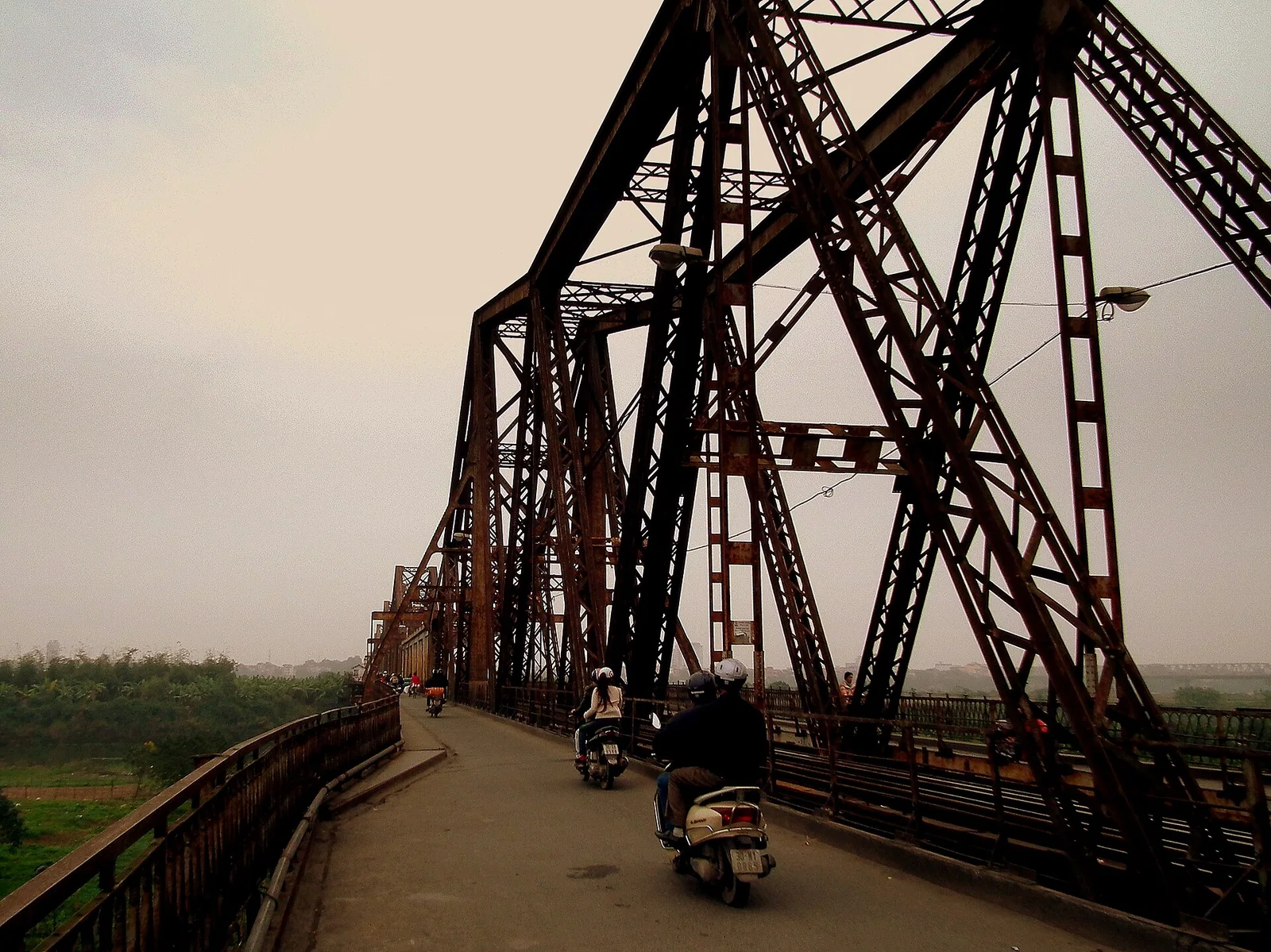
Our full Hanoi accommodation guide breaks these down street by street with what each area is like after dark, which matters more than the map suggests.
The Old Quarter on foot
The Old Quarter is a grid of narrow streets that were historically organised by trade, which is why so many of them are still selling one category of thing next door to each other. It is loud, it is crowded with scooters, and the pavements are parking. You walk in the road. Everyone does. Traffic moves around you if you keep a steady pace and do not make sudden decisions, which is genuinely the technique rather than a joke.
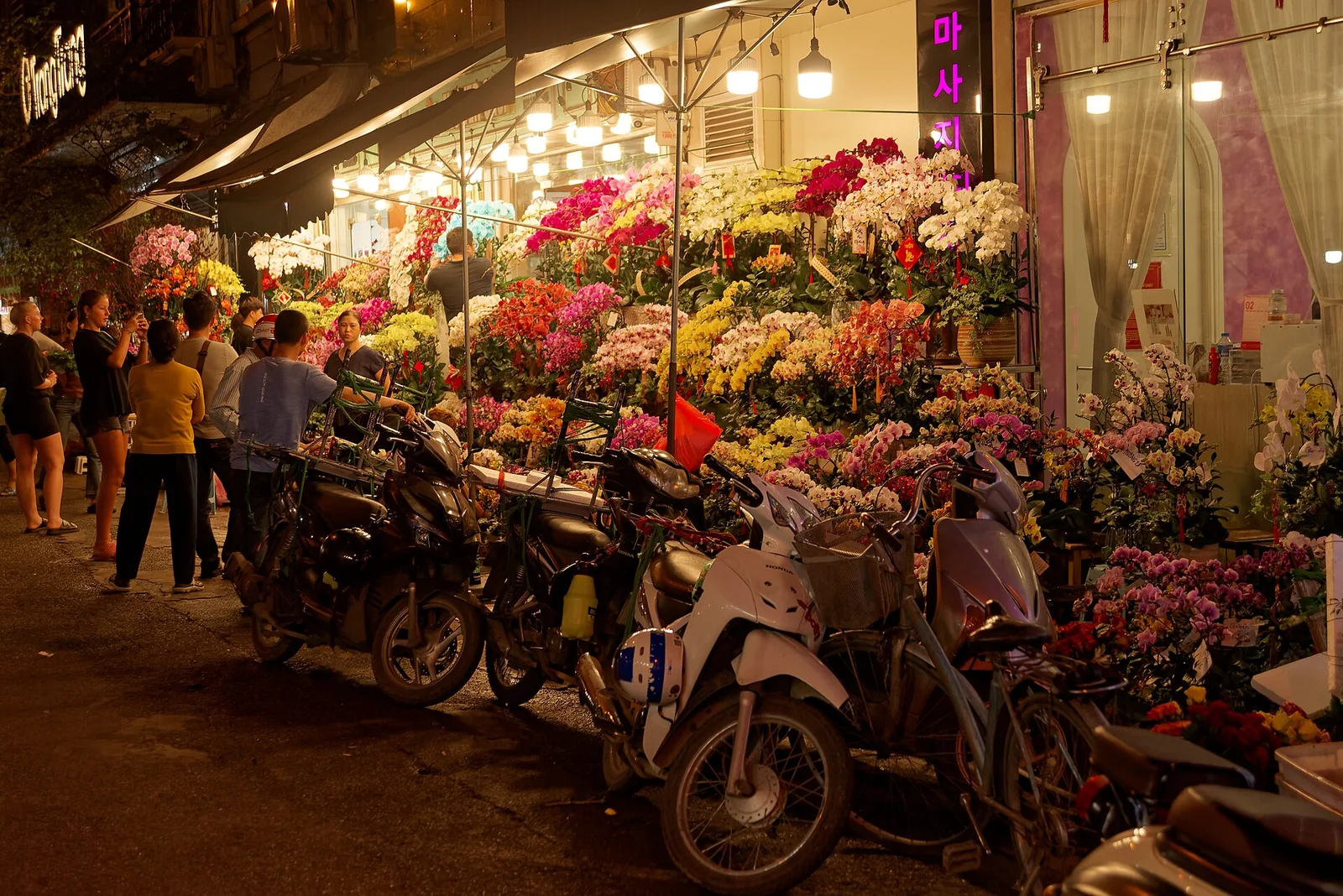
You do not need a route. Two hours of wandering covers most of it, and the reason to stay here rather than somewhere calmer is that you can go out at 21:00 and find something happening. Bia hoi, the cheap draught beer poured at street corners onto plastic stools, is the version of a night out that costs almost nothing and is the most reliably sociable thing in the city.
What the Old Quarter is bad at: sleeping. Rooms facing the street are noisy from early. If you are a light sleeper, ask for a back room or book one street off the main run.
On crossing roads, since it worries almost everyone on the first day. There are very few gaps in Hanoi traffic and waiting for one does not work. Step off at a steady, predictable pace and keep going. Riders are watching you and steering around you, and the thing that causes problems is stopping suddenly or stepping back, because that puts you somewhere the person aiming behind you did not expect. Walk with a local the first couple of times if it helps.
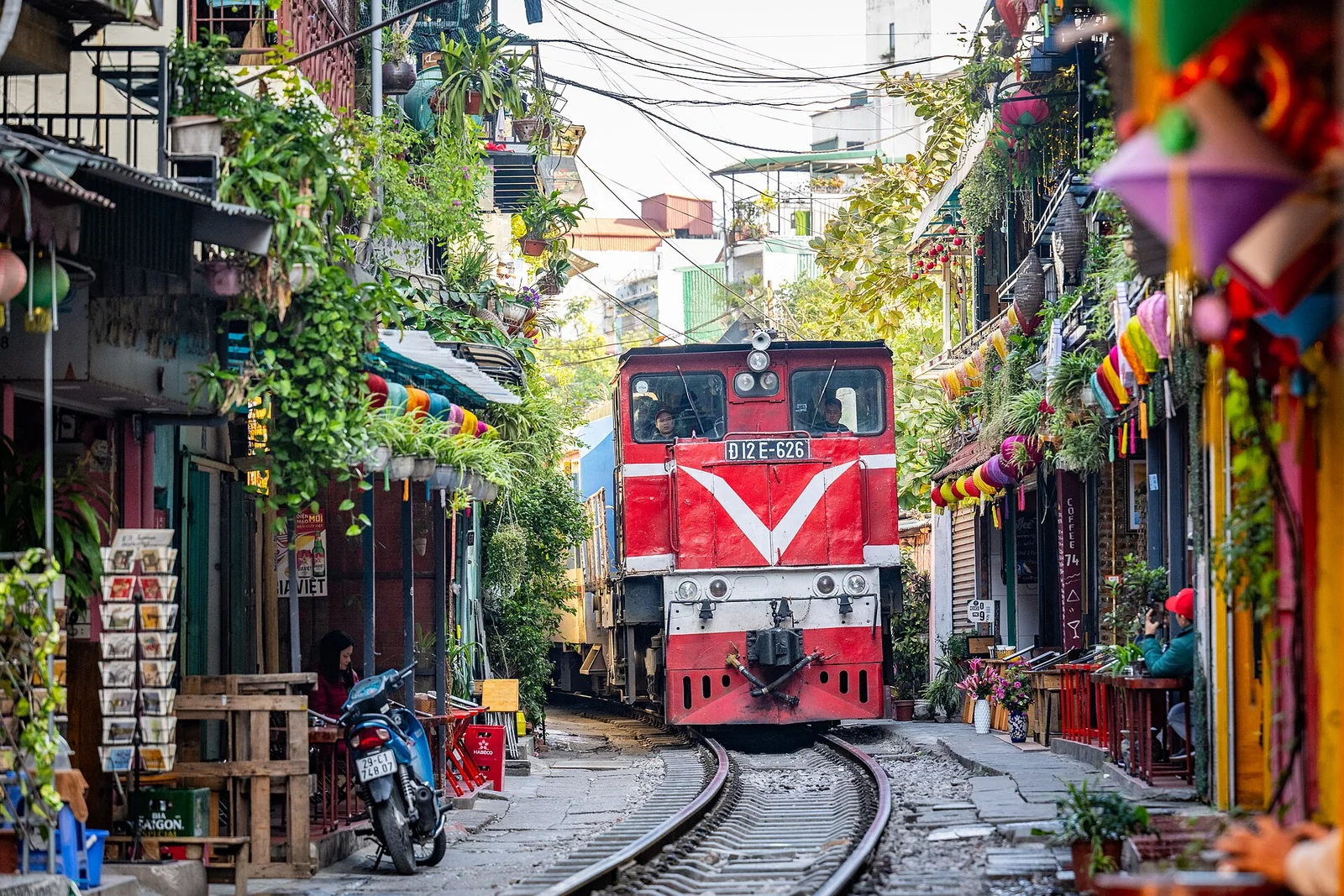
The rhythm of the day also matters more here than in most cities. Early morning, roughly 06:00 to 08:00, is when the lakes fill with people exercising and the breakfast places are at their best. Midday is hot most of the year and quiet. Late afternoon into the evening is when the streets fill again and the beer corners open. If you plan your two days around those three blocks rather than around a list of sights, you will see more of the city and enjoy it more.
Hoan Kiem, the Temple of Literature and Ba Dinh
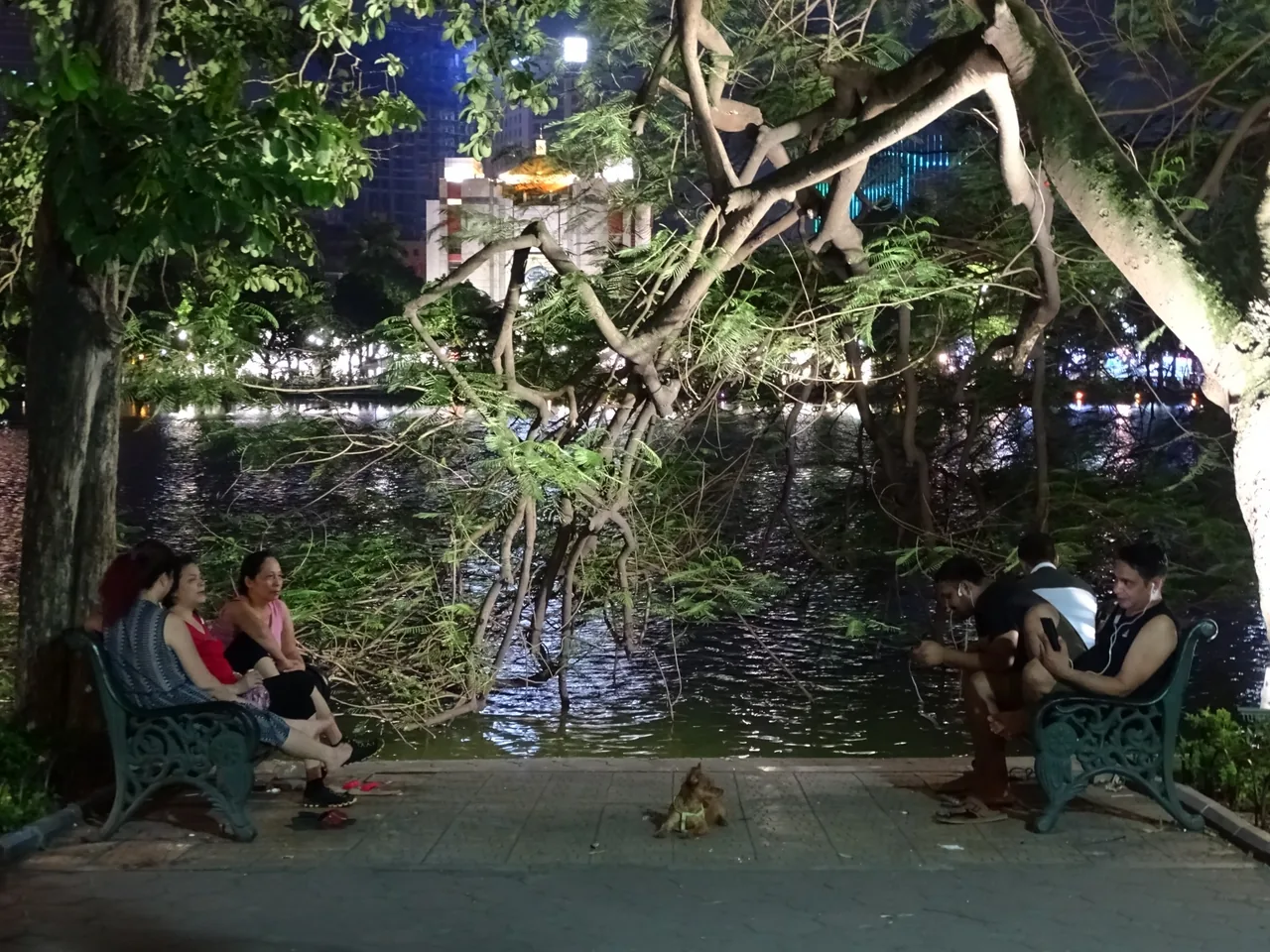
Hoan Kiem LakeMap sits immediately south of the Old Quarter and is the point everyone orients by. Go early if you can. The path around the water is one of the few places in central Hanoi where you can walk a full circuit without negotiating scooters, and it is a much better introduction to the city than the same walk at two in the afternoon in July.
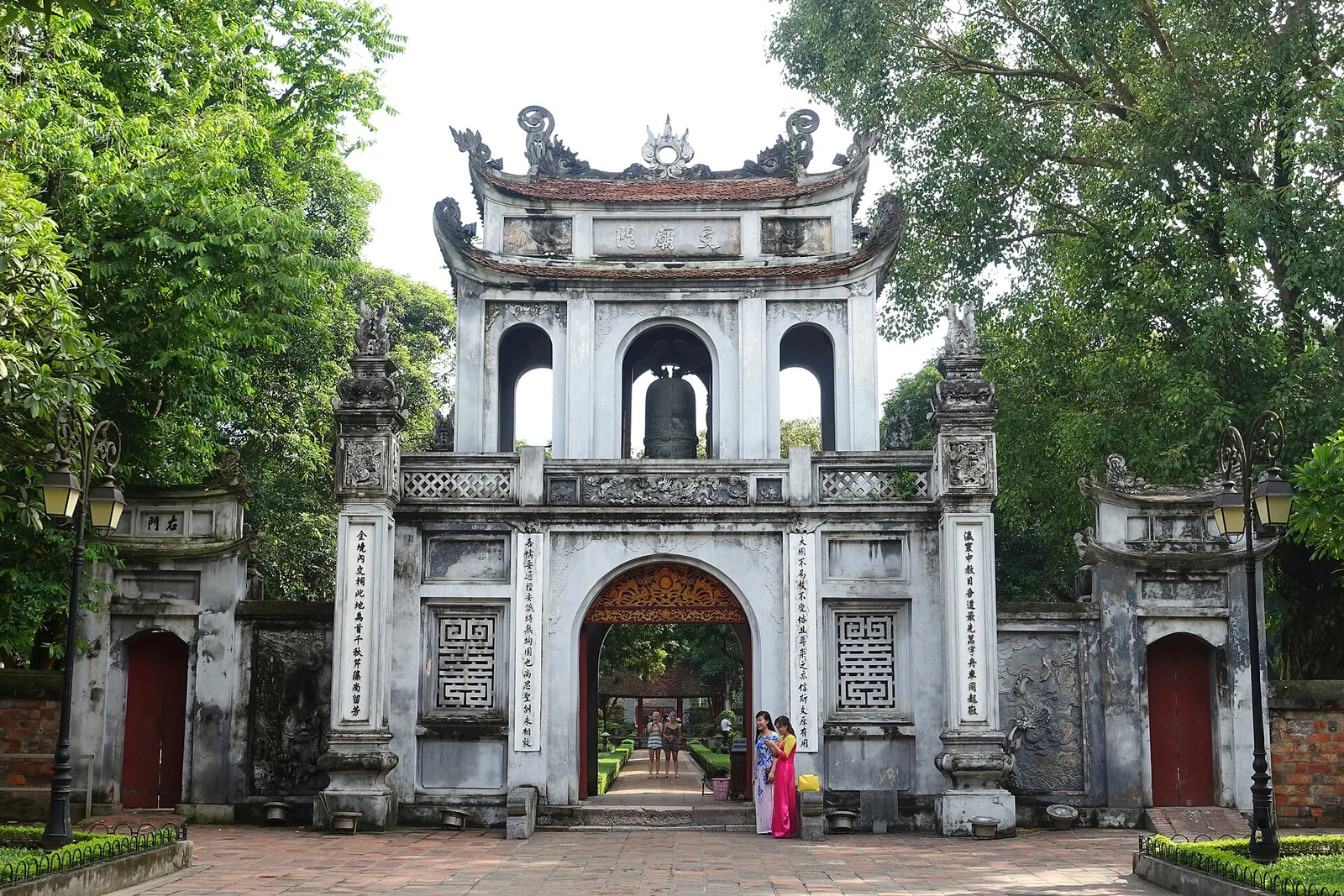
The Temple of Literature is the one ticketed sight in the city centre that most travellers should actually make time for. Entry is about $2.70 (approx. 70,000 VND) and it opens 08:00 and closes 17:00, so it is a morning or early afternoon item rather than something you drop into after dinner. It is walkable from Hoan Kiem, or a short Grab ride if the heat or the drizzle is winning.
Ba Dinh, west of the Old Quarter, is the formal district. Wide streets, official buildings, and a completely different pace from anywhere else in the centre. It is a good area to walk through on the way to somewhere rather than a place to base yourself, unless a particular hotel there appeals to you.
West Lake and why some people prefer it
West Lake, Tay Ho, is the largest lake in the city and the area around it has a distinct character: more residential, more cafes with seating, fewer scooters per square metre, and a large resident foreign population. Rooms tend to be bigger for the money than in the Old Quarter, and the lakeside is genuinely pleasant to walk or run around.
The problem for a short trip is distance. You are far enough from the Old Quarter that spontaneous evenings become planned ones. For a two-day first visit, that is the wrong choice. For a week, or a second visit, or if you are travelling with someone who found the Old Quarter overwhelming last time, it is the right one.
Getting around the city
Grab and Green SM are the default, and city fares are quoted in the app before you accept, so there is no negotiation and no meter to argue about. That single fact removes most of the friction people expect from Vietnamese cities. Our Grab and Green SM guide covers how to set both up and which one to use where.
Within the Old Quarter and around Hoan Kiem, walking beats everything. Distances are short and traffic is slow enough that a car is often no faster than your legs. Bike taxis are the quick way across the city and both apps quote that fare in advance too, so you can compare the two before you commit. Whether you want to be on the back of a scooter in Hanoi traffic is a decision only you can make.
One thing worth knowing about the buses: from 25 June 2026 all subsidised Hanoi bus routes moved to a single integrated electronic ticket, run through an app called The ve giao thong Ha Noi, and paper monthly passes stopped being valid from 1 July. As a visitor you are unlikely to need a monthly pass, but it is a reason not to trust older advice about how to pay on city buses.
Two days, laid out
| When | What | Notes |
|---|---|---|
| Arrival evening | Old Quarter walk, street dinner, bia hoi | Assume 40-60 minutes from Noi Bai before you start |
| Day 2 morning | Hoan Kiem at first light, breakfast nearby | The lake path is busiest and best before 08:00 |
| Day 2 midday | Temple of Literature | About $2.70 (approx. 70,000 VND), closes 17:00 |
| Day 2 afternoon | French Quarter or Ba Dinh on foot, coffee | Egg coffee was invented here; this is the moment for it |
| Day 2 evening | Bun cha or cha ca, then the Old Quarter again | Cha ca is cooked at the table, so leave time for it |
Hanoi in January and February is 10 to 17°C with overcast skies and drizzle that does not really stop, and this is the weather most first-time visitors are least prepared for. It is also the weather the city handles best, because almost everything worth doing here is either indoors, under an awning, or improved by being cold and grey.
| When it is raining | Why it still works |
|---|---|
| Temple of Literature | Courtyards and covered halls; about $2.70 (approx. 70,000 VND), 08:00-17:00 |
| Eating your way through the Old Quarter | Most of it is served under awnings, and the food does not care |
| Egg coffee | A hot, thick drink invented in exactly this climate |
| The French Quarter on foot | Wide pavements and arcades, unlike the Old Quarter |
| A day trip to Ninh Binh | Rowed boats and caves are fine in rain; the bay is not |
What does not work in the drizzle is the bay, which is the reason the weather section pushes cruises out of January and February. In the city, pack a light waterproof rather than an umbrella, because umbrellas and Old Quarter pavements do not get on.
If you have a third day in the city rather than out of it, spend it in West Lake and on food. The full Hanoi travel guide has the longer version, including what to do when it rains for three days straight, which in January and February it will.
8. Ha Long, Lan Ha or Bai Tu Long: picking a bay and a boat
Take an overnight cruise rather than a day trip, and choose Lan Ha Bay unless you specifically want the famous one. The overnight is about the ratio: 4.5 to 5 hours of round-trip driving gets you roughly 24 hours aboard instead of 4 to 6 hours on the water. The bay choice is about crowds, and the gap between the three is much larger than most people expect.
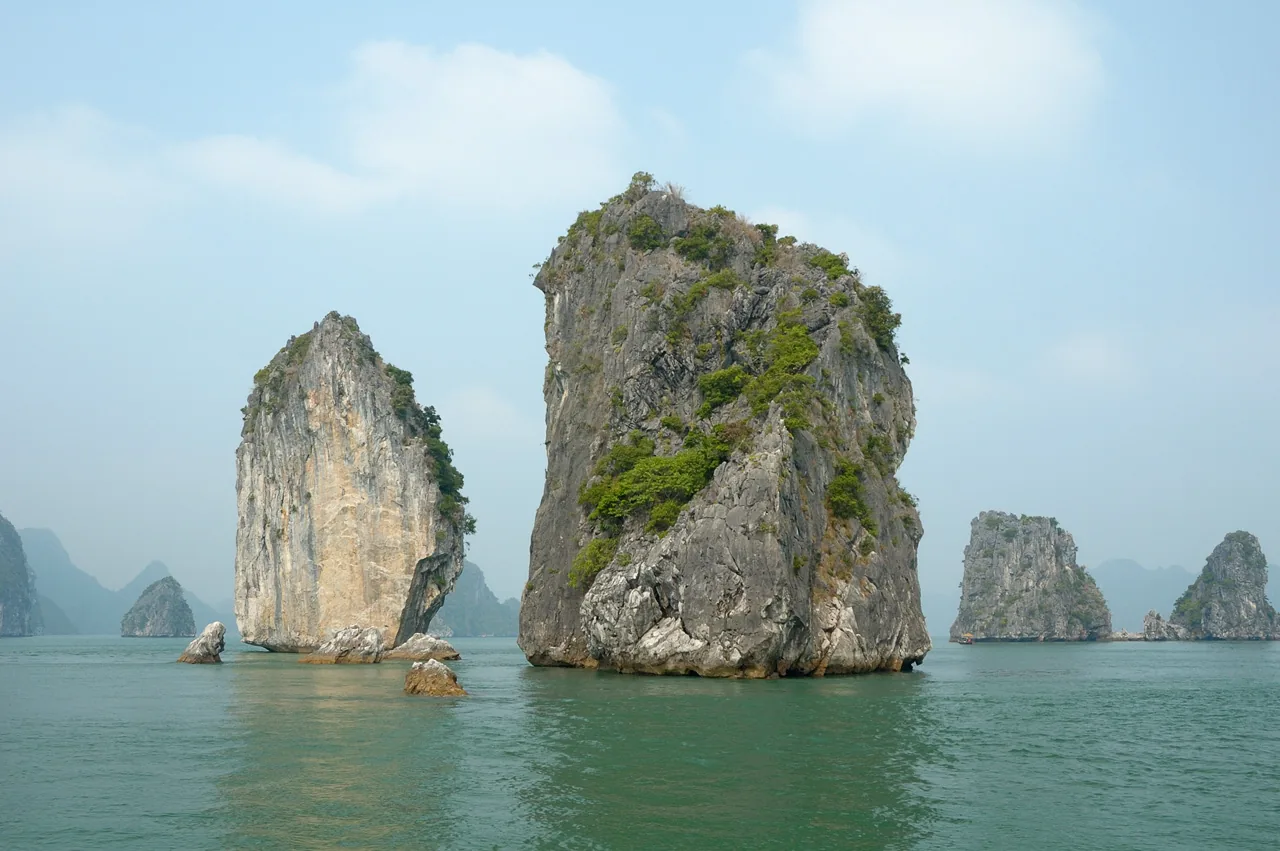
Three bays, three crowd levels
Ha Long BayMap is the name everyone knows, and it is the busiest. In peak season there are more than 500 boats out there. Lan Ha, immediately to the south, runs at roughly 30% of Ha Long’s crowding. Bai Tu Long, to the north-east, runs at about 15%, and you can go long stretches without seeing another boat.
| Bay | Relative crowding | What it has | Departs from |
|---|---|---|---|
| Ha Long | The benchmark, 500+ boats in peak season | The famous scenery, and the most boats on the water | Tuan Chau, Sun Port |
| Lan Ha | About 30% of Ha Long | Cat Ba National Park and beaches, so there is a land option | Got pier (Hai Phong), Cat Ba |
| Bai Tu Long | About 15% of Ha Long | Almost no other boats | Hon Gai |
All three are the same limestone country, which is why the choice comes down to how many other people are looking at it alongside you and what else is on the itinerary. Nobody picks between these three on scenery, and anyone telling you one has better rock than another is selling something.
Lan Ha is the pick for most travellers for one concrete reason: Cat BaMap gives you a national park and beaches, so a fogged-out or rained-off morning is not a wasted day. Bai Tu Long is the pick if quiet is the actual goal and you are prepared for a smaller operator list. Ha Long itself is the pick if you want the specific views you have seen in photographs and you accept the boats around you.
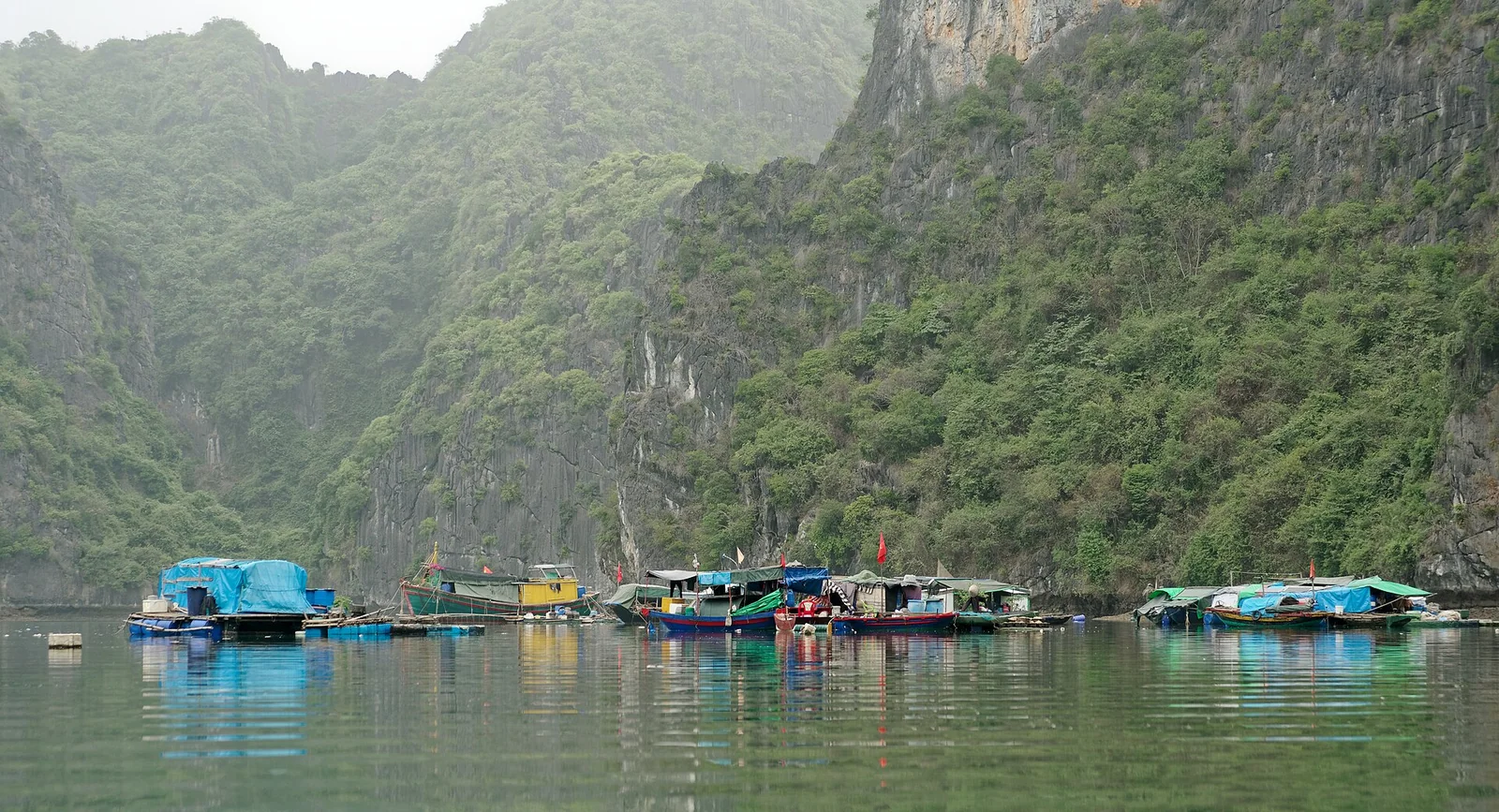
Day trip or overnight: run the numbers
A day cruise is $55 to $110 per person and gives you 4 to 6 hours on the water. An overnight is $130 to $250 per person and gives you about 24 hours aboard. Two nights is $280 to $600.
| Option | Price per person | Time on the water | Driving | Verdict |
|---|---|---|---|---|
| Day cruise | $55-110 | 4-6 hours | 4.5-5 hours round trip | Only if you genuinely cannot spare the night |
| One night | $130-250 | About 24 hours | 4.5-5 hours round trip | The right choice for almost everyone |
| Two nights | $280-600 | About 48 hours | 4.5-5 hours round trip | Worth it on Bai Tu Long or if you want to go further out |
Compare the day trip and the overnight properly. The day trip costs about half as much and gives you about a fifth of the time. Per hour on the water, the overnight is better value, and that is before you account for the part that cannot be bought during the day: the bay after the day boats have gone home, and the bay at first light before they come back.
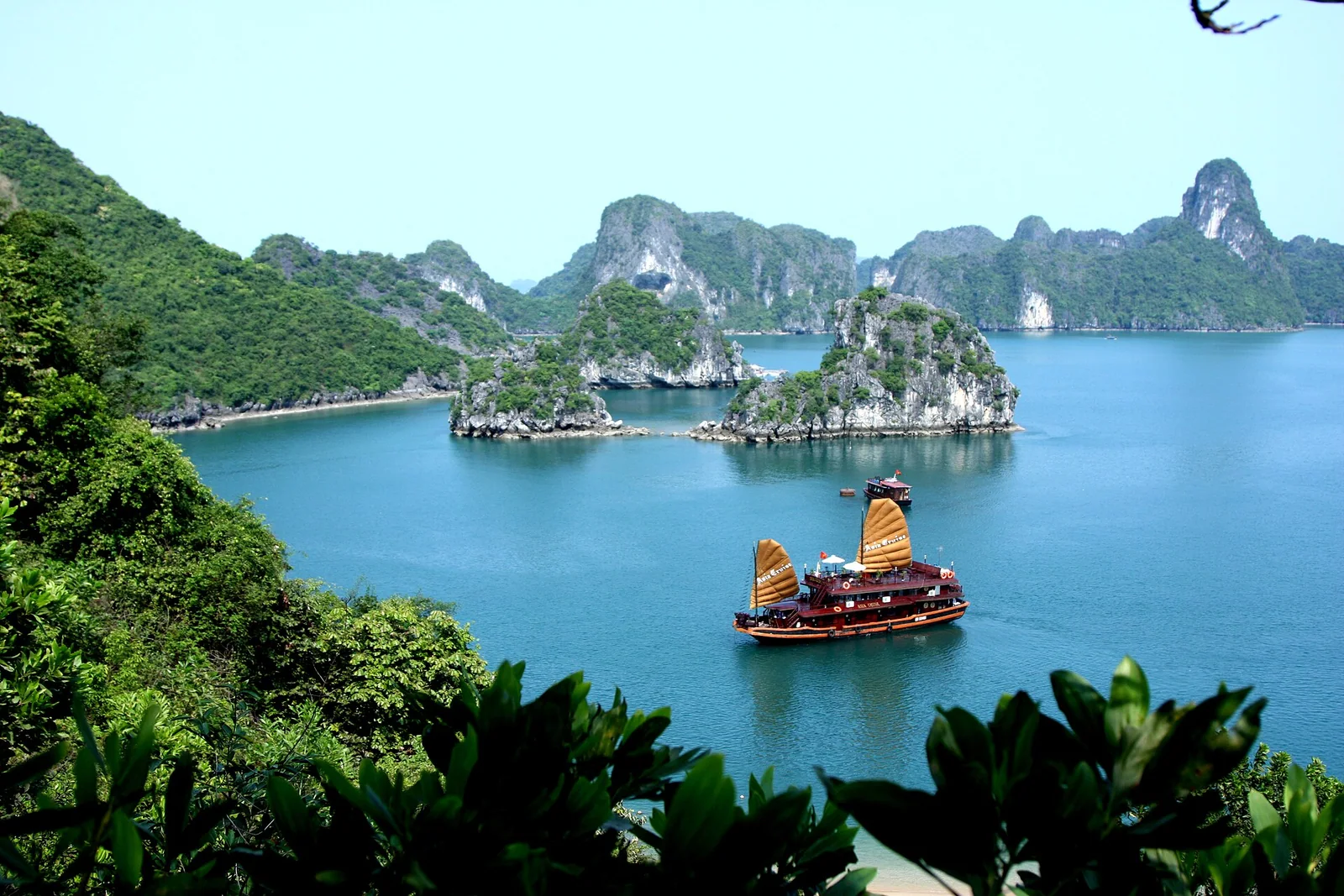
The two-night option is a smaller step up than it looks in price terms, and it makes most sense on Bai Tu Long, where the point is distance from other boats and the second day lets you actually get some.
What the price tiers mean
Within the $130 to $250 overnight band there are two distinct tiers, and the difference is real.
| Tier | Per person, one night | What you are getting |
|---|---|---|
| Reliable all-inclusive floor | $130-160 | A properly run boat, meals included, activities included, no surprises |
| Four and five star | $180-250 | Better cabins, better food, more space per passenger, smaller groups |
| Below $130 | Under $130 | See the warning below |
$130 to $160 is the floor for a boat you can rely on with everything included. That phrase matters, because a cheaper quote may be cheaper for a reason: bay admission, kayaking, the transfer or the drinks sitting outside the headline number. Add all four back before you compare two boats, and compare the totals rather than the advertisements.

Above $180 you are into the 4 and 5 star tier. Ask what specifically changes at that price on the boat in front of you, because cabin size, the food and the number of passengers are the three things worth paying for and the three things a listing tends to be vaguest about. Whether the difference is worth $50 to $90 more depends entirely on how you feel about sharing a sundeck.
Bay admission, tips and the extras
Bay admission is charged by route and runs $9.90 to $11.80 (approx. 260,000 to 310,000 VND). Routes 01 and 02 are $11 (approx. 290,000 VND). An overnight stay in the bay is charged differently, at $20.90 to $28.50 (approx. 550,000 to 750,000 VND). Most cruise fares include this. Confirm it anyway, because it is the line most worth checking when two headline prices look different.
Tipping on board is conventional and runs $5 to $10 per person for the crew. It is not compulsory and it is not built into the fare, so budget for it rather than meeting it for the first time on disembarkation morning. If you want to know how and when it is handled on your boat, that is a fair question to put to the operator alongside the others.
| Item | Cost | Usually included? |
|---|---|---|
| Bay admission, day routes | $9.90-11.80 (approx. 260,000-310,000 VND) | Usually yes |
| Bay admission, routes 01 and 02 | $11 (approx. 290,000 VND) | Usually yes |
| Overnight bay charge | $20.90-28.50 (approx. 550,000-750,000 VND) | Usually yes on overnight boats |
| Transfer from Hanoi | $12-20 | Usually yes on cruise packages |
| Crew tip | $5-10 per person | No |
| Drinks on board | Varies | No |
What actually happens on board
Schedules differ between operators, so ask for the hour-by-hour itinerary before you book rather than working from someone else’s. What is fixed by the numbers rather than by the operator is this: you are collected from your Old Quarter hotel, the drive is 2h15 to 2h30 each way, and an overnight puts you aboard for about 24 hours against 4 to 6 hours on the water for a day trip.
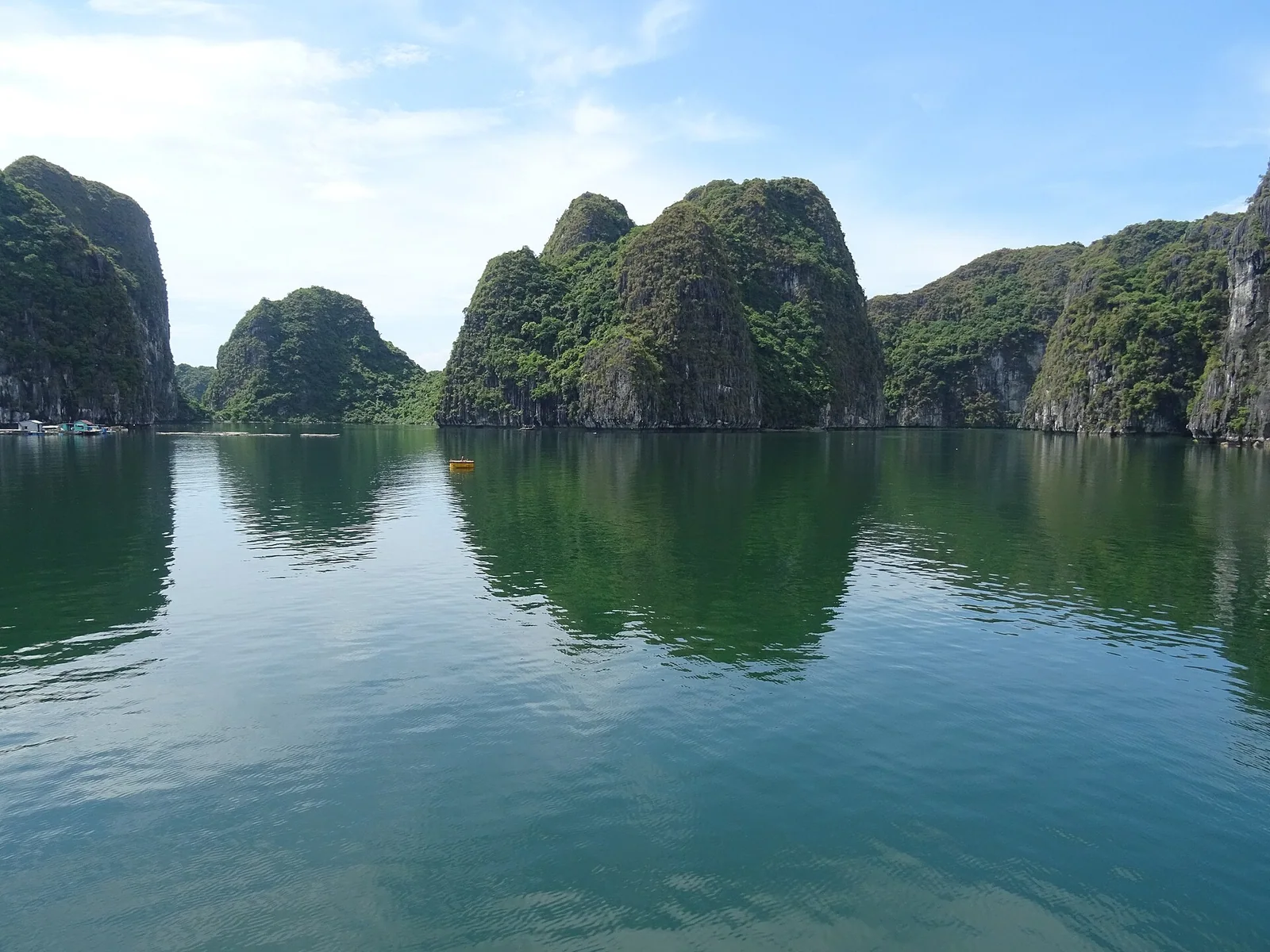
What that extra time is actually for is the evening and the early morning, once the day boats have gone and before they come back. That is the whole argument for the overnight, and it is the one thing a day cruise cannot sell you at any price.
If your route includes Ti Top Island, the climb to the top is about 400 steps. That is a real staircase in humid weather and not something to attempt in flip flops. Kayaking and cave entries are the two activities most worth confirming are included, because they are also the two you are most likely to have assumed. Our Ha Long Bay cruise guide goes through operator selection, cabin choice and what to check in the terms before you pay.

Booking order and dates
Book the boat first and build the week around it, for the reasons in the weather section: October to December is the best window of the year, March and April the second best, and July to September carries typhoon cancellation risk. Boats have fixed cabin counts, and October to December is the window everybody else is aiming at too.
If you are travelling in the peak window and find that everything reasonable is full, look at Bai Tu Long before you drop to a cheaper Ha Long boat. A mid-priced boat on the emptiest of the three bays is a better day than a bargain boat on the busiest one, and Bai Tu Long is the bay most people never think to check.
Before you pay, there are six questions that separate a straightforward booking from a bad afternoon. Ask them by message so you have the answers in writing.
- Is bay admission included? Day routes are $9.90 to $11.80 (approx. 260,000 to 310,000 VND) and the overnight charge is $20.90 to $28.50 (approx. 550,000 to 750,000 VND). Most fares include it; the ones that do not are the ones advertising a low headline number.
- Is the Hanoi transfer included? A cruise shuttle is $12 to $20 and is usually inside the fare, but not always, and $20 is a meaningful share of a $130 boat.
- Which bay, and which pier? Ha Long departs Tuan Chau or Sun Port, Lan Ha departs Got pier in Hai Phong or Cat Ba, Bai Tu Long departs Hon Gai. The pier tells you which bay you are actually getting.
- How many cabins on the boat? This is the single best proxy for how crowded the sundeck and the day activities will be.
- What happens if the sailing is cancelled for weather? Make them state the outcome, and ask separately whether it differs from a cancellation you make yourself. Do not assume the two are the same clause.
- Which activities are included and which are extra? Name kayaking and cave entries specifically, because those are the two you are most likely to have assumed.
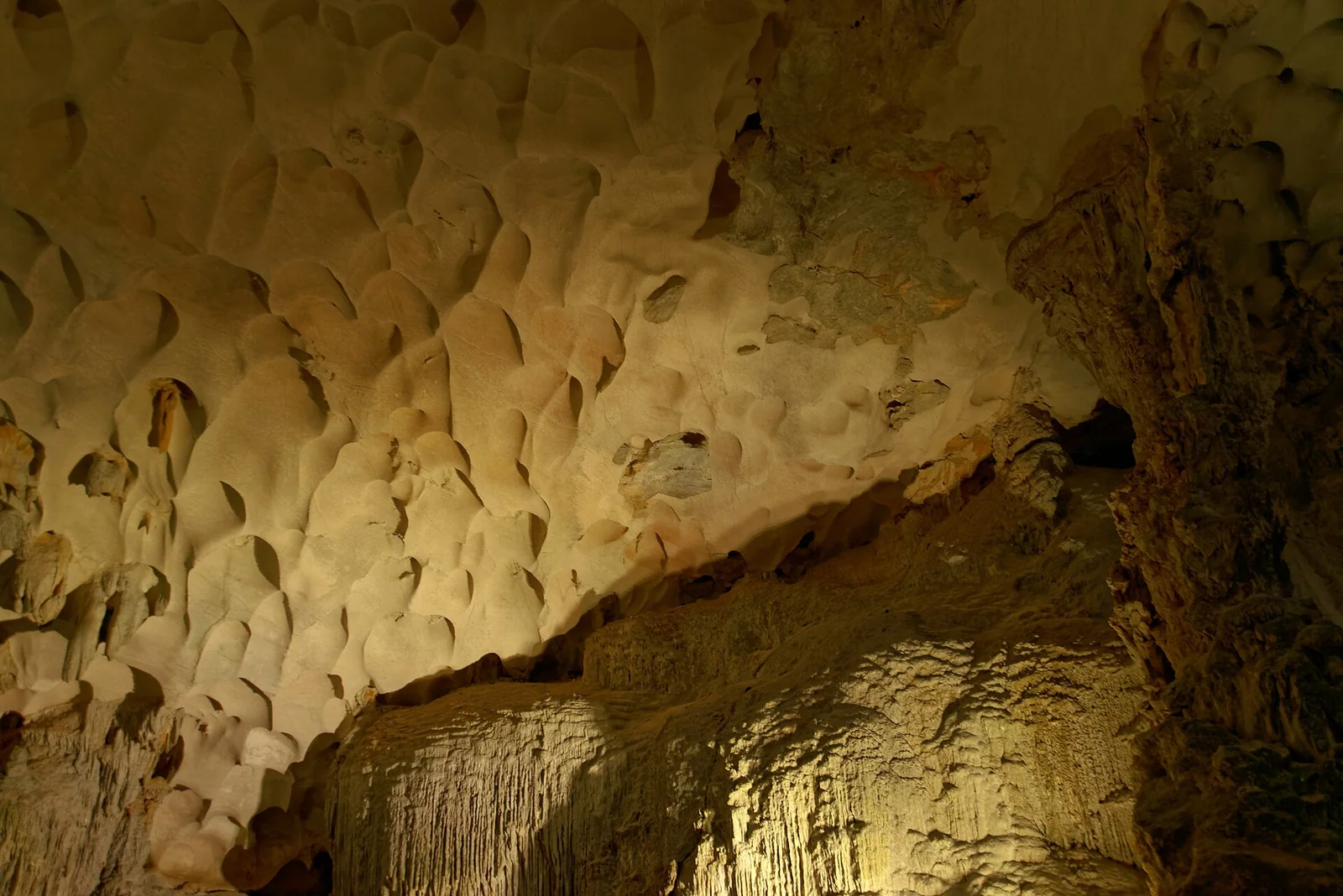
If an operator will not answer those in writing, that is the answer. The bay has hundreds of boats and no shortage of alternatives, and the difference between the good and the bad end is not the scenery, which is identical, but whether the day runs as described.
| You are | Take this |
|---|---|
| On a five-day trip, first visit | One night on Lan Ha, $130-160 all-inclusive |
| Travelling in January or February | Lan Ha, so Cat Ba National Park covers a fogged morning |
| Wanting the photographs specifically | Ha Long, one night, and accept the boat traffic |
| Prioritising quiet above everything | Bai Tu Long, two nights, from Hon Gai |
| Unable to spare a night | A day cruise at $55-110, knowing the ratio is poor |
| Travelling July to September | Any of them, booked early in your trip with a spare day after |
9. Sapa: two nights minimum, and what to do with them
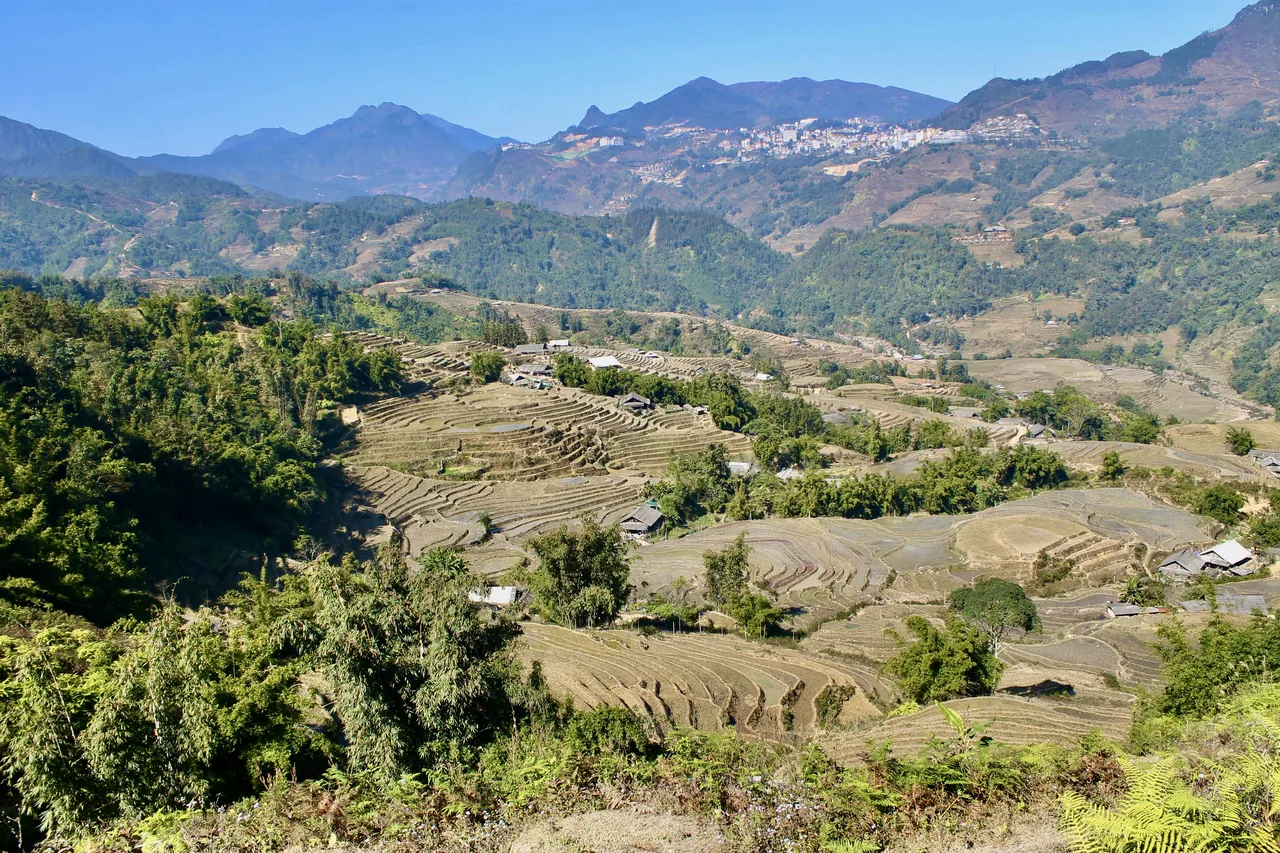
Sapa needs two nights and rewards three, because the round trip is 11 to 12 hours and the valley walking is the reason to come. The town itself is a hill station that has been built on hard and fast, and if you only see the town you will not understand why anyone recommended it. The walking, the villages and the terraces are 5 to 15 km out, and that is where the two nights go.
Why one night does not work
Run the timings. If you take the night train, you reach Lao Cai at about 06:10 and Sapa town about an hour later after 35 km by shared minibus. You have not slept properly. A single night in Sapa then means you leave the following evening, which gives you one full day, and that day starts with you tired.
If you take the day van instead, you leave Hanoi in the morning, arrive 5.5 to 6 hours later in the afternoon, and your one night means departing the next afternoon. That is roughly half a day on the ground for 11 to 12 hours of travel, and it is the worst ratio available anywhere in northern Vietnam.
Two nights gives you one clean full day plus two halves, which is enough for a valley trek and either Fansipan or a second walk. Three nights gives you two full days, which is enough to do a longer trek with a homestay night in the middle. That is the version most people who loved Sapa actually did.
Night train or day van
| Option | Time | Price | What it is like |
|---|---|---|---|
| Limousine van or sleeper bus | 5.5-6 hours | $13-18 (approx. 320,000-450,000 VND) | Straight through on the Noi Bai to Lao Cai expressway, door to door |
| Night train SP1 or SP3, 4-berth soft sleeper | 8 hours, roughly 22:00 to 06:10 | From about $15.20 (approx. 400,000 VND) | Shared cabin, saves a hotel night, then 35 km more to Sapa |
| Night train, 2-berth deluxe | Same | $133-140.60 (approx. 3,500,000-3,700,000 VND) | Private cabin; the usual booked range across all classes is $22-65 |
| Lao Cai station to Sapa town | About 1 hour, 35 km | A few dollars | Shared minibus from the station |
The van is faster and simpler. 315 km in 5.5 to 6 hours works because the Noi Bai to Lao Cai expressway runs almost the whole way, and it drops you in Sapa town rather than 35 km short of it.
The train is slower on paper at 8 hours, and closer to 9 door to door once you add the transfer from Lao Cai. What it does is convert a travel leg into a night you were going to spend somewhere anyway. That is worth a lot on a seven-day trip, and it is why plenty of people take the train up and the van back.
The 2-berth deluxe cabins at $133 to $140.60 (approx. 3,500,000 to 3,700,000 VND) are a large jump from the $15.20 (approx. 400,000 VND) four-berth, and most travellers land somewhere in the $22 to $65 band across the various classes and operators. Book the four-berth unless you specifically need a private cabin, because you are asleep for most of it.
The valley, which is the actual reason to come
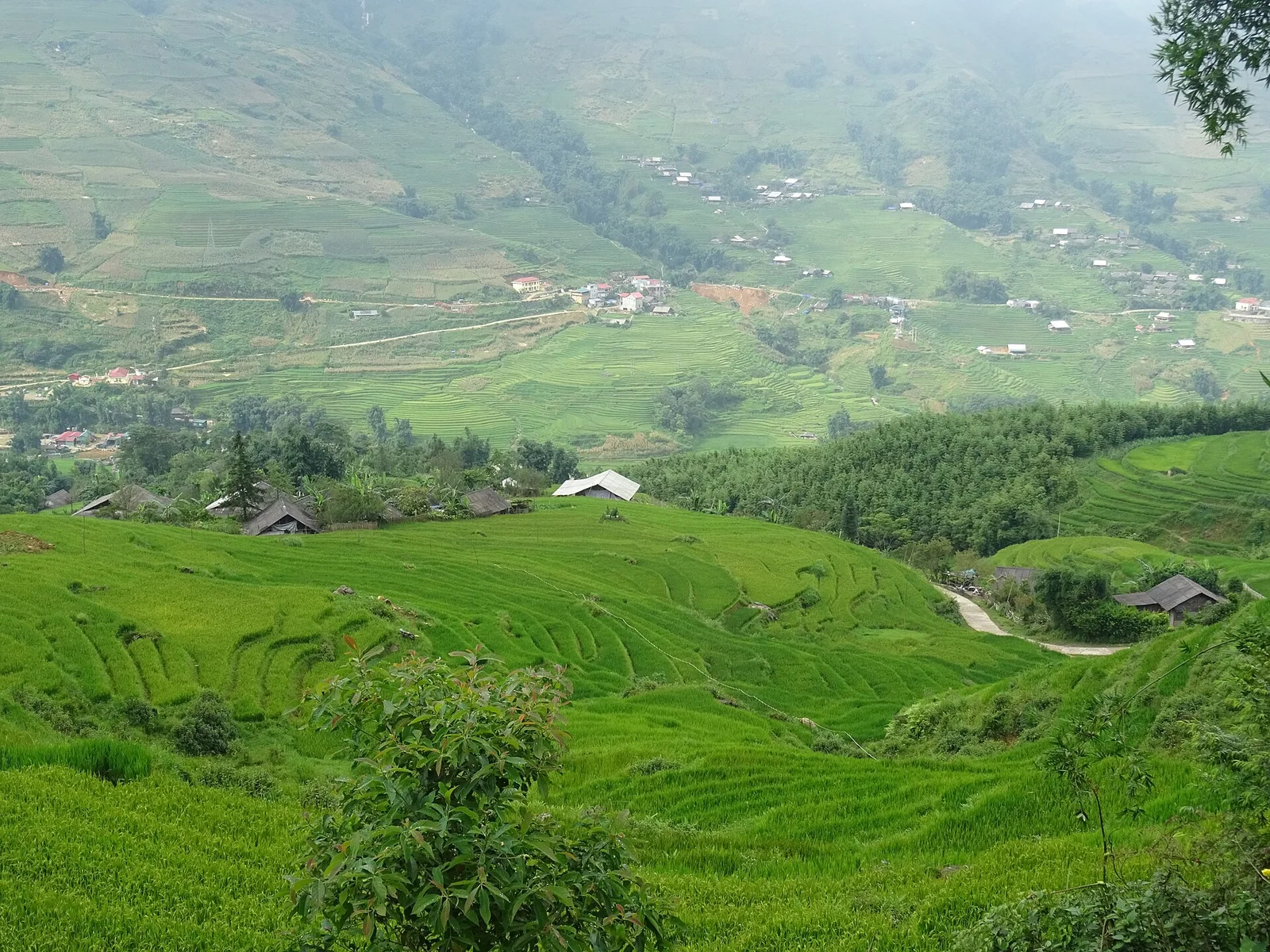
The Muong Hoa valleyMap runs about 15 km south-east of Sapa town, and this is where the terraced fields and the villages are. Most of the well-known walks either start in it or end in it.
| Route | Distance | Difficulty | Time |
|---|---|---|---|
| Cat Cat loop | 3-4 km | Easy | 2-3 hours |
| Ta Phin | 8-10 km | Easy to moderate | Half a day to a full day |
| Lao Chai to Ta Van | 10-14 km | Moderate | 1-2 days |
| Y Linh Ho to Lao Chai to Ta Van | 12-16 km | Moderate to hard | 2 days |
| Fansipan summit on foot | 11-19 km | Hard | 2 days, permit and guide required |
Match the route to the time you have. On a two-night stay with one full day, Lao Chai to Ta Van in a single day is the standard answer and it is a good one: 10 to 14 km through the terraces, ending in a village you can be picked up from. On three nights, do the same route over two days with a homestay night in Ta Van, which is a completely different experience because you are in the valley in the evening and the morning rather than passing through it at midday.
| Nights in Sapa | Do this | Leave out |
|---|---|---|
| 2 | Lao Chai to Ta Van in one day, plus Fansipan if it is clear | Any two-day trek, and Bac Ha |
| 3 | Lao Chai to Ta Van over two days with a valley homestay night | Cat Cat, unless you want an easy arrival afternoon |
| 3, with a Sunday in them | Bac Ha market as a full day, plus one valley trek | Fansipan, unless you have a fourth day |
| 4 or more | Y Linh Ho to Lao Chai to Ta Van over two days, Fansipan, Ta Phin | Nothing much |
Cat Cat is the shortest option and the closest to town. It is fine as an afternoon when you arrive and it is not what people mean when they talk about trekking in Sapa. Ta Phin is the quieter half-day, in a different direction from the main valley.
The Fansipan walking route is a serious two-day mountain trek requiring a permit and a guide, and it is not something to add on to a general sightseeing trip. If you want the summit and you are not a hiker, take the cable car.
Fansipan and the cable car
FansipanMap is 3,143 m and the highest point in Indochina, which is the reason it is on everyone’s list. Getting up it is now an engineering question rather than a mountaineering one.
The cable car is a three-rope system covering 6,292 m of horizontal distance and 1,410 m of vertical, in about 15 to 20 minutes. That works out to roughly a 1 in 4.5 average gradient across the whole span, which is why the cabins are large and the ride is stable rather than swinging. From the upper station you still have to gain the last stretch to the summit, either on a small funicular or on about 600 stone steps.
| Element | Figure | What it means in practice |
|---|---|---|
| Summit height | 3,143 m | Highest in Indochina; cold and often in cloud |
| Cable car length | 6,292 m | Three-rope system, large cabins |
| Vertical gain | 1,410 m | You go from valley weather to summit weather in one ride |
| Ride time | 15-20 minutes | Plan an hour with queueing at each end |
| From upper station to summit | Funicular or about 600 stone steps | The steps are steep and at altitude; the funicular is the sensible option |
| Ticket | About $32.30 (approx. 850,000 VND) on a weekday | Higher at weekends and on public holidays |
Whether it is worth $32.30 depends on one thing: cloud. Gaining 1,410 m in about 20 minutes means you can leave a clear valley and arrive inside a cloud. Check the ticket terms before you buy and do not assume a white-out entitles you to anything. The practical handling is to keep Fansipan flexible in your itinerary rather than fixing it to a particular day, look at the mountain in the morning, and go on the day it is clear.
The weekday and weekend pricing difference is another reason to stay flexible. If your two nights include a weekday, use it.
What everything costs in Sapa
| Item | Price | Notes |
|---|---|---|
| Fansipan cable car | About $32.30 (approx. 850,000 VND) weekday | Higher at weekends and holidays |
| Cat Cat village | About $5.70 (approx. 150,000 VND) | The most expensive village entry, and the closest to town |
| Other valley and conservation entries | $2.85-3.40 (approx. 75,000-90,000 VND) | Charged per valley or protected area |
| Cong Troi viewpoint | About $4.60 (approx. 120,000 VND) | Sits at roughly 2,000 m |
| Ham Rong hill | About $2.70 (approx. 70,000 VND) | In town, an easy fill for a spare hour |
| Hmong or Dao guide, per day | $1.90-26.60 (approx. 50,000-700,000 VND) | A very wide band; agree exactly what is included first |
| Scooter rental | About $5.70 (approx. 150,000 VND) per day | Useful for reaching trailheads and viewpoints |
That guide range needs a word of warning, because $1.90 and $26.60 cannot be the same product and the price on its own tells you nothing about which one you are being offered. Settle the hours, the route, whether lunch is included and whether they walk you back with you, before any money is discussed. If the answer to any of those is vague, so is the number.
There is no single Sapa ticket. Entries are charged by valley or conservation area, so a day that crosses two of them pays twice, and it is worth knowing which areas your route touches before you set off. Cat Cat at about $5.70 is the outlier on price, and it is also the closest to town.
Town hotel, valley homestay, and the Sunday market
You have two real options for where to sleep. A hotel in Sapa town with a view over the valley gives you restaurants, shops, easy transport and heating. A homestay down in the valley in Ta Van or Lao Chai gives you the fields in the morning and the evening, which is the whole point of coming, and a much quieter night.
The compromise that works on a three-night stay is one night in town and two in the valley, or the reverse. You get the walking access and the restaurants, and you only move your bag once.
One thing to check against your dates: the Bac Ha Sunday market is about 3 hours by car from Sapa, so it is a full-day commitment and only possible if one of your days is a Sunday. If your Sapa days include one, it is a strong use of it. If they do not, do not try to make it work.
Our Sapa travel guide covers the individual villages, homestay selection and the trekking routes in more detail than fits here.
10. Ninh Binh: Trang An or Tam Coc, and how to do it in a day
Do Trang An rather than Tam Coc if you only have time for one boat, and add Hang Mua for the view down over the whole thing. Trang An is $9.50 (approx. 250,000 VND), runs 2.5 to 3.5 hours and takes you through up to nine caves. Tam Coc is cheaper and shorter at $4.60 to $5.70 (approx. 120,000 to 150,000 VND) plus $3.80 (approx. 100,000 VND) entry, for 1.5 to 2 hours and three caves. For a single visit, Trang An gives you more of the landscape.

They are not the same place
This is the single most common Ninh Binh mistake, and it is easy to make because both are rowed boat trips through limestone. Trang AnMap and Tam CocMap have separate piers, separate ticketing, different prices and different durations. Booking one and turning up at the other is a wasted morning.
| Trang An | Tam Coc | |
|---|---|---|
| Boat price | $9.50 (approx. 250,000 VND) | $4.60-5.70 (approx. 120,000-150,000 VND) |
| Separate entry fee | No, it is in the boat price | Yes, $3.80 (approx. 100,000 VND) |
| Duration | 2.5-3.5 hours | 1.5-2 hours |
| Caves | Up to 9, depending on route | 3 |
| Boat sharing | Shared, 4-5 people | Shared |
| Route choice | Three fixed routes, pick one | One route |
Total cost is close: about $9.50 for Trang An against $8.40 to $9.50 for Tam Coc once you add the entry fee. So price is not the deciding factor. Time is. Trang An is roughly twice the length for the same money, and the extra hour is spent going through more caves rather than sitting in a queue.
Tam Coc’s case is the rice. The fields along the Tam Coc stretch turn gold from late May into mid June, at harvest, and during that window Tam Coc is the better of the two. Outside it, take Trang An.
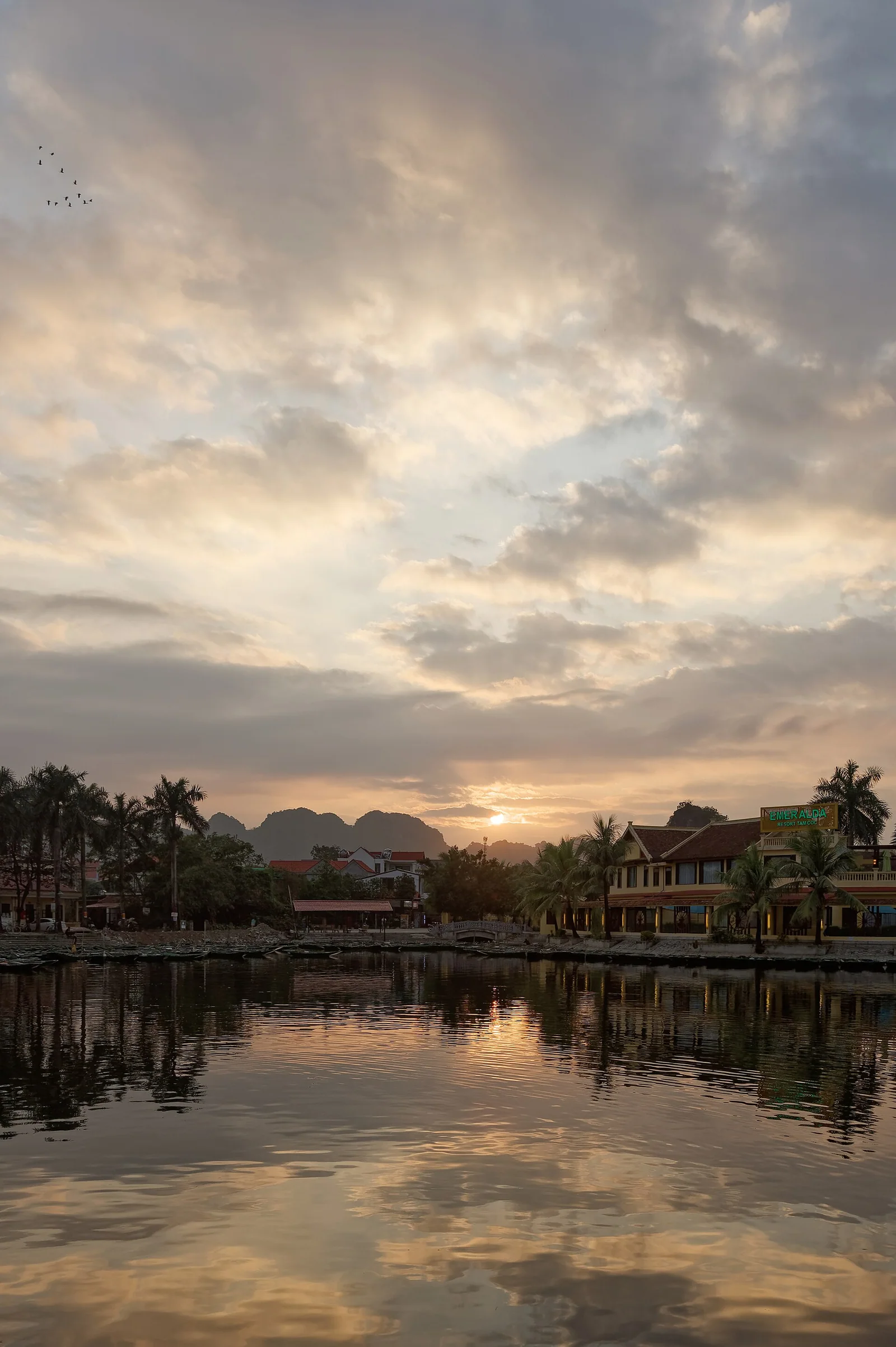
The three Trang An routes
You pick one route when you buy the ticket and you cannot mix them, so it is worth knowing what you are choosing between before you are at the counter with a queue behind you.
| Route | What it covers | Pick it if |
|---|---|---|
| Route 1 | Nine caves and three temples | You want the maximum amount of the landscape in one trip |
| Route 2 | Includes the Kong film set | You want the film location, or you are travelling with teenagers |
| Route 3 | The longest cave, Hang Bang, over 1 km, and the quietest route | You want fewer boats around you |
Route 1 is the default recommendation for a first visit, because nine caves and three temples is the fullest version of what Trang An is. Route 3 is the one to take if it is a busy weekend or a holiday, because a 1 km cave and a quieter waterway is a better experience than the best route in a queue of boats.
All three are rowed, shared with four or five people, and run 2.5 to 3.5 hours. Bring water and something for the sun, because you are sitting still in an open boat for most of it.
Hang Mua, Hoa Lu, Bai Dinh and Bich Dong
Beyond the boat, four things are worth knowing about, and they are all cheap.
| Site | Cost | What it is | Effort |
|---|---|---|---|
| Hang Mua | $3.80 (approx. 100,000 VND) | The viewpoint above the valley | About 500 steps |
| Hoa Lu | $0.76 (approx. 20,000 VND) | The old capital site | Flat, easy |
| Bai Dinh | About $2.30 (approx. 60,000 VND) for the electric cart | A very large temple complex | Long distances, hence the cart |
| Bich Dong | Free | Cave pagoda | Some steps |
Hang Mua is the one to prioritise if you only add one. The 500 steps are the price of the view that appears in every photograph of Ninh Binh, looking down over the river and the peaks. It is a real climb in humidity and the steps are uneven, so allow more time than the distance suggests and do it early or late rather than at midday.
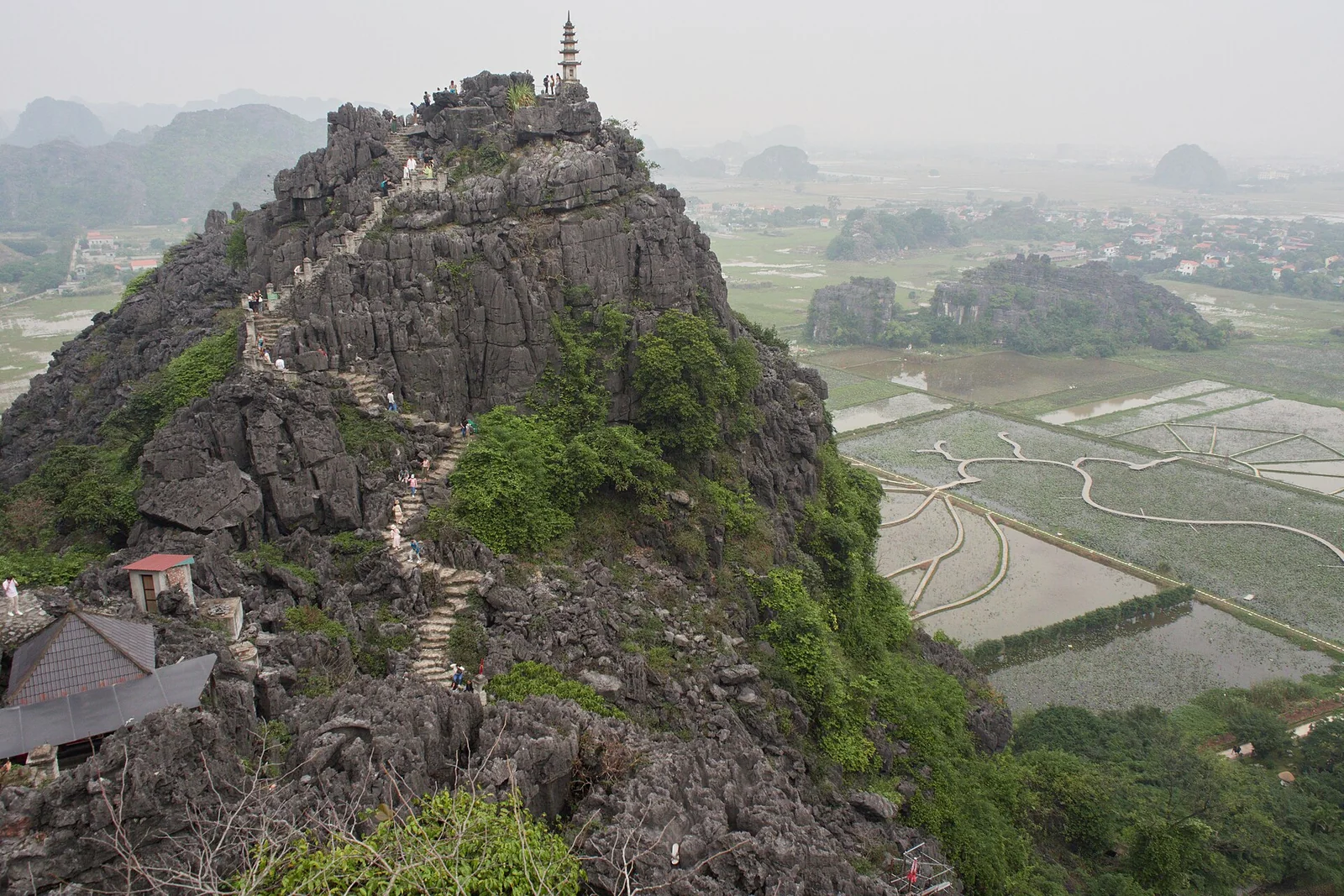
Bai Dinh’s electric cart at about $2.30 sounds like an optional extra and mostly is not. The complex is large enough that the cart exists for a reason, and $2.30 to skip the walking between sections of it is the easiest small decision of the day. Bich Dong is free, which makes it easy to add if you have twenty minutes.
Tipping the rower is conventional at $0.76 to $1.90 (approx. 20,000 to 50,000 VND). On the Trang An routes that is two and a half to three and a half hours of rowing, most of it through caves where they are also steering. Have the notes ready before you get off rather than searching your bag on a moving boat.
Getting there, and whether to take a tour
| Option | Time each way | Price | Notes |
|---|---|---|---|
| Limousine van | 1.5-2 hours | $6-10 | Roughly hourly from the Old Quarter |
| Guided day tour | 1.5-2 hours | $25-55 | Includes transport, boat, entries and lunch |
| Private car | 1.5 hours | $60-90 per vehicle | Your own schedule, splits well between four |
| Public bus | 2-2.5 hours | $3-5 | From Giap Bat terminal |
| Train | Varies | Varies | Runs, but the station is not next to the sites |
Do the arithmetic on the tour, because it comes out better than people expect. Doing it yourself with a van is $12 to $20 return, plus $9.50 for the Trang An boat, plus $3.80 for Hang Mua, which is $25.30 to $33.30 before lunch and before any local transport between the sites, which are several kilometres apart. A guided day tour at the bottom of its $25 to $55 range includes all of that plus lunch and the transfers between sites.
So the tour wins on price at the low end, and the reason to do it independently is control rather than money: your own timings, the route you want at Trang An, and as long as you like at Hang Mua.
The private car at $60 to $90 per vehicle is the option people overlook. Split between four it is $15 to $22.50 each, which is close to two van seats, and you get a driver who waits for you between sites. For a group of three or four this is usually the best version of a Ninh Binh day.
Day trip or overnight
At 95 km and 1.5 to 2 hours each way, Ninh Binh is the one destination in the north that genuinely works as a day trip. The 3 to 4 hour round trip leaves 7 to 8 hours on the ground, which covers one boat route, one viewpoint and lunch without rushing.
Here is that day laid out, assuming a morning van from the Old Quarter and an independent rather than guided trip.
| Time | What | Cost |
|---|---|---|
| Around 08:00 | Van leaves the Old Quarter, allowing for hotel pickups | $6-10 |
| Around 10:00 | Arrive; go straight to the Trang An pier | — |
| 10:15 to 13:30 | Trang An boat, route 1 or route 3, 2.5-3.5 hours | $9.50 (approx. 250,000 VND) plus a $0.76-1.90 tip |
| Around 14:00 | Lunch | Low |
| 15:00 to 16:30 | Hang Mua, about 500 steps, and the view over the valley | $3.80 (approx. 100,000 VND) |
| Around 17:00 | Van back to Hanoi | $6-10 |
| Around 19:00 | Back in the Old Quarter | — |
That is a full day and it has no slack in it, which is why the boat goes first. If the pier is busy and you lose an hour, you drop Hang Mua rather than the boat, and Hang Mua is the item that can be replaced with Hoa Lu at $0.76 (approx. 20,000 VND) if the legs have had enough.
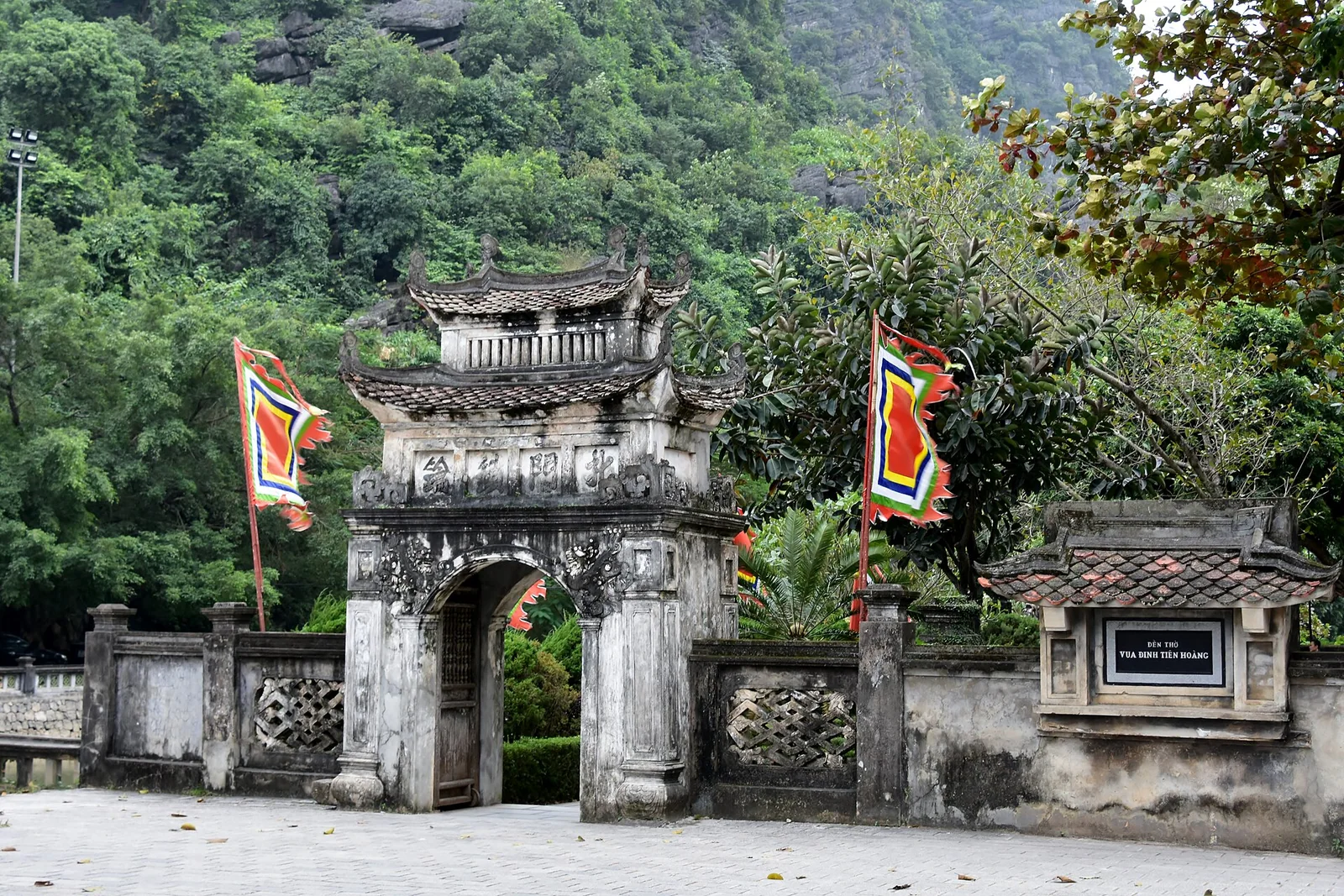
Doing Hang Mua before the boat is tempting for the light and it puts the item you cannot shorten last. A boat trip is 2.5 to 3.5 hours whichever end of the day it starts, and the pier queue is the one part of the day you have no control over, so meet it early.
Staying a night changes what you get rather than how much. Accommodation here is resorts and lodges set among the karst and the rice fields, and being there at dawn and dusk is the difference between seeing the landscape and being in it. On a ten to twelve day trip, give Ninh Binh a night. On a five-day trip, do not, because that night comes out of Hanoi or the boat.
When to go
Ninh Binh is the most weather-tolerant destination in the north, which is what makes it the obvious thing to put in the gap when a cruise is called off. Rain in a rowed boat under an overhang is atmospheric rather than ruinous, and none of the sites depend on sea conditions.
The two dated windows to know: the Tam Coc rice goes gold from late May into mid June at harvest, which is the only time Tam Coc clearly beats Trang An, and the general northern peak of September to December applies here too for clear, dry, cool weather. Our Ninh Binh day trip guide has the hour-by-hour version for a single day.
11. Ha Giang: the loop, the licence problem, and how people actually do it
The Ha Giang Loop is a 350 km mountain circuit that most travellers ride on the back of someone else’s motorbike, and that is usually the right call. Not because riding it yourself is impossible, but because the licence rules exclude most visitors from doing it legally, and because a local driver on those roads is genuinely better than you are. Three days and two nights with a driver runs $150 to $180, four days and three nights runs $250 to $379.
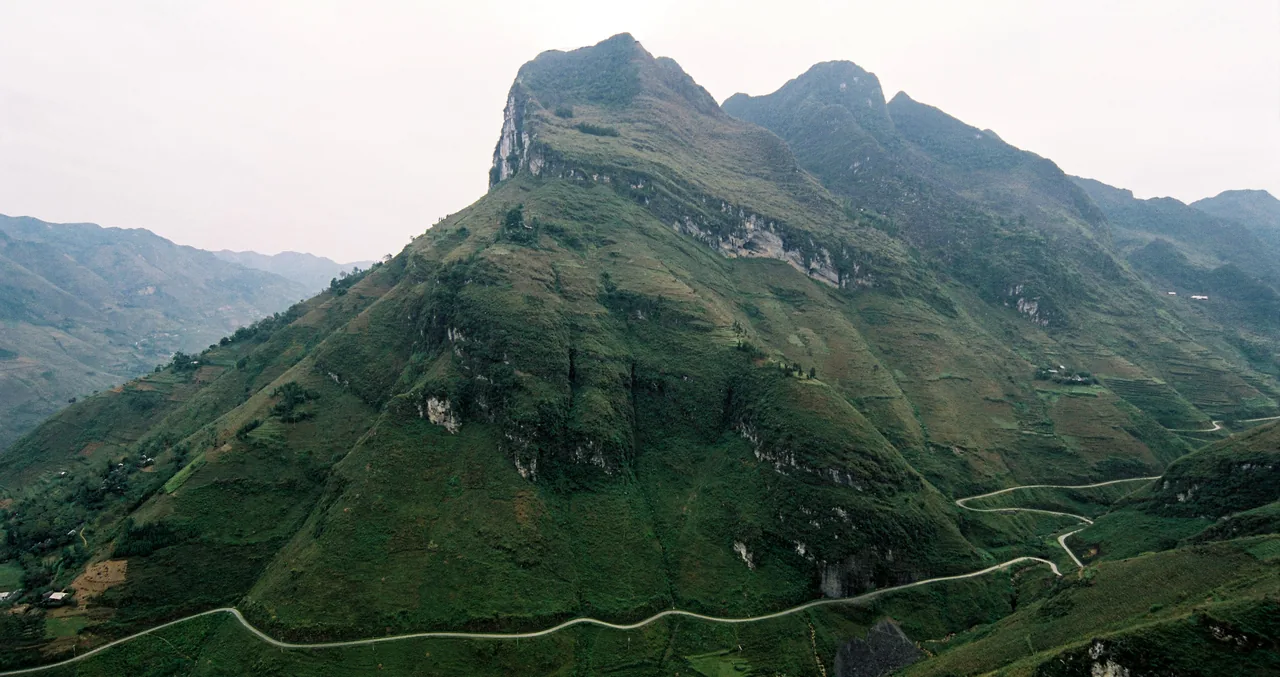
What the loop is, and the two numbers people confuse
Ha Giang city is 300 km north of Hanoi, 6 to 7 hours by road. The loop is a separate 350 km circuit that starts and ends there. You do both, which is why a “three-day loop” is really a five-day commitment once you add a night bus in each direction.
The circuit runs through the Dong Van karst plateau, which is limestone country like Ha Long and Ninh Binh but at altitude and inhabited. Around 17 ethnic minority groups live up there and roughly 88% of the population belongs to one of them, which is a completely different demographic picture from anywhere else you will go in Vietnam. This is the reason the loop is not simply a scenic drive: the villages and markets along it are the point as much as the road is.
Split over three riding days, 350 km is about 115 km a day. That sounds gentle. It is not, because it is mountain road with hairpins, surface changes and frequent stops, and because 115 km at mountain speeds is most of a day rather than two hours.
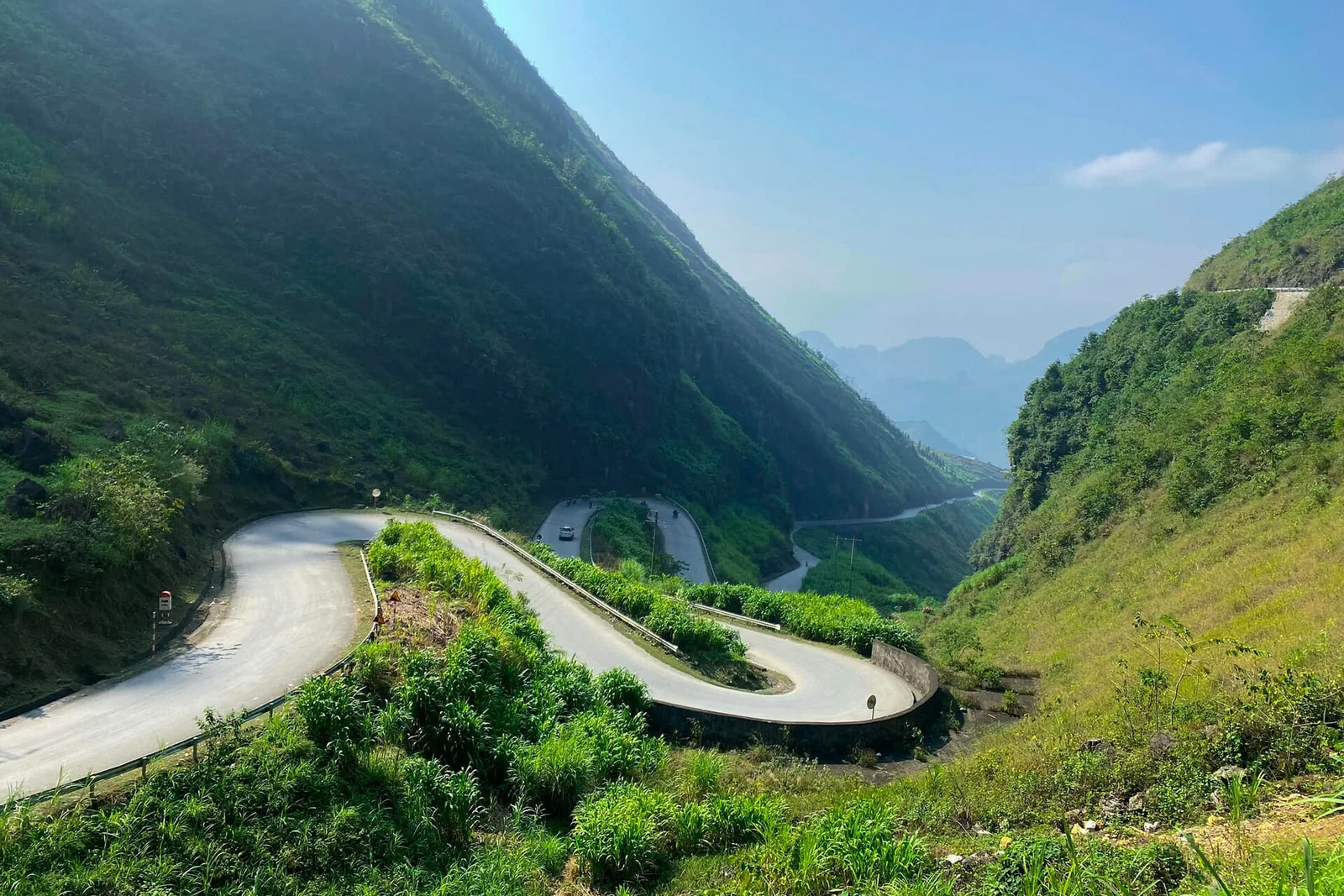
| Number | What it refers to |
|---|---|
| 300 km | Hanoi to Ha Giang city, one way, 6-7 hours by bus |
| 350 km | The loop itself, starting and finishing in Ha Giang city |
| 12-14 hours | The round-trip road time from Hanoi, before the loop starts |
| 3-4 days | The loop, at about 115 km of mountain road per day |
| 5-6 days | The honest total, door to door from Hanoi |
The licence problem, which is the real gate
This is the part that catches people out, either at the rental shop or, worse, after a crash. Read it before you plan to ride.
- Under 50cc, no licence is required in Vietnam. That is the one clean exemption, and 50cc is not enough bike for these roads.
- Vietnam’s own A1 licence has covered up to 125cc since 1 January 2025. It used to be 175cc. A lot of pages still say 175, and they are out of date.
- An International Driving Permit issued from a car licence shows category B only. B is cars. It does not cover a motorbike of any size. To get category A stamped on an IDP you need a motorcycle entitlement on your home licence first, and that is not something you can arrange at the airport.
- Insurers apply the same test. If you are riding a 150cc bike on a category B permit and something happens, the claim fails. This is the expensive version of the problem, not the police version.
- Whether your IDP is recognised in Vietnam at all depends on an agreement between Vietnam and your own country. Korea’s, as one example, took effect on 23 July 2023. Check your country’s position before you count on riding, because the answer is not the same everywhere.
The practical consequence is that most visitors either sort a motorcycle entitlement and an A-category IDP months in advance, or they ride pillion. There is no clever workaround, and the rental shops that do not ask are not the ones you want to be dealing with after an accident.
Easy rider, self-ride, or a car
An easy rider is a local driver who rides the bike while you sit on the back. It is the standard way the loop is done by foreign visitors, and the price includes the bike, the fuel, the homestay nights and the driver.
| Option | Price | What is included | Licence needed? |
|---|---|---|---|
| Easy rider, 3 days 2 nights | $150-180 (approx. 3,800,000-4,500,000 VND) | Driver, bike, fuel, homestays | No, you are a passenger |
| Easy rider, 4 days 3 nights | $250-379 | Same, over a longer route | No |
| Self-ride, semi-automatic | $6.80-7.60 (approx. 180,000-200,000 VND) per day | Bike only | Yes |
| Self-ride, manual 125-150cc | $8.70-24.70 (approx. 230,000-650,000 VND) per day | Bike only | Yes, and the 150 exceeds Vietnamese A1 |
| Self-ride, automatic scooter | $9.50 (approx. 250,000 VND) per day | Bike only | Yes |
Compare the two properly. Three days of self-ride on a semi-automatic is $20.40 to $22.80 for the bike, plus fuel, plus homestays, plus food, plus every entry fee paid separately. Fuel for the whole loop is $9.50 to $13.30 (approx. 250,000 to 350,000 VND), with petrol at about $0.80 (approx. 21,000 VND) a litre. So the vehicle side of a self-ride comes to roughly $30 to $36 for three days.
The easy rider at $150 to $180 therefore prices the driver, the homestays and the organisation at somewhere around $115 to $150 for three days. Whether that is good value depends on how you feel about riding an unfamiliar bike on wet hairpins with an 800 m drop beside you, and about arranging homestays in villages where you do not speak the language.
What the 350 km actually covers
The circuit takes in the plateau, several passes and the northernmost point of the country. Entry fees are small, which is a relief after Sapa.
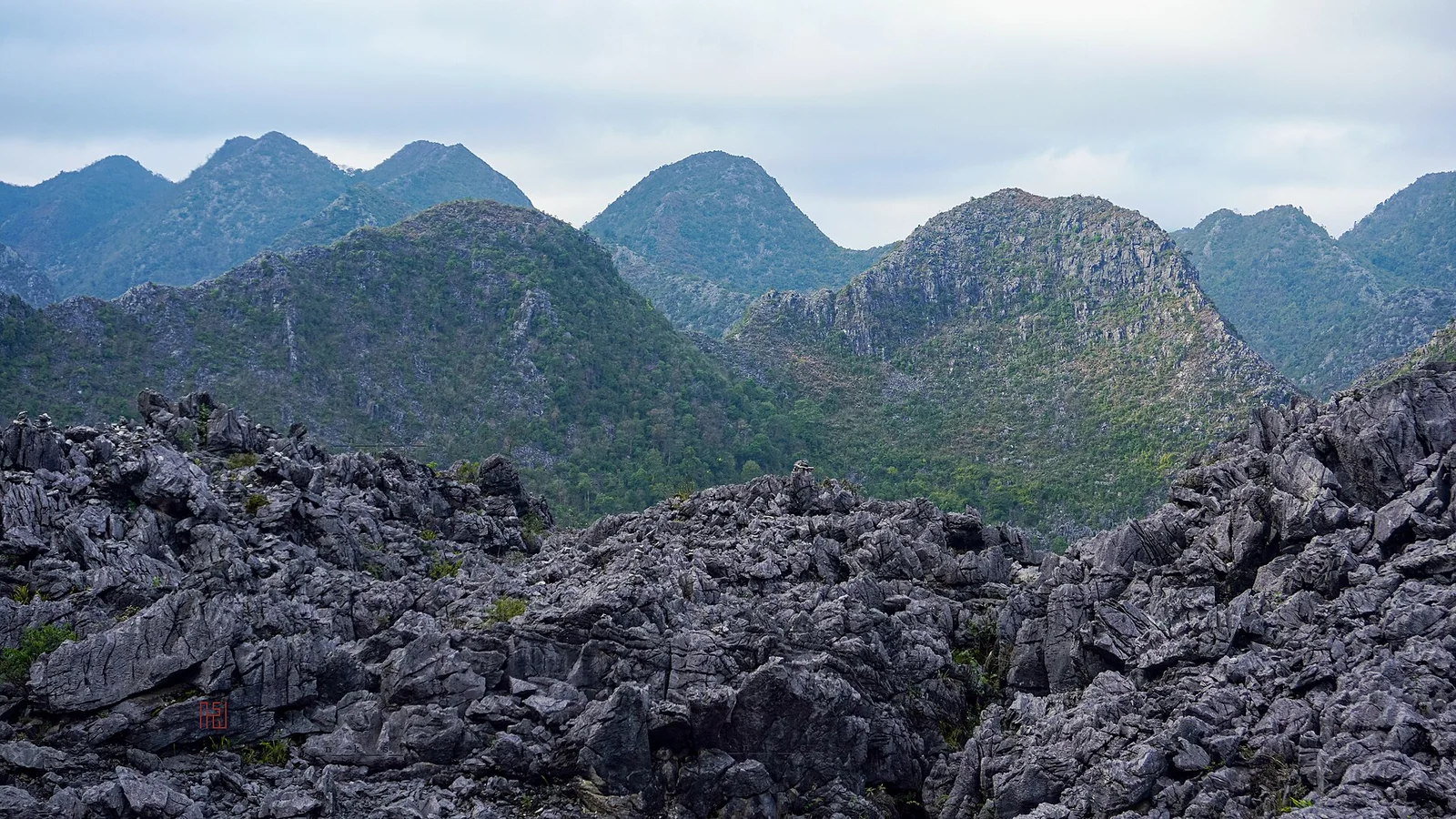
| Stop | Entry | What it is |
|---|---|---|
| Quan Ba Twin Mountains | About $0.38 (approx. 10,000 VND) | The first viewpoint out of Ha Giang city |
| Lung Khuy cave | $1.15-1.90 (approx. 30,000-50,000 VND) | Cave system on the plateau |
| Dong Van old street | Free | The old quarter of the plateau’s main town |
| Lung Cu flag tower | $0.95-1.52 (approx. 25,000-40,000 VND) | Vietnam’s northernmost point; 839 steps, or $0.57 (approx. 15,000 VND) for the electric cart |
| Other sites | About $0.76 (approx. 20,000 VND) | Small charges at various viewpoints and villages |
The two things people come for are the pass and the plateau town. The Ma Pi Leng PassMap is a roughly 20 km stretch of QL4C between Dong Van and Meo Vac, cut into the cliff, with the Nho Que river gorge about 800 m below. That 20 km is the section almost everyone comes for, and the reason the circuit works as a tourist route at all.
Dong VanMap is the town most itineraries overnight in, and its old street costs nothing to walk. The Lung Cu flag tower marks the northernmost point of Vietnam, and the 839 steps up to it are the single biggest staircase in the north. The electric cart at about $0.57 removes most of them and there is no shame in it after three days on a bike.
Operators run different routes and you should read the one you are actually buying rather than a generic version of it. What the geography fixes, regardless of who you go with, is that the circuit has to climb out of Ha Giang city onto the plateau, get to the far north, and come back over the pass.
| Day | The leg | What it is for |
|---|---|---|
| 1 | Out of Ha Giang city and up onto the plateau, past Quan Ba | The first viewpoint, and the change in the landscape as you climb |
| 2 | Across the Dong Van karst plateau, with Lung Cu as the far point | The northernmost point of Vietnam, and the villages between |
| 3 | Dong Van to Meo Vac over Ma Pi Leng, then back towards Ha Giang | The 20 km cliff section above an 800 m gorge |
The four-day version at $250 to $379 spreads the same circuit over an extra day, which means less riding per day. Ask what the extra day is actually used for before you pay the difference, because the answer varies. If you are prone to being uncomfortable after four hours on a pillion seat, that extra day is worth buying rather than a luxury.
A few practical things that make the loop considerably better, whether you ride or sit behind someone who does. Bring layers: the plateau is high, and mornings are cold even when Hanoi is warm. Bring your own rain gear rather than assuming something will be handed to you. Bring cash in small notes, because entries are $0.38 to $1.90 and nobody up there wants to break a large bill. Download offline maps before you leave Hanoi, since signal on the plateau comes and goes. And take gloves, because three days of wind on the back of a bike is harder on your hands than you expect.
If your dates happen to fall on it, the Khau Vai love market runs once a year on the 27th day of the third lunar month, which lands in late April or early May. It is a single day and it is not something you can schedule around unless you are flexible, but if it coincides, take it.
Getting to Ha Giang and back
Ha Giang has no airport and no train station. Every approach is a road journey from Hanoi, and almost everyone does it overnight because a 6 to 7 hour daytime run consumes a whole day of a trip that is already tight.
| Option | Time | Price | Notes |
|---|---|---|---|
| Sleeper bus | 6-7 hours | $9.50-15.20 (approx. 250,000-400,000 VND) | Shared berths, the standard option |
| Cabin sleeper | 6-7 hours | About $17.90 (approx. 470,000 VND) | Individual capsule, worth the extra for sleep |
| Limousine or VIP van | 6-7 hours | $13.30-19 (approx. 350,000-500,000 VND) | Seats rather than berths; better for a daytime run |
The cabin sleeper at about $17.90 is the one to take. It is roughly $3 to $8 more than a shared sleeper berth, and on a route where the loop’s first day starts a couple of hours after you arrive, an enclosed capsule is the version most likely to get you some sleep. On a trip built around three days on a motorbike, that is not a luxury.
Coming back, the same journey runs overnight in the other direction. This is where the two-night-bus mistake happens: people take the bus up, ride three days, take the bus down and then immediately board another night service. Put a Hanoi hotel night at the end. You have just spent three days on a motorbike.
When to ride, and when not to
Ha Giang’s own calendar is different from Sapa’s, which is useful if your dates are fixed.
| Window | What is happening | Verdict |
|---|---|---|
| Spring | Plum and peach blossom on the plateau | Good, and quieter than autumn |
| April to early May | Fields flooded before transplanting | Good; the Khau Vai market may also fall here |
| May to June | New green | Fine, rain increasing |
| July to August | Heaviest rain, landslide risk | Avoid, especially self-riding |
| September to October | Deep green into harvest, drying out | Good |
| Late October to early November | Buckwheat flowering, peak in early November | The best window Ha Giang has |
| December to February | Cold at altitude, fields brown | Possible, but cold on a bike for six hours a day |
The single clearest recommendation: if your trip lands in the first week of November, choose Ha Giang over Sapa. The buckwheat is at its peak, the rain has finished, and Sapa’s terraces are stubble by then. If your trip lands in late September, choose Sapa for exactly the inverse reasons.
Do not ride the loop in July or August. The mountain roads in the north give way in heavy rain, and this is the one place in the region where that turns from an inconvenience into a safety question. If those are your only dates and you still want the plateau, go with a driver who rides it every week, and accept that a day may be cancelled.
Our Ha Giang Loop guide covers operator selection, the day-by-day route, and what a homestay night on the plateau is actually like.
12. Arriving, and every leg between the five places
From the airport, use Grab or Green SM unless you are landing very late or travelling light enough for the bus, and be aware that app cars no longer pick up outside the terminal. Noi Bai International AirportMap is 27 to 30 km from the centre and the drive takes 40 to 60 minutes. Grab runs $7.60 to $13.30 (approx. 200,000 to 350,000 VND) for a four-seater, an airport contract taxi runs $15.40 to $19 (approx. 400,000 to 500,000 VND), and bus 86 is $1.90 (approx. 50,000 VND).
| Option | Price | Time | Best for |
|---|---|---|---|
| Grab or Green SM | $7.60-13.30 (approx. 200,000-350,000 VND) | 40-60 minutes | Almost everyone |
| Airport contract taxi | $15.40-19 (approx. 400,000-500,000 VND) | 40-60 minutes | Late arrivals, heavy luggage, no data |
| Bus 86 | $1.90 (approx. 50,000 VND) | 50-55 minutes to Hanoi station | Light luggage between 07:00 and 22:05 |
| Hai Van minibus | $3.40 (approx. 90,000 VND) per person | Varies | A middle option between bus and car |
| Pre-booked transfer | Varies | 40-60 minutes | Anyone who wants a name board at arrivals |
The kerbside changed in August 2026
From 07:00 on 3 August 2026, Noi Bai reorganised the traffic outside Terminal 2. There are now six lanes in front of the arrivals level, and each category of vehicle has its own place in them.
| Vehicle type | Where it waits at T2 |
|---|---|
| Contract taxis | Lane 4, between pillars 3 and 10 |
| Shuttle buses | Pillars 11 to 12 |
| Public buses | Pillars 12 to 15 |
| Meet-and-greet services | West end, to the left of door A4; east end, to the right of door A1 |
| App-hailed cars | Not at the terminal at all: car park P1 for T2, car park P2 for T1 |
The last row is the one that matters most. App-hailed cars can no longer stop in front of the terminal building. If you order a Grab or a Green SM at Terminal 2 you walk to car park P1, and at Terminal 1 you walk to car park P2. Your driver will not come to the door and will not be able to, and the confusion this causes on arrival, with a phone on a foreign network and a driver calling in Vietnamese, is entirely avoidable if you know about it in advance.
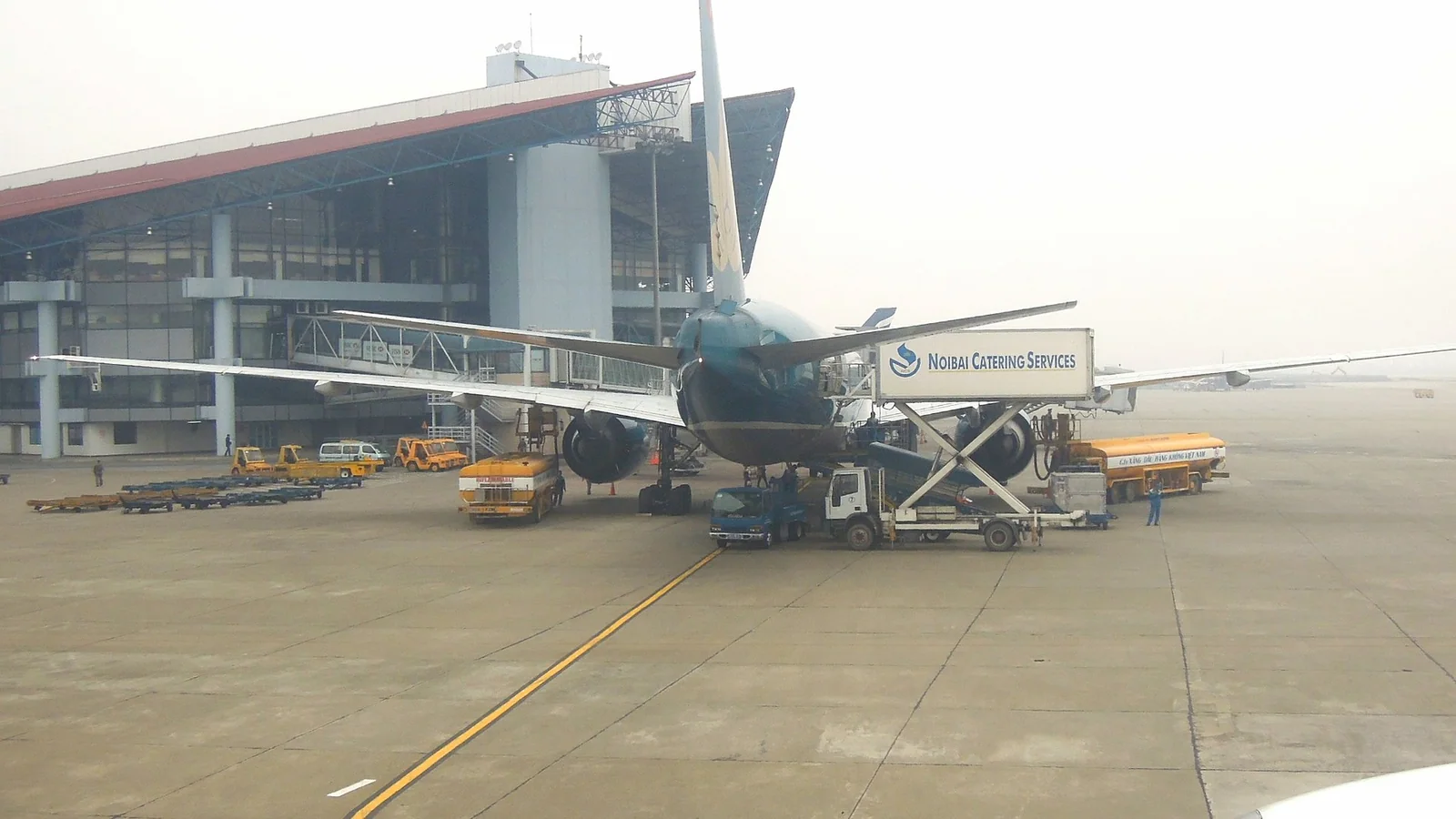
The meet-and-greet positions are worth noting if you have booked a transfer with a name board: T2 west end is left of door A4, T2 east end is right of door A1. Those are the two designated positions, so if you cannot see your driver, the likeliest answer is that you are at the wrong end of a long building rather than that nobody came.
Airport taxis do not have a fixed fare
This is the most persistent piece of misinformation about Noi Bai. There is no flat rate to the city. Airport contract taxis run on a per-kilometre meter, and since 1 March 2025 the rates have been $0.57 to $0.63 (approx. 15,000 to 16,700 VND) per kilometre depending on the company.
| Company | Per km, 5-seater |
|---|---|
| HP-Noi Bai | Approx. 15,000 VND |
| G7 | Approx. 15,500 VND |
| Mai Linh | Approx. 15,500 VND |
| Airport | Approx. 16,000 VND |
| Green SM | Approx. 16,000 VND |
| Taxi Group | Approx. 16,700 VND |
Multiply that out and the total makes sense: 27 to 30 km at 15,000 to 16,700 VND per kilometre gives 405,000 to 501,000 VND, which is exactly the $15.40 to $19 (approx. 400,000 to 500,000 VND) you will be quoted. If someone offers you a “fixed airport price” well above that, they have invented it.
The gap between a contract taxi and a Grab is about $5.70 (approx. 150,000 VND). That is the amount you are paying for a car that waits at the terminal instead of a car park, and for not needing a working data connection to book it. On a late-night arrival with three bags, $5.70 is a fair price for that. On a Tuesday afternoon with a carry-on, it is not.
Our Noi Bai airport to Hanoi guide covers the terminal layout and the pickup points in more detail, and the Vietnam scams guide covers the arrival-hall approaches the fixed-price claim belongs to.
Buses from Noi Bai, and the new ticketing
Bus 86 is the one most visitors want. It runs 07:00 to 22:05, every 25 to 30 minutes, takes 50 to 55 minutes to Hanoi station, and costs $1.90 (approx. 50,000 VND) per person.
| Route | Goes to | Fare |
|---|---|---|
| 86 | Hanoi station, via the centre | $1.90 (approx. 50,000 VND) |
| 68 | Ha Dong | $2.10 (approx. 55,000 VND) |
| 07 | Cau Giay | $0.46 (approx. 12,000 VND) |
| 17 | Long Bien | $0.57 (approx. 15,000 VND) |
| 90 | Kim Ma | $0.57 (approx. 15,000 VND) |
The cheap routes, 07, 17 and 90, at $0.46 to $0.57 are city routes, and they end at Cau Giay, Long Bien and Kim Ma rather than anywhere a visitor is likely to be staying. Very good value; think about your luggage and your destination first. Route 86 costs three to four times as much, runs to Hanoi station, and is the one sold as the airport service, which is what the difference is for.
One current change to be aware of: from 25 June 2026, all subsidised Hanoi bus routes moved to a single integrated electronic ticket through an app called The ve giao thong Ha Noi, and paper monthly passes stopped being valid from 1 July. A monthly pass is not something a visitor needs. The change does mean older instructions about ticketing on Hanoi buses want checking rather than trusting.
Data, because most of this now needs a phone
Ordering a car from car park P1, checking whether a cruise is still sailing, finding a homestay in the Muong Hoa valley whose registered address changed in the 2025 reform: all of it assumes a working connection from the moment you land. Roaming works, and an eSIM activated before you fly means you are online while you are still walking to baggage reclaim rather than hunting for a counter.
Coverage in the mountains is a separate question and worth setting expectations on. On the Ha Giang plateau and in the higher parts of the Muong Hoa valley, signal comes and goes. Download offline maps for those two areas before you leave Hanoi.
Our Vietnam eSIM and SIM card guide compares the options, and the Vietnam money guide covers cash, cards and what to carry for boat tips and village entries, which are the two things that stay cash-only.
Every leg between the five places, in one table
This is the consolidated version of the transport information in the destination sections above. Prices are per person unless stated.
| Leg | Option | Time | Price |
|---|---|---|---|
| Hanoi to Ha Long | Cruise shuttle | 2h15-2h30 | $12-20, usually inside the cruise fare |
| Hanoi to Ha Long | Limousine van, 9-16 seats | 2h30 | $12-18 |
| Hanoi to Ha Long | Private car | 2h15 | $70-110 per vehicle |
| Hanoi to Ha Long | Public bus | About 3 hours or more | Low |
| Hanoi to Ninh Binh | Limousine van | 1.5-2 hours | $6-10, roughly hourly from the Old Quarter |
| Hanoi to Ninh Binh | Guided day tour | 1.5-2 hours | $25-55 including boat, entries and lunch |
| Hanoi to Ninh Binh | Private car | 1.5 hours | $60-90 per vehicle |
| Hanoi to Ninh Binh | Public bus | 2-2.5 hours | $3-5, from Giap Bat terminal |
| Hanoi to Ninh Binh | Train | Varies | Varies |
| Hanoi to Sapa | Limousine van or sleeper bus | 5.5-6 hours | $13-18 (approx. 320,000-450,000 VND) |
| Hanoi to Sapa | Night train SP1 or SP3 | 8 hours, about 22:00 to 06:10 | From $15.20 (approx. 400,000 VND); usual band $22-65 |
| Lao Cai to Sapa town | Shared minibus | About 1 hour, 35 km | A few dollars |
| Hanoi to Ha Giang | Sleeper bus | 6-7 hours | $9.50-15.20 (approx. 250,000-400,000 VND) |
| Hanoi to Ha Giang | Cabin sleeper | 6-7 hours | About $17.90 (approx. 470,000 VND) |
| Hanoi to Ha Giang | Limousine or VIP van | 6-7 hours | $13.30-19 (approx. 350,000-500,000 VND) |
Two notes on reading that table. The word limousine does a lot of work in Vietnam and it does not mean what it means at home. A limousine van is a 9 to 16 seat minibus fitted with large reclining seats instead of rows of normal ones, so you get fewer passengers and more room. They run hotel to hotel rather than terminal to terminal, which is why they cost $6 to $18 for legs that a public bus does for $3 to $5.
They also collect. A shared van picks up from several Old Quarter hotels before it leaves the city, so a quoted time is moving-vehicle time and the collection round sits on top of it. Ask the operator what time they expect to clear Hanoi rather than what time they will be outside your hotel. On the Ninh Binh run that round is a meaningful share of a 1.5 hour journey; on the Sapa run it disappears into a 6 hour one.
A private car changes the arithmetic once you are three or four people. Hanoi to Ha Long at $70 to $110 per vehicle is $17.50 to $27.50 each for four, against $12 to $18 each for van seats, and you get door to door with no collection round and no fixed departure. Hanoi to Ninh Binh at $60 to $90 is $15 to $22.50 each for four, and the driver waits between sites, which on a day with a boat pier, a viewpoint and a temple complex several kilometres apart is worth the difference on its own.
The overnight services deserve a description, because two of the legs in that table are beds rather than seats and people book them without knowing what they are getting.
| Sleeper bus | Cabin sleeper bus | Night train | |
|---|---|---|---|
| Used for | Sapa and Ha Giang | Ha Giang | Sapa, via Lao Cai |
| What you get | A reclining berth in an open bay | An enclosed individual capsule | A berth in a 4-berth or 2-berth cabin |
| Price | $9.50-18 | About $17.90 (approx. 470,000 VND) | From $15.20 (approx. 400,000 VND), typically $22-65 |
| Duration | 5.5-7 hours | 6-7 hours | 8 hours, about 22:00 to 06:10 |
| Best for | Budget, and short notice | Actually sleeping before a loop day | Sapa without giving up a daytime |
A few things that make all three considerably better. Wear socks you are happy to be seen in, since you may be asked to leave your shoes at the door. Bring a layer, because overnight air conditioning can be cold whatever the weather is doing outside. Bring your own water and something to eat rather than counting on a stop at a useful time. And download offline maps before you leave Hanoi, because you will want to know where you are at 04:00 and mountain coverage comes and goes.
On the train specifically: the four-berth soft sleeper is shared with strangers and is perfectly civilised. The 2-berth deluxe at $133 to $140.60 (approx. 3,500,000 to 3,700,000 VND) is a large premium for privacy on a journey you sleep through, and most travellers are better served putting that money into the cruise.
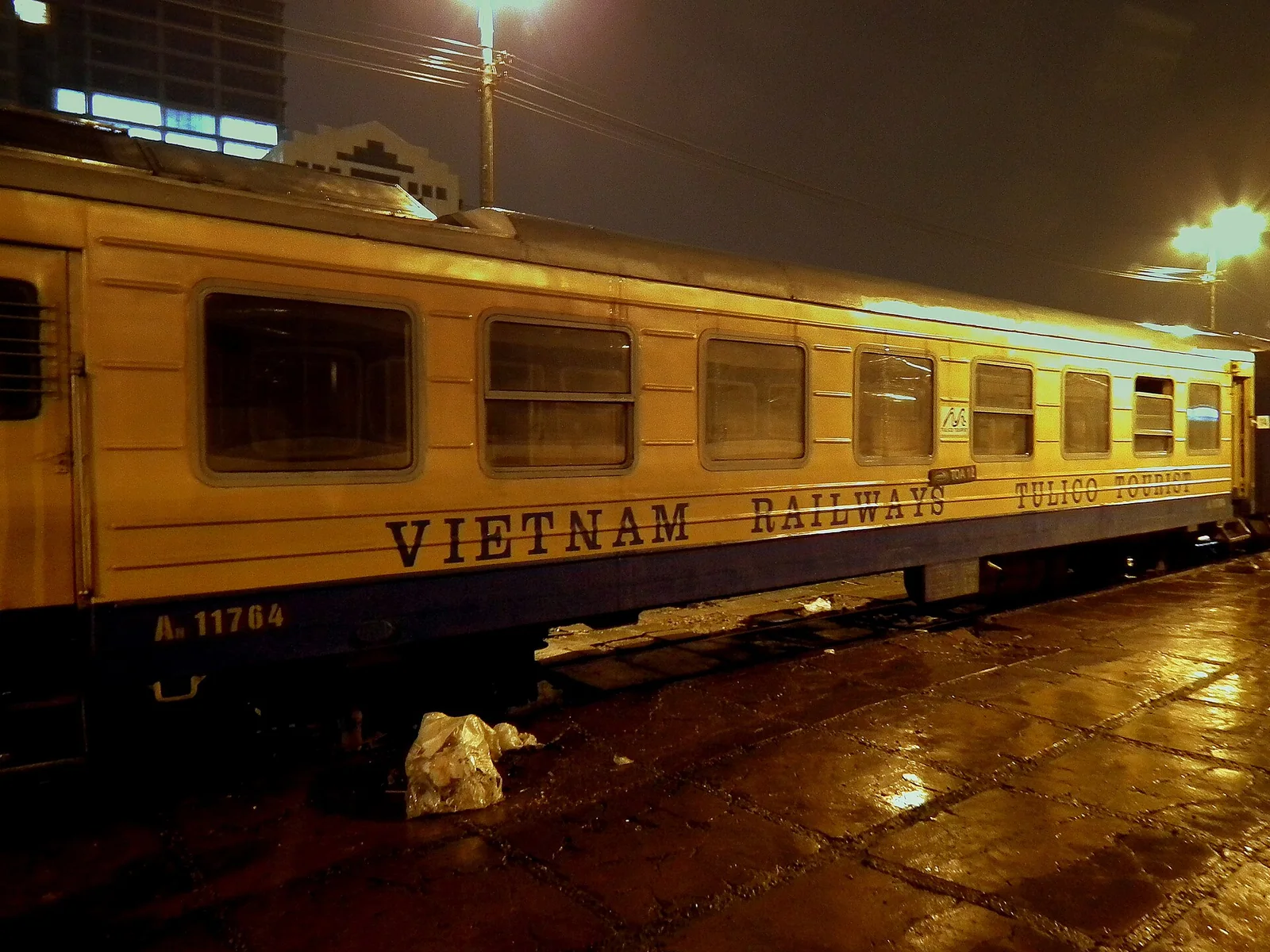
Which arrival gets which transfer
| Your arrival | Take this | Why |
|---|---|---|
| Daytime, light luggage | Bus 86, $1.90 (approx. 50,000 VND) | Runs 07:00-22:05 and reaches the centre in 50-55 minutes |
| Daytime, normal luggage | Grab or Green SM | $7.60-13.30, app-quoted, no negotiation |
| After 22:05 | Contract taxi or pre-booked transfer | Bus 86 has stopped for the night |
| Family, or three-plus bags | Pre-booked transfer | Meets you at the door rather than in car park P1 |
| No data on landing | Contract taxi | Metered at about $0.57-0.63 (approx. 15,000-16,700 VND) per km; no app needed |
Here is the sequence for the most common case, which is landing in daylight and taking an app car, so you are not working it out at the exit with a suitcase.
- Get online before you leave the aircraft door. An eSIM activated at home is live as soon as the phone finds a network. Otherwise you are relying on airport wifi to order a car.
- Clear immigration and baggage, then find the signs for the car park. At Terminal 2 that is P1, at Terminal 1 it is P2. Do not head for the arrivals kerb, because your driver cannot stop there.
- Order the car once you are walking, not before. Ordering from the carousel leaves a driver waiting in a car park for a passenger who has not appeared, which is how rides get cancelled.
- Match the plate, not the badge. The app shows the registration. That is the check that matters.
- Ignore anyone in the hall offering you a fixed price. There is no fixed fare from Noi Bai, and a stranger quoting one has invented it.
The whole walk takes a few minutes and the signage is there, but it is longer with luggage and after a long flight than the map suggests. If that sounds like more effort than you want at the end of a fourteen-hour journey, take the contract taxi at lane 4 and pay the roughly $5.70 difference, or book a pickup.
A pre-booked pickup is the option that ignores the whole car park question, because the driver is standing at door A4 or door A1 with your name, which is exactly where the airport now allows them to stand. On a first arrival after a long flight, that is worth the small premium over an app car.
13. Where to sleep, region by region
You need fewer bases than you think: one in Hanoi, plus whatever the excursions force on you. A five-day trip has two bases, Hanoi and the boat. A twelve-day trip has four or five. Everything else is a night you booked because the map made you nervous, and each unnecessary base means another checkout, another bag transfer and another morning lost to logistics.
| Trip length | Bases you need | Nights, roughly |
|---|---|---|
| 5 days | Hanoi, plus one night on a boat | Hanoi 3, boat 1 |
| 7-8 days | Hanoi, boat, Sapa | Hanoi 3-4, boat 1, Sapa 2-3 |
| 10-12 days | Hanoi, boat, Ninh Binh, and one mountain region | Hanoi 4, boat 1, Ninh Binh 1, mountains 4-5 |
Hanoi, and which price level to pay
Hanoi is where you will spend the most nights, so it is where the choice matters most. The eight areas were listed earlier; here is the same list read as a booking decision, with price levels in words rather than symbols.
| Area | Price level | Book here when |
|---|---|---|
| Old Quarter | Low to mid | First visit, short stay, you want to walk everywhere |
| Hoan Kiem | Mid | You want central but quieter than the Old Quarter |
| French Quarter | Mid to high | You want a bigger room and calmer streets, still walkable |
| Ba Dinh | Mid to high | A specific hotel there appeals to you |
| West Lake | Mid to high | Longer stay, second visit, or recovering from a night bus |
| Cau Giay | Low to mid | You have business out there |
| My Dinh | Low to mid | You have business out there |
| Long Bien | Low | Rarely worth it for a visitor |
The one Hanoi booking habit that saves real money and time: use the same hotel for both blocks of your trip, and ask at the point of booking whether they will hold a bag for you between stays. Where they will, you go to Sapa or Ha Giang with a day pack rather than a wheeled suitcase on a mountain road. Ask when you book rather than on the morning you leave, because it may change which hotel you pick.
Ha Long: the boat is the accommodation
There is no accommodation decision to make in Ha Long, because the cruise is where you sleep. What you are choosing is the boat, which was covered in the bay section: $130 to $160 per person for a reliable all-inclusive, $180 to $250 for four and five star.
People sometimes ask about staying in Ha Long City instead and doing day trips out. It works logistically and misses the point, because the reason to be on the water overnight is the bay after the day boats have left and before they return. A hotel on shore gives you neither.
The one situation where a shore night makes sense is Cat Ba, if you are doing Lan Ha Bay and want the national park properly rather than as a two-hour stop. That turns a cruise into a cruise plus an island stay, and it is a good use of an extra day at the eight to twelve day range.
Sapa: town hotel or valley homestay
Two genuinely different options here, and the right answer depends on how many nights you have.
| Sapa town hotel | Valley homestay | |
|---|---|---|
| Where | Sapa town | Ta Van or Lao Chai, in the Muong Hoa valley |
| Price level | Low to high, wide range | Low to mid |
| Good for | Restaurants, shops, transport, heating | Being in the fields at dawn and dusk |
| Heating | Expect it, but confirm | Many have none |
| Best with | One or two nights | Two or three nights, ideally after a trek |
The pattern that works on three nights is one night in town at each end and one or two in the valley in the middle, which also fits neatly with a Lao Chai to Ta Van trek. On two nights, pick one and stay put, because moving twice in two nights is not worth the view.
Ninh Binh and Ha Giang
Ninh Binh accommodation is resorts and lodges set among the karst and the rice fields, which is a different product from a city hotel and priced accordingly across low, mid and high. The reason to stay rather than day trip is the light: the peaks and the fields at dawn and dusk are what people photograph, and a day tripper arriving at 10:00 and leaving at 16:00 sees neither.
Ha Giang is simpler because you rarely choose. On a guided loop, the homestay nights are part of the package and arranged by your operator, and they are one of the things included in the $150 to $180. Ask what to expect of them, since the standard varies along the route and the answer is easier to get before you book than after you arrive.
If you are riding the loop independently you are also arranging your own beds each night, which needs either enough Vietnamese or early enough arrivals to give yourself options. It is the part of an independent loop that most often turns into a long evening, and it is the strongest single argument for going with a driver.
What the word homestay means in each region
Homestay is used for three quite different things in northern Vietnam, and the gap between them is wide enough to be worth spelling out before you book one.
| Where | What it means there | What to ask |
|---|---|---|
| Muong Hoa valley, Sapa | A family house in Ta Van or Lao Chai with guest rooms | Private or shared rooms; many have no heating. Ask about meals |
| Ha Giang plateau | A village house on your loop operator’s route | Arranged for you as part of the package. Ask what the sleeping arrangement is |
| Ninh Binh | The word is often used loosely here | Read what the room actually is rather than what it is called |
In Sapa the difference from a hotel is the one most worth having, because you are in the valley when the light is good rather than driving into it at 10:00. In Ha Giang it is arranged for you and there is no decision to make. In Ninh Binh the word does as much marketing as describing, so read what the room actually is rather than what it is called.
Two things to check in all three cases, and they are the two that a listing rarely answers: whether meals are included and at what time they are served, and whether there is heating, which matters from late October onwards. Both are one message to the host, and both are worth sending before you pay rather than after.
Where to spend and where to save
| Spend on | Save on |
|---|---|
| The cruise: the $130-160 floor is a real quality line | Hanoi hotel standard, since you are barely in the room |
| A cabin sleeper to Ha Giang, about $17.90 | Airport transfer, if you land in daylight with light bags |
| A private car for a group of four on day trips | Sapa town hotels, where the mid range is good |
| Heating in Sapa in winter | Village entry fees, which are $0.38-5.70 anyway |
The general principle for the north is that the expensive items are the ones that are hard to redo. A bad Hanoi hotel means one poor night’s sleep. A bad cruise means losing the thing you flew here for, and there is no second attempt on the same trip.
Five questions cover almost everything that goes wrong with accommodation in the north, and none of them appear on a booking site’s filter list.
- Will you hold a bag between my two stays? For Hanoi, where most itineraries book the same hotel twice. If the answer is yes, you travel light to the mountains, and that is worth more than a slightly nicer room.
- Is there heating? For any Sapa night between late October and March. Many valley homestays have none, and Sapa gets close to 0°C in January and February.
- What time is dinner, and is it included? For mountain homestays, which cook once for everyone.
- Which side of the building is the room on? For the Old Quarter, where street-facing rooms are noisy from early.
- How far is it from where the boat, the pier or the trailhead actually is? For Ninh Binh and Sapa, where a listing can be technically in the right place and 6 km from anything.
Hanoi is the booking you will make first and use most, so it is worth getting the area right before you compare rooms.
14. Eating in the north
Northern Vietnamese food is less sweet than southern cooking and less spicy than central cooking, and Hanoi is where several of the country’s best-known dishes were invented. That includes pho and egg coffee. If you have eaten Vietnamese food elsewhere and found it sweet, this is the region where you find out that was a regional style rather than the national one.
The practical version: eat on the street, eat where there are already people, and eat breakfast out. The best food in Hanoi is served from places with plastic stools and one item on the menu, and the good ones sell out and close.
The six things to eat
| Dish | What it is | When to eat it |
|---|---|---|
| Pho | Rice noodle soup in a clear broth; Hanoi is where it comes from | Any time, but go where there is a queue |
| Bun cha | Charcoal-grilled pork with nuoc mam and cold noodles | Lunch, almost exclusively |
| Cha ca | Turmeric-marinated fish cooked at your table with dill and spring onion | Dinner, sit-down |
| Banh cuon | Thin rice rolls filled with pork and mushroom | Breakfast |
| Ca phe trung | Egg coffee, invented in Hanoi | Mid-morning or mid-afternoon |
| Bia hoi | Draught beer poured on street corners | Late afternoon onwards |
Pho, and why the northern version looks plain
Pho comes from Hanoi and the Hanoi version has a clear broth. That is the defining characteristic and it is the thing that surprises people who have only eaten pho abroad, where the bowl often arrives loaded with garnish and a sweeter, darker broth.
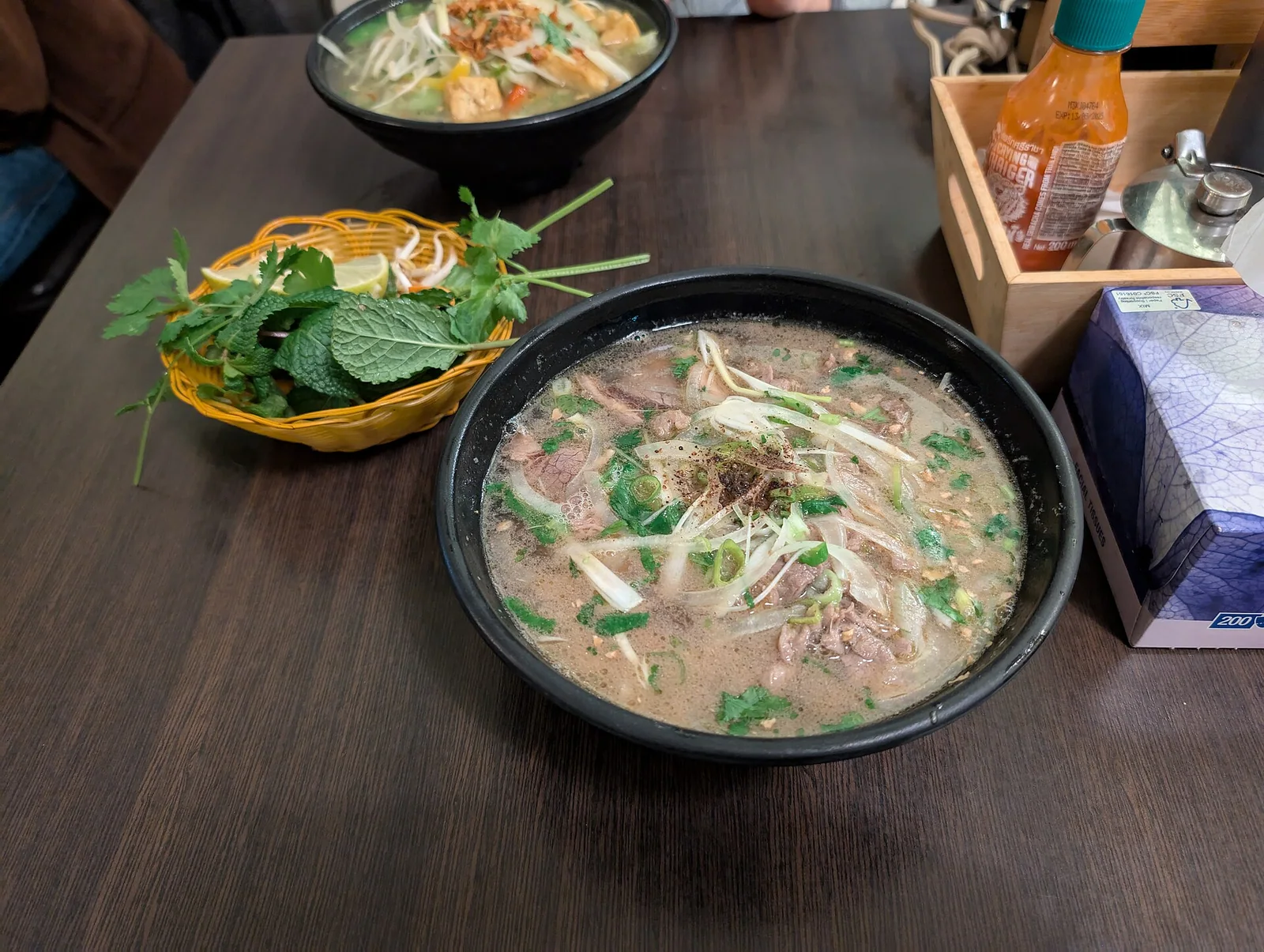
A clear broth is a harder thing to make well, because there is nothing to hide behind. The consequence for you as a visitor is that the difference between a good bowl and a mediocre one is much more obvious here than it is at home, and it is worth eating pho more than once from different places to see that for yourself.
Eat it early if you can, and eat it where there is a queue rather than where there is an English menu. A place selling one thing to a room of regulars is a better bet than a place selling twelve things to visitors, and that heuristic is worth more in Hanoi than any single address anyone can give you.
Bun cha and cha ca, the two lunches worth planning
Bun cha is grilled pork, cooked over charcoal, served in a bowl of nuoc mam with cold rice noodles and herbs on the side. You assemble each mouthful yourself, which is the part people get wrong on the first attempt: dip the noodles and herbs into the bowl with the pork rather than pouring anything over anything. Plan it for lunch rather than dinner.
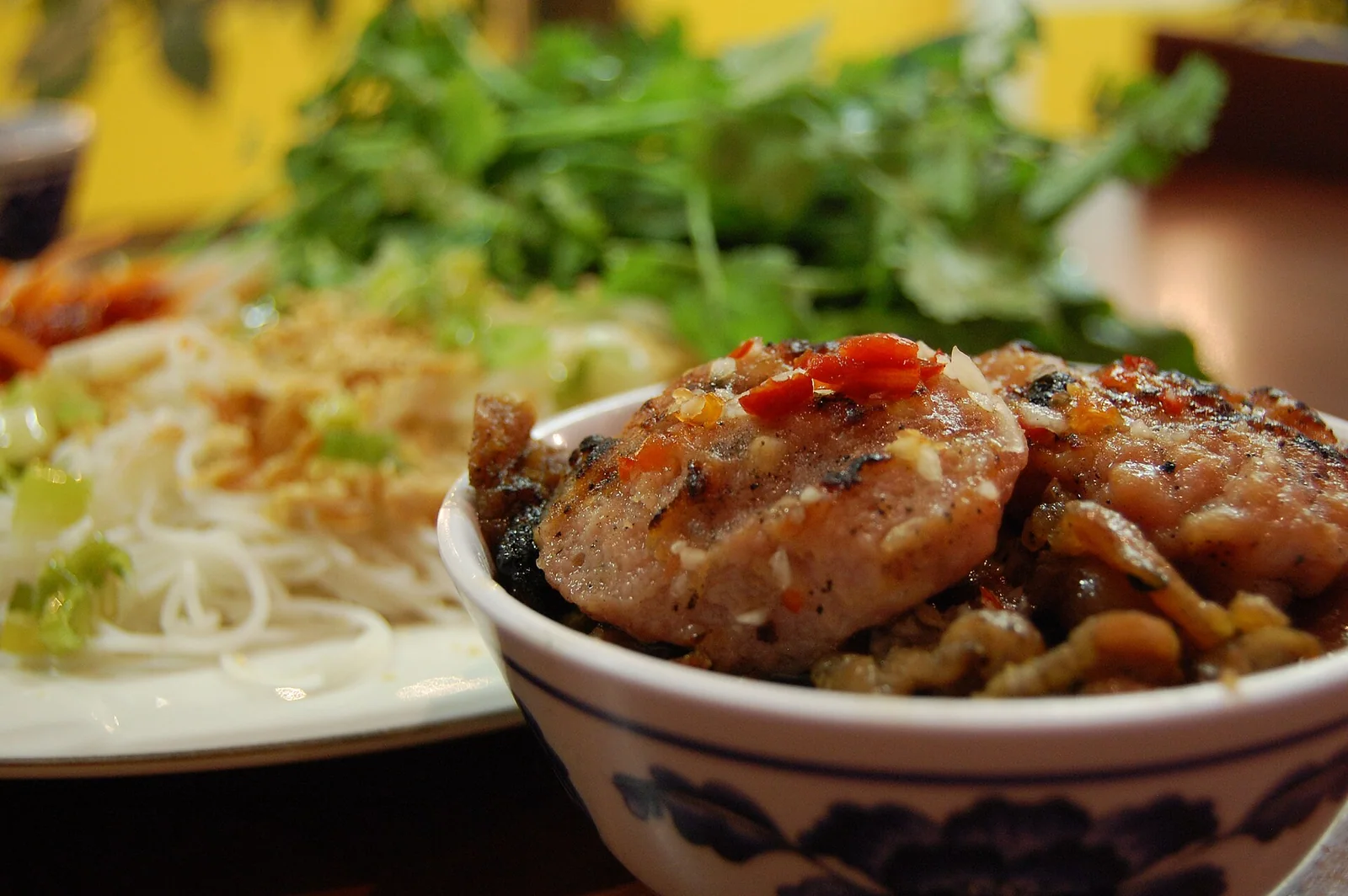
It is also the dish Barack Obama ate in Hanoi, which is why you will see it referenced everywhere you look. The dish is worth eating regardless of who else has eaten it, and the place with the photograph on the wall is not automatically the best one.
Cha ca is the sit-down one. Fish marinated in turmeric, brought to the table part-cooked, and finished in front of you in a pan with large amounts of dill and spring onion. It is a dinner, it takes time, and it is one of the few Hanoi dishes that works as an occasion rather than a quick stop. If you are having one proper restaurant meal in the city, this is a strong candidate.
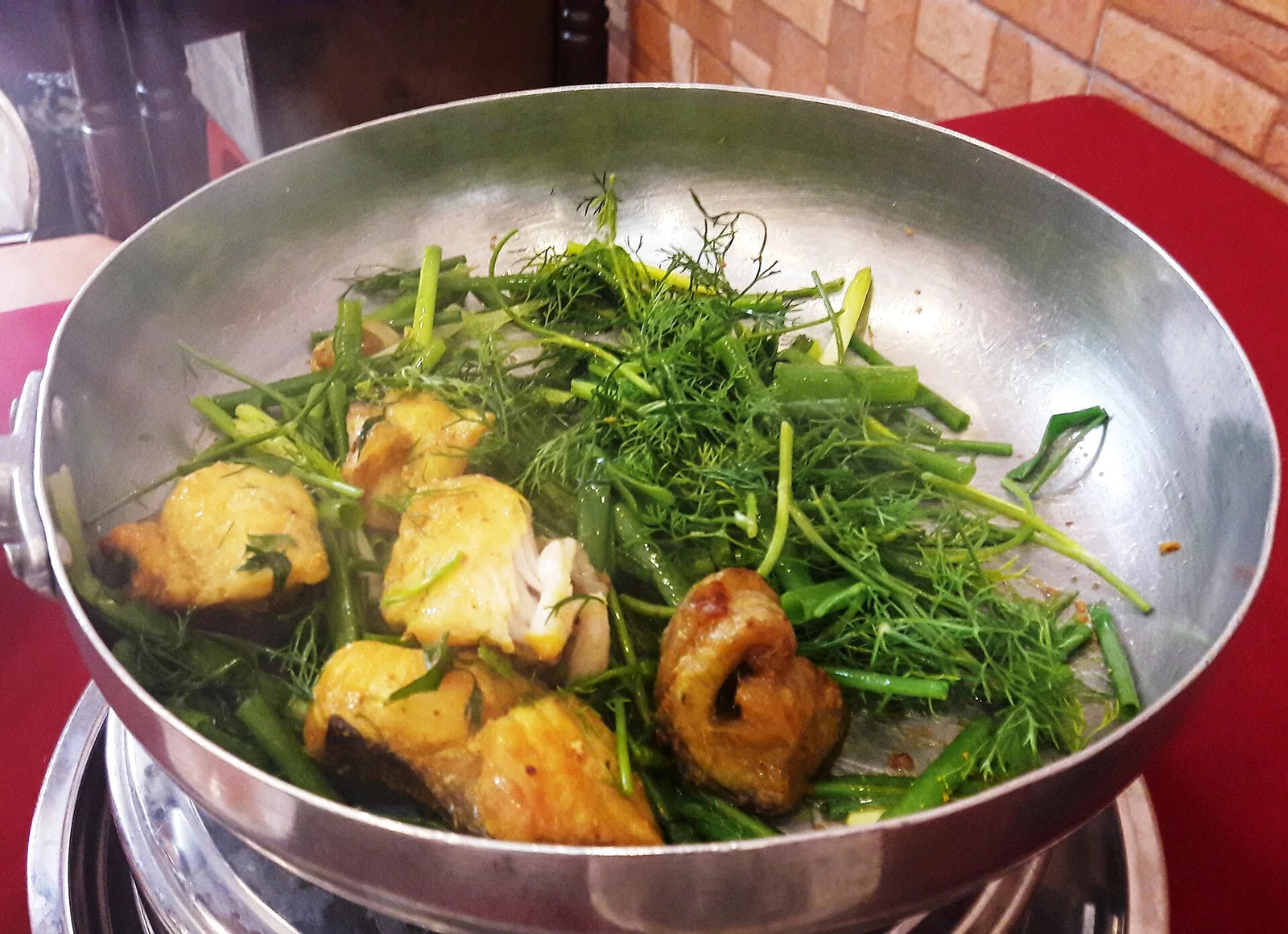
Breakfast, and the coffee
Banh cuon is the breakfast to look for: very thin rice sheets, steamed and rolled around pork and mushroom, served with dipping sauce. It is light, it is quick, and it is a morning dish, so do not go looking for it at 20:00.
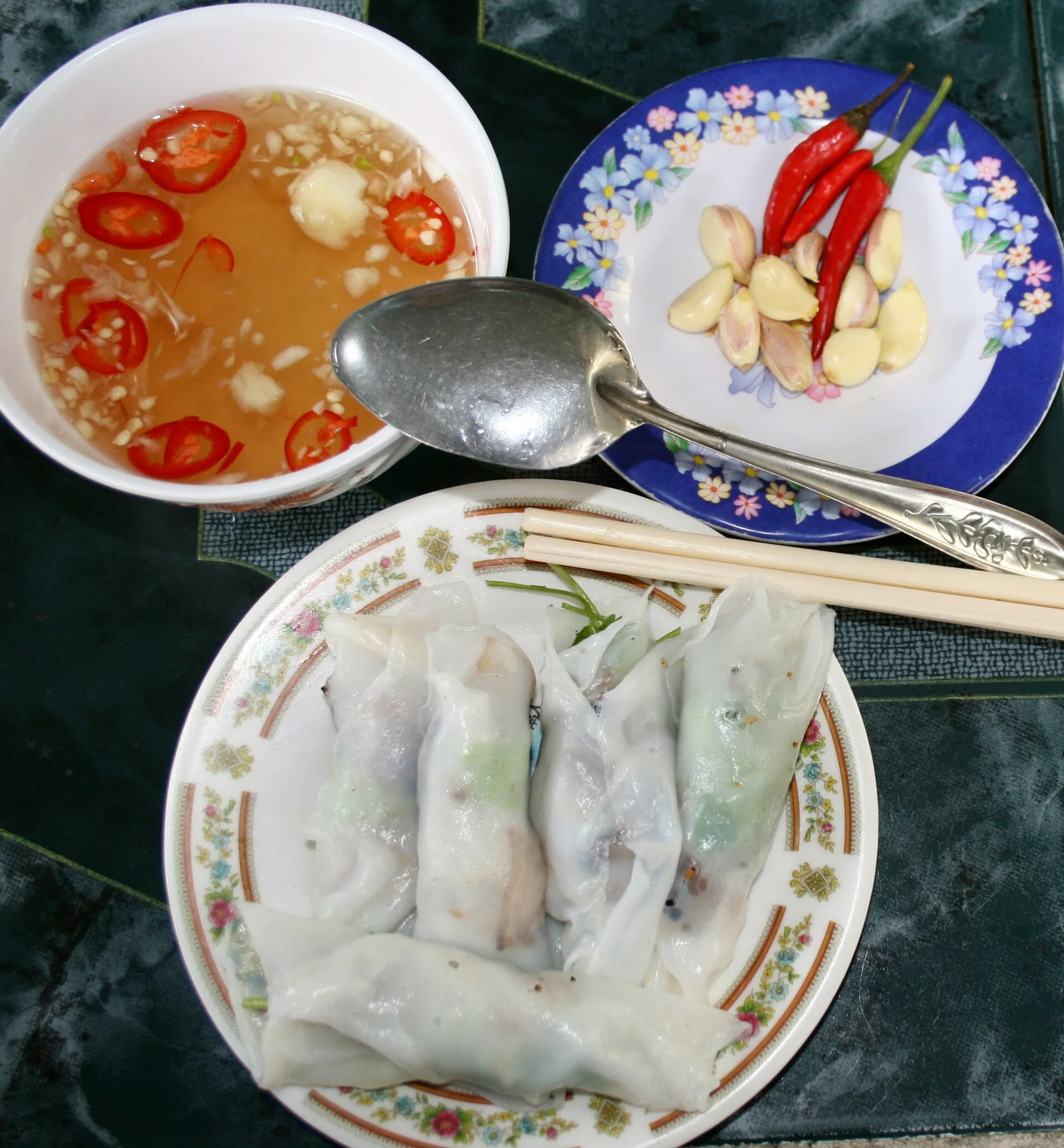
Egg coffee, ca phe trung, was invented in Hanoi. Whipped egg yolk over strong coffee, served hot, thick enough to eat with a spoon at the top. It is closer to a dessert than a drink and it is one of the genuinely distinctive things about the city rather than a tourist invention. Have it mid-morning or mid-afternoon; having it after dinner is a decision you will regret at 02:00.
Bia hoi and eating on the street
Bia hoi is fresh draught beer sold at street corners, poured into glasses, drunk on plastic stools on the pavement. It is one of the cheapest ways to spend an evening in the city and one of the most sociable. The stools are low, the tables are low, and the arrangement means you end up talking to whoever is next to you.
On drinks: stick to bottled or filtered water, which hotels, homestays and cruise boats all provide. You may be brought iced tea with a meal without having ordered it. Coffee here is strong, and iced is the version that makes sense in the summer heat.
Also worth planning for: the mountains and the boat both change how you eat. A cruise feeds you on its own schedule, so do not book anything on shore for the night you are aboard. In the mountains, ask your homestay or operator what time meals are served and whether they are included, rather than assuming you can eat whenever you get in. On a trip where the food is one of the reasons you came, those are two questions worth asking early.
On street food generally: the rule that works is to eat where the turnover is high. A stall with a queue is turning food over in front of you, which is the thing you actually care about. A quiet place at 14:00 with a display of pre-made items is a different proposition. Follow the crowd and the time of day, and eat the thing that place specialises in rather than the four other items they have added to the menu for visitors.
How the north compares with the rest of the country
| Region | Character | What that means at the table |
|---|---|---|
| North | Less sweet than the south, less spicy than the centre | Clear broths, restrained seasoning, herbs on the side |
| Centre | The spiciest of the three | Chilli is built in rather than offered separately |
| South | The sweetest of the three | Sugar in savoury dishes as standard |
This is the single most useful thing to know if you are travelling through more than one region on the same trip. The same dish name gives you a noticeably different bowl in Hanoi and in Ho Chi Minh City, and neither is wrong. Our central Vietnam guide covers the middle of that scale if you are heading south afterwards.
If you want a plan rather than a list, this is a good day of eating in Hanoi, and it uses all six items without repeating a meal slot.
| Time | Eat | Why then |
|---|---|---|
| Before 09:00 | Pho, or banh cuon | Both are breakfast dishes and the best places are busiest early |
| Mid-morning | Egg coffee | Thick and sweet; it works as a second breakfast, not as a nightcap |
| Around midday | Bun cha | A lunch dish; plan it for the middle of the day |
| Late afternoon | Bia hoi on a street corner | The corners fill from the end of the working day |
| Evening | Cha ca, sitting down | It is cooked at the table and takes time |
| Late | Pho again, if you are still out | It reappears at night, which is when the second-best bowls are |
That is six eating occasions in a day, which is more than most people manage. Pick four. The two to prioritise are a proper morning pho and a sit-down cha ca dinner, because those are the two that are hardest to find done well outside the north.
One last thing on eating in the mountains. Food in Sapa and on the Ha Giang plateau is simpler than in Hanoi, and a homestay meal may be communal, set and served at one fixed time. If you have dietary requirements, tell your operator or host well before you arrive rather than at the table, because that is not a thing anyone can solve at 19:00 in a village three hours from a market.
15. What a northern trip actually costs
Budget $305 to $580 per person for five days, $480 to $830 for seven to eight, and $700 to $1,250 for ten to twelve, with flights on top. Those totals are built from two things: a daily rate for food, rooms and local transport, and a short list of big items that dominate everything else. Once you see how the two combine, you can move your own numbers around with confidence.
The daily rate, at three levels
| Level | Per day | What that looks like |
|---|---|---|
| Backpacker | $25-40 | Dorms and cheap private rooms, street food, buses and shared vans |
| Mid-range | $30-55 | Decent private rooms, a mix of street and sit-down meals, Grab everywhere |
| Comfortable | $120 and up | Good hotels, private cars, restaurants rather than stools |
The backpacker and mid-range bands overlap, which is not an error. The difference between them in northern Vietnam is mostly the room and how often you sit down to eat, and both of those are cheap enough here that a careful mid-range traveller and a comfortable backpacker end up spending the same. The jump to $120 and up is a real step rather than a gradient, because it is where private cars and 4 and 5 star boats enter the picture.
What the daily rate covers: accommodation, food, drinks, local transport and small entries. What it does not cover: the cruise, the mountain region, and the intercity transfers. Those are the big items, and they are the reason the totals are not simply the daily rate multiplied by the days.
The big items, and why they dominate
| Trip length | Big-ticket total | What is in it |
|---|---|---|
| 5 days | $155-305 | Overnight cruise, plus the Ninh Binh day |
| 7-8 days | Add Fansipan and trekking | The above, plus Sapa transport, the cable car and a guide |
| 10-12 days | Add the Ha Giang Loop | The above, plus the loop package and the night buses |
Look at the five-day figure closely, because it explains the whole structure. An overnight cruise is $130 to $250. A guided Ninh Binh day is $25 to $55. Add them: $155 to $305. That is the entire big-ticket line for a five-day trip, and it is two items.
In other words, on a short northern trip the cruise is somewhere between a third and a half of everything you will spend on the ground. That is why the boat is the booking to get right and the one place where paying $30 more is a good decision, and it is also why a five-day trip and a comfortable five-day trip differ by less than people expect: the biggest single line is the same either way.
Stack that up against the daily rate and the totals fall out.
| Trip length | Daily rate x days | Big items | Total per person |
|---|---|---|---|
| 5 days | $150-275 at $30-55 a day | $155-305 | $305-580 |
| 7-8 days | $210-440 | Cruise, Ninh Binh, Sapa, Fansipan, trekking | $480-830 |
| 10-12 days | $300-660 | All of the above plus the Ha Giang Loop | $700-1,250 |
Note that none of these include international flights. They also assume you are travelling as one person paying one person’s share; a couple splitting private cars and rooms lands lower per head, and a solo traveller taking private cars lands higher.
A five-day budget, line by line
Here is where the money actually goes on the shortest workable itinerary, at a mid-range level.
| Item | Cost | Note |
|---|---|---|
| Airport transfer in and out | $15.20-26.60 | Grab both ways at $7.60-13.30 each |
| Overnight cruise | $130-250 | Bay admission usually included; confirm |
| Crew tip on the boat | $5-10 | Conventional, and not inside the fare |
| Ninh Binh, guided day | $25-55 | Transport, boat, entries and lunch |
| Ninh Binh, done independently instead | $25.30-33.30 | Van both ways, Trang An boat, Hang Mua |
| Temple of Literature | $2.70 (approx. 70,000 VND) | Open 08:00-17:00 |
| Rooms, food and local transport, 4 nights | $120-220 | At $30-55 a day |
Add the middle of each range and you land close to $350 to $400 per person for five days, which sits comfortably inside the $305 to $580 band. The single largest lever is the boat. Move from a $130 all-inclusive to a $250 four-star and the trip total moves by $120, which is more than every entry fee, tip and Grab ride combined.
A ten to twelve day budget, line by line
| Item | Cost | Note |
|---|---|---|
| Airport transfers | $15.20-26.60 | Both directions |
| Overnight cruise | $130-250 | Plus $5-10 crew tip |
| Ninh Binh with a night | $25-55 for the day, plus a room | Resort or lodge among the karst |
| Night bus to Ha Giang and back | $19-35.80 | Cabin sleeper at about $17.90 each way |
| Ha Giang Loop, 3 days 2 nights with a driver | $150-180 | Driver, bike, fuel and homestays included |
| Loop entry fees | Roughly $3-6 in total | Individual sites are $0.38-1.90 |
| Rooms, food and local transport, 8-9 days | $240-495 | At $30-55 a day |
That lands between roughly $580 and $1,050, inside the $700 to $1,250 band once you allow for the four-day loop option at $250 to $379 instead of the three-day one, and for the days you spend eating well in Hanoi at the end.
The comparison worth making: a twelve-day trip costs roughly double a five-day trip, not two and a half times, because the cruise and the airport transfers are one-off costs that do not scale with length. Extra days in northern Vietnam are cheap. Extra destinations are not.
How to spend less without spoiling it
There are cheap savings and expensive ones. The cheap savings are the ones that change a number without changing your day. The expensive ones look like savings and remove something you came for.
| Worth doing | Saves | The downside |
|---|---|---|
| Bus 86 instead of a taxi from the airport | About $13-17 each way | Nothing, if you land 07:00-22:05 with light bags |
| Do Ninh Binh independently rather than guided at the top of the range | Up to about $25 | The guide, and having lunch arranged |
| Four-berth night train rather than the 2-berth deluxe | Well over $100 | Privacy on a journey you sleep through |
| Sapa town mid-range hotel rather than the top end | Varies, and the mid range here is good | Very little |
| Skip Cat Cat at $5.70 and walk a quieter valley at $2.85-3.40 | A couple of dollars, plus the crowds | The closest village to town |
| Not worth doing | Saves | What it actually removes |
|---|---|---|
| A cruise below the $130 floor | $40-70 | The quality of the single biggest item in the trip |
| Day cruise instead of overnight | $60-140 | About 18 hours on the water, including the quiet ones |
| Shared sleeper instead of a cabin to Ha Giang | $3-8 | The sleep you need before a day on a motorbike |
| One night in Sapa instead of two | One night’s room | Most of the reason for 11-12 hours of driving |
| Renting a bike in Ha Giang without the right licence | $115-150 | Your insurance cover |
The general shape of it: transport and rooms are where northern Vietnam is genuinely cheap and where cutting makes no difference to your day. The cruise and the mountain days are where cutting removes the trip. If your budget is tight, take fewer destinations rather than cheaper versions of the same ones.
Cash, cards and tipping
The split that matters is when you pay rather than where. Book in advance and you can generally pay by card. Pay at the point of use and you are paying cash: boat tickets at the pier, village entries, rower tips, crew tips, bia hoi, street food, homestay extras and petrol. Plan your cash around that split rather than around a daily figure, because the cash days are the ones with a boat or a mountain in them.
| Tip | Amount | When |
|---|---|---|
| Cruise crew | $5-10 per person | Collected at the end of the cruise |
| Ninh Binh rower | $0.76-1.90 (approx. 20,000-50,000 VND) | At the end of the boat trip, in cash |
| Sapa village guide | Agreed in advance, $1.90-26.60 a day | Settle the terms before you set off |
| Restaurants and street food | No fixed convention | Round up if you want to |
Carry small notes. The rower tip, the village entries at $0.38 to $0.76 and the electric cart at $0.57 all want exact-ish change, and handing over a large note at a village gate in Ha Giang is a slow way to start a morning. Our Vietnam money and currency guide covers where to change money and which cards work.
16. Twelve things older guides still get wrong
Northern Vietnam has changed enough in the last two years that a lot of otherwise good travel writing is now inaccurate on specifics. The province map was redrawn in July 2025, motorbike licence categories changed in January 2025, the airport reorganised its kerbside in August 2026, and the Ha Long seaplane stopped flying in early 2026. Here is the list, so you can spot an out-of-date source in about ten seconds.
| Commonly written | Actually the case |
|---|---|
| Ha Giang province | Merged into Tuyen Quang province on 1 July 2025. Ha Giang remains a city and region name |
| Sapa is in Lao Cai province, capital Lao Cai City | Lao Cai province still exists, but the provincial capital is now Yen Bai City |
| Vietnam has 63 provinces | 34 since 1 July 2025: 28 provinces and 6 centrally run cities |
| Bus 86 from Noi Bai is 45,000 VND | The airport’s posted fare is $1.90 (approx. 50,000 VND) |
| Order an app car and meet it outside the terminal at Noi Bai | Since 3 August 2026, app cars use car park P1 for T2 and P2 for T1 |
| Airport taxis run on a fixed fare | No fixed fare. Metered at $0.57-0.63 (approx. 15,000-16,700 VND) per km since 1 March 2025 |
| There is a seaplane to Ha Long | Suspended in early 2026. Road is the only option |
| Ha Long has a single bay admission fee | Charged by route at $9.90-11.80 (approx. 260,000-310,000 VND); overnight is $20.90-28.50 (approx. 550,000-750,000 VND) |
| A Vietnamese A1 licence covers 175cc | 125cc since 1 January 2025 |
| An international permit from a car licence lets you ride a motorbike | It shows category B only, which is cars |
| Ha Long cruises run normally all year | Cruises have been cancelled for weather, with July to September the peak typhoon risk |
| The Sapa terraces are always green | Late October to March they are brown stubble |
| Trang An and Tam Coc are the same thing | Separate piers, separate prices, different durations |
The three that will make you overpay
The fixed airport fare. There isn’t one, and the claim that there is exists mainly so that someone can quote you a number well above the meter. The real arithmetic is 27 to 30 km at 15,000 to 16,700 VND per km, which is $15.40 to $19 (approx. 400,000 to 500,000 VND). Anything materially above that is invented.
The single Ha Long admission fee. Bay admission is charged by route, and overnight is charged separately at $20.90 to $28.50 (approx. 550,000 to 750,000 VND). Most cruise fares include it. Ask specifically whether bay fees are in the number before you compare two quotes, because that single line is enough to make two otherwise identical boats look like different prices.
The $60 overnight cruise. It is not in the list above, since it is a price signal rather than a factual error. It belongs here anyway. It is the clearest price signal on the bay, and what it signals is a tout product. The reliable all-inclusive floor is $130 to $160.
The two that will get you into real trouble
Both concern motorbikes, and both still appear in older Ha Giang write-ups.
The first is the 175cc figure for a Vietnamese A1 licence. The limit dropped to 125cc on 1 January 2025. This matters because the manual bikes rented for the loop are 125 to 150cc, and the 150 sits above the current A1 ceiling.
The second is the belief that an international driving permit issued from a car licence covers a motorbike. It does not. It shows category B, which is cars, and no amount of confidence on a bike changes what is printed on the document. Insurers apply the same test, which means the consequence of getting this wrong is not a fine but an uninsured accident on a mountain road.
The two that ruin the photographs
Green terraces all year and clear skies over the bay all year are the two most common pieces of accidental fiction, and they are the ones that cause the most disappointment because you cannot fix them once you are there.
The Sapa terraces are brown stubble from late October through March. That is five months of the year. A photograph taken in late September will illustrate a December article perfectly well, and nobody has to lie to do it. They simply do not say when the picture was taken, and there is no rule that says they must.
Ha Long in January and February is frequently fogged in with short visibility, so a winter cruise carries a risk to the view that is separate from any risk to the sailing. If your dates are in the winter and the bay itself is the point, either move the cruise to March or April, or pick Lan Ha so that Cat Ba National Park gives you something to do on land when the water is white.
What has not changed, despite all of that
It is easy to read a list like the one above and conclude that nothing you have read about northern Vietnam is reliable. That is the wrong conclusion, and it matters because a lot of older writing is still the best thing available on the parts that do not move.
| Still true | Why it does not date |
|---|---|
| Trang An is a better single boat trip than Tam Coc outside harvest | It is a comparison of duration and caves, not of prices |
| Sapa’s terraces are gold for two to three weeks in late September | It is a farming calendar, not a regulation |
| Lan Ha is quieter than Ha Long | It is a comparison of scale between adjacent bays, not a published figure |
| Hanoi is the base and everything is a round trip from it | The road network has not changed shape |
| The Lao Chai to Ta Van walk is the standard Sapa day | Paths and villages do not get renamed by resolution |
| Hanoi food is less sweet than the south and less spicy than the centre | Regional cooking styles are not administered |
The dividing line is roughly this: anything set by a government, an operator or a price list should be checked against a dated source. Anything set by geography, farming or cooking can be taken from a good older guide without much worry. Applying that test saves you from both errors, which are trusting a 2022 fare table and ignoring a 2022 description of a trek.
How to date a source in ten seconds
| Check | If it says this, it predates |
|---|---|
| Number of provinces | 63 means before July 2025 |
| Ha Giang’s status | “Ha Giang province” as a current administrative unit means before July 2025 |
| Vietnamese A1 limit | 175cc means before January 2025 |
| Bus 86 fare | 45,000 VND means the writer has not checked the airport’s own posting |
| Noi Bai app car pickup | “Meet your driver at arrivals” means before August 2026 |
| Ha Long seaplane | Any mention as a current service means before early 2026 |
None of these are reasons to throw a source away. A guide written in 2023 can still be excellent on which trek to do or which street to eat on, because those things do not change on a legislative timetable. Fares, licences, provincial names and pickup points do. Keep the judgement, check the numbers.
17. Where to go from here
Read this hub for the shape of the trip, then read the guide for whichever place you have decided to add, then read the practical ones before you book. There is a sensible order, and it is not alphabetical. The decisions that constrain everything else are the dates and the mountain region, so those guides come first, and the airport and money pieces come last because they only matter once the rest is fixed.
The order that works
| Step | Read | Because |
|---|---|---|
| 1 | This page | Fixes the trip length, the base and which mountain region |
| 2 | The cruise guide | The cruise is the booking with real scarcity and the biggest single cost |
| 3 | Sapa or Ha Giang, whichever you chose | These need the most lead time, especially the loop |
| 4 | Hanoi and Hanoi accommodation | You will book Hanoi rooms for three or four nights |
| 5 | Ninh Binh | Bookable close to the date, so it can wait |
| 6 | Visa, eSIM, money, Grab, scams | Practical layers that apply whatever the itinerary is |
Two of those deserve a note. The cruise comes second rather than first because you cannot choose a sailing date until you know how long the trip is and where the cruise sits in it, which is what this page settles. And the practical guides come last because they are the same regardless of route, so reading them early tends to mean reading them twice.
Lead times differ a lot between these, which is the other reason the order matters. Some of the north can be arranged the day before. Some of it cannot.
| Booking | How far ahead | Why |
|---|---|---|
| Overnight cruise | Weeks, more in October to December | Fixed cabin counts and the year’s best window |
| Ha Giang Loop with a driver | Weeks | You are booking a driver, not just a seat on something |
| Sapa valley homestay | Weeks in autumn | The gold window is two to three weeks long and everyone wants it |
| Hanoi hotel | Days to weeks | Large supply in and around the centre |
| Night train berths | Days to weeks | A fixed number of berths per train, on two services |
| Ninh Binh day trip | The day before | Vans run roughly hourly from the Old Quarter |
| Fansipan cable car | Same day | Go on the clear day rather than the booked one |
The destination guides
Hanoi
The city you will keep coming back to. Areas, food, what to do with two days and what to do when it rains for three. Hanoi travel guide
Where to stay in Hanoi
The eight areas street by street, with what each is like after dark and which ones are worth the extra. Hanoi accommodation guide
Ha Long Bay cruises
Choosing an operator, reading a cabin plan, and what to check in the terms before you pay $130 to $250. Ha Long Bay cruise guide
Sapa
The individual villages, homestay selection, and the trekking routes in more detail than fits on this page. Sapa travel guide
Ninh Binh
The single-day version, hour by hour, including which Trang An route to take and when to climb Hang Mua. Ninh Binh day trip guide
Ha Giang Loop
Operator selection, the day-by-day route, and what a homestay night on the plateau is actually like. Ha Giang Loop guide
If you have not decided between Sapa and Ha Giang yet, read both and use your dates as the deciding factor rather than the photographs. Late September favours Sapa, early November favours Ha Giang, and April to early May is genuinely a draw.
The practical layer, before you book
Visas. What you need depends on your passport, and Vietnam’s e-visa runs for up to 90 days for stays beyond whatever exemption applies to you. Check your own entitlement early rather than late, because the answer affects how long a trip you can plan and there is no way to fix it at the airport. Our Vietnam visa and e-visa guide walks through the process.
Data. Everything from ordering a car out of car park P1 to checking whether your cruise is still sailing assumes a working connection from the moment you land. The Vietnam eSIM and SIM card guide compares the options and covers what coverage is actually like on the Ha Giang plateau.
Money. Boat tickets, village entries, rower tips, crew tips and petrol are all cash. The Vietnam money and currency guide covers where to change and what to carry, and it is worth reading before you arrive rather than at an ATM.
Getting around. Grab and Green SM handle almost all your city movement and both quote the fare in the app before you accept. The Grab and Green SM guide covers setup, payment and which to use where.
Avoiding the obvious. Most of what goes wrong for visitors in the north happens in the first two hours: the arrival hall, the fixed-fare claim, the cruise resold three times. The Vietnam scams guide is short and worth ten minutes.
If the north is only part of the trip
Plenty of people do the north and then keep going. Vietnam is long, the domestic flights are cheap and frequent, and the food changes noticeably as you move south, which is one of the better reasons to do more than one region.
The central Vietnam travel guide is the direct sibling to this page and covers the middle of the country. It is the natural second region if you want beaches and a warmer, spicier version of the food, and it is the sensible replacement if your dates land badly for the north, since central Vietnam’s calendar is different.
The complete Vietnam travel guide is the one to read if you have not yet decided how much of the country you are doing. It sets out how the three regions differ and how much time each needs, which is the decision that sits above everything on this page.
Three things to take away
If you forget the rest of this page, these three will still get you a good trip.
Plan in round-trip hours, not kilometres. Ninh Binh is 3 to 4 hours there and back, Ha Long is 4.5 to 5, Sapa is 11 to 12 and Ha Giang is 12 to 14. Those four numbers determine what fits in your week far more than any map does. Under twelve days, that arithmetic means one mountain region rather than two, because doing both is 23 to 26 hours of road before you have looked at anything.
Book the cruise first, and put it early in the trip. It is the item with real scarcity, it is between a third and a half of what you will spend on the ground, and it is the only one that can be cancelled outright by weather. Sailing on day three of eight leaves you five days to try again. Sailing on day seven leaves you whatever the terms allow and a flight to catch.
Go in October if you possibly can. It is the only month when Ha Long, Sapa, Ninh Binh and Ha Giang are all at or near their best at once. If your month is fixed, let it choose for you: late September for Sapa’s gold, early November for Ha Giang’s buckwheat, April to early May for flooded terraces in both, and March to April for the quietest version of the whole region.
A planning checklist
Run this in order. Each line depends on the one above it.
| Do this | When | Why in this order |
|---|---|---|
| Check your visa or e-visa position | First | It caps how long your trip can be |
| Fix the trip length: 5, 7-8, or 10-12 days | Next | It determines whether a mountain region fits at all |
| Pick the month, or check what your fixed month gives you | Next | October is best; your month decides Sapa versus Ha Giang |
| Choose one mountain region if the length allows | Next | Both together is 23-26 hours of road |
| Book the overnight cruise, in the first half of the trip | Early | Fixed cabin counts, and weather cancellations need a fallback day |
| Book the Ha Giang Loop or Sapa accommodation | Early | Both need more lead time than anything else on this list |
| Book Hanoi rooms, ideally the same hotel twice | Then | Ask about bag storage between stays; that is the practical benefit |
| Sort a motorcycle entitlement if you intend to ride | Months ahead | A car-based permit shows category B only |
| Buy an eSIM and activate before departure | Week before | App cars now load at car park P1, not the kerb |
| Book the airport pickup if you land late or heavy | Week before | Bus 86 stops at 22:05 |
| Book Ninh Binh | Last | Available close to the date, and it is your cruise fallback |
One last thing, and it applies to every version of this trip. Leave the final day in Hanoi unbooked. Every delay in northern Vietnam eventually arrives as a late return into the city, and an empty last day absorbs a landslide, a rescheduled cruise, a cancelled bus or simply being too tired to do anything else. If nothing goes wrong, you spend it eating, which is not a bad outcome either.
🎡Things to Do4
🏨Where to Stay1
🚇Getting Around3
🧭Travel Tips1
🧭Vietnam-wide essentials143
Northern Vietnam FAQ
Five days is the minimum that produces a complete trip, and ten to twelve is where it stops feeling rushed. Five days gets you Hanoi, one overnight cruise and a day in Ninh Binh. Seven to eight adds one mountain region. Ten to twelve adds the Ha Giang Loop without distorting everything else.
The reason it grows in steps rather than smoothly is the round-trip driving. Ninh Binh is 3 to 4 hours there and back, Ha Long is 4.5 to 5, Sapa is 11 to 12 and Ha Giang is 12 to 14. Each destination is a fixed block of road time that you cannot compress, so adding one is never a matter of half a day.
Three or four days is not enough for anything beyond Hanoi and a day trip. If that is what you have, do Hanoi properly and add Ninh Binh, and save the bay and the mountains for a trip with room in it. A rushed overnight cruise squeezed into a three-day visit is the version people regret.
October, and it is not a close call. It is the only month when all four destinations are at or near their peak at the same time: the typhoon season has passed, the cruise season has started, the Sapa terraces are gold or freshly cut, and Hanoi is cool, dry and clear.
If October is not available, the next best options are November to December and March to April. November and December are the best cruise months of the year and the coldest in the mountains, with the Ha Giang buckwheat peaking in early November. March and April are mild and quiet, and April into early May is when the terraces are flooded rather than green.
The windows to avoid if you can are July to September, which carries the highest typhoon risk on the coast and the heaviest rain and landslide risk in the mountains, and January to February, when the bay is frequently fogged in and Sapa gets close to 0°C with brown fields.
Let your dates choose. Late September into early October favours Sapa, because that is the two to three week window when the rice terraces are gold. Late October into early November favours Ha Giang, because the buckwheat is flowering and Sapa’s fields are already cut. April to early May is a genuine draw, since both have flooded terraces.
Beyond the calendar, they are different kinds of trip. Sapa is walking: valley treks of 3 to 16 km, villages you can reach on foot, and the Fansipan cable car if you want the 3,143 m summit without a two-day climb. Ha Giang is a 350 km motorbike circuit through the Dong Van karst plateau, and the licence rules make riding pillion behind a local driver the realistic option for most visitors, over three or four days.
Sapa is also easier to fit. Its round trip is 11 to 12 hours against Ha Giang’s 12 to 14, the night train lets you sleep through one leg, and two nights is a workable stay. A Ha Giang Loop needs three to four days plus the approach in each direction, which is why it belongs in a ten to twelve day trip.
Lan Ha for most people. It runs at roughly 30% of Ha Long’s crowding, the scenery is the same limestone formation, and its itineraries include Cat Ba National Park and beaches, so a foggy or rained-off morning still leaves you somewhere to go on land.
Choose Ha Long itself if you specifically want the views you have seen in photographs and you accept the company. In peak season there are more than 500 boats out there, departing from Tuan Chau and Sun Port.
Choose Bai Tu Long if quiet is the actual goal. It runs at about 15% of Ha Long’s crowding and you can go long stretches without seeing another boat. It departs from Hon Gai, has fewer operators, and it is the bay where a two-night cruise at $280 to $600 makes the most sense, because distance from other boats is the thing you are buying.
Per person, excluding flights: $305 to $580 for five days, $480 to $830 for seven to eight, and $700 to $1,250 for ten to twelve. Those are built from a daily rate of $30 to $55 at mid-range level, plus a short list of big items.
On a five-day trip the big items are just two: the overnight cruise at $130 to $250, and the Ninh Binh day at $25 to $55. That is $155 to $305, which means the cruise alone is somewhere between a third and a half of everything you spend on the ground. Longer trips add the Fansipan cable car at about $32.30 (approx. 850,000 VND), a Sapa guide, or a Ha Giang Loop package at $150 to $180 for three days.
Everyday costs are low. Village entries run $0.38 to $5.70, the Temple of Literature is $2.70 (approx. 70,000 VND), bus 86 from the airport is $1.90 (approx. 50,000 VND), and a Trang An boat is $9.50 (approx. 250,000 VND). Extra days in northern Vietnam are cheap. Extra destinations are not.
Probably not, and this is the question people get wrong most expensively. An International Driving Permit issued from a car licence shows category B only, which is cars. It does not cover a motorbike of any size, and insurers apply the same test, so riding on a category B permit puts your cover at risk as well as your licence.
To get category A on an IDP you need a motorcycle entitlement on your home licence first, which is not something you can arrange after you arrive. Separately, whether Vietnam recognises your IDP at all depends on an agreement between Vietnam and your country, so check your own position rather than assuming. Anything 50cc and under needs no licence, and 50cc is not enough bike for these roads.
Also note that Vietnam’s own A1 licence has covered up to 125cc since 1 January 2025, down from 175cc, and the manual bikes rented for the loop are 125 to 150cc. The practical answer for most visitors is an easy rider: you sit on the back, a local driver rides, and $150 to $180 covers three days including the bike, fuel and homestays.
Grab or Green SM at $7.60 to $13.30 (approx. 200,000 to 350,000 VND) is right for most arrivals, but you must walk to a car park to meet the driver. Since 3 August 2026, app-hailed cars cannot stop in front of the terminal: Terminal 2 pickups are in car park P1 and Terminal 1 pickups are in car park P2.
The alternatives are an airport contract taxi at $15.40 to $19 (approx. 400,000 to 500,000 VND), which waits at the terminal in lane 4 between pillars 3 and 10, and bus 86 at $1.90 (approx. 50,000 VND), which runs 07:00 to 22:05 every 25 to 30 minutes and takes 50 to 55 minutes to Hanoi station. The airport is 27 to 30 km out and the drive is 40 to 60 minutes.
There is no fixed airport taxi fare, whatever anyone in the arrivals hall tells you. Contract taxis are metered at 15,000 to 16,700 VND per kilometre, which is where the 400,000 to 500,000 VND total comes from. If you would rather be met at the door, a pre-booked transfer stands at door A4 at the west end or door A1 at the east end.
Trang An, unless you are there between late May and mid June. Trang An is $9.50 (approx. 250,000 VND) for 2.5 to 3.5 hours through up to nine caves. Tam Coc is $4.60 to $5.70 (approx. 120,000 to 150,000 VND) plus $3.80 (approx. 100,000 VND) entry, for 1.5 to 2 hours and three caves.
Total cost is almost identical once you add Tam Coc’s separate entry fee, so this is a decision about time rather than money: Trang An gives you roughly twice the trip for the same spend. The exception is harvest, when the rice along the Tam Coc stretch turns gold from late May into mid June, and during that window Tam Coc is the better of the two.
They are separate places with separate piers, separate ticketing and different durations, so make sure your driver knows which one you want. At Trang An you also pick one of three fixed routes: route 1 is nine caves and three temples, route 2 includes the Kong film set, and route 3 has the longest cave at over 1 km and the fewest boats. Whichever you take, add Hang Mua at $3.80 (approx. 100,000 VND) and about 500 steps for the view down over all of it.
Start with the whole country — our complete Vietnam travel guide →