
Phu Quoc Travel Guide: Arrival Times, Drive Times and What a Day Actually Costs
The island runs 50km north to south and the airport sits in the middle of the west coast. Once you know the drive times and when your flight lands, the rest of the trip plans itself.
| Getting there | Direct flights from Bangkok, Singapore, Hong Kong, Kuala Lumpur and Taipei. From anywhere else you connect in Ho Chi Minh City or Hanoi, about an hour away. |
|---|---|
| Airport to hotel | Duong Dong and Long Beach are 13 minutes, Sunset Town 28, VinWonders 39, Vinpearl Safari 54. |
| North to south | The northern theme parks sit 53 minutes from the southern shows. Do not put both in one day. |
| Taxis | Metered taxis run about 17,000 dong per km, Green SM about 14,000. Airport to Duong Dong lands around 200,000 dong. |
| How long | Three nights is the floor. Five nights buys you a separate day for the north and the south. |
| Visa | Arrive straight into Phu Quoc and you get 30 days visa-free whatever passport you hold. |
1. The short answer: how this island actually works
2. When you land decides your first day
3. Airport to hotel: what it costs by area
4. Getting around the island
5. Which part of the island to sleep on
6. How many nights you need
7. Splitting the day: north and south are 53 minutes apart
8. What a day actually costs
9. What to eat
10. Which beach, and when
11. Theme parks and shows: which day to use
12. When to come
13. Visas and arrival
14. Arriving and leaving by boat
15. Things that save you trouble
16. Who this island suits
17. 🏝️ The rest of our Phu Quoc guides
1. The short answer: how this island actually works
🛬 Phu Quoc Airport — the pre-arrival form, and how far your hotel really is →
🛥️ An Thoi island hopping: which port your boat leaves from, and what the fare leaves out →
Two things decide your days on Phu Quoc: what time your plane lands, and which stretch of coast your hotel sits on. The island is long, the sights are split into three clusters, and the road between the far north and the far south takes the better part of an hour. Sort those out first and the rest of the trip falls into place.
Start with the map in your head. The airport is roughly in the middle of the west coast. Here is how long the drive actually takes from there.
| From the airport | Distance | By car |
|---|---|---|
| Duong Dong town | 6.9km | 13 min |
| Long Beach (Bai Truong) | 7.4km | 13 min |
| Bai Vong ferry port | 7.8km | 13 min |
| Dinh Cau night market | 10.4km | 15 min |
| Sao Beach | 18.1km | 25 min |
| Ong Lang Beach | 19.6km | 27 min |
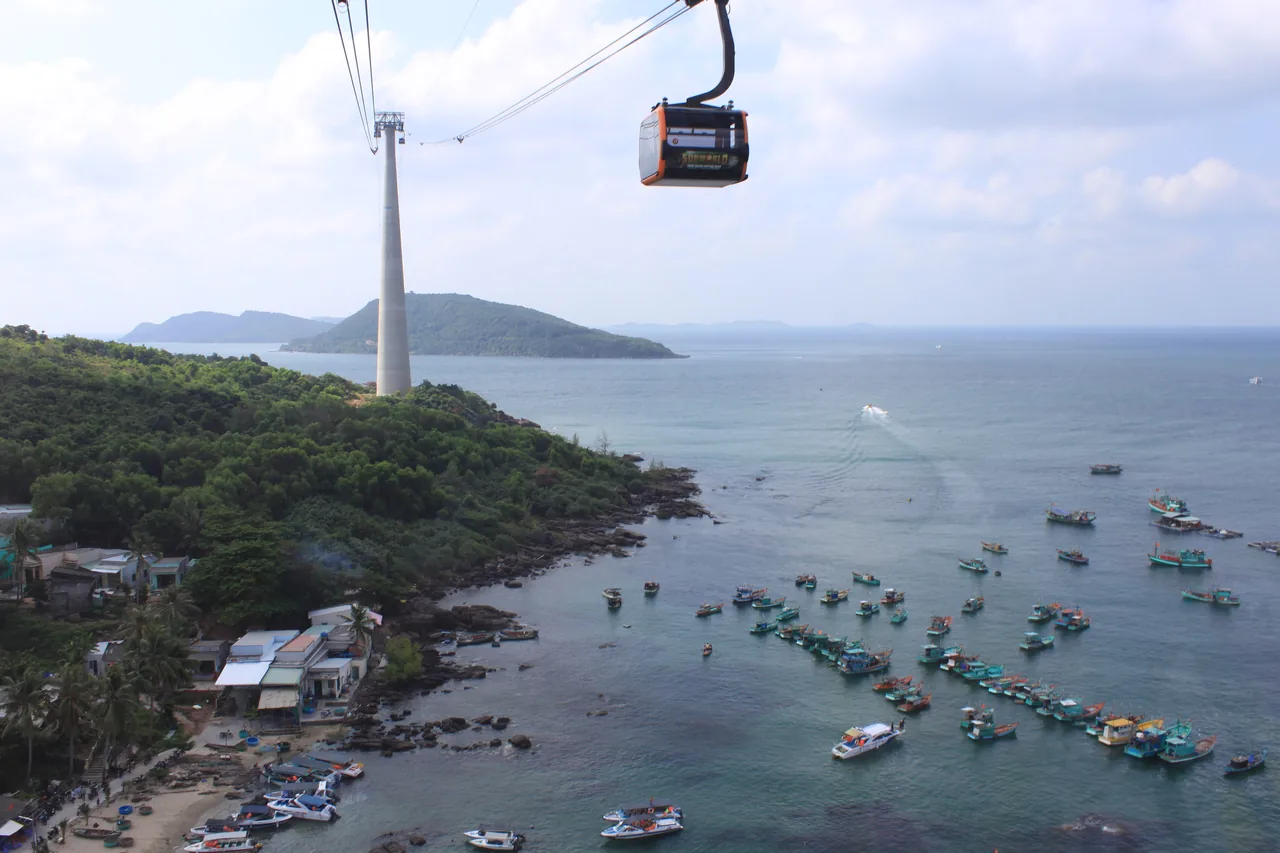
| Hon Thom cable car | 21.0km | 24 min |
| Sunset Town | 20.9km | 28 min |
| Grand World | 31.9km | 41 min |
| VinWonders | 32.3km | 39 min |
| Vinpearl Safari | 35.5km | 54 min |
Two things stand out. Only Duong Dong and Long Beach are genuinely close to the airport, and the big attractions sit at opposite ends of the island. Getting from VinWondersMap in the north to Sunset TownMap in the south is a 53-minute drive.
What is where
The island runs about 50km north to south, a little smaller than Bali. The things you came for sit in three groups with one main road connecting them.
- North: the theme parks. VinWonders, Vinpearl Safari and Grand World are within walking distance of each other and linked by free shuttles. The national park forest is up here too. Reckon on 39 to 54 minutes from the airport.
- Middle: Duong Dong town and Long Beach. Night market, day market, restaurants, the fish sauce distilleries, and most of the hotels. Thirteen minutes from the airport.
- South: An Thoi and Sunset Town. The cable car crosses to the islands offshore and the evening shows run here. Sao Beach and Khem Beach are on this side. Between 24 and 28 minutes from the airport.
That layout is why you should not stack north and south into one day. The two clusters are 53 minutes apart, and the road runs back past the airport in between.
What kind of island is this
Phu Quoc sits off Vietnam’s south-west coast, closer to Cambodia than to Ho Chi Minh City, which is an hour away by plane. More than half the island is national park, so the development is concentrated on the west and south coasts while the east and north are still forest and fishing villages.
It became a holiday destination recently. The international airport, the big resorts and the theme parks all arrived within the last decade, which is why there is very little old town or historic architecture and a great deal of new construction. Administratively the island is now a special zone under An Giang province, but every sign, ticket and map still says Phu Quoc.
2. When you land decides your first day
Phu Quoc has direct international flights from a short list of Asian cities and domestic flights from all over Vietnam. Which one you take changes how much of your first day survives.
Direct flights
- Bangkok: Thai AirAsia from Don Mueang, Thai VietJet from Suvarnabhumi. Under two hours.
- Singapore: Scoot and Sun PhuQuoc Airways. About two hours.
- Hong Kong: HK Express year-round, Greater Bay seasonally.
- Kuala Lumpur: Berjaya Air into Subang, with Sun PhuQuoc adding the main airport.
- Taiwan: Starlux to Taipei and Taichung, VietJet and Tigerair to Kaohsiung.
- Mainland China: China Eastern to Beijing Daxing and Xi’an, Ruili to Kunming, Sun PhuQuoc to Chengdu.
- Korea: several carriers from Seoul Incheon, mostly leaving in the evening and landing between 21:00 and midnight, plus a VietJet red-eye that arrives around 05:35. Busan has fewer flights but one of them, on VietJet, leaves in the morning and lands about 11:00, which is the only Korean routing that leaves you a usable first afternoon.
There is no direct flight from Japan, Europe, North America or Australia. From those markets you connect, and the sensible connections are Ho Chi Minh City, Hanoi, Bangkok or Singapore.
Connecting through Vietnam
Vietnam Airlines, VietJet and Sun PhuQuoc Airways all fly the domestic legs. Ho Chi Minh City to Phu Quoc takes an hour, Hanoi a little over two. There are flights through the day, so a morning arrival into Vietnam can put you on the island by early afternoon.
One thing to watch: if your international and domestic tickets are on separate bookings you will have to collect your bags, clear customs and check in again. Leave three hours for that connection. On a single through-ticket the bags are usually tagged all the way.
What time you actually get to your room
Add it up rather than reading the arrival time on the ticket. Immigration, bags and customs take about half an hour when the terminal is quiet and closer to an hour when several flights land together. Then add the drive: 13 minutes if you are staying in town, 40 or more if you are up north. A flight that lands at 21:00 puts you in your room around 22:15 in Long Beach and closer to 23:00 at a northern resort.
This matters most on short trips. On a three-night stay the evening you arrive is effectively gone, which leaves two full days and a morning.
Getting out of the airport
Phu Quoc International has one terminal. Arrivals opens straight onto the taxi rank and the drivers holding name boards. There is a currency desk, a SIM counter and a convenience store, all of them small and some of them shut late at night. Departures has a handful of restaurants and a small duty-free shop.
The airport is being rebuilt at the moment, with a longer runway and new terminals planned, so expect construction hoardings and changed walkways.
When to book
Fares move with the season more than anything else. The dry months from November to March cost the most, and Lunar New Year and the Christmas fortnight cost the most of all. The wet months from June to September are visibly cheaper. Two to three months out is a reasonable time to look, and on the budget carriers you should compare fares with checked bags included rather than the headline price.
3. Airport to hotel: what it costs by area
The airport is small and the taxi rank is right outside arrivals. What varies is the fare, and between the town and the far north it roughly doubles.
Taxis
Metered brand taxis charge around 17,000 dong per kilometre. Mai Linh and Vinasun are the ones you will see most; Green SM, which runs electric cars, is a little cheaper at about 14,000. From the airport into Duong Dong you should pay somewhere around 200,000 dong, and about 350,000 down to An Thoi in the south. If a driver offers a ride without the meter, walk to the next car.
Grab
The Grab app works well on the island. Into Duong Dong it comes to 100,000 to 150,000 dong, and because the app quotes the fare up front there is nothing to argue about. Late at night there are fewer cars, so if you are landing near midnight, book a transfer instead of taking your chances.
Download the app and add a payment method before you travel. Registering on arrival needs an SMS code, which does not always come through on roaming. Choosing cash payment sidesteps that. At the airport, Grab has its own pickup bay and the app map will point you to it.
Hotel transfers and booked cars
Most resorts sell an airport transfer. It costs more than a taxi, but a driver is waiting with your name on a board and the car definitely exists at one in the morning. If you are staying in the north, that is worth paying for.
Booking a transfer separately works the same way. You will need the flight number, arrival time, number of passengers and how many large bags you have. Check whether the driver tracks the flight and how long they wait if you are delayed.
| Where you are staying | From the airport | Rough taxi fare |
|---|---|---|
| Duong Dong and Long Beach | 13 min | 150,000 to 200,000 dong |
| Ong Lang | 27 min | 250,000 to 300,000 dong |
| Sunset Town and An Thoi | 28 min | 300,000 to 350,000 dong |
| Bai Dai in the north | about 40 min | 400,000 to 500,000 dong |
Those are meter estimates, so what you actually pay moves with the time of day and the size of the car. Some companies add a night surcharge. A group of five or more, or four people with big suitcases, needs a van, which runs about half as much again.
Landing late
If you get in at 23:00 you will be outside by about 23:30. Have the order straight: turn on your eSIM, find your driver or open Grab, and go. Change money tomorrow in town and only take what you need for the fare at the airport. If you want water and something for breakfast, ask the driver to stop near your hotel in Duong Dong or Long Beach, where shops stay open until midnight. On the road north almost nothing is open.
Heading back
Leave more time than you think for the return. The roads rarely jam, but a northern resort is 40 minutes out and the town stretch slows down behind the scooters. International flights want you there two hours ahead, so from the north that means leaving three hours before departure.
4. Getting around the island
There is no useful public transport on Phu Quoc. A handful of local bus routes exist and none of them serve the places you are going. In practice you are choosing between taxis, Grab and a scooter.
Taxis and Grab
This is the default and it works. A return trip from Duong Dong down to Sao Beach, with the driver waiting, runs 600,000 to 800,000 dong. Booking the return matters more than the price: at a beach or a waterfall there is often nothing to flag down, and the app struggles to find a car. Most drivers are happy to wait a few hours and settle up at the end.
Scooters
A scooter costs 120,000 to 150,000 dong a day and most hotels will arrange one. The roads are wide, the traffic is light, and the riding itself is easy. Two things to know before you take one. You need a licence Vietnam recognises, which an international permit alone usually is not. And most travel insurance policies exclude scooter accidents, so read the wording before you ride rather than after.
Helmets are compulsory and the ones handed out with rentals are thin, so check the fit. Police do stop riders. Take photos of the bike before you leave, since a scratch nobody noticed can turn into an argument at the end, and return it with the fuel level you were given.
Booking a car for the day
A car with a driver runs 1 to 1.5 million dong for a day and is the least stressful way to see both ends of the island. The driver waits while you are inside things, which removes the problem of finding a ride back from a beach. Hotels arrange them, and so do the booking platforms.
Agree what the day covers before you set off: which stops, roughly what time you finish, and whether fuel and parking are included. Most drivers speak limited English, so having the stops written down in Vietnamese saves a lot of gesturing.
Free shuttles
The Vin-branded attractions in the north run shuttles between themselves. VinWonders, Vinpearl Safari and Grand World are all connected, so a day spent up there needs no other transport. Nothing similar links the north to the south.
What to choose
| Option | Per day | Good for | Catch |
|---|---|---|---|
| Grab | 300,000 to 600,000 dong | Fares quoted up front | Hard to get in remote spots |
| Taxi with waiting | 600,000 to 1,000,000 dong | The car stays with you | More than Grab |
| Car with driver | 1,000,000 to 1,500,000 dong | A whole day, door to door | The most expensive |
| Scooter | 120,000 to 150,000 dong | Cheapest by far | Licence and insurance |
Three or more people are usually better off with a car and driver than with repeated Grab rides. A couple is better off calling cars as they go and only booking a return for the beaches.
The roads
One main road runs the length of the island and it is in good condition. Traffic lights are rare and jams are rarer. The two catches are darkness and construction. Long stretches have no street lighting, and roadworks appear without much warning. Riding a scooter back from the north after dark is not something we would recommend.
Fuel stations sit along the main road and take cash. Parking is free almost everywhere, with paid lots at the theme parks and the night market.
5. Which part of the island to sleep on
Where you sleep sets your daily driving. The short version:
- Long Beach (Bai Truong): 13 minutes from the airport. Restaurants and shops within walking distance and the widest range of prices. The easy choice for a first visit.
- Duong Dong: 13 minutes. The town, with the night market, the day market and the cheapest rooms. Somewhere to walk in the evening.
- Ong Lang: 27 minutes. Quiet beach, small hotels, very little to walk to after dark.
- Bai Dai in the north: about 40 minutes. Next to the theme parks, which is convenient with children and a long way from anywhere else.
- An Thoi and Sunset Town: 28 minutes. The cable car and the evening shows.
Prices split along the same lines. Duong Dong has rooms in the 400,000 dong bracket, Long Beach runs from about 600,000 up to 2,000,000, and the north and Sunset Town are dominated by large resorts where much under 2,000,000 is rare. Ong Lang sits around the million mark in small properties.
Check whether the beach is actually attached. Plenty of Long Beach hotels sit on the inland side of the road, which means a five to ten minute walk. The map will tell you: look for a road between the property and the water.
One rule for choosing
Pick by what you came to do. Theme parks means north, the cable car and the shows mean south, eating out every night means Duong Dong or Long Beach. For a stay of three nights or more where you want both ends of the island, Long Beach in the middle minimises the driving.
Splitting the stay works too. On five nights or more, three in the south and two in the north cuts the transfers down. On four nights or fewer the half-day you lose moving hotels is not worth it.
Our guide to where to stay in Phu Quoc takes the five areas one at a time, with what each is like and when to book. For this page, the drive times are the part to remember.
What the resorts are like
The island is dominated by large properties built in the last decade. That has two consequences. The rooms and pools are new and generally good for the money, and the properties are big enough that walking off the site is not always practical. Read the map before booking rather than the photographs.
Smaller guesthouses cluster in Duong Dong and along the inland side of the Long Beach road. They are a fraction of the price, and in town you trade the beachfront for being able to walk to dinner. Ong Lang is where the small boutique places are, usually a dozen rooms in a garden.
When to book
Rates roughly double between the wet season and the peak weeks around Lunar New Year and Christmas. In the dry season, two to three months ahead is sensible; in the wet season you can often book a fortnight out and still choose. Cancellation terms are worth reading either way, because weather changes plans here more than in most places.
6. How many nights you need
Count the nights with the arrival time included and the answer changes.
Three nights
You get two full days and a morning. The evening you land is travel, and the last day is checkout followed by waiting for a plane. On that budget, take the south for one day and the beach and the town for the other, and leave the northern parks out. Trying to fit everything means spending the trip in a car.
What to drop, in order: the northern theme parks go first, because the round trip alone is two hours. Island hopping goes second, because the boat takes half a day and can be cancelled by the weather. What is left is the cable car, the beaches, the evening show and the night market, all of which sit in the south and the middle.
With children the order flips. Keep the cable car and the water park in the south, and drop the evening shows, which run past bedtime. Put the night market early instead.
Four nights
Now the north fits. Three full days means one for the south, one for the north, and one for the beach and the town. Start early on the northern day: VinWonders is 39 minutes from the airport and the safari 54, so from a southern hotel the one-way drive is close to an hour.
| Day | Morning | Afternoon | Evening |
|---|---|---|---|
| 1 | none | none | Land, transfer to the hotel |
| 2 | Beach at the hotel | Duong Dong, fish sauce distillery | Dinh Cau night market |
| 3 | Hon Thom cable car | Sao Beach | Sunset Town show |
| 4 | Vinpearl Safari | VinWonders | Grand World |
| 5 | Checkout, Ham Ninh village | Airport | Fly out |
Days three and four are the south and the north. Back to back they mean an hour in the car on each, so if you have the time, put a slow day between them.
Five nights and more
Four usable days lets you keep one in reserve, and on an island that is worth more than it sounds. Rain moves a plan by a day, and a boat trip out to the islands off An Thoi fits neatly into the spare slot. This is also the point where splitting your stay between two hotels starts to pay.
A week or longer
After four days the sightseeing is done and the trip becomes about the water and the hotel. There are small islands off the southern tip with boats running daily, and enough dive schools to finish an open-water course in three or four days.
The longer you stay the more the location matters. Three nights anywhere is survivable. Seven nights somewhere with nothing to walk to gets old, which is why we would put a long stay in Duong Dong or Long Beach.
Coming back a second time
If the parks and the shows are done, what is left is the north and the east: the national park trails, the pepper farms inland, Ham Ninh fishing village, and the islands offshore. A scooter makes that trip much easier.
Using the first evening and the last day
A late arrival leaves you almost nothing, but two things are worth doing. Buy water and something for breakfast near the hotel, since resort minibars charge several times the shop price. And book the next morning, because the morning after you land is effectively your first slot.
The last day is the opposite problem: checkout at noon, a flight in the evening. Leave the bags at the hotel and spend the half day in the direction of the airport so you are not doubling back. Duong Dong, Ham Ninh and Suoi Tranh are all within 20 minutes of the terminal. Skip the swimming, because there is nowhere to shower afterwards.
7. Splitting the day: north and south are 53 minutes apart
Take the island one half at a time. The drive times show why.
| Leg | Distance | By car |
|---|---|---|
| VinWonders to Sunset Town | 48.4km | 53 min |
| Vinpearl Safari to Sunset Town | 49.6km | 56 min |
| Duong Dong to Sunset Town | 20.6km | 28 min |
| Long Beach to Sunset Town | 15.1km | 22 min |
| Ong Lang to Sunset Town | 35.8km | 41 min |
The southern day
Build the southern day backwards from the evening show. At Sunset TownMap, Symphony of the Sea seats at 19:30 and Kiss of the Sea starts at 21:00. Watch both and you are leaving at 21:30, which is 22 minutes back to Long Beach and closer to an hour to a northern resort.
So the day runs like this. Morning on the Hon Thom cable carMap and in the water on the island at the other end, afternoon at Sao BeachMap or Khem BeachMap, then into Sunset Town for dinner and the show. If two shows in one evening sounds like a lot, take one. Our comparison of the two shows sets out what each one is.
Drop the cable car and the day opens up
The cable car takes half a day. Without it the southern day is far calmer: a slow morning at your own beach, lunch, Sao or Khem in the afternoon, then Sunset Town late. Two moves instead of four, and no need for a car on standby.
The south also has the Phu Quoc Prison museumMap, 21 minutes from the airport and an hour to walk round. It is the one indoor thing on that side of the island and it fits neatly between the beach and the show.
The southern day, hour by hour
| Time | What | Note |
|---|---|---|
| 09:00 | Leave the hotel | 22 min from Long Beach, 28 from Duong Dong |
| 10:00 | Hon Thom cable car | Return trip and the island parks on one ticket |
| 15:00 | Sao or Khem Beach | Under 20 minutes from the cable car station |
| 17:00 | Arrive Sunset Town | Sunset from Kiss Bridge |
| 19:30 | Symphony of the Sea | Seating time. It ends at 20:10 |
| 21:00 | Kiss of the Sea | Thirty minutes, finishing with fireworks |
| 21:40 | Drive back | 22 min to Long Beach, an hour to the north |
Kiss Bridge itself is priced by the hour of the day: 100,000 dong until four in the afternoon, 200,000 through the sunset window to eight, and 50,000 after half past eight. A cable car ticket includes entry, so if you rode across you have already paid for it.
The northern day
The north runs the other way round: leave early. Vinpearl SafariMap is 54 minutes from the airport and close to an hour from Duong Dong, and the animal feeding sessions are all in the morning, so a late start costs you the best part of the visit. Do the safari first, then move across to VinWondersMap for the afternoon, or give VinWonders the whole day on its own. A free shuttle links them.
If you stay up there into the evening, Grand WorldMap is next door and open late. Give up on the southern show that night, though. Driving 53 minutes at the end of it is not worth it.
| Time | What | Note |
|---|---|---|
| 08:00 | Leave the hotel | Close to an hour from Duong Dong |
| 09:00 | Vinpearl Safari | Feeding times cluster in the morning |
| 12:30 | Move across, lunch | Free shuttle |
| 13:30 | VinWonders | Five of the six zones run 10:00 to 18:00 |
| 18:00 | Grand World | Walking distance |
| 20:30 | Drive back | About 40 minutes to Duong Dong |
That is the maximum version. With small children, do the safari in the morning and go back to the hotel afterwards. VinWonders involves a lot of walking and stacking the two makes for a hard day.
Rearranging for rain
The southern day is the one the weather breaks. The cable car stops in strong wind and the shows are outdoors. If the morning looks wet, swap to the north: VinWonders has indoor zones and the safari runs in the rain.
When neither works, go into town. The fish sauce distilleries and pepper farms are under cover, so are the spas, the cafes and the day market. The night market thins out in the rain but does not close.
8. What a day actually costs
Phu Quoc is more expensive than mainland Vietnam. Everything arrives by boat or plane, and the island runs on resort prices. Here is what two people spend in a day.
| Item | Careful | Middle | Comfortable |
|---|---|---|---|
| Room for two | 400,000 to 700,000 dong | 1 to 2 million | 3 million and up |
| Three meals for two | 300,000 to 500,000 dong | 600,000 to 1 million | 1.5 million and up |
| Getting around | 150,000 (scooter) | 400,000 to 600,000 (taxis) | 1 million (car and driver) |
| Tickets and activities | 0 to 200,000 dong | 500,000 to 1 million | 2 million and up |
The middle column comes to between 2.5 and 4.6 million dong a day for two, which is roughly 100 to 180 US dollars. Any day with a theme park in it sits outside that range.
Tickets are what move the number
| Where | Adult | Note |
|---|---|---|
| VinWonders | 950,000 dong | 710,000 for 1m to 1.4m tall and over 60 |
| Vinpearl Safari | 850,000 dong | 650,000 for 100 to 140cm |
| Safari and VinWonders, one day | 1,500,000 dong | 1,800,000 bought separately |
| Night safari | 950,000 dong | Separate from the daytime ticket |
| Symphony of the Sea | 649,000 to 949,000 dong | By seating category |
| Kiss of the Sea | around 950,000 dong | Cheaper online |
Two people doing a park day spend close to 2 million dong on entry alone, which doubles the daily budget. How many parks you put in the itinerary decides what the trip costs. The combined ticket saves 300,000 dong, so if you are doing both, buy them together from the start.
A real day, itemised
Two people staying at Long Beach and going south: breakfast included at the hotel, 200,000 dong by Grab to the cable car, 1,700,000 for two cable car tickets with the island parks, 300,000 for lunch over there, 150,000 to move to the beach, 500,000 for dinner, 1,300,000 for two show seats, 200,000 back to the hotel. That is 4,350,000 dong before the room, about 170 dollars.
The same day done carefully: skip the cable car, spend the afternoon on the beach and watch one show. Transport 400,000, meals 600,000, one show 650,000. That is 1,650,000 dong, about 65 dollars. The tickets are the whole difference.
Why the island costs more
Vegetables, meat and manufactured goods all come across from the mainland, so shop prices sit above Ho Chi Minh City. The same bowl of noodles that costs 40,000 dong in the city is 50,000 to 60,000 here. Seafood is the exception and is cheaper than on the mainland, because it lands a few hundred metres away.
Bringing it down
- Stay in Duong Dong or Long Beach. It saves 200,000 to 400,000 dong a day in transport alone.
- Buy the combined park ticket. That is 300,000 dong for two.
- Eat breakfast at a noodle shop if it is not included, which saves about 150,000 a head.
- Buy water by the large bottle from a shop rather than the minibar, which is five times the price.
Money
The airport exchange desk gives a poor rate, so change what you need for the taxi and do the rest in town. Gold shops in Duong Dong usually beat the banks and do not ask for a passport; for larger amounts use a bank. ATMs are everywhere, dispense 2 to 3 million dong at a time and charge around 50,000 dong, so make fewer, larger withdrawals.
Cards work at resorts, larger restaurants and the theme parks. The night market, small restaurants, scooter rentals and taxis are cash. If a card machine asks whether to charge in your home currency, say no and pay in dong.
Vietnamese notes have a lot of zeros and two of them, the 20,000 and the 500,000, are both blue-ish. Count what you hand over, especially at night.
9. What to eat
Seafood is the reason to eat out here, and it costs less than it would on the mainland. The gap between a tourist restaurant and a local one, on the other hand, is wide.
Working the night market
The busiest stretch is between seven and nine in the evening. Arrive around six and you will not queue. The market is one long line of stalls, so walk it once looking at prices, then come back and choose. The stalls at the far end tend to be a little cheaper.
Dinh Cau night marketMap opens at five and runs to eleven, in the middle of Duong Dong and walkable from a lot of hotels. Pick from the tanks and they weigh it, price it and cook it in front of you. Prawns, scallops, squid and crab are the staples.
Beyond the food there is a run of shops selling fish sauce, pepper and dried seafood. If you are buying presents, this is the one-stop version.
What comes out of the water
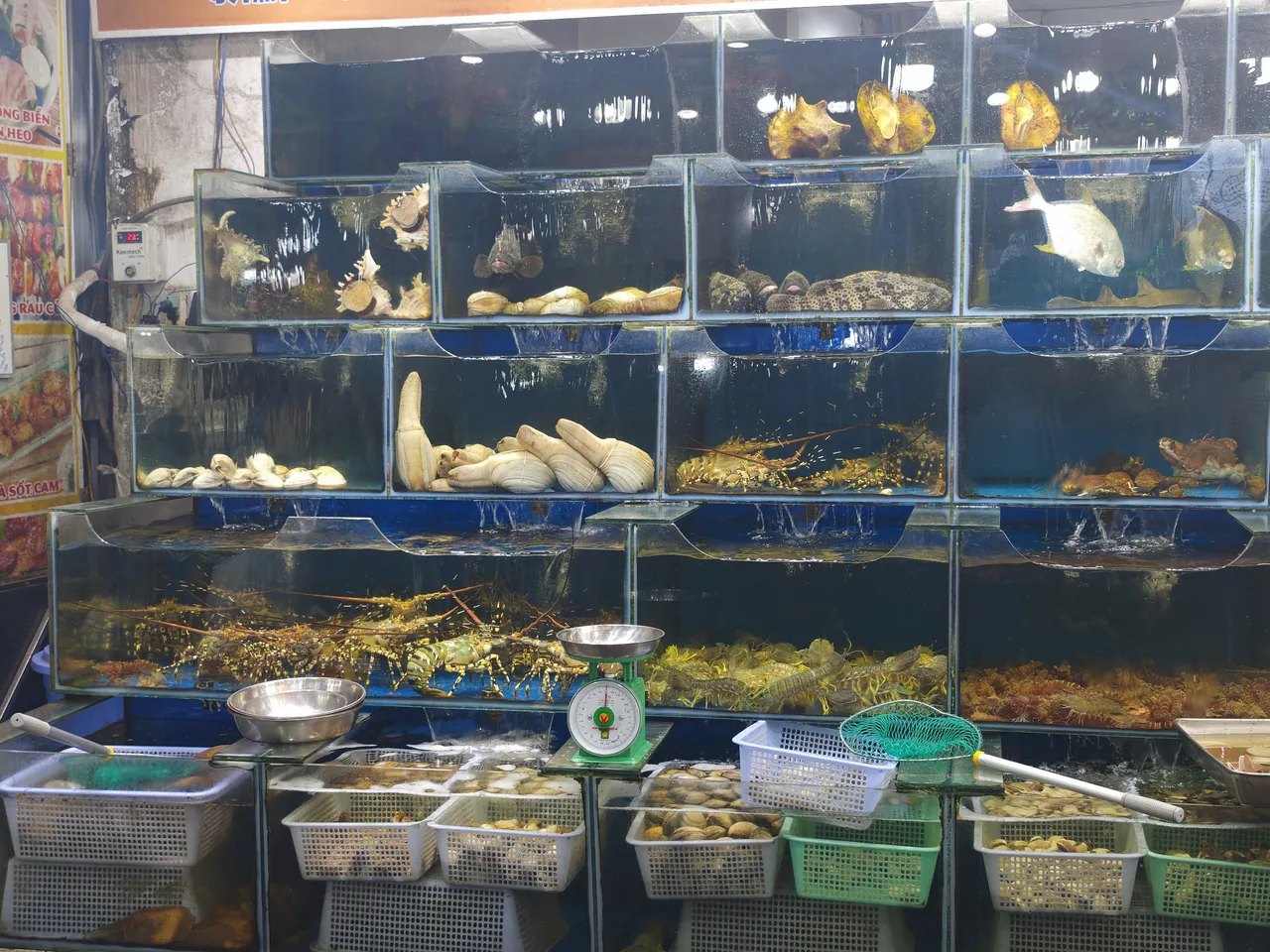
The common catch is prawns, squid, scallops, blue crab and sea snails. Lobster exists and the price jumps accordingly. Sea urchin appears in summer. Grilling is the default, usually with garlic butter or spring onion oil. Grilled scallops run about 100,000 dong a plate, which makes ordering several things in small quantities easy.
There is more than seafood. Com tam is broken rice with grilled pork, banh xeo is a rice-flour pancake, and both run 50,000 to 80,000 dong at a local place. Vegetarians will find a handful of dedicated restaurants in town and options at any resort.
Seafood restaurants
Several sit in Duong Dong itself. Crab HouseMap builds its menu around crab, and Ra KhoiMap is the pick-from-the-tank kind of place, known for its herring salad. Both fill up in the evening.
To eat with the water underneath you, go to Ham NinhMap, the fishing village on the east coast, ten minutes from Duong Dong and nine from the airport. Restaurants line a wooden pier and blue crab is the local dish. At low tide the mud flats appear, which changes the view entirely.
Sunset Town has its own cluster of restaurants. Everyone eats before the show, so from about seven there are no tables. If you have show tickets, book or eat at six.
Duong Dong marketMap is the daytime version: fruit, dried fish and spices, cheaper than the night market and aimed at people who live here.
Made on the island
- Fish sauce: anchovies fermented in wooden vats for more than a year. The Khai Hoan distilleryMap lets you walk through the warehouse of vats, nine minutes from Duong Dong. It is a liquid, so it goes in checked baggage.
- Pepper: farms are scattered across the east of the island. Places like Ngoc Ha pepper farmMap let you walk round for nothing and sell at the gate. Fifteen minutes from the airport.
- Sim wine: made from a berry that grows here. Bay GaoMap does tastings, five minutes from Duong Dong.
Noodles and breakfast
Bun quay is the island’s own noodle dish: squid and prawn fish cake, assembled in the bowl rather than served in broth, and you mix your own dipping sauce at the table. Mostly a breakfast thing, about 50,000 dong. If your room rate does not include breakfast, find a noodle shop nearby and the whole trip gets easier.
Banh mi carts are everywhere at 20,000 to 30,000 dong. Coffee means iced coffee with condensed milk, 30,000 to 50,000 in a cafe, and coconut coffee is on most menus.
| What | Price | Where |
|---|---|---|
| Bowl of bun quay | 40,000 to 60,000 dong | Duong Dong breakfast shops |
| Banh mi | 20,000 to 30,000 dong | Street carts |
| Iced coffee | 30,000 to 50,000 dong | Cafes |
| Night market seafood for two | 400,000 to 800,000 dong | Dinh Cau |
| Local restaurant for two | 200,000 to 350,000 dong | Duong Dong |
| Resort restaurant for two | 800,000 dong and up | Long Beach, Bai Dai |
Ordering at the tanks
Buying seafood at the market or in Ham Ninh has two stages. They weigh what you picked and price the ingredients, then charge separately to cook it. Some places only mention the cooking charge afterwards, so ask about both before you choose. With anything expensive, compare the per-kilo price at the next stall along.
Take the bill and read it. Wet towels and peanuts that appeared on the table are often on it. Send back what you do not want at the start.
Where you sleep changes where you eat
- Duong Dong: everything is walkable. Night market, day market, noodle shops and seafood restaurants. The easiest base if you want to eat out every night.
- Long Beach: restaurants and bars along the beach road, more expensive than town but walkable, and ten minutes by Grab into Duong Dong.
- Ong Lang and the north: very little within walking distance. You eat at the resort or you call a car. Three nights of resort dining gets repetitive, so plan two trips into town.
- Sunset Town: restaurants inside the development, at development prices.
Most resorts include breakfast. Where they do not, it is around 200,000 dong a head, against 50,000 for noodles up the road. Check when you book.
Planning three meals
Breakfast at the hotel or a noodle shop, lunch wherever you happen to be, dinner in town for seafood or at a local restaurant. Lunch inside a theme park costs about double what it does outside. If you are staying in the north and eating out every night, the round trip into town can cost more than the meal, so alternate.
Taking food home
Fish sauce is the classic. Bottles and small gift sets are sold everywhere, with the widest choice at the night market. Pepper is usually sold as a black and red mix. Sim wine is sweet and low in alcohol, which makes it an easy present. Dried squid and prawns are cheap but the smell travels, so seal them well. Coffee here is grown on the mainland, so it is not really a local product.
10. Which beach, and when
The west coast is for sunsets, the south-east for clear water. In short:
- Long Beach: the long west-coast strip the hotels sit on. It changes character along its length and faces the sunset head on.
- Sao Beach: south-east, fine sand, shallow water, 25 minutes from the airport. Quiet in the morning.
- Khem Beach: next along from Sao, partly managed by a resort and tidier for it.
- Ong Lang: north-west, rockier and much quieter.
Fitting a beach into the day
Beaches work best slotted between other things. A whole day on the sand means a whole day in the midday sun. On the southern day, do the cable car in the morning and reach Sao after three, when the shade starts and the crowds thin.
Water is clearest in the morning: less wind, smaller waves, less sand stirred up. So mornings are for photographs and swimming, late afternoons for sunsets on the west coast.
Loungers and umbrellas rent for about 100,000 dong. In front of a resort they are often free for guests, so ask before you pay.
What there is to do at each beach, and when the water is at its best, is covered beach by beach in our guide to things to do in Phu Quoc.
What each one is like
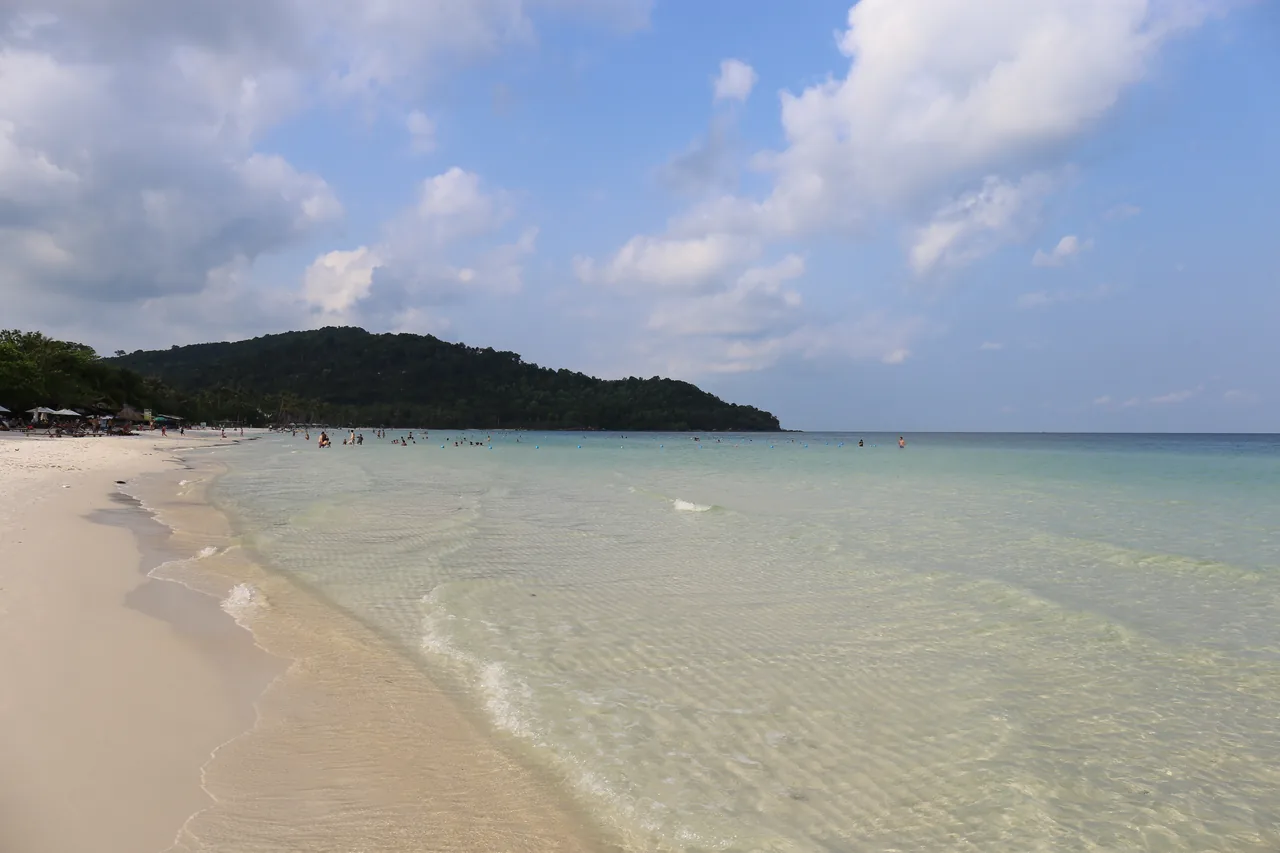
Long Beach is the working beach: hotels, bars, boats, people selling things. It is not the prettiest water on the island but it is the one you can walk to, and the sunsets are the reason people book the west coast in the first place.
Sao Beach is the postcard. Fine white sand, water so shallow you can wade a long way out, and a line of restaurants behind it. It is also busy from mid-morning, when the tour buses arrive, which is why the afternoon slot works better than the middle of the day.
Khem Beach next door is quieter, partly because a resort manages a section of it and partly because it is less well known. Ong Lang, on the north-west coast, has rocks mixed into the sand and a scattering of small hotels; the water is calm and there is almost nobody there.
Practical bits
Public beaches have no showers or lockers to speak of. Restaurants behind the sand will usually let you use a bathroom if you eat there. Bring cash for loungers and drinks, because card machines are rare on the sand.
Sea conditions flip with the season. Between November and March the west coast is flat, and in the wet months the swell picks up in the afternoons. The south-east side is more sheltered, which is part of why Sao stays calm when Long Beach is choppy.
11. Theme parks and shows: which day to use
There are four headline attractions. Rather than trying to see them all, attach one to a day.
- VinWonders: north. Six zones that open and close at different times. A full day. → our VinWonders guide
- Vinpearl Safari: north. Go for the morning feeding times. Half a day. → our safari guide
- Hon Thom cable car: south. The crossing plus the water park on the island, on one ticket. Half a day to a full day.
- Island hopping off An Thoi: south. Boats leave from the port with snorkelling and fishing attached, half a day upwards. Cancelled when the sea is rough.
- Evening shows: south, at Sunset Town, at 19:30 and 21:00. → the two shows compared
The two northern parks sit next to each other and work as one day. The cable car and the evening shows are both in the south and work as another. The only combination to avoid is north and south on the same day.
How many to include
One on a three-night trip, two on four nights, three if you have five or more. Each takes half a day to a full day and the tickets add up: two people doing all four spend over 4 million dong on entry alone.
Choose by who you are travelling with. Children point you at VinWonders and the safari, couples at the cable car and the evening shows, older parents at the cable car and Grand World, where the walking is flat and short.
What each one asks of you
VinWonders is a full day on your feet across six zones, two of which close earlier than the rest. The safari is a shorter visit but has to be a morning one, because the feeding sessions are clustered before lunch. The cable car is the least demanding: you sit down for the crossing, and what you do at the other end is up to you.
The evening shows are the one thing with a fixed clock. Symphony seats at 19:30 and Kiss of the Sea starts at 21:00, so an evening in the south is committed from about six until half past nine. Anyone with small children should think about that before buying tickets.
Booking
Buy online for everything. Gate prices are higher, dated tickets are cheaper midweek, and the combined park ticket only exists as an advance purchase. For the shows, seats are tiered, so decide whether you want the middle blocks before you book rather than at the door.
12. When to come
The year splits into dry and wet. November to March is dry, calm and the peak season. April and May are hot. June to September is the wettest stretch, and October is the turn.
Wet season does not mean all-day rain. It means an hour or two of heavy rain, usually in the afternoon, and then it stops. What it really means is rough water, and boats that do not sail. Room rates fall by close to half.
Month by month temperatures, sea temperatures and prices are laid out in our guide to the best time to visit Phu Quoc.
Roughly what each stretch is like
- November to February: the reliable window. Calm sea, low humidity, and the highest prices of the year over the holidays.
- March to May: still dry and getting hot, with April and May the hottest. Fewer people than the peak and the water is still flat.
- June to September: the wet stretch. Heavy afternoon rain, rough sea on the west coast, and rates at their lowest.
- October: the turn. Rain easing, prices still low, and a reasonable gamble if you are flexible.
Sea temperature barely moves, sitting between 26 and 31 degrees all year, so swimming is never off the table for temperature reasons. It is the swell and the visibility that change.
What the season decides about your plans
Less the weather, more whether the boats run. In the dry months, island hopping and snorkelling off An Thoi go out every day. In the wet months they cancel when the swell is up, often the same morning. If island hopping matters to you, put it early in the trip so you have another day to fall back on.
The cable car stops in strong wind. Theme parks stay open in rain, and the evening shows usually run, though they are occasionally called off. Check the cancellation terms when you book so a washout is a refund rather than a loss.
Busy periods
Vietnamese New Year brings a wave of domestic visitors: expensive rooms, expensive flights, queues at the parks. The Christmas and New Year fortnight is similar. There is a weekly rhythm too, with people flying in from Ho Chi Minh City for the weekend, so Friday evening and Saturday are the busiest at the night market and the shows. Midweek gets you better seats.
13. Visas and arrival
Fly straight into Phu Quoc and you can stay 30 days without a visa, whatever passport you hold. It applies if you arrive from abroad directly, by air or by sea, and your passport needs six months of validity left.
There is one condition. The exemption covers Phu Quoc only. Travel on to Ho Chi Minh City or Hanoi in the same trip and that portion falls under the normal rules.
What this means for your passport
| Passport | Mainland Vietnam | Phu Quoc only |
|---|---|---|
| UK, France, Germany, Italy, Spain | 45 days visa-free | 30 days visa-free |
| Korea, Japan, Russia | 45 days visa-free | 30 days visa-free |
| United States, Canada, Australia | e-visa required | 30 days visa-free |
| Taiwan, mainland China | e-visa required | 30 days visa-free |
The bottom half of that table is the interesting part. If you hold an American, Canadian or Australian passport and the whole trip is on the island, there is no paperwork and no fee at all. Add two nights in Ho Chi Minh City and you need an e-visa for the trip, so apply before you fly.
Arriving
- Passport at immigration. There is no arrival card.
- Collect bags. There are two belts, so check the flight number.
- Through customs into arrivals.
- Turn on your SIM or eSIM. If it is already running, call a car straight away.
- Change only what you need at the airport and do the rest in town.
Leaving
Two hours before departure is the rule. The airport is small and check-in moves quickly, but late evening brings several flights at once and the queues build. Duty free is limited, so buy fish sauce and pepper in town where there is more choice at a better price.
Liquids cannot go in the cabin. Fish sauce comes in large glass bottles, so pack it in the hold wrapped in clothes. The same goes for sim wine. Anything bought airside comes in a sealed bag and is fine to carry on.
Overstaying
Overstay the visa-free period and you pay a fine on the way out, and even a single day turns departure into a slow process. Ferries do get cancelled and people do get stuck, so leave a day or two of margin rather than planning to the last night. Extensions have to go through an agency and the paperwork usually goes to Ho Chi Minh City, which takes time.
14. Arriving and leaving by boat
Ferries connect the island to the mainland. If you are travelling around southern Vietnam it is worth doing one leg by sea.
| Route | Time | Fare | Departures |
|---|---|---|---|
| Ha Tien to Phu Quoc | 1 hr 20 min | around 230,000 dong | 07:45 / 09:40 / 13:15 |
| Rach Gia to Phu Quoc | 2 hr 20 min | around 330,000 dong | 07:00 / 08:10 / 10:40 / 13:10 |
Boats come into Bai Vong portMap, 13 minutes from the airport and 15 from Duong Dong, so the arrival end is easy. Sailings increase at weekends and in high season, and stop altogether when the swell is up. If you are travelling in the wet season, keep a flight in reserve.
Times and fares change with the operator and the season. Check the schedule for your date before you travel.
Buying tickets
You can buy at the port, but sailings sell out in high season. Booking online gets you a reserved seat and you will need passport numbers. Check that the spelling matches the passport, because a mismatch can stop you boarding.
Which port
Ha Tien is close to the Cambodian border, so it suits anyone coming down through southern Cambodia. Rach Gia is six hours by bus from Ho Chi Minh City but easier to reach, though the crossing is twice as long. Coming from Ho Chi Minh City the plane is faster and barely more expensive; the boat makes sense mainly if you are working your way through the Mekong Delta.
On the boat
- Seats are assigned. Book online and you can pick one by a window.
- It moves in a swell. Take something for seasickness and sit in the middle.
- Vehicle ferries are separate from the passenger fast boats and run to a different timetable.
- Taxis meet the arrivals but disperse afterwards. If you are slow off the boat, check Grab.
Bringing a scooter or car over is only worth it if you are touring southern Vietnam on two wheels. Renting on the island is cheaper.
Boat against plane
From Ho Chi Minh City the plane takes an hour. The boat means six hours on a bus to Rach Gia and then two hours twenty at sea, which is most of a day, and the fares are not far apart. The sea route earns its place when you are already in the Mekong Delta or coming across from Cambodia, not as a way of saving money.
Coming the other way, leaving the island by boat and flying out of Ho Chi Minh City is a common plan. Give yourself a full day of margin: sailings are cancelled in rough weather and the bus from the port is not quick.
15. Things that save you trouble
Getting online
Resort wifi is generally fine, though it fades away from the room, and you need data the moment you leave the building to call a car or read a map. An eSIM switched on before you fly is the simplest version, and it matters most on a late arrival.
Language
English works at resorts and attractions. It does not go far in local restaurants or in taxis. Download a translation app, and for destinations show the Vietnamese name on a map rather than saying it. Korean menus have started appearing in places, since a lot of Korean visitors come.
Safety
Walking around at night is not a problem. Bag snatching from passing scooters happens in Vietnam and the island is no exception, so carry a bag on the side away from the road and do not stand at the kerb with your phone out. Leave valuables in the hotel when you swim.
Bills and change
Some things have no price list: market stalls, beach loungers, scooter rental. Ask first and the problem disappears. Prices are rarely raised after the fact, but you have no argument if you never asked. Count your change, especially at night, and glance at card slips before you sign.
In the water
Lifeguards only really exist on resort stretches. On public beaches, assume there are none. On a choppy day the pull is noticeable even at knee depth, so with children bring buoyancy aids or use the pool. Life jackets handed out on hopping boats are often the wrong size; try yours before you leave the dock, and the same goes for snorkelling gear.
Sun
Ten degrees north of the equator, the midday sun is strong. Between eleven and three, find shade. Anything that keeps you outside all day, like the cable car or a boat trip, calls for a hat and long sleeves. Use reef-safe sunscreen.
Rubbish and the sea
Some stretches of coast collect plastic, particularly on the west side at the end of the wet season when the wind pushes it ashore. Resort beaches are cleaned every morning; public ones are not always. It is worth knowing so it does not come as a surprise, and worth not adding to.
Jellyfish
They turn up at the end of the wet season. When a beach puts a warning board out, stay out of the water that day. Some resort stretches have nets.
Travelling with children
Almost no taxi carries a child seat. Ask when you book a transfer, and expect to manage with a pushchair or a carrier. Nappies and formula are sold in town supermarkets, though the brands differ, so bring what you rely on. Parks price by height rather than age, and under a metre is often free, so measure before you book.
Insurance and doctors
There is one general hospital on the island and a few clinics in the resort areas, which cover upset stomachs and minor injuries. Anything serious means a transfer to Ho Chi Minh City, and that is expensive, so check that your policy includes medical evacuation. Many policies exclude water sports and scooters; if you are snorkelling, hopping or riding, read those clauses first. Diving is usually separate again.
What to pack
- Insect repellent: there is forest and standing water nearby, and rooms do not supply it.
- Basic medicines: seafood and ice occasionally disagree with people. Pharmacies are in town and English is limited.
- A light long-sleeved layer: for the sun, and for the air conditioning.
- A dry bag: for phones on boats and at the water park.
- Two kinds of shoes: something for the beach, something for walking.
Power and water
Electricity is 220V and sockets take the standard two-pin plugs used across Europe and much of Asia. Do not drink the tap water. Bottled water is sold everywhere for around 10,000 dong for a large bottle, and resorts usually leave two in the room each day. Ice in restaurants is factory-made and generally fine; if your stomach is sensitive, ask for drinks without it.
16. Who this island suits
It works if you want to spend most of your time at a hotel and go out for a day or two. The beaches are wide, the water is clear, and the theme parks are close enough to build a day around. Thirty days without a visa also makes it an easy place to settle in for a while.
It does not work if you travel to see cities and history. There are no old quarters and no major monuments. Walking as a way of getting around is not an option either, because the distances are too great. If that is the sort of trip you want, our comparison of Da Nang and Phu Quoc is the place to start. Da Nang puts a city and a beach next to each other, which is a different proposition.
By who you are travelling with
- With children: the parks, the safari and the water park are all in the north, so staying up there cuts the driving. The trade-off is distance from town.
- With older parents: pick things with short walks. The cable car is seated and Sunset Town is flat. The safari involves a lot of ground, so add the buggy ticket.
- As a couple: the evening shows in the south and the sunsets on the west coast are the standard combination. Long Beach and Ong Lang are the quieter places to stay.
- Alone: transport is the problem, since a Grab fare is the same whether one person or three are in the car. Duong Dong puts most things within walking distance.
Against the alternatives
Within Vietnam, Nha Trang puts a city and a beach together and costs less. Da Nang gives you Hoi An and Hue nearby. Phu Quoc beats both on water clarity and on having the big attractions in one place, and loses on variety.
Against other islands in the region, it is quieter than Phuket and has none of the cultural sightseeing of Bali. It is a resort island where you go out once or twice, and it is good at that.
The short version
Flights land late, the airport is 13 to 54 minutes from wherever you are staying, and the two halves of the island are 53 minutes apart. Plan around those three numbers and you will not lose days to the road. The rest is a matter of taste.
17. 🏝️ The rest of our Phu Quoc guides
- Where to stay: the five areas compared, for choosing a base
- Things to do, the cable car, island hopping, beaches and farms
- VinWonders, zone opening hours and tickets
- Vinpearl Safari, the feeding timetable
- Symphony and Kiss of the Sea, the two shows compared
- When to go, month by month weather and prices
- Da Nang or Phu Quoc, which one fits your trip
- Southern Vietnam and the full Vietnam guide
- Vietnam eSIM and SIM cards, what to sort before you fly
- Getting around Vietnam, for pairing the island with other cities
If you are starting from scratch, read the accommodation guide next. Once the base is fixed, the daily driving is fixed, and what you do follows from that.
If you plan to buy tickets ahead, read the seasonal guide alongside it. The same product costs different amounts in the dry and wet seasons, and boat trips are cancelled by the swell. Fix the dates first and buy the tickets second.
🎡Things to Do21
🍜Food2
🏨Where to Stay9
🚇Getting Around4
🧭Travel Tips7
🧭Vietnam-wide essentials116
Frequently asked questions
For a beach and resort holiday, yes: the water on the south-east coast is genuinely clear, the beaches are wide, and the theme parks and shows are close together. For city sightseeing and history, no. There is no old town and nothing walkable between the sights.
Long Beach for a first visit, because it is 13 minutes from the airport, has the widest range of prices and sits in the middle of the island. Duong Dong for eating out and cheaper rooms, the north for theme parks with children, and Sunset Town for the cable car and the shows.
It is 28 minutes by road, about 21km. A metered taxi runs 300,000 to 350,000 dong, Grab a little less. There is no bus, so it is a taxi, Grab or a booked transfer.
Three nights is the minimum and buys you two full days and a morning, because flights land in the evening and the last day goes on waiting for a plane. To give the north and the south a day each you need four nights.
Duong Dong and Long Beach are 13 minutes, Ong Lang 27, Sunset Town in the south 28, and the northern resorts around 40. Vinpearl Safari, the furthest point, is 54 minutes. A taxi into Duong Dong is about 200,000 dong; a northern resort is 400,000 or more.
No, if you fly straight in. Every nationality gets 30 days visa-free on direct arrival, with six months of passport validity. The exemption only covers the island: travel on to the mainland and the normal rules apply, which for American, Canadian and Australian passports means an e-visa.
Grab, generally. The fare is quoted up front and there is nothing to negotiate. A ride across Duong Dong is 100,000 to 150,000 dong. Late at night and at remote beaches the cars dry up, so book a return or arrange a transfer.
Two people travelling in the middle bracket spend 2.5 to 4.6 million dong a day, roughly 100 to 180 dollars, not counting the room. Cutting the accommodation lowers it a lot, and any day with a theme park in it doubles it: VinWonders alone is 950,000 dong a head.
We would not. VinWonders to Sunset Town is 53 minutes and the safari to Sunset Town 56. The gap between the park closing and the show starting is tight and you would spend over two hours in a car. Use two days.
It costs 120,000 to 150,000 dong a day and the roads are quiet and wide. You need a licence Vietnam recognises, and most travel insurance excludes scooter accidents, so check the wording. If someone asks for your passport as a deposit, offer cash instead.
Yes. Ha Tien takes 1 hour 20 minutes and Rach Gia 2 hours 20, at about 230,000 and 330,000 dong. Boats dock at Bai Vong port, 13 minutes from the airport. Sailings are cancelled in heavy swell, so keep an alternative in the wet season.
It does not rain all day. You get an hour or two of heavy rain, usually in the afternoon. Room rates fall by close to half. The real issue is the sea: boat trips are cancelled when the swell is up, so leave a spare day if island hopping matters.
Grilled seafood at Dinh Cau night market, blue crab at Ham Ninh, and bun quay noodles for breakfast. To take home, fish sauce, pepper and sim wine are all made on the island. Fish sauce is a liquid, so it travels in the hold.
Very little. Even a 21:00 landing puts you in the room after 22:00. Buy water and something for breakfast, and book the next morning. The night market runs to eleven, so if you are staying in Duong Dong a late dinner is possible.
An eSIM switched on before you fly is easier. You need data immediately to call a car, and the SIM counter has queues and sometimes closes late at night.
Ask the hotel about early check-in, which many will do for a fee. Otherwise leave the bags and use the morning. Suoi Tranh stream is 12 minutes from the airport and Duong Dong is 13.
Online rather than at the gate. If you are doing both the safari and VinWonders, the combined ticket is 300,000 dong less than buying them separately. Prices move by date, so compare for the day you want.
Two to three months for the dry season, and more for Lunar New Year and the Christmas fortnight, when rates double and the good rooms go first. In the wet season a month is usually enough.
Not really. Twenty to fifty thousand dong for a porter or at a spa is normal. Restaurant bills often include a service charge, so check the itemisation before adding more.
The sea sits between 26 and 31 degrees year-round, so temperature is never the problem. Waves are. In the wet season the west coast gets choppy and jellyfish appear at the tail end of it. If a beach posts a warning, skip the swim.
Excluding flights, two people on three nights spend 8 to 14 million dong, roughly 320 to 560 dollars. Two theme parks add about 4 million to that. Peak season doubles the room rate, so the range is wide.
Clearest at Sao and Khem on the south-east coast, where you can see the bottom in the morning. Long Beach on the west has the sunsets but slightly less clarity, and it gets murky in the wet season.
Easily. Grab is available and cheap. The catch is remote beaches and waterfalls where there is nothing to flag down for the return, so either ask the driver to wait or book a car for the day.
Da Nang if you want a city and history, with Hoi An and Hue close by and everything walkable. Phu Quoc if you want a resort holiday: clearer water and the big attractions in one place, but you drive to everything.
During the day, yes. Late at night there are fewer cars and the wait grows. If you land after 23:00, a booked transfer or the airport taxi rank is faster.
With a driver, normally. That runs 1 to 1.5 million dong a day and works out cheaper than repeated Grab rides for three or more people. Self-drive requires a licence Vietnam recognises.
It is a stretch. With two full days, giving one to the northern parks and one to the cable car and the shows leaves no beach time. On three nights, keep the cable car and a show together in the south and save the north for another trip.
Only on five nights or more, because moving hotels costs you half a day. On four nights or fewer, stay in the middle at Long Beach or Duong Dong and travel out to each end.
It opens at five and runs to eleven, and is busiest between seven and nine. Arrive around six for a table. Walk the length of it looking at prices, then double back and order.
Plenty, in Long Beach and at the resorts, at two to three times local restaurant prices. Duong Dong is where the cheap eating is.
Not if you land during the day and there are two of you. Book one if you arrive after 23:00, have a lot of luggage, or are staying in the north, because late-night Grab waits get long and vans are harder to find.
No. Bottled water is sold everywhere at around 10,000 dong for a large bottle and resorts usually leave two in the room daily. Restaurant ice is factory made and generally fine.
220V, with sockets that take the standard European two-pin plugs used across much of Asia. UK and US plugs need an adapter.
Not usefully. A few local routes exist and none of them link the attractions. The Vin properties in the north run free shuttles between themselves, but nothing connects north to south. It is taxis, Grab or a scooter.