
The Lady Buddha & Linh Ung Pagoda: Da Nang’s Tallest Statue
The serene white figure watching over Da Nang from the hills of Son Tra is the Lady Buddha — a 67-metre statue of Quan Âm, the Goddess of Mercy — standing in the grounds of Linh Ung Pagoda. Here’s everything: what she is, the legend behind her, how to visit, what to wear, and how to make the most of one of the city’s most loved (and free) sights.
- What it is: the Lady Buddha (also called Lady Buddha statue, the Goddess of Mercy, or Quan Âm / Guan Yin) is a 67-metre statue — the tallest Buddha statue in Vietnam — standing in the grounds of Linh Ung Pagoda on the Son Tra Peninsula, about 10 km northeast of central Da Nang.
- Cost & hours: entry is completely free (donations welcome), and it’s open daily 6:00am–9:00pm. There’s only a small charge to park a scooter.
- Dress code: it’s an active temple, so cover your shoulders and knees. Free robes are available at the entrance if you arrive in shorts or a vest.
- Why go: a giant, beautiful statue facing the sea, sweeping views over Da Nang Bay and My Khe beach, a calm and genuinely sacred atmosphere — and it costs nothing.
- When & how: go early morning or late afternoon (cooler, softer light, fewer people); it’s a 15–20 minute Grab, taxi or scooter ride from the city along the Son Tra coastal road.
1. Lady Buddha or Linh Ung Pagoda? The Names Explained
2. The Lady Buddha Statue, Up Close
3. The Legend & History Behind the Pagoda
4. The Three Linh Ung Pagodas & the “Buddhist Triangle”
5. The Pagoda Grounds & the Views
6. Where It Is & How to Get There
7. Tickets, Opening Hours & Dress Code
8. The Best Time to Visit & Beating the Heat and Crowds
9. The Monkeys & Son Tra (“Monkey Mountain”)
10. Temple Etiquette & Visitor Tips
11. Is the Lady Buddha Worth Visiting?
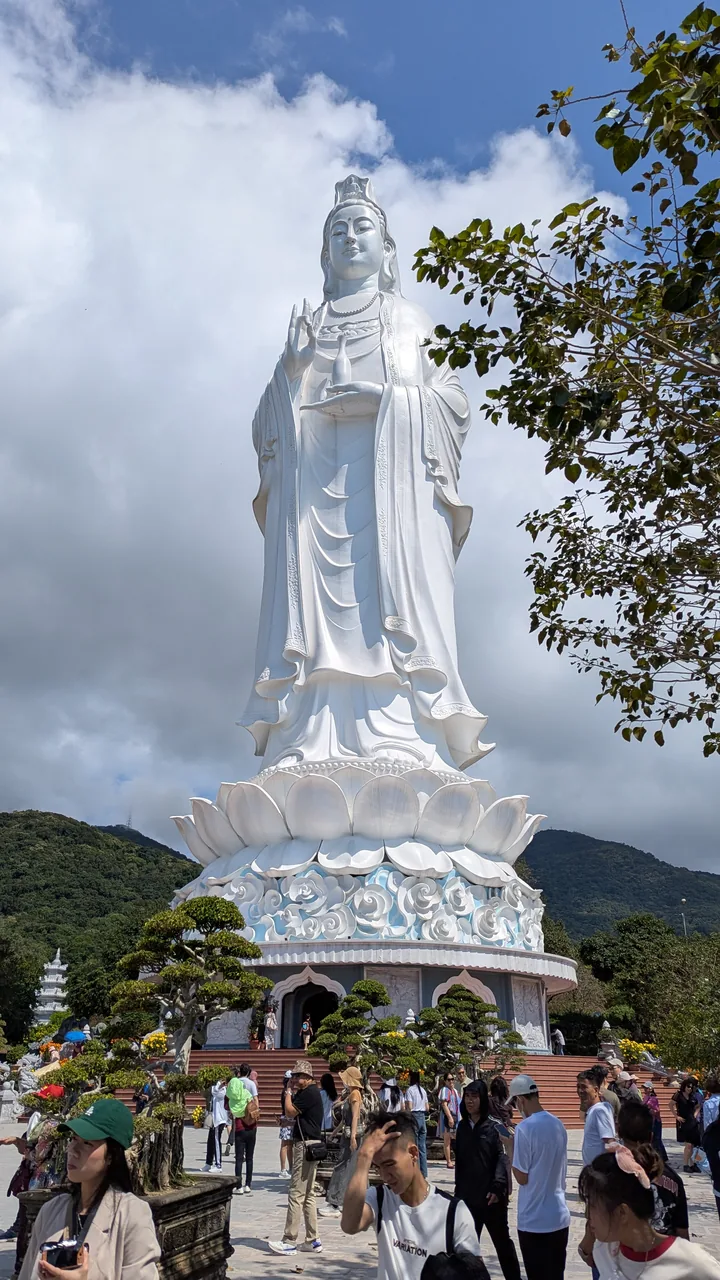
If you’ve looked north from a Da Nang beach and seen a tall white figure standing serenely on the green hillside, you’ve already met the Lady Buddha. The Lady Buddha is a 67-metre statue of Quan Âm — the Bodhisattva of Compassion, known across cultures as the Goddess of Mercy or Guan Yin — and at 67 metres she is the tallest Buddha statue in Vietnam. She stands in the grounds of Linh Ung Pagoda on the Son Tra Peninsula, the forested headland that locals call Monkey Mountain, gazing out over the sea as if watching over the city and its fishermen. People search for this place under many names — Lady Buddha, Lady Buddha statue, the Goddess of Mercy, Quan Âm, Guan Yin, or simply Linh Ung Pagoda — but they all lead to the same hilltop. It’s one of Da Nang’s most beloved sights, it’s completely free to visit, and it rewards you with both a striking monument and one of the finest views in the city. This guide covers everything: what the statue actually is and means, the legend and history behind the pagoda, the three Linh Ung pagodas and the “Buddhist triangle,” exactly how to get there, what to wear, the best time to go, and the small courtesies that make a visit to a working temple go smoothly. The Lady Buddha sits on Son Tra, so to pair it with the rest of the peninsula — the viewpoints, beaches and the famous road — see our Son Tra Peninsula guide, and for the whole trip our complete Da Nang travel guide.
1. Lady Buddha or Linh Ung Pagoda? The Names Explained
First, let’s clear up the names, because the same place is searched for in half a dozen ways and it confuses a lot of first-time visitors. “Lady Buddha” is the giant statue; “Linh Ung Pagoda” is the temple it stands in. They’re at the same spot on Son Tra, so in practice people use the two names interchangeably.
The statue itself depicts Quan Âm (full name Quan Thế Âm Bồ Tát) — the Bodhisattva of Compassion, the same figure known in China as Guan Yin and widely translated as the Goddess of Mercy. So “Lady Buddha,” “Lady Buddha statue,” “Goddess of Mercy,” “Quan Âm” and “Guan Yin” all refer to this one 67-metre figure. You’ll also see the whole headland called Monkey Mountain, after the wild monkeys that live there. And confusingly, there are three Linh Ung pagodas in Da Nang — the famous one with the Lady Buddha is the Son Tra (Bãi Bụt) pagoda, which we cover in detail below.
2. The Lady Buddha Statue, Up Close
🌅 Da Nang with older parents: a day that starts on the beach before sunrise →
The Lady Buddha statue stands 67 metres tall — roughly the height of a 30-storey building — making it the tallest Buddha statue in Vietnam. She rises from a lotus-shaped base about 35 metres in diameter, set on a hill within the pagoda grounds, and faces east out to sea. In Vietnamese belief that orientation matters: Quan Âm, the Goddess of Mercy, looks over the ocean to bring calm waters and watch over the fishermen who have always worked this coast.
What many visitors don’t realise is that the statue is hollow and can be entered. Inside are 17 floors, and each floor holds an altar with 21 smaller Buddha statues in different poses — a quiet, layered space that contrasts with the vast figure outside. The serene face, the flowing robes and the small Buddha she carries in her headpiece are all rendered with real craft; up close the sheer scale is hard to take in, and from the beaches across the bay she’s a tiny white sentinel on the green hill.
3. The Legend & History Behind the Pagoda
The story of how this temple came to be is a lovely one. Local lore traces it to the reign of Emperor Minh Mạng of the Nguyễn Dynasty (early 19th century), when a Buddha statue is said to have drifted ashore onto a sandbank on the Son Tra Peninsula. The fishermen took it as an auspicious sign — and indeed the seas around the spot were said to grow calmer — so they built a shrine there to worship. The beach earned the name Bãi Bụt, which means “Buddha Beach,” and the area has been considered sacred ever since.
The grand temple and the towering Lady Buddha you see today are far more recent. The Lady Buddha statue was built between 2004 and 2010, sculpted by local artisans, and the whole complex — Linh Ung Pagoda on Son Tra — was officially opened on 30 July 2010. In just over a decade it has become one of the defining images of Da Nang, blending that old fishermen’s legend with a modern monument on a spectacular setting.
4. The Three Linh Ung Pagodas & the “Buddhist Triangle”
Here’s a detail most guides skip: there isn’t one Linh Ung Pagoda in Da Nang — there are three, and together they form what locals call a “Buddhist triangle” around the city. The belief is that this triangle, with downtown Da Nang at its centre, spiritually protects the area from natural disasters such as the typhoons that hit the coast each year.
| Linh Ung Pagoda | Where | Note |
|---|---|---|
| Son Tra (Bãi Bụt) | Son Tra Peninsula | The famous one — the 67 m Lady Buddha; opened 2010 |
| Marble Mountains | Ngũ Hành Sơn | The oldest, dating from around 1825 |
| Ba Na Hills | On the mountain | Inaugurated in 2004, up at the resort |
The one with the Lady Buddha — the subject of this guide — is the Son Tra pagoda. If you’re temple-hopping, the other two are easy to fold into other plans: the Marble Mountains pagoda sits among the caves and grottoes of Ngũ Hành Sơn (the Marble Mountains), and the Ba Na Hills pagoda is part of a day at Ba Na Hills.
5. The Pagoda Grounds & the Views
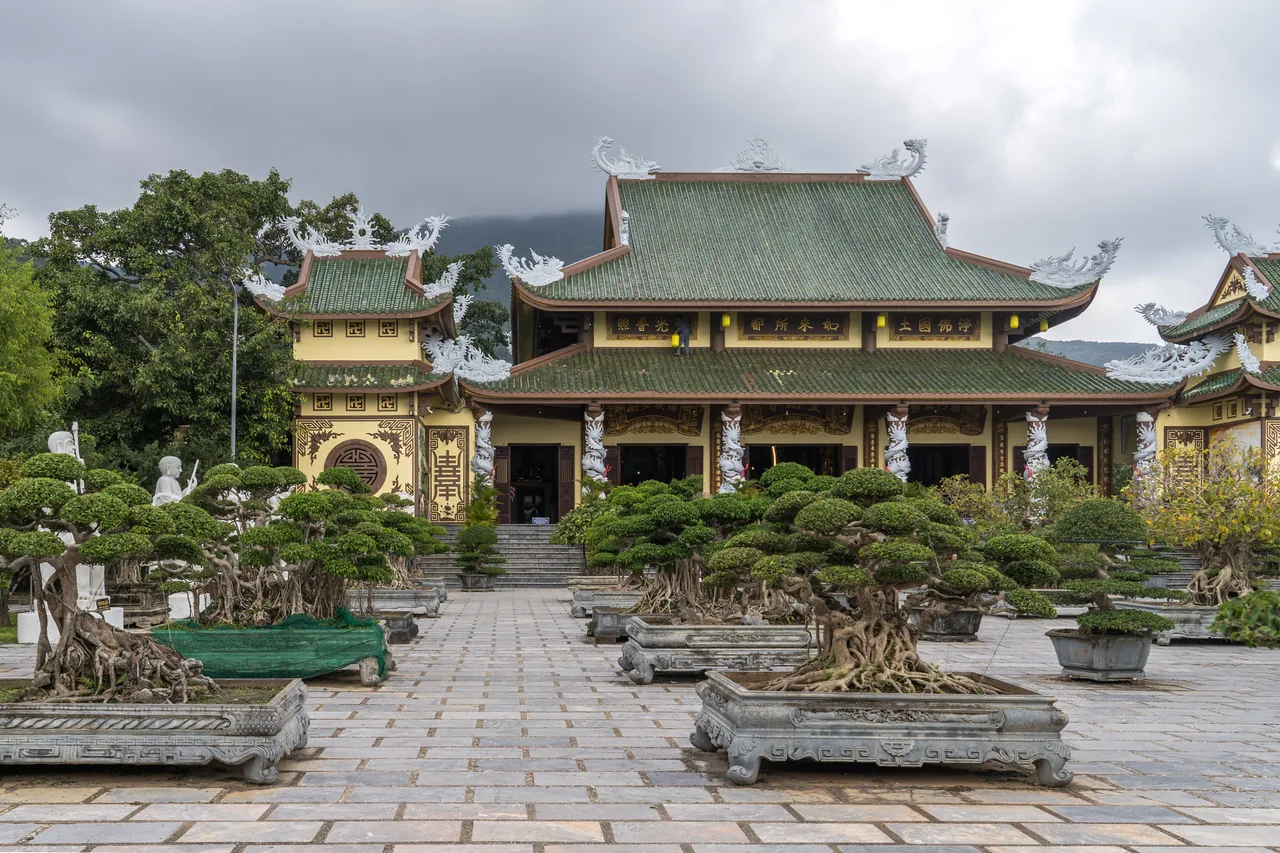
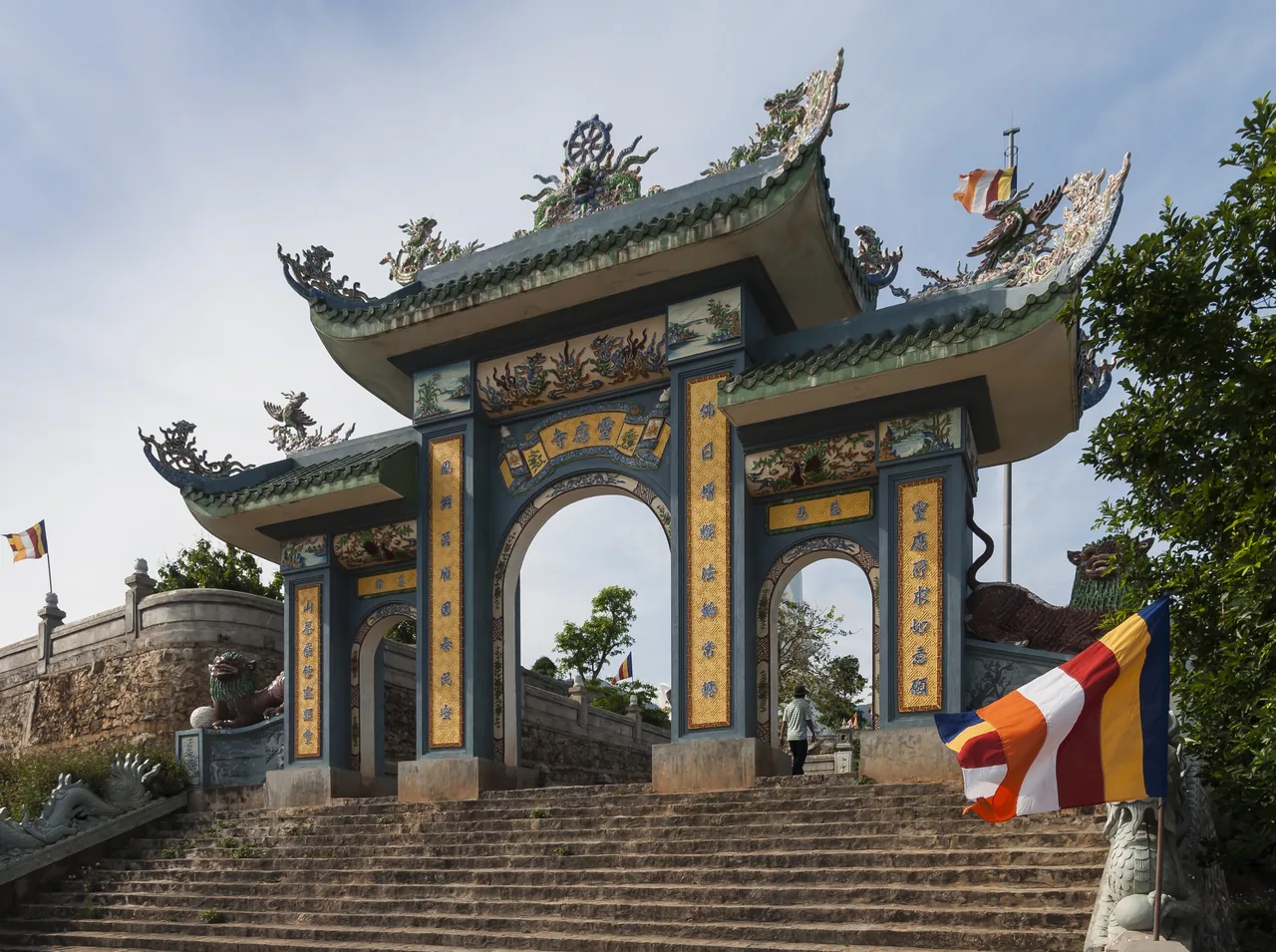
The Lady Buddha may be the headline, but the grounds of Linh Ung Pagoda are worth lingering in. This is a large, active temple complex, beautifully kept, with a main worship hall, ornate dragon-decorated gates, manicured bonsai gardens, and a path lined with statues of the 18 Arhats (enlightened disciples), each carved with a distinct, expressive face. It’s peaceful and uncrowded enough at the right hours to feel genuinely contemplative.
And then there’s the view. Because the pagoda sits high on the Son Tra hillside facing the city, it offers one of the finest panoramas in Da Nang — a sweep across Da Nang Bay, the long curve of My Khe and the city beaches, the river and the skyline, with fishing boats dotting the water below. It’s especially lovely in the soft light of early morning or late afternoon. Many visitors come as much for this outlook as for the statue itself.
6. Where It Is & How to Get There
The Lady Buddha and Linh Ung Pagoda are on the Son Tra Peninsula, about 10 km northeast of central Da Nang — roughly a 15–20 minute drive from My Khe Beach or the city along the scenic Hoàng Sa coastal road that hugs the shoreline of the headland.
| How | Roughly | Good for |
|---|---|---|
| Grab / taxi | ~15–20 min from the city | Easiest; agree a return or have the app ready |
| Rented scooter | Coastal road, ~20 min | Freedom to combine with Son Tra viewpoints |
| Half-day tour | Bundled transport | Often paired with Marble Mountains / Son Tra |
There’s no convenient public bus, so most people take a Grab or a metered taxi, ride a scooter, or visit on a tour. If you’re confident on two wheels, the scooter is the nicest option, because the same road carries on to Son Tra’s viewpoints and beaches — turning a temple visit into a half-day peninsula loop (our Son Tra guide maps that out).
7. Tickets, Opening Hours & Dress Code
This is the practical heart of the visit, and the good news is simple: entry to the Lady Buddha and Linh Ung Pagoda is completely free.
| Detail | What to know |
|---|---|
| Entrance fee | Free (donations welcome). Small fee to park a scooter. |
| Opening hours | Daily, ~6:00am–9:00pm |
| Dress code | Cover shoulders & knees; free robes at the entrance |
| Best time | Early morning or late afternoon |
The one thing to get right is the dress code. Because this is a living place of worship — not just a viewpoint — visitors are asked to cover their shoulders and knees. That means no short shorts, vests or strappy tops at the temple itself. If you turn up in beachwear, don’t worry: there are usually free robes or shawls at the entrance to cover up before you go in. Dressing respectfully also simply feels right in a space where people are genuinely praying.
8. The Best Time to Visit & Beating the Heat and Crowds
The best time to visit the Lady Buddha is early morning or late afternoon — and it’s worth being deliberate about it for three reasons. First, the light: the white statue and the bay views are at their most beautiful in the soft, golden hours, and harsh midday sun flattens everything. Second, the heat: the hilltop is exposed with little shade, and the middle of a Da Nang summer day up there is punishing. Third, the crowds and tour buses, which are thickest from mid-morning to early afternoon.
Late afternoon has an extra reward: as the sun drops, the bay and the city catch the warm light, and it’s a gorgeous spot to wind down a day. In terms of season, the dry months (roughly February to August) give you the clearest skies and the best chance of those long coastal views; in the wet season the hilltop can be misty or rained-out (our Da Nang weather guide has the month-by-month picture). On any day, a clear sky is what makes the panorama sing.
9. The Monkeys & Son Tra (“Monkey Mountain”)
Linh Ung Pagoda sits on the Son Tra Peninsula, nicknamed Monkey Mountain for the troops of wild monkeys that live in its forests — and you’ll very likely see some around the temple walls and the roadside. They’re fun to watch and photograph, but they are wild animals, so admire them from a distance, don’t feed them, and keep snacks and loose bags out of sight; a visible plastic bag can attract a curious (and quick) monkey.
The pagoda is really the gateway to the whole peninsula, which is a beautiful half-day in its own right: forested coastal roads, hidden beaches, the giant banyan tree and a string of clifftop viewpoints. If you’ve made the trip out here, it’s well worth carrying on — our Son Tra Peninsula guide covers the road, the viewpoints and the best loop to ride.
10. Temple Etiquette & Visitor Tips
A working temple asks for a little awareness, and a few small habits keep your visit smooth and respectful:
- Dress modestly (shoulders and knees covered) and use the free robes if you need them.
- Lower your voice in the worship halls, and follow any signs about where photography is or isn’t allowed — generally the grounds and statue are fine, the inner altars may not be.
- Remove your shoes where indicated before entering halls, and don’t point your feet at the altars or Buddha images.
- Bring sun protection and water — the hilltop is exposed, with little shade and a fair bit of walking and steps.
- Be monkey-smart: no feeding, no visible snacks, and keep a hand on your bag.
- Cash for the car park / a small donation is handy; entry itself is free.
11. Is the Lady Buddha Worth Visiting?
Yes — and for most visitors it’s an easy recommendation, because it costs nothing and delivers a lot. You get a genuinely impressive monument (the tallest Buddha statue in the country), a calm and beautiful temple to wander, and one of the best views in Da Nang, all for free and only 15–20 minutes from the city. It’s cultural, scenic and serene in equal measure, and it suits everyone from families to photographers to anyone after a quiet hour.
The visit is fairly short on its own — perhaps an hour or so at the pagoda — so the smart move is to treat it as the anchor of a wider Son Tra outing. Ride or drive out in the cooler hours, spend time at the Lady Buddha, then continue around the peninsula’s viewpoints and beaches. Our Son Tra Peninsula guide shows how to build that half-day, and our complete Da Nang travel guide ties it into the rest of your trip.
🎡Things to Do52
🍜Food8
🏨Where to Stay6
🚇Getting Around9
🧭Travel Tips21
🧭Vietnam-wide essentials58
Frequently Asked Questions