
The Golden Bridge, Da Nang: Vietnam’s Giant Hands Bridge
The golden walkway cradled by two giant stone hands that put Da Nang on the world’s bucket lists. Here’s the full story behind it, exactly how and when to visit, how to beat the crowds, and how to get the photo everyone comes for — without the disappointment that catches a lot of people out.
- What it is: a 150-metre golden footbridge held up by two enormous weathered-stone hands, sitting at 1,414 m up in the clouds at Sun World Ba Na Hills, about 45 minutes west of Da Nang.
- Getting there: you reach it by a record-breaking cable car inside Ba Na Hills — there’s no other way up. The bridge itself is free once you’re inside; you just need a Ba Na Hills entry ticket (which covers the cable car and everything else).
- When to go: the dry months (roughly March–August) for clear skies, and — this is the big one — go early, ideally as the park opens around 7:30–8am. From 10am to 2pm, on weekends, and in summer it gets genuinely packed.
- The catch: at 1,414 m the bridge is often in cloud, which can be magical or can hide the view entirely; and the walk itself is short. Time it right and it’s unforgettable — show up at midday on a holiday and you’ll queue shoulder-to-shoulder.
- One tip: the early start is everything. The first couple of hours are your only real shot at the bridge with space to breathe and a photo without a hundred strangers in it.
1. The Short Answer: What It Is & How to Do It Right
2. The Story Behind the Hands
3. The Giant Hands, Up Close
4. Where It Is & How to Get There
5. Tickets & Cost: What You Actually Pay
6. The Best Time to Visit (Season & Time of Day)
7. How to Beat the Crowds
8. How to Get the Photo
9. Is the Golden Bridge Actually Worth It?
10. What Else Is at Ba Na Hills
11. Practical Tips for Your Visit
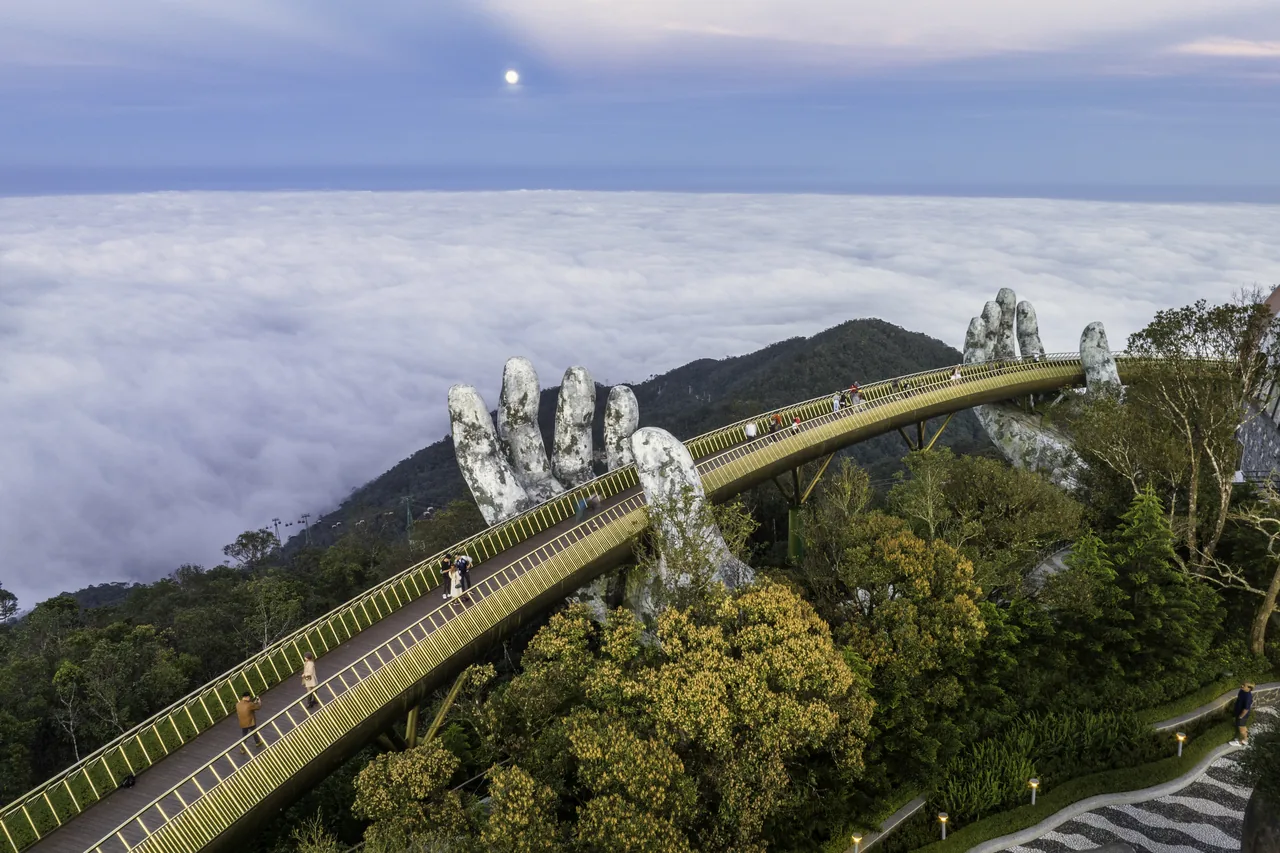
Some places live up to the photo, and some don’t — the Golden Bridge does, as long as you go about it the right way. You’ve almost certainly seen it: a ribbon of golden walkway curving through the mist, lifted high above a forested mountain by two colossal hands that look as though they’ve been carved from ancient, weathered stone. Since it opened in 2018 it has become the single image that says “Da Nang” to the world, splashed across TIME magazine and a billion phone screens. And it absolutely deserves the hype — but only if you understand what you’re walking into. This is a mountaintop attraction that lives in the clouds, gets ferociously busy in the middle of the day, and rewards anyone who shows up early with something close to magic. This guide is the deep dive: the real story behind the hands, exactly how to get up there and what it costs, the precise timing that makes or breaks the visit, how to take the photo properly, and an honest answer to the question everyone quietly asks — is it actually worth it? The Golden Bridge sits inside Sun World Ba Na Hills, so for the rest of the park — the French Village, the gardens, the cable cars and the rides — pair this with our full Ba Na Hills guide, and for the bigger trip our complete Da Nang travel guide.
| ⏰ Hours | 07:30–21:30 (inside Ba Na Hills) |
| 💵 Entry / price | Included in the Ba Na Hills ticket (≈1,000,000 VND) |
| 📍 Location | Ba Na Hills, ~35 km west of Da Nang📍 Map → |
| 🚗 Getting there | Cable car from the base, then a short walk |
| ⏱️ Time needed | 30–60 min at the bridge |
| 📅 Best time | Early morning, before the clouds roll in |
| 🔗 Official site | banahills.sunworld.com |
1. The Short Answer: What It Is & How to Do It Right
🏔 Staying overnight on Ba Na Hills: the dawn cable car to the Golden Bridge →
If you only read one section, make it this. The Golden Bridge — Cầu Vàng in Vietnamese — is a 150-metre pedestrian walkway, painted gold, that appears to be held aloft by two giant hands reaching out of the mountainside. It sits at 1,414 metres above sea level inside Sun World Ba Na Hills, the mountaintop theme park about 45 minutes west of Da Nang, and you get to it by riding one of the world’s record-breaking cable cars up through the forest and the clouds.
Two things matter more than anything else. First, the bridge is free once you’re inside Ba Na Hills — there’s no separate Golden Bridge ticket, you simply need a Ba Na entry ticket, which already includes the cable car and all the park’s attractions. Second, and this is the one that makes or breaks the day: go early. Aim to be on the first cable cars as the park opens, around 7:30–8am. Between roughly 10am and 2pm — and all day on weekends and through the summer — the bridge becomes one of the most crowded spots in all of Vietnam, and that dreamy empty walkway you pictured turns into a slow shuffle through a crowd.
2. The Story Behind the Hands
The Golden Bridge didn’t slowly grow famous — it detonated. When the first photos appeared in 2018, the world genuinely struggled to believe they were real, and within weeks TIME magazine had named it one of the “World’s 100 Greatest Places.” What people were reacting to was the idea as much as the structure: a slender golden thread, seemingly held up by the weathered hands of some giant emerging from the mountain.
That was exactly the intention. The bridge was designed by TA Landscape Architecture, with Vũ Việt Anh as principal architect, and the brief, in his own words, was to “invoke the sensation of walking along a thread stretching through the hands of God.” The two hands are meant to read as the hands of a mountain deity, gently lifting a strip of golden silk out of the forest and offering it to the sky. Construction began in 2017 and, remarkably, the whole thing was finished in under a year — no small feat when every beam and panel had to be hauled up a mountain and assembled in fickle, cloud-wrapped weather.
The result was something Vietnam had never had before: a single, instantly recognisable image that travels the globe on its own. It turned Ba Na Hills from a pleasant mountain resort into a must-see, and gave Da Nang a landmark to rival anything in Southeast Asia.
3. The Giant Hands, Up Close
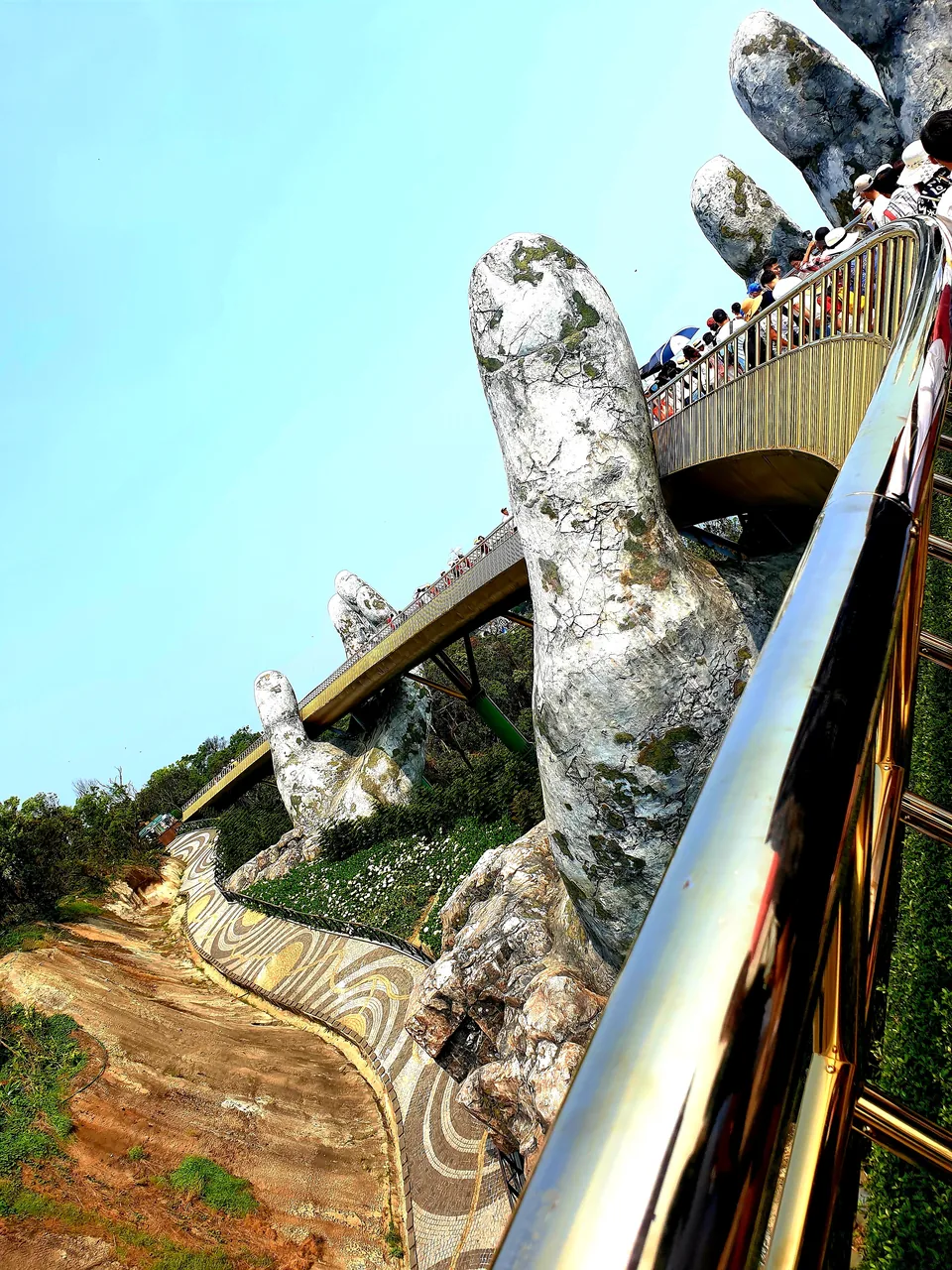
Part of the magic is that the hands look ancient — as though they’ve held the bridge for a thousand years, slowly gathering moss in the mountain damp. They haven’t. They’re a beautiful piece of theatre. Each hand is built from a steel framework wrapped in wire mesh and fibreglass, then painstakingly textured and painted to mimic old, weathered, moss-streaked stone. Stand close and you can see the craft in it; from a few steps back the illusion is total.
The walkway they cradle is just as considered. The golden ribbon is a steel structure painted gold, laid with an ironwood (lim) deck underfoot so that the surface feels warm and natural rather than industrial, and it curves gently across eight spans over a 150-metre run. The whole design is meant to sit lightly in its surroundings — to look less like engineering and more like something the mountain itself produced. It’s worth slowing down halfway across to actually look at it, because most people are so busy queuing for the photo that they never really see the thing they came to photograph.
4. Where It Is & How to Get There
The Golden Bridge is not a standalone sight you can simply walk or drive up to — it lives inside Sun World Ba Na Hills, and the only way to reach it is the cable car. So “getting to the Golden Bridge” really means getting to Ba Na Hills, which is about 25–40 km west of Da Nang, a 45-minute to one-hour drive from the city or the beach.
Most people get to the foot of the mountain in one of three ways: a private car or taxi (the easiest, roughly 800,000–1,100,000₫ for a round trip depending on the vehicle), a Grab, or an organised day tour that bundles the transfer with the entry ticket. From the base station you board the cable car, which is an attraction in its own right: the Ba Na system holds four Guinness World Records, including the longest single-track non-stop cable car (5,801 m) and the greatest elevation gain (1,368 m). The ride takes roughly 17–25 minutes and lifts you straight up through the forest and, very often, out the top of the clouds.
5. Tickets & Cost: What You Actually Pay
This is where people get confused, so let’s be clear: there is no Golden Bridge ticket. The bridge is one of the free attractions inside Ba Na Hills, so the only thing you pay for is the Ba Na Hills entry ticket — and that single ticket already covers the round-trip cable car, the Golden Bridge, the French Village, the gardens and the indoor Fantasy Park rides.
| Ticket | Roughly (2026) | Notes |
|---|---|---|
| Adult | ~900,000–1,000,000₫ (about $36–40) | Includes cable car + Golden Bridge + attractions |
| Child (100–~140 cm) | Reduced rate | Priced by height; check current bands |
| Child under 100 cm | Free | With a paying adult |
A couple of things worth knowing for 2026. Prices shift, and different sellers (the official gate, hotels, online tour platforms) quote slightly different numbers, so treat the figures above as a guide and confirm the current price when you book. The genuinely good news is the ticket is now valid for 1–3 days rather than a single day, so if the weather turns or you simply can’t see everything, you can come back. Because the Golden Bridge sits inside a paid park, it also means you can’t “just pop up to see the bridge” cheaply — you’re committing to a Ba Na Hills day, which is exactly why it’s worth planning the whole visit well.
6. The Best Time to Visit (Season & Time of Day)
Timing matters here more than at almost any other sight in Da Nang, on two separate levels: which season, and which hour.
The season comes first because the bridge lives in the clouds. The dry months, roughly March to August, give you the clearest skies and the best chance of those long views out over the mountains and toward the coast. And here’s a lovely quirk of the altitude: because the bridge sits at 1,414 m, it frequently pokes above the cloud line, so it can be bright and sunny up top even when Da Nang down below is grey and drizzly — which makes Ba Na a genuine rainy-day trump card (more on the seasons in our Da Nang weather guide). It’s also noticeably cooler up there, usually around 20–25°C, so bring a layer even in summer.
| When | Verdict |
|---|---|
| Mar–Aug, early morning | ✅ Best — clear skies, soft light, fewest people |
| Weekday vs weekend | Weekdays far quieter |
| 10am–2pm | 🔴 Most crowded — slow shuffle, harsh midday sun |
| Sep–Nov | More cloud & rain; views often hidden |
The hour is the part most people get wrong. Aim to be on the first cable cars as the park opens (around 7:30–8am), or failing that, head up in the late afternoon. The first couple of hours are your one real window for the bridge with room to move and clear morning light on the gold. By mid-morning the tour groups arrive and from about 10am to 2pm it’s wall-to-wall.
7. How to Beat the Crowds
It’s worth being blunt about this: the Golden Bridge is one of the most crowded attractions in Vietnam, and the gap between a great visit and a disappointing one is almost entirely about avoiding the crush. The dreamy, empty walkway in the marketing photos is real — it’s just only real for the first hour or two of the day.
So the plan writes itself. Leave Da Nang early — many people set off around 6:45–7am — and be among the first up the cable car. Go on a weekday if you possibly can, and steer clear of Vietnamese public holidays (especially Tết) and the June–August peak, when even early mornings fill up fast. If an early start truly isn’t an option, the late afternoon is the next best thing, as the day-trippers thin out before closing. Whatever you do, treat the middle of the day as the time not to be on the bridge — that’s when you’ll be shuffling across in a tight, shoulder-to-shoulder line with everyone’s selfie stick.
8. How to Get the Photo
Let’s be honest about why most people come: the photo. The good news is it’s very gettable, as long as you’ve sorted the timing above. A few things help.
- Morning light is your friend. The soft early sun flatters the gold and keeps the harsh midday shadows off the hands. It’s also, not coincidentally, the quietest time.
- Walk to the middle. The classic shot — the walkway curving away between the two hands — works best from around the midpoint of the bridge, looking along its length.
- Be patient and be kind. Even early, you’ll likely take turns with a few others for the clearest frames. A little patience (and letting others have their moment too) gets everyone a better shot.
- Dress for the gold. Reds, whites and warm tones pop beautifully against the bridge and the green mountains; flowing outfits read well in the breeze up there.
- Drones: the sweeping aerial shots you’ve seen are spectacular, but drone use is restricted — check the current park rules before you fly, and don’t assume it’s allowed.
9. Is the Golden Bridge Actually Worth It?
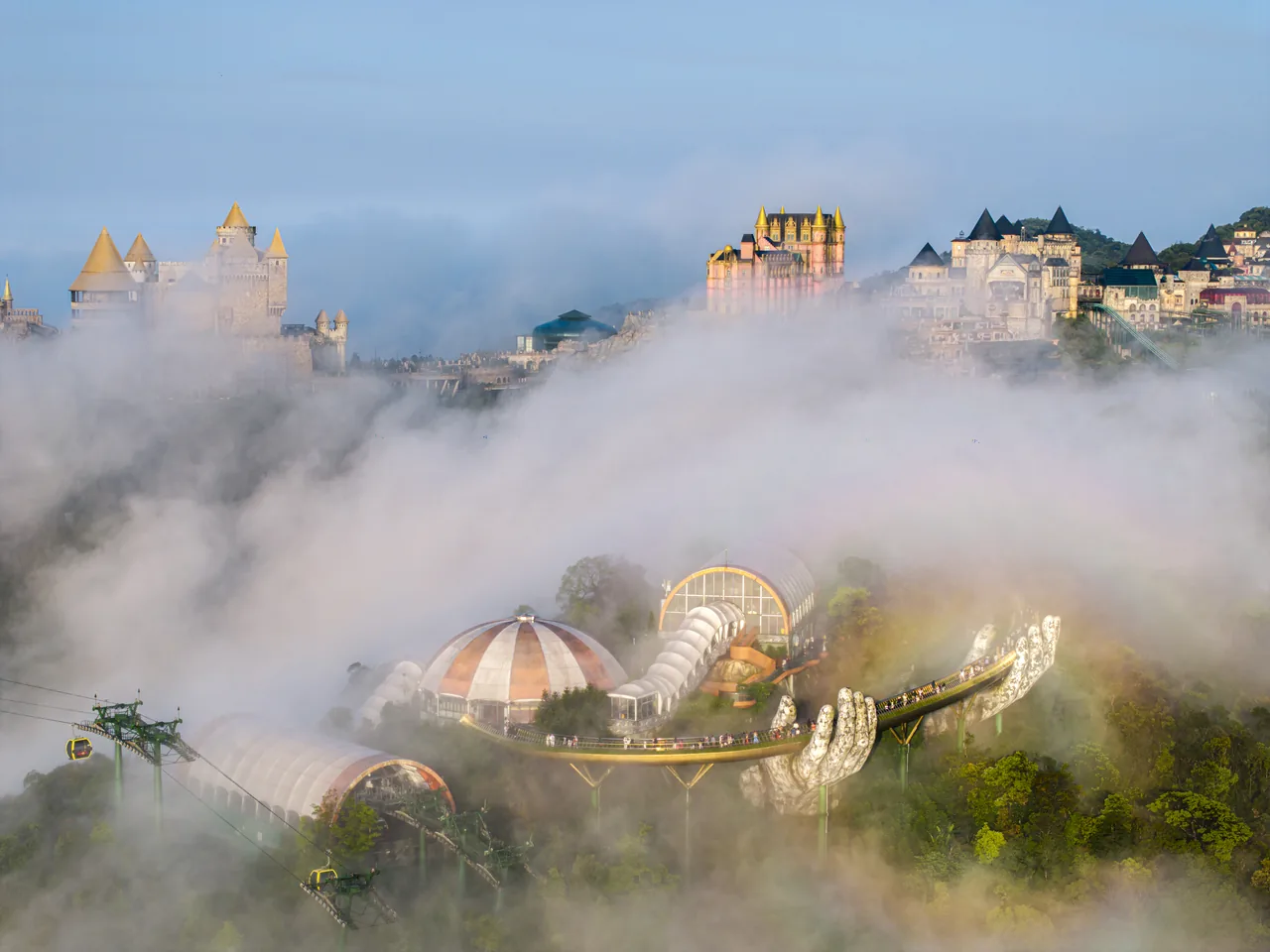
The honest answer is yes — with conditions. If you time it right (an early start, a clear dry-season morning) and you come for what it actually is — a brilliant, photogenic piece of design in a spectacular mountain setting — you’ll likely rate it a highlight of the whole trip. The sight of that golden ribbon lifted above the clouds genuinely lives up to the pictures.
The people who come away underwhelmed almost always made one of three mistakes: they arrived at midday and spent the visit in a crowd; they came on a fully clouded-in day and saw nothing but white; or they expected the bridge alone to fill hours, when the walk itself is short. So go in with clear eyes. The bridge is the icon, but you’re really buying a day at Ba Na Hills — the cable car, the French Village, the gardens and the rides — with the Golden Bridge as its jewel. Treat it that way, time it well, and it’s worth every dong. Our full Ba Na Hills guide helps you make a proper day of it.
10. What Else Is at Ba Na Hills
Because you’re paying for a whole park, it pays to know what else is up there once you’ve had your moment on the bridge. The headline is the French Village — a whole hilltop recreation of a French town, complete with cobbled square, church and pastel buildings, which is far more charming than it has any right to be. There’s Le Jardin D’Amour, a set of beautifully landscaped gardens, the indoor Fantasy Park with its arcade and rides (a lifesaver if the weather turns), the Linh Ung Pagoda with its big white Buddha, and the funicular that links the different levels of the mountain.
Realistically, the Golden Bridge plus the rest of Ba Na Hills is a half to full day, and with the ticket now valid for up to three days you don’t have to cram it all in. For a full breakdown of every zone, the cable-car lines and how to plan your hours up there, head to our dedicated Ba Na Hills guide. And if you’re slotting this into a wider itinerary, our Da Nang travel guide shows how it fits with the beaches, Hoi An and the rest.
11. Practical Tips for Your Visit
A few small things make the day run smoothly up on the mountain:
| What | Why |
|---|---|
| A light jacket or layer | It’s ~20–25°C up top — cooler than the city, even in summer |
| Comfortable shoes | Lots of walking and steps across the park |
| Sun protection | Sun is strong above the clouds; little shade on the bridge |
| Cash + your ticket/QR | For food and extras; keep your entry ticket handy |
| A rain layer (wet months) | Cloud and showers roll in fast at altitude |
| An early start | The single biggest thing — beats the crowds and the cloud |
- Eat smart. There are restaurants and buffets up top, but they’re priced for a captive audience; some people eat before they go up or keep it light.
- Build in buffer time. The cable-car queues, the walking and the sheer size of the park mean things take longer than you’d expect — don’t pin a tight schedule to it.
- Check the forecast, but don’t over-trust it. Mountain weather changes by the hour; a grey morning can clear, and a bright one can cloud over. The 1–3 day ticket softens the gamble.
Get the timing right and the Golden Bridge delivers exactly what it promises — a golden walk through the hands of a mountain, above the clouds. When you’re ready to plan the rest, our complete Da Nang travel guide ties the whole trip together.
🎡Things to Do52
🍜Food8
🏨Where to Stay6
🚇Getting Around9
🧭Travel Tips21
🧭Vietnam-wide essentials57
Frequently Asked Questions